




Abstract
Research continues to demonstrate that female social workers earn less than their male counterparts and experience significant barriers to professional advancement. Yet, little has been written about factors promoting women’s progress within the structural barriers that disadvantage women social workers. The combination of ethic of care, risk and resilience, and ecological theories informs the conceptual model outlined in this article. This model provides a roadmap for understanding national and organizational impediments to the success of women social workers and offers strategies for empowering women in the profession in the United States. Social work practitioners and administrators must engage in frank discussions about sexism, nurture leadership skills, and advocate for the elimination of gender discrimination and for the promotion of equal opportunity in social service organizations.
Introduction
More than 50 years after the passage of the Equal Pay Act of 1963 and Title VII of the Civil Rights Act of 1964, women continue to earn less than their male counterparts and trail behind in professional advancement in the United States. According to the Institute for Women’s Policy Research (IWPR, 2015), women’s median earnings are consistently less than men’s. In addition, structural barriers disadvantage women who choose to aspire to managerial positions (Billing, 2011). Women are socialized to be caregivers, discouraged from pursuing leadership positions, and are at increased risk to confront prejudice and discrimination throughout their careers; these factors, in combination, lessen opportunities for advancement (Hoyt & Simon, 2011). In addition, the overrepresentation of men in management positions tends to reproduce gender biases that limit women’s access to leadership positions (Cohen & Huffman, 2007).
Gender inequity with regard to salary and leadership opportunity is also widespread in the profession of social work. Although social work has been uniquely dedicated to the promotion of economic and social justice, gender-based salary disparities and glass ceilings persist. Women consistently earn less than men in those occupations considered female-dominated professions, including nursing, teaching, and social work. Specifically, the weekly median income for women social workers is reported to be US$839 compared to the weekly median income of US$892 for men (IWPR, 2015). Advanced degrees and licensure are related to higher salaries among social workers, yet even among licensed practitioners, a gender gap remains. After controlling for race, age, geographic region, degree attainment, years of experience, and practice area, Whitaker, Weismiller, and Clark (2006) found that men, on average, made 14% more than their female peers.
Although the majority of social workers are women, they are disproportionately underrepresented in social service administration (Gibelman, 2003; Koeske & Krowinski, 2004; Riccucci, 2009). Being a part of the mathematical majority is not the same as possessing power and control (McPhail, 2004). Men in professional fields, where the numeric majority of workers are women, receive preferential treatment and are often tracked into managerial positions (Acker, 2006). Instead of encountering a “glass ceiling,” male social workers are able to ride the “glass escalator” to management positions (Williams, 1992).
Social workers are trained to be agents of change and thereby have the capacity to promote gender equity within the social service organizations they are employed. In addition, social workers are expected to advocate for policy reforms that advance economic and social justice (Council on Social Work Education, 2015). Ethical practice dictates that social workers challenge gender discrimination within the agencies they work (Lane & Flowers, 2015). Yet, how effectively do women in social work apply these skills for their own benefit? Although gender inequality among social work faculty is addressed in the literature, little research specifically examines structural barriers that disadvantage women social work professionals. This article presents a conceptual framework examining these influences and suggests strategies to promote women’s progress.
The Need for a Theoretically Informed Conceptual Framework
Feminist ethics of care, risk and resilience, and ecological theories inform the reciprocal interactions between women and environment (Kerby & Mallinger, 2014). Together, these theories are useful in building a conceptual model that considers diversity and complex systems in relation to the success of women social workers. The blend of these three paradigms form the basis for the model described in the following sections of this article. This model considers the additive and interactive risks negatively influencing women social workers. These theoretical concepts in the aggregate are also used to create the structural model designed to examine paths toward equity and advancement for women social work professionals.
Bronfenbrenner’s (1977, 1979) theory of human ecology, introduced in the 1970s, highlights the importance of the interactive influence of interpersonal, organizational, and societal context on professional development,. According to Bronfenbrenner, the ecological environment is comprised of nested systems. Microsystems refer to the interactions between the worker and her immediate environment, consisting of her coworkers, and immediate supervisors. Mesosystems are comprised of connections between microsystems in which the social worker is an active participant, such as her relationships with supervisors and coworkers. Exosystems are defined as systems in which workers are not directly involved but are affected by decisions, including administrative policies developed by the executive director in conjunction with the board of directors. Macrosystems consist of established cultural patterns that influence individual workers. For example, institutional sexism and resultant economic disparities would be considered macro-level influences. A central tenant of the ecological perspective is that people are heavily influenced by the interrelationships among social networks. These linkages can serve as supports or barriers. Workers with support systems have an increased opportunity for success.
Risk and resilience theory can be used as a framework for clarifying variations in outcomes for women vulnerable to developing negative life outcomes, including impediments to occupational success (Fraser, Kirby, & Smokowski, 2004). While the paradigm of risk and resilience emerged from research on children and adolescents, it is applicable to adult professionals as well. Risk refers to distal (ecological environmental) and/or proximal influences (e.g., individual stressors) that place women at risk for adverse outcomes, including poor job performance due to work stress (Dollard, & Gordon, 2014). These risk factors often occur simultaneously and may be additive or exponential (Tehrani, 2014). Resilience is the ability to effectively handle hardships. Some individuals at high risk for negative consequences overcome risk and succeed, despite difficult circumstances. Protective factors are environmental conditions that occur outside of the control of the individual and interrupt the trajectory from risk to negative consequences (Adamson, 2012; Kerby & Mallinger, 2014). By definition, a protective factor may only happen in the occurrence of risk. These factors are assets that counteract, moderate, or mediate risk for negative outcomes (Fraser et al., 2004). Women become resilient through transactions among personal, relational, and structural factors (Tehrani, 2014). For example, close relationships with supervisors and mentors serve as potent protective factors ameliorating risk.
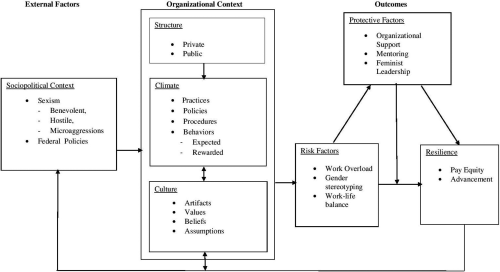
Applied Model of Care.
Feminist ethics of care theory also has utility for explaining gender disparity and informing interventions toward equity. As developed by Gilligan (1982) and Noddings (1984), this theory addresses gender relations and sociocultural context, including structural power differentials. Thus, care ethics not only focuses on relationships between social workers and clients but also includes relationships among colleagues, middle management, administration, and policy makers (Bowden, 2000). Leaders who sincerely care encourage mutuality and create environments that inspire worker growth professionally and personally (Noddings, 2005; Pimentel, 2011). Tronto (2010) explored the intersection among feminism, politics, and care ethics. She emphasized the political forces of care relations, including the tendency for women and other marginalized groups to care in ways that advantage the elite. Further, society has denigrated the importance of care in order for those in power to maintain their privilege. She argued that “good care” within an institutional context is comprised of a clear purpose of care, a distinct understanding of inequality, and the accommodation of care to meet individual needs. Bowden (2000) argued care requires a structural critique that entails a revolution in the organization … the institution of relations charged with nurturing the moral integrity and autonomy of all their participants, rather than the reproduction of the hierarchical chains of control that stifle the development of capacities for ethically successful care. (p. 48)
The Applied Model of Care
The applied model of care provides a roadmap for understanding national and organizational impediments to the success of women social workers. This conceptual model also offers strategies for their empowerment within the structural barriers that disadvantage them.
Sociopolitical Context
The applied model of care begins with the consideration of sociopolitical context. Sexism is an external construct that influences organizational climate and culture. Although distinctly different, the constructs of benevolent and hostile sexism negatively affect women social workers. Hostile sexism is perceived as overt and takes the shape of denigrating and stereotypical remarks about women’s incompetence or of resentful behavior to women who are “too powerful.” Benevolent sexism consists of seemingly positive attitudes depicting women in need of protection (Glick & Fiske, 2001). These forms of sexism lead to overt and covert challenges for women social workers, including discrimination and limited networking and mentoring (Basford, Offerman, & Behrend, 2014; Lazzari, Colarossi, & Collins, 2009).
Covert sexism is synonymous with gendered microaggressions. Sue and colleagues (2007) defined microaggressions as casual comments and/or behaviors by people of privilege that communicate disparaging messages to marginalized recipients. Microaggressions serve to demean and devalue individuals, whether or not they are intentional. Women social workers are not exempt from being targets of microaggressions within the agencies they are employed (Ross-Sheriff, 2012). Manifestations of sexism in social service agencies tend to be subtler than in other contexts. Male supervisors, for example, may be mindful of using gender-neutral language, but consistently “forget” to include women in invitations to watch sporting events. Women who confront gender-based microaggressions are perceived as unable to perform “warmth-related” jobs, such as social work (Becker, Glick, Ilic, & Bohner, 2011; Good & Rudman, 2010). Despite the harmful cumulative damages associated with subtle sexism, the effects are minimized and thus there is decreased motivation to address these (Basford et al., 2014).
Political climate is another external factor described in this model and includes federal policies, or lack thereof, that influences organizational culture and climate. Although women currently account for 50.8% of the U.S. population (U.S. Census, 2014), only 18.7% of those holding congressional seats in 2014 are women (Center for American Women in Politics, 2014). Female representation increases the likelihood of advocacy for national gender equality policies, such as the Paycheck Fairness Act (Annesley, Engeli, Gains, & Resodihardjo, 2014). Wittmer and Bouché (2013) found a significant positive correlation between the female leadership and the passage of laws pertaining to women’s issues.
Organizational Context
Gendered attitudes and consequent behaviors are culturally engrained and influence organizational context, the second component of this model. Social workers often underestimate the impact of organizational climate, culture, and structure on their morale, including the paradox between the overt ethic of social and economic justice for women and the environmental context in which social workers practice (Spitzer, Silverman, & Allen, 2015). In this model, organizational structure refers to private and public institutions and agencies. Climate refers to the shared understanding of practices, policies, and procedures associated with the institution, including expected and rewarded behaviors (Schneider, Ehrhart, & Macey, 2013). Culture consists of artifacts, including organizational myths and rituals, values and beliefs, and assumptions (Schein, 2010). In his seminal piece on the difference between culture and climate, Denison (1996) argued organizational climate is malleable and is easily influenced by people with power. Culture, in contrast, has strong historic roots and is shared by members of the organization. Simply put, culture describes the way things are done and climate depicts the workers’ perceptions of their organizational environment; each can either promote organizational engagement or stress (Glisson, 2007).
Structure, climate, and culture are interrelated and influence risk and protection for women with regard to pay and advancement opportunity. In the majority of social service agencies, symbols and images reinforce leadership positions as occupied by white men. Performance evaluations favor socially constructed masculine characteristics (Bird, 2011). In fact, due to incongruity between leadership role characteristics and stereotypes of female traits, women leaders receive more negative evaluations than men (Anderson et al., 2015). In addition, women’s internalization of sexism within the organizational context limits their confidence in career advancement (O’Meara, 2015; Vakalahi & Starks, 2010).
Risk Factors
In the early years of the social work, men were more likely to be paid professionals, while women were unpaid volunteers and thus were excluded from leadership positions. (Sakamoto, Anastas, McPhail, & Colarossi, 2008). Women in social work continue to face pay inequity and diminished leadership opportunities. Males dominate administrative positions in social service agencies. Gender stereotyping is manifested in expectations of women doing the bulk of the organizational housework (Chiloane-Tsoka, 2012; Sakamoto et al., 2008). In addition, role-related strains with regard to work–life balance also serve as barriers to advancement. Unlike their male counterparts, women face questions about their ability to be effective in balancing their responsibilities on the job with their responsibilities at home (Sullivan, 2015). Lack of time, resources, and support are exponentially linked to stress among women social workers.
Women social workers who hold multiple identities (women of color, working-class women, lesbian-identified women, Muslim women, and women with physical disabilities) may be more at risk. Gender cannot be contemplated without considering the impact of diverse, interrelated systems of oppression (Mehrotra, 2010). Collins (2000) developed the matrix of domination to describe the multiple axes on which domination is structured. In addition to being organized along axes of identity, the experiences of micro, mezzo, and macro influences are considered. In addition, Collins discussed the exponential risk associated with intersecting identification, stating that the additive models of oppression are patriarchal.
Protective Factors
A feminist ethic of care informs ways organizations can promote resilience by ameliorating risk. As Tronto (2010) describes, care acknowledges the reciprocity between the one cared for and the one caring within an environmental context of power and privilege. Concerned administrators in social service agencies can acknowledge structural barriers inhibiting women from advancement and create leadership opportunities. Specifically, agencies need to create prospects for women by developing training programs, increase access to continuing education aimed at strengthening administrative skills (Fouche & Martindale, 2011).
Mentoring through a feminist ethic of care lens also serves as a protective factor. In contrast with hierarchical traditional paradigms, feminist mentoring focuses on relational qualities and active participation of the mentee (Duntley-Matos, 2014; Gutierrez, 2012; Tower, Faul, Hamilton-Mason, Collins, & Gibson, 2015). Mentoring relationships have been shown to positively influence the career success of women in terms of earnings and opportunities for promotion (Buchanan, 2014). These interactions encourage information sharing and network development and assist woman in having a unified voice in discussions with administration (Chiloane-Tsoka, 2012). Through formal and informal mentorship, protégés are provided with professional and relational support. Professional support includes assistance in effectively negotiating organizational structures through coaching and networking, leading to advancement opportunities (Metz, 2009). Relational support includes positive role modeling, nurturance, advocacy, and acceptance. This particular type of support leads to increased professional efficacy (Giblin & Lake, 2010; Simon, Roff, & Perry, 2008). Bent-Goodley and Sarnoff (2008) suggest mentors and protégés can benefit by engaging in meaningful discussion about barriers due to intersecting identities and about how to best manage sexism. An ethics of care model allows mentors and mentees to understand oppressive histories and develop multicultural strategies that promote success for marginalized individuals.
Consistent with feminist ethics of care theory, relational leading involves mutual connections between supervisors and employees. Feminist leadership, grounded in an ethic of care, suggests facilitating open and honest communication, teamwork, consensus building, and mutual respect (Fine, 2009; Mallow, 2010; Shapira-Lishchinsky & Levy-Gazenfrantz, 2015). Specifically, this includes the sharing of information, resources, decision-making, and accountability (Lazzari et al., 2009). Relational leadership also involves a critical examination of the influence of patriarchy on organizational climate and culture, especially in professions rooted in caregiving (Humble, Solomon, Allen, Blaisure, & Johnson, 2006; Tronto, 2010).
Conclusion
Social workers are ethically committed to social and economic justice and are obligated to actively advocate for pay equity and the advancement of women within and beyond the profession. A focus on national and organizational climate and culture is essential to positioning women for vertical mobility. However, limited legislation continues to leave women vulnerable. Professional social work organizations, including the National Association of Social Workers, the Council of Social Work Education, Baccalaureate Program Directors, the National Association of Black Social Workers, must initiate and sustain frank discussions about these issues and advocate for equity on a national level.
Social work educators are charged with making a concretive effort to advocate and model mentoring in leadership. Students are socialized for the profession but not always for leadership within social work organizations. As a profession committed to equality and equity between the genders and races, social work needs to take the lead on impacting the role of women in leadership within and beyond the profession. Social work educators need to make conscious efforts to discuss and promote leadership for women students. Departments of social work must openly acknowledge structural barriers inhibiting women’s advancement and teach students skills in recognizing these barriers and intervening to eliminate them.
Although the national climate and culture are not easily shifted, an increased number of women in leadership roles along with a focused and continued determination can assist in making needed change. As suggested by the feminist ethic of care, relationships among women on vertical and horizontal axes can promote frank discussions about the influence of sexism, including the recognition of harm caused by microaggressions. As the dialogue about women, leadership, and resilience continues, the profession must begin to examine the impact of mentoring and advocacy for women of color, women with disabilities, lesbian identified women, and the intersections thereof for leadership roles (Barretti, 2015). Their voices need to be heard and their talents developed, utilized, and shared with the next generation of social workers. Conversations endorsing the value of care are essential to shifting the organizational climate and culture to financially rewarding women social workers and assisting in advancement. This requires further research, resources, and shifts in attitudes regarding the importance of women as successful leaders.
The theoretically informed conceptual model outlined and discussed in this article provides a roadmap to success for women social workers. As conceived, this model also has utility for empirically testing linkages among national climate, organizational influences, and risk factors promoting or inhibiting resilience. The examination of potential moderating and/or mediating effects of various protective factors related to caring can also be verified. The results of future studies can be then used to inform change strategies promoting parity in salaries and opportunities for advancement among women social workers.
Footnotes
Declaration of Conflicting Interests
The author(s) declared no potential conflicts of interest with respect to the research, authorship, and/or publication of this article.
Funding
The author(s) received no financial support for the research, authorship, and/or publication of this article.