




Abstract
This research compared male and female elected social workers to discover whether they report the same gender differences as other elected officials. Few gender differences were found among respondents. Differing from elected officials as a whole, female and male social workers reported similar levels of recruitment, favorable views of power and the demands of office and family, and interest in and knowledge about a variety of issues, with the exception of the issue of abortion. The potential contribution of anticipatory socialization and implications for social work education, political recruitment, and reproductive rights work are discussed.
This article examines the population of elected social workers to determine whether similar gender differences exist within this population. Previous research has found significant gender differences between women and men’s political activity (Thomas, 2014). Women score lower on measures of political interest, information, and efficacy than comparable men (Verba, Burns, & Schlozman, 1997), are less likely to consider running for office, assess themselves as qualified to run, or run for high-level office (Fox & Lawless, 2005). Women report that family responsibilities, particularly those around children, affect decisions about running for office more than men, and they make different strategic decisions in terms of when and for which office to run (Fulton, Maestas, Maisel, & Stone, 2006). Women, 51% of the total population, hold only 18.3% of the seats in the federal Congress, 22.8% of statewide elected executive offices, and 24.2% of seats in state legislature (Center for American Women and Politics, 2013).
The presence of women in elected office is particularly important because in office, women and men show differences in their views and voting patterns (Thomas, 2014). The only article on this topic in the social work literature compared the voting records of male and female members of the 103rd Congress (1993–1995) on significant legislation of that time (Segal & Brzuzy, 1995). They found a statistically significant difference in votes by women and men on issues of family leave and abortion, regardless of political party. They found similar differences on other issues not traditionally thought to be “women’s issues” such as gun control and gay rights and theorize this difference may be explained by categorizing these issues as “domestic concerns,” which they suggest are viewed differently by the two groups. Similar results have been found more recently in the political science literature, with female state legislators holding more liberal stands on social welfare policy (Poggione, 2004), abortion, and gun control than their male counterparts and less liberally on gambling/lottery (Jenkins, 2012). Internationally, countries with more women in national legislatures are more likely to enact maternity and child care leave and to offer more generous versions of such legislation (Kittilson, 2008).
The issue of gender is interwoven into the history of social work and politics. Some held that an impartial approach to the political world, clean and above the fray, was necessary for social work to obtain and maintain a professional status (Mahaffey, 1987). Those with this perspective were apprehensive that social workers who became involved in politics would risk the unbiased image of the new profession. Leighninger (2001) notes that social workers in the past were ambivalent about direct involvement in elected politics and were generally afraid of risking the status of the profession in the eyes of the larger society. Jeannette Rankin, a former member of Congress, reported being treated as less competent and paid less than her less experienced male counterparts during her political advocacy work (Regional Oral History Office, 1974).
Other concerns continue to be myriad. There was (and continues to be) a general view that the most appropriate training for elected office is law school (Haynes & Mickelson, 2006), although female legislators are more likely to come from fields such as teaching and social work (Thomas, 2014). Nongovernmental organizations have been prohibited from participating in many partisan political activities for many years, depending on their tax status. The Hatch Act includes restrictions on partisan activities for public employees, including holding elective office. Recent revisions of this Act have loosened the restrictions, but for many years, there was an absolute prohibition (Thompson, 1994), and Rocha, Poe, and Thomas (2010) suggest agencies have a wider range of allowable activities than they realize. Finally, in more recent years, the difficulties faced by women and persons of color made choosing a career in politics difficult for social workers in these groups (Political Parity, n.d.).
Many social activists have been social workers who were women, persons of color, or both. An early and notable partisan political actor in the field was Jane Addams (Leighninger, 2008). She played a major role in building the platform of the Progressive “Bull Moose” Party and seconded the nomination of Theodore Roosevelt for the Presidency on the party ticket. Other notable political social workers include Jeannette Rankin, a feminist, pacifist, and social worker trained at the New York School of Philanthropy and the first woman to serve in Congress (Davidson, 1994; Josephson, 1974). Rankin began her first term in Congress in 1916 and continued her political activities until her death in 1973. The next social worker in Congress was Ron Dellums, elected in 1971 (Dellums & Halterman, 2000), followed by Barbara Mikulski, who was elected to Congress in 1976 (Mikulski et al., 2000). In 1986, Mikulski became the first Democratic women elected to the Senate in her own right. Other pioneers include Wayne McMillen, who ran unsuccessfully for Illinois State Senate, challenging the Democratic machine in Chicago and facing criticism from many social workers (Leighninger, 2001), and Maryann Mahaffey, elected to the Detroit City Council in 1974 (Mahaffey, 1987).
The subset of social workers discussed previously has gravitated toward political involvement since the first days of the profession. The involvement of professional social work organizations in politics first became formalized in the decade of the 1970s when the National Association of Social Workers (NASW) began its political involvement with the Political Action for Candidate Election (PACE) (Dempsey, 2003) and Education Legislative Action Network (ELAN) committees devoted to political advocacy (Alexander, 1982). In conjunction with the development of ELAN and PACE, the first NASW Social Work in Politics Conference occurred in 1976, chaired by NASW president and Detroit City Council member Maryann Mahaffey (1987). During the 1980s, NASW increased legislative efforts as well as support to political candidates (Reeser & Epstein, 1989).
Political activity among social workers in the United States has been examined in several empirical studies that reveal a higher level of activity among social workers than the general population. The first national study of social worker activism was conducted by Reeser and Epstein in 1968 and replicated in 1984. They found that levels of political involvement increased between the two studies (1989). Parker and Sherraden’s national study of NASW members’ electoral participation in 1991 suggested that 92% of social workers had voted in recent elections. This extremely high rate of voter participation was 1.62 times that of the general public that year. Domanski’s (1998) study of the political activity of a group of social workers, leaders in medical social work, developed 10 prototypes of political participation by social workers, each of which combined a number of the possible political activities. She found that almost all of her sample was engaging in some sort of political activity, even if they had not themselves conceptualized it as political activity. Domanski did not include working for an elected official, running for office, or being elected to office in her list of 44 possible political activities.
Wolk (1981) surveyed social workers in Michigan and found the political involvement of social workers comparable to other professional groups, with macro-level social workers significantly more likely to be politically involved than micro-level social workers. Ezell (1993, 1994) surveyed members of the Washington State chapter of NASW and graduates of the University of Washington regarding advocacy and political participation. Every social worker who responded reported that he or she was active in at least one political activity. Hamilton and Fauri’s (2001) study of political activity among certified social workers in New York State used the Citizen Participation Model to define political activity, including such activities as voting, contacting government officials, volunteering in a campaign, contributing to candidates or parties, and participating in rallies or demonstrations. As with other studies, almost all participants reported voting (92%), and a majority of respondents reported contacting government officials (60%). Social workers’ political activity often varies by job title or field of practice. Administrators often see political activity as part of their responsibilities (Ezell, 1991). A study of executive directors (Pawlak & Flynn, 1990) found that over half of those interviewed had written letters, talked with elected officials, used intermediaries to influence elected officials, testified at public hearings, or served on a task force or committee. Rome and Hoechstetter (2010) found that nearly half (46.6%) of NASW members surveyed were highly involved with political activity, 88% believed they had a professional obligation to stay informed of changes to social policy, and the majority (65.3%) agreeing that every social worker had an obligation to promote policies to benefit clients.
Two studies of social workers who have run for political office have been conducted. In 1994, the (now) Nancy A. Humphreys Institute for Political Social Work (NAHIPSW) surveyed 41 social workers elected to state legislatures (Humphreys, 1994). The majority (57%) reported involvement in advocacy or campaign work before their first run for office. Approximately 22% had run for office unsuccessfully at least once before their first successful campaign as a candidate. Ninety percent reported that their social work education had helped them in their political career. Haynes and Mickelson (2006) surveyed elected officials in 1998. They compiled a list of 84 social workers in federal, state, and local office. The 31 respondents included one member of Congress, 25 state legislators, and five local officials. All of the respondents to this study were initially hesitant to run because they believed a law degree was necessary to run for office. As with the Humphreys survey, many of the respondents to this survey had reported participation in advocacy and political work before their first run for office, including community organizing, civic activities, political staff positions, and campaign work.
Finally, political action by social workers can be seen from the viewpoint of the profession as a whole. The profession of social work encourages political action by social workers through many of its major bodies and professional associations. The current NASW’s policy statement on Electoral Politics states that involvement in electoral politics can be part of any practitioner’s repertoire. The statement provides the following encouragement to social workers: Social work is inextricably linked to electoral politics in a myriad of ways. When the voice of social workers is absent in the political process, the quality of public policy deteriorates. (NASW, 1999)
Political activity is promoted in the Code of Ethics, specifically in section 6.04 (NASW, 1999), and Delegate Assemblies have encouraged social workers to get involved in politics. In 2001, the International Association of Schools of Social Work and the International Federation of Social Workers issued a joint definition of social work which included “social and political action to impact social policy and economic development” (Council on Social Work Education [CSWE], 2001, p. 37). The CSWE’s (2008) Educational Policy and Accreditation Standards state that graduates of CSWE accredited programs are expected to be able to analyze, formulate, and influence social policies. In sum, while there are still those who are ambivalent about the propriety of social workers’ involvement in politics, the profession as a whole is more likely to emphasize all social workers’ “professional obligation to be an integral part of ongoing deliberation about and formation of the ends and means of public purpose” (Caputo, 2005, p. 177) than to advocate removal from the political arena.
Theoretical Frameworks
This study uses two theoretical frameworks to examine political activity among social workers and compare it to the general population. Verba, Schlozman, and Brady’s Civic Volantarism Model (1995) identified factors that contribute to whether an individual chooses to act politically in ways as small as voting or as large as running for office. These researchers believe that political action is possible if an individual has both the motivation and the capacity to participate. In this model, empirically tested nationally and longitudinally with several large samples of Americans, three main groupings of factors predict political activity. The first is psychological engagement, which includes political interest, political efficacy, political information, family influences, and party identification. The second is resources, including time, money, and civic or political skills. The third is recruitment, defined as whether people are members of social networks or groups that encourage others to get involved politically.
Ritter (2006) used the Civic Participation Model to compare social workers to the general public by examining predictors of political activity among licensed social workers in 11 states across the country. She found that while the general public was less likely to become politically active if they had less time and money available to them, social workers participated in political activity regardless of their available resources. In addition, while degree of partisanship predicted political activity in the general public, it did not predict political activity among social workers. Ritter also noted that NASW membership in particular was a strong predictor of social workers’ political participation.
The second theory, gender and political ambition, addresses the process by which individuals decide to run for elected office. This theory was developed in response to the rational choice paradigm, the predominant perspective in this area, which suggests that the main variable to explain political decision making is a favorable political and structural situation in which the actors believe that victory in a given election is possible (Lawless & Fox, 2005). The rational choice theory ignores relevant characteristics of individual candidates, including gender, as well as the process of moving from citizenship to an interest in candidacy. In order to address the limitations of this theory, Lawless and Fox (2005) defined and empirically tested two stages in the path from the “eligibility pool” or general citizenship to elective office: first, considering a candidacy, and second, choosing to run for a specific office. They completed a second survey in 2011 to update their findings (Lawless, Fox, & Baitinger, 2014).
The first stage of this candidate emergence process is considering a candidacy or beginning to conceptualize oneself as a potential candidate. The political ambition theory posits that because of traditional gender socialization, women evaluate the costs and benefits of candidacy differently than do men and therefore experience this stage differently than do men. The researchers found that, all other things being equal, the women surveyed in this study were 15% less likely to consider running for office than were men in 2001 and 2011 (Lawless et al., 2014). Besides gender, other variables that affected the consideration of running for office included education, income, political knowledge, political interest, and previous political participation. Individuals who were most likely to consider running for office were men, those with more education and higher incomes, those who were most knowledgeable about and interested in politics, and those who had been involved with political activity in the past (Lawless & Fox, 2005).
The second stage in this process is the movement from thought to action—from thinking about running to deciding to run for a specific office. Rational choice does not account for gender or other personal characteristics at this stage of the process, instead theorizing that only the situational factors will affect a person’s decision to enter or to not enter a race (Lawless & Fox, 2005). Lawless and Fox (2005) found that in addition to male gender, having high levels of political interest and previous political participation were the variables that significantly correlated with a decision to run for office. In addition, women were more likely to seek local-level offices and men to seek state-level offices (Lawless et al., 2014). Encouragement by family differed between the two groups, with men more likely to be encouraged by their parents at a young age to think about politics than women. Women were more likely than men to cite family responsibilities as a reason not to run. Finally, women considered themselves less qualified to run than did similarly situated men (Lawless et al., 2014).
Method
The study of political social workers completed in 2008 and described here surveyed social workers who had run for elected office utilizing an electronic and mail survey via the Dillman’s (2007) Tailored Design Method. In order to investigate gender differences between male and female social workers who had run for elected office and consider whether the barriers that have been reported in the political science literature are as prominent for female social workers who run for office, this article examines the variables that have been found in the existing literature to vary by gender, including recruitment, political knowledge, political interest, previous political activities, family encouragement, age of children at first running, type of office chosen, respondents’ perceptions of the effects of campaigning on family, the effects of holding office on family, and the comfort with use of power. Results of this study as they relate to an overview of social workers who run for office and implications for social work education can be found elsewhere (Lane, 2011; Lane & Humphreys, 2011).
Sampling and Participants
The sampling frame included social workers who were current or former candidates or elected officials at federal, state, or local levels. Individuals were defined as social workers if they had obtained a bachelor of social work or master of social work degree from a school of social work accredited by the CSWE. Running for office was defined as having declared themselves as candidates for public offices including school board, city council, town council, county commission, mayor, state legislator, judge, statewide office such as attorney general or secretary of state, governor, U.S. House of Representatives, and U.S. Senate.
The members of this sampling frame were identified through the National Association of Social Workers (2007), a series of Internet searches, and contacts with NASW chapters and local social workers throughout the country, and amplified by snowball sampling of the social workers who participated in the research. Using these methods, 467 individuals who met the study criteria were discovered. An accurate e-mail or mailing address could be established for 416. Of those, 270 responded to the survey, providing a 66% response rate.
The sample was 61% female and 39% male, with one transgender participant. At the time of this study, 83% of NASW members and 81% of licensed social workers were female (Arrington & Whitaker, 2008; Whitaker, Weismiller, & Clark, 2006), making this sample more likely to be female than elected officials as a whole, but less likely to be female than social workers in general.
The most commonly reported racial/ethnic background was Caucasian (74%), followed by Black, African American, or African origin (13%); Spanish, Hispanic, or Latino/Latina (6%); Asian/Pacific Islander (2%); and Native American (1%). Twenty-six percent of the respondents to this survey identified themselves as non-white, compared to 14% of NASW members (Arrington & Whitaker, 2008) and licensed social workers at the time (Whitaker et al., 2006). The range of ages for sample members was 25–87, with a mean of 58. A majority of the sample (72%) was married or partnered. Seven percent had never been married, and the remainder was divorced (12%), widowed (9%), or separated (1%). Eighty-four percent of the sample had children. Forty-nine percent had children over the age of 18 when they first ran for office, while only 5% had children under the age of 1. The majority of respondents (57%) reported a personal income of US$75,000 or less. A smaller percentage (23%) had a total household income of US$75,000 or less. Respondents to this study resided in 45 different states as well as the District of Columbia. The regions with the largest numbers of respondents were New England, the South Atlantic, the Eastern Midwest, and the Pacific West.
Half (51%) were current officeholders, 39% were former elected officials, and 10% described themselves as current or former candidates for office, but not officeholders. The largest group had been officeholders or candidates at the local level (69%), with 29% running at the state level and 2% at the federal level. When provided a forced choice of three options for political philosophy, 60% chose liberal, 38% moderate, and 2% conservative. Respondents were given three selections for party identification, with the options of Democrat, Republican, or “other.” The respondents to this survey were more likely to identify as Democrats (84%) than Republicans (9%), while 8% identified with other parties.
Procedures
The questionnaire used for this research was a modified version of Lawless and Fox’s (2005) instrument. It consisted of 32 questions in four sections and was available in both paper and online formats. Questions included political party and philosophy, the offices for which they had been a candidate (successful or not), potential future runs, and previous political activity. Questions related to issues focused on a list from the literature and asked respondents to choose which they considered most important and about which they were most knowledgeable but did not ask for positions on these issues. Respondents were asked about those who had recruited them to run for office and their feelings about various responsibilities of campaigns and officeholding. Respondents described the degrees and content of their social work education, their political context, and demographic information.
Human subjects approval was granted from the University of Connecticut Institutional Review Board. Data collection occurred between May 7 and July 31, 2008. Data from paper surveys were manually entered into a Statistical Package for the Social Sciences (SPSS) database. The electronic survey data were downloaded from surveymonkey.com into a csv (comma separated value) file that could be opened in Microsoft Excel and transferred into SPSS. The results of bivariate data analysis are reported here.
Results
The first set of results examines the “path” to elective office, including recruitment, political knowledge, political interest, previous political activities, family encouragement, age of children at first running, and type of office chosen, for male and female social workers.
In order to compare the rates at which men and women were recruited into running for office, questions were asked about nine potential sources of recruitment (see Table 1). Small, nonstatistically significant differences were found in eight of the individual sources of recruitment. However, when combined, those small differences did result in an overall statistically significant difference. Women were recruited from an average of 2.98 sources out of 9, compared to men, with an average of 3.69 sources (t = −2.164, p = .032). Respondents were asked to choose from a set of issues those about which they felt the most knowledgeable and those that were their highest priorities. Tables 2 and 3 illustrate the issues that respondents reported as their priorities and about which they reported being knowledgeable. Only one issue, abortion, showed a statistically significant difference between male and female respondents in either question. Women were more likely to describe abortion as a priority issue and one about which they felt knowledgeable.
Recruitment.a
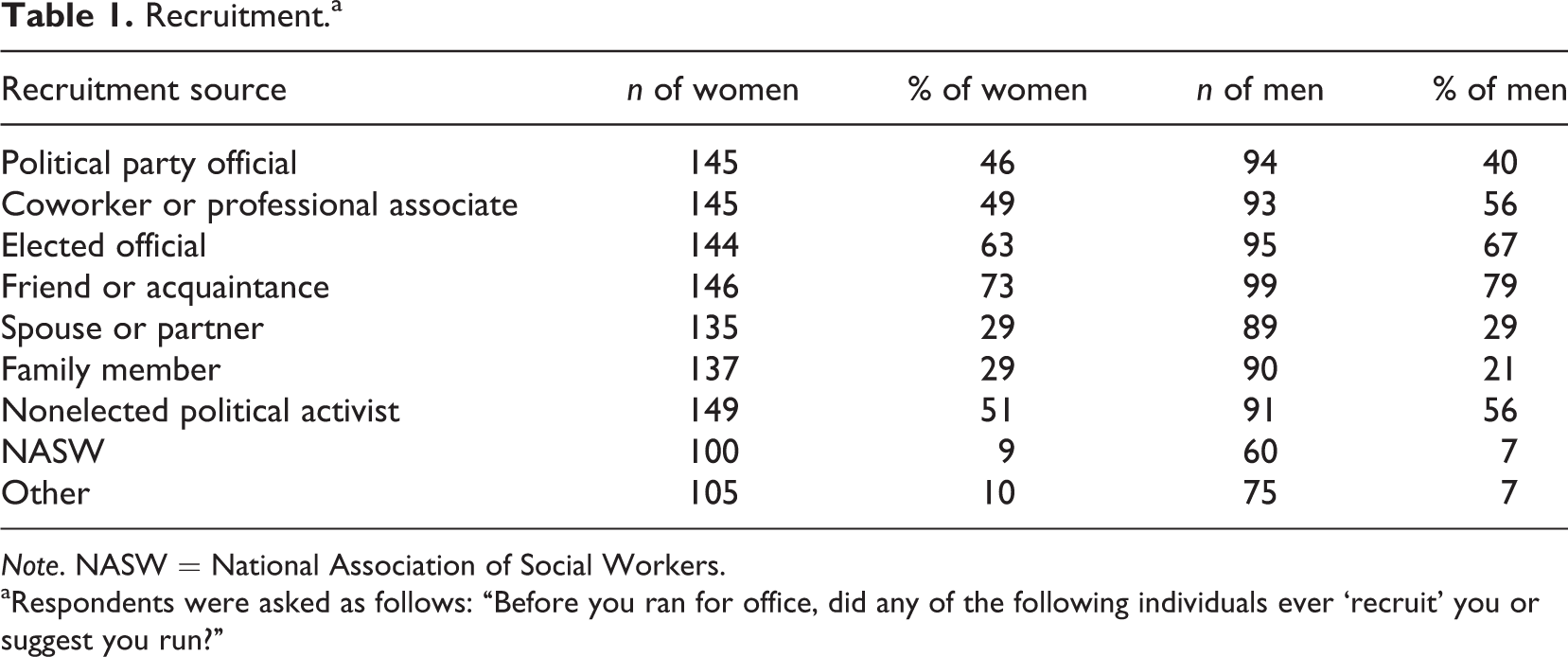
Note. NASW = National Association of Social Workers. aRespondents were asked as follows: “Before you ran for office, did any of the following individuals ever ‘recruit’ you or suggest you run?”
Political Priorities.a
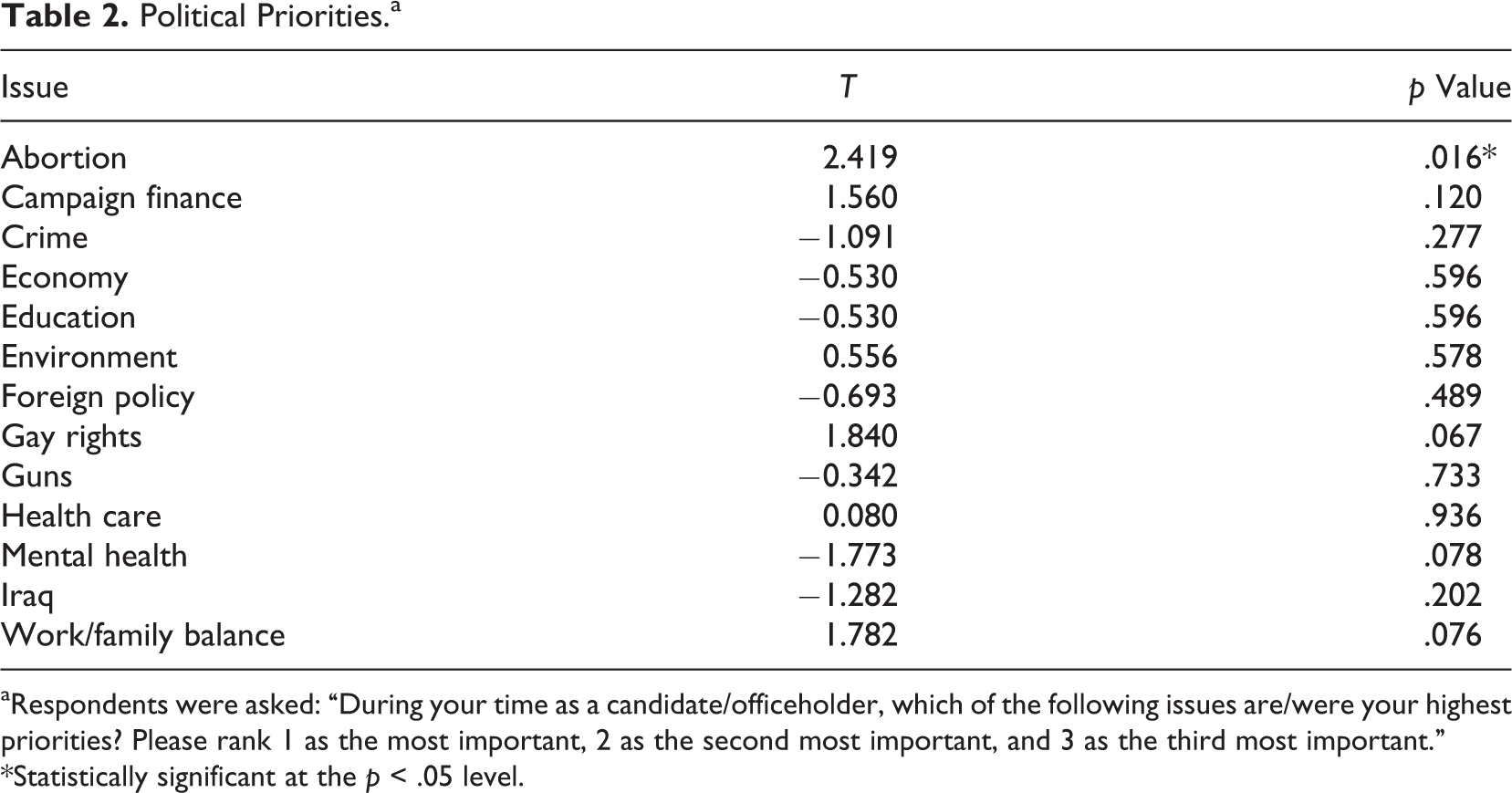
aRespondents were asked: “During your time as a candidate/officeholder, which of the following issues are/were your highest priorities? Please rank 1 as the most important, 2 as the second most important, and 3 as the third most important.”
*Statistically significant at the p < .05 level.
Political Knowledge.a
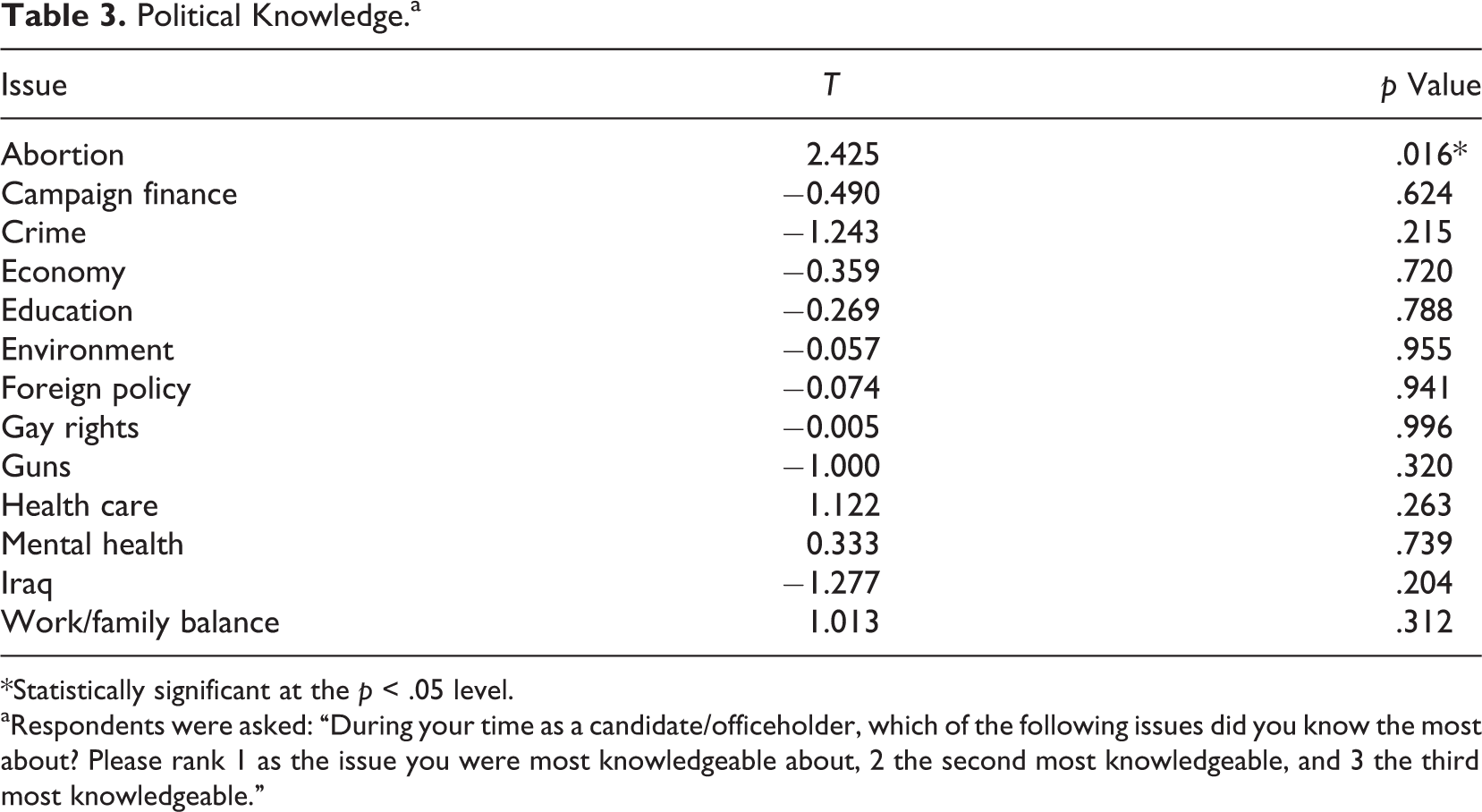
*Statistically significant at the p < .05 level.
aRespondents were asked: “During your time as a candidate/officeholder, which of the following issues did you know the most about? Please rank 1 as the issue you were most knowledgeable about, 2 the second most knowledgeable, and 3 the third most knowledgeable.”
Respondents were asked about political activity they had participated in prior to their first run for office. Table 4 lists the 12 activities provided as options. There were no statistically significant differences in any of the individual activities. On average, women participated in 10.5 of the possible 12, and men participated in 10.7. The difference in the overall index was also not significant (t = −.928, p = .354).
Previous Political Activities.a
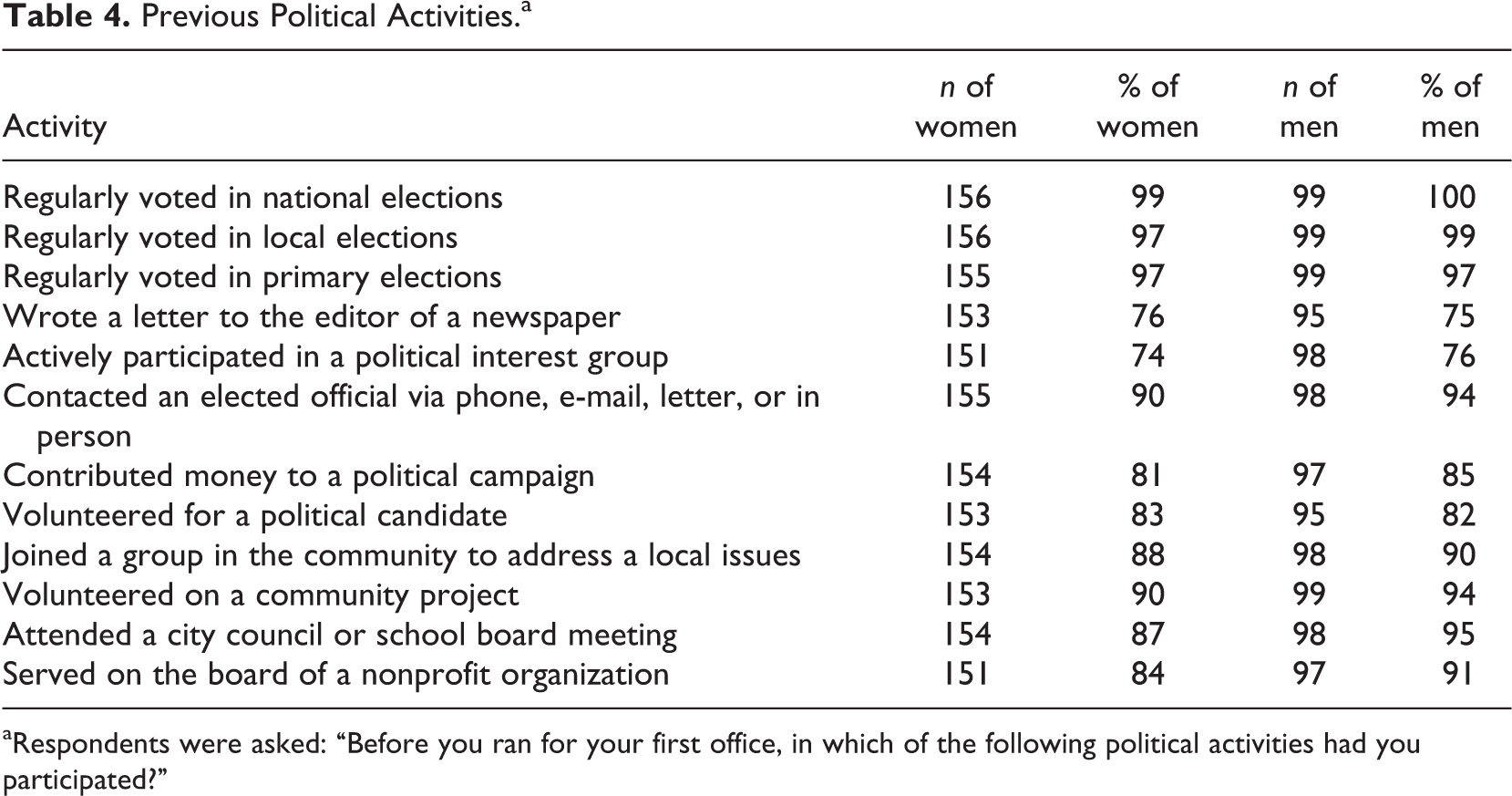
aRespondents were asked: “Before you ran for your first office, in which of the following political activities had you participated?”
Finally, respondents were asked whether their parents had urged them to run for office, the type of office chosen, and the age of their children at their first run for office. There were no statistically significant differences in parental encouragement (t = 1.554, p = .121), with 14% of women and 17% of men reporting they were encouraged to run “frequently” or “occasionally.” Level of office chosen did not differ by gender (t = −.088, p = .930). Respondents were also asked about the age of their children at the time they first ran for office. Eighty-two percent of women and 86% of men had children at their first run. There was no statistically significant difference in three groups: those who had children under the age of 1 (t = −.478, p = .634), between 6 and 10 (t = 12.824, p = .070), between 11 and 17 (t = −.140, t = .889), or over the age of 18 (t = −.864, p = .389) on their first run for office. However, 39% of men had children between the ages of 1 and 5 on their first run for office, compared to only 21% of women (t = −2.266, p = .026). In general, both groups were least likely to run with children who were not yet in school (29% of women and 49% of men) and most likely to run with children in school (84% of women and 99% of men). Interestingly, only 63% of women and 70% of men had children 18 or older at their first run (because they could have multiple children, these numbers total more than 100%).
Demands of Office
There were no statistically significant differences between male and female respondents in feelings about demands of running for office on family (t = −1.765, p = .079), with 76% of women and 63% of men feeling “favorably” or “very favorably” about balancing campaigning and family or the demands of serving in office with a family (76% of women and 66% of men felt “favorably” or “very favorably”; t = −1.835, p = .068). Perception of use of power in office was similarly consistent and positive (t = .991, p = .323). In this group, 94% of men and 86% of women felt “favorably” or “very favorably” about the use of power.
Discussion
In general, the gender differences that we expected to find did not appear. The path to elected office was very similar for male and female social workers. While recruitment is generally very different for male and female elected officials, this study found that female social workers were recruited by an average of 2.98 sources, compared to 3.69 sources for male social workers. This difference, while statistically significant, is much smaller than expected. While in the general population, the difference in recruitment is generally interpreted as a view of men as more competent or interested in electoral politics than women, it appears that this difference among men and women in social work is present, but less pronounced.
Male and female respondents had similar levels of previous political activity, similar encouragement by parents, and level of office. In addition, there were few differences in ages of children, with both groups having similar levels of children in all age groups except for the ages of 1 through 5. This difference may connect to a gendered difference in child care for that age difference. Finally, there were no significant differences between the groups in their concerns about the effects of running for or holding office on family or the use of power in holding office. In fact, both groups felt very favorably about these aspects of political life. Given the importance of power and its use to achieve and be successful in elected office, this is a positive sign.
Among elected officials as a whole, as described by Segal and Brzuzy (1995) and others (e.g., Poggione, 2004), men and women tend to differ significantly in their attitudes toward and interest in issues. Segal and Brzuzy interpreted this as a preference among women for interest in domestic issues. This study found no such preference, with men and women equally interested in both domestic and nondomestic issues, with the exception of abortion. There was a striking lack of reporting among male respondents that they considered this issue a priority or that they considered it one of the issues about which they were most knowledgeable. Only one man listed it as one of their top three priorities (as compared to 10 women); only four said it was one of the issues they considered themselves most knowledgeable about (as compared to 19 women). Given the resurgence of this issue in the past few years at the federal and state levels (“State level assault,” 2013), the results here suggest that even within a population with relatively small gender differences, abortion is still seen as belonging to the realm of women alone. Given the changes in the political context in the last few years, with more national and state-level attention paid to reproductive health, including abortion and birth control, many men in elected office are routinely making decisions about issues related to abortion.
Why, then, do we see so many similarities between male and female social workers who are elected officials? The authors hypothesize that two major reasons for this difference are socialization within the profession and anticipatory socialization before entry. Socialization is the process by which people acquire the culture of a group in which they have or would like to have membership (Weiss, Gal, & Cnaan, 2005). Anticipatory socialization is described by Robert Merton to describe the process by which an individual adopts the attitudes and values of a group to which that individual does not belong (Colman, 2001). Anticipatory socialization serves two purposes. The first is that it functions as a method of facilitating a move into a group. The second is that it eases the process of adjustment after one has become a member of a group (Colman, 2001).
Anticipatory socialization into a profession occurs before and during professional education. New entrants into a profession may begin this socialization prior to professional education, as they begin the process of moving into the new profession through recruitment and generating and maintaining commitment to their new profession (Brown, 1991). Socialization into a profession includes internalization of that profession’s characteristics, including values, interests, skills, and knowledge. While specific skills are important to this professional identity, the internalization of an identity as a member of that profession and its values are paramount in this process. In social work, this socialization would be expected to occur as part of the formal activities of social work education, such as recruitment, orientation, and a similarity in the content of course content. There is an informal aspect as well, including the interactions between students, students and faculty, and experiences in field placement. Those who are outliers from the profession may self-select out during the recruitment process, be denied acceptance, choose not to complete the educational process, or distance themselves from the profession postgraduation. If anticipatory socialization occurs within the population of social workers, it could result in gender differences between male and female social workers which are smaller than those between men and women in the general public. This socialization could mute differences between the men and women who run for office in a manner not seen with male and female elected officials outside of social work.
Limitations
As with all self-reported data, the method of data collection in this study may potentially lead to social desirability bias. In addition, the time frame between some of the events being discussed in the survey and the date the survey was answered was significant. Many respondents had run for office more than 10 years in the past. This leads to a potential inaccuracy of retrospective recollections.
Two aspects of this study limit its generalizability. The size and description of the sampling frame of social workers who are elected officials is unknown. We cannot be sure that those who were discovered during this research are the entire population or in some important way differ from the entire population. In addition, as with all survey research, we cannot be sure that those who responded were representative of the entire sample. All of these limitations suggest care may be needed in discussions of the entire population of elected social workers based on this sample.
Practice Implications
Social work seems to provide an excellent example of equalizing opportunity and encouragement for elected office between men and women. Professional organizations have an opportunity to build on this in order to encourage both female and male social workers to run for office. In addition, social work education has the opportunity to prepare students by engaging them in the political process during their social work education. One example of this is the Campaign School at the NAHIPSW (information can be found at politicalinstitute.uconn.edu). In addition, classroom policy faculty can provide the foundational material that students need to understand the process, using resources such as those developed by Influencing State Policy and available through www.statepolicy.org. Practice faculty at all levels can incorporate discussions of advocacy and social change efforts to show that social work practitioners have a responsibility to include advocacy in their ethical practice in order to best serve clients. Much of the research about gender differences in the United States suggests that women are less likely to think of themselves as prepared to run for office than men. The social work field can be a model of preparing women and men equally strong for political action. Current elected social workers can serve as case studies, models, and mentors for students and demonstrate the variety of paths social workers have taken to run for office.
In addition to the work of groups within the profession, this research suggests that those interested in increasing the number of women who run for elected office (such as EMILY’s List and the Barbara Lee Family Foundation) should look more closely at social work as a pool of potential female candidates for office. Women and men in this study reported being engaged, comfortable with power, and comfortable balancing elected office with family. These social workers can be a rich recruitment pool. Finally, groups that are interested in the election of elected officials who will prioritize reproductive issues should consider recruiting and encouraging female social workers to run for office or considering the way that the issue can be framed and communicated in order to include men in the discussion.
Future Research
Future research in this area should consider two significant questions. First, while the respondents to this study did not display the gender differences in their paths to elected office that we would expect, the self-reported data here do not tell us whether the outcomes of the policy process are different when we elect social workers to office. Segal and Brzuzy (1995) and others suggest that the outcomes of the policy process are different if more women are elected to office. Does electing more social workers to office have the same outcomes? If so, should we be focused on electing more social workers to office, more women, or some combination of the two?
Second, what are the implications of the differences found here for policy related to abortion and reproductive health? More research should examine the way that this particular issue seems to stand on a different footing than other issues and the way that men and women prioritize this issue differently.
Conclusion
This research demonstrates that social work programs are effectively producing female and male graduates who are engaging in political activity, being recruited and encouraged to run for office, and as part of that process are similar in their abilities to approach the use of power favorably, positively view their ability to manage the demands of office and family successfully, and consider themselves interested in and knowledgeable about a variety of issues, domestic or otherwise. We can do more to recruit both groups into politics and work to eliminate the slight difference in that regard that remains between women and men. In addition, attention needs to be paid to the ways in which we frame issues around abortion and reproductive health, which may suggest that men are not welcome in or appropriately part of those conversations.
Footnotes
Declaration of Conflicting Interests
The author(s) declared no potential conflicts of interest with respect to the research, authorship, and/or publication of this article.
Funding
The author(s) received no financial support for the research, authorship, and/or publication of this article.