




Abstract
This article discusses the emergence and development of women’s fund-raising for charitable centenarian agencies in a southern city. These activities set the stage for the diversification of strategies that still have gender and racial overtones in the contemporary fund-raising activities of the city. The findings reveal that women did whatever they could legally do to raise funds and in-kind contributions. Women were active, visible agents, “pounding the pavement” to solicit or beg for funds. Gendered and racial roots of philanthropic activities in these centenary organizations still influence both the intentions and actions of these organizations today and have implications for women in fund-raising positions.
In this article, our intent is to document the deep roots that women have as fund-raisers, recognizing the important roles that women have played for hundreds of years in building the capacity and sustaining the work of charitable organizations. In telling the story of the emergence and development of fund-raising for charitable centenarian agencies in a southern city, we reveal the relational nature of fund-raising that has always been a skill that women have cultivated and that today’s fund-raising professionals recognize as critical to any such effort. We illustrate how women excelled in what is now known as “the ask” and how they recognized the importance of the diversification of funding. An underlying theme is that as long as these causes were seen as being of lesser importance and women’s methods were seen as frivolous and short term, women worked under the cover of subjugation. We believe that the subjugation of these efforts as inferior or less worthy has hidden the powerful nature of women’s relational abilities in garnering resources until more recently, when women have become more visible in professional development positions. We hope to raise consciousness about the abilities and skills of early women in paving the way for generations of women to excel as fund-raisers.
Introduction
Our title is partially derived from a poem (1925) in Rhymes of a Cross-Roads Man, describing “Tag Days” in Richmond, Virginia, in which the fat cats and sugar daddies of the city were tagged by women if they contributed to a charitable cause.
Along the main streets here and there
You’ll find on guard a maiden fair
Who offers you a tag—a tag.
And if there is no maiden there
You’ll find a matron plump and fair. (Meacham, 1925, p. 40)
Our story begins over 200 years ago, many years before there were tag days, in a small town on the James River before the Revolutionary War. In this article, we examine how boards of charitable agencies financially supported their causes through challenging times. Relying on commitment and creativity, early leaders borrowed approaches from religious and other community institutions and developed new approaches on their own that often involved their friends and families. Early gendered roles and racial relationships are also embedded in the fund-raising activities of these agencies. This historical complexity and the lessons that can be found in these early fund-raising efforts are relevant to understanding the contexts in which these centenary and similar human service organizations operate today.
It took several years to identify the charitable agencies in Richmond that had been founded more than 100 years ago. To locate historical information, we visited all the city’s state and local museums, libraries, and repositories of historical documents; talked with historians, librarians, and archivists; and contacted leaders in the contemporary versions of these seasoned organizations. We located at least 25 agencies (Netting, O’Connor, & Fauri, 2009) and found that a number of them had donated their records, minute books, and materials to special collections. Others had written histories. Still others had limited surviving records. Thus, we have drawn from both available primary and secondary documents guided by two questions: What fund-raising strategies were used by women’s and men’s boards of managers? and What can be learned about their intentions in raising funds?
Charitable Development in Richmond
The Town of Richmond was officially established on the banks of the James River on June 19, 1742, by an act of the General Assembly. The Revolution brought change to the city. With the disestablishment of the Anglican Church as the state religion based on the separation of church and state, the parish-based system of providing for the poor was relocated to counties as divisions of the state. The development of veterans’ and widows’ pensions singled out these groups as deserving, and the former capital in Williamsburg was moved to Richmond as a safer location. As laws of settlement that had kept the poor tethered to their parish communities began to erode, the residents of Richmond witnessed an increasing number of strangers and wayfarers. Not having residency, newcomers were ineligible for any public assistance. In response to their needs, the first documented organized charity in the city, the Amicable Society, was founded by 60 gentlemen (the language of the times) in 1788 (Click, 1989). From the beginning, Jewish men were members of the Amicable Society because “there was much social intermingling during the early part of the century” (Click, 1989, p. 82). Therefore, it was not surprising in 1790 when the Amicable Society was joined in aiding travelers by an organization called Ezrat Orchim, founded by members of Beth Shalome synagogue (Green, 2003, p. 30). Ezrat Orchim was responding to the growing number of requests for help being received by local congregations from “Jewish peddlers and other travelers in financial distress” (Urofsky, 1997, p. 27).
Green (2003) presented an insightful history of how this southern city confronted poverty from 1740 to 1940, choosing Richmond because it had early private charitable associations and a public almshouse dating back to 1810. Richmond was also the home of the Confederacy, which made it a magnate for issues surrounding poverty and relief work during reconstruction. It was one of the South’s most important industrial centers. It had particularly rich records of almshouse admissions, and it was a “city greatly torn between its ‘New South’ aspirations and its ‘Old South’ traditions” (p. 3). Green (2003) recounted how in “1819 Mrs. Mehetable Dabney petitioned the city council for permission to establish a ‘society for the promotion of industry’” (p. 34), offering relief to poor women. The all-male council approved and funded the effort in which women would be given materials used to sew goods for sale. But two years later, when funds were tight in the city’s coffers, the council cut off the appropriation and ordered “the ladies who were so good to undertake and conduct the establishment . . . to close the business of said house” (p. 35). Green contended that cutting off the ladies’ funds illustrates the social structure and power dynamics within Richmond in 1821 and attests to “the level of tolerance for women’s activism at the time” (p. 35). The men who ran the council did not simply say that funding would be discontinued; they terminated the effort altogether. Green (2003) concluded that poor relief had been almost exclusively a male activity because it was part of the public sector and that women’s participation in publicly funded relief was not yet fully acceptable.
Funding Richmond’s Charities
The oldest continually operating female-founded and governed charity in Richmond was the Female Humane Association (FHA), established in 1805 by an ecumenical Protestant group of ladies (the language of the times) from the city’s Episcopal, Methodist, Baptist, and Presbyterian congregations who came together to operate “a nonsectarian Christian asylum for ‘the relief and comfort of distressed females,’ as well as a day school for poor white girls” (Barber, 1999, p. 121). Later the association’s female leaders were credited with planting the seeds for establishing the Richmond Male Orphan Asylum in 1846, when a young boy came begging at the door of the FHA, and since only girls were served by this association, the ladies encouraged male leaders in the community to create an orphanage for boys (Memorial Foundation for Children, 1938).
Even though the FHA and other similarly founded organizations were managed by women and chartered in their names, male boards of corporators or advisers always accompanied these female-founded charities (Netting & O’Connor, 2005). Male boards focused on institutionalizing long-term investment opportunities as a fund-raising strategy. For example, the Richmond Male Orphan Asylum’s board (without a lady board of managers) bought and sold both real estate and stocks and bonds (especially for railroads), as well as received rent, as primary sources of income. The asylum’s board engaged in a variety of long-range fund-raising strategies. Consistent with the times, they received public subsidies of $90 per year when a child was moved from the City Alms House to their asylum (Richmond Male Orphan Asylum, 1870, p. 1). When expected donations and subscriptions were slow to arrive, they employed “a suitable collector to be sent out at once to solicit contributions from the citizens generally in order to relieve the Society from its financial embarrassment and enable it to carry on and extend its work of benevolence” (Richmond Male Orphan Asylum, 1876, p. 68). Employment of the boys, to bring in funds to the orphan asylum, became a major focus of the board beginning in the 1870s (Richmond Male Orphan Asylum 1875, p. 58), and in 1877, they arranged for the boys to make cigars on a 1-month trial (Richmond Male Orphan Asylum, 1877, p. 69). Several years later, the cigar factory was going so well that the boys who made good-quality cigars were given incentives, and the annual report included hopes that cigar making or another industry would render the asylum “largely self-sustaining” (Richmond Male Orphan Asylum, 1884, p. 140).
Whereas the FHA and the Richmond Male Orphan Asylum were closely tied to Protestant denominations, Catholic and Jewish charities were forming in the same general period. St. Joseph’s Orphan Asylum and Academy (later called St. Joseph’s Villa) was founded in 1834 by three Sisters of Charity who were called to Richmond by the Catholic bishop. During the Civil War, daughters of Confederate officers found safe haven at St. Joseph’s, and in 1886, Dr. Daniel H. Gregg of Aylett left his residuary estate to St. Joseph’s Villa, allowing the sisters to purchase a 246-acre farm. Years later, in 1922, Major James H. Dooley, a trustee at St. Joseph’s Villa for many years, left the Sisters of Charity $3 million. “And so St Joseph’s Villa grew up where formerly one old frame farm house stood” (Burgess, 1934, p. 4).
In 1849, the Ladies Hebrew Association was established in Richmond to care for the sick and to provide funds for the poor and needy. An initiation fee of $2.50 was charged, followed by monthly dues of 50 cents. Sick members were paid $3.00 per week, and volunteers administered to them while they were ill. During the Civil War, the funds were used almost exclusively for caring for the sick and wounded soldiers. After the war, the association continued to pay member benefits, but also established a charity fund. In 1890, when the name changed to the Ladies’ Hebrew Benevolent Association (LHBA), its funds were devoted entirely to charity. Thus, the organization moved from being a mutual aid association for members to a charitable agency (Council of Jewish Women, 1910).
The LHBA, like St. Joseph’s Villa, benefited from its association with men who had prospered in business, and the ladies who served on the board were typically married to prominent businessmen. An example was Philip Whitlock, who developed the cheroot, a hybrid between cigars and cigarettes. Upon his death, he left a sizable bequest to the LHBA (Opper, 1999, p. 23). Membership dues had been the only source of funds for the LHBA until the latter part of the century. In 1883, the LHBA invited the community to an evening of “Musical, Literary and Dramatic Entertainment” as a fund-raiser (Opper, 1999, p. 25). Zipporah Cohen, who served as president of the LHBA for 34 years, was legendary for her fund-raising skills, speaking before community groups on an ongoing basis and even cajoling them to give whatever they could (Opper, 1999, p. 41).
Opper (1999) wrote this of the LHBA: “In keeping with the chauvinism of the times, men were appointed trustees for the endowment of this all-female organization!. . . This tradition of appointing a separate trustee board independent of the agency board of directors, continued throughout the 20th century” (pp. 36–37). Indeed, this separation of roles was evident in charity after charity. For example, The Protestant Episcopal Church Home’s male board of corporators established the duty of the treasurer to handle “all entrance fee donations, bequests, and other funds. Of these funds, the corporators shall set apart whatever may be described as a permanent endowment fund, the remainder shall be invested or used . . . for the benefit of the institution” (Protestant Episcopal Church Home, Board of Corporators 1879, p. 14). Considerable effort was expended in attending to legalities and responsibilities associated with legacies. The minutes reflect attention to the details of investing in city bonds and the value of their stocks. By 1899, there was an increasing dialogue about the pros and cons of legacies and property left to the Church Home (Protestant Episcopal Church Home, Board of Corporators 1899, p. 48), probably because of the complexities of managing them and dealing with heirs.
The Church Home’s lady board marketed their organization through the “Southern Churchman and one or more of the daily papers” (Protestant Episcopal Church Home, Lady Board of Managers 1878, p. 44). In subsequent meetings, donations originating in other cities and states were acknowledged and directed to the Church Home’s endowment fund. When Mrs. James R. Werth sent money collected from friends and family members in New York to name a room after her aunt, the lady board struck upon a new way to raise endowment funds (Protestant Episcopal Church Home, Lady Board of Managers, 1887, p. 75). The idea of naming a room became part of their ongoing fund-raising drives. Other Richmond charities adopted the same practice. For example, in 1888 the Young Women’s Christian Association provided boarding houses, and donors sponsored rooms (Brinson, 1984).
Both monetary and in-kind contributions were constantly solicited from the local community. The female superintendent of the Richmond Male Orphan Asylum developed the idea of raising money “by the sale of Bricks. . .. The children by hundreds have been engaged in ‘selling bricks’ and thus raising money and identifying themselves with this charity” (Richmond Male Orphan Asylum, 1884, p. 170). She proposed other fund-raising ideas, such as holding a “donation party,” and was compensated that same year as the “solicitor collector. . . to procure annual and contributing members” (Richmond Male Orphan Asylum, 1885, pp. 170–181). In 1885, there are several references to the “Ladies Bazaar,” which brought in enough money to allow an increase in the asylum’s census from 50 to 52 (Richmond Male Orphan Asylum, 1885, p. 207).
In a slightly different way, the Protestant Episcopal Church Home periodically opened its doors to the public and held a “pounding.” This annual pounding netted in-kind supplies for the winter. “The pound party took place on the 14th of November and was quite a success. The number of packages sent amounted to 600. Many of the packages being several pounds each. In these included one barrel of apples, 1 barrel of potatoes, 1 barrel of flour, eight hams, 1 pound of beef, several pieces of china such as cups and saucers, the content of a mite box at $2.25” (Protestant Episcopal Church Home, Lady Board of Managers, 1876, p. 28). In another effort to generate revenue, life memberships were created at $25 each in 1876 by the Church Home’s lady board. “This seemed to go toward the endowment fund. The object of this was not to abridge the annual giving, but to show who are, and have been friends of the Home” (Protestant Episcopal Church Home, Lady Board of Managers, 1876, p. 29). These life memberships supplemented the ongoing collection of subscriptions that were a part of this organization from its beginning.
The relationship of the need for resources and Christian values was reflected in appeals to the religious community in solicitations, and boards were not above using guilt as a motivator. Annual reports of the Richmond Male Orphan Asylum referred to the moral responsibility of good Christian people to support the cause. “I felt almost ashamed last year to report only $404 contributed by all the citizens of this Christian city” (Richmond Male Orphan Asylum, 1889, p. 255), lamented the asylum’s president. It was at the annual meetings of the Orphan Asylum that an appeal to local clergy, congregational members, and any other Christian citizens occurred each year (Richmond Male Orphan Asylum, 1877, p. 72). Clergy made up the Church Home’s board of corporators, but the lady board members regularly appealed to “the clergy of the city. . . to earnestly commend the cause to his congregation, soliciting contributions in money or provisions” (Protestant Episcopal Church Home, Lady Board of Managers, 1875, p. 16).
In Richmond’s 19th-century black community, it appears that African American women may have also relied more heavily on their personal networks for resources, but their strategies were slightly different from the more overt fund-raising strategies used by white women. For example, the bylaws of the first black orphan asylum reveal that in the latter part of the 19th century, African American women were involved in the development and mobilization of resources of human services targeting African American children (Crenshaw, 1869). Specifically, Lucy Goode Brooks, who had lost her elder daughter to the slave trade, grew increasingly concerned about the growing number of homeless black children wandering the streets of Richmond after Emancipation in 1865. The Ladies Sewing Circle for Charitable Works, led by Brooks as their president, recognized the need to address the large number of destitute African American former slave children. The Ladies Sewing Circle enlisted the Quaker Society of Friends because of its known opposition to slavery. Miss Brooks worked and lived in the house of Reverend John Bacon Crenshaw of the Quaker Society of Friends. Through Reverend Crenshaw’s auspices, the City Council voted in 1867 to give a location that was first known as the “Old Orphans Asylum” as a site to provide “the care and provide for education of children of colored parentage” (Crenshaw, 1869, p. 2). The Friends’ Asylum for Colored Orphans, founded by Brooks and her Ladies Sewing Circle, was incorporated by the General Assembly in March 1872. Not only does the Friends Association for Children (which still operates today) credit Lucy Goode Brooks with its founding but several years ago, as part of its fund-raising efforts, the association sold bracelets honoring her legacy.
In the same year (1867) that the Friends’ orphanage was incorporated, a former slave named Mary Prout established the Grand United Order of St. Luke in Baltimore, Maryland, to provide burial and social services to African Americans (Marlowe, 2003). In the late 1800s, the Virginia Order was led by Richmond resident Maggie Lena Walker, a prominent African American women who achieved remarkable success as the first woman in the United States to establish a bank that is still in existence today (Schiele, Jackson, & Fairfax, 2005). Recognizing the power in economic development made Walker a pioneer in community development and the generation of funds through charitable and for-profit ventures, regardless of gender or racial issues. Walker believed that men and women should work alongside one another, yet in 1905, she and 21 “women of the Order did not wait for men’s support. Instead, they continued to promote African American community development by establishing the St. Luke Emporium, a neighborhood department store” in Richmond (Schiele et al., 2005, p. 29). Walker was known to release her employees in the emporium and the bank to do service projects in charitable agencies, thus providing in-kind resources as part of her corporate responsibility, which represented a kind of good corporate citizenship even before this was part of good business practices.
In 1874, the Magdalene House was established by a group of men, and in 1875, the name was changed to the Spring Street Home. A lady board of managers was established to operate the home for unmarried mothers and their children. In 1876, the male founder of the home, who was also the president of the Board of Managers of the Richmond Male Orphan Asylum, beseeched the asylum board to lend the Magdalene Society $4,000 at 8% per annum, but when objections arose, the request was dropped (Richmond Male Orphan Asylum, 1876). This request illustrated the “from hand to mouth” operation under which the home was operating, until a “Tag Day was started to raise funds for the home’s maintenance. Later, the Home would become an agency of the Community Fund for awhile, receiving a small amount of funds but continued largely dependent upon donations” (Brookfield Incorporated Home for Girls, n.d.). But in 1929, Dr. A. Spiers George (one of the original founders) left a legacy to the Spring Street Home, financing a new building in 1932. The name was changed to Brookfield Home for Girls. Since Dr. George had no other heirs, “being free from debt, unmarried, and without entangling alliances or complications of any nature whatsoever,” his will provided that his entire property should be given to five charitable institutions in Richmond—the Home for the Incurables, the Home for Confederate Women, Sheltering Arms Hospital, the FHA, and Spring Street Home (George, 1929).
Similarly, in 1877, five women started the City Mission to provide food, fuel, and clothing to those in need. This interdenominational association is considered the first city-wide relief agency that was designed to address the needs of poor persons who were not connected to any particular church. The Young Men’s Business Association spawned the Citizens Relief Association to help raise funds for the City Mission, enabling “the ladies to give their time and attention to the relief of the poor, the care of the sick, and the encouragement of the unfortunate” (Shelburne 1932, p. 27). Formally, and typical of the times, men handled financial investment and property concerns and women saw to the “housekeeping” dimensions of direct service delivery and its oversight.
In 1883, a group of 21 women representing the five Presbyterian churches in the city founded the Richmond Exchange for Women’s Work. Seven of the members of the Richmond Woman’s Club were on the board (Treadway, 1995, p. 10). These founders were inspired by the work of the New York Exchange about which they had read in the New York Evangelist. “The founders organized the Richmond Exchange as a joint stock company, raising initial capital in $25 shares” (Sander, 1998, p. 63). Their objective was to help “needy women support themselves through consignment sales of their needlework, baked goods, and similar handmade products” (Treadway, 1995, p. 10). An annual subscription of $2 was worth the price of three tickets, allowing three women to consign their wares. A commission of 10% was kept by the Richmond Exchange (Sander, 1998).
The 1888 annual report of the Richmond Exchange revealed the wide net cast for consignments and reports on the items sold:
We cordially invite all persons to visit the rooms, inspect the consignments and learn what we are doing…. A large proportion of the consignors reside in our own city and State; consignments have also been received from the [12 other] States. During the past year, 6,556 articles were deposited in the rooms; 3,688 in the needlework department, 2,868 in the domestic department. Of these 2,473 were sold in the former and 2,559 in the latter department, realizing the sum of $4,454.82, an increase of $1,079.82 over the amount received last year—$4,009.10 was paid to depositors, who numbered 405; 1538 orders were received and satisfactorily filled; 705 for articles of needlework, and 833 for special delicacies in the domestic department. (p. 14)
A bookkeeper who was trained by the bookkeeper at the New York Exchange was hired in Richmond. In its 1888 annual report, the lady board of managers of the Richmond Exchange explained the importance of this hiring.
This marked an important advance in our business methods, and gave us the benefit of the system of bookkeeping finally adopted by the NY Exchange as most satisfactory, and which they had tested by an experience of several years. The system appears complicated and laborious, but the numberless small details of the business are simply reduced to a science which has been completely mastered by the faithful and accomplished lady whose services the Board so fortunately secured. (p. 9)
Multiple records attest to the difficulties faced by all these organizations in maintaining a stable funding base, documenting separate roles for women and men in terms of financial strategies. Women were involved in deciding what fund-raising strategies would be used and in actively pursuing them; male trustees or corporators were sometimes engaged in active fund-raising, but also handled the investment of funds and the legalities of bequests, endowments, and physical property. It was common for boards of managers of new charities to appeal immediately to the city council for subsidies for both black and white charities. Thus, it was not unusual for women to petition male decision makers on the city council for public dollars. In addition, most charities were formed as associations to which subscribers or members would be solicited and annual dues were assessed.
Some years were better than others, and the records show constant vigilance. Members of lady boards were assertive in their fund-raising efforts. Miss Greenhow (known as Aunt Mamie) was often seen going to market with two baskets on her arm—one for her purchases and the other for donations from local merchants for patients at the Home for Incurables. Green (2003) provided an apt description of private charity fund-raising in the late 1800s in Richmond:
Nearly every week, the local newspapers carried an announcement of some fundraiser for one group or another: “pound parties,” “tag days,” “tableaux.” Private charities, even those run by women, could be aggressive in their pursuit of funds: “Let no man escape” was the motto of the women, who stood in the streets all day. No one got away. The committee members held the corners, camped in front of the banks, besieged the post office, guarded the emporiums into which men are likely most to wander, made the passengers on street cars surrender, and saw that the denizens of the public buildings came across. (p. 108)
There would come a time when almost every day was a Tag Day, and each charity would be given a specific day a week or a month on which it could solicit funds. Otherwise, the competition was becoming overwhelming. Women on street corners were visible figures as they unabashedly tagged donors so the donors would not be solicited by other women soliciting for the same or another cause. Such formidable forces were these assertive women that Meacham (1925, p. 40) wrote a poem about this phenomenon: And so they meet us every day, Matron sedate or maiden gay, They look at you as though to say, Dig down, and out of your wallet drag And buy a tag, and buy a tag.
Implications of the Gendered Nature of Early Fund-Raising
In early Richmond, white women’s charitable solicitations heavily focused on asking men with money to contribute to their causes. Their creativity in how to marshal support was much broader than small donations. The women also solicited in-kind contributions, gave out of their own pockets, and petitioned the city and state for public dollars (Clift, 2005). Several charitable agencies received large donations that created endowments and invested wisely; these donations made the difference in their ability to survive. These activities set the stage for the diversification of strategies that still have gendered and racial overtones in the contemporary fund-raising activities of the city.
In Richmond’s 19th-century black community, women engaged in fund-raising, but it was not allowed to be as visible, and limited records reveal the solicitation of more in-kind resources than actual dollars (Crenshaw, 1869), except when white patrons acted on their behalf. Unfortunately, our historical story tends to privilege the creative proliferation of fund-raising strategies used by white women and men in many of the centenarian agencies in the city because of limited remaining data about racial differences in power in Richmond beginning well over a century ago. However, what we do know about African American women in the late 1800s and early 1900s is remarkable. Despite the double jeopardy of gender and race, African American women in Richmond were engaged in founding agencies, in mobilizing resources, and in establishing businesses that contributed to charitable causes, possibly without the same trivialization experienced by white women, if Maggie Lena Walker is any indication.
Gordon’s 1988 book, Bazaars and Fair Ladies: The History of the American Fundraising Fair, is probably the most comprehensive treatment of how women mastered the art of event planning from the 1820s onward. Gordon illustrated the tensions surrounding ladies’ fairs between the art of performing housekeeping and business tasks and between frivolity and work. She contended that the early trivialization of these events provided an opportunity for women to engage in fund-raising without raising men’s suspicion. As long as these types of events could be written off as something women with time on their hands did, then no one would have to take them too seriously. Ironically, these events were highly productive, and the fact that they still exist today as fund-raising events speaks to their ability to garner resources. A review of Richmond’s local newspaper revealed annual events that are still held today as major fund-raising efforts for local agencies. For example, the Women’s Board of the Virginia Home for Boys and Girls (formerly the Richmond Male Orphan Asylum) holds Havana Nights in May. Sheltering Arms Physical Rehabilitation Hospital has an annual fashion show and the Bal du Bois, held at the Country Club and organized by the Junior Board, to introduce young women to philanthropy. The Virginia Home (formerly the Home for the Incurables) holds its annual Autumn Elegance event, and the Women’s Board of the Tredeger Iron Works Gun Foundry holds its Raise the Roof benefit fund-raiser.
In Richmond’s charitable community, “Funding presented an ongoing source of anxiety” (McCarthy, 1982, p. 11), and it was a never-ending task. Boylan (2002) focused on the unpredictable nature of the nation’s early history, as “the boom-and-bust cycle that characterized the new economy could be giddingly enriching or terrifying impoverishing, or both” (p. 174). This was an unpredictable context in which a world event, a business failure, or even a growing panic among the people led to growing economic needs and lives lived in insecurity. “Like a group of entrepreneurs, starting a business, the founders of women’s organizations had to raise funds for their work. The volume of funds raised depended in part upon the organization’s ambitions and in part upon its access to resources” (Boylan, 2002, p. 174).
Richmond’s early history reveals that there were active, visible agents “pounding the pavement” to solicit or beg for funds. Men were rarely as visible in fund-raising activities, focusing instead on investments, stocks, and endowment planning. In this arena, as well as in other aspects of emerging charitable or human service agency life (Netting et al., 2009), men’s and women’s activities were closely related to the roles held in private life. Men and women used the relationships that grew as a result of their roles to facilitate fund-raising. Women used their associations to establish types of giving circles (Eikenberry, 2008, 2009), such as sewing circles and mite (penny- or cent-saving) societies, pooling their resources. The use of sewing circles, women’s clubs, and church groups by both white and African American women has been well documented as a way to mobilize monetary and in-kind resources. Men used their business connections to further their planning and investment activities. The activities selected by women and men were highly gendered in their early days, leaving major implications for the culture of today’s philanthropic activities. Payton and Moody (2008) argued that “both the intentions and the actions of philanthropy are important” (p. 28). Under the umbrella of philanthropy, we see that both the intentions and the actions of fund-raising (and garnering of in-kind support) for charitable agencies embedded cultural elements into Richmond’s philanthropic ethos that remain deeply rooted. The gendered roots of philanthropic activities in these centenary organizations still influence both the intentions and actions in these organizations today.
Male boards were intent on investment, financial oversight, financial networks, and the details of wisely investing for long-term organizational growth and stability. Financing of bricks and mortar and program expansion were part of their purview. In addition, male philanthropists left large sums of money to various charities that were run by women. These “sugar daddies” likely saved several of Richmond’s agencies during the buildup to the Great Depression. In an interesting twist, one of the “sugar daddies” of the African American community was Maggie Walker, who demonstrated the best of corporate responsibility and stewardship, initiating savings accounts for persons of low income almost a century before it became popular to set up Individual Savings Accounts as a social welfare strategy. On the other hand, female boards demonstrated the ability to raise funds and garner in-kind contributions in creative ways to support internal program operations. It is not surprising that the lady boards’ fund-raising approaches were similar to what women had done for generations in their churches—holding bazaars, sponsoring poundings, asking for contributions to the cause, naming a room for a benefactor, selling bricks, and marketing through church magazines.
What is striking are the many ways in which fund-raising was conducted and the inherent knowledge of those involved that the diversification of resources was critical to an agency’s survival. The fund-raising and revenue-generating approaches used by these organizations were as broad as those used by contemporary human service agencies. Table 1 shows the strategies that we identified in our review of minutes and other published material of the times, compared to what our review of the fund-raising literature indicates is currently essential to the financial stability of human service agencies.
The Richmond Male Orphan Asylum received public contracts for housing individual boys without questioning church or state issues (examples of current-day purchase-of-service contracts) and set up profit-making enterprises like the cigar factory (a modern social enterprise). The Home for the Incurables developed a way to cane and repair chairs that would make money for supporting the home. Our research indicates that the level of businesses developed to support nonprofit efforts is approximately the same proportion as we see today in modern Richmond’s human service community.
Historical and Modern Fund-Raising Approaches
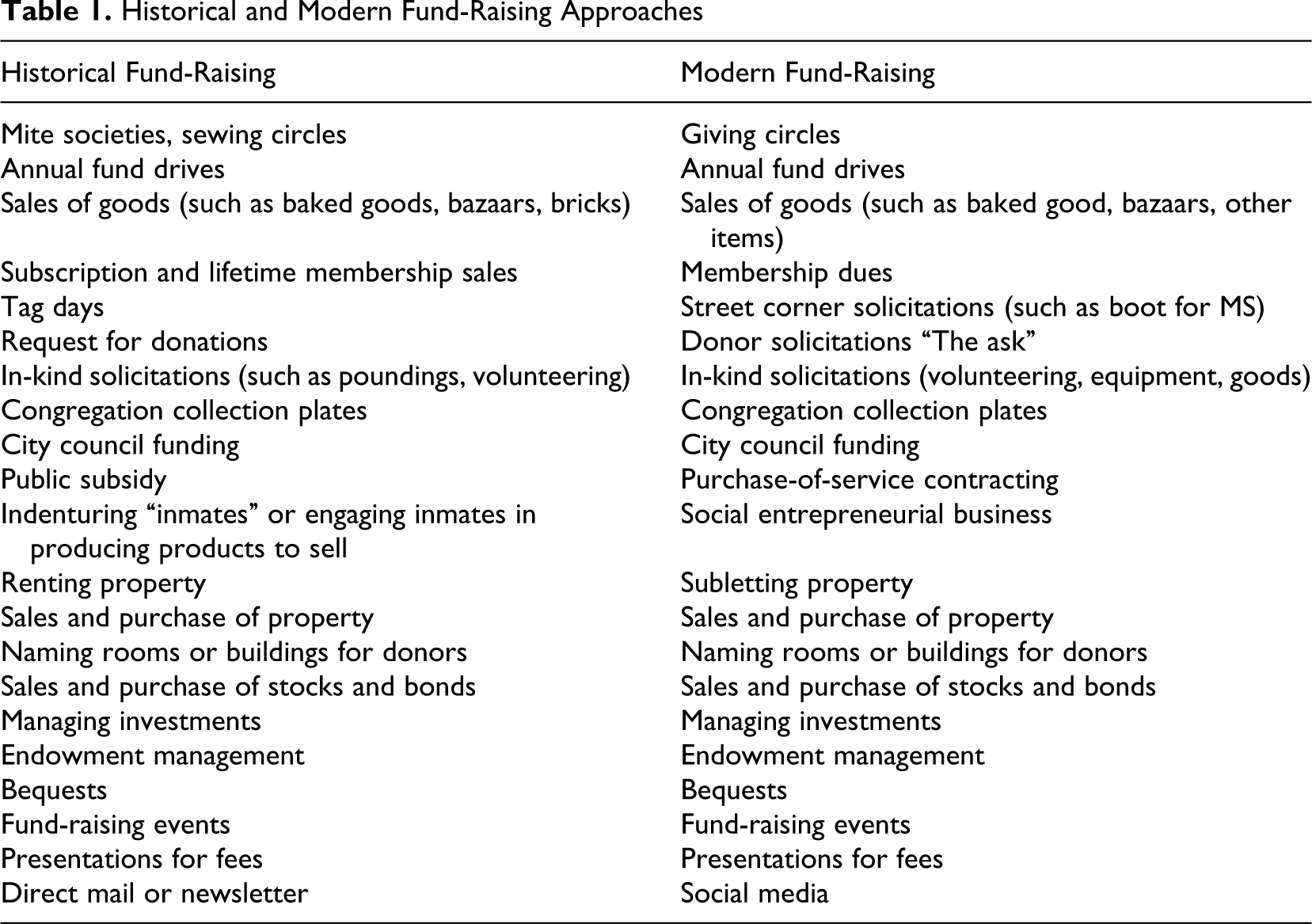
Almost every charity solicited annual membership subscriptions or encouraged lifetime memberships much like child-placing agencies do today. In addition, centenary agencies, because of their faith connections like modern faith-based agencies, asked clergy to hold collection days for their causes through local congregations. The president of the Orphan Asylum’s board used almost every annual meeting to appeal to Christians to give. The faith-permeated Church Home, with two ladies from each Episcopal Church serving on the board, had ambassadors for the cause to the Episcopalian community with special responsibilities for raising funds from their home congregations.
In the early part of the twentieth century, a sea change was approaching. Richmond’s agencies would begin to professionalize, some more rapidly than others. The fund-raising function of boards of managers remained evident well into the 1900s, although with the development of the United Way, restrictions were often placed on agencies so that their fund-raising drives did not compete with the United Way’s campaign. In contemporary times, constrained funding if United Way is involved continues and, further, the function of fund-raising is manifested in the professionalization of fund-raising itself. It appears, however, that the strategies remain remarkably similar.
In the past 15 years, there have been an increasing number of studies on fund-raising and gender equity (Conry, 1998; Mesch & Rooney, 2005; Sampson & Moore, 2008), revealing that the majority of members in the top three professional fund-raising associations are women and that more women than men are now paid development directors or fund-raisers in nonprofit organizations. Referred to as “the feminization of fundraising,” in what has traditionally been a male-dominated profession, there are concerns that fund-raising may be seen as “women’s work” and will carry less prestige, salary, and status (Sampson & Moore, 2008, p. 324). In addition, women’s philanthropy (Clift, 2005) and the development of women’s funds (Rose, 1994) has emerged as a field over the past 40 years with the goal of changing the way the world sees women (Clift, 2005). It would appear that there is an emerging phenomenon of women and fund-raising becoming tightly linked.
Yet, women and fund-raising (just as women involved in board membership) have been linked for a long time in the charitable sector (Netting et al., 2009). The difference between now and over a century ago is that women were fund-raising as volunteers developing strategies that were based on what they knew from life experiences and are now well ensconced in the professional fund-raising field, based on training and professional education. In addition, the number of women with access to and control over their own philanthropic dollars has greatly increased. In this article, we hoped to show what women in one southern city have been doing for hundreds of years—successfully investing their intellectual, financial, social, and cultural capital in improving the world around them by using strategies that made sense to them without the benefit of fund-raising theories or empirical evidence.
Ironically, women have been voluntarily fund-raising for a long time in a visible way, yet it was not until recent years that the number of professional women in fund-development positions has increased (Sampson & Moore, 2008). Early women in Richmond recognized that relationship was everything and did not hesitate to perform what today is called “the ask.” In another irony, the concept of tag days has transcended geography and is now being manifested in a virtual world in which agencies reach out to solicit funds far and wide through social media. Similar to the time when Richmond agencies were competing on a geographic plain, the concept of online competitive solicitation can be traced to the actions of women who believed in their causes and reached out to tag male passersby.
Conclusion
We entitled this article “Maidens Fair, Matrons Plump, Fat Cats, and Sugar Daddies” not to stereotype or disparage. Meacham’s (1925) poem used “maidens fair and matrons plump” in a way that would be politically incorrect in contemporary times. Yet, his term reflects the culture of the times in which women tagged the “fat cats” of the city, thus forcing their participation in funding the women’s particular causes. Clearly, that effort and the responses attended only partially to the need. Some of these same fat cats provided long-term support as well. Many of the centenary agencies in Richmond would not have survived had they not had prominent men of means leave their fortunes to them.
In fact, Mollner and Wilson (2005) noted that “Many wealthy women gave in their husbands’ names, and to their husbands’ institutions” (pp. 15–16), and we discovered an excellent example in the William Bryd Community House. Grace Arents left her resources to this settlement house, but she would not have had this money had it not been for Lewis Ginter, a railroad magnate, who had left his estate to his niece, Grace. Thus, Ginter served as a sugar daddy for the community house.
With the gendered nature of fund-raising, women were extraordinarily active in doing the things they did so well—asking for money, developing fund-raising events, and keeping these agencies going when times were tough. They and their male advisers recognized that funding had to be diversified well before diversification plans were being put forth as the way for nonprofit agencies to survive and before professional fund-raisers came on the scene. Regardless of the new technologies of the professionals in the fund-raising field, we are humbled by the force created by these women who were guided by instinct, wisdom, and life skills. In these challenging times, we can learn from their creativity and pragmatism.
Footnotes
Acknowledgments
An earlier version of this article was presented at the annual meeting of the Association for Research on Nonprofit Organizations and Voluntary Action, Alexandria, VA, November 18, 2010.
Declaration of Conflicting Interests
The author(s) declared no potential conflicts of interest with respect to the research, authorship, and/or publication of this article.
Funding
The author(s) received no financial support for the research, authorship, and/or publication of this article.