




Abstract
It has been well established that adolescents face a high risk of dating violence in the United States. One explanation links these behaviors to attitudes and behaviors that are reflected in the media, such as books, movies, and video games that target a teenage audience. In the study presented here, a content analysis of the popular four-book Twilight series provided evidence of behaviors and attitudes that are conducive to dating violence. Cases of physical and sexual abuse, stalking, threats, and intimidation were identified in the text. Given that this book series has been praised for its “wholesome” presentation of teenage romance, these are troubling findings. Implications include the use of the Twilight series in social work, education, and violence prevention efforts.
Violence in intimate and dating relationships continues to be a significant problem in the United States, resulting in more serious injuries for women than men (Rennison, 2003). It has been established that, as a group, adolescents are at an elevated risk of experiencing and perpetrating violence in intimate or dating relationships (Kim-Godwin, Clements, McCuiston, & Fox, 2009). Various explanations have been advanced in an attempt to understand this increased prevalence, with some researchers focusing on the role of the media. The content of a variety of types of media, including film, music, and television, has been linked to such teenage issues as sexual activity, smoking, drug use, body image, obesity, and violence (Brown et al., 2006; Brown & Witherspoon, 2002). The study presented here examined the presentation of dating violence in a teenage book series, The Twilight Saga, by Stephenie Meyer, Twilight, New Moon, Eclipse, and Breaking Dawn. The target audience for this popular four-book series is teenage girls (McCulloch, 2009), although it has arguably reached a much wider audience. Since the first book was released in 2005, the Twilight books have sold more than 40 million copies worldwide and topped the USA Today best-sellers list in both 2008 and 2009 (Memmott & Cadden, 2009). To date, the first two books in the series have been successfully transformed into movies (Stone, 2009), with the second movie reportedly breaking box office records by grossing $72.2 million on its opening day (Gray, 2009). The study presented here used content analysis to examine the presentation of relationship violence in the four Twilight books. Given the popularity of these books, especially among teenage girls, it is important to identify both the obvious and the subtle messages that these books present concerning dating violence.
Literature Review
In the past several decades, researchers have documented the prevalence and nature of violence that is perpetrated in the course of heterosexual relationships (Smith-Stover, 2005). Most of this research has focused on intimate partner violence by married or cohabitating partners, with a smaller collection of studies limited to violence among those in dating relationships, especially young people in high school and college (Eckhardt, Jamieson, & Watts, 2002; Gover, Kaukinen, & Fox, 2008). A greater understanding of the behaviors that are common to both intimate partner and dating violence may be gleaned from the following brief review of the literature.
Dating violence is gendered, with females suffering higher rates of victimization and injury than males (Centers for Disease Control and Prevention, 2000). At particular risk are adolescent males and females (Kim-Godwin et al., 2009). This vulnerability has been attributed to adolescents’ tendency to exaggerate gender roles, as well as their subscription to fantastical ideals of romance (Prothrow-Stith, 1993). Estimates indicate that 2–9% of male adolescents and 4–20% of female adolescents in the United States have been victims of physical or sexual abuse at the hands their dating partners (Howard, Wang, & Yan, 2007). In addition, adolescents who have already experienced mild forms of dating violence are 2.4 times more likely to be more severely victimized and 1.3 times more likely to be victims of sexual violence than are those who have not experienced dating violence (Foshee, Benefield, Ennett, Bauman, & Suchindran, 2004). Reported cases of dating violence among adolescents are on the increase, with the proportion of adolescents reporting that physical violence occurred in the previous 12 months increasing from 9.2% in 2005 to 13.2% in 2007 (Ackard, Eisenberg, & Neumark-Sztainer, 2007; Centers for Disease Control and Prevention, 2007). Female adolescents have also reported greater levels of fear as a direct result of their victimization (O’Keefe, 2005).
Dating has traditionally been defined within the context of heterosexual relationships and is influenced by socially accepted forms of masculinity and femininity. Adelman and Kil (2007) described “conservative dating conflicts,” characterized by dominant heterosexual comprehensions of masculinity and femininity, emphasizing the supremacy of intimate, romantic relationships over all other relationships. They noted that these conflicts occur when individuals become isolated from other societal relationships, including those with friends and family members, and can lead to the objectification of dating partners, jealously, and possessiveness. Bernard, Bernard, and Bernard (1985) also noted that strong patriarchal attitudes are linked to an increased risk of violence by men in dating relationships. Dating violence is strongly associated with dominant forms of masculinity and femininity (Black & Weisz, 2003; Feldman & Gowen, 1998).
Researchers have long noted the similarities between dating violence and intimate partner violence, both of which are linked to issues of power and control (Gover et al., 2008). The feminist perspective purports that intimate partner violence results from a social structure that is inherently male dominated and the socialization of males and females into specific gender roles (Pagelow, 1984; Prospero, 2007). These socialization processes reinforce socially appropriate behaviors for both sexes in a patriarchal society that promotes male privilege (Prospero, 2007). Social norms support the use of relationship violence as a means for the male to remain in control of the female (Marin & Russo, 1999).
Tactics that are designed to exert power and control have been identified as strong predictors of dating violence (Kaura & Allen, 2004; Riggs & O’Leary, 1996). In relationships in which power differentials exist and decision making is not shared, dating violence is more likely to occur (Felson & Messner, 2000). Instances of violence result from struggles over who is going to make important decisions in the relationship and dissatisfaction over the perceived level of power that each partner possesses (Hendy et al., 2003; Pulerwitz, Gortmaker, & DeJong, 2000; Ronfeldt, Kimerling, & Arias, 1998). Behaviors, such as stalking and threats of homicide and suicide, have been found to be strongly correlated with future violence and homicide (McFarlane et al., 1999; Roehl, O’Sullivan, Webster, & Campbell, 2005). Research has also indicated that 75–90% of femicide victims were stalked prior to their murder (McFarlane et al., 1999), and in a high proportion of femicide cases, the perpetrator committed suicide following the act of homicide (Roehl et al., 2005).
It has been estimated that between 20% and 96% of dating relationships contain psychologically abusive behavior (James, West, Deters, & Armijo, 2000; Jezl, Molidor, & Wright, 1996). The presence of psychological abuse in dating relationships is positively related to the risk of physical violence (Kasian & Painter, 1992). Foshee (1996) identified four types of psychological abuse in adolescent dating relationships: Threatening behavior, which includes threats of physical violence; behavior monitoring, in which the perpetrator forces the victim to communicate where they are physically located personal insults; and emotional manipulation. In addition, interpersonal violence has been found to be strongly associated with suicide and suicidal ideations for both the perpetrator and the victim of the dating violence (Swahn, Lubell, & Simon, 2004).
Research has also demonstrated that violence and love often become intertwined in adolescent relationships (Black & Weisz, 2003; James et al., 2000; Vezina, Lavoie, & Piche, 1995). In a 1990 study, Carlson found that the majority of adolescents supported the use of violence against a dating partner in some situations. In addition, Bergman’s (1992) study of high school students showed that more than 79% of the girls who had experienced dating violence continued to date the perpetrators of that violence.Dating Violence and the Media
The media have been found to have an impact on a wide range of adolescent issues, such as sexual activity, smoking, substance abuse, body image, obesity, and violence (Brown et al., 2006; Brown & Witherspoon, 2002; Collins et al., 2004). Although causality has not been established, the media have been found to influence teenagers’ attitudes and indirectly to affect behaviors (Brown et al., 2006; Collins et al., 2004). Teenagers are well aware of the way the media shape their attitudes and behaviors (Lavoie, Robitaille, & Hébert, 2000), and they turn to media sources for information on dating and romantic relationships. Borzekowski and Rickert (2001) found that 23% of teenagers used the Internet-accessed information about dating violence.
Violence is not exclusive to television or the Internet and can be found in other forms of media that have a teenage audience. Certainly, movies that are popular among teenagers include considerable violence (Sargent et al., 2002), as do music lyrics and videos (Haynes, 2009; Strasburger, 1995). A large proportion of the media, including music, movies, television, and books, specifically target a teenage audience.
Because violence has been recognized as being an acceptable expression of love in adolescent relationships (Vezina et al., 1995), it is necessary to examine the social messages that teenagers are receiving through the media. Of particular interest is Stephanie Meyer’s Twilight Saga. This four-book series has a core target audience of teenage girls (Stone, 2009; Young, 2009) and has sold an estimated 40 million copies worldwide since its debut in 2005 (Memmott & Cadden, 2009). The first two books have been made into movies and have been widely successful, with the first movie, Twilight, grossing $190 million in North America alone (Stone, 2009). The series is centered on the relationship between a 17-year-old girl (Bella) and a 17-year-old vampire (Edward) and has sparked much controversy over the modeling of a healthy relationship for teenagers (McCulloch, 2009; Stone, 2009; Young, 2009). The series also includes a teenager named Jacob, who competes with Edward for Bella’s affections.
The series has been said to be attractive to teenage girls because it portrays a “traditional, romantic relationship” and positively frames the issue of abstinence (Stone, 2009). Christian publications have heralded the book series, noting that the characters restrain from engaging in sexual intercourse until they are married (Smith, 2008) and portray themes of immense self-control in the face of temptation. Others, however, have criticized the series for modeling unhealthy, inequitable romantic relationships. In a 2009 article published by MSNBC, the relationship between the two main characters, Bella and Edward, was labeled “controlling” (Young, 2009). Others have argued that the books contain “a dark undercurrent of sexual assault and abuse” (Editorial, 2009), identifying unhealthy relationship behaviors that are synonymous with stalking, self-harm, and suicide (McCulloch, 2009). Clearly, critics disagree about the presentation of adolescent relationships in the Twilight series. The study presented here examined the book series with special attention to behaviors that are commonly associated with dating and intimate partner violence.The Study
Theoretical Framework
The analysis was guided by feminist theories, which “analyze women’s experiences, articulate the nature of social relations between women and men, and provide explanations that support efforts to transform these social relations” (Swigonski & Raheim, 2011, pp. 10–11). Specifically, gender-reform feminism provides the framework (Lorber, 2005). This approach focuses on gender inequality in the social order and its cultural and structural components. To be female in the United States brings a variety of disadvantages, such as lower pay than males for the same work and disproportionate exposure to sexual harassment, sexual assault, and other forms of gender-based violence (Tong, 2009). These disadvantages do not apply equally to all women; wealthy, white, attractive, heterosexual, and able-bodied women tend to have fewer disadvantages. In fact, more recent feminist theorists have argued that we must note the “complexities of multiple, competing, fluid, and intersecting identities” (Gringeri, Wahab, & Anderson-Nathe, 2010, p. 394).
Philaretou and Allen (2001) noted that under societally enforced, strict gender-role guidelines, men are pressured to use aggression and competition in romantic relationships. In this way, masculinity emphasizes sexualized violence and dominance. In an examination of adolescent masculinities, Messerschmidt (2000) also noted that under hegemonic masculinity, which is both youthful and heterosexual, force may be acceptable in romantic relationships. Such gender stereotypes, reinforced by mediated messages, may certainly encourage dating violence and perceptions of romance that reflect traditional gender roles.Method
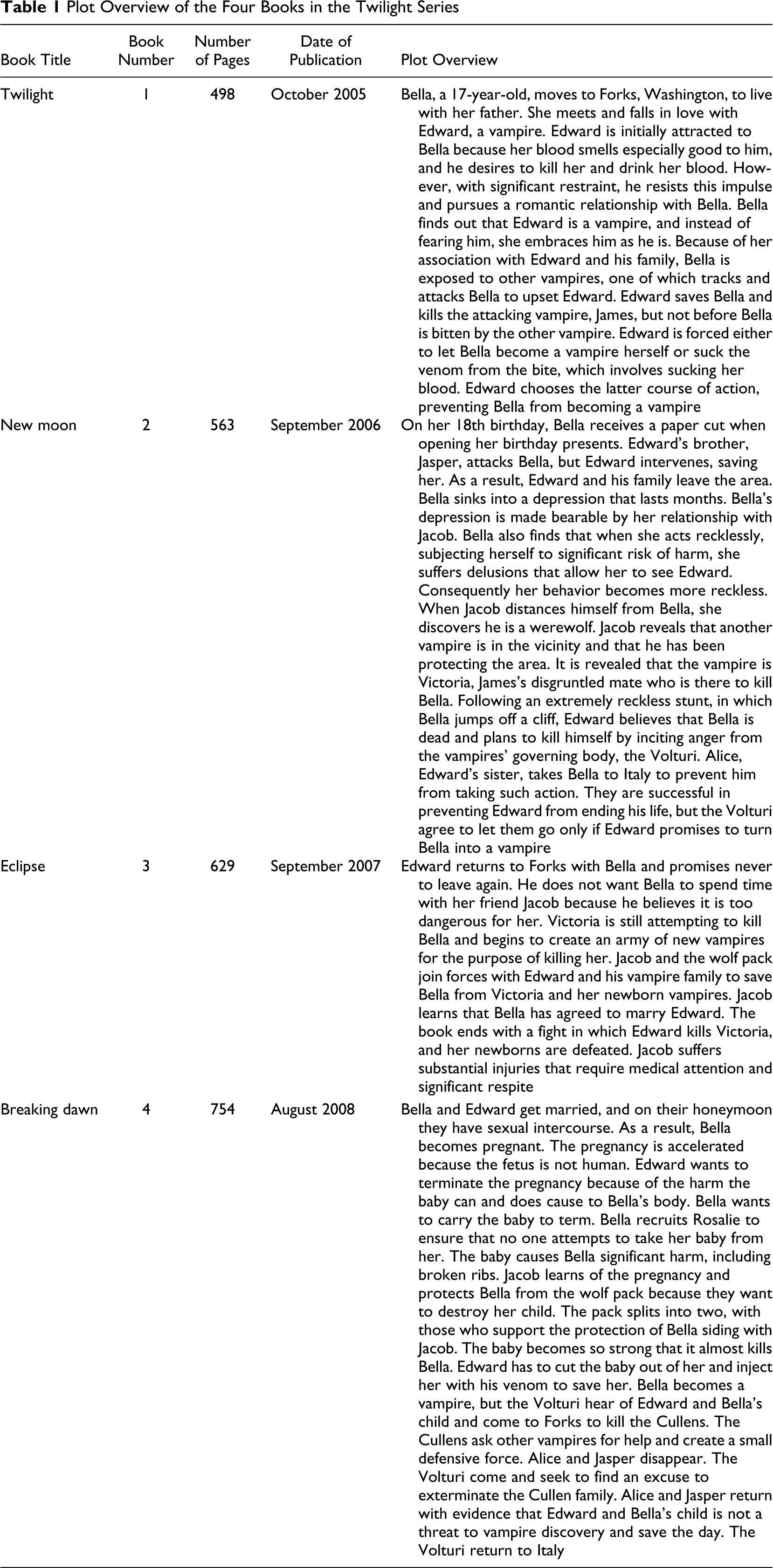
An ethnographic content analysis (Altheide, 1996) of the four books in The Twilight series provided the basis for the study. Table 1 presents brief overviews of the plots of the four books in the series. Prior to the coding, conceptual coding categories were identified, on the basis of previous research on predictors of dating violence (Felson & Messner, 2000; Hendy et al., 2003; Kaura & Allen, 2004). The results are reported in both quantitative and qualitative formats. The initial categories were drawn from the Duluth model of power and control (Pence & Paymar, 1993). These predictors included physical violence, which was defined as actual or threats of unwanted physical touching, pushing, and hitting; sexual violence, which was defined as unwanted or forced sexual behaviors, including physical harm and violence perpetrated during sexual acts; and controlling behaviors. Controlling behaviors were divided into three subcategories for the purpose of coding. These categories included (a) physical control, which included physically detaining, restraining, or preventing a character from moving in order to obtain compliance; (b) verbal orders, such as demanding that someone do something; and (c) emotional control, which involved one character controlling the dissemination of information to another character, reacting with anger to threaten another character into compliance, or making threats to harm a loved one or himself if the character did not comply with his wishes. In addition, stalking behaviors, such as following and constantly monitoring a partner’s location, were coded. Since jealousy is often used to justify such behaviors, it was also included in the analysis. Another category was male aggressiveness, which included the three subcategories of male territorial behavior that emerged during the analysis on the basis of the actor’s intent. The first theme involved the display of male aggressiveness to exert territorial dominance over a female. The second theme was the use of aggressiveness or anger to obtain compliance from another character.
Plot Overview of the Four Books in the Twilight Series
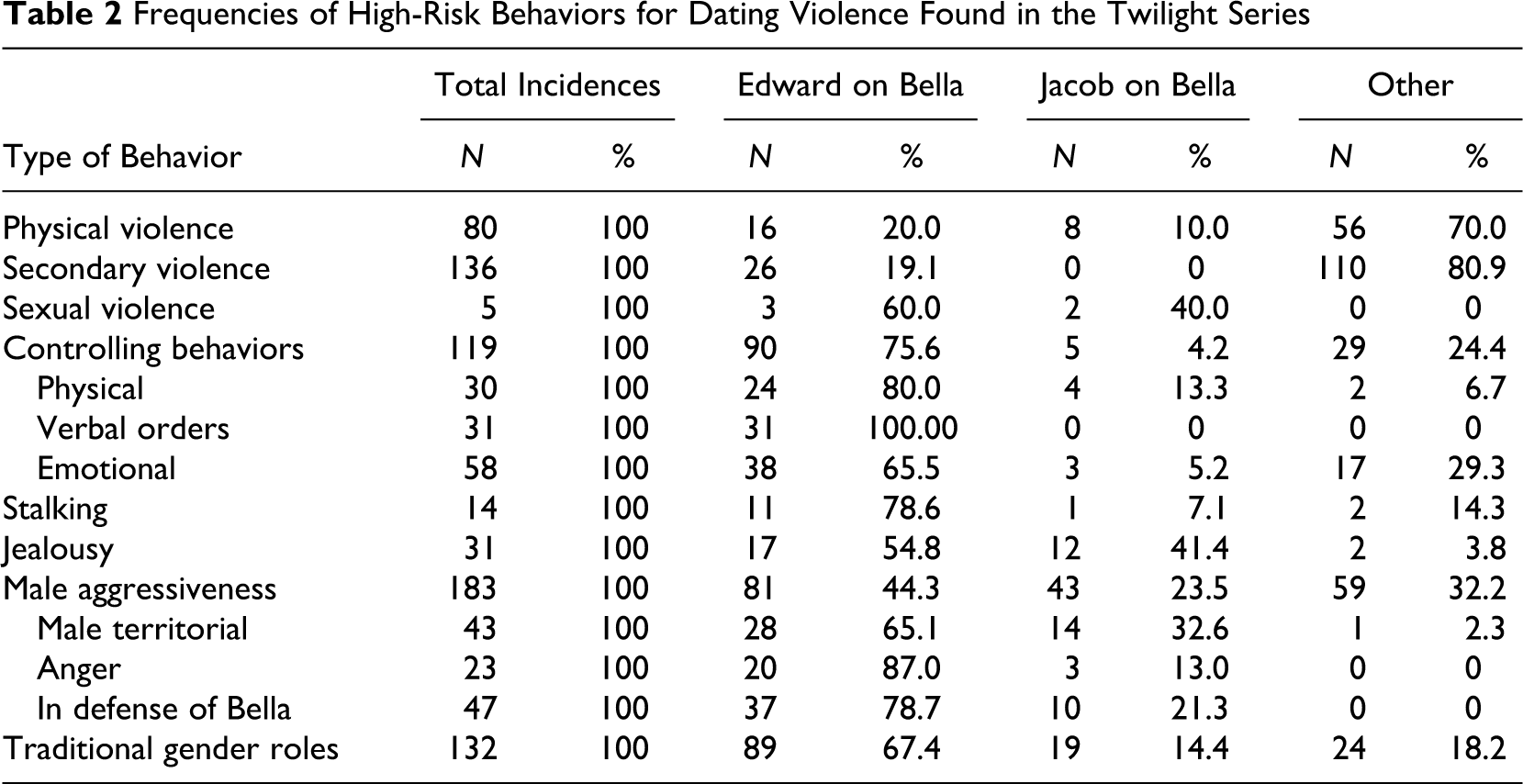
The last category involved the male characters’ use of aggression as a means of defending a female character, namely, Bella. Finally, on the basis of the findings of Kettrey and Emery (2010), who found that traditional gender roles are a dominant theme presented in magazines for teenagers, particularly the central focus on finding a man, having a romantic relationship, and securing a home, the presentation of traditional gender roles was included in the analysis. During the process of coding the last category, secondary violence emerged, that is, violent acts or threats of violence against Bella that were a direct result of her being involved with Edward or his vampire family. Table 2 provides frequencies for each coding category. Moving forward with the textual analysis, each book was coded independently by two coders. To maximize the reliability of the data, the two coding sets were then compared and combined to reflect only those cases that both coders had independently identified.
Frequencies of High-Risk Behaviors for Dating Violence Found in the Twilight Series
Results
Situations involving physical violence or threats of immediate physical violence were identified 80 times across the series, and 30% of the physical violence was perpetrated by a male in the course of an intimate relationship. Within this category, 66.7% of the violence was perpetrated by Edward on Bella and 33.3% was perpetrated by Jacob on Bella. Throughout the series, references are made to Edward’s desire to drink Bella’s blood, either as a mechanism that allows Edward to control both Bella’s behavior and the course of their relationship or as a reminder of the power differential between the two characters. Physical violence also occurs when Edward attempts to protect Bella from harming herself or from being harmed by others. Although Edward’s intention is not to harm Bella, she suffers physical harm on 16 (20%) occasions. For example, when Bella receives a paper cut while opening a birthday gift, another vampire lunges to attack her, and Edward jumps to her rescue, resulting in injury to Bella, “He threw himself at me, flinging me back across the table. It fell, as did I, scattering the cake and the presents, the flowers and the plates. I landed in the mess of shattered crystal” (Meyer, 2006, p. 28).
Bella is the victim of 96 instances of secondary violence in the book series. The most frequent perpetrators of this secondary violence are other vampires. The story involves a romantic relationship in which Bella’s love for Edward repeatedly places her at risk of serious injury or death. In addition, Edward himself poses a threat because of his desire to drink her blood, “They have a name for someone who smells the way Bella does to me. They call her my singer—because her blood sings for me” (Meyer, 2006, p. 490). It is also interesting to note that in Breaking Dawn, the fourth book in the series, Bella is expecting Edward’s child. Throughout the pregnancy, the nonhuman child causes significant injury to Bella, threatening both her health and her life.
We identified five cases of sexual violence in the four books. All were perpetrated against Bella by either Edward or Jacob. The following excerpt describes sexual violence perpetrated by Edward, “Under the dusting of feathers, large purplish bruises were beginning to blossom across the pale skin of my arm. My eyes followed the trail they made up to my shoulder, and then down across my ribs. I pulled my hand free to poke at a discoloration on my left forearm, watching it fade where I touched and then reappear” (Meyer, 2008, p. 89).
Although Edward and Bella do not engage in sexual intercourse until after they are married, which is in accordance with those who promote the series as advocating abstinence, the sexual relationship they do have is extremely violent.
Another instance of sexual violence involves Jacob and Bella. Jacob physically overpowers Bella and kisses her forcibly against her will. This act occurs twice in the series, and after the first time, Bella retaliates by punching Jacob, inadvertently breaking her hand. Bella’s injury and distress are then the cause of amusement for both Jacob and Bella’s father, Charlie, which trivializes both Jacob’s perpetration of sexual violence and Bella’s victimization.
With regard to cases of controlling behavior, 30 cases of the first type of controlling behavior, physical control, were detected, all but two of which involved either Edward or Jacob controlling Bella. The second type of controlling behavior, verbally ordering someone to comply, occurred exclusively between Edward and Bella, with Edward ordering Bella to do something a total of 31 times. For the last type of controlling behavior, emotional control, 58 cases were identified.
Examples of Edward’s use of violence for the purposes of controlling Bella’s behavior are illustrated by the following quotation, in which Edward intimates Bella, “‘Where do you think you’re going?’ he asked, outraged. He was gripping a fistful of my jacket in one hand” (Meyer, 2005, p. 103), or through asking other characters to restrain her physically, “‘Emmett,’ Edward said grimly. And Emmett secured my hands in his steely grasp” (Meyer, 2005, p. 382), or by threatening violence to ensure that Bella complies with his wishes, “‘No! No! NO!’ Edward roared charging back into the room. He was in my face before I had time to blink, bending over me, his expression twisted in rage” (Meyer, 2006, p. 535).
Throughout the series, there are 60 references to self-harm or suicide. The majority of these thoughts and behaviors (60.67%) are Bella’s. Within this category, three themes emerged. The first theme is Bella’s desire to become a vampire and consequently to go through the process of becoming undead, a process that involves enduring intense pain and death. Bella is willing and eager to endure a painful death to be with Edward forever. The second theme is related to Bella’s suicidal ideations when Edward leaves her. Bella’s deep depression manifests itself through thoughts of suicide and subsequent reckless behaviors. The last suicidal theme is related to self-harm initiated in an effort to save another character. For example, during a fight with hostile vampires, Bella has the following thoughts, “If I had to bleed to save them, I would do it. I would die to do it” (Meyer, 2007, p. 539). Repeatedly, images of suicide or self-harm are romanticized in this book series.
We identified 14 instances of stalking behavior in the books, 11 (78.6%) of which were perpetrated by Edward against Bella. These behaviors included Edward breaking into Bella’s room without her knowledge, listening to her conversations with other people, following her, and monitoring her interactions with others. For example, in Eclipse (Meyer 2007, pp. 131–132), Bella visits Jacob against Edward’s orders. When she returns, the following ensues, “It came out of nowhere. One minute there was nothing but bright highway in my rearview mirror. The next minute, the sun was glinting off a silver Volvo right on my tail.” Edward uses stalking techniques as a means of manipulating and controlling Bella. These behaviors are both minimized and romanticized throughout the series through Bella’s response, or lack of response, to them, “‘You spied on me?’ But somehow I couldn’t infuse my voice with the proper outrage. I was flattered” (Meyer, 2005, p. 292).
The content analysis also revealed 31 episodes involving jealousy in the series. Most of these episodes involved Edward’s jealousy of Bella’s interactions with another male (54.8%), and 41.4% were expressed by Jacob over Bella’s interactions with another male. These behaviors manifested themselves in many ways: admitting jealously outright, acting aggressively toward other males, and physically fighting over Bella’s attentions.
Edward and Jacob repeatedly express their feelings through anger and aggression. We found 183 instances of male aggressiveness, machismo, or male privilege in the book series. The majority of these behaviors are perpetrated by Edward (44.3%), followed by Jacob (23.5%). Displaying male aggressiveness to exert territorial dominance over a female occurred 43 times (23.5%) and was either presented through expressions of possessiveness by Edward and Jacob toward Bella or establishing dominance when confronted by another male. For example, in Eclipse, when Jacob attempts to warm Bella up by getting into her sleeping bag with her, the following occurs: Edward snarled, but Jacob didn’t even look at him. Instead, he crawled to my side and started unzipping my sleeping bag. Edward’s hand was suddenly hard on his shoulder restraining, snow white against the dark skin. Jacob’s jaw clenched, his nostrils flaring, his body recoiling from the cold touch. The long muscles in his arms flexed automatically.” (Meyer, 2007, p. 490)
In addition, claims of ownership are made concerning Bella. On three occasions, Edward refers to Bella as if she is his property, as in the following example, “‘She is mine.’ Edward’s low voice was suddenly dark, not as composed as before” (Meyer, 2007, p. 341).
We identified the use of aggressiveness or anger to obtain compliance from another character in 23 instances in the series, with 87% of the acts of aggressiveness perpetrated by Edward toward Bella and 13% by Jacob toward Bella. These acts vary from aggressive vocalizations, such as growling, snarling, or shouting, to threatening looks, physical intimidation, and physical restraint. There were also incidents involving the male characters’ use of aggression to defend a female character, namely, Bella These incidents occur 47 times (25.68%) in the series, most frequently by Edward (n = 37) and Jacob (n = 10). It is also interesting to note that the most common descriptive words used to convey expressions of male aggressiveness throughout include “growl, snarl, and hiss.” These words are animalistic, normalizing a primitive imagery of male dominance.
Of the 132 representations of traditional gender roles in the four books that we identified, most involved Edward’s behavior toward Bella (67.4%) or Jacob’s behavior toward Bella (14.4%). Bella is physically saved from harm by male characters seven times (5.3%). Although these events occur relatively infrequently, they are often major events in the story. In one instance, Edward saves Bella from death by stopping a van that is speeding toward her, “Two long, white hands shot out protectively in front of me, and the van shuddered to a stop a foot from my face, the large hands fitting providentially into a deep dent in the side of the van’s body” (Meyer, 2005, p. 56). Traditional gender roles are also emphasized in the chivalrous behaviors exhibited by both Edward and Jacob toward Bella (16.67%). These behaviors include opening doors, lending Bella clothes to ensure her warmth, carrying Bella when she is tired, and giving Bella comfort. Bella is repeatedly depicted as weak and dependent, requiring male protection from harm.Discussion
Viewed through the lens of dating violence, the Twilight series offers many troubling examples of controlling behaviors and violence. Many of these behaviors are minimized, justified, normalized, and sometimes romanticized. The majority of controlling and violent behaviors—physical and sexual violence, stalking, controlling, intimidating, and threatening—are exhibited by male characters. The central characters manifest behaviors that are consistent with traditional gender roles, with Edward and Jacob presenting as aggressive, territorial, and demanding, and Bella presented as subservient and weak. Considering the popularity of the books and the marketing of their stories to a predominantly teenage audience, these messages are counterintuitive to the promotion of healthy, equitable, nonviolent relationships. This is especially true with regard to sexual violence since the representation of a sexually violent relationship seems to be in direct contradiction to advocating abstinence.
Twilight, published in 2005, was ranked the best-selling book of 2008 by USA Today, closely followed by the book’s sequels. In 2009, New Moon, published in 2006, was ranked number one on the U.S. best-seller list, again followed by the other three books in the series (DeBarros, Cadden, DeRamus, & Schnaars, 2010a). The books have reportedly sold more than 40 million copies worldwide (DeBarros, Cadden, DeRamus, & Schnaars, 2010b), with Breaking Dawn, published in 2008, selling 1.3 million copies in the United States the day it was released, debuting at the top of the best-seller lists in Britain, France, Italy, Ireland, and Spain. The books have also been printed in 37 languages, including Vietnamese, Croatian, Chinese, and Latvian (Parsons, 2008).
Given the widespread popularity of the series and the fact that the target audience is predominantly teenage girls (Young, 2009), it is of particular concern that the dominant romantic relationship is presented with behaviors that are characteristic of relationship violence. The presentation of these behaviors in popular fiction clearly does not cause dating violence. However, it is troubling when one of the most popular book series in recent history repeatedly normalizes, minimizes, and romanticizes these behaviors. It reinforces cultural norms that condone men’s use of force to obtain a variety of goals.
These findings have several implications for social work. Given the popularity of the Twilight saga among adolescent girls, social workers who seek to engage young women may find that the books provide some “common ground” for a discussion of the issues related to romantic relationships and societal pressures to comply with traditional gender roles. Behaviors that were previously assumed to be evidence of love (such as stalking, jealousy, and isolation) may be redefined as tactics of power and control. Girls may initially be more willing to discuss Bella’s relationships than their own. In addition, programs to prevent dating violence and educational programs could certainly use examples from these books to illustrate behaviors and attitudes that are related to dating violence. To recognize behaviors that were previously presented as chivalrous and romantic as clear examples of control, stalking, abuse, and intimidation may offer young people new insights into the insidious and often-subtle nature of abuse and control. In this way, the Twilight series could continue to influence young lives, but in a new way.
Footnotes
The authors declared no potential conflicts of interest with respect to the research, authorship, and/or publication of this article.
The authors received no financial support for the research, authorship, and/or publication of this article.