




Abstract
This article examines gender sensitivity among social workers in different service settings, who handle domestic violence cases and its implications for social workers' professional development in Hong Kong. The findings of in-depth interviews with both social workers and survivors of domestic violence revealed that the major difference in the handling of domestic violence cases by social workers in family settings and those working in shelters or with survivors' groups is that the former perceive women’s problems as family problems that require mediation and adjustment, whereas the latter consider them to arise from an imbalance in power relations between men and women, thus leading them to focus on enhancing women’s well-being in their practice. Helping social workers to recognize structural inequality between men and women is the starting point for the development of gender-sensitive practice in domestic violence cases.
This article examines gender sensitivity among social workers in handling domestic violence cases and its implications for social work professional development in Hong Kong. The discussion is based on part of the findings of a 2-year research project conducted between 2006 and 2008. The main objective of the study was to identify and understand the difficulties of and opportunities for gender mainstreaming the domestic violence policy in Hong Kong. This article focuses on the findings on the gender sensitivity of frontline social workers in handling domestic violence cases.
Research has clearly shown that domestic violence is a gender issue. A World Health Organization (2005) report based on research on violence against women in 10 countries found that more than 75% of the perpetrators were men. The situation in Hong Kong is similar. According to data from the Social Welfare Department of Hong Kong (2009), of the 4,807 domestic violence cases reported in 2009, 4,012 (83.5%) involved female victims, whereas only 795 (16.5%) involved male victims. There is no doubt that women are typically the victims of violence in intimate relationships and that abuse is usually inflicted by men on women. Although an increasing number of men suffer from battering by their female partners, domestic violence is not a symmetrical problem, nor do men have an equal chance of being abused by their partners.
In Hong Kong, many professionals, including social workers and the police, tend to view domestic violence as a problem between individuals and marital disputes as a family issue caused by family dysfunction (Y. C. Chan, 1997; Tam & Tang, 2005). The family approach reinforces the popular conception in Hong Kong that abused women are responsible for their own victimization because they provoke their male partners. Such a view, combined with the failure to address the gender dimension of the problem, leads to policy outcomes that are harmful to women. One example is the family tragedy of Kam Shuk-ying and her daughters that occurred in Tin Shui Wai (a new community in the northwestern part of Hong Kong that is one of the poorest districts in Hong Kong and has the highest number of reported domestic violence cases) in 2004.
Kam Shuk-ying, a new immigrant, and her two daughters were killed by her husband. The investigation following their deaths uncovered at least three problems related to the handling of Kam’s case by social workers. First, in the first few contacts with Kam, the social worker treated the case not as domestic violence but, rather, as a marital dispute. Second, the social worker prematurely arranged a joint interview with Kam and her husband to mediate the conflict between them, thereby triggering the abuser’s anger. Third, while Kam was staying in a shelter, she received a telephone message from her husband saying that her two daughters would be killed if she did not go home immediately. Kam sought help from a social worker and the police before returning home, but her request for assistance was ignored. Kam and her two daughters were then killed, after which the murderer committed suicide (“Wife Seeks Help Three Times,” 2004). As stated in the report of a review panel, the social worker did not deliberately ignore Kam’s needs but simply treated the situation as a family dispute that could be resolved through individual counseling (Social Welfare Department, 2004). What lessons can social workers draw from this tragedy? The article examines gender sensitivity among the social workers in different service settings, who handle domestic violence cases in Hong Kong. Exploring social workers' perceptions of domestic violence can shed light on the factors that influence social work practice.
Contested Perspectives on Domestic Violence: Family Versus Feminist
In this article, the term domestic violence refers to violence that occurs in the context of the marriage, cohabitation, or separation of heterosexual partners, even though the gender-neutral use of the term is open to challenge in several ways. First, it may trivialize the abuse as a private matter, rather than an issue reflecting common societal beliefs that require explanation and change. Second, it may fail to reflect accurately the relationship between the abuser and the abused. For example, a male abuser and female victim may not live together, and many women continue to suffer abuse after separation from their violent partners. Third, it may give the incorrect impression that domestic violence is a gender-symmetrical issue (Mooney, 2000; Mullender, 1996). Although the term is not ideal, I use it here to put the discussion in context, since domestic violence is the predominant term used in social service agencies and the policy context in Hong Kong, and the article is aimed at the social work profession.
The family and feminist perspectives are the two major theoretical perspectives that have been widely adopted in both the West and Hong Kong to explain the causes of domestic violence. According to the family perspective, domestic violence has no single cause but rather results from the psychological problems of an individual (Dutton, 2006), situational factors (Johnson & Ferraro, 2000), poor anger management skills, or frustration with the responses and feedback of other family members (Straus, 2009). Individual problems are seen as a manifestation of a dysfunctional family unit, and each family member has a part to play in creating conflict and violence. Applying the family perspective to domestic violence is likely to result in the problem being understood as gender symmetrical, with men and women seen as equally likely to be the perpetrators and victims of violence (Archer, 2000; Dutton, 2006; Fiebert, 1997; Straus, Gelles, & Steinmetz, 1980). The research conducted by Straus et al. (1980) is representative of this perspective. It used the Conflict Tactics Scale to measure all forms of family violence and to examine the claim that men and women perpetrate approximately an equal number of violent acts against their partners. This claim has gained further support from scholars such as Dutton (2006), who criticized feminists for ignoring female-initiated aggression and women’s use of violence.
In contrast to the family perspective, the feminist perspective stresses that domestic violence results from men’s oppression and domination of women in marriage. It makes societal male–female relationships the central unit of analysis. Feminist researchers believe that the social institutions of marriage and family functioning in traditional forms are special contexts that promote and maintain men’s use of violence (Bograd, 1988; Dobash & Dobash, 1992). McCue’s (2008, p. 15) views are typical of this perspective: Violence against women of any kind is part of male control. Although there is no one feminist approach to intimate partner violence, most look to power imbalances that create and perpetuate violence against women. These imbalances exist in patriarchal societies where structural factors prevent equal participation of women in the social, economic, and political systems. Imbalances at the societal level are reproduced within the family when men exercise power and control over women, one form of which is violence.
Feminist researchers have also refuted the claim that domestic violence is a symmetrical problem between the sexes, arguing that women are the victims of such violence more frequently than are men (Dobash, Dobash, Wilson, & Daly, 1992; Kimmel, 2008). Evidence shows that women’s aggression and violence are dramatically different from men’s aggression and violence. For example, women tend to use violence expressively, that is, to express frustration or immediate anger or to prevent further injury. Women’s violence is often the outcome of feeling trapped or helpless. Men, in contrast, use domestic violence instrumentally, that is, for the specific purpose of striking fear into their wives' hearts and/or to ensure compliance, obedience, and passive acceptance of the husbands' rule in the home. The lack of gender statistics on domestic violence further reinforces the impression held by the public that men and women are equally aggressive and impedes recognition that such violence stems from gender inequality in the family and in society (Kimmel, 2000).
Feminist researchers have also pointed to the importance of considering the cultural context in enhancing understanding of women’s abuse, particularly in the case of immigrant women. Evidence shows that abused women are more invisible, and hence vulnerable, if they are members of an ethnic minority with a culture different from the prevailing one (Fong, 2010; Guruge, 2010). Fong (2010), for example, pointed out that Chinese immigrant women in Canada are particularly vulnerable because their cultural beliefs may prevent them from leaving their abusive husbands. Although divorce is now accepted in Western countries, it is still widely considered taboo and shameful among the Chinese. At the same time, the socially constructed identity of “ethnic minority” or “other” can deprive women of services if they do leave their homes. Furthermore, Confucian ideology has a strong influence in Chinese society. Its promotion of the traditional belief that men are the heads of their families and the expectation that women should be submissive and loyal to their husbands and responsible for preserving the cohesion of the family unit can be used to perpetuate male domination and support discrimination against women. However, as Amirthalingam (2003, p. 9) argued, “it is important to distinguish between cultural practices and patriarchal practice. Where cultural practices reflect and perpetuate gender discrimination, the law must be ever more cognizant of the underlying causes of violence against women.”
Similar conceptual issues are prevalent in Hong Kong. For example, studies by K. L. Chan (2000), Tang (1998), Tsun and Lui (2005), and Yeung (1991) tended to view domestic violence as marital problems or pathologies of an individual, whereas those by the Coalition on Equal Opportunity for Women in Hong Kong (2006) and Leung (2008) put more emphasis on the power imbalance between men and women. However, the majority of research on domestic violence in Hong Kong has placed the issue within the family rather than the feminist discursive framework. The dominant discourse on domestic violence affects the practices of social workers in Hong Kong in direct and indirect ways. Adopting the feminist perspective to analyze the practices of social workers, as this article does, requires a shift in social workers' way of thinking about domestic violence.
Method
The study on which this article was based aimed to identify the problems that current social work practice in Hong Kong has in dealing with domestic violence cases and to explore gender sensitivity among frontline professional social workers who handle such cases. The social workers who were interviewed in this study (all of whom were trained academically in social work) work in different service settings, thus permitting a comparison of their views on the handling of domestic violence cases. They were selected through the purposive sampling method. Face-to-face in-depth interviews were ultimately conducted with 12 frontline social work practitioners. Of the 12, 6 were employed in family service settings, namely, the Family and Child Protection Service Units (FCPSUs, which the Social Welfare Department reorganized in 2000 to provide so-called one-stop services for abused women and their children) and Integrated Family Service Centres (IFSCs, operated by the Social Welfare Department and subvented nongovernmental organizations, that provide preventive and supportive services to meet the multifarious needs of individuals and families in the community. Less serious cases of domestic violence or marital disputes are handled by the IFSCs, and more serious cases are handled by the FCPSUs). The remaining 6 worked in shelters for abused women and with survivors' groups. Of these 12 interviewees, 4 were referred by the Social Work Officers' Branch of the Hong Kong Chinese Civil Servants' Association, 8 were identified through agency contacts, and 2 were personal contacts.
To obtain the perspective of service users, the research team also conducted face-to-face in-depth interviews with 20 female survivors of domestic violence. The aim was to capture the complexity of the women’s experience in seeking help from social service agencies and their feelings about how social workers handled their situations. These participants were also selected via the purposive sampling method on the basis of their years of residence in Hong Kong (thus permitting a comparison of the experiences of local women with those of new immigrants) and experience with social workers in different service settings. All the women were referred by social service organizations, including the IFSCs, survivors' support groups, and shelters for abused women. Of the 20 women, 9 were born locally, 10 had emigrated from mainland China, and 1 was from the Philippines. At the time the immigrant women sought help from social workers, they had been living in Hong Kong for fewer than 7 years and thus, according to Hong Kong immigration policy, are considered new arrivals (i.e., they do not enjoy full citizenship rights and are not entitled to either social security benefits or public housing). The experiences of all the women were recurrent and overlapping. For example, the women may have been in and out of shelters and, at the same time, have required assistance from a family service center. Of the 20 women, 15 had sought help from an IFSC; 6 from an FCPSU; 6 from a survivors' group; 10 from a shelter for abused women; and 4 from another service setting, such as a medical or community center.
Semistructured interviews lasting approximately 2 hours were held with each social worker and survivor. The interviews were audiotaped and transcribed word for word. The content analysis approach was used to analyze the findings. The aim was not to provide a systematic or comprehensive overview of the data set but, rather, to reveal subtle features of the survivors' narratives of their encounters with social workers and the social workers' construction of meaning concerning their practices. Data are presented here as accounts of social phenomena and social practices, with extensive illustrative quotations from the interviews, which I translated into English. The names of the interviewees have been changed to preserve their anonymity. The intent of this article is not to generalize the situations discussed here to the wider social work community in Hong Kong, since the study’s sample was small, but rather to precipitate critical questions about gender sensitivity practices in Hong Kong.
Survivors' Perceptions of the Practices of Social Workers
The survivors were generally appreciative of the efforts of social workers who worked in shelters, self-help groups for survivors, and women’s organizations. They reported that these practitioners were generally willing to help, to take their problems seriously, and to be able to help them deal with emotional distress and to explain clearly their rights and entitlement to benefits. A number of complaints were made about the social workers in family service settings, however. Previous studies conducted in the West and in Hong Kong have found that abused women reported that social workers were unable to offer constructive help (McWilliams & McKieman, 1993), ignored women as persons in their own right (Maynard, 1985), blamed the victim (Dobash, Dobash, & Cavanagh, 1985; Maynard, 1985), failed to work with or confront abusers (Maynard, 1985), made the woman in question feel worse (Dobash et al., 1985), and focused on family relationships and mediation (Coalition on Equal Opportunity for Women in Hong Kong, 2006).
I took these six common problems identified in previous studies as units of analysis to gain a better understanding of survivors' perceptions of the problems they encountered with social workers. Each issue was assigned a code, and the number of times it was raised in the interviews was recorded (see Table 1 for a summary).
Survivors' Perceptions of Problems Encountered With Social Workers in the Help-Seeking Process
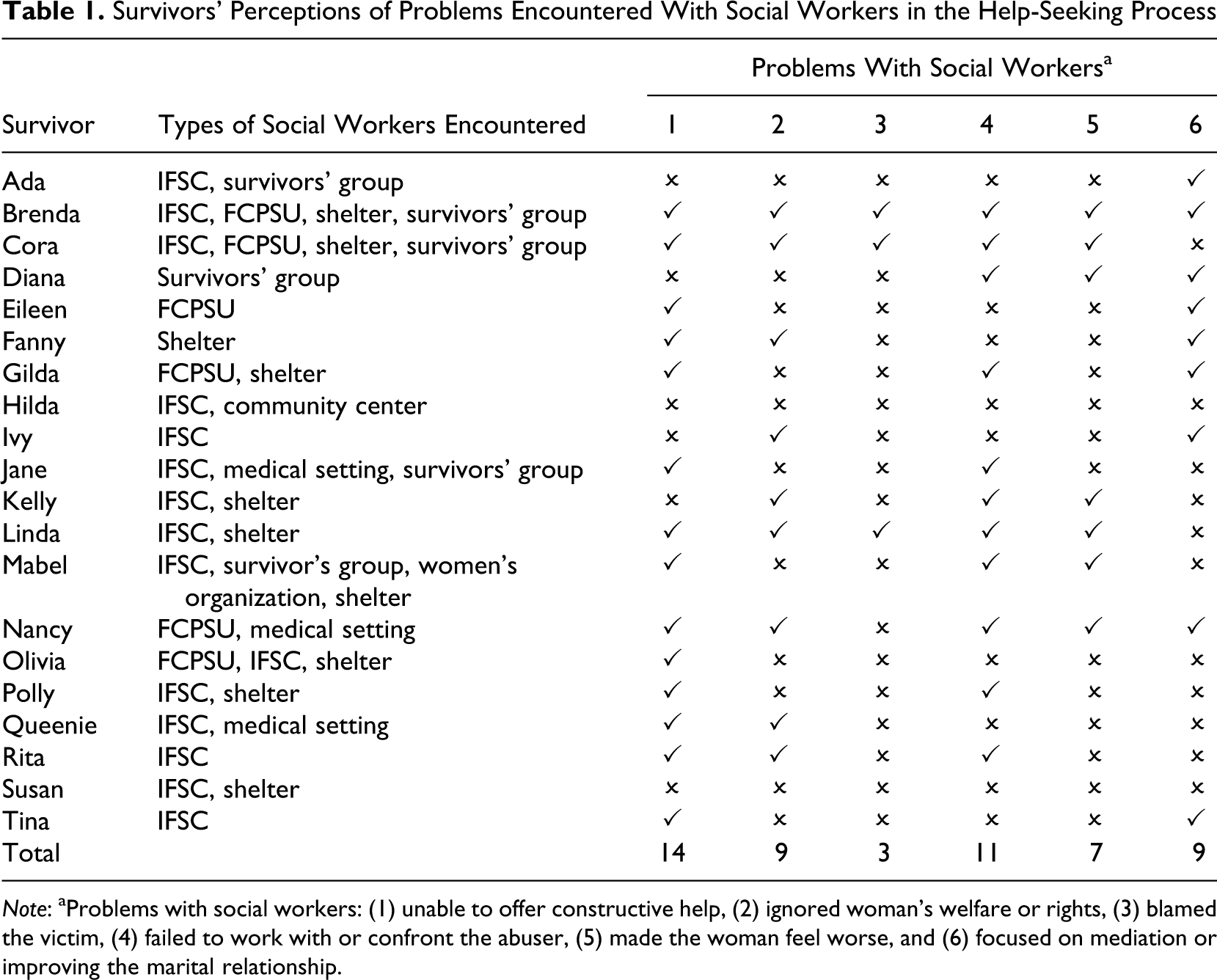
Note: aProblems with social workers: (1) unable to offer constructive help, (2) ignored woman’s welfare or rights, (3) blamed the victim, (4) failed to work with or confront the abuser, (5) made the woman feel worse, and (6) focused on mediation or improving the marital relationship.
As Table 1 shows, the most common problems that the survivors encountered in dealing with social workers were, in descending order, the inability to offer constructive help (14 women); the failure to work with or confront the abuser (11 women); a focus on mediating the marital relationship, rather than on the violence perpetrated by the abuser (9 women); and the neglect of the woman’s welfare or rights (9 women). The problems that the women reported facing were similar to those reported by abused women in previous studies (Coalition on Equal Opportunity for Women in Hong Kong, 2006; Dobash et al., 1985; Maynard, 1985; McWilliams & McKieman, 1993). Although the simple count presented in Table 1 summarizes the common problems that the survivors experienced with social workers, it neglects other minor problems mentioned during the interviews, fails to differentiate among different types of social workers, and omits the women’s subjective feelings during the social work encounter. To ground the analysis in the dynamic experience of the help-seeking process and give weight to the specific context in which the survivors' perceptions were formed, I next present narrative accounts of two survivors, Brenda and Cora.
Brenda’s Account
At the time of the interview, Brenda was a 23-year-old locally born woman with an infant daughter. She was first beaten by her husband in 2004 and left the marital home 3 months later. At the time of her interview, Brenda had divorced her husband and was seeing a psychiatrist. In the past few years, she had met with a variety of social workers in an FCPSU, an IFSC, a women’s shelter, a social security office, and a survivors' support group. Brenda recalled her experiences during the interview: Because I was so frightened, I went to see a social worker, the one in the IFSC, which is an NGO [nongovernmental organization], not run by the government. … I told her the whole story. She didn’t offer much help. She just gave me the telephone number of the police station nearby and advised me not to call 999 because the call would be disclosed to the press…. She also gave me the telephone number of the Legal Aid Department and suggested that I divorce my husband. She advised me to take these actions by myself and then closed the file…. She did not take my situation seriously and just told me that I should call the police if he [her then husband] threatened me again…. About three months after I returned home, his [her now ex-husband’s] attitude got worse again…. I prepared more before going to see a social worker this time and hoped that I could communicate better with the social worker…. [I saw] a male social worker [at the IFSC]. I told him what had happened in the past…. He just saw things from the male perspective. Men can only stand on the side of men…. He just told me that he would like to talk with my husband. He said that we didn’t communicate enough and that if he could mediate our conflict, the situation would improve…. I didn’t think so. If he [ex-husband] knew that I had gone to see a social worker, the situation might get worse. I stopped [the IFSC social worker] from [talking with my husband]…. Then, he said that because I didn’t report [the incident] to the police, he had no choice but to consider my injury an accident that was caused by my own carelessness…. He simply didn’t believe me…. He was so calm, didn’t even say a word to comfort me, just asked me what I wanted from him. I was finally admitted to a shelter, but had to repeat my story again and again…. I asked her [the FCPSU social worker] to apply for benefits for me, but she refused to do so…. She complained to me, grumbling that she had 300 cases [to deal with]; how could she just focus on my case? She said: “I think I have enough sympathy for you, but you have to understand my situation. I am now even more helpless than you.” … I knew some sisters in the shelter who were in contact with X Association [a survivors' group]…. I learned more about my own rights and entitlement to compassionate rehousing.
Cora’s Account
At the time of the interview, Cora was a 40-year-old woman originally from mainland China who immigrated to Hong Kong with her son in 2003. She suffered multiple forms of abuse, including physical, emotional, and sexual, soon after her arrival in Hong Kong. She sought help from the IFSC and later phoned the police after being repeatedly beaten by her husband. The FCPSU followed up her case, but, like Brenda, Cora received little help from her social worker and was told that she was entitled to neither social security nor housing benefits. As she stated: I had no idea about where to get help at that time. Someone told me that I could seek help from family service centers. They provide services for new arrivals…. The first social worker [at an IFSC] was the worst I have ever met…. I cried and cried and talked a lot about my situation to her. She just replied: “You new arrivals think that Hong Kong is a heaven. If you can’t adjust to the living situation here, why don’t you just go back to mainland China?” … I hoped that a social worker would counsel my husband, but that guy [the social worker] just blamed new arrivals for making trouble and getting benefits. The first time I lived in a shelter … the [FCPSU] social worker didn’t explain clearly to me the procedure for applying for social security. She told me that I would have to rent a place outside before applying…. She didn’t give me any information about compassionate rehousing. We should have choices, right? If I had known that I could apply for public housing, I wouldn’t have gone out to rent a place…. That was the social worker from the FCPSU…. I faced another problem when applying for social security benefits. The officer told me that I had less than seven years of residency, so she would not approve my application…. Later, the social security officer told me that I would be able to get benefits if my application was supported by my caseworker…. I was under such pressure, couldn’t bear the situation. I have a mental health problem. I started to beat my son—I couldn’t control myself…. Some of the residents [in the shelter] told me that X Association [a survivors' group] might help. They give you more information. I knew more after approaching the association and learned how to fight for my benefits…. The first social worker from the family service center hurt me a lot…. I nearly jumped off the building after seeing that social worker.
Why did the two groups of social workers behave differently in the eyes of the abused women? Was it because their skills or attitudes differed? In an attempt to answer these questions, the following section considers gender awareness among social workers who handle domestic violence cases in family social work settings from the feminist perspective.
Lack of Gender Sensitivity Among Family Social Workers
As I previously noted, 6 social workers from family service settings (the FCPSU and IFSC) and 6 from shelters for abused women and women’s organizations were interviewed. I found that quite a few of them, particularly those who worked in family service settings, demonstrated poor gender awareness. The results of the interviews suggested that four of those who worked in family service settings tended to blame the victim, feel sympathetic toward abusers, and emphasize the unity of the family when dealing with cases of domestic violence. Examples of these attitudes follow.
Blaming the Victim
Some of the social workers considered abused women, particularly those who had emigrated from mainland China, to be unreliable and a burden on society, as the following comments indicate: I can’t help them [abused women] to apply for any social welfare benefits because they are not citizens of Hong Kong…. We have to be responsible for every penny of public money. We can’t be so careless. That’s taxpayers' money. They [abused women] can’t abuse it. (Flora, FCPSU) … [These couples consist of] an old husband and a young wife. Men want a wife from the mainland, while women just want an identity card. They [new immigrant women] have children because they will not be able to get an identity card or any benefits if they do not have children. (Simon, IFSC) … Public housing is a kind of public resource, which we cannot abuse…. Most people have to queue up. They [immigrant women] also have to wait if it is not urgent. Or, we can find another way to solve the problem. Public housing is the last resort. (David, IFSC)
What do you expect from the man? You already know that it’s a kind of “trading” marriage…. If you [the new immigrant woman] don’t feel happy about the situation, why don’t you just leave? …. The problem is caused by [the abused women] themselves, all because they insist on staying in Hong Kong. (Flora, FCPSU).
Sympathy for the Abuser
Some family social workers viewed domestic violence as a symmetrical issue. They thought that, in some cases, women’s abuse by their partners was motivated by the men’s anger and frustration arising from family conflicts, that the women sometimes provoked the abusive behavior, or that some violent acts were simply “mutual fights.” Here are some representative comments: Men [abusers] are less motivated [to seek help]. Maybe they have suffered, suffered from verbal abuse, maybe have been verbally attacked [by their wives]. But when their wives seek help, the [men] become abusers…. Men are usually the abusers in physical abuse cases, but in my understanding, women should bear responsibility for being beaten. Sometimes they may verbally abuse [their husbands]. (Joanne, IFSC) … There is no doubt that men use force, … but very often violent acts are committed by both sides. They may hit each other…. Men are usually strong and use more force. But women use their mouths [verbal abuse]. (David, IFSC) … It is hard to say who is right or wrong. But sometimes our clients agitate the abuser too often (to agitate means to scold the man about not finding a job). The scolding has been repeated not once, or 5 times or 10 times, but every day. Actually, he [the abuser] is also a victim; he is also suffering. (Simon, IFSC)
Emphasizing the Unity of the Family
Influenced by the Confucianism that is prevalent in the Chinese society of which they are a part, social workers in Hong Kong, especially those working in family service settings, tend to hold the strong belief that a “complete” family is always better than a “broken” one. Maintaining the family as a unit has long been the basic approach of family services in Hong Kong, which has attracted strong criticism from women’s groups because it encourages women to sacrifice themselves for the sake of family unity (Association for the Advancement of Feminism, 1990). The following comments illustrate the social worker’s view that the family needs to be maintained: Our agency thinks that the family is very important, that maintaining the unity of the family is an important mission, … and that maintaining a family relationship will reduce violence…. This mission has been practiced for many years. (Terry, IFSC) … I will assess whether the family can be maintained because the family involves children…. I’d rather spend more time dealing with their marriage problems. (Flora, FCPSU)
Gender-Aware Social Work Practice
Gender-aware social work practice recognizes that problems between women and men are rooted in structural inequality and links personal experiences with social position and status (Dominelli & McLeod, 1989; Langan & Day, 1992). In this study, the six social workers who worked in women’s shelters or with survivors' groups, unlike the family social workers, tended to endorse egalitarian attitudes and to acknowledge the significance of gendered power relations in constructing women’s experiences in intimate partner relationships, rather than to focus on the family. The following comments make this point clear: I think that most of the [domestic violence] cases are caused by the control of husbands over their wives. The husbands don’t respect their wives…. The use of violence is a kind of control. (Lena, shelter) … This is a deep-rooted social problem—men are superior to women according to traditional Chinese culture…. When the police handle domestic violence cases, they tend to try to pacify the victims…. Abused women are likely to be financially dependent on their husbands…. That makes them stay in the violent relationship. (Sue, shelter) … We try to get across to them that they shouldn’t blame themselves or shoulder all the responsibility. We help them to understand the societal factors that affect them. (May, survivors' group)
Conclusion
This article has drawn attention to the problems that abused women in Hong Kong encountered in seeking social services. The most common problems the women experienced with social workers were the social workers' (a) inability to offer constructive help, (b) failure to work with or confront the abuser, (c) focus on mediating the marital relationship rather than on violence perpetrated by the abuser, and (d) ignoring the welfare rights of abused women. Abused immigrant women are often more vulnerable than are local women, since they are blamed as being a “burden” because of the prevalent xenophobic climate in Hong Kong society. The findings of the study also indicated that social workers who hold a family perspective tend to overlook the structural inequality that exists between men and women and the intersecting oppressions that negatively affect women. Accordingly, they focus primarily on maintaining the family unit or improving the marital relationship and pay little attention to the welfare of the women who have been abused. Social workers who lack gender sensitivity not only reinforce the victimization of women in the handling process but are blind to their own use of their professional knowledge to control the meaning of women’s experiences in intimate partner relationships. In contrast, social workers who adopt a feminist perspective are able to engage in a more complex analysis of the power that men hold over women and to link the private experiences of abused women to public policy. Lacking awareness of the patriarchal roots of the violent acts committed in intimate partnerships, social workers inevitably become part of the problem.
To develop good practices in handling cases of domestic violence, social work agencies need to recognize that domestic violence is a gender and human rights issue and to take action to help social workers formulate appropriate responses. Doing so will require gender sensitivity training for frontline workers to sensitize them to the needs and problems of abused women when they deal with cases of domestic violence.
Footnotes
The project entitled “The Possibilities of Gender Mainstreaming Social Policy on Domestic Violence in Hong Kong” was substantially supported by grants from the Central Policy Unit of the Government of the Hong Kong Special Administrative Region and the Research Grants Council of the Hong Kong Special Administrative Region (Project No. CityU 1003-PPR-2) and partially supported by a top-up grant from the City University of Hong Kong.
The author declared no potential conflicts of interest with respect to the research, authorship, and/or publication of this article.
The project entitled “The Possibilities of Gender Mainstreaming Social Policy on Domestic Violence in Hong Kong” was substantially supported by grants from the Central Policy Unit of the Government of the Hong Kong Special Administrative Region and the Research Grants Council of the Hong Kong Special Administrative Region (Project No. CityU 1003-PPR-2) and partially supported by a top-up grant from the City University of Hong Kong.