




Abstract
This article reports on a content analysis of the social work research literature to assess the level of attention that the profession has paid to the rape of adults. The analysis of 66 social work articles published between 1975 and 2008 revealed that rape was a primary focus in about one third of the articles. However, 94% of the articles connected rape with another issue that was central to the profession (such as domestic violence or mental health). The majority of articles were client focused, rather than addressing practitioners' needs or macro-level issues. A large number of articles framed rape as a form of domestic violence; however, there is a clear need to address the issue of rape both within and outside the context of domestic violence. Implications for future research are discussed.
Keywords
Sexual violence against women is a widespread, yet often hidden, problem in our society. One particularly insidious form of sexual violence is rape, also referred to as “sexual assault” in some states. The high number of rape survivors suggests that social workers in all settings who work with women will likely encounter clients who have experienced sexual violence. According to the most recent National Violence Against Women Survey, 17.7 million women in the United States were raped at some point in their lives, with roughly half those assaults occurring when the women were aged 18 or older (Tjaden & Thoennes, 2006). Given that rape is one of the most underreported crimes, the actual prevalence is likely much higher (Koss & Harvey, 1991).
The devastating impact of rape on survivors, including negative outcomes in the physical, mental, social, and interpersonal domains, has been well documented (Bachar & Koss, 2001; Campbell, 2008; Koss, Koss, & Woodruff, 1991; Waigandt, Wallace, Phelps, & Miller, 1990). Moreover, only a small number of survivors actually seek treatment from formal sources of support immediately after they have been assaulted (see Ullman, 2007, for a review). Numerous studies have reported the reasons why survivors of rape do not report assaults or seek services, including fear, shame and embarrassment, and stigmas associated with sexual assault (Bachar & Koss, 2001; Logan, Evans, Stevenson, & Jordan, 2005; Patterson, Greeson, & Campbell, 2009; Sable, Danis, Mauzy, & Gallagher, 2006; Ullman & Filipas, 2001). In addition, service providers may hold prejudicial assumptions about survivors of rape, also called rape myths, that negatively affect survivors' search for assistance (Burt, 1980, Campbell, Wasco, Ahrens, Sefl, & Barnes, 2001). When survivors do come forward to report abuse or seek services, they may be revictimized and encounter what has been termed a “second rape” because of uninformed, insensitive, and victim-blaming responses from a variety of service providers, including those in hospital emergency rooms, law enforcement, and the legal system (Ahrens, 2006; Campbell, 2005; Madigan & Gamble, 1991; Maier, 2008).
Despite these problems, a number of substantial changes have occurred in the past few decades to improve the response to survivors of rape by various systems. In particular, the development of a community-coordinated response to sexual assault has been established as a best practice for responding to survivors of sexual violence (Campbell, 1998; Campbell & Ahrens, 1998). The implementation of sexual assault response teams (SARTs) has been instrumental in providing an improved response to survivors. SARTs include individuals from multiple service agencies (often police, health, counseling, and advocates) who work together to ensure that survivors are treated with compassion and are presented with accurate information about their options. A key aspect of SARTs are sexual assault nurse examiners (SANEs), who are specially trained to provide sensitive health care to and collect evidence from survivors (Campbell, Patterson, & Lichty, 2005). Research has found that the coordinated efforts between SANEs and advocates are especially useful for survivors, since forensic evidence is collected more efficiently, survivors are interviewed sooner, and cases are more likely to be prosecuted (Campbell et al., 2005; Littel, 2001).
Even with these positive advances, there is additional work to be done to improve the response to survivors of sexual assault, and social workers have a critical role to play. On a daily basis, social workers in settings as diverse as hospitals, mental health centers, homeless shelters, drug and alcohol treatment centers, correction facilities, schools, and private practice routinely encounter women who are suffering the traumatic effects of rape, although the women may not disclose the rape as the presenting problem (Ahrens & Campbell, 2000; Macy, 2007). The severe and prevalent sequelae of sexual assault, such as depression and posttraumatic stress disorder (PTSD), may be presenting or accompanying problems for clients who are seen by social workers (Campbell, 2008).
Given the likelihood that social workers will encounter survivors of rape in their practice with women, it is essential that the topic is prominent in the profession, including education, training, and research. One way to assess the profession’s priorities of various issues, such as rape, is to review the prominence of rape in the social work research literature. Thus, the purpose of the study presented here was to conduct a content analysis of the social work research literature to assess the level of attention given to the rape of women by the profession thus far. We begin by examining the social work profession in relation to violence against women, describe the content analysis methods we used, and present the findings and implications for the profession.
The Social Work Profession and Sexual Assault
Although the majority of rape survivors do not disclose their assault to professionals, the aftermath of the rape may result in symptoms that bring a survivor to see a social worker. The chance to address rape in social work settings presents a critical opportunity for social workers to gain a better understanding of rape not only as an isolated social problem, but as one that is deeply connected with other social welfare areas of concern to the profession (Macy, 2007). Indeed, addressing the needs of survivors of sexual violence falls under social work’s mission to serve vulnerable populations. In particular, the person-in-environment framework that guides the profession requires social workers to understand the contextual factors that contribute to the occurrence of rape and its impact on survivors. Increasingly, researchers are recognizing the value of an ecological approach to understanding the etiology and impact of violence against women (Campbell, Dworkin, & Cabral, 2009; Carlson, 1997; Casey & Lindhorst, 2009; Macy, 2007). Social workers thus have a unique opportunity to have a major impact on rape prevention, treatment, education, policy, and research using an ecological model (Postmus, 2008).
The ecological model fits with the feminist analysis of rape, which views rape as a culturally shaped event (Sanday, 1981). In addition, the feminist perspective frames rape as a gendered issue, highlighting the importance of social work practitioners and researchers to engage in the critical analysis of social problems that affect women (Reinharz, 1992). This feminist framework further supports the need to explore the ways in which the profession explicitly addresses the issue of rape and its impact on women. A feminist perspective frames rape as an issue that affects women because it includes not only the actual act of sexual assault, but the threat of sexual violence (Brownmiller, 1975). This threat serves as a form of social control that ultimately limits the actions of women because women must constantly function in fear of the actual sexual violence that may occur (Sheffield, 1997). Given the large number of women who are served by the social work profession, rape is an issue that should be of particular importance.
One of the issues facing social work is the lack of information on how to respond specifically to the issue of rape. Historically, rape has often been addressed along with domestic violence under the larger umbrella of “violence against women.” These issues are connected in important ways, including understanding their etiology through a feminist perspective as rooted in male dominance, power, and control (Brownmiller, 1975). Together, the antirape and battered women’s movements raised awareness of the issue and advocated for legal reform. Indeed, there is evidence that numerous survivors of domestic violence experience sexual assault and that many agencies that were established to assist survivors are “dual” focused, providing assistance for both sexual assault and domestic violence (Macy, Giattina, Parish, & Crosby, 2010). However, there is question as to whether this dual focus is most effective, since research has suggested that the needs of survivors of sexual assault are often overshadowed by the issues of domestic violence (Macy, Giattina, Sangster, Crosby, & Montijo, 2009). Furthermore, not all survivors of rape are assaulted in the context of domestic violence. This is especially true for young women aged 16–24, who are at a high risk of being sexually assaulted by an acquaintance (Tjaden & Thoennes, 2006). Given the different context of women who are raped in other than a domestic violence situation, the trauma and experiences of survivors may also be different. Therefore, it is important to understand the needs that are specific to survivors of rape, both within and outside the context of domestic violence.
Although the potential for social workers to have an impact on the issue of rape is compelling, there has yet to be a comprehensive assessment of how the profession addresses the issue. To explore the social work literature on rape further, we conducted a content analysis of social work journal articles from 1975 to 2008 to answer the following research questions: (1) Does the issue of the rape of women appear as a priority in the social work research literature? (2) How does the research literature conceptualize rape and its connection with other social work issues? (3) Does the social work research literature use an ecological framework to address the issue of rape?
Method
The study used an exploratory design with content analysis as the method for reviewing the social work literature on rape in adulthood (hereafter “adult rape”). Previous authors have used the content analysis of publications as a way to reveal which issues are important to the profession and to gauge how social work has responded to other social issues, such as race (McMahon & Allen-Meares, 1992), women’s issues (Nichols-Casebolt, Krysik, & Hamilton, 1994), domestic violence (Pyles & Postmus, 2004), and gay and lesbian issues (Van Voorhis & Wagner, 2002).
Content analysis is a long-standing technique that uses specialized procedures to increase a researcher’s understanding of particular phenomena (Krippendorff, 2004). It is a scientific tool that involves the systematic and objective review of material using the coding of communication messages to identify trends or patterns (Allen-Meares, 1984). Explicit rules are used to achieve objectivity and allow replication by others (Allen-Meares, 1984; Krippendorff, 2004; Van Voorhis & Wagner, 2002). They include the use of clear criteria for the selection of journals and articles.
Sample and Procedures
To conduct a comprehensive search for articles, we used the database Academic Search Premier, which contains 8,250 journals from a variety of multidisciplinary academic fields, including social work, sociology, psychology, and women’s studies. To complete a comprehensive review, we reviewed journal abstracts from 1975 to 2008 using the keywords rape, sexual assault, sexual violence, and sexual abuse. Some articles used the term rape, and others used the term sexual assault, so for the purposes of this article, these terms are used interchangeably. Because we wanted to see specifically how social work addresses the issue of rape for adult survivors, we excluded abstracts that focused solely on child sexual abuse (younger than age 18), but included articles that looked at child sexual abuse as a predictor of or as related to sexual abuse in adulthood. We focused on the provision of social work services to survivors of rape and therefore excluded those articles that addressed the treatment of sexual offenders or only addressed prevention. To be considered a social work article and be included for review in the study, the article had to have at least one author who was from a department of social work in a college or university or who appeared when paired with the search term social work (Pyles & Postmus, 2004). In addition, we considered only articles from the United States and examined only those in peer-reviewed journals, not dissertations, book reviews, or opinion pieces.
On the basis of these criteria, we identified a total of 147 possible abstracts for inclusion in the sample. We then reviewed the full articles, which we read independently, and judged whether the articles should be included in the content analysis on the basis of the criteria (Patton, 1990). Although a large number of abstracts initially seemed to meet the criteria, upon reading the full articles, we considered 81 to be ineligible for consideration, most often because of a focus exclusively on child sexual abuse, which was not readily discernible from reading the abstract alone. We agreed on the inclusion of 97% of the articles in the study, with only 5 articles in question. The 5 articles had unusual topics, such as satanic sexual abuse and clergy abuse, and thus needed further discussion to see if they were within the scope of the study; thus, we reviewed them a second time and discussed them until we reached a consensus.
Data Analysis
In our analysis of the articles, we started by coding each article as having a primary, moderate, or minor focus on sexual assault. Articles were coded as primary when sexual assault was clearly defined and discussed prominently throughout. Articles were coded as moderate if they had a shared focus on sexual assault and other issues. Articles were coded as minor when sexual assault was mentioned only as a variable related to another social issue but was not explored in depth.
Next, we further analyzed the articles using the coding system developed by Van Voorhis and Wagner (2002) in their review of the social work literature on lesbian and gay issues. Van Voorhis and Wagner coded the primary content of each article as client-focused, practitioner-focused, or macro focused. We adapted their three categories for the topic of rape. We defined client-focused articles as those that reviewed the impact of rape on clients, as well as interventions, such as therapeutic treatment, advocacy, legal assistance, or other issues. We defined practitioner-focused articles as those that addressed the knowledge, attitudes, or behaviors of social workers in relation to rape, such as those on the education needed by social workers or social workers' attitudes toward rape. Finally, we defined macro-focused articles as those that addressed larger, systems issues related to rape and social work, such as laws on violence against women, policies for social workers to respond to sexual violence, and societal-level factors, such as the media, that contribute to the occurrence of rape.
Under each of these three main coding categories—client, practitioner, and macro, we developed a list of topics to describe further the visible, surface (manifest) content of each article (Rubin & Babbie, 2005). For example, under client focused, categories included what type of impact on a client was covered (such as substance abuse, depression, or trauma) and what type of intervention was discussed (like crisis intervention, mental health, or medical). We carefully developed the conceptualization and operationalization of these topics on the basis of our knowledge of the field and attempted to include a broad spectrum of possible content. Then we reviewed the coding tool with colleagues in the field and pilot-tested and revised it several times (Rubin & Babbie, 2005).
In addition to coding the manifest content, we searched for the underlying (latent) content (Rubin & Babbie, 2005) by maintaining independent notes on our perceptions of the language and themes used in each article. To increase reliability, we each coded each article independently and then compared the results (Patton, 1990). Those abstracts that were coded differently were discussed until agreement was reached. The manifest coding was transferred into Statistical Package for the Social Sciences (SPSS) 16.0 to provide an opportunity to conduct descriptive analysis, including frequencies, cross tabulations, and correlations. We reviewed the latent content through ongoing discussions with and notes from the reviewers and identified themes independently. Then we compared, discussed, and revised the themes in an ongoing process until convergence was attained.
Results
The analysis revealed themes in the overall set of articles as well as findings specific to the categories of client-, practitioner-, and macro-focused articles. We present the overall findings first and then those that are particular to each of the three categories.
Overall Findings
A total of 66 articles on adult rape were identified as meeting the criteria for this study that appeared in 35 different peer-reviewed journals between 1975 and 2008. However, most journals (n = 25) included only one article on adult rape by a social worker during this period. Exceptions included Affilia, with 13 articles, and Social Work, with 8. Although the total number of articles on adult rape in the social work literature was low for a 30-year period, the number of articles appears to have increased over the past decade. For example, from 1976 to 1986, we found only 3 articles with a focus on rape and social work, but between 2001 and 2008, we found 44 articles in 25 different journals. However, these 44 articles represent only 0.7% of all the articles that were published (N = 9,631) in these journals during that period.
Rape was identified as a primary focus in 23 articles, meaning that the issue was clearly defined and discussed prominently throughout the articles. Rape was identified as a moderate focus in 20 articles, meaning that there was a shared focus with sexual assault and other issues. In the remaining 23 articles, rape was identified as a minor focus, meaning that it was mentioned only as a variable related to another social issue but was not explored in depth.
Theoretical frameworks were provided in only 15 articles, with feminist theories used most frequently (n = 7) to frame the issue of violence against women and the response to rape. Stress and coping theories were used in 3 articles to describe survivors' varied responses to rape, and 2 articles used ecological frameworks. The remaining 3 articles referred to a mixture of cognitive, developmental, and psychodynamic theories.
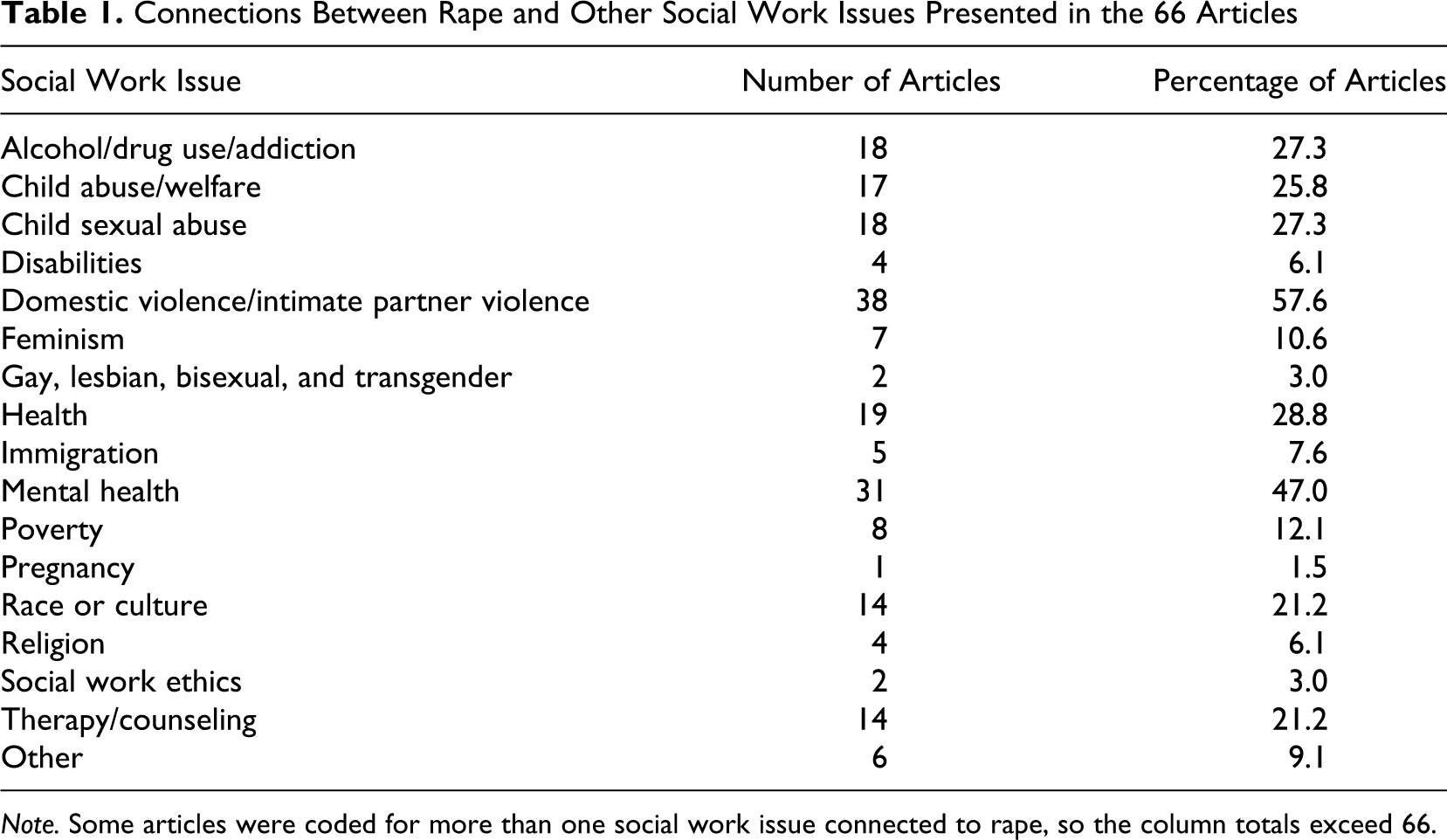
A total of 62 articles (94%) made a connection between rape and another central issue in social work practice (see Table 1 ). The most frequent connection was with domestic violence (n = 38), where rape was typically discussed as one form of violence used by an abuser. Most commonly, these articles discussed the impact of sexual, physical, and emotional abuse collectively without paying attention to the specific impact of and trauma associated with rape. For example, Engstrom, El-Bassel, Go, and Gilbert (2008) sampled 416 women in a methadone treatment program and found that women who were currently being abused by their partners had greater PTSD, depression, and psychological distress. However, the women were asked whether they had been physically or sexually abused in the past 6 months, and the categories were collapsed to indicate “abuse” or “no abuse” without differentiating between physical and sexual abuse. The authors provided recommendations for incorporating the assessment of trauma and intimate partner violence into methadone treatment programs, but not assessment specific to rape, which was characteristic of most of the articles on domestic violence that we reviewed.
Connections Between Rape and Other Social Work Issues Presented in the 66 Articles
Note. Some articles were coded for more than one social work issue connected to rape, so the column totals exceed 66.
In addition to domestic violence, rape was connected to other social work issues in the articles, including drug and alcohol use, mental health, physical health, and child sexual abuse (see Table 1). Despite the connection between rape and other social work issues, the provision of implications for practice was not always consistent, since many articles lacked follow-up information about how to incorporate sexual violence into screening, assessment, or treatment. Only 32 of the 66 articles provided implications for practice that were specific to rape, and only 13 of the 32 were directed explicitly to social workers. As may be expected, the articles that treated rape as a primary or moderate focus were more likely to present implications for practice than those that treated it as a minor focus.
The majority of articles (n = 41) were client focused, with almost an even number of practitioner- and macro-focused articles (see Table 2 ). The client-focused articles were more likely to include rape as a primary focus than were the practitioner-focused and macro-focused articles.
Articles with a Client, Practitioner, or Macro Focus (N = 66 articles)

Client-Focused Articles
A total of 41 articles (62.1% of all the articles) were coded as client focused. The themes explored within the client-focused articles included the impact of rape on clients, screening and clients' disclosure of rape, and interventions for survivors.
Impact of rape on clients
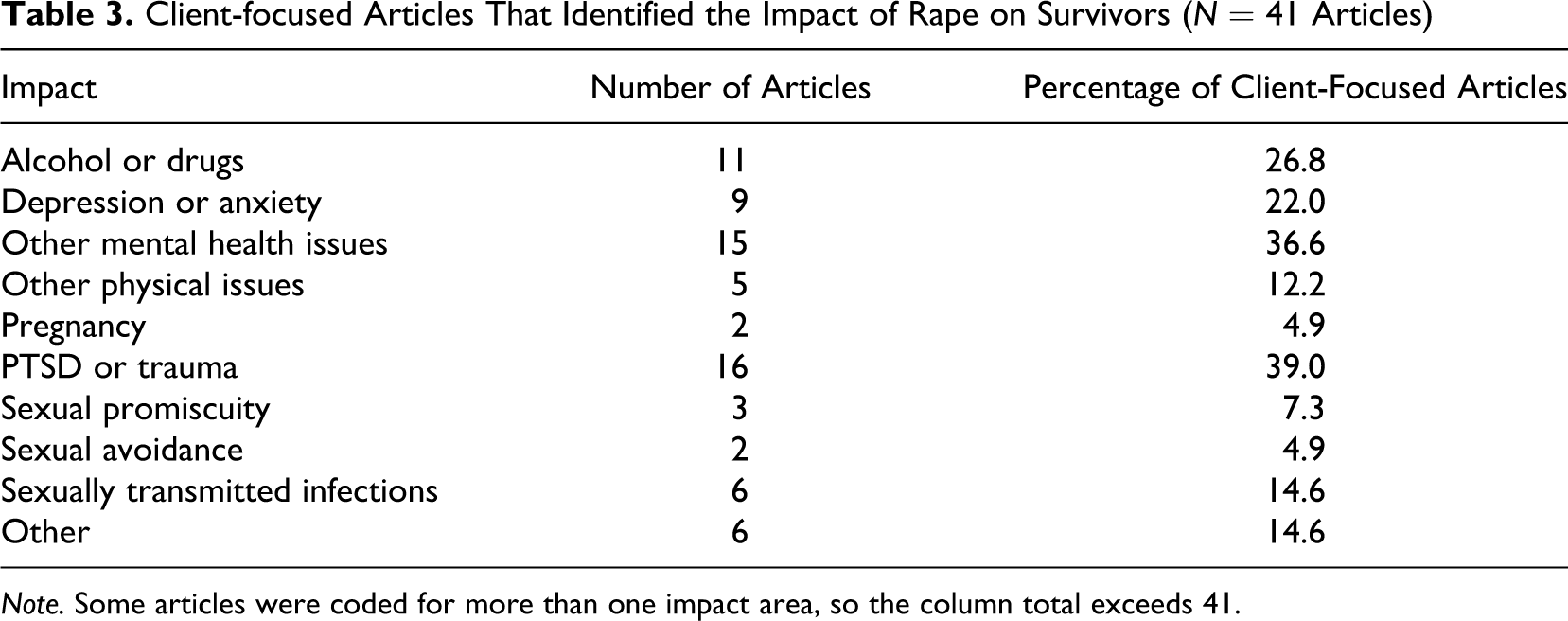
Of the 41 client-focused articles, 31 included discussions of the impact of rape on survivors (see Table 3 ). The most commonly cited impact was PTSD, which was consistently identified as a problem for survivors that not only severely impaired their functioning in a number of domains, but increased their propensity for other mental health problems, such as substance abuse and depression. The impact of rape on survivors was often described as complex and variable and as compounded by other forms of abuse. A subset of articles explored the sequelae of childhood and adult sexual abuse and found that those who experienced both consistently demonstrated poorer outcomes (Gilbert, El-Bassel, Schilling, & Friedman, 1997; Macy, 2007; Weisbart et al., 2008).
Client-focused Articles That Identified the Impact of Rape on Survivors (N = 41 Articles)
Note. Some articles were coded for more than one impact area, so the column total exceeds 41.
Screening and clients' disclosure of rape
Despite the identification of the severe and traumatic impact of rape on survivors, screening for sexual violence was mentioned by only 19 of the client-focused articles as an important tool for identifying and subsequently treating survivors of rape. Articles that addressed screening often explored the practitioner’s response, and numerous problems were cited. For example, Rountree, Pomeroy, and Marsiglia (2008) surveyed 21 domestic violence shelters and found that while 90% of them screened for sexual violence, service providers did not follow up with resources for HIV/AIDS testing or treatment.
Some client-focused articles (n = 14) addressed the process of a client disclosing that she was raped. Of those articles, topics of focus included barriers to disclosure for survivors, effective responses by practitioners to clients' disclosure, safety concerns for disclosing, and developing organizational protocols for responding to clients' disclosures of rape.
Interventions for survivors
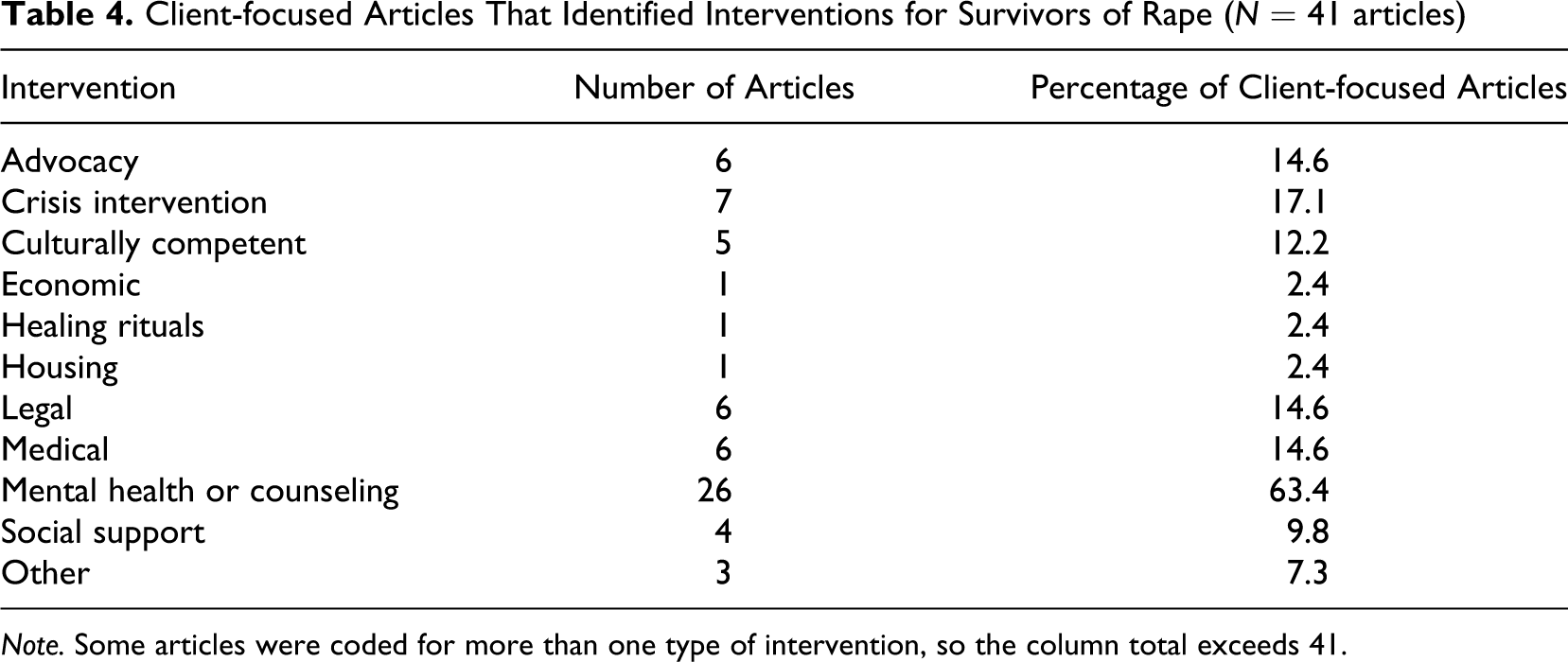
Identifying effective interventions for survivors of rape was a common theme of the client-focused articles. Of the 27 articles on intervention, 26 included some focus on mental health counseling as essential for survivors. Russell and Davis's (2007) important work reviewed 41 studies on treatment for sexual assault and found that exposure and cognitive behavioral interventions were the most successful; however, these authors cited a number of concerns with the quality and strength of the research and emphasized the need for further, more rigorous studies. Other interventions covered in the articles included crisis intervention, advocacy, and medical or legal assistance.
Only five of the client-focused articles addressed the delivery of interventions in a culturally competent and specific manner. For example, Low and Organista (2000) discussed the cultural factors that may shape the experiences of Latina survivors of sexual assault and called for social workers to provide culturally competent services to meet their needs (see Table 4 ).
Client-focused Articles That Identified Interventions for Survivors of Rape (N = 41 articles)
Note. Some articles were coded for more than one type of intervention, so the column total exceeds 41.
Practitioner-Focused Articles
Of the 13 articles (19.7%) that were identified as practitioner focused, 10 addressed the need for increased support for social workers in working with survivors of rape through training or supervision. The impact of working with rape survivors on practitioners and the potential for vicarious traumatization was addressed in only four articles, two of which had a primary focus on rape. Clemans (2004) highlighted the increased risk of vicarious traumatization for social workers who are engaged in rape crisis work with survivors of sexual violence and called for the profession to address the unique needs of this group.
Only two of the practitioner-focused articles talked about including content on rape in social work education, with only one article specifically discussing the need to incorporate it into the formal curriculum, and that article was geared toward undergraduate students (Carey, 2007). No articles specifically addressed the need to include content on sexual assault in the MSW curriculum.
Macro-Focused Articles
Twelve articles were identified as macro focused, representing 18.2% of all the articles. The focus of the majority of these articles was the societal-level factors that contribute to sexual violence, with seven identifying the role of sexism and gender roles; the media/pornography and racism were each linked with violence against women in one article each.
The problematic connection between rape and other institutions and systems, including the legal and judicial systems, was a common theme in the macro-focused articles. For example, Sullivan and Hagen (2005) reported the results of focus groups with survivors (of both domestic violence and rape) and found multiple experiences of revictimization by survivors that were due to various systems, such as the child protection, health care, medical, and legal systems.
The role of laws or policies in the experience of survivors was explored by a number of macro-focused articles in various ways, including the enforcement of laws, the evolution of laws, the history of the feminist/antirape movement, and the content of state laws. No articles discussed federal legislation, such as the landmark Violence Against Women Act, and few articles called on social workers to take action to influence policies related to rape. Only three articles were identified as including an explicit call to action for social workers to become involved with the issue of rape, and they were all more than 20 years old (Andrews, 1988; Scheyett, 1988; Stout, 1989).
Another subset of macro-focused articles (n = 6) explored issues related to researching the topic of rape, including methodological and ethical issues. A common theme was the importance of carefully selecting methods that will not revictimize survivors (Brzuzy, Ault, & Segal, 1997). Recommendations included the use of person-centered models (Macy, 2008; Nurius & Macy, 2008), as well as participatory action research (Mason & Clemans, 2008) and forging collaborations among researchers, practitioners, and survivors of domestic violence and rape to set research agendas in the field (Bell et al., 2004).
Discussion and Implications for Practice
The research literature is a critical resource for social work practitioners and researchers and serves to shape the profession’s focus. The overall low number of articles that were available for this study is an indication in and of itself that the issue of rape in adulthood has not been a priority for the profession. A total of 66 articles were identified as addressing rape, with only 23 including a primary focus on the issue. By comparison, in much shorter periods, Van Voorhis and Wagner (2002) identified 77 social work articles that addressed gay and lesbian issues between 1988 and 1997, and Pyles and Postmus (2004) found 105 social work abstracts that addressed domestic violence between 1985 and 2000. On the basis of the sheer number of rape survivors who are social workers' clients, the argument can be made that most social workers in direct practice will encounter survivors of sexual assault in their practice and therefore that the professional social work literature should more effectively address this issue.
Rape and Domestic Violence
An important finding of the study was that rape is often framed as a form of domestic violence, which has both positive and negative implications. On one hand, it is encouraging because it is essential that women who have experienced domestic violence be assessed for sexual violence, along with other forms of abuse, to help us understand their experiences and needs. However, although domestic and sexual violence certainly overlap, there are also unique aspects of rape that must be considered and warrant a greater presence in the literature. The impact of sexual trauma presents its own challenges, manifested in unique ways and needing different types of treatment and recovery processes that can be integrated with those that address other forms of domestic violence (Macy et al., 2009; O’Sullivan & Carlton, 2001). For example, Próspero and Vohra-Gupta’s (2008) study of 200 college students found that the students were significantly more likely to seek mental health services for psychological or physical abuse than for sexual assault, even though half the sample reported experiences of sexual assault. The authors concluded that “sexual violence may elicit different types of help-seeking behaviors than physical and psychological violence” (p. 385). Their conclusion emphasizes the urgent need for social workers to recognize the difficulties that clients may have in disclosing sexual violence and to develop effective, sensitive, and safe ways to gather this information.
In addition, our review highlighted the glaring absence of articles focused on the experiences of women who have been raped in contexts other than domestic violence. A substantial research literature exists on acquaintance rape, but, for the most part, it does not appear in the social work literature. The contextual factors of women experiencing sexual violence within and outside domestic violence contexts are likely quite different, yet this has not been addressed in the literature.
Screening for Rape in Practice Settings
In addition to domestic violence, many articles addressed sexual assault as connected with other issues that are central to the social work profession, such as mental health, alcohol and drug use, child abuse, physical health issues, poverty, and immigration. This connection, too, has mixed implications. The fact that rape has been consistently found to have a significant link with so many other issues that clients face is an essential finding, since it underscores the interconnections between rape and other issues that are central to the profession. It suggests that sexual violence should be consistently addressed as a contributing factor to clients' presenting issues, with proper screening and assessment integrated into all social work settings. However, fewer than half the articles even mentioned the importance of screening or how to accomplish it in a safe way for survivors. This is a critical opportunity to provide survivors with much-needed services and for practitioners to gather a fuller picture of their clients' experiences, yet is clearly being missed by many in the profession. It is long overdue for social workers to screen clients routinely for sexual violence, regardless of the setting, and to know how to respond to survivors safely and properly. Other disciplines, such as nursing and health care, are further advanced in this area, and their knowledge can be adapted and applied to social work.
Culturally Competent Responses to Rape
The dearth of articles on developing culturally competent responses to survivors of rape was astounding. Only five articles addressed the needs of particular ethnic groups, which is sorely insufficient. Using an ecological perspective, we know the prominent role of culture in the lives and experiences of individuals and therefore can appreciate the important function it would play in the lives of survivors of rape. Culture may be arguably even more salient for sexual violence, since cultural norms surrounding sexual behavior and gender norms are often powerful and varied. This cultural framework will have a direct impact on the resources available to survivors and their willingness to access services. Immigrant women, especially those who are undocumented, may be especially isolated and fear deportation for engaging with formal social services systems (Raj & Silverman, 2002). Research has also found that responses to the symptoms of sexual trauma, such as PTSD, are likely affected by culture and thus that it is incumbent on practitioners to find culturally competent avenues to engage clients in treatment (Zayfert, 2008). In addition, culture is defined not only by ethnicity but may also include the experiences of those in the gay, lesbian, bisexual, and transgender and disability communities, as well as in other groups, such as the military, all of whom have unique experiences that need to be further understood and included in research.
Impact on Practitioners
The lack of articles on the role of social work practitioners in responding to rape was glaring. Given the intensity of working with survivors of sexual violence, the appearance of only five articles on vicarious traumatization is clearly not enough. Further research is needed on the impact of engaging in this work, as well as on evaluating strategies to assist social workers in the field and to prevent vicarious traumatization. In addition, only two articles addressed the presence of rape in the social work curriculum. Information is needed on how to infuse information on sexual violence effectively into the curriculum, to understand what competencies are associated with addressing sexual violence, and to evaluate methods and approaches to equip social workers with the tools they need needed to address the issue of sexual violence in diverse settings.
Ecological Perspective
The lack of an ecological perspective that looked beyond treating the individual survivor was striking, with only two articles mentioning an ecological framework. With social change as a tenet of the social work profession, efforts to influence the environmental, structural, and systemic factors that support or permit sexual violence are essential yet absent. Few articles addressed the need to prepare social workers to understand the significance of changing the environment that supports rape and other forms of violence. Stout’s (1991) article was an exception, stating that “social work educators and practitioners have an obligation to educate themselves and others about the multifaceted issues that emerge to create an environment in which male violence against women is allowed to persist” (p. 306).
As part of the ecological perspective, the lack of policy articles was another concern, since practitioners need to be informed of state and federal legislation as a resource and to be able to identify strengths and weaknesses of the legislation. For example, laws that define what constitutes rape vary by state, so it is important for social workers to be aware of the laws in order to help navigate clients through the legal system. The Violence Against Women Act is a major piece of federal legislation that has been reauthorized three times since it was originally passed in 1994 and has major implications for social workers, including important resources for clients. Although it may be mentioned in the domestic violence literature, it did not appear once in the articles on sexual violence.
Limitations
Several limitations must be considered when interpreting the findings of the study. First, although we attempted to conduct a comprehensive literature search, there were likely articles that addressed social work and rape that were not included in the study because of the search criteria. For example, if a social work practitioner wrote an article and was not associated in some way with a department of social work, the articles would not have appeared in the search. Although parameters were needed to help guide the study, they likely excluded certain articles that may have contained significant contributions to the field.
Second, a handful of articles were not included because of an exclusive focus on offenders or prevention. Although these topics were not in the scope of the study, they are relevant and important ones that need further attention and review in the social work literature. Third, some articles did not fall neatly into the categories in our coding scheme. For example, some articles had both a client and a practitioner focus, yet for the purposes of this analysis, were judged to have one focus more than the other. The need for some mutually exclusive categories did not allow for multiple or overlapping themes for some of the questions.
Despite these limitations, this content analysis produced a number of important findings and guidance for future research directions. As demonstrated by this review, the issue of adult rape is not yet adequately addressed in the social work literature. Social workers have a number of important roles to play in assessing, treating, and responding to sexual assault on multiple levels of the social ecology, which should be integrated more prominently into research publications.
Footnotes
Acknowledgment
The authors would like to thank Kristine Aguilar, Judy Postmus, Corinne Warrener, Bonnie Carlson, and Deepa Naik for their assistance with this project.
The authors declared no potential conflicts of interest with respect to the research, authorship, and/or publication of this article.
The authors received no financial support for the research, authorship, and/or publication of this article.