




Abstract
Since the 1960s, Privately Owned Public Space (POPS) has been studied as a significant development in urban space provision. Through a review of key studies (1980–2023), this paper traces how POPS scholarship has changed from fundamental critiques of privatization to evidence-based assessment of spatial practices. The analysis reveals three phases in the literature's development, demonstrating a shift from early concerns about intrinsic problems of private control to accepting POPS as a distinct type of public space requiring its systematic evaluation. The geographical expansion of research has explored how different cultural, institutional, and urban contexts shape the implementation of POPS and scholarly approaches to studying them.
Introduction
Privately Owned Public Spaces (POPSs) have been discussed as a significant component of urban public realm provision. They represent a complex intersection of public interest and private development through regulatory frameworks offering development incentives distinct from privately owned and managed facilities such as airports, shopping centers, or transportation hubs (Carmona 2010; Lynch and Hack 1984; Kayden 2000). POPSs are deliberately created to serve as public amenities, with specific public access and use requirements embedded in their development agreements (Loukaitou-Sideris and Banerjee 1993; Kayden 2000; Schmidt, Nemeth and Botsford 2011). The practice of using private-sector land and investment to create POPS originated in 1961 with New York City's zoning resolution, which offered floor area bonuses to developers providing public spaces within private developments (Kayden 2000). Similar models subsequently developed across American cities and internationally, generating various POPSs (Huang and Franck 2022). The implementation of POPS varies significantly across urban contexts, reflecting distinct local regulatory frameworks and development patterns.
The discourse on POPS exists within broader theoretical debates about public space transformation and urban governance, particularly in the context of neoliberal urbanism that has reshaped cities since the 1980s. The theoretical understanding of public space has shifted from traditional definitions based on state ownership and control (Madanipour 2010) to more complex interpretations that accommodate various forms of provision and management. While theorizations of public space have traditionally emphasized these spaces’ role in fostering democratic dialogue and civic life (Habermas 1989), recent scholarship recognizes that publicness exists along a spectrum rather than as a binary state (Langstraat and van Melik 2013; De Magalhaes and Frere Trigo 2017). Within this spectrum, POPS represent more than just a pragmatic solution to public space provision; they signify a fundamental shift in how cities conceptualize and manage their public realm under market-driven imperatives (Carmona, de Magalhaes and Hammond 2008; Leclercq, Pojani and van Bueren 2020). This neoliberal approach has reconfigured public spaces to prioritize safety, surveillance, and tidiness, often at the expense of accommodating diverse public behaviors and demographics (Low 2006; Németh and Schmidt 2011), while establishing POPS as a distinct type of space characterized by their regulatory origins, intended civic function, and specific management requirements (Carmona and Wunderlich 2012).
The scholarship exploring POPS reflects this tension between market efficiency and public value. Early critics viewed these spaces as symptomatic of the “end of public space” (Mitchell 1995) or an “illusion of public space” (Banerjee 2001). They argued that privatization fundamentally undermines the democratic and social functions of public space (Sorkin 1992). These scholars contend that market-driven management approaches lead to the homogenization of urban landscapes, reducing their diversity, vitality, and accessibility (Minton 2006; Madanipour 2003). However, more recent scholarship has challenged this binary opposition between public and private provision. Rather than witnessing the “death” of public space, more recent researchers suggest these transformations indicate shifts in form, function, and governance that reflect evolving societal needs (Carmona 2010; De Magalhaes and Frere Trigo 2017; Madden 2010). This perspective is supported by empirical studies demonstrating how properly designed and managed POPS can contribute positively to urban public life (Huang and Franck 2018; Leclercq, Pojani and van Bueren 2020; Lee and Scholten 2022; Mohammadi and Stevens 2024). The relationship between publicness, ownership, and management in POPS has become a key focus in numerous studies, necessitating a thorough analysis of both theoretical frameworks and practical implications.
This paper reviews and synthesizes POPS literature to understand how scholarly discussions and perspectives have changed over time. The review has three main objectives. First, it maps the trajectory of academic discourse from early fundamental critiques of privatization to more recent systematic assessments of POPSs’ spatial qualities and publicness. Second, it synthesizes and categorizes how different scholars have analyzed and evaluated design and management practices in POPS, examining how various theoretical and empirical studies have approached these aspects across different cities and countries. Third, it explores how the literature has addressed the influence of local conditions and regulatory frameworks on POPS implementation, revealing both common themes and contextual variations in different geographical settings. Through this comprehensive review of POPS literature, the paper traces the shifts in academic perspectives and research approaches, providing valuable insights for future studies by identifying key shifts in scholarly focus, methodological developments, and research priorities across different geographical contexts.
Methodology
To understand how POPS literature has evolved during the past five decades, we systematically analyzed scholarly work from 1980 to 2023, focusing on both theoretical developments and empirical findings across different geographical contexts. We searched for such work in key urban studies and planning databases, including Web of Science, Scopus, ScienceDirect, Taylor and Francis Online, JSTOR, SAGE Publications, Wiley Online Library, and Google Scholar. The initial search utilized a carefully constructed set of keywords, including “Privately Owned Public Spaces,” “POPS,” “public space privatization,” “Design and management of POPS,” “social diversity in POPS,” “POPS accessibility,” “publicness in POPS,” “control practices in POPS,” and “POPS and urban governance.” This search was supplemented by backward reference searching (snowballing) to identify influential works, particularly older foundational studies, that laid the groundwork for POPS research.
We followed strict inclusion and exclusion criteria for the selection of literature to ensure the quality and relevance of the reviewed materials. For inclusion, studies needed to meet several key requirements. First, they had to be academic publications of recognized scholarly quality, focusing specifically on POPS rather than general public space discussions. This included peer-reviewed journal articles, academic books, and book chapters from established publishers, and doctoral dissertations that contributed substantial original research to the field. The review prioritized empirical studies demonstrating clear methodology and findings, and theoretical works addressing POPS frameworks and concepts. Case-based studies were included when they provided detailed analysis of POPS implementation and outcomes. Given the international scope of the review, only English-language publications were considered. Additionally, studies needed to substantially examine design, management, or policy aspects of POPS to be included in the review. Several types of works were systematically excluded from the review. Studies that only tangentially mentioned POPS within broader public space discussions were omitted, as were opinion pieces or commentary lacking empirical or theoretical contributions. To maintain academic rigor, the review excluded conference abstracts, master's degree theses, and incomplete studies. Works examining broader privatization trends without specific attention to POPS were also excluded.
This process resulted in a final collection of 57 sources, comprising 21% books and book chapters, 68% academic journal articles, and 11% PhD theses. The selected literature spans from 1980 to 2023. Table 1 provides a comprehensive summary of the studies analyzed in this review, documenting their geographical focus and primary contribution to the field.
Key POPS Literature (1980–2023).
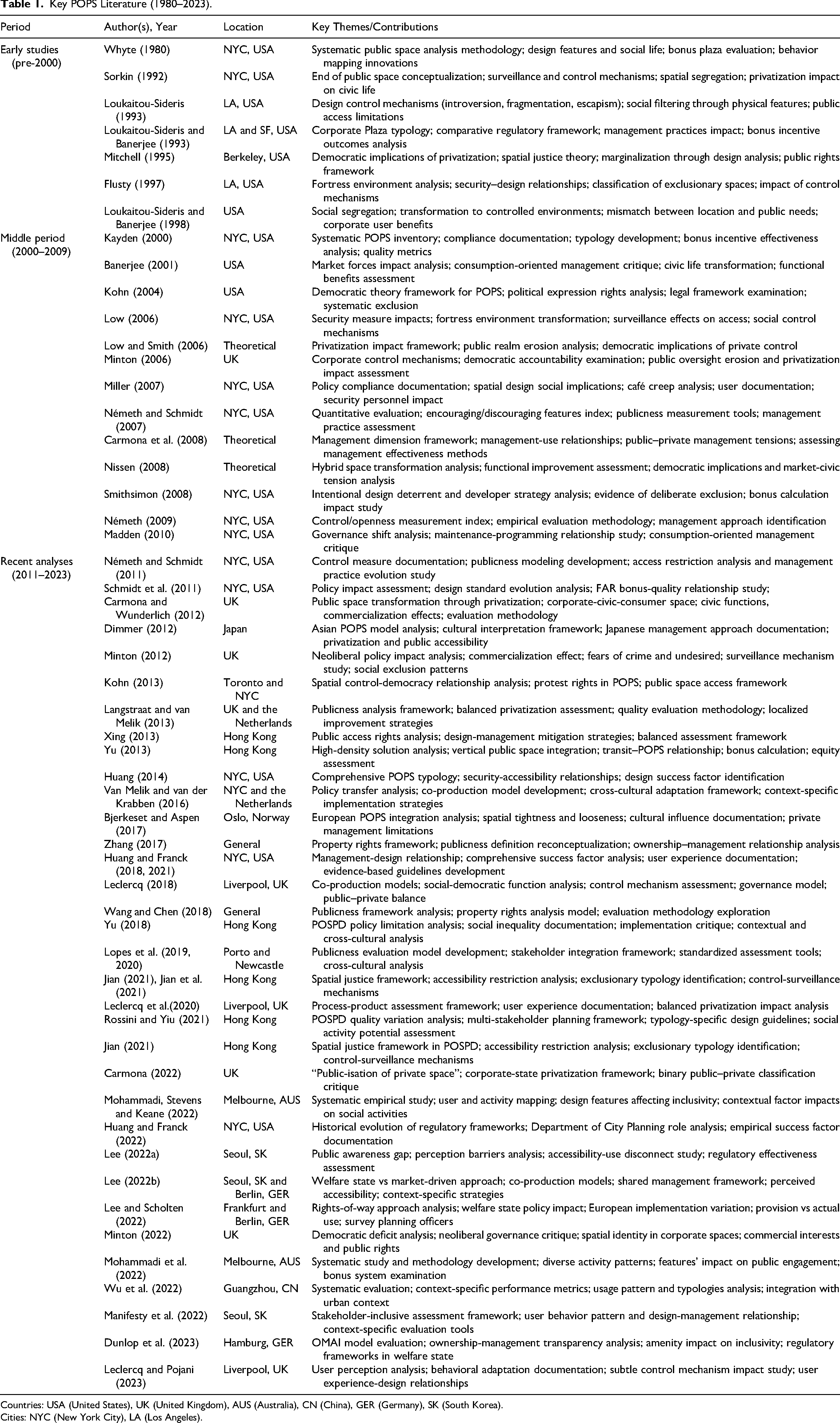
Countries: USA (United States), UK (United Kingdom), AUS (Australia), CN (China), GER (Germany), SK (South Korea).
Cities: NYC (New York City), LA (Los Angeles).
Following literature selection, we conducted qualitative thematic content analysis to trace the shifts in POPS scholarship across the three periods. Our approach focused on identifying how researchers framed POPS-related problems, research questions, and evaluative criteria within each period. Dominant themes were established through iterative reading and comparative analysis. A theme was classified as “dominant” when it served as the primary analytical focus or theoretical framework in the majority of studies within that period. For example, “physical control mechanisms” emerged as one of the dominant themes in early studies because scholars structured their analysis around documenting and critiquing these mechanisms, not simply mentioning them in passing. The identification of periods was based on a qualitative assessment of changing research orientations. We identified shifts from early critical-theoretical approaches emphasizing privatization's inherent problems, to systematic empirical evaluations, to recent context-sensitive approaches examining geographic variations. This classification considered each study's central analytical orientation while recognizing that multiple perspectives coexisted within each period. This approach enabled us to identify substantive shifts in scholarly discourse rather than simply documenting chronological changes.
The Shifts in POPS Literature: From Critical to Evidence-Based Assessment
The academic discourse on Privately Owned Public Spaces (POPS) was initiated in 1980 through Whyte's pioneering study of New York City's bonus plaza program, establishing the first systematic analysis of these spaces’ public use and design effectiveness. Over the subsequent four decades, POPS literature has undergone a fundamental transformation in both theoretical orientation and methodological approaches. This transformation traces three distinct phases: early scholarship (pre-2000) that critiqued privatization and documented control mechanisms; a middle period (2000–2010) that developed the first systematic evaluation frameworks; and recent research (2011–2023) that examines geographical variations in implementation while moving beyond binary public–private critiques. Although many studies from each period draw upon earlier critiques and concepts, they collectively reveal a broader reorientation in urban scholarship. Since 1980, research has shifted from theoretical critiques grounded in political economy toward evidence-based assessments of spatial practices that acknowledge the complexities of urban public space provision.
Early Studies (pre-2000): Fundamental Critiques Documenting POPSs’ Physical Control Mechanisms
Early POPS research began during a period of intense debate about urban privatization in the 1980s and 1990s, when critical urban theorists were examining how market forces were reshaping public spaces (Harvey 1989; Sorkin 1992; Zukin 1995). In this context, scholars approached POPS as symbolic cases of broader transformations in urban governance and public realm management (Mitchell 1995; Loukaitou-Sideris and Banerjee 1998). Our review identified three dominant themes in this foundational period's literature: physical control mechanisms, design practices for social filtering, and critiques of commercialization.
The fundamental critique during this period centered on how social control over spaces was manifested through privatization mechanisms. This was discussed as a manifestation of broader social control and exclusion processes in urban space. The privatization of public space presented fundamental challenges to earlier theoretical frameworks for public spaces (Sorkin 1992; Sennett 1992). These critiques targeted the inherent tensions in allowing private actors to create and manage spaces intended for public use. Because they addressed the structural consequences of privatization itself, their arguments remain relevant to most POPSs, including many developed in later decades. More recent literature acknowledges these intrinsic concerns but treats them as a historical foundation rather than the main focus of analysis.
Scholars argue that POPSs are often highly regulated environments that impose boundaries and restrictions on users’ interactions. For example, every interaction is carefully planned (Mitchell 1995), contributing to the cultivation of a specific code of public behavior (Loukaitou-Sideris and Banerjee 1998). The literature highlights instances where POPSs specifically prohibit various activities and enforce strict behavioral rules that effectively proscribe other actions (Sorkin 1992; Flusty 1997; Low 2006). Surveillance, policing techniques, and behavior-constraining design elements in POPSs are shown to prioritize security concerns over the potential for social interaction (Loukaitou-Sideris and Banerjee 1998; Kayden 2000). Another significant issue underscored in the literature is the diminishing of public rights and the concurrent rise of private-sector influence in decision-making about the public realm. This erosion of public rights is manifest on multiple scales, ranging from excluding specific individuals and behaviors to the broader context of city management (Loukaitou-Sideris and Banerjee 1998). There have been comprehensive analyses of the lack of social freedom and opportunity due to prohibitions and restrictions on people using POPSs (Loukaitou-Sideris 1993). At the city-wide scale, social surveillance as a collective responsibility is replaced by private surveillance and policing in POPSs and other privately owned spaces (Madden 2010).
Another key concern in the literature is that POPSs are often treated as private domains rather than integral parts of the public sphere. These spaces tend to position the public as temporary visitors rather than welcomed participants in urban life (Kayden 2000; Banerjee 2001). Scholars frequently describe them as nominally public areas embedded within private developments, surrounded by commercial or corporate functions that reinforce their limited openness (Miller 2007). Some literature even compares them to lobbies for office towers and hotels, with stylish and decorative materials (Loukaitou-Sideris and Banerjee 1998; Miller 2007), creating autonomous designs fragmented from their diverse urban context (Loukaitou-Sideris and Banerjee 1998; Minton 2006), with far-reaching impacts on urban public life (Miller 2007; Dovey 2016). When encountering such spaces, individuals may feel obligated to make purchases, such as food or beverages, to access the facilities (Kayden 2000; Xing 2013; Wang and Chen 2018), effectively making access conditional on financial capacity (Flusty 1997; Miller 2007). Banerjee (2001) refers to the words of Charles Moore (1997, 57), “You have to pay for public life,” resulting in POPSs being predominantly frequented by higher-income individuals and middle-class workers, while lower-income users are notably underrepresented. POPSs are often viewed as representative of market-driven urbanism, planned, designed, and packaged to serve a specific, narrow clientele and emphasizing commercial consumption (Loukaitou-Sideris and Banerjee 1993; Kayden 2000; Kohn 2013).
The critiques outlined above predominantly focus on the ownership-related issues of POPSs, which shift the control of public spaces and activities from the public to private entities and trade off some rights between the public and private. Consequently, POPSs have been characterized in terms of the diminution (Kayden 2000), illusion (Banerjee 2001), and erosion (Low 2006) of public space. Mitchell (1995) characterizes privatization as the “end of public space,” arguing that privatization fundamentally undermined democratic urban life. These fundamental critiques manifest in various ways in the literature of POPSs, from questions of democratic access versus private control (Mitchell 1995) to concerns about social diversity being compromised by commercial homogenization (Sorkin 1992; Zukin 1995). Such perspectives were grounded in classical public space theory, drawing on Haberma'’s (1989) concept of the public sphere and Lefebvre's (1991) work on the social production of space. They also expressed a more fundamental pattern of the erosion of public rights by privatizing public spaces. They described an increasing shift of decision-making authority from democratically elected representatives to business interests (Loukaitou-Sideris and Banerjee 1998; Sorkin 1992), impacting broader urban dynamics as social surveillance gave way to private policing and public authority over urban space diminished (Mitchell 1995; Sennett 1992).
Scholars in this period also described how physical design and management practices regulated social interactions within these spaces, leading to autonomous environments that were disconnected from urban contexts. (Mitchell 1995). Loukaitou-Sideris (1993) identified key design characteristics: introversion, fragmentation, escapism, orderliness, and design rigidity. Whyte's (1980) study showed how POPSs were often visually inaccessible, blocked off by blank walls. Flusty (1997) characterized POPSs as slippery and jittery spaces where security guards and cameras prevented the spontaneity of public life. Much of the early discussion on design and user exclusion draws from the seminal studies of Loukaitou-Sideris and Banerjee (1993, 1998). They portray POPSs as fragmented, inward-looking spaces designed to be autonomous from their surroundings (1998, 11). Their earlier research (1993) showed that such environments edited out everyday life, excluding undesired users and activities while accommodating commercial functions and office workers. Together, these studies demonstrate how design operates as a subtle mechanism of social filtering. The critiques of private control over public spaces extended beyond physical design to also encompass management practices, with studies noting how security personnel and surveillance systems worked alongside architectural elements to restrict public use (Flusty 1997; Loukaitou-Sideris and Banerjee 1998).
While predominantly critical, this early scholarship period established crucial frameworks for understanding private control in public space, laying the groundwork for the systematic evaluation approaches in the following decades. Literature in this period focused on documenting control mechanisms, critically examining how design choices served broader social control and exclusion purposes. This perspective significantly influenced the direction of subsequent research, leading to more systematic approaches to evaluating POPS design and management practices.
Middle Period (2000–2010): Initial Systematic Assessment of POPS
Critiques of the problems intrinsic to POPS continued during this period. However, this period marked a significant shift toward systematic evaluation methods in POPS scholarship rather than just articulating their intrinsic problems. Kayden's (2000) comprehensive study of New York City's POPS program initiated this change by empirically documenting implementation outcomes, revealing that 41% of POPSs were non-compliant with public access requirements. Banerjee (2001) examined POPSs through both physical design and social dimensions, noting that public life increasingly occurs in private settings. Such empirical focuses were continued by Németh and Schmidt's (2007) development of a quantitative framework considering multiple dimensions: laws/rules, surveillance/policing, design/image, and access/territoriality.
Literature in this period also emphasized how POPS management practices affected social diversity and interaction. Kohn (2004) presented privatization as a severe threat to democracy and civic life, identifying how POPS systematically undermined political speech and assembly. Miller (2007) observed how minor changes in security protocols and commercial programming could impact public access and social interaction patterns. She highlighted how post-9/11 security concerns became a legitimizing factor for increased private control, even when physical changes to these spaces remained minimal. Low (2006) and Németh (2009) focused on how surveillance and security practices prioritized control over social interaction. Németh (2009) developed an empirical evaluation methodology with an index to measure control/openness, and identified specific management approaches used in POPSs. Meanwhile, Nissen (2008) analyzed the transition to hybrid spaces, acknowledging some functional improvements while raising concerns about democratic implications. Other critiques examined POPSs’ programming and private events as changes that restricted public access without creating obvious physical barriers. This challenged earlier assumptions about the relationship between design and control. Smithsimon (2008) found that developers intentionally designed POPS to be uninviting, challenging previous assumptions that their design failures were unintentional.
The geographic spread of POPS research brought new insights during this period. Although the majority of studies during this period continued to emerge from the US, particularly New York City, this phase marked the emergence of geographically diverse perspectives. North American scholarship continued to concentrate on vertical development and bonus-plaza mechanisms, exploring how zoning incentives shaped design and compliance. In contrast, new European research, exemplified by Minton's (2006) work in the United Kingdom, examined how privatization was reshaping local democracy and urban culture. It highlighted the growing influence of corporate interests in decision-making about the wider public realm and raised early concerns about the erosion of civic accountability in urban governance. Work by Carmona, de Magalhaes and Hammond (2008) suggested that privatization was not the death of public space, but a change in its form, function, and appearance. They proposed new frameworks for understanding public space management dimensions through a three-way partnership model between public, private, and community sectors. These studies reflected early responses to different national planning cultures and governance systems, but remained primarily focused on documenting local privatization processes rather than engaging in systematic cross-national comparisons. Critical perspectives remained important during this period, but they evolved to offer more sophisticated analyses of POPS’ social implications. Madden (2010) acknowledged improvements in maintenance and programming in POPSs while critiquing their consumption-oriented management. These analyses laid important groundwork for understanding how design and management practices could either enhance or constrain public use and engagement in POPS, setting the stage for more comprehensive evaluations in subsequent decades.
Recent Analyses (2011–2023): Global Perspectives and Complexity
Recent scholarship reveals a more sophisticated understanding of POPS that moves beyond ownership and management critiques of privatization, reflecting multiple concurrent developments that fundamentally transformed the field. A key theoretical reorientation is the recognition that ownership structure alone does not determine publicness in urban spaces (Carmona 2022; De Magalhaes and Frere Trigo 2017). This period saw POPS research significantly influenced by broader economic and social shifts, particularly the 2008 Global Financial Crisis, which led to a reevaluation of private roles in public space provision as municipalities faced reduced funding (Banerjee and Loukaitou-Sideris 2011).
Post-2010 scholarship reflects internationalization of POPS research, corresponding with the global diffusion of development incentives as a governance approach and increased privatization across diverse political economies. While the first European research emerged during the middle period, the most recent period marks a qualitative shift toward global comparisons. Asian studies represent 32% of empirical research post-2011 compared to zero in earlier periods, while North American studies declined from 80% (middle period) to 21% (recent period). Rather than a simple increase in non-US case studies, this geographic diversification enabled methodological shifts toward interrogating how cultural, institutional, and spatial differences shape POPS implementation and perception, generating theoretical contributions distinct from earlier North American frameworks.
Building on frameworks from the 2000s, scholars significantly reframed the theoretical understanding of privatization's impact. Rather than viewing this as the death of public space—as argued in early critiques—researchers conceptualized it as a transformation in form and function requiring new analytical approaches (Carmona and Wunderlich 2012; Carmona 2022). This theoretical shift was reinforced by empirical research, much of it originating from doctoral dissertations that later evolved into multiple journal publications. Together, these studies demonstrate how POPS’ success depends on a network of interrelated design, management, and contextual factors (Yu 2013; Huang 2014; Leclercq 2018; Jian 2021; Mohammadi 2021; Bjerkeset 2021). Moreover, the assessment methodologies for POPS have become increasingly advanced and empirically grounded, including more criteria and indexes specific to POPS than borrowing from other types of public spaces frameworks. Németh and Schmidt (2011) enhanced their earlier quantitative framework for measuring publicness in privatized spaces. Several scholars have expanded upon these evaluation approaches. For example, Langstraat and van Melik (2013) developed the OMAI model (Ownership, Management, Accessibility, and Inclusiveness) to systematically evaluate POPS. Lopes, Cruz and Pinho (2020) developed the Publicness Evaluation Model (PEM), integrating multiple dimensions and incorporating urban life, physical design, human connection, and management practices.
POPS research in this period began to examine a wider range of urban and geographic contexts, with more studies in Asia, Europe, and Australia. Asian scholarship revealed distinctive typologies, challenges, and solutions for POPSs based on different local contexts. Several studies in Asian cities (Dimmer 2012; Xing 2013; Yu 2013; Lee 2022b) documented how their extremely high density and land scarcity led to diverse POPS solutions. For instance, Rossini and Yiu (2021) examined how extreme density necessitates POPS-related solutions like elevated walkways. Also, Jian, Chan and Yao (2021) identified distinct typologies supporting differing use patterns. Another emergent area of analysis during this period was the role of information. Jian, Chan and Yao (2021) highlighted how information access problems can hinder POPS’ effectiveness as much as physical design issues, and demonstrated that lack of knowledge about locations, access rights, and amenities leads to underutilization, particularly among disadvantaged groups. Several studies revealed that POPS’ exclusion and underuse often result not from design deficiencies but from a lack of knowledge about POPS as a type of public space. Lee (2022a) identified a lack of public awareness about POPSs in Seoul and about their accessibility for public uses. Mohammadi (2021) also observed the same lack of information about the types, benefits, and public rights in Melbourne POPSs. Huang and Franck (2018) demonstrate how transparent management and clear communication about public access rights create more inclusive spaces in Manhattan.
European scholars identified different approaches to POPS there, with different impacts on urban life. Bjerkeset and Aspen's (2017) study in Oslo explored how design and management practices can create “tight” spaces limiting public appropriation, despite high-quality environments. Lopes et al.'s (2019, 2020) studies in Porto and Newcastle provided empirical evidence challenging negative assumptions about privately owned spaces, demonstrating that POPS’ success depends more on integrating physical and social factors throughout the spaces’ lifecycle than on ownership structure alone. These findings complement Lee and Scholten's (2022) work on how welfare states approach POPS differently than liberal market economies. Dunlop et al.'s (2023) studies in German cities like Hamburg showed how the absence of explicit control mechanisms in POPSs can enhance their perceived publicness.
Recent literature thus presents POPS as complex urban spaces whose successes and shortcomings depend on multiple factors. Wu et al. (2022) developed context-specific performance metrics for studying POPS in Chinese cities. Manifesty, Min and Kim (2022) proposed stakeholder-inclusive assessment frameworks considering both spatial and social dimensions. Huang and Franck (2022) provided a comprehensive historical context while challenging negative assumptions with empirical evidence, suggesting the need for locally adapted frameworks. Mohammadi, Stevens and Keane (2022) proposed an activity-based methodology for analyzing how the design of POPSs impacts their diverse public uses. These developments reflect the growing recognition that effective POPS evaluation must consider multiple scales of analysis, from immediate user experience to broader urban integration and management.
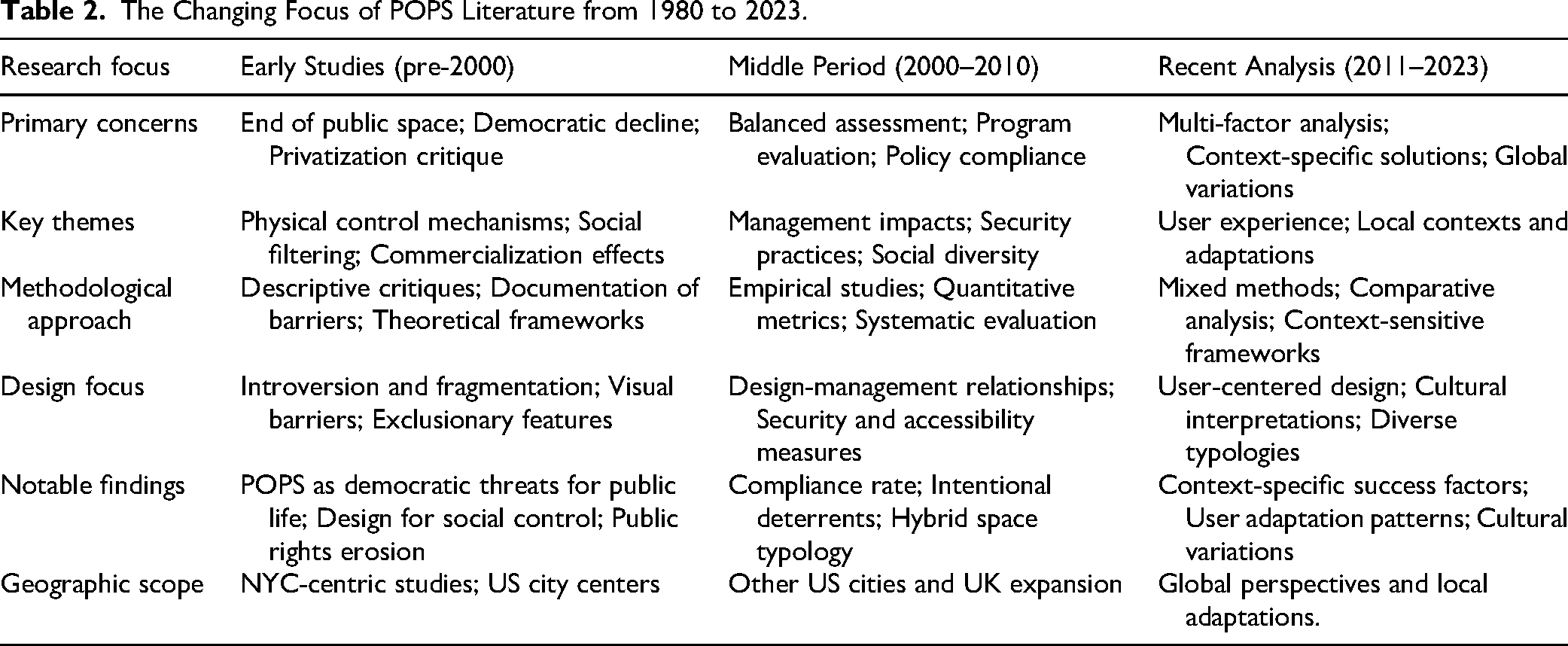
A chronological review of the POPS literature across these three periods reveals three fundamental shifts in scholarly discourse. First, research has changed from viewing privatization as inherently problematic to examining specific practices that enhance or constrain public use. Second, evaluation approaches have changed from documenting physical control features to analyzing complex interactions between design, management, and user experience. Third, the geographical expansion of literature has revealed how cultural, regulatory, and urban morphological differences shape both POPS implementation and how it is researched/evaluated. As Table 2 illustrates, this shift from intrinsic critiques to systematic assessment reflects a deeper change in how researchers understand public space provision through studying POPS. Such literature has enabled a more comprehensive analysis of specific design and management practices, which we examine in detail in the following sections.
The Changing Focus of POPS Literature from 1980 to 2023.
Analyzing the Design and Management Features That Are Examined in POPS Literature
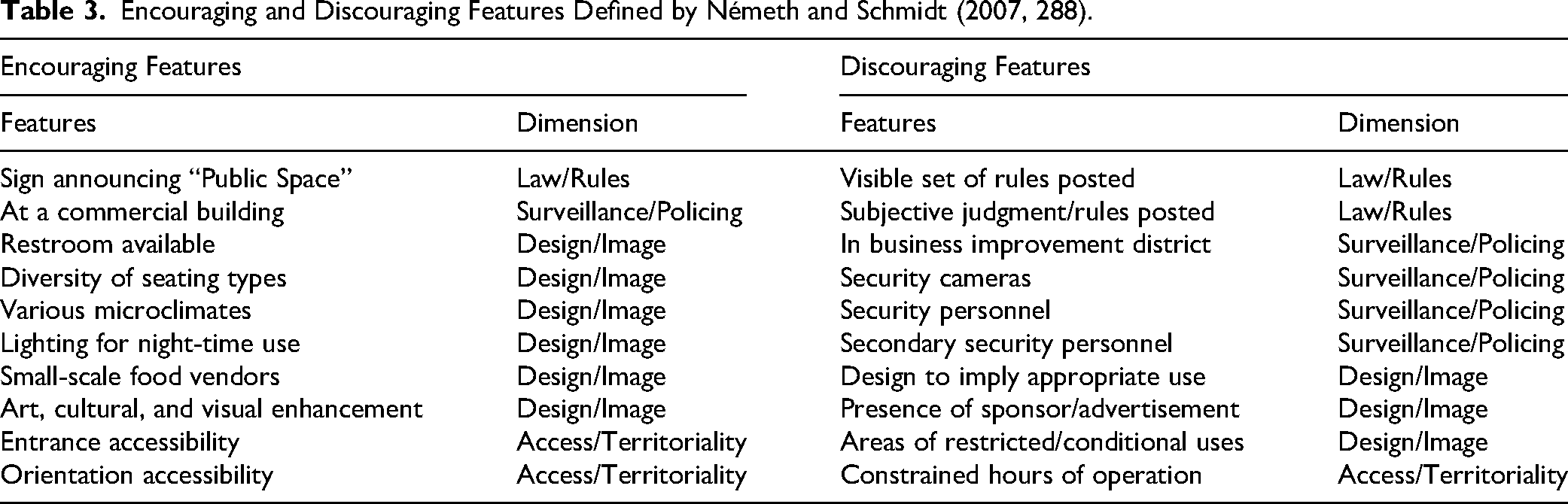
This section addresses the second objective of this review: to synthesize how different scholars have analyzed and evaluated design and management practices in POPS. It examines which aspects received the most scholarly attention and how evaluation approaches progressed across the literature's development. While early literature up until 2000 predominantly focused on ownership-related issues of POPSs—critiquing the shift of control from public to private entities—it rarely examined specific design and management practices of existing POPSs. Building on the chronological and thematic synthesis presented in earlier sections, this analysis demonstrates how scholars developed increasingly systematic approaches to studying specific POPS features. To understand this shift, we use Németh and Schmidt's (2007) framework (Table 3) to analyze how POPS features have been studied in the literature. Building on Oc and Tiesdell's (1999, 2000) work, Németh and Schmidt categorized these features into four dimensions—Law/Rules, Surveillance/Policing, Design/Image, and Access/Territoriality—and identified which elements encouraged or discouraged public use. This framework has influenced subsequent evaluation methods across different contexts (Lopes, Cruz and Pinho 2020; Jian, Chan and Yao 2021; Rossini and Yiu 2021; Mohammadi 2021; Dunlop et al. 2023). We conducted a content analysis of 21 publications in the recent period (2011–2023) with empirical explorations of POPSs. Our analysis reveals varying levels of scholarly attention across different feature categories, with several significant patterns occurring in how recent researchers studied POPS features. These patterns are examined for each dimension below.
Encouraging and Discouraging Features Defined by Németh and Schmidt (2007, 288).
Law/Rules and Surveillance/Policing Features
The scholarly literature demonstrates substantial consensus regarding several features associated with Law/Rules and Surveillance/Policing dimensions, with many studies emphasizing their significance in POPS management. The attention to specific features within these dimensions varies significantly: posted rules and security personnel receive extensive attention (85%), while elements like “Public Space” signage and business district location appear in less than 50% of the reviewed literature. Early research primarily documented the physical manifestations of control. van Melik and van der Krabben (2016) examined human surveillance practices, while Huang and Franck (2018) explored the role of security personnel and their influence on patterns of use. More recent studies by Lopes, Cruz and Pinho (2020) and Lee (2022a, 2022b) provide detailed analyses of surveillance mechanisms within case studies.
Studying POPS-related laws and rules dimension focused on exploring local policies. Studies of Liverpool ONE in the UK demonstrated that behavioral control often operates through subtle environmental cues rather than explicit rules, with no visible “private property” signs or lists of prohibited activities (Leclercq, Pojani and van Bueren 2020). Dunlop et al. (2023) also referred to observations of German POPSs, where implicit regulation is more prevalent, potentially enhancing perceptions of publicness while raising questions about transparency. Similarly, Mohammadi (2021) documented the absence within Melbourne policies of requirements for signage that would identify POPSs as publicly accessible spaces. Recent research by Leclercq and Pojani (2023) adds crucial insights into user perceptions of surveillance. Their Liverpool case studies reveal that users often don’t notice surveillance measures, even in heavily monitored spaces. More significantly, they found that visible security measures don’t necessarily enhance feelings of safety. Their research demonstrates that safety perceptions are more strongly influenced by factors like active street fronts and the presence of other people than by formal surveillance measures, supporting Jacobs's (1961) “eyes on the street” theory. These findings challenge earlier assumptions about the behavioral effects of surveillance and its relationship to user comfort.
The evaluation of research focus reveals a significant shift: while early studies emphasized documenting and categorizing control features, recent research increasingly examines the complex relationship between surveillance measures, user perceptions, and actual space usage. These findings suggest that Németh and Schmidt's original classification of surveillance features as uniformly “discouraging” may oversimplify their impact on user experience. While included in their framework, commercial buildings and public space signage have received limited attention in subsequent research, likely reflecting contextual differences in regulatory systems and incentive structures across regions, particularly in European and Asian cities.
Design/Image Features
The literature reveals significant attention to design elements in POPSs. Scholars particularly examine how these elements function as behavioral control mechanisms, manifesting through both explicit and subtle design strategies. Explicit design control is documented in several studies. Yu (2018) examines design as a political control mechanism, analyzing specific modifications implemented to prevent protest activities. Dunlop et al. (2023) identify deliberate physical deterrents, such as “small screws on seating” aimed at discouraging skateboarders and the strategic placement of concrete bollards to control space usage. Subtle control strategies receive equal scholarly attention. Huang and Franck (2018) document other design approaches, such as placing a flowerpot on a single bench to discourage certain uses and arranging furniture to deter homeless individuals. Langstraat and van Melik (2013) further develop this concept of subtle control, introducing the term “stealthy space” to describe how design can inconspicuously regulate behavior. Several scholars examine the broader implications of design control. Rossini and Yiu (2021) analyze how design features systematically limit specific activities, while Lopes, Cruz and Pinho (2019) incorporate design control as a criterion in evaluating public use. Bjerkeset and Aspen (2017) explore how design creates “tightness” in space use, demonstrating how physical form and accessibility can mask a space's intended function.
Seating diversity is another prominent focus, discussed in approximately 70% of reviewed studies since 2011. The wider literature collected shows an evolution in how seating is analyzed, transitioning from early critiques focusing on the absence of appropriate seating (Whyte 1980; Kayden 2000) to more detailed discussions of seating diversity and arrangement (Miller 2007; Xing 2013; Huang 2014; Leclercq and Pojani 2023). Recent studies examine various seating configurations and their impacts on space utilization (Lee 2022a; Leclercq, Pojani and van Bueren 2020; Manifesty, Min and Kim 2022). Notably, Langstraat and van Melik (2013) categorize diverse seating options as “welcoming amenities,” while Manifesty, Min and Kim (2022) document how users actively create informal seating arrangements.
Environmental comfort and microclimate features have received moderate attention in the literature, with only 50 percent of the studies addressing these elements. In the US context, particularly in New York, Huang and Franck's studies (2018, 2021) examine how high-rise developments affect environmental conditions, documenting specific challenges of “windiness” and “insufficient sunlight.” Several scholars note the influence of indoor climate control on public use patterns (Miller 2007; Smithsimon 2008; Huang 2014; Leclercq and Pojani 2023). In studies of POPS outside the US, attention shifts to outdoor environmental features. Several studies examine the role of natural elements and passive climate control strategies (Lee 2022b; Lopes, Cruz and Pinho 2020; Manifesty, Min and Kim 2022; Jian, Chan and Yao 2021), though some provide only a cursory examination of these elements (Bjerkeset and Aspen 2017; Dunlop et al. 2023). This geographical variation reflects the evolving typology of POPSs, with recent studies outside the US focusing more on outdoor POPSs and their features, rather than the indoor POPSs and plazas that characterized early research.
Night-time lighting has received moderate attention in POPS research (57% of reviewed studies). Several scholars examine lighting's role both as a safety feature and as an enabler of extended space usage (Langstraat and van Melik 2013; Lopes, Cruz and Pinho 2020; Huang and Franck 2018, 2021). Manifesty, Min and Kim (2022) highlight gender considerations by documenting female respondents’ emphasis on adequate lighting for personal safety. The literature reveals a notable tension in how lighting is interpreted and implemented in POPSs: while some scholars describe lighting primarily as a control mechanism within the broader management strategy (Minton 2022), others emphasize its potential for creating welcoming and inclusive environments, suggesting that lighting's role extends beyond basic functionality to influence the overall character and use of these spaces (Leclercq, Pojani and van Bueren 2020; Lee 2022a).
Small-scale food vendors and restaurants in POPSs have been discussed as both activating and contested design elements. Whyte's (1980) observation that “if you want to seed a place with activity, put out food” emphasized how food attracts people, and how people, in turn, attract more people. Building on this insight, later studies examined in greater detail how food services shape publicness, inclusion, and everyday use. US-based studies document how cafes and food courts influence usage patterns and space vitality (Németh and Schmidt 2011; Miller 2007; Huang and Franck 2018, 2021). Loukaitou-Sideris and Banerjee (1998) note their role in increasing office space profitability and tenant retention. Miller (2007) specifically examines how food kiosks in luxury POPSs can attract middle-class workers through affordable options. Dunlop et al. (2023) discuss more complex dynamics: food trucks primarily served office workers during weekday lunchtimes, demonstrating curated inclusion that reinforces existing user patterns rather than broadening public engagement. This observation aligns with Langstraat and van Melik's (2013) findings about amenities potentially limiting inclusiveness. Several studies in other countries documented the absence of small-scale food providers (vendors, kiosks, and food trucks) in POPSs, noting instead the dominance of large-scale food courts surrounded by cafes and restaurants in plazas (Mohammadi 2021).
Some studies critique the impacts that large restaurants, food courts, and cafes can have on the social use of POPS. Smithsimon (2008) noted cafés paying to extend their seating into plazas. Wang and Chen (2018) document how restaurants and cafes can privatize frontage areas. The relationship between food services and space utilization shows varying patterns. Xing (2013) observes employees using food courts in POPSs to avoid on-street restaurant queues. Huang (2014) documents how spaces can become dominated by food court functions, potentially compromising their public character. Many scholars refer to such examples as the creation of consumption-oriented spaces and “café creep,” which foster user homogeneity in POPS (Kayden 2000; Kohn 2004; Low 2006; Madden 2010; Carmona 2010; Wang and Chen 2018; Lee 2022a). The literature indicates that the impact of food services on POPSs’ publicness varies significantly.
Certain design features have received less attention in the literature. Less than 50% of the studies we reviewed examined restroom availability, art and cultural elements, and the presence of advertising. Only a few studies specifically examine restrooms as essential amenities of POPSs (Lee 2022a; Langstraat and van Melik 2013). Also, a few scholars have studied the presence of sponsorship and advertising through digital boards and TVs as design/image features impacting public use (e.g., Miller 2007; Xing 2013; Huang 2014).
Access/Territoriality
Entrance accessibility is one of the most extensively studied design features of POPSs, with 85% of the reviewed literature addressing this aspect. Literature attention started by addressing the physical dimensions of access and then extended to its psychological aspects. Huang and Franck (2018) observed how entrance conditions influence use patterns and public perception. Huang (2014) identifies three distinct entrance configurations in New York office towers: separate entrances, shared entrances with distant reception desks, and shared entrances with central security desks, arguing that shared entrances often diminish public use. Bjerkeset and Aspen (2017) examine psychological barriers and the impact of security presence at entrances. Zhang (2017) provide broader conceptual frameworks addressing property rights and legal requirements in accessing POPSs.
Orientation accessibility, defined by Németh and Schmidt (2007) as the visual and physical connection between POPSs and surrounding public areas at street level, has been studied by 71% of reviewed sources. Several scholars examined how spatial relationships between entrances and surrounding urban fabric affect public use. Early studies by Whyte (1980) and Loukaitou-Sideris (1993) identified how public accessibility is diminished by spaces hidden within buildings or featuring blank walls and inward orientations. Recent literature expands on these findings: Leclercq, Pojani and van Bueren (2020) analyze street-level connections and visual accessibility. Lee (2022a) examines how elevation differences from the street level affect usage patterns. Lopes, Cruz and Pinho (2020) provide specific evidence, demonstrating how strong street connections enhance accessibility. Bjerkeset and Aspen (2017) further emphasize the importance of sidewalk visibility and the negative impacts of below-grade locations on public access.
Operational hours and temporal accessibility receive less scholarly attention, being discussed in only 38% of analyzed studies. Langstraat and van Melik (2013) briefly discuss how temporal changes in accessibility may impact inclusiveness, which can vary across different times of day/week. Huang and Franck (2018) document specific impacts of temporal restrictions, noting how private events in POPSs limit public access to certain areas. Minton (2022) examines the broader implications of time-based restrictions. The limited attention to operating hours in European contexts reflects the prevalence of ungated outdoor POPSs, highlighting how urban context influences both management practices and scholarly focus.
Expanded Perspectives: Complexities in POPS Design and Management Features
Recent studies have significantly expanded upon earlier frameworks in POPS literature, moving beyond Németh and Schmidt's binary classification of features by revealing three key analytical shifts. First, recent research has shown that design and management features in POPS can both encourage and discourage public activities—the impacts of these features can vary for different activities and users (Huang and Franck 2018, 2021; Mohammadi 2021; Dunlop et al. 2023). Second, several studies have highlighted the importance of considering POPS within their broader urban context, including the diversity of adjacent land uses, proximity to public transportation, the presence of cross-block connections, and active street edges (Leclercq, Pojani and van Bueren 2020; Jian, Chan and Yao 2021; Dunlop et al. 2023; Wu et al. 2022; Manifesty, Min and Kim 2022) employed Space Syntax analysis—an analytical tool used to measure accessibility and integration within urban layouts—to understand better the relationships between POPSs and their wider city contexts. Third, several studies have examined how the integration of POPS with their host buildings affects user diversity and activity patterns, both during and after business hours (Huang and Franck 2018; Mohammadi 2021; Bjerkeset and Aspen 2017). While Németh and Schmidt's four dimensions addressed spatial form, access, and regulation as fixed attributes, expanded perspectives emphasize how the same features operate differently across time, user groups, and urban contexts. This analytical shift moves from cataloguing formal attributes to understanding dynamic social processes within POPSs.
Across regions, scholars highlight how material choices shape the inclusivity of POPSs. In North America, luxury finishes often create psychological barriers for lower-income users: Huang (2014) notes that high-end materials can make spaces feel exclusive or fee-based, while Miller (2007) shows how decorative elements such as marble benches and waterfalls, though visually appealing, discourage everyday use. Building on this, Huang and Franck (2018) and Bjerkeset and Aspen (2017) confirm that stylistic choices influence both accessibility and perceived openness. European studies emphasize the opposite strategy, using consistent materials that integrate POPSs with their urban context. While in Australia, Mohammadi (2021) similarly finds that aligning materials across public and private areas lowers psychological barriers to access.
Recent literature has moved POPS evaluations toward more user-centered approaches to explore how these elements collectively foster welcoming environments. They acknowledge the necessity of integrating both physical attributes and social dynamics in POPS policy, design, and management. Researchers such as Lee (2022b) and Manifesty, Min and Kim (2022) have employed interviews and surveys to understand user perceptions of POPS as a type of public space.
Several recent studies observed the integration of small-scale amenities in POPSs, which was rarely discussed in earlier research. Huang and Franck (2018) and Mohammadi (2021) describe how features like free Wi-Fi and power outlets influence the types of activities, the diversity of users, and the duration of visits in these spaces. Carmona (2022) articulates how such modern conveniences not only facilitate accessibility but also foster social inclusion and contribute to the democratic functionality of public spaces, indicating a pivotal shift in how public spaces are conceptualized and utilized. Furthermore, European studies (Lopes, Cruz and Pinho 2019, 2020) explore other small amenities like bicycle parking, recognizing their role in enhancing public accessibility in POPS.
Global Shifts in POPS Literature: Variation in Approaches and Focus
The shifts in POPS scholarship demonstrate a rich diversity shaped by distinct geographic conditions, institutional frameworks, and localized research methodologies. This section explores how these factors influence the study of POPS across different geographical regions, reflecting the interplay between universal principles and specific local contexts.
Geographical regions and urban contexts play a critical role in shaping distinctive POPS typologies and the focus of scholarship. North American researchers predominantly examine plaza-style spaces and atria associated with office towers in central business districts, concentrating on individual ground-level indoor and outdoor spaces within high-density commercial developments (Kayden 2000; Miller 2007; Németh and Schmidt 2007; Huang and Franck 2018, 2022). European scholarship adopts a larger-scale typological approach, exploring POPS within mixed-use projects on a neighborhood scale and urban regeneration initiatives (Minton 2006, 2012; Leclercq 2018; Lee 2022a; Leclercq and Pojani 2023). Researchers focus on integrating these spaces with historic urban fabrics, retail environments, and existing infrastructures, emphasizing contextual design and public realm connectivity (Leclercq, Pojani and van Bueren 2020; Dunlop et al. 2023). In Asia, design responses to extreme urban density have produced complex hybrid POPS typologies like sky gardens, elevated walkways, and transit-integrated spaces (Rossini and Yiu 2021; Jian, Chan and Yao 2021). Research into Asian POPS explores both the physical constraints of Asian megacities and their cultural interpretations of public spaces, which have more fluid public–private boundaries. Studies particularly focus on how these privately owned and managed multi-level networks create new forms of social interaction and urban connectivity.
Scholarship on POPS reflects distinctive urban regulatory regimes and development challenges across different geographical contexts. In North America, researchers concentrate on regulatory effectiveness and design control mechanisms, systematically examining how bonus incentive regulations influence spatial outcomes (Németh and Schmidt 2011; Schmidt, Nemeth and Botsford 2011). Scholars prioritize empirical evaluations exploring the impacts of locally established regulatory standards on implemented design and management practices as well as user behaviors. In contrast, European scholarship approaches POPS through a governance-focused lens, particularly within welfare state contexts, understanding broader social and institutional dynamics over physical design characteristics (Lee and Scholten 2022; Leclercq and Pojani 2023). Researchers examine privatization's implications for civic life and democratic access, emphasizing institutional arrangements and public–private space management interactions. In the UK, analysis extends to the private management of publicly-owned spaces, reflecting a distinct type of privatization (Minton 2006, 2012; De Magalhaes and Freire Trigo 2017; Carmona 2022). This includes an exploration of policy contexts that facilitate transfer of the management and operation of public spaces to private entities. There is a robust body of literature that examines the governance and effectiveness of such arrangements. Studies exploring Asian cities adopt analytical frameworks addressing hybrid governance models where public and private interests are deeply intertwined. Scholars investigate the intricate relationships between state supervision, private development, and public use, focusing on state supervision of private spaces and development planning policies (Yu 2018; Wu et al. 2022).
Methodological approaches in POPS research highlight how scholarly traditions and local contexts influence knowledge production across different regions. In North America, researchers employ systematic observation techniques and quantitative metrics, focusing on direct observation of user behaviors and spatial configurations to gauge the effectiveness of POPS design and regulatory practices (Németh and Schmidt 2007; Huang 2014; Huang and Franck 2018). In contrast, European studies predominantly utilize qualitative methods, including in-depth case studies in the UK. These integrate stakeholder interviews, policy analysis, and field observation, providing a better understanding of how privatization impacts public space management and governance (Leclercq, Pojani and van Bueren 2020; Dunlop et al. 2023). Methodologies used in Asia adapt and refine Western analytical frameworks to fit high-density urban contexts, emphasizing vertical spatial relationships and the complex layering of public and private spaces (Rossini and Yiu 2021; Jian, Chan and Yao 2021). This includes detailed spatial analysis and user behavior studies, which explore both the physical design and the broader social and cultural dynamics at play in POPS. These diverse methodological approaches underscore the regional variations in how POPS are studied, reflecting each area's unique urban challenges and scholarly perspectives.
Conclusion
This paper has synthesized five decades of academic discourse on privately owned public spaces (POPS), drawing from literature in urban design, planning, and urban policy. The analysis reveals a clear trajectory: from broad critiques of privatization's intrinsic problems toward more systematic evaluations of specific spatial practices and their contribution to public life. Early scholarship (pre-2000) approached POPS through a critical lens of public space decline, while the middle period (2000–2010) developed structured assessment approaches. Recent scholarship (2011–2023) has established more sophisticated frameworks for understanding these spaces, supported by empirical evidence from diverse global contexts. This more sophisticated understanding has yielded several crucial insights. The impact of POPSs’ design and management features on public use is more complex than previously theorized, with features simultaneously encouraging and discouraging different user groups and activities. Studies across different contexts demonstrate that successful POPS implementation depends on local conditions. The analysis has established a richer understanding of how design and management practices shape POPS functionality and public reception, moving beyond binary classifications to recognize the interplay between spatial features, management approaches, and user experiences.
The shifts in POPS research have generated significant theoretical insights that directly inform practical applications across diverse urban contexts. The reconceptualization of publicness as a spectrum rather than a binary state has led to more nuanced approaches to space management and regulation. This shift is evident in the development of multidimensional evaluation frameworks (Németh and Schmidt 2011; Lopes, Cruz and Pinho 2020; Wang and Chen 2018) and the documentation of context-specific implementations across diverse geographic settings. At the same time, this growing empirical literature has tended to prioritize spatial and managerial features over more critical-theoretical lenses, leading to a partial eclipse of earlier traditions grounded in political economy, law, and cultural critique. This review has not fully examined the disciplinary dynamics behind this shift, but future work might explore how institutional priorities—such as shifts in planning culture, evaluation metrics, or funding regimes—have influenced this trajectory. While this review did not examine traditional public spaces such as parks or waterfronts, future comparative studies could clarify how ideals of publicness have shifted across different urban spaces under changing governance models.
These findings distinguish between intrinsic concerns about privatization and specific implementation issues in particular contexts, helping stakeholders understand the scope and aims of various POPS policies and practices. This includes the importance of regulatory frameworks that combine clear baseline requirements with flexibility to adapt to local conditions, moving beyond prescriptive design standards toward performance-based criteria. Research demonstrates that effective POPS management demands a careful balance between physical and psychological accessibility, maintenance standards and public access, and programming needs and community interests. These insights can help urban designers, planners, and policymakers leverage POPS to enhance urban vitality while addressing local spatial challenges and policy objectives.
Building on this review's synthesis, several future directions emerge in response to observed trends and gaps. First, the dominance of fixed evaluative frameworks—especially those focused on spatial and managerial features like design, surveillance, and access—signals the need to examine how publicness unfolds through temporal, relational, and affective dynamics. Future work could explore how experiential dimensions of publicness vary across users, events, and temporal cycles. Second, although the literature extensively documents control mechanisms, less attention is paid to how users negotiate or resist these constraints. A greater focus on civic agency could offer deeper insights into the co-production and enactment of privately owned public space. Third, despite a clear global expansion in POPS research since 2010, evaluative frameworks remain rooted in Anglo-American paradigms. Future studies should engage more deeply with how different governance cultures shape design rationales, management models, and institutional contexts. Fourth, the definition of POPS-related problems has shifted—from early critiques of privatization, to standardization efforts, to more pluralistic conceptions—yet these conceptual shifts are rarely examined explicitly. Research could investigate how evolving assumptions shape methodological choices and normative judgments. While this review has traced key conceptual and methodological developments, it did not explore broader disciplinary dynamics behind the decline of critical-humanities approaches. Future work might examine how institutional shifts in planning, funding, and evaluation have influenced these trends. Finally, although this review excluded traditional public spaces such as parks and waterfronts, comparative studies between fully public spaces and POPSs may reveal how publicness ideals have evolved across different types of urban spaces and governance arrangements. Addressing these areas can further enrich both theoretical insight and policy relevance, supporting evaluation frameworks that are responsive to local conditions and grounded in strong conceptual foundations.
Footnotes

Funding
The authors received no financial support for the research, authorship, and/or publication of this article.
Declaration of Conflicting Interests
The authors declared no potential conflicts of interest with respect to the research, authorship, and/or publication of this article.