




Abstract
Since the 1950s, organizations like the European Commission, World Bank, and United Nations have increasingly employed community development approaches to foster local development worldwide. However, their impact on reshaping power dynamics and governance rescaling remains underexplored. This article contributes to their understanding by examining these initiatives through the lens of the politics of space. By considering four analytical dimensions—governance rescaling, multilevel governance, performative imaginary, and spatial-temporal fix—we explore the role of community development in the emergence of new territorial polities and soft spaces of planning, ultimately contributing to the reconfiguration of traditional territorial powers and statehood.
Keywords
Introduction
Community development approaches have been increasingly employed by major organizations such as the European Commission (EC), the World Bank, the United Nations (UN) to foster local development globally over the past seven decades. Supranational agendas like the UN's 2030 Agenda (United Nations 2015), New Urban Agenda (United Nations 2016), and the European Union's Urban Agenda (European Commission 2016), New Leipzig Charter (European Commission 2020b), and Territorial Agenda 2030 (European Commission 2020a) reflect growing interest in bottom-up, people-centered, and place-based policies tailored to specific regional needs (Armondi and De Gregorio Hurtado 2020; Barca 2009; Barca, Mccann, and Rodríguez-Pose 2012). These initiatives emphasize community engagement and command in planning, decision-making, and territorial investments, aiming to improve living conditions (Ahmad and Talib 2015; Mansuri and Rao 2004; Mohan 2014), promote socio-spatial justice (Fainstein 2014), and reduce poverty.
Since the 1950s, community development programs have proliferated across geographies, encompassing various concepts, objectives, and forms. Key examples include Community-Based development (CBD), Community-Driven development (CDD), now called Community and Local Development (CLD), Community Economic Development (CED), Community-Led Local Development (CLLD), Community-Based Initiatives (CBI), and Asset-Based Community Development (ABCD).
Despite extensive literature on community development and numerous assessments of its initiatives (Allmendinger and Haughton 2013; European Commission 2023; Holdcroft 1978; Mansuri and Rao 2004, 2013a, 2013b; Owen and Vercruysse 2014; Phillips, Trevan, and Kraeger 2020; Wong 2012; Wong and Guggenheim 2018), the relationship among these approaches remains underexplored, particularly regarding their origins, meanings, policy agendas, governance arrangements, and impacts on the politics of space. The lack of consensus on community development's origin and history, along with its diverse and integrated disciplinary and ideological approaches, results in a fragmented and complex status quo (Cornwell 1987).
This article aims to systematize community development approaches by analyzing their initiatives through the lens of the politics of space—the exercise of power through space and place (Certomà, Clewer, and Elsey 2012; Lefebvre 1991). Specifically, we explore whether these initiatives promote governance rescaling and the creation of soft spaces of planning. We focus on the transfer of powers and responsibilities from the state to alternative, nonstatutory governance arrangements alongside the rise of citizen-based political entities capable of local planning, decision-making, and mobilizing funding resources, reshaping state power through emergent grassroots territorial polities (de Oliveira Gonçalves et al. 2024; Illsley et al. 2010). We pose three key questions: (i) Do these approaches create a territorial polity responsible for its implementation? (ii) Does this polity co-create a performative and spatial imaginary for its territory? (iii) Does its agency foster spatial-temporal fixes through local development strategies, resource allocation, and territorial outcomes?
To address these questions and examine community development approaches over time, we use an analytical matrix based on four key dimensions of spatial politics—governance rescaling, multilevel governance, performative imaginary, and spatial-temporal fix. Two main aspects emerge from our review. First, community development approaches have evolved from initiatives where the community is invited to participate (e.g., CBD, CED) to those where the community takes the lead within a polity arrangement, assuming responsibility for strategizing, implementing, and distributing funds (e.g., CDD/CLD; LEADER/CLLD; ABCD/CBI), with an increased emphasis on territory-focused and place-based approaches. Second, there are notable Global North and South dialectics. Initially led by the United States (US) and the UN in the Global South, community development approaches have spread to the Global North through programs supporting community development in high-income countries like the US, Canada, European countries, and Australia. In the Global South, these approaches often focus on post-conflict or post-disaster situations, aiming at poverty reduction, basic infrastructure and services delivery, and support for vulnerable communities with weak governmental institutions (Owen and Vercruysse 2014; Wong 2012). In contrast, in the Global North, they focus on improving territorial cohesion and community resilience, emphasizing the involvement of socio-economic stakeholders and civil society to build local capacity and foster place-based approaches (Anderson 2019; European Commission 2020b; Haughton 2013; Servillo and De Bruijn 2018).
The paper is structured as follows. First, we examine the historical background of community development approaches globally. Second, we analyze the initiatives shaping community development and their evolution through the lens of spatial politics. Third, we discuss the impact of these approaches on governance rescaling dynamics and the emergence of new territorial polities and soft spaces of planning. Finally, we conclude with a comprehensive overview.
Historical Background
Despite growing attention to community development approaches (Ahmad and Talib 2015; Mansuri and Rao 2004; Mohan 2014), the debate on citizens’ self-organization is not new. From Aristotle's conception of a self-governed community in Politics to modern theories of democratic participation by Jean-Jacques Rousseau (Pateman 1970; Rousseau 1997, 2018), John Stuart Mill (Mill 1859), Alexis de Tocqueville (Tocqueville, Lawrence and Mayer 1969), and Friedrich Raiffeisen in the 18th and 19th centuries, scholars have long emphasized participatory processes, cooperative movements, and collective action as means to combat poverty.
Community development became institutionalized as a policy tool in the 20th century. Emerging in the 1930s with a focus on community participation in local planning, the term was officially introduced in 1948 by the British Colonial Office to prepare African colonies for independence, emphasizing local government strengthening and territorial economic development (Holdcroft 1978).
Rooted in cooperative movements, community development approaches have since been adopted by international, supranational, and national agencies, along with philanthropic organizations, to design and implement initiatives fostering community participation, engagement, and empowerment globally.
Since its inception, community development has been shaped by profound transformations in political economy, shifting from the Keynesian welfare state model, dominant from the end of the Second World War until the late 1970s, to a neoliberal framework emphasizing small government, deregulation, and individual responsibility (Harvey 2005). The economic crises of the 1970s challenged welfare principles and accelerated the rise of neoliberal ideologies, reducing state responsibilities (Jessop 2002) and driving a broader ideological turn toward free markets and individualism (Peck and Tickell 2002). This transition also marked a shift in community development from a welfare-based model to one centered on accountability and the transfer of powers to the local sphere.
Scholars have systematized this evolution into three main waves (Mansuri and Rao 2004; White 1999; Wong and Guggenheim 2018). Though not universally accepted—partly due to the complexity and diversity of community development approaches—these frameworks help clarify their background and progression.
First Wave: Targeting Unprivileged Citizens and Communities
The first wave of community development programs arose in the 1950s and 1960s, following World War II and the decline of colonial regimes. Known as Community-Based Developments (CBDs), these initiatives were championed by entities such as the United Nations, the United States Agency for International Development (USAID), and private sponsors like the Ford and Rockefeller Foundations, which invested extensively in projects for community development across Africa, Asia, and Latin America (Mansuri and Rao 2004).
The first major program, launched in India in 1952 with Ford Foundation support, drew on Ghandi's theories on power decentralization in Village Swaraj (1962). It encouraged community engagement and self-reliant village communities through rural development and participatory processes to counter modernization and colonial oppression (Cornwell 1987; Holdcroft 1978). USAID extended similar efforts to the Philippines, Indonesia, Iran, and Pakistan. By the 1960s community development projects targeting over 60 Global South countries aimed to improve living conditions through investments in basic infrastructure and social services, mobilizing rural communities to raise living standards, foster self-reliance, and strengthen democratic foundations (Holdcroft 1978; Mansuri and Rao 2004; White 1999).
During this period, the US government's interest in community development was driven by multiple motivations, including the intent to secure newly independent states from external military threats and internal unrest, especially agrarian communist movements (Arizpe 2004; Holdcroft 1978). Amid the Cold War, community development was framed as a democratic counter to the communist bloc, with the provision of social rights, alongside humanitarian, economic, and military aid, serving to neutralize communist influence (White 1999).
Another key reference from the Global South is Paulo Freire's (1972) concept of “conscientization” or “critical awareness-raising.” Aimed at helping marginalized groups recognize their subordinated socioeconomic situation, understand its underlying causes, and identify ways to challenge oppression, Freire's approach sought to build political awareness and capabilities, while expanding the individual agency within a social context (Ware 2017).
Despite ambitious goals, first-wave initiatives were often considered short-term remedies providing quick relief during crises. They created temporary jobs, basic social services, and infrastructure, typically managed by semi-autonomous government bodies staffed with trained personnel overseeing short-term projects proposed by community groups, NGOs, or local governments (White 1999).
By the late 1960s, these approaches were deemed failures and discontinued (White 1999). Critics argued their short-term focus hindered meaningful community engagement, allowed projects to be co-opted by local elites, and failed to challenge existing power structures (Holdcroft 1978; White 1999).
In response, centralized, top-down government initiatives were implemented globally, prioritizing viability, efficiency, and representation over participation. These large-scale, centrally-led efforts focused on economic development were considered more stable than direct community involvement (Mansuri and Rao 2004). Examples include Tanzania's Ujamaa Villages (1960s–70s), which aimed to collectivize agriculture but led to forced relocations and failed productivity (Scott 2008); India's Operation Flood (1970), which modernized dairy production but marginalized small farmers and overlooked rural nutrition; and Indonesia's Transmigration Program (1960s), which sought to reduce population density by relocation but caused environmental damage and land tenure conflicts (Fearnside 1997).
While targeting economic development, these projects often employed a “one-size-fits-all” approach that exacerbated poverty and disempowered local communities (Mansuri and Rao 2004).
Second Wave: Changing by Capacitating Communities
During the 1980s, large-scale top-down development programs faced strong criticism for disempowering local communities, failing to deliver lasting results, depleting investments quickly, exacerbating poverty, and contributing to environmental degradation (Escobar 1995; Mansuri and Rao 2004; Scott 2008).
In response, the potential of local decision-making has gained renewed attention. Contrary to Olson's theory (1965, 124:29), which argued that individuals would not act in their common interest without coercion, Ostrom's research (1990) demonstrated the potential of local collective action. Building evidence on case studies, Ostrom showed that cultivating community capabilities could enable local institutions to manage common-pool resources successfully, redefining community development through capacity-building.
Acknowledged as a second wave, Chambers and fellow researchers developed a strategy based on small-scale interventions that enabled affected communities to actively participate in decision-making (Chambers 1994; Kenny, McGrath and Phillips 2017; Thompson and Cannon 2023). External stakeholders acted as facilitators, overseeing the allocation of investment funds. These initiatives, known as Community-Driven Development (CDD) projects, were implemented worldwide by the World Bank (De Silva and Sum 2008; Kumar 2005).
The first implementation occurred in 1987, when Bolivia, facing an economic crisis, received an investment fund to address unemployment and provide essential social services, focusing on education and health. In the following decades, other countries in the Global South, particularly in Latin America and Africa, including Honduras, Nicaragua, Peru, and Zambia, received similar support from the World Bank (Wong 2012).
In the Global North, similar policies to the World Bank's CDD emerged in the 1970s and beyond. In the USA, the Community Development Block Grant (CDBG) program, established in 1974 by the U.S. Department of Housing and Urban Development (HUD), allocated block grants to eligible counties and municipalities for community development projects. These initiatives aimed to support rural communities, improve housing, build infrastructure, and foster economic opportunities for low- to moderate-income individuals (Theodos, Stacy and Ho 2017).
In the 1990s, Community Economic Development (CED) approaches emerged, drawing inspiration from earlier CBD (first wave) and CDD models used in the Global South. CED aimed to regenerate declining urban areas by addressing economic, social, and environmental challenges while reducing community dependence on state or private funding and leveraging local expertise and resources (Haughton 2013). The first CED projects were primarily implemented in the UK, with additional cases in the USA and Canada (Seattle 1993; Seyfang 2013).
Alongside the UK's CED initiatives, the European Commission launched, in 1992, the LEADER program (Liaison Entre Actions de Développement de l’Économie Rurale 1 ) under the EU's Cohesion Policy to promote local development, initially focusing on rural areas. Sharing the community-driven principles of the World Bank's CDD, LEADER was described as a “bottom-up approach with decision-making power for local action groups concerning the elaboration and implementation of local development strategies” (European Commission 2014b, 6), focusing on territorial cohesion across Europe.
LEADER aimed to address specific issues identified by the community, represented by Local Action Groups (LAGs)—territorial polities composed of various private and public actors, including local citizen-based structures with deep social and territorial knowledge. LAGs acted as intermediaries, allocating structural funds to their respective territories and proposing local development strategies to guide investments.
Third Wave: the Possibility of co-Creation of a Spatial Vision
In the late 1990s and 2000s, community development approaches entered a third wave, emphasizing deeper community empowerment, capacity-building, and co-creation.
Building on stronger participatory processes (Narayan-Parker and Ebbe 1997), the World Bank introduced a second generation of Community-Driven Development (CDD) initiatives, empowering local actors to lead the allocation, management, and delivery of funds. In the World Development Report 2000/2001: Attacking Poverty, community empowerment was highlighted as a cornerstone of development policy (World Bank 2000). Notable examples of this approach include Indonesia's Kecamatan Development Program (KDP) following the 1998 Asian economic crisis, Afghanistan's National Solidarity Program (2003), the Kapit-Bisig Laban sa Kahirapan–Comprehensive and Integrated Delivery of Social Services (Kalahi-CIDSS) project in the Philippines, India's Andhra Pradesh District program, and Nepal's Poverty Alleviation Fund (Wong 2012). CDD has remained the World Bank's principal instrument for combating poverty globally and has been rebranded as Community and Local Development (CLD) 2 in the 2020s.
Building on the World Bank's CDDs, Australia's long-lasting collaboration with the World Bank has evolved to support local leadership in community development. Since the 2010s, the World Bank has partnered with the Australian Department of Foreign Affairs and Trade (DFAT) to implement CDD/CLD projects in neighboring Global South countries (Anderson 2019; Dornan and Pryke 2017). Domestically, Australian municipalities have also embraced these approaches, with projects like Logan Together. Launched in 2015 in Logan, Queensland, this place-based, participatory initiative aimed to improve developmental outcomes for disadvantaged children and break cycles of poverty through community-driven processes (Smart 2017).
In Europe, LEADER expanded to coastal regions during the 2007–2013 programming cycle and to urban areas in 2014–2020, supported by additional funding from the European Maritime and Fishery Fund (EMFF), the European Agricultural Fund for Rural Development (EAFRD), the European Regional Development Fund (ERDF), and the European Social Fund (ESF). During this last cycle, LEADER's focus on social capital and community-driven initiatives evolved into what became known as Community-Led Local Development (CLLD). According to the European Commission, “CLLD is a tool for involving citizens at local level in developing responses to the social, environmental and economic challenges we face today. [It] requires time and effort, but for relatively small financial investments, (…) can have a marked impact on people's lives and generate new ideas and the shared commitment for putting these into practice” (European Commission 2014a, 5).
While the UK was in the European Union, there was significant overlap between CED and LEADER/CLLD instruments, with LEADER funds supporting CED approaches (Greer et al. 2013; Haughton 2013).
In the late 1990s, in parallel to formally led initiatives, other grassroots organizations began rising, focusing on bottom-up innovative approaches to address gaps left by governments in providing services and public goods. Community-Based Initiatives (CBIs) (Igalla, Edelenbos and van Meerkerk 2019) emerged globally, driven by citizens’ needs to take matters into their own hands (Edelenbos et al. 2021) and emphasizing self-organizational capacity (Healey 2015). While, in the Global North, CBIs were fueled by budget cuts and state retrenchment in areas like healthcare, social services, energy, urban livability, in the Global South, they arose from weak governance, corruption, and scarce financial resources (Brandsen, Trommel and Verschuere 2017; Chaskin 2001; Teasdale 2012). In both contexts, CBIs often served as test beds for new ideas, particularly in sustainable development (Seyfang and Haxeltine 2012).
Similarly to CBIs, Asset-Based Community Development (ABCD) approaches gained traction in the 1990s. Developed by John L. McKnight and John P. Kretzmann at Northwestern University's Institute for Policy Research in Illinois, ABCD aimed to create “an alternative community development path” (Kretzmann and McKnight 1993, 8). This “citizen-led,” “relationship-oriented,” “asset-based,” “place-based,” and “inclusion-focused” approach prioritizes neighbor-to-neighbor relationships over institutions (Russell 2020). By focusing on communities’ existing strengths and resources rather than on their weaknesses, ABCDs aim to drive positive community transformation (Denning 2023; Kretzmann and McKnight 1993; McKnight and Block 2011).
The essence of grassroots community development approaches like CBIs and ABDCs—where cooperatives can play an important role (Majee and Hoyt 2011)—lies in coordinating existing community assets to enhance residents’ socio-economic well-being by linking local initiatives with external opportunities. Unlike other approaches (CBD, CED, CDD/CLD, LEADER, and CLLD), CBIs, ABCDs, and cooperatives rely entirely on bottom-up efforts without prior external investments from donors or governments.
Overall, the third wave of community development approaches shifted from a strict material focus (i.e., infrastructure and public space regeneration) to strengthening community capacity building, empowerment, resilience, and social inclusion, adopting a more holistic developmental approach (Sen 2014).
Community Development Approaches Framed by the Politics of Space
Over the past 70 years, community development approaches have shaped the politics of space—understood as the territorial arrangements of power, or how power is exercised and distributed across space (Certomà, Clewer and Elsey 2012; Lefebvre 1991). By reinforcing community empowerment and leadership, particularly through the co-creation of local development strategies and the establishment of new arenas for discussion and deliberation, these approaches have the potential to rescale power and responsibilities. This shift may lead to the rise of grassroots territorial polities—tailored governance arrangements with stakeholders who share a common identity and are institutionally organized within specific territorial contexts (de Oliveira Gonçalves et al. 2024; Illsley et al. 2010)—and the creation of new soft spaces of planning (Haughton and Allmendinger 2007; Purkarthofer and Granqvist 2021)—flexible, discretionary areas of planning and decision-making that cross administrative boundaries and political jurisdictions to address the “real geographies of problems” (Haughton and Allmendinger 2007, 306). Indeed, community development is typically performed within subregional, bottom-up, functional spaces of planning and decision-making, regardless of their scale, spatial or geographical configuration, ranging from the neighborhood to the regional level (Allmendinger and Haughton 2010).
In this article, we examine community development approaches through the lens of spatial politics to explore their role in fostering new soft spaces of planning, rescaling power and responsibilities, and ultimately signaling a soft turn in policy design and implementation (Cavaco et al. 2023).
To this effect, we use four key conceptual dimensions:
Governance Rescaling: Refers to the political process of reconfiguring governance structures, redefining territorial scales, and creating new spaces of intervention. It involves a diversity of interests, political forces, and actors (Keating 2014), particularly through the creation of specific policy initiatives and the engagement of various stakeholders. Community development approaches facilitate the creation of new intervention scales at the local level while engaging the community and local stakeholders in planning, decision-making, and funds allocation. Multilevel governance: Refers to the governance setting—political structures and decision-making processes—through which approaches are implemented. It involves the vertical (across different government tiers) and horizontal distribution (multiple sectors and actors) of central government authority (Bache and Flinders 2004; Jessop 1998) and encompasses political mobilization (politics), policy-making initiatives (policy), and steering structures (polity) (Piattoni 2009, 165). In community development approaches, new actors and relationships are introduced horizontally, while vertically, the community interacts with donors and with international and governmental structures. Performative Imaginary: Refers to the act of co-creating a spatial imaginary, i.e., a collective vision or shared idea of a territory or place that enacts shifts in social perceptions and practices of space. As collective representational discourses tied to specific territories, spatial imaginaries function as “performative acts” that, through relations of power and political struggles, not only give meaning to a place but also allow communities to reshape and reinvent socio-spatial practices (Davoudi 2018). By fostering the development and implementation of local strategies, community development approaches contribute to the formation of common territorial visions that may enact and legitimize transformative sociospatial perceptions and practices, particularly in relation to the emergence of new spaces of power and decision-making—new soft spaces. Spatial-temporal fix: Refers to the fixation of capital in place in physical form (Harvey 2000) and as an “improvised, temporary solution, based on spatial re-organization and/or spatial strategies” (Jessop 2006, 147). Supported by temporary funding, community development approaches produce territorial outcomes that impact local development, whether temporarily or with more lasting effects.
By bringing together these concepts, we aim to explore whether community development approaches produce spatial-temporal fixes, established through a rescaling of powers, functioning within a multilevel governance arena, and providing new spatial imaginaries as performative acts.
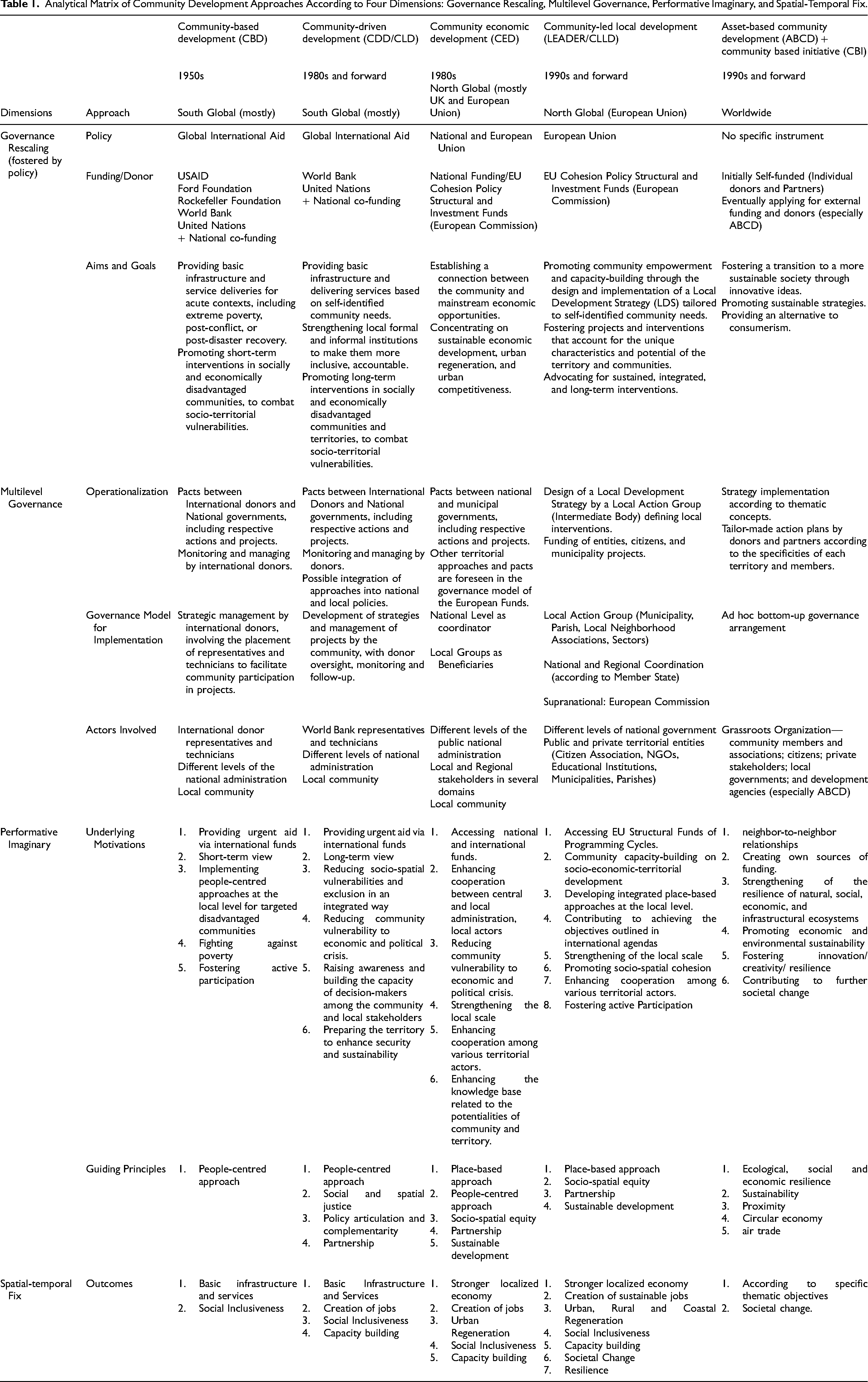
To achieve this, we advance a framework (Table 1) that analyzes community development approaches through the lens of the politics of space. Methodologically, this analysis is based on both direct sources—USAID, World Bank, and EU documents (EC, 2014a, 2023; USAID, 2010; World Bank, 2020)—and indirect sources, including working papers from these institutions and specialist researchers who evaluated and discussed their implementation, as well as other critical literature on the topic (Becker, Franke and Gläsel 2018; Haughton 2013; Mansuri and Rao 2004, 2013a; Mathie and Cunningham 2003; Servillo 2019; Wong 2012; Wong and Guggenheim 2018).
Analytical Matrix of Community Development Approaches According to Four Dimensions: Governance Rescaling, Multilevel Governance, Performative Imaginary, and Spatial-Temporal Fix.
Shifts in the mindset of community development approaches
Examining the evolution of community development approaches framed by the politics of space reveals a three-level shift in the mindset of initiatives:
a transition from a people-centered to a place-based approach, acknowledging the intrinsic relationship between communities and their territories; a transformation in the model of community participation, moving from passive engagement to a co-creation paradigm that empowers community leadership; a reorientation of intervention outcomes, shifting focus from tangible, material results (hard outcomes) to intangible, immaterial outcomes (soft outcomes).
From a People-Centered to a Place-Based Mindset
During the first wave of community development approaches (CBDs), the focus was on addressing basic needs—such as water, sanitation, food, and education—to combat poverty and provide urgent humanitarian aid, especially in post-conflict and post-disaster areas. This people-centered approach, coined by former USAID advisor David Korten (1984), gained widespread adoption in international agendas. Korten criticized growth-focused strategies as unsustainable and inequitable, advocating instead for a self-sustaining system driven by citizen participation.
Over time, community development approaches broadened to promote resilience in territories and communities, reducing vulnerability to economic and political crises (Mansuri and Rao 2013a). The shift to long-term strategies steered development away from immediate solutions, focusing on capacity-building and sustainability to improve living conditions based on self-identified community needs and resources (Wong and Guggenheim 2018). These changes marked the second wave of community development with the emergence of CDDs, which evolved into the third wave to prioritize the community-territory relationship, highlighting the importance of place and space. Third-wave initiatives built on people-centered principles by adopting asset- and place-based perspectives. The second generation of CDDs (renamed CLDs), alongside the EU's LEADER/ CLLD programs and grassroots movements like CBIs and ABCDs, identified endogenous resources and unique territorial characteristics as drivers of locally rooted, community-led development.
This place-based approach gained prominence in the Global North, particularly within the EU during the 2000s, as an effective strategy to address the “persistent underutilization of potential” and mitigate entrenched social exclusion (Barca 2009, VII). It is grounded in two key principles: recognizing the geographical context as the foundation of multiple capital assets (human, natural, physical, economic, social, and institutional) essential for local development, and fostering development through knowledge-building via collaboration between local groups and external elites (Barca, Mccann and Rodríguez-Pose 2012). These approaches emphasize partnerships among diverse stakeholders and governance levels, serving as mechanisms for institution-building and leveraging local knowledge and engagement (Pike, Rodríguez-Pose and Tomaney 2007). “A place-based development policy is the idea that most of the knowledge needed to fully exploit the growth potential of a place and to design tailor-made institutions and investments is not readily available—whether held by the state, large corporations, or local agents—and must be produced anew through a participatory and deliberative process involving all local and external actors” (Barca, Mccann and Rodríguez-Pose 2012, 147).
The ABCD movement also underscored the role of place, presenting an alternative to traditional “needs-driven” approaches by positioning the neighborhood—rather than institutions—as the “primary unit of change”. This neighbor-to-neighbor impact is not about service provision; it is about neighborliness. (…) ‘Neighborhood’ is the potential context within which everything can come together, where relational civic power (…) can join with the power of civic professionals and their institutional resources. In sum, places can exist and thrive without people, but people cannot exist and thrive without places. (Russell 2020, 27)
Nevertheless, this trend and emerging mindset of community development are less prevalent in the Global South than in the Global North. Due to the specific socio-economic contexts in which urgent basic needs prevail, World Bank's CDD/CLD projects in the Global South tend to maintain a focus on needs-driven, people-centered approaches rather than encouraging a distinct place-based perspective.
From Participation to co-Creation and Community Empowerment
First-wave CBD approaches in the Global South heavily relied on the community workforce to directly execute initiatives and identify beneficiaries, requested services, and supplies (Mansuri and Rao 2004). Focused primarily on addressing the needs of the underprivileged and effecting rapid change in their lives, these approaches depended on community collaboration to engage a broader spectrum of individuals who would benefit from and contribute to their implementation.
In the institutional arrangements of CBDs, donors typically assumed leadership roles, while community involvement was often limited to including community members in projects. However, there was frequently a lack of clarity regarding the extent of participation, the specific roles assigned to individuals, and their influence within governance structures managing financial assistance (Mansuri and Rao 2013a).
Evaluations of these initial-wave projects are limited, making it difficult to assess whether the ideas and requests of community members were genuinely considered (Mansuri and Rao 2013b). However, participation is often believed to have been superficial, staged to create the appearance of community engagement, while actual decision-making authority likely rested with the statutory system, local elites, or select community members. Moreover, CBDs were highly susceptible to co-optation by external interests and various forms of elite domination, which were more likely to affect disadvantaged communities (Bourdieu 1984; Mansuri and Rao 2004). For example, contracts for services such as drainage systems or construction might have been awarded to companies influenced by elite individuals, or the local statutory system may have directed projects to align with its own agendas rather than addressing the community's true needs and demands (Mansuri and Rao 2013a). Indeed, affluent community members may have possessed stronger internal and external networks than their less privileged counterparts, enabling them to leverage these connections to reinforce existing structures of inequality.
The criticism directed at the implementation of CBDs (Escobar 1995; Scott 2008) led to refinements in the collaborative model, with a concerted effort to strengthen the role and engagement of community members. Emphasis was placed on cultivating cultural roots and promoting long-term involvement and outcomes. In response, second- and third-waves CDD initiatives, promoted by the World Bank, sought to empower community members, ensuring their control over the process and active participation in the co-creation of strategies and interventions. The focus expanded beyond addressing immediate needs in deprived villages to include building the community's capacity to foster genuine, long-term relationships grounded in trust, to nurture a sustainable future (Wong and Guggenheim 2018).
The co-creation dimension of CDDs emerged from a shift in community engagement, evolving from mere participation to active leadership roles. The goal was for communities not only to engage actively but also to hold the power to create, envision, and take responsibility for designing and implementing strategies. This approach also aimed to strengthen both formal and informal local institutions, making them more inclusive and accountable (Wong 2012): Villagers engage in a participatory planning and decision-making process prior to receiving block grants to fund their self-defined development needs and priorities. (Voss 2008, v)
Wong and Guggenheim (2018) identify three pragmatic reasons for this: (i) communities often possess deep, intrinsic knowledge of their own circumstances, enabling them to define priorities and design development strategies more effectively than centralized governments; (ii) communities have a natural incentive to use funds efficiently, and through mechanisms of social control, they can help minimize corruption; (iii) centralized governments stand to benefit from collaborating with community governance bodies, as this partnership allows for parallel efforts to address infrastructure and service delivery gaps more efficiently, rather than relying on the slow and cumbersome process of building nationwide government delivery systems. The potential gains from community-driven development are large. It has the explicit objective of reversing power relations in a manner that creates agency and voice for poor people, allowing them to have more control over development assistance. This is expected to make the allocation of development funds more responsive to their needs, improve the targeting of poverty programs, make government more responsive, improve the delivery of public goods and services, and strengthen the capabilities of the citizenry to undertake self-initiated development activities. (Mansuri and Rao 2004, 19:3)
In CEDs, which aim to strengthen local economies by connecting projects to mainstream economic opportunities while integrating marginalized groups (Seyfang 2013), the institutional framework involves partnerships with local enterprises, public authorities, and community representatives. These initiatives are considered holistic approaches to local and regional regeneration and include: […] building up and building upon local expertise, experience and resources, encouraging local ownership of a growing physical asset base in order to reduce vulnerability associated with high dependence on external (state and private) funding sources, and working within locally accountable frame-works. (Haughton 2013 [1999], xiii)
As territorial polities with task-specific dominion (Piattoni 2009), LAGs operate within ad-hoc areas—soft spaces of planning—defined by the groups themselves but guided by top-down criteria and the objectives of local development strategies. LAGs play a central role in uniting actors within a shared geographic territory to form task forces dedicated to co-create proactive visions—spatial imaginaries (Davoudi, Kallio and Häkli 2021)—which may shape new collective perceptions of socio-spatial relationships and practices. This participatory environment is fostered through voluntary engagement via workshops, participatory meetings, and community engagement activities.
Implemented across different geographical regions, CDD/CLDs in the Global South and LEADER/CLLDs in the Global North share a foundational emphasis on community leadership, as reflected in their designations as “community-driven” and “community-led”. While united in this focus, each initiative addresses distinct challenges shaped by the specific needs and priorities of their target territories.
Despite the advances and innovations in territorial governance and policy-making these new territorial polities represent (Ray 1998; Servillo and De Bruijn 2018), they are without risks and limitations. Although active citizen participation and engagement have improved, participatory processes often favor the most literate citizens—those with the knowledge, skills, and time to engage effectively in local organizations, informal networks, and institutional frameworks that influence decision-making. Conversely, others may feel excluded due to cognitive, economic, and social barriers (Falanga 2018). This imbalance may hinder the achievement of key objectives such as social inclusion, empowerment, and territorial resilience.
Regarding participation and community empowerment, both ABCDs and CBIs diverge from the aforementioned approaches, primarily because, unlike CED, CBD, CDD, and CLLD initiatives, which are often supported by external donors such as international institutions or foundations (e.g., Rockefeller Foundation, the World Bank, the European Commission), ABCDs and CBIs are fundamentally self-organized and self-funded, contrasting “organic participation” (“organized by civic groups outside government”) with “induced participation” (“bureaucratically managed development interventions” (Mansuri and Rao 2013a, IX). This independence from external investment sources distinguishes them apart, as they operate without financial backing and institutional connections, and, consequently, top-down guidance and control that characterize the other models.
As a proactive participatory methodology focused on mobilizing local assets and capabilities within a defined geographic area, ABCDs closely resemble CLLDs, albeit without the guidance and funding from supranational and national bodies. The governance structures of ABCDs also function as territorial polities engaged in performative imaginaries, bringing together multistakeholder platforms that include community organizations, private sector actors, local governments, and development agencies. These stakeholders collaborate to identify local assets and priorities, co-design strategies, and set interventions, all while ensuring alignment with broader policy frameworks. The roles of stakeholders vary: local authorities often provide regulatory support and resources, community members contribute with endogenous knowledge and labor, private entities offer financial and technical expertise, and development organizations facilitate capacity building and coordination (Mathie and Cunningham 2003).
Similarly, CBIs operate within a soft space of planning—a nonstatutory territory of experimentation and innovation. In contrast to ABCDs, which adhere to a more structured, pre-defined methodology (Kretzmann and McKnight 1993), CBIs are ad-hoc organizational forms consisting of individuals engaged in community development: (…) one or more individuals working together embedded in the community or grassroots that do the work of experimenting and institutionalizing novel grassroots innovations and whose work directly or indirectly has the potential to support a transition. (Becker, Franke and Gläsel 2018, 7)
Overall, these initiatives reflect a growing trend toward fostering more active participation and co-creation translating into community command and leadership. This shift encompasses community involvement in planning, strategy-making, financial resource management, and the selection of projects and interventions. Despite the significant top-down influence exerted by donors, funders, and both central and local governments—who often hesitate to fully delegate power and responsibilities to the local level—adopted multilevel governance frameworks highlight the role and responsibilities of local actors. Indeed, the strengthening of grassroots territorial polities marks a significant step toward governance rescaling and a transformation in the politics of space.
From Hard and Tangible Outcomes to Immaterial and Intangible Outcomes
Community development approaches yield outcomes that can be understood as temporal-spatial fixes—manifestations of capital fixation in specific places through various forms of investment over defined periods. These outcomes are closely tied to scalar fixing dynamics, influenced by the transfer of power and decision-making from statutory governmental levels to ad-hoc, nonstatutory spheres of governance facilitated by grassroots territorial polities. Empowered by access to investment, these polities channel resources into projects designed to address the unique assets and needs of their communities and territories.
The focus and nature of these outcomes, however, are heavily influenced by the mindset underpinning community development initiatives and the geographical context in which they unfold. In the Global South, where dynamics such as decolonization processes, acute poverty, fragile newly established nations, natural disaster recovery, and political-economic crises predominate, approaches like CBDs and CDD/CLDs have prioritized delivering urgent basic infrastructure, facilities, and services (Mansuri and Rao 2013a). Conversely, in the Global North, where poverty and infrastructural deficits are less severe and persistent 3 , community development initiatives have centered on sustainability, social inclusion, spatial justice, the creation of sustainable employment, resilience, and territorial cohesion (Haughton 2013; Ray 2006).
Initially, first-wave initiatives primarily addressed immediate material needs in disadvantaged communities by providing essential infrastructure—such as roads, hospitals, schools, water supply, and sewage—and basic services, including medical care and primary education. These capital investments materialized as tangible outcomes, performing temporal-spatial fixes within the territory.
While CBDs focused predominantly on delivering material and tangible outcomes—often leveraging community labor and local resources under the guidance of donor organization facilitators—second- and third-waves CDD/CLDs marked a substantial paradigm shift. Transitioning to “community-driven” approaches, these later initiatives embodied a commitment to empowering community members to actively engage in decision-making, planning, and implementation. The ultimate goal expanded to include intangible, soft outcomes, such as community capacity-building and empowerment, reflecting a more holistic and sustainable model of development that seeks to transform spatial–temporal fixes into enduring results, supporting communities in achieving lasting development and resilience.
In the Global North, similar trends emerged. During the second-wave CEDs, investments focused primarily on urban regeneration in post-industrial settings marked by high unemployment rates and urban decay. However, these efforts aimed to go beyond mere physical rehabilitation. By mobilizing community resources and potential, the objective was to reduce dependency on state or private funding (Haughton 2013 [1999], xiii) and integrate local businesses into mainstream economic opportunities, thereby fostering sustainable employment and achieving long-term outcomes.
The introduction of initiatives like LEADER in the 1990s and CLLDs in 2014 marked a step forward. Citizens were encouraged to transition from passive recipients of financial aid to active co-creators of their own development. These approaches sought to facilitate reciprocal learning, empowering community members to become proactive citizens while addressing interconnected challenges of social inclusion, infrastructure development, and sustainability within their territories (Ray 1998). Capital fixation in these contexts extends beyond tangible, material outcomes or the generation of jobs and economic wealth. It seeks to cultivate deeply rooted individual and collective strengths, drawing on grassroots human, social, and institutional intangible capabilities.
Indeed, the literature on community development (Haughton 2013; Owen and Vercruysse 2014) emphasizes that beyond providing essential infrastructure, services, and urban renewal, development approaches should create opportunities for community members to actively participate in decision-making processes and build their future. Such involvement is expected to generate intangible outcomes, including community capacitation, social capital building, empowerment, social inclusion, resilience, and, ultimately, societal change and sustainability.
Prioritizing soft outcomes also requires transferring power and control. As noted in the World Bank's Poverty Reduction Strategy Paper Sourcebook (Dongier et al. 2003), CDDs, by fostering social capital, can strengthen new governance structures and enable local associations and institutions to complement public or private sector services and activities, thus enhancing governance and empowerment.
Moreover, CDD/CLDs have the potential to operate at regional or national levels if projects are integrated into the statutory system after interventions. Similarly, LEADER and CLLDs serve as vehicles for advancing broader policy goals, contributing to territorial cohesion at regional and national scales. This is especially relevant for ABCDs and CBIs, which emerge from bottom-up initiatives and grassroots capabilities. Even in these cases, for initiatives to significantly impact territorial resilience and spatial politics, they must have the capacity to scale, replicate, and ultimately mainstream innovative practices—either by applying them in different geographical contexts, by incorporating them into statutory systems or by providing ongoing support to community members to continue their efforts.
In short, community capacity-building highlights a governance shift, redistributing power and responsibilities, strengthening the local scale, and fostering cooperation among diverse territorial actors. It also enhances the knowledge base about the potential of both the community and the territory. An interesting outcome of channeling funds into a community association, initially perceived as simply enhancing infrastructure and providing financial support, is that the process itself can enrich the associational community life (Putnam 1994). Engaged communities are “schools” where citizens learn to take charge of local affairs themselves, to resolve disputes without violence, and to replace locally chosen leaders who do not deliver on their promises. (Wong and Guggenheim 2018, 7)
By channeling investments into territories that might otherwise be overlooked and giving communities the knowledge, power, and responsibility to shape their lives and future, community development approaches function as spatial–temporal fixes, with the capacity to enhance territorial and community resilience and ultimately contribute to the reconfiguration of spatial politics.
Conclusions
The history of community development over the past century reveals a series of evolving trends, marked by waves and counter-waves that have continually reshaped the models and institutionalization of collective action and citizens’ self-organization. These shifts embody a complex interplay between top-down and bottom-up dynamics, challenging the traditional distribution of state powers and responsibilities.
This article offers an in-depth overview of community development approaches, exploring their role in redistributing territorial powers and redefining traditional statehood. It analyzes how these approaches, as policy initiatives, can induce governance rescaling and impact the politics of space by facilitating the creation of new soft spaces of planning through the transfer of powers from the state to alternative, nonstatutory, citizen-based political entities responsible for planning, decision-making, and mobilizing funding. In essence, the article investigates how community development approaches contribute to the formation of performative imaginaries, the shaping of territorial polities, and the establishment of spatial-temporal fixes, while engaging local actors in the design and implementation of local development strategies and the fixation of investments in a given area.
By collecting and analyzing key concepts and characteristics of community development approaches, structured around four main dimensions of spatial politics, this article identifies and discusses the main trends that have foregrounded community development from its emergence in the 1950s and 1960s to the present day.
In retrospect, an ongoing transition becomes apparent, characterized by: a shift from people-centered to place-based approaches; a transformation in community participation models toward co-creation, local leadership, and empowerment; and a broadening of targeted outcomes to emphasize intangible, soft outcomes such as capacity-building and empowerment. These aim to achieve enduring results and introduce territorial resilience within the spatial-temporal fixes community investments generate.
We argue that these trends collectively foster the rescaling of traditional statehood, enabling the emergence of new soft spaces of planning and grassroots agency. This transformation reflects broader changes in the politics of space, echoing the trajectory of state models: from the welfarist Keynesian model of first-wave, top-down-assisted initiatives to its decline and transition in the late 1980s and 1990s into a more neoliberal model of statehood. Characterized by deregulation and the hollowing-out of state functions, as well as by the delegation of tasks and responsibilities to nonstatutory spheres of decision-making, this neoliberal model is widely reflected in third-wave initiatives and the proliferation of grassroots territorial polities.
That said, it is also essential to acknowledge that these underlying trends, reflected in policy initiatives and their principles, do not always align with real practices. Although community development is conceptually rooted in bottom-up approaches, persistent struggles with top-down control often hinder genuine community empowerment and resilience. This challenge reflects an enduring inclination toward centralized control and decision-making.
A critical question remains whether these controlling mechanisms obstruct multilevel governance and co-creation by imposing excessive bureaucracy and collateral expenses on local groups and grassroots governance arrangements, such as LAGs. The latest EU evaluation report (European Commission 2023) highlights this issue, emphasizing how red tape creates significant barriers to co-creation, thereby impeding the development of performative imaginaries and the rise of corresponding territorial polities and spatial-temporal fixes.
Understanding community development approaches through the lens of the politics of space offers a valuable framework for assessing their long-term impacts and addressing existing challenges. This perspective is essential for shaping future policymaking and introducing social innovation in public policies, to better support sustainable, inclusive, and resilient territorial development.
Footnotes
Authors contributions
Miriam de Oliveira Gonçalves contributed to conceptualization, methodology, investigation, discussion, writing‒original draft, review, and editing. Cristina Cavaco contributed to conceptualization, methodology, discussion, writing‒original draft, review and editing. João Morais Mourato contributed to discussion, and writing‒minor reviews.
Declaration of Conflicting Interests
The authors declared no potential conflicts of interest with respect to the research, authorship, and/or publication of this article.
Funding
The authors disclosed receipt of the following financial support for the research, authorship, and/or publication of this article: this work is financed by national funds through FCT - Fundação para a Ciência e a Tecnologia, I.P., under the Strategic Project with the references UID/04008:Centro de Investigação em Arquitetura, Urbanismo e Design and through the research project SOFTPLAN—From Soft Planning to Territorial Design: Practices and Prospects (Ref. n° PTDC/GES-URB/29170/2017). The author Miriam Gonçalves also acknowledges to FCT for the PhD Scholarship n° 2021.07021.BD.
