




Abstract
This systematic literature review explores justice operationalization in spatial planning, examining key markers, domains, and conceptions. Clarity in definition can advance the discourse beyond processes or outcomes. Our review reveals the prevalence of implicit egalitarian values through words like “equity” and “equality,” while pluralistic markers like “participation” allow for varied interpretations depending on the context. The relationship between procedural and distributive justice, though rarely addressed, has clear reciprocal effects. The research calls for transparency and alignment between academics and practitioners, bridging ethical theories and real-world challenges to contribute to a more just planning approach.
Keywords
Introduction
Rapid urbanization and the increasing frequency of extreme weather events have intensified the demands placed on scarce resources such as land, leading to complex social, economic, and environmental challenges (Fainstein and DeFilippis 2016). Amid the often-contested mosaic of spatial claims, conflicts over land use arise as societies seek “just,” “fair,” and “efficient” ways of allocating land use (Davy 1997; Goh, Loukaitou-Sideris, and Mukhija 2022). As these conflicts intensify (Córdova, Bravo, and Acosta-Córdova 2023), justice considerations are becoming increasingly important in spatial planning research and practice.
Many different perspectives on justice exist within planning theory (Davy 1997; Pirie 1983). For example, Rawls’ (1971) theory of justice as fairness has significantly influenced planning debates, emphasizing the difference principle in which inequalities are only permitted if they improve the lives of the ones who are most disadvantaged. He argues that a just society is one where equal basic rights and opportunities are available and where economic and social inequalities are structured in such a way that they benefit the least advantaged members of society. Young (1990) expands Rawls’ theory by focusing on justice beyond distributive aspects to include recognition, participation, and power dynamics. Harvey (1996) emphasizes how spatial and environmental justice are tied to broader socioeconomic inequalities, focusing on the role of capitalism in perpetuating injustices. Davy (1997) asserts that planning is just when it prioritizes meritorious ideas over the majority. Fainstein (2016) grounds justice in democracy, diversity, and equity. Soja (2010) discusses justice as a unifying force that transcends social movements. These theoretical perspectives show the complexity and diversity of justice in planning, yet discussions often lack transparency and conceptual clarity in how justice is articulated.
Not only do many different theoretical conceptualizations of justice exist, but Van Hootegem, Abts, and Meuleman (2020) show that people's justice perceptions are fluid and context-dependent. It is therefore not a case of ensuring that planning adheres to a single justice perspective, but to make explicit which perspectives are included. This crucial step is often absent in spatial planning processes, where, if justice is mentioned in plans, it is often not clear according to which conception or perspective justice is operationalized. As a consequence, spatial planning policies often appeal to justice without defining how it should be achieved. For instance, the draft version of the new Dutch national spatial policy Nota Ruimte explicitly mentions the need to look for just solutions to distribute land uses, such as “(a) doing right by future generations, not postponing problems into the future; (b) doing right by scarcity, promoting efficient land use through combining land uses; and (c) doing right by local characteristics, promoting and preserving local spatial quality” (Voorontwerp Nota Ruimte 2024, 9). Yet, it remains vague about how justice is operationalized or how tradeoffs are addressed. Such ambiguities can lead to inconsistent applications across regions, resulting in unintended injustices, even though nobody will advocate for an unfair distribution, inefficient use of space, or a low spatial quality. The Nota Ruimte could have benefitted from a clearer and more explicit operationalization of these three principles to encourage more transparency to outline potential tradeoffs.
While justice principles have always been implicit in planning theory and practice (Dadashpoor and Sheydayi 2021), there is increasing reliance on their explicit integration in planning (Giamarino et al. 2022). For example, in the field of transportation planning (Karner et al. 2020) and energy use (Touché 2004), discussions of justice are crucial as it extends beyond the distribution of resources to questions of access, participation, and governance.
There are various frameworks and markers to operationalize justice in planning (e.g., Basta 2016; Moroni 2020). However, their consistent application in specific contexts remains challenging. Researchers often struggle to concretely define what is required for more just planning (Moroni and De Franco 2024). This may stem from the evolving conceptualization of justice in spatial planning and social research, where differing interpretations and undeclared philosophical underpinnings can sometimes lead to inconsistencies (Dirth, Biermann, and Kalfagianni 2020; Wijsman and Berbés-Blázquez 2022). Without greater clarity, justice runs the risk of becoming an abstract ideal rather than a concrete guiding principle in planning.
Varying interpretations in academic discourse can be amplified in practice because of the reciprocal relationship between planning theory, empirical research, and practice. While practitioners develop their own practice-based theories, these are often informed by diverse academic frameworks (Fainstein 2016; Whittemore 2015). Ambiguity in how justice is operationalized can contribute to confusing definitions that then lead to practical unclarity, as we have seen in the Nota Ruimte (Voorontwerp Nota Ruimte 2024). To increase transparency, it is important to know what frameworks are used and how they influence decision-making.
A clearer understanding of justice in practice is particularly relevant given that planners are expected to act as agents of the public interest within complex power relations (Tasan-Kok et al. 2016). Yet, like justice, public interest is not homogenous; it reflects diverse and sometimes conflicting priorities among communities (Dadashpoor, Sheydayi, and Esmaeili 2024). As Machakaire and Mokhele (2024) observe, claims of public interest are often framed strategically, using participation mechanisms to legitimize specific agendas. In the end, as Moroni (2018) writes, planners need to determine justifiable public interventions in the face of diversity while acknowledging that public interest is a pluralistic and context-dependent construct rather than a universal standard.
To navigate these complexities, greater transparency in how justice is framed within planning is needed. As Weghorst, Buitelaar, and Pelzer (2024) argue, critical discussions on the application of justice principles—especially those influenced by planning processes—can help clarify the sociopolitical consequences of planning decisions. By reflecting on the language scholars use to describe justice, both explicitly and implicitly, we can improve clarity and explicitness in planning discourse. This, in turn, can improve accountability in decision-making and ensures that justice is not just applied rhetorically, but actively informs spatial planning. As Sandel (2009) notes, determining “the right thing to do” requires a conscious engagement with the principles guiding those choices.
To address this gap, this paper systematically explores how justice is expressed in spatial planning literature by examining the following: (1) the topics to which justice markers are applied, (2) the meaning of these markers, (3) their associated justice domains, and (4) what justice conceptions they represent. This paper argues that justice in spatial planning is a multifaceted concept that requires clearer articulation and operationalization in research. By emphasizing the need for more explicit articulation of justice in planning, this study contributes to a more transparent and actionable integration of justice theory into empirical research and planning practice.
Theoretical Framework
Justice in spatial planning research draws from philosophical, social, political, and economic theories, particularly through the work of geographers and planners who applied justice theories to the context of spatial planning. For instance, Harvey (1996), Smith (2010), and Soja (2010) built on Lefebvre's (1991) concept of the “production of space” to apply egalitarian thinking to spatial organization. While these foundational perspectives shaped theoretical debates, contemporary research increasingly focuses on how justice is operationalized in practice. A critical shift in this direction occurred with the rise of environmental justice research in the 1990s, which moved beyond abstract principles, such as Rawls’ (1971) theory of justice, to empirical investigations of spatial disparities (Holifield, Porter, and Walker 2011).
In this study, we distinguish between three key aspects of justice: conceptions, domains, and markers. Justice conceptions reflect broad ideological perspectives (Moroni 2020), whereas justice domains encompass different fields of application of justice claims (Stumpf, Becker, and Baumgärtner 2016). Finally, markers are specific words and concepts used to define or measure justice, whether quantitatively or qualitatively.
Justice Conceptions
In this study, we use three predominant justice conceptions: utilitarianism, libertarianism, and egalitarianism. Utilitarian justice (Bentham 1780; Mill 2015) seeks to optimize overall well-being, prioritizing the greatest good for the greatest number, even if benefits and burdens are unequally distributed (Campbell and Marshall 2002).
Libertarian justice emphasizes individual rights to personal, social, and economic freedom, as long as they do not infringe upon the rights of others (Nozick 1983). It prioritizes individual freedom and property rights above redistribution (Davy 1997; Sandel 2009)
Egalitarian justice focuses on reducing inequalities in resource allocation and opportunities, advocating for an equal distribution of burdens and benefits (Rawls 1971; Sen 2009; Young 1990).
These three conceptions are neither exhaustive nor mutually exclusive, and the authors mentioned above may not always adhere to one conception or the other. Each embodies distinct principles—maximizing utility, protecting individual rights, or promoting equality—to articulate different perspectives on what justice entails.
Justice Domains
The moral values of these conceptions of justice can be applied to various domains (Stumpf, Becker, and Baumgärtner 2016). Two domains regularly used in the context of spatial planning are procedural justice and distributive justice (McCauley and Heffron 2018). Distributive justice concerns itself with the division of burdens and benefits of scarce goods that affect the livelihoods of communities (Stumpf, Becker, and Baumgärtner 2016). These burdens and benefits can be assessed using multiple frameworks, including capabilities, risks and responsibilities, and vulnerability.
Procedural justice relates to the decision-making processes involved in allocating burdens and benefits across people and space (Tyler 1989). This includes approaches by which stakeholders and citizens can exert influence over planning processes or ways that processes have been communicated to them, such as planning by referendum or public consultation.
Recognition justice is often considered as a third domain for justice, addressing the need to consider group differences in justice considerations (Fraser 2020; Schlosberg 2007). However, for the scope of this review, we argue that recognition is a marker for both procedural and distributive justice, grouping it under these domains rather than considering it as its own.
In addition to recognition justice, planning literature has increasingly explored new domains such as restorative justice, which focuses on correcting past injustices (Nickayin et al. 2023); care ethics, which emphasizes engagement with local circumstances (Williams 2017); and cosmopolitan justice which considers global justice (Sovacool and Dworkin 2015). This highlights the growing integration of justice from adjacent fields of study. However, our study focuses on the operationalization of justice in spatial planning, so we limited our analysis to the more commonly applied justice domains within this context.
Markers and Operationalization
The operationalization of justice largely depends on the used markers. Operationalization refers to the translation of abstract concepts, such as justice, into measurable and observable markers. This process determines how justice is thought to be achieved and is often described through specific words embedded within a conceptual framework or extracted from empirical case studies. Here, the term markers refers to measurable justice-related qualities (Gillespie-Marthaler et al. 2019). These measurements can be qualitative (e.g., procedural elements) or quantitative (e.g., distribution of resources) and objective (e.g., noise pollution) or subjective (e.g., perceptions) (Kato-Huerta and Geneletti 2022).
Methods
A systematic literature review of peer reviewed empirical spatial planning articles published over the last decade was conducted to identify justice markers and investigate their nuances with respect to their related terms and concepts. Systematic literature reviews provide a qualitative interpretation of the state-of-the-art knowledge of a well-defined issue (Sovacool, Axsen, and Sorrell 2018), which supports the broad thematic scope handled in this study. Similarly, much like content analysis, this approach allows for searching patterns and frequencies of given terms (MacCallum, Babb, and Curtis 2019).
Review Process
Replicability and rigor were ensured by following the PRISMA review guideline (Page et al. 2021). This process consists of three phases: identification, screening, and inclusion (Figure 1). For the identification phase, a literature review search was conducted in September 2024 using the SCOPUS database. This database was selected because of its comprehensive journal coverage and its greater coverage than the Web of Science database (Singh et al. 2021). The search terms “spatial planning” and “justice” in combination with “distributive” or “procedural” were used in the search string (TITLE-ABS-KEY: “spatial planning” AND “justice” OR “spatial planning” AND “distributive justice” OR “spatial planning” AND “procedural justice”).
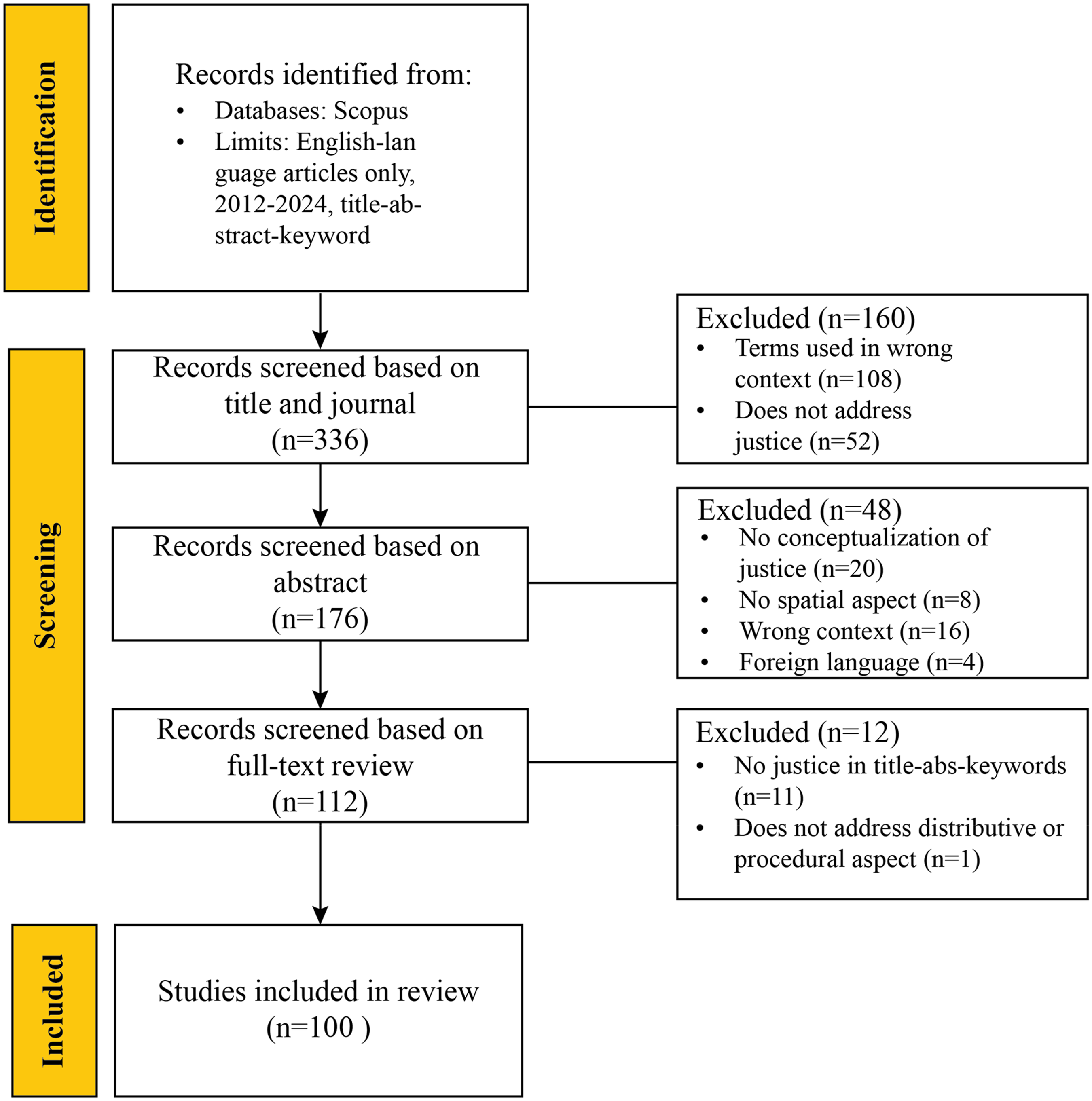
Flow chart of systematic literature review process (PRISMA).
Next, 336 articles were screened based on the presence of these terms in article and journal titles, abstracts, or keywords, ensuring relevance to spatial planning and justice. The search strings yielded a diverse range of articles, including some appearing in journals unrelated to spatial planning, such as workplace management. In addition, the search yielded publications that were related to spatial planning but not justice, which required further screening. In the screening phase, 176 articles were excluded based on the title and journal, 48 articles were excluded based on the abstract, and 12 more were excluded based on a full-text screening. The final sample for analysis comprised 100 articles.
Analysis Approach
A combined inductive and deductive approach was used to analyze the sample. While conceptions and domains were predetermined deductively, markers were collected inductively. Thematic analysis of the full publication texts was conducted through coding using ATLAS.ti software for (a) the topics in which the article is positioned, (b) the markers used for just solutions or approaches, (c) procedural and/or distributive domains, and (d) the conceptions of justice used in the research.
This approach was operationalized as follows:
Topics are typically found within the journal or article title and in some cases within the aim and scope of a journal. For example, Graham et al.’s (2015) contribution titled “Towards fair local outcomes in adaptation to sea-level rise,” which was published in Climatic Change, indicates the topic of climate adaptation. Markers signal discussions of what justice is or what it should lead to and often embody abstract ideals. Terms that indicate how and when a planning outcome or process is just were coded. A major challenge here was the wide range of markers and their differing applications depending on the perspective of the article. For example, “Distributive justice’ concerns fairness in the outcome, that is the distribution of costs and benefits” (Knudsen et al. 2015, 300) was coded with fairness and cost-benefit division. Domains of justice were determined through explicit definitions or mention by authors such as “We draw on procedural environmental justice because of its emphasis on fair processes as opposed to fair outcomes and because of the interdependent relationship between participation and just procedure” (Carrick et al. 2022, 4). However, the frequency of definitions and mentions is not always definitive of which domains are more prominently featured and further coding of the full text was necessary. Conceptions of justice were identified when they were explicitly used by authors, such as in the statement “A second ground on which justice is made to matter is human wellbeing. A utilitarian approach centers the greatest happiness principle to achieve human wellbeing: the goal for a just society is the greatest good and the least harm for the greatest number of people” (Wijsman and Berbés-Blázquez 2022, 382). Often, though, an implicit identification had to be made by coding synonymous keywords used in a context, such as “equal” signaling egalitarianism. For instance, Carrick et al. (2022, 4) define justice “to comprise three interrelated and interdependent elements: equal distribution of environmental risks; fairness of procedures; and recognition for other participants, issues, and values, irrespective of position and identity.”
Results
The results of the full-text reviews revealed publications that spanned several topics, with 43% coming from spatial planning, 21% from energy studies, 17% from policy science, 16% from environmental sciences, and 3% from transportation studies. Aside from the observations about justice conceptions and markers, we also found the use of a wide variety of justice frames in the reviewed articles. These frames differ from the domains because they relate more to a specific thematic field and object to which the conceptions of justice are applied. The justice frames include environmental justice (n = 46), social justice (n = 37), spatial justice (n = 29), energy justice (n = 19), and climate justice (n = 11).
Markers and Domains
The results of our study yielded 25 different markers, which most often appeared in the introduction or discussion sections of the articles. The markers can be grouped according to the domains of justice they operationalize. Five studies did not mention either of the two domains in their studies (De Blust et al. 2022; Eugenio Pappalardo, Zanetti, and Todeschi 2023; Humberto 2023; Pries 2022; Sotiropoulos 2022). While most studies covered both domains in their research, there were more studies who only covered distributive justice (n = 12) than studies who only covered procedural justice (n = 2).
The markers used most regularly in combination with distributive justice were cost and benefit division, equality, fairness, and equity. For procedural justice, the most regular markers were participation, transparency, representation, recognition, and co-creation. As Figure 2 shows, cost-benefit distribution is mostly used to describe distributive justice, whereas participation is almost exclusively used to describe procedural justice. Many other markers such as fairness, perceived justice, social acceptance, equity, and equality appeared regularly in both justice domains. Figure 3 shows how various markers relate to the two justice domains discussed in this study. The diagram clearly shows that the markers equality, equity, and fairness are roughly equally used to describe both domains, while the markers cost-benefit distribution and participation are more aligned with only distributive or procedural justice, respectively. Below, we explore how the most frequently used markers connect to procedural and distributive justice. We analyze how authors interpret and apply these markers in different ways, even when the marker itself remains consistent. One reason for focusing on the most frequently used markers is to provide a reflection of the language most commonly used by scholars in the field, highlighting how these markers are used differently across studies. The second reason is that we can conduct a more robust analysis of emerging themes with a larger sample size. However, we also examine perceived justice as a less common marker, as it reveals important patterns.

Graph with the most often used markers for justice and their frequency of occurrence. It also shows the number of studies in which markers co-occurred in the text with either procedural or distributive justice.

Diagram showing co-occurrence between markers (green) and justice domains (yellow). The closer a marker appears to a domain, the stronger it can be associated with that domain. The thicker the line, the greater its co-occurrence.
Cost-Benefit Division
Cost-benefit division or distribution was used as a marker for justice in 71 out of 100 articles, with the strongest co-occurrence emerging with the domain of distributive justice (n = 61). The term describes how externalities are defined and to whom and where the burden of these externalities is redistributed. However, it rarely appears on its own, as it usually refers to an instrument or an outcome of justice in tandem with other markers.
For instance, 31 articles discuss addressing distributive justice by applying an equal (n = 16) or equitable (n = 15) cost-benefit distribution (e.g., Garvey et al. 2022; Upham, Sovacool, and Ghosh 2022). Twenty-four articles associate distributive justice with fair cost-benefit distribution (e.g., Begg 2018; Li et al. 2019). Twenty-two articles name cost-benefit distribution or division as a marker for distributive justice, without using another marker to describe in what way that distribution should be made (e.g., Jafino, Kwakkel, and Klijn 2022; Riedel et al. 2015).
Participation
Participation is used as a marker for justice in 79 out of the 100 articles and shows a strong co-occurrence with the domain of procedural justice (n = 54). Some articles use participation as a marker of procedural justice without further elaboration (e.g., Anguelovski et al. 2020; Dadashpoor and Alvandipour 2020). For instance, Anguelovski et al. (2020) mention that participatory planning processes can co-opt the demands of environmental justice groups, without further explaining what those participatory processes could look like. Moreover, some articles define procedural justice by describing injustice (Cotton 2017; Riedel et al. 2015; Sankaran et al. 2022), showing how an absence of participation or inaccessible planning processes lead to procedural injustice. However, they do not clarify what type of participation ensures procedural justice.
A few of the articles surveyed use a very clear set of planning measures that can be used to increase procedural justice through participation, such as resident steering communities, closely partnering with local nonprofits and activist organizations (Hoover et al. 2021), public opinion surveys, and participatory budgeting (Nguyen and Batel 2021).
Fairness
Fairness is used as a marker in most articles (59 out of 100), encompassing both procedural (n = 29) and distributive justice (n = 33). Two distinct uses of fairness as a marker of justice were identified.
First, fairness is used to describe procedural or distributive justice without further elaboration. Descriptions, such as “Distributive justice concerns fairness in the outcome, that is, the distribution of costs and benefits” (Knudsen et al. 2015, 300), are found in many articles describing distributive justice (e.g., Begg 2018; Pasetto, Mattioli, and Marsili 2019). The same was observed in descriptions for procedural justice, such as “…procedural justice is concerned with the fairness of the process by which decisions are made” (Kerselaers et al. 2013, 202).
Second, fairness is often linked with equity or equality as additional markers of justice, emphasizing the fair and equal distribution of resources and opportunities in social space (Ghaderi Hajat and Hfeznia 2020).
Equity
Equity is used as a marker for justice in 49 out of the 100 articles and is used more often to describe distributive justice (n = 28) than procedural justice (n = 13). Several articles discuss distributive justice as focused on equity in the distribution of benefits and burdens (e.g., Rogge, Dessein, and Verhoeve 2013; Wang, Dodd, and Ko 2022). Equity is used as a marker for procedural justice as well, describing procedural justice as “process equity” (Perrin and Nougaredes 2022, 123) or by equating participation to procedural equity (Fitzgerald 2022).
Equality
Forty-seven out of 100 articles use equality as a marker of justice. The use of this marker evokes a clearer idea of what distribution or procedures can look like, because as a principle, it is not as widely interpretable as fairness. Thus, authors tend to use equality more often as a marker of distributive justice (n = 25) than for procedural justice (n = 17). For distributive justice, equality is often applied in discussing the distribution of resources and opportunities (Ghaderi Hajat and Hfeznia 2020), per capita distribution of resources (Wu and Liu 2022), allocation of benefits and burdens (Garvey et al. 2022; Radtke and Ohlhorst 2021), access to environmental benefits and exposure to pollution (Hoover et al. 2021), distribution of environmental risks (Carrick et al. 2022), spatial primary goods (Basta 2016), and intergenerational distribution of resources (Graham et al. 2015). For procedural justice, equality is mostly used to describe the desired distribution of power between stakeholders (Knudsen et al. 2015; Otsuki 2021), sharing of power among participants (Begg 2018) or the rights, opportunities, and capacity to participate (Carrick et al. 2022).
Perceived Justice
Although perceived justice was not among the most frequently used markers, it is still significant, appearing in 14 articles. The marker is more commonly associated with procedural justice (n = 7) than distributive justice (n = 3). The literature reveals two distinct uses of this marker. First, some authors use perceived justice to reflect stakeholders’ ability to voice their perceptions of injustice, linking it to procedural justice (Bailey and Darkal 2018; Mueller and Brooks 2020). For example, Perrin and Nougaredes (2022) argue that “the procedure should ensure that stakeholders are able to publicly express feelings of injustice” (129). Second, perceived justice is framed as a broader marker, where it becomes a goal in itself. In this context, perceived justice is equated with stakeholders’ perceptions of justice: if stakeholders perceive an outcome or process as just, it is deemed just (Begg 2018; Li et al. 2023; Schmitt and Weck 2024).
Conceptions of Justice
Generally, conceptions of justice were not explicitly addressed in the reviewed articles, but rather implied. Key exceptions were Ghaderi Hajat and Hfeznia (2020) for utilitarianism; Wang, Chen, and Long (2018) for libertarianism; and Jafino, Kwakkel, and Klijn (2022), Garvey et al. (2022), and Sotiropoulos (2022) for egalitarianism.
Utilitarianism
Ghaderi Hajat and Hfeznia's (2020) study stands out as the only article that explicitly uses utilitarianism as their conception of justice. Their research focuses on spatial justice and spatial planning in Iran. They define spatial planning as “the optimal distribution of a population and activities in a space such that each territory enjoys a proper spectrum of social and economic activities in proportion with its potentialities, needs, and location” (Ghaderi Hajat and Hfeznia 2020, 359) and use markers such as participation, transparency, effectiveness, and efficiency. Especially the use of efficiency and effectiveness shows an explicit use of utilitarianism as a conception of justice. On the other hand, the authors also write how inequality in the distribution of power, wealth, and opportunities are challenges to achieving spatial justice (ibid). Finally, while inequality is a marker more strongly aligned with egalitarianism, the authors present a utilitarian approach to justice to decrease inequality, showing the overlap in outcomes between different justice conceptions. Given that the goal of utilitarianism is to optimize overall well-being, reducing inequality can play an important role in achieving that goal.
Other articles mention utilitarianism but do not clearly operationalize the conception. Utilitarianism is described as maximizing the aggregate happiness of individuals (Begg 2018; Thaler, Doorn, and Hartmann 2020), growing the “societal pie” and accepting a skewed distribution of the results of growth (van Vulpen 2022), or achieving the greatest good and the least harm for the greatest number of people (Liebe and Dobers 2020).
Libertarianism
Wang, Chen, and Long (2018) used libertarianism in the context of perceptions of rural land distribution in China. They used self-interest theory to show that individuals perceive distributive justice more favorably when their social and economic status improves. This aligns with libertarianism's, emphasis on individual rights and freedoms. Here, distributive justice is seen not as an equalization of outcomes, but as a voluntary exchange of resources.
Other articles (e.g., Thaler, Doorn, and Hartmann 2020; Vejchodská, Shahab, and Hartmann 2022) that explicitly mention libertarianism as a conception of justice base their discussion on the findings of Hartmann and Spit (2015), who state that libertarian justice emphasizes individual liberty and minimal state involvement.
Egalitarianism
Compared to articles that use utilitarianism or libertarianism as conceptions of justice, the 21 articles that employ egalitarianism as a conception of justice present a striking contrast. Out of these articles, only three explicitly name egalitarianism as a justice conception, and across these three, egalitarianism is described in several ways. For instance, Jafino, Kwakkel, and Klijn (2022) discuss egalitarianism as a moral principle gaining prominence in the climate justice field. Garvey et al. (2022) refer to the term as “luck-egalitarianism,” which aims to address spatial differences that occur organically. Lastly, Sotiropoulos (2022) describes egalitarianism as “horizontal-egalitarian justice,” emphasizing its contrast with institutional vertical hierarchy. This reflects the conception of egalitarianism, which focuses on the equal distribution of burdens and benefits to reduce inequalities in resources and opportunities.
The other 18 articles implicitly use egalitarianism through markers such as equality (Carrick et al. 2022; Knudsen et al. 2015; Pries 2022; Schwenkenbecher 2017; Upham, Sovacool, and Ghosh 2022; Wu and Liu 2022), inequality (Langemeyer and Connolly 2020; Otsuki 2021; Verheij and Corrêa Nunes 2021), equity (Fitzgerald 2022; Li et al. 2019; Nylund 2014), putting the vulnerable first (Evensen 2016; Graham et al. 2015; Jafino, Kwakkel, and Klijn 2022; Mohtat and Khirfan 2022), or universal access (Bailey and Darkal 2018; Pries 2022).
The Example of Participation
This section delves deeper into the marker participation as an example from our results. As the most frequently occurring marker for procedural justice, participation requires a more nuanced explanation to illustrate how its multifaceted dimensions encompass both justice domains and conceptions. It is important to note that this in-depth exploration is intended purely as an example. A similar analysis could have been conducted for other markers with a comparable sample size.
Many articles describe the need for procedures to be equally accessible to all, implying a relation to egalitarian justice. While this finding does not specify which form of participation is necessary for more just procedures, it does imply that participation should not be exclusionary. For example, Kato-Huerta and Geneletti (2022) discuss how this connection between accessibility and equal representation is often made in relation to participation: “… all parties should be able to meaningfully and representatively participate in the process” (124). Similar approaches can also be seen in other papers (Vasstrøm and Lysgård 2021; Wang, Dodd, and Ko 2022). Relating participation to equality also aligns participation with egalitarianism. However, the results do not show an explicit co-occurrence between participation and egalitarianism, utilitarianism, or libertarianism.
In addition, participation and recognition are two intertwined markers in procedural justice, as highlighted by Schlosberg (2007, 26), who writes, “If you are not recognized, you do not participate; if you do not participate, you are not recognized.” This notion of indivisibility between participation and recognition is echoed in various articles. For example, Verheij and Corrêa Nunes (2021) employ Schlosberg's argument verbatim in their depiction of procedural justice and participation. Dekker, Van Koppen, and Buijs (2022) and Anguelovski et al. (2020) emphasize the importance of involving cultural minorities in decision-making processes and participation.
As Arnstein (1969) documented with her widely known “participation ladder,” participation in planning ranges from relatively superficial information sharing to transformative power redistribution. We do not propose a single ideal form of participation to achieve procedural justice, as it is highly context-dependent. However, clarity about this in planning research and practice is very important. In our review, we found inconsistencies in specifying which forms of participation should be used to enhance procedural justice, with some studies adopting specific ladder rungs without consensus. We explain those inconsistencies below through the identification of three rungs of participation in our sample.
The first rung corresponds to the highest levels on the participation ladder, which are based on the redistribution of power. Some articles advocate for participatory processes that aim to redistribute power from dominant planners and stakeholders. Knudsen et al. (2015) emphasize the importance of broad participation and sharing decision-making power as key components of procedural justice. Similarly, Wilmsen and Rogers (2019) and Graham et al. (2015) highlight the need to critically examine questions of participation and power distribution in the pursuit of procedural justice. Further, Albrechts, Barbanente, and Monno (2019) argue for empowering citizens through new governance cultures to challenge existing power relations. Begg (2018) takes a more ambitious stance, asserting that “environmental decision-making procedures are only fair when power is shared equally among (potential) participants” (385).
The second rung that emerged in our sample refers to consultation and involves the use of local knowledge and expertise without the transfer of decision-making power. Nylund (2014) writes that municipalities should prepare draft plans for public consultation before finalizing any plan. Bailey and Darkal (2018) describe procedural justice as the promotion of stakeholder participation to use local knowledge, which is a form of consultation.
The third rung refers to information, which is the lowest level of participation (Arnstein 1969). Here, Carrick et al. (2022) describe participation as stakeholders having access to information. Rogge, Dessein, and Verhoeve (2013) identified characteristics of procedural justice, which include allowing for public access to information to help the public understand development issues.
This highlights the multitude of interpretations of a single marker and the need for greater transparency. Participation can take different forms depending on the justice context, making it essential to specify its type in justice discussions. Simply advising practitioners to include participation is not enough—research should also examine what type of participation, where, and when it enhances justice. By exploring this marker, we want to compel scholars to reflect on their own and their peers’ language use, encouraging a deeper understanding of the nuances underlying justice markers.
Discussion
This literature review investigates markers used in spatial planning research to express what is considered “just.” Over the past decade, different perspectives on justice have enriched the discourse, leading to a broad variety of interpretations. Some markers align more clearly with specific justice domains and conceptions, offering a foundation for explicit discussions on the often implicit moral values that shape real-world planning decisions.
Dynamic Nature of Justice
Our results show that many articles (n = 23) stated that justice is a contextual concept open to various interpretations. Paradoxically, many articles that address the subjective nature of justice still include pluralistic markers in their own operationalizations, making it difficult to express the variety between justice conceptions. For example, Wijsman and Berbés-Blázquez (2022, 378) write how “justice is not a static ‘thing’ to be achieved through formalized protocols and procedures but is instead better understood as a constantly redefined and negotiated ideal,” a finding that is similar to other interpretations (e.g., Jonkman and Janssen-Jansen 2018; Thaler, Doorn, and Hartmann 2020). Other articles emphasize the importance of differing interpretations between several types of stakeholders, particularly between planners and the communities they work in (Hoover et al. 2021; Liebe and Dobers 2020). For instance, Li et al. (2019, 170) write how Western conceptions of justice may take on different meanings in China, which illustrates the importance of adapting justice discourses for a diversity of cultural contexts.
Justice is inherently malleable, shaped by who interprets it and who benefits from processes or outcomes. In spatial planning, where common resources are at stake, public interests should ideally be balanced. However, justice perceptions shift depending on stakeholders’ positions (Van Hootegem, Abts, and Meuleman 2020). Here, an operationalization of justice built on common values and goals is important. Yet, this review finds that current justice discourses do not necessarily help with the translation of justice into tangible measures. Most articles lean on pluralistic markers, ultimately placing the responsibility of determining justice's exact meaning on the shoulders of other researchers and practitioners. Since planning involves procedural decisions and resource distribution, the acceptability of planning varies among stakeholders. The dominant use of pluralistic markers to operationalize justice complicates the practitioner's role.
So, how should researchers and practitioners handle a normative concept that is dynamic? Decades of justice theory provide a solid foundation, but bridging the gap from abstract theory to empirical research and practice remains challenging.
Implicit Preference for Egalitarianism
The results of this study suggest that academics often favor egalitarianism as a justice conception, showing a clear preference to equate justice with egalitarianism. This might suggest that, for planners, the public interest generally equates taking approaches that promote a more egalitarian society.
It is therefore important to recognize the limitations of egalitarianism, particularly across temporal and spatial scales. Ensuring an equal distribution of amenities, for example, could require major changes to existing spatial configurations (Buitelaar 2018).
Furthermore, “equally dividing costs and benefits” takes a static view of costs and benefits, ignoring their evolution over time. A striking example is the Noordoostpolder in the Netherlands, an experiment in engineered spatial equality. Designed for equal access, towns were placed equidistant, based on a comfortable biking distance, and provided identical amenities, including churches and schools (Vriend 2022). Citizens for these new towns were selected by the government to represent various social groups (Vriend 2022). While initially successful, this rigid egalitarian design struggled to adapt to societal shifts, such as farming mechanization, leading to economic decline and underdevelopment (Rot 2022).
This example shows how benefits to one generation can limit future benefits. This does not only relate to changing societal demands but also to the finite nature of many spatial resources. To include future generations into egalitarian thinking, we need to consider resource limits (Raworth 2012). Thus, by focusing on current injustices, egalitarianism often overlooks global and intergenerational justice factors.
Links Between Distributive and Procedural Justice
Planning theory has long acknowledged the reciprocal relationship between procedural and distributive justice (Campbell and Marshall 2002; Pirie 1983; Uitermark and Nicholls 2017). Recent research by Pérez Figueroa and Ulibarri (2024) underscores this connection: failures in procedural justice can undermine the effectiveness of distributive measures, while unresolved distributive injustices can erode trust in procedural mechanisms. Moreover, empirical findings demonstrate that perceptions of procedural justice can influence preferences for specific distributive outcomes (Hammond Wagner and Niles 2020). So, while the outcomes of planning processes should be evaluated for their degree of justice through a distributive lens, the procedural component is essential for ensuring that the decision-making process adheres to a consistent standard of justice (Reynolds and Shelley 1985).
While most articles that incorporate both domains describe how they should be considered, only one study explicitly discusses their reciprocal influence (Schmitt and Weck 2024). It is possible that situations arise in which an agreed-upon procedure which is perceived as just by stakeholders results in a redistribution of costs and benefits that stakeholders find unjust, and vice versa. The question remains to what extent it matters whether “just outcomes” are achieved through unjust procedures (Pirie 1983). One could say that outcomes are more important because they influence more than just the stakeholders involved in the process, but also future generations, the landscape, and nonhuman actors, whereas the planning process itself is only perceived as just or unjust by stakeholders, who happen to be involved only for a limited time. Schmitt and Weck (2024) confirm through reviewing case studies that a just process does not always guarantee a just outcome; but outcomes can be positively evaluated even if the process is seen as unjust (766). This challenges planners’ responsibility: they not only plan to ensure local support but also advocate for the public interest, with its own pluralistic definition (Dadashpoor, Sheydayi, and Esmaeili 2024; Machakaire and Mokhele 2024). Procedural justice, with participation as the main medium to achieve it, is closely tied to power relations as it involves redistributing power and legitimizing the claim to represent the public interest (Bailey and Darkal 2018; Machakaire and Mokhele 2024).
The case of the nitrogen crisis in the Netherlands 1 displays the tension between distributive and procedural justice. In 2019, the national government was faced with a national building permit gridlock because of long-term excesses of nitrogen emissions in the agricultural sector, industry, and construction (Selnes 2023). The national government released a top-down plan which presented an outcome in which the quality of natural landscapes would be restored and would achieve a more egalitarian distribution of the burden of nitrogen emissions in the country. However, this plan lacked a clear pathway towards that outcome, especially for livestock farmers. Large farmers’ protests ensued for weeks, which led the government to retract the plan. Ever since, the government has been working on putting more emphasis on a just process, making sure farmers feel heard, but as a result, the outcomes (i.e., nature restoration and a viable economic solution for many farmers) keep getting postponed. This shows how procedural and distributive justice can influence each other and that the two cannot be treated separately. Future research could explore this link in more detail, particularly with respect to different justice conceptions and if or how they are expressed within the two domains.
Discourse Diversity
The results also show topics for which justice becomes increasingly relevant in both theory and practice. Frames such as environmental and social justice seem to be popular (e.g., Pratt 2023; Touché 2004). Articles tackling multiple justice frames also suggest that achieving greater levels of justice in one aspect can sometimes cause injustice in another. For example, Nguyen and Batel (2021) discuss how the siting of renewable energy infrastructures, to address issues of energy justice, can give rise to social injustice:
“This transpires when political, economic, environmental, psycho-social and health impacts of those infrastructures and related technologies are not recognized, considered, nor distributed equally” (Nguyen and Batel 2021, 3). Other researchers, notably Jenkins (2018), acknowledge how frames can build upon each other. “The origins of the energy justice literature are largely reported as coming from activist accounts of energy issues using the environmental justice frame—a precursor to the energy justice concept which shares overlapping philosophical groundings” (Jenkins 2018, 67). This review spans several justice frames, including environmental, spatial, and energy justice, which all build on the values of egalitarianism. However, when these frames are covered in empirical research, the connection to egalitarianism is rarely explicitly made.
Study Limitations
Our findings predominantly revealed implicit uses of justice conceptions, suggesting that justice and its various markers are often intertwined with alternative terminologies. While terms like fairness and equality are commonly used interchangeably with justice, they were excluded from the search strings to maintain a focused exploration of this specific justice-related discourse.
Also, spatial planning itself has multiple names, including “land use planning,” “regional planning,” and “urban planning.” While these fields may have subtle distinctions, they share a theoretical foundation. In choosing to narrow our scope to the term “spatial planning,” we may have overlooked literature from other contexts.
Future research could expand its scope to better reflect linguistic diversity. Additionally, since participation was more extensively covered in this study, future research could shift attention to other markers.
Furthermore, exploring the historical evolution of justice in planning could add valuable context. A historical analysis would provide deeper insights into the societal and geographical shifts in the justice discourse. Future research could investigate how justice has been operationalized across different time periods and institutional contexts.
Conclusion
Justice considerations in spatial planning have gained prominence over the past decade, yet our study shows that few articles explicitly articulate their approach to conceptualizing and operationalizing justice. From the 100 articles reviewed, egalitarianism emerged as the dominant justice conception, often implicitly conveyed through markers like equity and equality. Markers such as fairness and participation allow for interpretive flexibility, leading to a plurality of meanings in practice. The resulting lack of transparency complicates the practical application of knowledge generated by these articles.
As we have discussed before, the example of the Nota Ruimte in the Netherlands demonstrates how the practical application of justice conceptions can lead to conflicting principles. Such conflicts can result in inconsistent applications, procedures, and outcomes in planning, further diluting the understanding of justice in practice.
Our study also highlights the underexplored connection between procedural and distributive justice. Without examining how these domains connect, planning academics risk overlooking critical ethical dimensions that can affect the distribution of resources in society and the perceived justice of the planning process itself.
In essence, this study both maps the current discourse on justice operationalization in spatial planning and pushes for the integration of ethics, theory, and practice. By taking a step back, we examined the broader justice landscape, including multiple topics, markers, domains, and conceptions.
While specific explorations of justice topics exist, this systematic review of justice operationalization in the broad field of spatial planning is a novel contribution. Our findings emphasize the importance of transparency, explicitness, and conceptual clarity in the discourse of justice in spatial planning research. By clearly articulating their chosen justice conception, using markers with limited interpretive flexibility, and examining the interplay between procedural and distributive justice, planning scholars can provide more actionable guidance and contribute to a more ethical and just approach to research and practice. Future research could explore the practical applicability of these findings by applying the markers and justice conceptions to concrete planning case studies. This can help develop actionable recommendations for practice, finding out how the markers used by scholars compare to those used by different stakeholders in real-world settings.
Footnotes
Acknowledgements
I thank my promotor, Martha Bakker, for her valuable guidance, my colleague for their helpful language editing at an earlier stage, and the editor and anonymous peer reviewers for their constructive feedback.
Declaration of Conflicting Interests
The authors declared no potential conflicts of interest with respect to the research, authorship, and/or publication of this article.
Funding
The authors received no financial support for the research, authorship, and/or publication of this article.
