



Abstract
This article advances an understanding of urban regeneration shaped by accumulation by dispossession theory. Using available urban regeneration scholarship, we examine the framings and outcomes of urban regeneration projects and community responses. This analysis contributes to understanding urban regeneration thinking in global South cities, and the neoliberal strategies that make them attractive to state actors and problematic for vulnerable urban residents. The analysis focuses on Sub-Saharan African cities—a region where informality is dominant and urban regeneration is common. The findings indicate that the dispossession dynamics and consequences of urban regeneration reflect the globalization of neoliberal strategies facilitated by the state.
Introduction
In the face of slum growth and proliferation, inequality, environmental degradation, and other negative externalities associated with informal urbanization and climate change, especially in Sub-Saharan Africa (SSA), there is increasing scholarly interest in urban regeneration (Cirolia 2020; Govender and Reddy 2020; Pariente 2017; Spire and Choplin 2018). Urban regeneration projects follow an existing urban infrastructure deficit which is incommensurate with unprecedented urban population growth in the subregion (Turok 2016), and existing projections that show that the region could account for over 50% of the global population between 2019 and 2050 (United Nations Department of Economic and Social Affairs (UNDESA), 2022). For example, the UN-Habitat (2018) 1 reports that 54% of the SSA urban populace live in slums, and they are characterized by poor housing conditions and deprived environmental and sanitary conditions (Doe, Peprah, and Chidziwisano 2020; Muchadenyika and Waiswa 2018). Considered as having a significant potential to address the negative implications of slums in SSA, many cities across the subregion have embraced urban regeneration projects (Asante and Helbrecht 2022).
Although following the Second World War, urban regeneration was narrowly conceptualized as slum clearance, it has now evolved to encapsulate the improvement of urban competitiveness within the context of globalization (Xie, Liu, and Zhuang 2021). Characterized as a long term, transformative process of revitalization that involves disruption and risk, urban regeneration has emerged and evolved as an umbrella concept for various strategies of urban development projects focusing on restoring profitability, including urban redevelopment, urban renewal, and urban reconstruction (Castree, Kitchin, and Rogers 2013; Pan and Cobbinah 2023; Xie, Liu, and Zhuang 2021). For example, urban regeneration in the SSA cities largely takes the form of market renewals (Amoako, Adjei-Poku, and Dankyi 2022), slum upgrading (Agayi and Sağ 2020; Muchadenyika and Waiswa 2018), low-income housing development (Ibem 2013), as well as mega housing and road infrastructure developments (Amoah, Owusu-Sekyere, and Angmor 2019; Kotze and de Vries 2019). Often neoliberal in nature, regeneration projects in SSA are defined by the coercive displacement of street hawkers and traders as well as the demolishing of informal settlements from the city space (Adama 2021; Waldorff 2016) to create a perceived conducive environment for private investments to thrive (Gillespie 2020). Through these regeneration interventions, city authorities engage in “the enclosure of the urban commons” through discursive and physical–legal strategies (Gillespie 2016). Despite extensive empirical documentation of entrepreneurial tendencies to implement the Western conception of modernization via regeneration projects in African cities (Enns and Bersaglio 2020; Olajide and Lawanson 2022), much remains to be learned about how they emerge, the factors that make them a political tool for displacement, how such enclosures affect the urban proletariat and how they respond to them in SSA. The term, urban proletariat, is normally reserved for the urban working-class people in most writings, but in this study, the term is an embodiment of all members in urban spaces who are subjects of and negatively affected by urban regeneration interventions. The urban spaces include the markets, streets, slums, and other common spaces within the city that the proletariat lay claim to in SSA.
We use accumulation by dispossession theory (Harvey 2003) to inquire: What are the framings and outcomes of urban regeneration in SSA cities? How do urban residents respond to urban regeneration? And what insights can be derived from urban regeneration to drive future improvement in the SSA? In addressing these questions, we attempt to position this study at the center of current research on urban regeneration and dispossession nexus. In so doing, we generate a comprehensive picture of the realities of an increasingly ubiquitous practice with the aim to improve policy and urban regeneration planning interventions for cities of SSA. Some scholars have argued that the dynamics of urban regeneration in the global South are different from that of the global North (Abass and Kucukmehmetoglu 2021). While regeneration projects are used as a means to formalize informal areas in cities of the South, regeneration projects in global North cities are not necessarily for formalization, but usually as a planning response for a particular urban need based on political and social reaction (Mehdipour and Nia 2013). However, whether in the global South or North, Smith (2002) has argued that urban regeneration in cities leads to gentrification across the globe (also see Smith 2017). We support and extend this argument by demonstrating that the current development state of countries in Africa makes the negative experiences of urban regeneration among the urban poor extreme, especially in the face of nonexistent safety nets and the implementation of neoliberal policies discouraging any investment in the welfare of the poor.
Our analysis calls for a shift in urban scholarship from the global North to the global South (see Schindler 2017) by interrogating the theory of accumulation by dispossession within the context of urban regeneration. This is because the current model rooted in the global North becomes deficient when extended to the South due to differences in urban characteristics. The shift we call for is based on the argument that the possession by accumulation in the global South may have exaggerated effects and give reasons for the more pronounced consequences.
This article is organized as follows: the next section on research approach briefly presents the data collection and analysis methods used. Framings of urban regeneration section conceptualizes urban regeneration to set the tone for appreciation of its breadth and scope, and how it is relevant to African urban space. It further provides an analysis of urban informality as the foundation of urban regeneration in Africa. Next is an analysis of the accumulation by dispossession theory and its contextualization within the framework of urban regeneration. The framings and outcomes of urban regeneration as well as urban residents’ responses are further discussed. We provide critical reflections on dispossession tendencies of regeneration and proletariat response in the discussion section. The concluding remarks are finally presented.
Data Collection and Analysis
We reviewed empirical studies on urban regeneration in SSA. We used secondary data to understand the framings and outcomes of urban regeneration on the urban proletariat as well as how the proletariat responds to the dispossession tendencies of urban regeneration in SSA. We used the Google Scholar search engine as well as major electronic databases such as Scopus and ProQuest. Scopus and ProQuest as multidisciplinary databases have comprehensive bibliometric data on urban development and planning studies. Their usage in this study provided well refined results in relation to our keywords search. Search criteria were designed prior to searching the databases and included articles authored in the English Language with a geographic focus on SSA, and the time frame was limited to articles published since the year 2000.
First, to understand the framings and outcomes of urban regeneration on the urban proletariat, the following keywords were used in the search: urban regeneration, urban renewal, urban revitalization, slum upgrading, market renewal, urban poor, informal settlement, and slum dwellers, street traders, and hawkers. The literature search began with a search for phrases combining these keywords with “impact,” “effect,” “character,” and “manifestation.” To understand the response strategies of the urban proletariat to urban regeneration, we combined the above keywords with “resistance,” “response,” and “strategies” in our search. Only journal articles, book chapters, and a book were selected for this analysis.
The year 2000 was used as the base year to better appreciate the dynamics of urban regeneration in SSA over the past two decades: since the coming into effect of the Millennium Development Goals which served as the first internationally coordinated response to improve the living conditions of the urban poor (Goal 1: Eradicate extreme poverty and hunger), and subsequently the Sustainable Development Goals. A total of 64 studies with explicit consideration of the character and responses to urban regeneration in SSA were analyzed. The highest number of studies came from Nigeria, and the lowest was from Burkina Faso (see Figure 1). Each of these studies was analyzed inductively through qualitative content analysis following the process outlined by Schreier (2014). This involved determining the research questions, selecting, and screening the studies, establishing a coding frame, segmentation, trial coding, appraising, and adjusting the coding frame, and analyzing and presenting the findings.
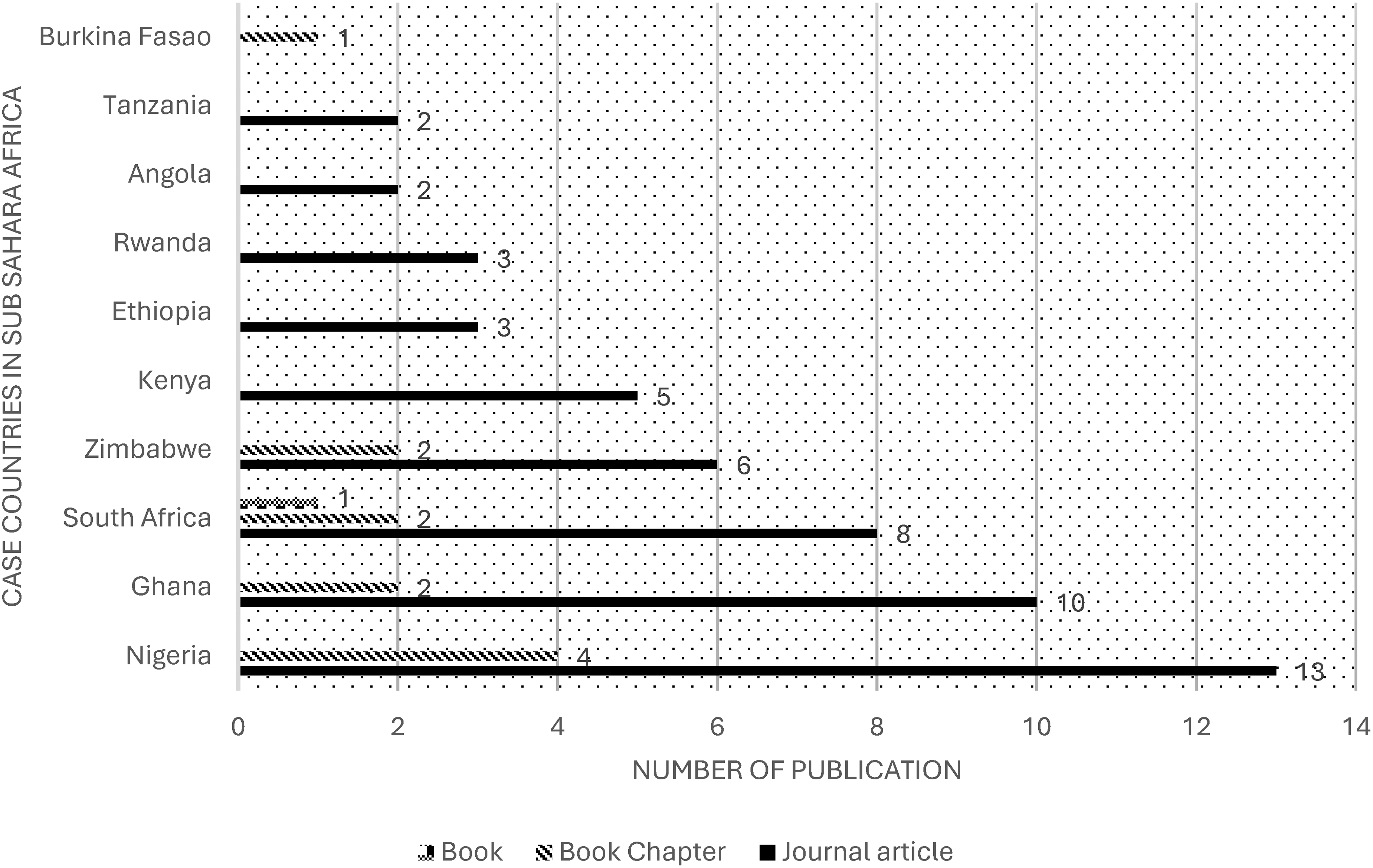
Urban regeneration publications per country (from 2000 to 2022).
Diversity of Publications Considered
The publications considered covered diverse urban regeneration interventions in case-specific contexts in SSA ranging from housing (re)development; market renewal; slum clearance, upgrading and renewal; eviction; resettlement; and inner-city renewal. Based on the studies considered and analyzed, we consider urban regeneration as a compound intervention, an embodiment of different urban projects. Urban regeneration is loosely viewed in this work to capture all urban interventions that seek to revitalize, renew, and improve the image of an urban setting. While this may arguably be considered a subtle misconstruction of urban regeneration from a critical diagnostic perspective of urban planning interventions, such a limitation paradoxically serves as the strength of our paper as it allows us to put urban (re)development projects to a reality check through a review approach to ascertain how they impact the urban proletariat following implementation. Again, it allows us to skip the practical impossibility of finding out which urban interventions were considered urban regeneration by implementing agencies across SSA; something beyond the scope of our contribution which is basically a review study.
The diversity of urban regeneration Interventions shows that while some urban generation projects (e.g., slum upgrading) are not expected to result in dispossession, their practical manifestations may show otherwise—our analysis of outcomes of urban regeneration tends to support the manifold adverse consequences of urban regeneration on the urban proletariat.
To visualize the diversity of publications used for our study, we relied on VOSviewer (see Figure 2). This was done based on “co-authorship” and “author analysis” based on “full counting,” to identify the “total link strength” of each author cited in the work. The highest “total link strength” was 7, and the lowest, 0; and characterized by more than 50 clusters. This analysis shows that we considered a wide variety of works for our study to ensure that diverse findings in case-specific contexts across SSA are considered. None of the authors (and coauthors) has more than three of their published works included in the analysis, as we were more interested in diversity and key documents that relate to urban regeneration projects and their outcomes, instead of paper citations, the popularity of publications, and interconnectedness.

Author and coauthor analysis of cited materials (Vosviewer).
Framings of Urban Regeneration
Characterized as urban renewal, redevelopment, revitalization, and renaissance, urban regeneration involves the process of resolving the problems in urban spaces through a set of actions. This set of actions entails a “comprehensive and integrated vision and action which seeks to resolve urban problems and bring about a lasting improvement in the economic, physical, social and environmental condition of an area that has been subject to change or offers opportunities for improvement” (Roberts 2017, 18).
In the developed world, urban regeneration emerged as a political and social reaction to urban areas’ physical, economic, health, and environmental conditions (Mehdipour and Nia 2013). The urban disorders generated by industrialization in the eighteenth and nineteenth centuries provided the milieu where slums “were eventually acknowledged as an unacceptable” urban phenomenon (Roberts 2017, 12). Regeneration in this context was viewed as an instrument for resolving the inequities created by capitalist interventions (Tallon 2013). This background shapes the contemporary framing of regeneration where proponents argue that urban regeneration makes urban environments “more balanced, more attractive, more socially inclusive, more aesthetically harmonious, more environmentally sustainable, and generally much better all round,” (Lovering 2007, 344).
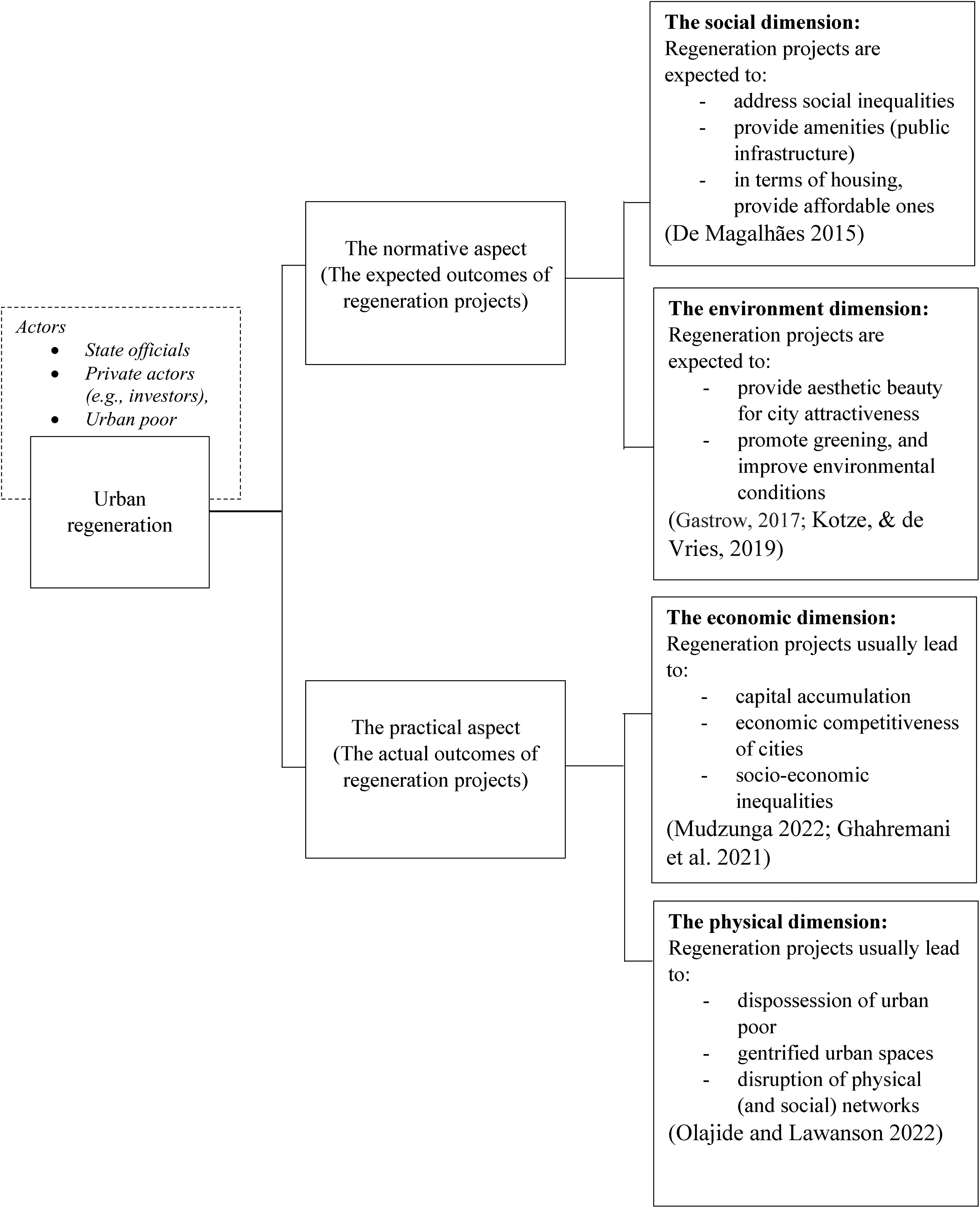
Conceptual outcomes of urban regeneration.
Urban Informality: A Foundation for Urban Regeneration in Africa
Urban informality has widely been conceptualized as the means and process for the growth of urbanization in Africa (Okyere and Kita 2015; UN-Habitat 2014). While the literature is replete with urban informality research (e.g., Azunre et al. 2022; Finn and Cobbinah 2023; Kovacic et al. 2021), its consideration and response in urban planning and politics, and development policies in Africa remain a grey area (Cobbinah 2023). The nature, processes, and patterns of urban informality are yet to be fully understood by policy actors (usually the government officials in African states) (see Banks, Lombard, and Mitlin 2020) as the “traditional” dichotomized concept of informality remains entrenched in African planning ideals and popular discourses: economic (formal vs. informal economy), and legal (conformity to regulated frameworks vs. nonconformity to the regulated frameworks) understanding of informality, and with little understanding of the social forces and sustainability perspectives that unproblematized informality and present it as a means by which vulnerable urban residents cope and survive the brutal presence of the state in the city space (Amoako 2016; Okyere and Kita 2015).
Informality as the central means and process for the growth of African cities comes with sociospatial qualities/nature, which the “paralyzed” formal planning institutions do not understand leading to ill-informed policies and unsustainable planning interventions (Finn 2018; Kreibich 2012). On the one hand, informality in Africa is perceived to pertain to the physical (spatial) nature of urban space, and on the other hand, it is perceived to be concerned with social nature where the “notion of empowerment, manifested by the self-organization of collective survival of the poor, a sort of opportunity-creating tendency,” (Okyere and Kita 2015, 105) in which the proletariat showcases resilience, and work toward improvements in the urban space (Gouverneur 2015). Urban regeneration projects in Africa are more driven by the former than the latter.
Consequently, informality has become the foundation for which urban regeneration is promoted in Africa. As Fält (2016) indicated, there is a tremendous transformation of African city spaces with neoliberal rationalities constantly influencing the organization of city spaces by government officials. The trend of urban modernism and entrepreneurial tendencies manifesting in African cities (Amoah, Owusu-Sekyere, and Angmor 2019; Watson 2014) points to an increasing replacement of informality to “brighten” the image of such cities to meet the “so-called” global standard while pushing the urban poor into intense suffering and poverty due to “unfair” displacement (Asante and Helbrecht 2020; Battersby and Muwowo 2019). This outcome points to the narrow way in which informality has been conceptualized. As Banks, Lombard, and Mitlin (2020) have argued, urban informality goes beyond the formal–informal dichotomy and should be seen as “a site for critical analysis in which political economies at the local, municipal, and national scale are central” (p.223).
We frame urban informality following Banks, Lombard, and Mitlin (2020) argument to enable us to bring to the fore the complex nature of informality: a political subject that is nonstatic in nature and characterized by complex (social) relations and processes that consolidate and enforce (dis)advantage not only to specific domains of people, for example, the urban poor as popularly spearheaded in the literature. In this way, we can visualize the creation (and disruption) of opportunities as well as the (negotiated) processes of how different domains of inequality (political, economic, and social) emerge to disadvantage the urban proletariat in the study. More specifically, viewing informality as a site for critical analysis provides the conceptual basis and synergy with our adopted theory, Harvey's accumulation by dispossession, by focusing on the dense nature of state–society relationships where informality becomes a source of accumulation for private developers via neoliberal-driven urban regeneration projects, and at the same time, a source of dispossession of the urban proletariat. In doing so, we draw (policy) attention to inclusive urban planning and development in African cities—which Cobbinah (2023) refers to as the oddity of desiring informality—that can advance sustainable urban regeneration projects that are beneficial to the urban proletariat.
The Theory of Accumulation by Dispossession
While Marx (1976 [1867]) earlier argued that accumulation is typical at the onset of capitalism referring to such as primitive accumulation, Harvey (2003) contends that accumulation is an ongoing process and hence introduced the concept of accumulation by dispossession. Harvey (2003, 144) substituted primitive accumulation with accumulation by dispossession following his “re-evaluation of the continuous role and persistence of the predatory practices of “primitive” or “original” accumulation within the long historical geography of capital accumulation.” In the capitalist setting, accumulation by dispossession is seen as a key route for the resolution of the problem of overaccumulation. Overaccumulation occurs when surplus capital (and labor) lies idle without any immediate outlet for reinvestment (Harvey 2001). Accumulation by dispossession makes available resources at a low cost for overaccumulated capital to make profitable use of such resources. Under primitive accumulation, this involves the enclosure of common land and expelling its occupants to produce a landless proletariat and making it available for privatization and capital accumulation (Hall 2013).
The state is central in accumulation by dispossession, where it either through legal or extralegal means makes available common assets to market forces for overaccumulated capital to “invest in them, upgrade them, and speculate in them (Harvey 2003, 158). The state perpetrates accumulation by dispossession in some instances even against the will of the masses (Harvey 2003). Among others, urban regeneration is identified as a mechanism of accumulation by dispossession where displacement and dispossession are central to accumulation processes in urban settings and reflects the valorization of capital through urban renewal (Obeng-Odoom 2013; Wilhelm-Solomon 2016). Gillespie (2020) identified that the state facilitates the privatization of public and communal lands in support of regeneration. Harvey (2010, 8) describes how financial corporations working with state apparatus “engage in forcible slum clearance, in some cases violently taking possession of a terrain occupied for a whole generation by the slum dwellers” in Mumbai, India. These practices provide credence to Smith's (2002) notion of globalization of gentrification under the disguise of urban regeneration.
The dispossession of the proletariat often does not go unchallenged. Accumulation by dispossession provokes sociopolitical struggles and resistance (O'Brien, Vilchis, and Maritescu 2019; Petras and Veltmeyer 2017). The resistance of the proletariat is geared towards the reclamation of the commons and the defense of their right to the city. The right claims of the proletariats generally include “habitation (to live in the city and use its facilities), appropriation (to take full advantage of its economic opportunities), and participation (to influence its form and operation)” (Lefebvre 1996; Purcell 2014; Turok and Scheba 2019, 3). These right claims pose a challenge to capital accumulation and provide the ground for the struggle against accumulation by dispossession. In this paper, we situate urban regeneration in SSA within Harvey's (2003) framing of accumulation by dispossession to understand the impacts and resistance to such interventions in the subcontinent.
Outcomes and Responses of Urban Regeneration in SSA
Outcomes of Urban Regeneration on the Urban Proletariat in SSA
We categorized the outcomes of urban regeneration in SSA into restricted livelihood sources, poor living and health conditions, disruption of cultural heritage, and perceived human rights abuses. The ensuing sections discuss each of these categories and demonstrate their relevance in changing the framings of urban regeneration in African cities.
Restricted Livelihood Sources
The urban poor not only live in the spaces that become the focus of regeneration but are sources of their livelihood. The formal market system that serves the working class is out of reach of the urban poor. Regeneration targeting informal markets in the city space largely impacts the small-scale traders in these spaces negatively by displacing them from those markets and essentially replacing them with well-off traders (Obeng-Odoom 2013). The regeneration of the markets increases the value of the market infrastructure such that petty traders cannot afford to rent. Those who can, are only able to afford small spaces (Asante 2020). Many petty traders are forced to the streets to make a living. City authorities perceive the presence of traders on the streets as a threat to capital accumulation and use extraeconomic force to clear them off the streets (Alabi 2017; Gillespie 2016).
For example, the “Operation Restore Order” championed by the government of Zimbabwe in 2005 resulted in the clearance of traders who made their living on the streets of Bulawayo (Moyo 2018). De Satgé and Watson (2018) describe the forceful eviction of informal traders from the streets of Johannesburg (South Africa) through a process called “Operation Clean Sweep.” This puts the petty traders in a desperate situation as their source of livelihood is constrained by regeneration and outlawed by city authorities. Obeng-Odoom (2013) identified the obstruction of the livelihood of informal urban dwellers who engage in urban agriculture due to the clearance of such spaces for mega housing projects in Accra, Ghana. Several other studies have shown the nonpayment of compensation to the displaced, dispossessed from their homes and source of livelihood (Amoah, Owusu-Sekyere, and Angmor 2019; Omotosho 2015). In a review of urban regeneration schemes in Nigeria, Ibem (2013) observed the lack of support and compensation for slum dwellers, evicted for urban renewal in Lagos and Port Harcourt.
Also, in cases where affected city lands belong to an urban poor coming from a traditional land-owning clan (the case of southern Ghana), these urban poor are relocated to alternative houses that are provided to them in the peripheries (King and Amponsah 2012). These are the “lucky dudes,” but the problem is that in the peripheries, they get disconnected from many urban services (city shops and other city facilities and services—electricity and quality drinking water), and even urban friends, disrupting their social lives (Lawanson, Odekunle, and Albert 2019). In Kenya, Agayi and Sağ (2020) observed that this relocation separated slum dwellers from their established business locations and customers.
Poor Living Conditions
The study identified that urban regeneration projects in SSA worsen the living conditions (housing quality) of the urban poor contrary to their expressed objectives. Most urban regeneration projects in SSA often set out to improve the living conditions of poor households through slum upgrading and the provision of low-income housing (Agyabeng and Preko 2021; Olajide and Lawanson 2022). However, available evidence suggests that the housing quality of the poor whose dwellings have been regenerated has not improved (Kotze and de Vries 2019; Meth 2013). Such projects have only displaced such people from better to worse living conditions: as alternative accommodations are often not provided for them when they are evicted from their original places of abode (Ibem 2013). Olajide and Lawanson (2022) in a study in Nigeria observed that while the government secured a loan for slum upgrading, these funds were used to facilitate the eviction of the poor residents of Badia-East in Lagos to make way for real estate for more affluent residents. In Ethiopia, Zewdie, Worku, and Bantider (2021) observed that redeveloped houses were rented out to wealthy households in Addis Ababa. Thus, the displaced continue to find themselves in areas with limited access to water and proper sanitation (Alabi 2017). Meth (2013) describes such a situation as an unintended consequence of the previous Millennium Development Goal which sought to improve the lives of slum dwellers but was ill-conceived by states as an instrument of slum clearance. Valorization of such spaces through regeneration makes them attractive to the rich. Low-income housing often ends up in the hands of middle- and high-income residents as the poor cannot afford to rent such spaces (Buckley, Kallergis, and Wainer 2016; Wilhelm-Solomon 2016). Properties keep getting high and the poor have no way back, as they set up structures on any available unoccupied space as housing. Urban regeneration therefore only shifts the problem of poor housing quality of the urban poor from one part of the city to another.
Poor Health Conditions
The study showed that regeneration negatively affects the health of the proletariat. The deprived living conditions of the urban poor affect their health and well-being. Adekola et al. (2019) reported incidences of depression among inhabitants displaced by urban regeneration in Nigeria. This was attributed to despondency and sleeplessness that the displaced go through which often lead to more severe health problems such as stroke and other heart diseases (Adekola et al. 2019). Also, the experiences of forced displacement negatively affect the psychological and mental health of the proletariat (Alabi 2017). Takyi et al. (2020) attribute the general health problems of the urban poor to the prevalent impoverishment, poor water, hygiene and sanitation amenities, low-quality housing, as well as the general lifestyle changes engineered by urban regeneration. The loss of livelihood of the poor implies that they cannot afford basic health services, and, in some instances, they are evicted to faraway places with no physical access to health services as identified by Lawanson, Odekunle, and Albert (2019) in Makoko, Nigeria.
Disruption of Cultural Heritage
Cultural heritage is a subject of dispossession in urban regeneration projects in SSA. Though evidence exists to suggest that urban regeneration projects could be used to advance cultural heritage (Ahokpe and Sağ 2021; Van der Merwe and Patel 2017), that is yet to be realized in many parts of SSA. Inner-city building in SSA that becomes a subject of regeneration represents an important aspect of the cultural heritage of the people living in these spaces. The cultural heritage of the people is reflected in their building materials as well as the structure of their buildings. Urbanization often engulfs such areas due to their strategic locations (De León, Babere, and Swai 2020). The view of these spaces as areas wanting redevelopment is a recipe for the dispossession of the cultural heritage of the people. De León, Babere, and Swai (2020) observe that urban regeneration in the city of Dar es Salaam, Tanzania resulted in the displacement of the cultural heritage of the city and the way of life of its native residents. Also, Zewdie, Worku, and Bantider (2021) reported the destruction of structures of historical significance in Addis Ababa, Ethiopia. A similar obfuscation of cultural identity was identified by Gastrow (2017) in Angola with the aestheticization of Luanda. Urban regeneration in these areas involves the destruction and replacement of hitherto cultural and historical buildings with modern buildings reflecting the image of a modern city.
Perceived Human Rights Abuses
The reported incidence of beating, destruction of property, extortion, indiscriminate arrest and detentions, and loss of life of the urban poor are prevalent in the literature. State security forcefully evicts the poor from informal settlements, streets, and other public spaces, destroying their hard-earned properties. Waldorff (2016) describes the conundrum of the poor in Luanda, Angola, where the state introduced land legislation that stripped informal residents of their land rights and hence paved the way for their eviction and demolition of their properties. In this case, the state drew on the law to deprive the poor of their property rights and belonging without compensation. Similarly in Nigeria, Onyebueke et al. (2020) observed that evictions were carried out by law enforcement agencies with impunity and total neglect of the circumstances of the displaced. There were also cases where informal street vendors’ “food had been confiscated and consumed by some enforcement agents” (Adama 2021, 542). Some security personnel engage in extortion by illegally collecting money from street hawkers and permitting them to trade on the streets (Amakihe 2017). Some informal traders liken their experience to “escaping death” in the hands of enforcement officers (Adama 2020, 19). Several informal traders were killed in Nairobi during protests over their relocation to “new Ngara” (Morange 2015). These brutal measures are contrary to the efforts of the African Commission on Human and Peoples’ Rights (2017, 12) seeking to ensure that legislation “undermining the dignity of persons on the basis of their status” and criminalizing “life-sustaining activities in public places” are reviewed and decriminalized. The alleged offences of the poor based on which they are subjected to these inhuman treatments, according to the African Commission on Human and Peoples’ Rights, are contrary to provisions of Articles 2, 3, and 18 of the African Charter on the right to equality and nondiscrimination as well as Article 5 of the African Charter on the right to dignity and freedom from torture, cruel, inhuman, or degrading punishment and treatment.
Proletariat Response to Urban Regeneration Interventions in SSA
We identified radical and nonradical responses to urban regeneration projects in SSA. The nonradical response includes media engagements, clientelism, and litigation. The radical response includes subversive acts of encroachment and demonstrations. The use of any of these strategies is strategic and contextual: the proletariat uses nonradical and more formal processes if they will be favorable to their course and flout formal processes if they perceive such as unjust and restraining. They thus continuously invent alternative routes to assert and claim their right to a “just city” (Miraftab 2009).
Nonradical Strategies
The nonradical strategies involve a combination of strategies that are nonviolent and seek to appeal to the senses of the city authorities to address the concerns of the urban proletariat. The study identified that the urban poor organize themselves into groups with clearly defined leadership that interact with the city authorities to ensure their needs are met (Gillespie 2017). For example, the Federation of Slum/Informal Settlement Dwellers of Nigeria was formed due to the evictions of poor residents of Badia-East, Lagos (Olajide and Lawanson 2022). Also, the Western Cape Anti-Eviction Campaign was formed as a coalition to resist the eviction of the poor in the informal settlements of Cape Town, South Africa (Miraftab 2009). The groups engage the media when the city authorities are not yielding to their demand. The groups organize press conferences to make their demands known to the public and to galvanize public support for their course. Emerging literature shows that some groups use social media to get their demands out to the public (Asante and Helbrecht 2020). De Satgé and Watson (2018) identified instances of counter-press conferences organized by city authorities to dispel the claims of the proletariat and to reinforce the position of the state in support of regeneration—N2 Gateway project 2 —in South Africa.
Clientelism is another strategic response of the proletariat, where the groups appeal to the political senses of the city authorities through the leadership of political parties. Individual members of displaced groups use their affiliations with ruling parties to gain access to regenerated spaces. In Zimbabwe, Muchadenyika, Chakamba, and Mguni (2019) recount that the government regularized informal settlements as a form of reward to poor inhabitants in Harare who support the ruling party. Those who are not affiliated with such parties will be displaced. Asante and Helbrecht (2020) refer to this type of displacement as politically induced displacement. The displaced groups could then threaten to vote against the party in power if their decision is not rescinded (Gillespie 2017). Gillespie (2017) observes that this has helped to slow down the pace of dispossession in Accra, Ghana. This has proven successful in some instances where such displacements are happening closer to election periods. However, in most instances, such projects are initiated when the election period is distant and so such groups do not have so much leverage over city authorities in such contexts (De Satgé and Watson 2018).
The urban proletariat resort to litigation if the public outcry and the political leverage are not yielding results. This is where the proletariat resort to the law courts to claim their right to the contested spaces. The study showed that the proletariat is mostly not successful in the law court as their claims are often informal, and not able to stand the test of the law. In Rwanda, Nikuze, Sliuzas, and Flacke (2020) report that the lawsuit of a group of Kangondo residents against their resettlement was repeatedly dismissed by the courts in Kigali. From the unsuccessful lawsuit of market traders against a market regeneration project in Kumasi, Ghana (Asante and Helbrecht 2019) to the failed lawsuit of the Western Cape Anti-Eviction Campaign against the eviction of informal settlement dwellers in Cape Town, South Africa (Miraftab 2009), the litigation story of the proletariat in SSA is one of the same, failure. In most cases, city authorities in collaboration with private investors obtain court orders before evicting occupants of informal settlements (Wilhelm-Solomon 2016). The courts referring to the “public interest” claims of states often dismiss the claims of the proletariat. This thus sparks radical responses from the proletariat.
Radical Strategies
The radical resistance takes the form of rebellious acts of encroachment. This is reflected in the illegal occupation of spaces over which the proletariat are outlawed. Gillespie (2017) describes the proliferation of street hawkers and squatter settlements in Ghana's capital, Accra through quiet encroachment. In instances where petty traders complain of smaller trading spaces, they illegally extend their spaces beyond what is legally allocated to them (Asante and Helbrecht 2020). Some resort to selling on the streets to earn a living and only run with their belongings upon sighting law enforcement agencies or operate during periods when law enforcement agencies are not available (Adama 2020; Akuoko, Amoako, and Owusu-Ansah 2021). In Nigeria, Adama (2020) observed that some street traders take advantage of the absence of law enforcement personnel during the night to “encroach on ‘forbidden’ spaces.” Where regeneration involves the clearance of slums, the hitherto slum dwellers set up informal structures on any available vacant land without the legal title to such lands and in disregard of planning protocols. De Satgé and Watson (2018) found extensive rent boycotts in Joe Slovo Park, South Africa, as a show of discontent with poor quality low-income housing managed by the state. De Satgé and Watson (2018) refer to this as a “not-so-quiet encroachment” as these boycotts took the form of private arrogation of public rental housing based on claims of valid grievances of poor housing quality.
Also, demonstrations are one of the most widely used forms of radical response against urban regeneration interventions. This is where displaced groups engage in protest to show their displeasure against an urban regeneration project (Miraftab 2009). Such protests aimed at averting demolitions and evictions are characterized by riots, the setting up of barricades, lighting of fires, and stone-throwing and “may lead to political organizing to defend gains made through encroachment” (Gillespie 2017, 977). Petitions are also sent to city authorities during such matches (Asante and Helbrecht 2019). Some of these demonstrations are often met with brutal crackdowns from state law enforcement agencies. For example, Skuse and Cousins (2007) identified that police fired tear gas into a group of Nkanini residents protesting the demolition of their informal settlement in Cape Town, South Africa.
Discussion: Unpacking Urban Regeneration Enmeshment as Gentrification in SSA
The analysis presented in this paper demonstrates that the disparate framings and outcomes of urban regeneration in SSA are grounds for the displacement of vulnerable people and communities, and these go beyond the global South. In the UK, for example, Hodkinson and Essen (2015) identify three dimensions of dispossession: restrictive consumer rights; home acquisitions through force; and place identity obfuscation. Similarly, in the United States, Stabrowski (2015) provides a detailed account of how affordable housing programs through private developer-led inclusionary zoning have been implemented in ways that normalized the displacement of low-income households in New York. These parallels support Smith's (2002) thesis on the globalization of gentrification. Though the two contexts are different, the dispossession tendencies of gentrification masked as urban regeneration in SSA are manifestly clear: one that treats the urban proletariat as the “other” with no rights to the city (Harvey 2003).
According to Smith (2002, 445), urban regeneration schemes cover in essence the “social origins and goals of urban change and erase the politics of winners and losers out of which such policies emerge.” The substitution of gentrification with urban regeneration makes it appealing as it flatly covers up the truth gentrification tells “about class shift involved in regeneration of the city” (Smith 2002, 445). The class shifts this study identified include the taking over of regenerated markets by wealthy traders. In addition, the clearance of informal/squatter settlements could be “generating” (instead of regeneration) while slum upgrading normally results in urban regeneration (and a gentrified urban environment) due to the occupation of these areas by middle and high-income groups. This increases the inequities and injustices within cities as the proletariat are left to their fate with no form of support. Thus, for the ills of urban regeneration in SSA to be addressed, it should be called for what it is, gentrification.
The facilitative role of the state in accumulation by dispossession in SSA is consistent with Harvey's postulation. City authorities embodying the interest of the state and private corporations are complicit in the dispossession of the proletariat from their source of livelihood, worsening health and housing conditions as well as the erasure of the cultural heritage of the proletariat through gentrification. States pursue entrepreneurial urban governance systems that limit citizen—Proletariat—participation in initiating and implementing regeneration interventions (Amoah, Owusu-Sekyere, and Angmor 2019; Asante and Helbrecht 2022). Thus, the state's overt public interest in such projects is a staged conspiracy to advance private interest—capital accumulation—through the enclosure of the urban commons (Harvey 2003; Onyebueke et al. 2020). The state uses both discursive and physical–legal strategies in the enclosure of the commons (Gillespie 2016). The discursive strategies include the counter-press conferences by city authorities that frame the abode of the proletariat as a reflection of “dirt and disorder.” The physical–legal strategies include the proletariat's consistent loss of lawsuits against the state as well as the state's use of brutal force in slum clearance and eviction of informal trades on the streets (De Satgé and Watson 2018; Nikuze, Sliuzas, and Flacke 2020).
The dispossession tendencies of urban regeneration provoke both radical and nonradical responses from the urban proletariat in SSA. Several scholars have identified similar patterns of resistance to urban regeneration outside of SSA. In India for instance, Banerjee-Guha (2013) identified resistance to regeneration ranging from peaceful demonstrations to armed resistance. Ünsal and Kuyucu (2010) describe how the proletariat resorted to press statements and protests as a way of expressing their displeasure against urban regeneration projects in Turkey. Similar resistance strategies against gentrification have been reported in the global North (Lees, Annunziata, and Rivas-Alonso 2018; Luke and Kaika 2019; O'Brien, Vilchis, and Maritescu 2019). For example, O'Brien, Vilchis, and Maritescu (2019) report an incidence of fierce protest in the form of boycotts and demonstrations by racialized groups (Boyle Heights Alliance Against Artwashing and Displacement) in Boyle Heights, Los Angeles (USA) against white-state sponsored arts-driven gentrification that sought to displace racialized groups. This shows that the story of the struggle against gentrification in the global North by racialized groups and that of the struggle of the urban proletariat in the global South against urban regeneration is one of the same, the struggle for survival in the city.
A theoretical point of departure from Marx's conceptualization of primitive accumulation is evident in this study. The separation of the proletariat from their source of livelihood through urban regeneration in SSA follows the narrative of primitive accumulation by Marx. Superficially, this may seem to corroborate the orthodox Marxist view of primitive accumulation which describes the enclosure of the commons to increase labor supply for the capitalist production process. However, a careful examination reveals otherwise as the urban proletariat in the context of this study that has been separated from the urban common has not been employed by capital. The proletariat becomes surplus seen as a threat to capital accumulation in the city (Gillespie 2016). The lack of compensation or any form of economic support to the proletariat is a testament to this (Ibem 2013). This makes the surplus population emanating from the enclosure of the commons become part of the rising group of dispossessed in the global South who are left out of the formal system (Levien 2018; Prentice 2020; White et al. 2012). Schindler (2017, 53–54) observes that the economies of southern cities have proven incapable of productively engaging the multitude of people “being violently dispossessed from their means of subsistence” and hence the tenacious disconnect between labor and capital in the global South. In this case, infrastructure and real estate become the focus of capital investment to the neglect of production. The focus on infrastructure to the neglect of the needs of the population is further contributing to the widening of the economic disparities and inequities in the cities. This culminates in the magnificent transformation of urban spaces, with the proletariat struggling for survival in informal spaces.
Conclusion
This study has examined the literature on urban regeneration in SSA to understand the framings and outcomes of urban regeneration, particularly on the urban proletariat and how the urban proletariat responds to the dispossession tendencies of regeneration projects. Diminishing livelihood sources, worsening health and housing conditions, erasure of cultural heritage, and perceived human rights abuses were identified as the key impact of urban regeneration on the proletariat. The dispossession dynamics and consequences of urban regeneration transcend the North-South dichotomy and reflect the globalization of neoliberal strategies which are facilitated by the state. As a result, the dispossession tendencies of urban regeneration provoke both radical and nonradical responses from the urban proletariat—the determinants of the type of responses used are conditions (favorable/unfavorable) and expected impacts (possibility that the state will respond). On this basis, the proletariat continuously invent alternative routes made of both radical and nonradical interventions to assert and claim their right to a “just city.” Contrary to Marx's postulation of primitive accumulation that suggests the reabsorption of the proletariat into the capitalist production process as surplus labor after being separated from their means of sustenance, the tenacious disconnect between labor and capital in the global South is apparent in this study, making the situation in the SSA different from that of the global North where there are absorptions of the proletariat due to surplus labor demand in capital production.
The study recommends an integrated approach to urban regeneration in SSA: one that addresses urban infrastructure and the socioeconomic plight of the urban poor (poverty-alleviated strategies). Social safety net programs should accompany urban regeneration projects to cushion the urban poor against dispossession. This can take the form of the provision of alternative accommodation to the proletariat instead of using brutal force to clear the slums and simply shifting “the problem” to a different space in the city. There should be increased involvement of all affected social groups in the planning, design, implementation, monitoring, and evaluation of urban regeneration interventions. Participation should be encouraged and ensured in the terms of reference of such interventions. This is to ensure that such interventions address the needs of the diverse groups in the cities of SSA. Adequate compensation should be given to the proletariat so they can afford alternative decent accommodation when their spaces are been redeveloped. The capacity of the proletariat could also be improved to make them more employable within the city. This could be tailored toward the labor needs of the city. Credit facilities should be provided to proletariats who have small businesses to enable them to expand. Moreover, city authorities should make provisions for the protection of sites of significant cultural heritage even as they pursue urban regeneration projects.
Future research should examine how urban planning can address the injustice and inequities produced by urban regeneration interventions in the global South where informality should serve as a lens to understand the history of urban development and planning response. Further, future research on the state of the proletariat within the framing of urban regeneration should be open to the research context driving the conception of accumulation by dispossession, as this study has demonstrated that the manifestation of the theory is not uniform across space but context specific.
Supplemental Material
sj-docx-1-jpl-10.1177_08854122241242132 - Supplemental material for Accumulation by Dispossession and the Truism of Urban Regeneration
Supplemental material, sj-docx-1-jpl-10.1177_08854122241242132 for Accumulation by Dispossession and the Truism of Urban Regeneration by Abdul-Salam Ibrahim, Mohammed Abubakari, Patrick Brandful Cobbinah and Vincent Kuuire in Journal of Planning Literature
Supplemental Material
sj-docx-2-jpl-10.1177_08854122241242132 - Supplemental material for Accumulation by Dispossession and the Truism of Urban Regeneration
Supplemental material, sj-docx-2-jpl-10.1177_08854122241242132 for Accumulation by Dispossession and the Truism of Urban Regeneration by Abdul-Salam Ibrahim, Mohammed Abubakari, Patrick Brandful Cobbinah and Vincent Kuuire in Journal of Planning Literature
Footnotes
Acknowledgments
The first author would like to acknowledge the research training support of the School of Cities Graduate Fellowship Program at the University of Toronto, Canada.
Declaration of Conflicting Interests
The author(s) declared no potential conflicts of interest with respect to the research, authorship, and/or publication of this article.
Funding
The author(s) received no financial support for the research, authorship, and/or publication of this article.

Supplemental Material
Supplemental material for this article is available online.
Notes
Author Biographies
References
Supplementary Material
Please find the following supplemental material available below.
For Open Access articles published under a Creative Commons License, all supplemental material carries the same license as the article it is associated with.
For non-Open Access articles published, all supplemental material carries a non-exclusive license, and permission requests for re-use of supplemental material or any part of supplemental material shall be sent directly to the copyright owner as specified in the copyright notice associated with the article.
