



Abstract
Co-production is a concept that is becoming increasingly popular across various fields including planning. This article reviews planning literature on co-production and reveals that the term has not been well defined. The existing definitions are inconsistent and ambiguous, requiring more conceptual clarity to avoid contention. Based on the systematic literature review, and aided by bibliometric analysis, the article identifies seven dimensions within the current definitions of co-production: (1) actor, (2) reason, (3) input, (4) output, (5) phase, (6) means, and (7) context. This article concludes by proposing a conceptual and analytical framework for defining co-production in planning theory and practice.
Introduction
Coined by Elinor Ostrom and her colleagues in 1970s, the term ‘co-production’ was used to explain and give a theoretical foundation to practices that involved citizens in the production of public services (Ostrom 1972, 1996). Although initially it received little attention, the concept has gained in popularity since the 2000s in the context of austerity and new governance (Bingham, Nabatchi and O'Leary 2005). As evidenced by the increasing number of publications, programmes and activities related to co-production, the concept is of great interest to scholars and practitioners for several reasons (Nabatchi, Sancino and Sicilia 2017) including the reduction of service delivery costs, increased efficiency and creating new types of relationships among the involved parties (Galuszka 2019). However, the rapid growth of the concept has resulted in ambiguity about its meaning. In fact, there are various definitions across diverse disciplines and co-production is often used as a buzzword without a clear definition. As will be illustrated later, there are publications that use the term in the title, keyword or abstract without defining it at all.
The concept has gained in popularity within planning theory and practice as well. It has been introduced to address multi-actor involvement different from established forms of collaborative planning (Watson 2014). As will be demonstrated later, there has been a rapid growth in planning literature on co-production. Although the concept in relation to planning has its origin in the Western world, it has spread to other parts of the world in different ways (Albrechts, Barbanente and Monno 2019) resulting in further ambiguity. Notwithstanding, there is no systematic literature review on co-production in this field so far. Indeed, the result of a Web of Science (hereinafter WoS) search suggests that the majority of review papers on co-production are from environment-related sciences, medicine/healthcare, business and public administration/management. There are five review papers identified from the planning field (Falco und Kleinhans 2018; Raymond, Giusti and Barthel 2018; Rizzo, Habibipour and Stahlbrost 2021; Haraguchi et al. 2022; Bayuo, Chaminade and Goransson 2020), yet they are written in relation to mobility, digital participation, cultural ecosystem services, urban living labs and the role of universities, rather than defining the concept in the planning field.
A permanent conceptual contention due to various understandings can result in the collapse of a concept (Kirchherr, Reike and Hekkert 2017). To avoid this, it is important to establish transparency regarding current understandings of the concept. Hence, the main research question in this article is: What is the current understanding of the concept of co-production in planning literature? To this end, this article aims to: (1) identify the most influential publications/authors cited in the planning field; (2) trace the theoretical origins of the field; (3) identify how the concept is defined in the field; and (4) illustrate the development of the concept in the field. The remainder of the article is structured as follows. The next part describes the methodology used to conduct the bibliometric analysis and systematic literature review. The third and fourth sections present the findings of the analysis. The last section summarises the results.
Research Methods and Materials
The process of sample selection for this study involved six steps (see Figure 1). First, the datasets for this study were retrieved from the WoS citation database (the last search was on August 16, 2022). The search term “co-production” OR “coproduction” yielded 13,113 results. In the second stage, the scope of investigation was delimited by selecting English-language publications only. In order to search for planning-related publications, the result was further filtered through a WoS category ‘regional (and) urban planning’. Lastly, a number of document types were selected, that is, article, review article, book chapter, early access, proceeding paper and editorial material. We did not filter the results based on publication year, as the first publication defined in this search was relatively recent (i.e., 1981). As a result, we found 302 publications, which we used for the bibliometric analysis. 1 For the systematic literature review, 302 publications were manually screened to identify whether they actually defined co-production. They were excluded if they did not define the term (n = 157) or were not accessible (n = 3). This resulted in 142 publications. 2
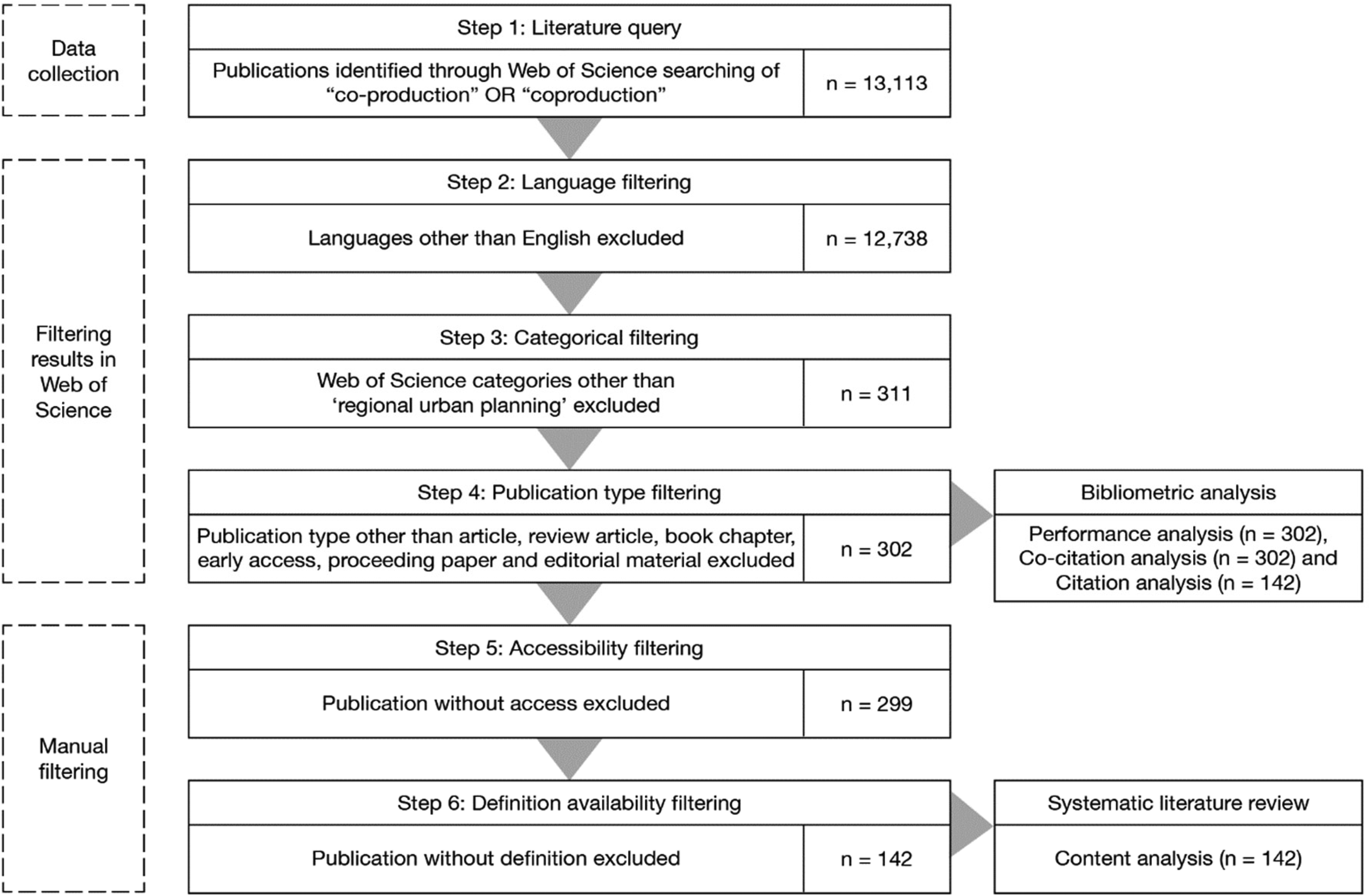
Flow chart of literature search and analysis process (source: own diagram). Note: Last search was on August 16, 2022.
In order to meet the four research aims mentioned in the introduction, both a bibliometric analysis and a systematic literature review were conducted (see Figure 1). Bibliometric analysis is a method that involves the use of quantitative techniques on bibliometric data. We used it for performance analysis, co-citation analysis and citation analysis (Donthu et al. 2021). Regarding the performance analysis, publication-related metrics (e.g., total publications), citation-related metrics (e.g., total citations) as well as citation-and-publication-related metrics (e.g., citation per cited publication) were used based on the citation report by WoS. This allowed us to identify times cited and publications over time as well as the most cited publications/authors from the planning field. Moreover, co-citation analysis helped us identify the most influential publications/authors in the co-production literature and trace the theoretical origins of co-production literature in the planning field (Newell and Cousins 2015; Noyons 2001). VOSviewer was used to visualise and analyse the co-citation network. While the performance analysis and co-citation analysis involved the analysis of 302 publications and their references, citation analysis was used to analyse the cited publications of 142 definitions. The result of the citation analysis was then visualised through Gephi.
In addition to the bibliometric analysis, a systematic literature review was conducted to study how the term ‘co-production’ has been defined in the planning field. A systematic literature review is used for different purposes (Xiao and Watson 2019); in our case, the aim was to describe the state of the literature (i.e., definition of co-production) at the time of the review. Hence, we conducted a content analysis of definitions found in the planning literature by using systematic procedures. The first step involved identifying definitions for the analysis. We acknowledge that definitions written in publications can be rather narrow operationalisations of the understanding of a concept and may not capture the full complexity elaborated in the original text (Kirchherr, Reike and Hekkert 2017). However, we argue that definitions still represent authors’ understanding of the concept. In order to address the issue, we considered not only the most relevant sentence but also the neighbouring text. Among the publications, 142 publications actually defined the term. From each publication, one definition was taken, mainly from the introduction and literature review. Where possible, the author's own definition was taken.
The 142 definitions were analysed manually based on the coding framework we developed in an iterative process. Based on the initial knowledge of the concept as well as a preliminary literature review, dimensions (hereinafter codes) and subdimensions (hereinafter subcodes) were developed deductively. These were then added and adapted inductively throughout the coding process. A new subcode was created if there were at least three matching codings. Seven codes were developed eventually (actor/reason/input/output/phase/means/context) with 51 subcodes. Each code with its subcodes is defined in the findings section. In order to address the problem of manual coding (i.e., low reliability), every definition was coded by two coders based on an initial set of coding rules. In the case of diverging coding results, the definition was reviewed by a third coder and discussed by all. Lastly, we calculated the word frequency for each code and compared the result with the result of the content analysis to confirm the findings. Thereby, words with the same stems (e.g., involve, involvement and involving) were considered as one. The result of the word frequency check and the explanation of how it supports the results of the content analysis are presented in the findings section.
Findings of the Bibliometric Analysis
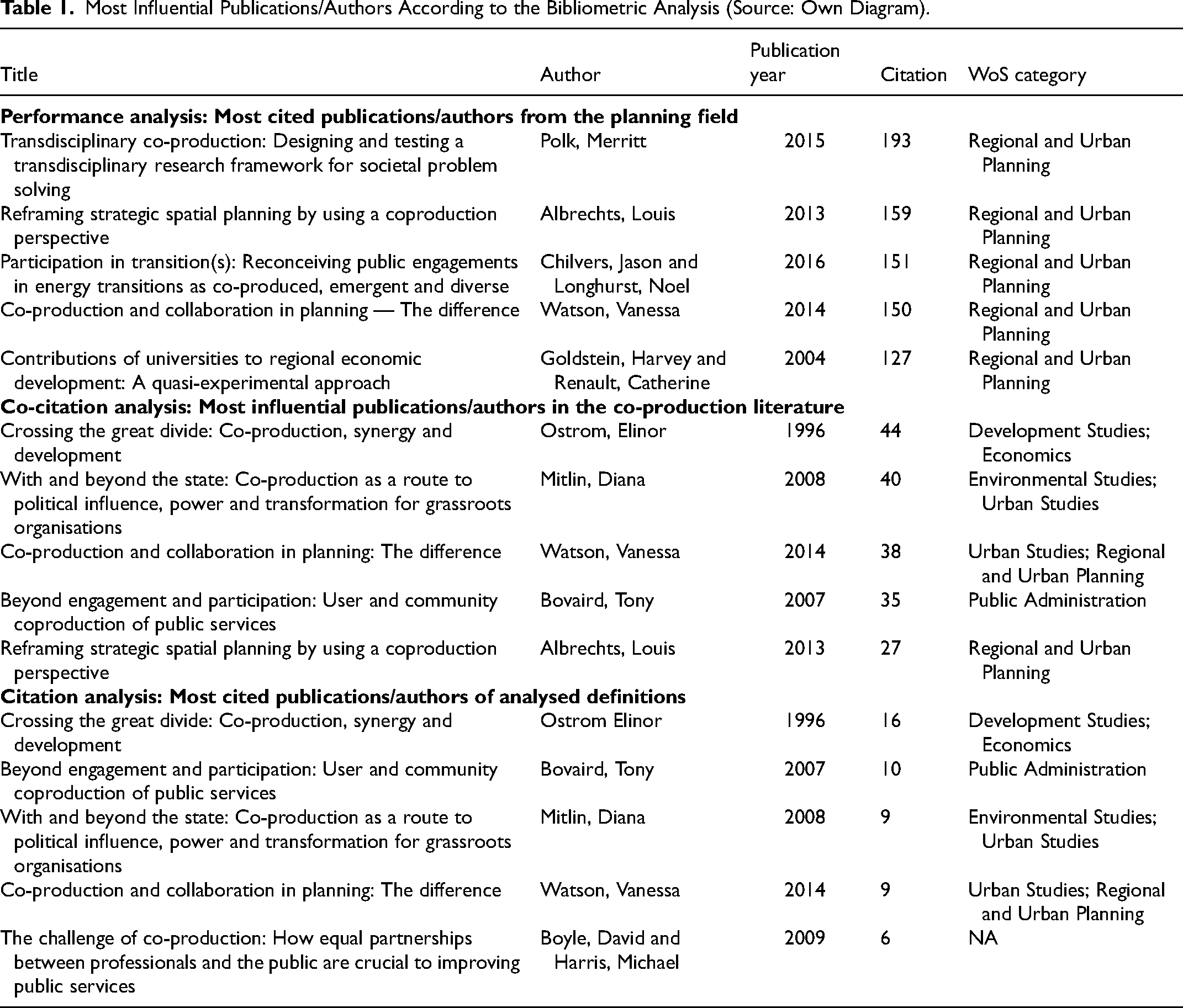
This section presents the result of the performance analysis, co-citation analysis and citation analysis, all of which are part of the bibliometric analysis. First, citations were analysed through performance analysis to identify times cited and publications over time as well as the most cited publications/authors from the planning field. As shown in Figure 2, the very first publication defined in the search was published in 1981; however, it took 30 years before the annual productivity would flourish at an exponential rate. The development stagnated until 2004 when it started to rise steadily and then from 2012, there has been a large quantity of planning literature on co-production. This trend is also observed with regard to the number of citations as there is an exponential growth starting from 2004. Out of 302 publications, 239 have received more than one citation. The sum of the times cited until August 2022 is 4,365. The five most influential publications/authors based on the total number of citations are listed in Table 1. They all have more than 100 total citations.
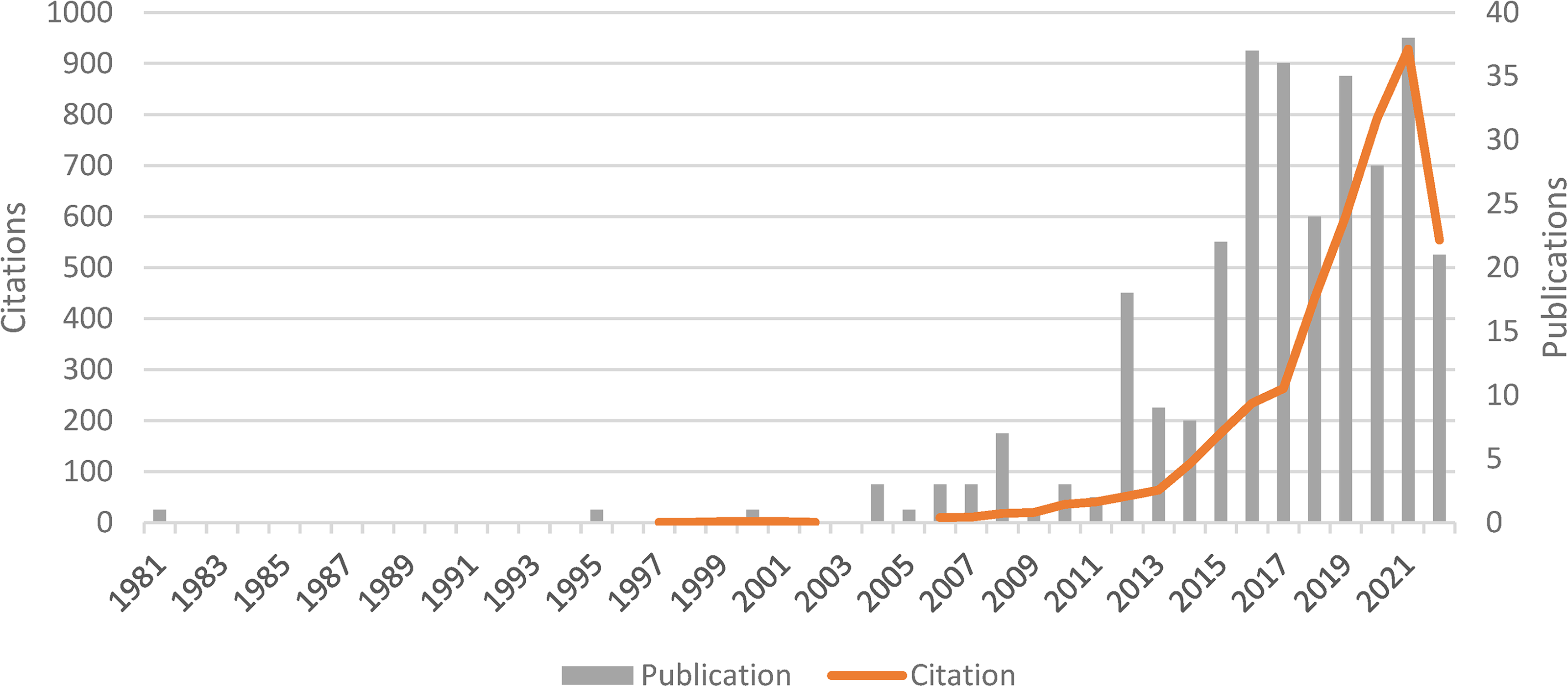
Times cited and publications over time in the planning field (source: own diagram).
Most Influential Publications/Authors According to the Bibliometric Analysis (Source: Own Diagram).
Co-citation analysis was also conducted to trace the theoretical origins of co-production literature in the planning field (see Figure 3). Altogether, 13,845 references from 302 publications were analysed. The threshold was set at nine, leading to 30 references. Altogether, three clusters were identified. A cluster is a set of closely related references (Van Eck and Waltman 2014). For instance, the publications by Albrechts (2013) and Watson (2014) were found in the same cluster, suggesting that they are closely related. This may be because both are from the field of regional and urban planning. Interestingly, the publication by Mitlin (2008) was found in this cluster as well and in close connection with Albrechts (2013) and Watson (2014) although it does not belong to the planning field according to the WoS category. This may be because it belongs to the category ‘urban studies’ which is close to the planning field. Broadly speaking, three fields can be identified from the five most influential publications/authors (see Table 1), that is, public administration, environmental studies and regional and urban planning. As shown in Figure 3, the publications are closely connected with 261 links.
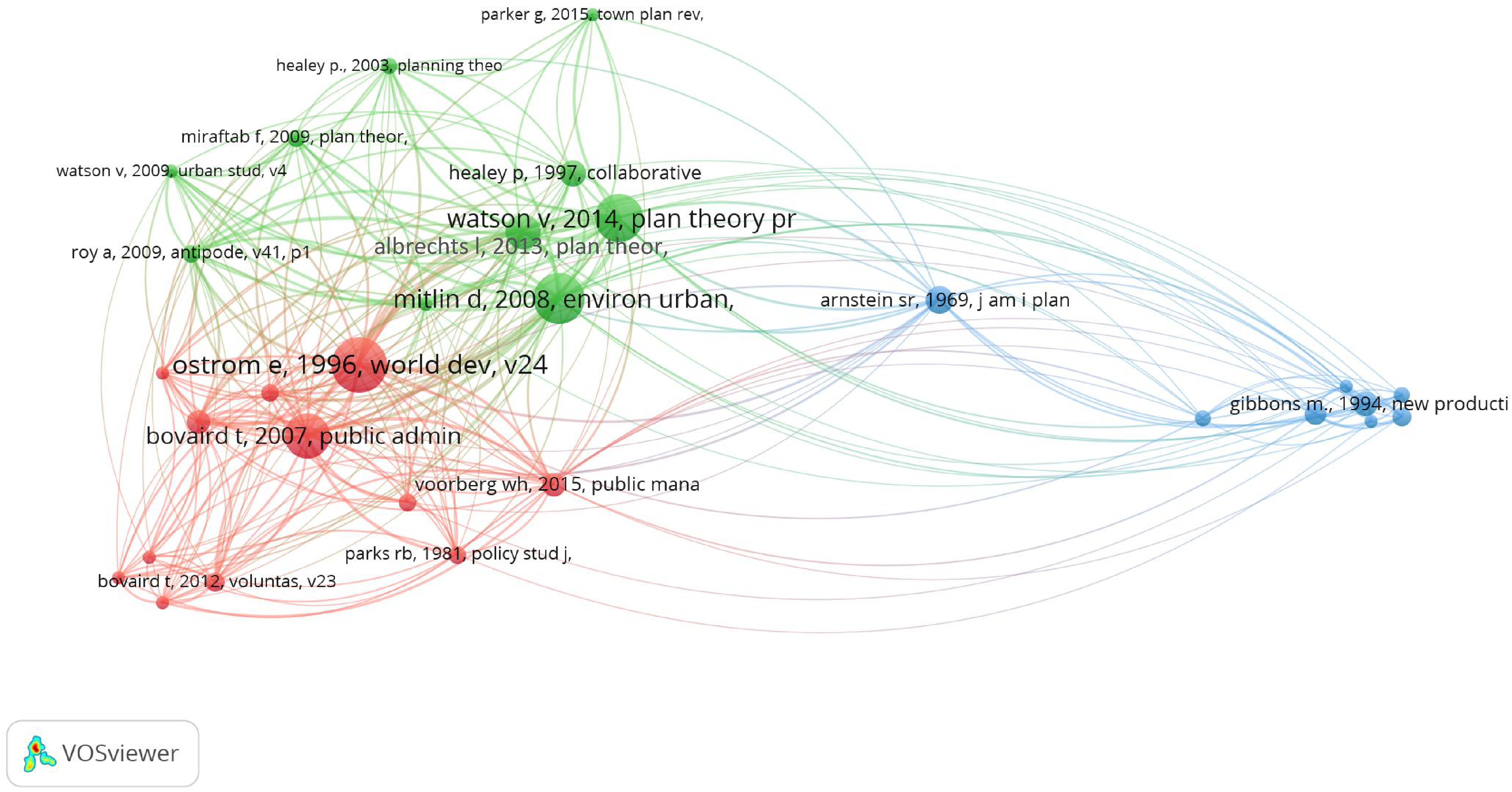
Result of co-citation analysis (source: own diagram; visualisation: VOSviewer). Note: The node represents specific references cited; the edges signify that two references are cited together; nodal size reflects the number of connections a reference has in the network (degree centrality); and colour of nodes represents clusters.
Lastly, cited publications/authors of definitions were analysed. Out of 142 definitions, 105 directly or indirectly referred to other publications/authors. Hence, they were subject to the analysis. Fifty-eight definitions use at least one citation; 47 have more than two citations. Altogether, 105 definitions cited 118 publications; 28 out of 118 publications were cited more than twice. According to the WoS category, most of the 28 publications come from the field of public administration and environmental studies. We found two publications from the regional and urban planning field as well (i.e., Albrechts 2013; Watson 2014). The fact that the publications from the field of public administration and environmental studies influenced the co-production literature in the planning field is in line with the result of the co-citation analysis. The five most cited publications/authors of analysed definitions are listed in Table 1. What is remarkable is that three of them were also identified in the co-citation network, that is, Ostrom (1996), Bovaird (2007) and Mitlin (2008). As shown in Figure 4, the top five publications are connected in the large network.
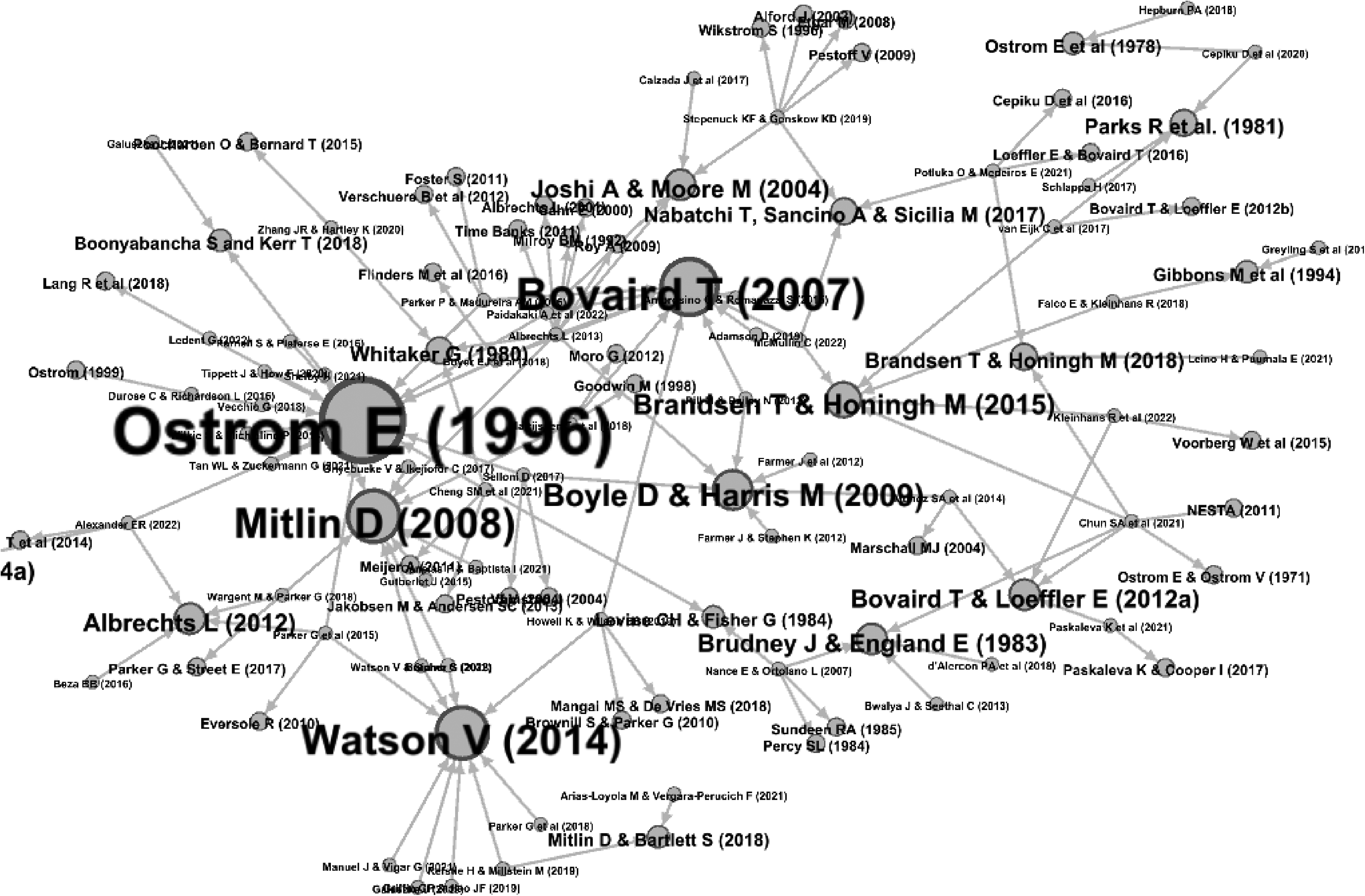
Result of citation analysis (source: own diagram; visualisation: Gephi). Note: The node represents both citing and cited publications; the edges signify that a publication (outward) cites another (inward); nodal size reflects the number of connections a publication has in the network (in-degree centrality). This figure shows the largest network only. Other networks that are small and not connected to this network are not shown.
To sum up, bibliometric analysis was conducted to identify the most influential publications/authors and to trace the theoretical origins of co-production literature in the planning field. The results of the performance analysis, co-citation analysis and citation analysis show a similarity to some degree. For instance, among the literature in the planning field, the publications by Albrechts (2013) and Watson (2014) are regarded as the two most influential works. Interestingly, the three most cited publications/authors from the planning field other than Albrechts and Watson (i.e., Polk 2015; Chilvers and Longhurst 2016; Goldstein and Renault 2004) are not remarkable in the results of the co-citation and citation analysis. The co-citation analysis and citation analysis show a similar result as well. The result of the citation analysis reveals that many definitions of co-production in planning literature cited publications in other fields — mostly public administration and environmental studies. This is also proved by the results of the co-citation analysis as the publications from regional and urban planning are closely linked with publications from these two fields. Overall, publications by Ostrom (1996), Bovaird (2007) and Mitlin (2008), Albrechts (2013) and Watson (2014) serve as theoretical origins of co-production literature in the planning field.
Findings of the Systematic Literature Review
Interestingly, not all publications dealing with the concept of co-production define co-production. Out of 299 publications, 157 do not define the term ‘co-production’ at all, although 88 have the term in their title, keyword or abstract. 3 This section presents the results of the systematic review of 142 definitions based on seven codes and 51 subcodes. Several codes share two subcodes, that is, unspecified and others. Unspecified is a subcode for those that are not specific enough (e.g., in the case of ‘actor’: different actors), whereas others is a subcode that contains the remaining codings which do not belong to any other subcodes and are not frequent enough to form a new subcode. This section includes the definition of each code and its subcodes and an explanation of how frequently the subcodes appear in definitions in general and over time. In order to study the development of definition over time, we applied three time intervals: before 2015, 2015–2018 and 2019–2022. While the number of publications started to increase from 2012, it was only after 2015 that stability was achieved. Accordingly, three time intervals were differentiated to better explore the trend.
Actor
This code describes the actors involved in co-production. According to the result of the analysis, ‘actor’ is the code with the highest number of codings, which shows its central importance when it comes to the definition of co-production. Various actors are involved in co-production; hence, we categorised them into nine types (see Table 2). Individuals from the public sector, the private sector, service providers and civil society act as representatives of an organisation or group, whereas individual citizens, professionals and service users/consumers/clients act on their own behalf. Service providers can be public, semipublic or private institutions. The subcode civil society includes both organised citizen groups and NGOs. Professionals range from scientists, practitioners, planners, policymakers to professionals in general without specification in the text. It is important to mention that a person can have several attributions, but the coding was done based on the role highlighted in the definitions. As an example, service users are also citizens, but the definitions that use terms such as service users, consumers or clients emphasise their role in the use of (public) services.
Coding Result on ‘Actor’.
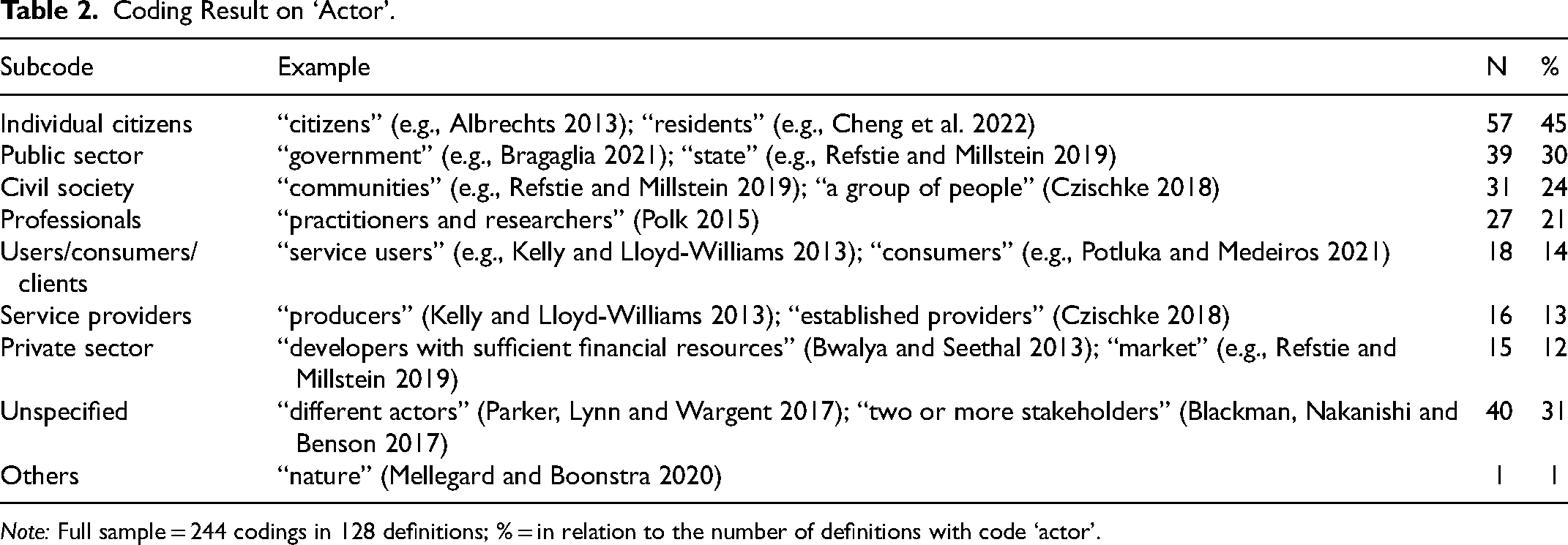
Note: Full sample = 244 codings in 128 definitions; % = in relation to the number of definitions with code ‘actor’.
Out of 142 definitions, 128 include actor-elements (90%); within those definitions, there are 244 codings. The most mentioned subcode is individual citizens, present in 45% of all definitions with the code ‘actor’, followed by unspecified (31%) and the public sector (30%), civil society (24%) and different types of professionals (21%). Private sector is mentioned as well, but far less often (12%). What is interesting is that about a third of definitions do not indicate specifically who the co-producers are, but mention the actors rather vaguely like ‘different actors’ (thus unspecified). As co-production involves different types of actors, 60% of definitions contain more than one subcode. Indeed, 29 definitions mention more than two types of actors, the maximum being six different subcodes. The combinations of involved actors vary considerably. The most common combination is individual citizens and the public sector (21 times; six out of 21 with other subcodes meaning other types of actors). Other frequent combinations with citizens are professionals (nine times, always combined with other subcodes), users (nine times; eight out of nine with other subcodes) and service providers (nine times; six out of nine with other subcodes). On the other hand, definitions that only address actors in the public sector and private sector without mentioning any other actors are rare. A more frequent combination without citizens is the public sector with professionals (10 times; four out of 10 with other subcodes).
Looking at the development of actor-elements over time, there are a number of interesting trends (see Figure 5). For instance, the distinction between different types of actors is less remarkable in the definitions before 2015 than in the other two phases. Indeed, individual citizens, the public sector, and professionals shared the same frequency (32%) followed by users/consumers/clients (27%), service providers (23%), the private sector (23%) and civil society (18%). While the frequency for the public sector is relatively stable throughout all phases (between 22% and 32%), other types of actors show a fluctuation — either upwards or downwards. Apart from individual citizens and civil society, other types of actors have seen a decrease. Interestingly, the subcode with the greatest fluctuation (or increase in this case) is unspecified (from 14% to 34%). This suggests, on the one hand, more emphasis is put on the role of citizens. On the other hand, other types of actors are increasingly grouped together under ‘different actors’ without distinction.
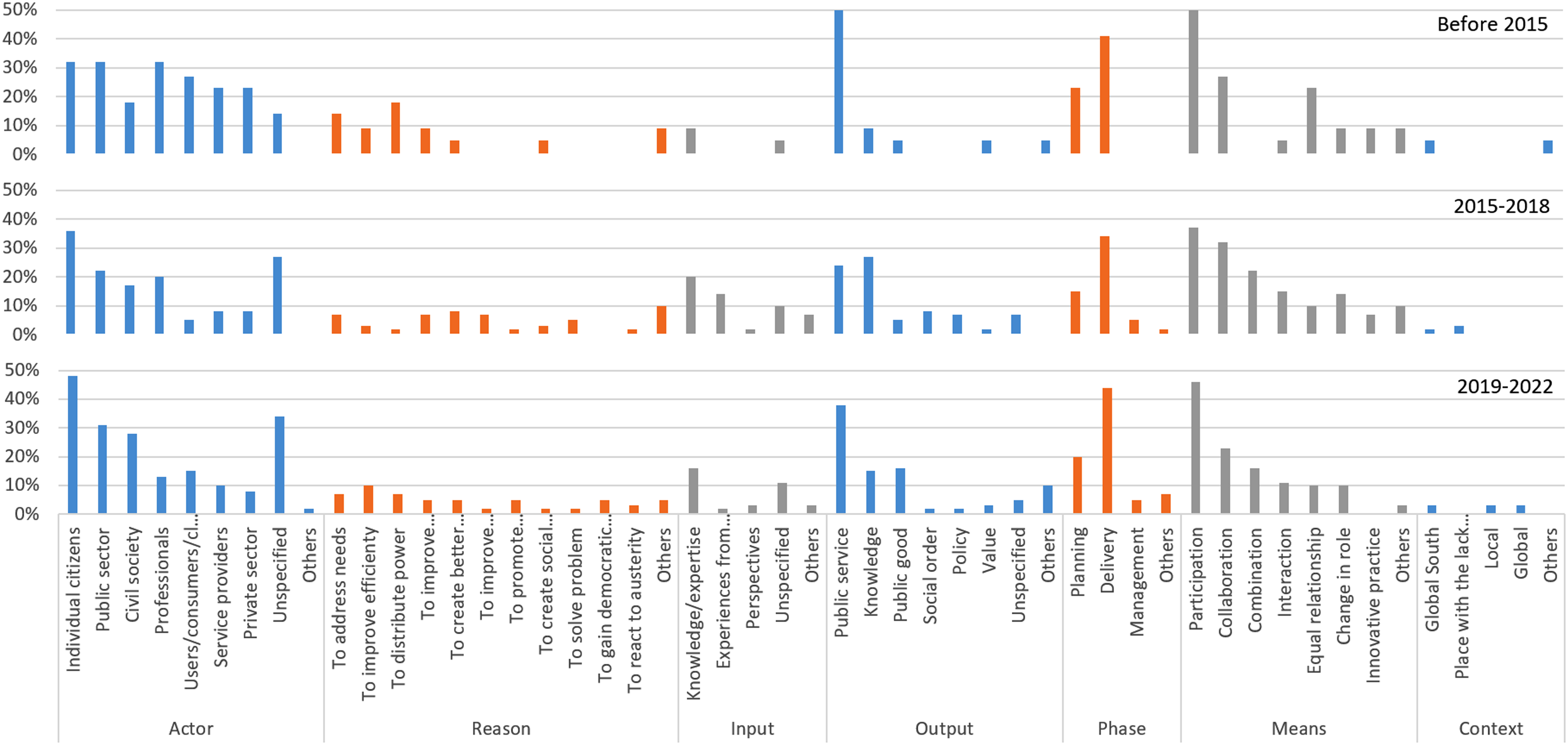
Development of subcodes over time (source: own diagram). Note: The figure shows the percentage of subcodes in relation to the number of definitions in each period, that is, before 2015 (n = 22); 2015–2018 (n = 59); 2019–2022 (n = 61).
Reason
This code refers to the justifications, aims or reasons for co-production. Twelve different reasons were identified, suggesting that there are various reasons why co-production takes place. These range from rather general reasons, that is, to address needs, to solve problems, and to create better outcomes, to more specific reasons, such as to react to austerity, to improve efficiency and to improve quantity/quality mostly in relation to services and goods. There are also normative reasons with underlying criticism, such as to distribute power between the state and citizen, to create social benefits, to promote engagement and to gain democratic legitimacy. Linked to these reasons is to improve knowledge production in reference to, for instance, diversification of the inclusion of knowledge types and their trajectory into policymaking.
Out of 142 definitions, 55 have reason-elements (39%); within those definitions, there are 82 codings. While the most common subcode is to address needs (20%), the difference among the top five reasons is small (between 16% and 20%). The remaining reasons are rather minor, ranging from 5% to 9% (see Table 3). The analysis reveals that there is not a single dominant reason for co-production; about a third of definitions mention from one to three reasons. What is also interesting is the fact that the most popular reasons for co-production change constantly over time (see Figure 5). Before 2015, the top two reasons were to distribute power (18%) and to address needs (14%), while in the second period the top reasons were others (10%) and to create better outcome (8%). For the 2019 until 2022, the top reasons shifted again — to improve efficiency (10%), to distribute power (7%) and to address needs (7%). The constant change may be due to societal changes but this needs further research.
Coding Result on ‘Reason’.
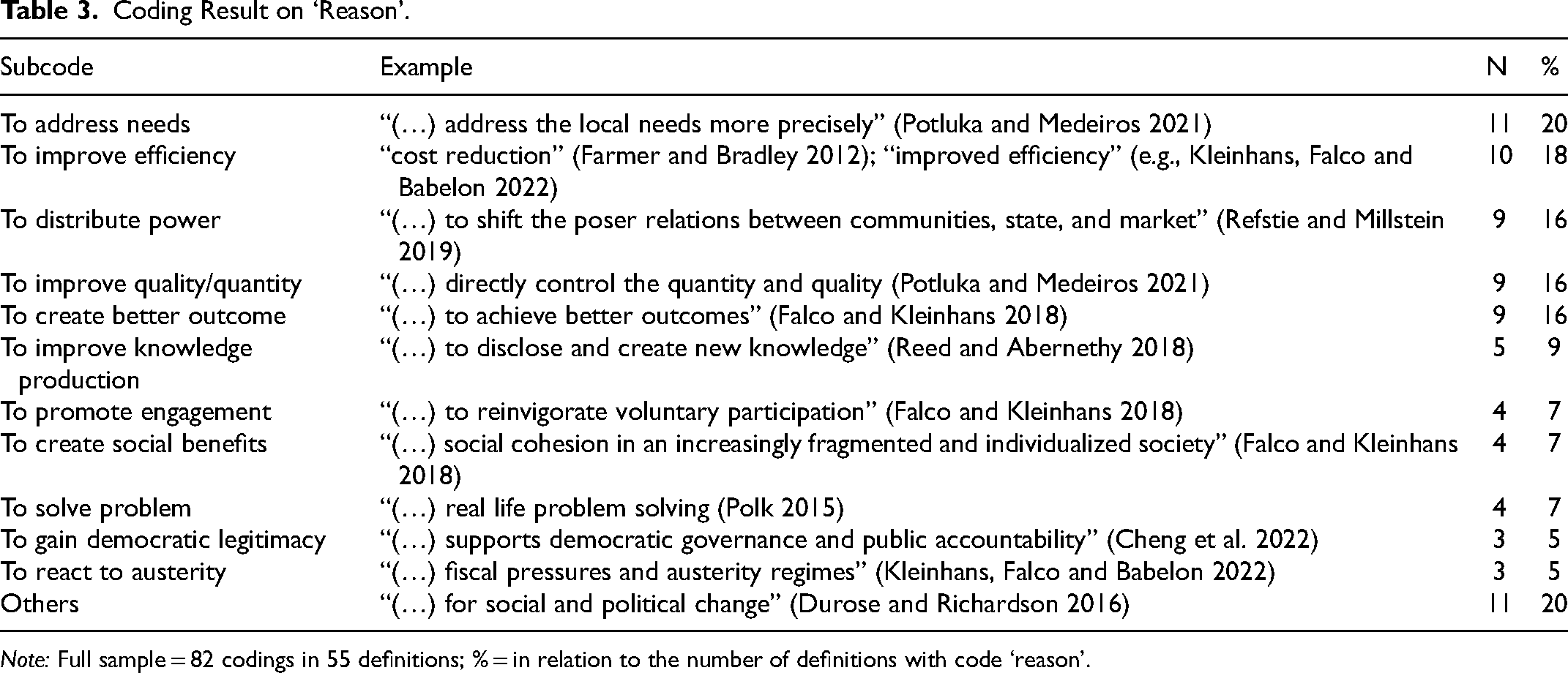
Note: Full sample = 82 codings in 55 definitions; % = in relation to the number of definitions with code ‘reason’.
Input
This code describes the inputs different actors contribute throughout the process of co-production. The inputs mentioned are mostly immaterial, such as knowledge/expertise, experience from different practices and perspective. These three subcodes are fairly close to each other; the first is about different kinds of knowledge, the second about practical experience, and the third includes interpretations and opinions.
Out of 142 definitions, 48 include input-elements (34%); within those definitions, there are 56 codings. According to the result of the analysis (see Table 4), knowledge/expertise is by far the most common subcode, present in 50% of all definitions with the code ‘input’. Indeed, this code is most important in definitions regarding knowledge co-production, highlighting the input of various forms of knowledge, including nonacademic types such as local knowledge. What is noticeable is the high percentage of unspecified input ranking second (29%). Interestingly, this type of inputs is fleshed out by mentioning actors, mainly citizens, service providers and users: for instance, ‘citizens provide inputs to services that are traditionally produced exclusively by public agencies’ (Nance and Ortolano 2016: 2). Thus, the more relevant question may be who provides an input rather than what kind of input is provided. Among 48 definitions, eight have two subcodes. The most frequent combination is between the subcodes knowledge/expertise and experience from different practices (five times).
Coding Result on ‘Input’ and ‘Output’.
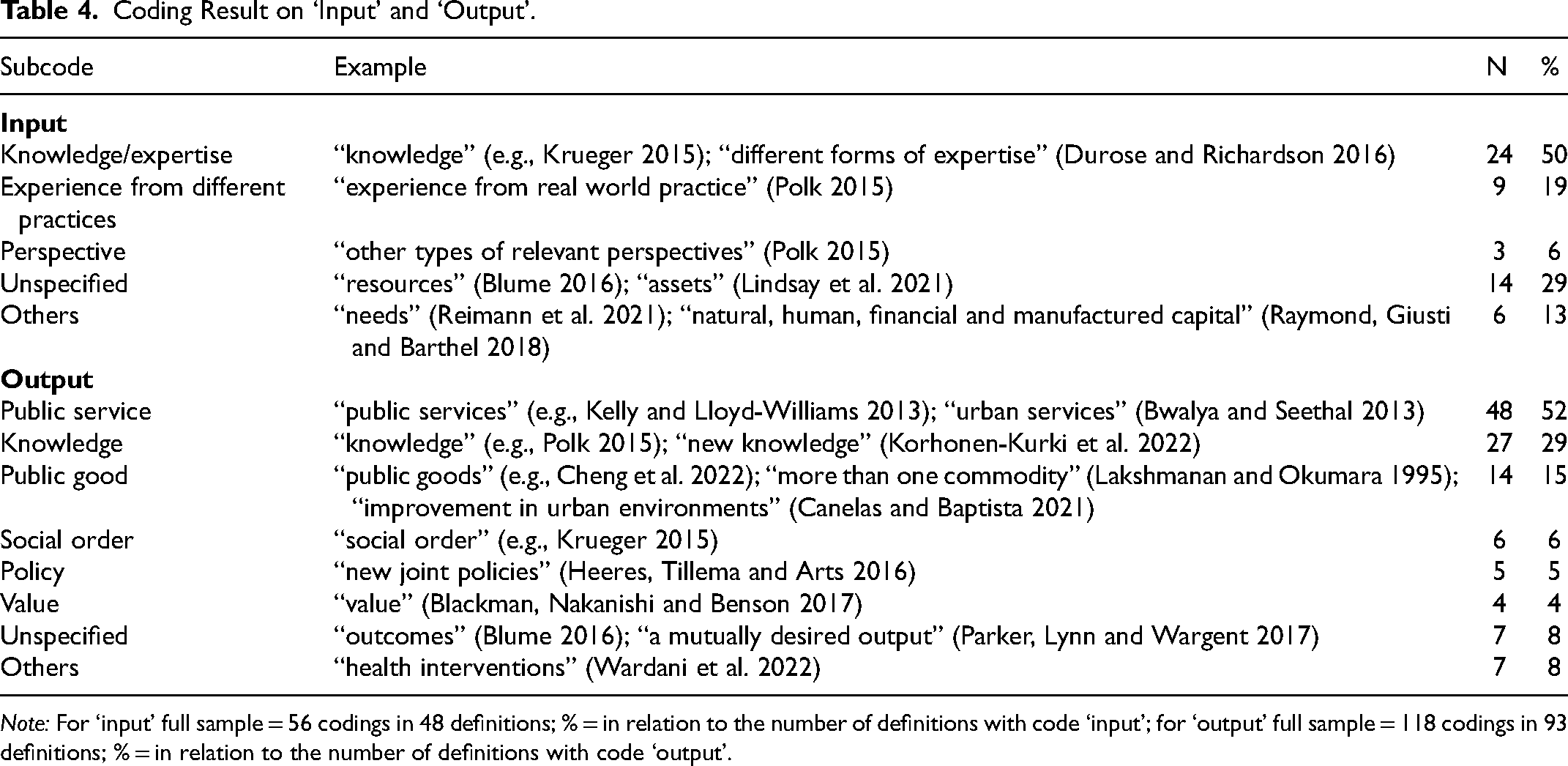
Note: For ‘input’ full sample = 56 codings in 48 definitions; % = in relation to the number of definitions with code ‘input’; for ‘output’ full sample = 118 codings in 93 definitions; % = in relation to the number of definitions with code ‘output’.
Although knowledge/expertise is revealed to be the prevailing input, the development of input-elements shows a somewhat different picture (see Figure 5). Even though knowledge/expertise ranks first, its share has decreased from 20% to 16% with time. A similar observation is made about the subcode experience from different practices. This type of input has seen the highest fluctuation from 0% (before 2015) to 14% (2015–2018) to 2% (2019–2022). Indeed, it dropped from number two (2015–2018) to number five (2019–2022). In contrast, the subcode unspecified has shown a steady increase and ranks second in the latest phase. This suggests that authors tend not to distinguish between different types of input.
Output
This code describes what is co-produced and includes public service, knowledge, public good, social order, policy, and value as the output of co-production. As shown by the examples (see Table 4), the coded elements for each subcode are quite similar. Public good is an exception in this regard, as it includes specific public goods such as the urban environment.
Out of 142 definitions, 93 include output-elements (65%); within those definitions, there are 118 codings. According to the result of the analysis, the most frequent subcode is public service, present in 52% of all definitions with the code ‘output’, followed by knowledge (29%) and public good (15%). Overall, 27% of the definitions contain more than one subcode of what output, none of them containing more than two. Among others, public service and public good are coded together in 10 documents, highlighting the close connection between these subcodes. Another frequent combination of subcodes is knowledge and social order; all of these definitions refer to Sheila Jasanoff (see e.g., Jasanoff 2004). What is also interesting is the relation between input and output of co-production. For instance, knowledge is often mentioned not only as an input but also as an output: indeed, out of 27 definitions that have knowledge as an output, 16 include knowledge as an input as well. In contrast, other outputs such as public services and public goods are mentioned in combination with unspecified inputs, if any.
The development of ‘output’ over time (see Figure 5) generally corresponds to the result presented in Table 4. So for instance, public service remains outstanding although it has seen a drop. In fact, the output of co-production goes beyond public services and includes other types. So for instance, public good is increasingly seen as an output. Although it was less notable until 2018 (sixth place among eight subcodes), it has moved up to second place in the ranking in the latest phase. Knowledge is another type of output though it saw a drop from 2015–2018 to 2019–2022. Other types of output remain less mentioned.
Phase
This code refers to the phase through which co-production takes place. According to the result of the analysis, co-production takes place from planning to delivery and management (see Table 5). The first phase, planning, is where related issues are discussed and decisions made to prepare the actual implementation of a plan, that is, delivery. After a plan is realised, it requires management practices, including evaluation and control.
Coding Result on ‘Phase’.
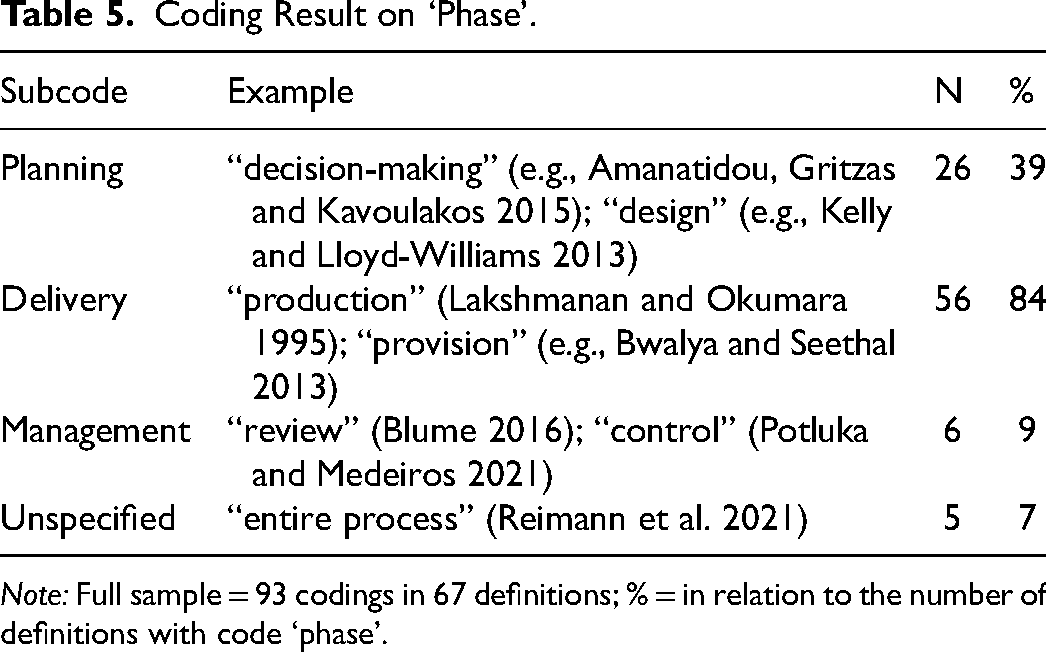
Note: Full sample = 93 codings in 67 definitions; % = in relation to the number of definitions with code ‘phase’.
Out of 142 definitions, 67 have phase-elements (47%); within those definitions, there are 93 codings. Among the three different phases, delivery is the most common subcode, present in 84% of all definitions with the code ‘phase’, followed by planning (39%) and management (9%). A few definitions mention ‘all phases’ (see Table 5). Out of 67 definitions, 22 (33%) mention more than one subcode. The most frequent combination is planning and delivery (15 times). Delivery and management are found in two definitions. Interestingly, four definitions cover the whole spectrum by mentioning all three subcodes — planning, delivery and management. Looking at the development of phase-elements over time (see Figure 5), definitions before 2015 saw planning and delivery as phases of co-production only. Although the management phase has appeared since 2015, it is far less mentioned compared to planning and delivery.
Means
This code refers to the means through which co-production takes place. According to the result of the analysis, co-production takes place in different ways (see Table 6). For instance, co-production may emerge through various forms of action, such as participation (i.e., taking part), collaboration (i.e., working with someone), combination (i.e., merging) and interaction (i.e., communicating). Moreover, the co-production literature suggests that the change in role and equal relationship between different actors allow co-production to happen. Finally, yet importantly, innovative practice is also mentioned as an impetus for co-production.
Coding Result on ‘Means’.
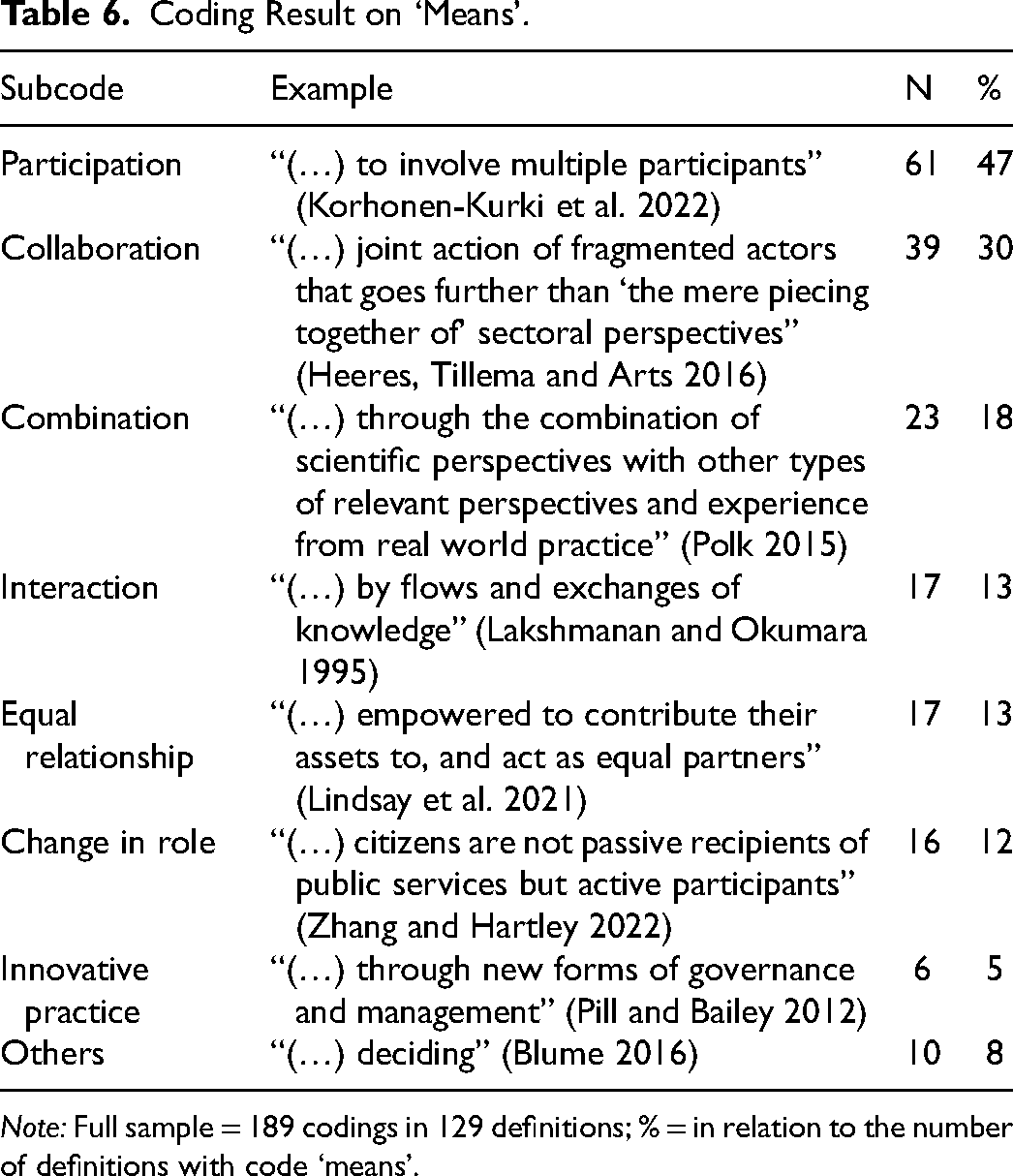
Note: Full sample = 189 codings in 129 definitions; % = in relation to the number of definitions with code ‘means’.
Out of 142 definitions, 129 have means-elements (91%); within those definitions, there are 189 codings. The most common subcode is participation, present in 47% of all definitions with the code ‘means’, followed by collaboration (30%) and combination (18%). Interaction, change in role and equal relationship are in fourth and fifth places with a similar frequency (12–13%). A few definitions mention innovative practice (5%) as a way in which co-production takes place. The development of the means-elements over time (see Figure 5) generally corresponds to the results presented in Table 6. Yet there are a few exceptions. For instance, equal relationship was much emphasised before 2015; it was in fact the third most common subcode after participation and collaboration. However, since 2015 this subcode has been much less mentioned. What is also interesting is that no definition mentioned combination before 2015. It became popular from 2015 though and since then has taken third place. Lastly, innovative practice is generally not popular; it did not appear at all between 2019 and 2022.
Context
This code refers to the characteristics of the location that might influence the emergence of co-production. The subcode Global South highlights specific conditions in southern cities such as limited resources as well as the role of self-organisation and informality. The definitions specifically mentioning Global South contexts suggest that co-production is a pragmatic way to ensure access to basic services that communities ‘would probably not receive otherwise’ (Calzada, Iranzo and Sanz 2017, 404). Indeed, much of the cited literature, such as Ostrom 1996 or Mitlin 2008, is based on cases from the Global South. In contrast to that, the Global North is not mentioned in any definitions. The subcode place with the lack of capacity and resources points in a similar direction, emphasising that co-production can be an answer to the lack of state capacity. The subcode local more generally highlights the importance of local contexts for co-production and the spatial scale in which it takes place. The subcode globally on the other hand points out that the concept has become popular all over the world.
With 11 out of 142 definitions, ‘context’ is the least common code, reflecting that most definitions do not distinguish between different spatial and societal contexts. This suggests that co-production can take different forms depending on the context, but is not limited to specific locations. None of the definitions encompasses more than one subcode. Among the four subcodes (see Table 7), Global South is the most frequent, present in 36% of all definitions with the code ‘context’. The rest are equally represented with only two codings (18%). What is interesting regarding the development of context-elements (see Figure 5) is that place with the lack of capacity and resource was much emphasised between 2015 and 2018 only, while both local and global contexts gained attention from 2019 onwards. Global South is the only context that has received constant attention in co-production literature although there has been a decrease.
Coding Result on ‘Context’.
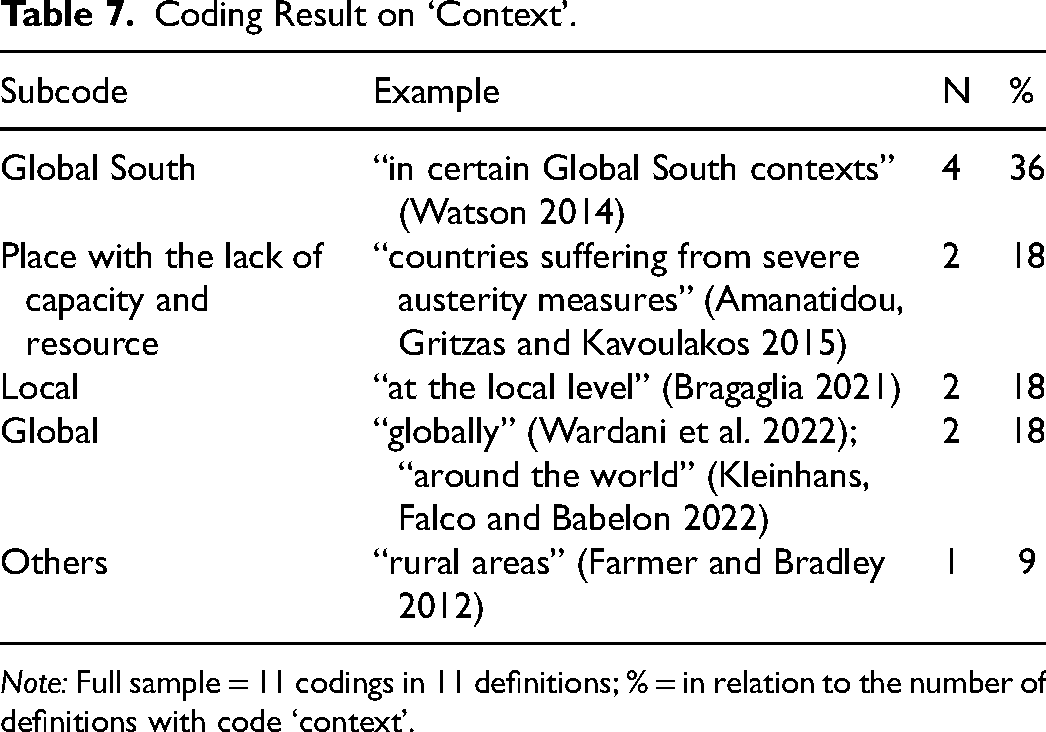
Note: Full sample = 11 codings in 11 definitions; % = in relation to the number of definitions with code ‘context’.
To sum up, we performed a content analysis of 142 definitions of co-production in planning literature to find out how the concept has been defined in this field. The result suggests that there is no single definition; rather, various definitions exist covering seven different codes, that is, actor, reason, input, output, phase, means, and context. Among the codes, ‘actor’ and ‘means’ are most commonly used to define the concept as they appear in approximately 90% of definitions analysed (see Figure 6). In contrast, ‘context’ is the least common code appearing in less than 10% of definitions. What is also interesting is the difference between ‘input’ and ‘output’; the latter is twice as frequently mentioned. Each code has subcodes and there is generally a substantial difference between them as certain subcodes are more prominent than others. Word frequency was calculated to crosscheck this and the result confirmed the dominance of certain subcodes, that is, service (108 times) and knowledge (63 times) as an input and/or output of co-production as well as citizen (66 times) and the public (83 times) sector as co-producers. Note that the word ‘public’ is often part of a word combination.
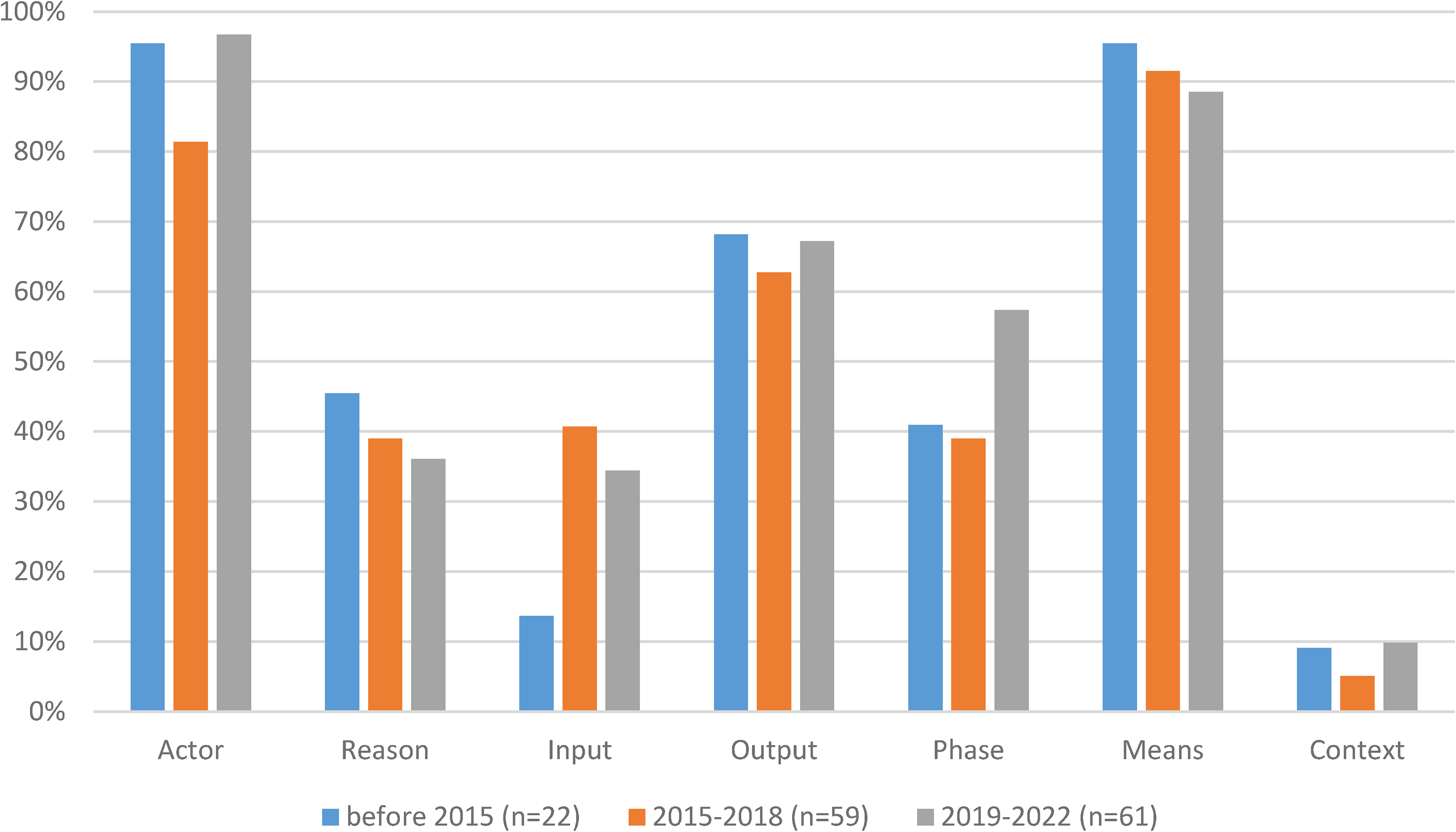
Development of codes over time (source: own diagram). Note: The figure shows the percentage of codes in relation to the number of definitions in each period.
Conclusion
Processes of urban planning and development typically involve multiple stakeholders. While there are various terms that refer to the multi-actor involvement, co-production as a concept gained popularity from 2012 onwards. This suggests that scholars in the planning field see an advantage in using the term. Indeed, as our findings (especially for ‘reason’) suggest, co-production is considered to play an important role in dealing with various challenges and complex problems. As the concept of co-production has become increasingly popular across disciplines, the ambiguity of the concept has increased as well. The result of the bibliometric analysis partly explains this phenomenon as definitions mentioned in planning literature often come from various fields in addition to planning. The findings of the systematic literature review confirm the ambiguity as co-production is defined in various ways, or in some cases, not defined at all. In fact, 88 publications did not provide any definition, even though co-production is used in the title, abstract or keywords. We see the risk that the concept is used as a buzzword. Hence, based on the result of the systematic literature review, this study provides clarity to the concept by fleshing out what the core dimensions of co-production are.
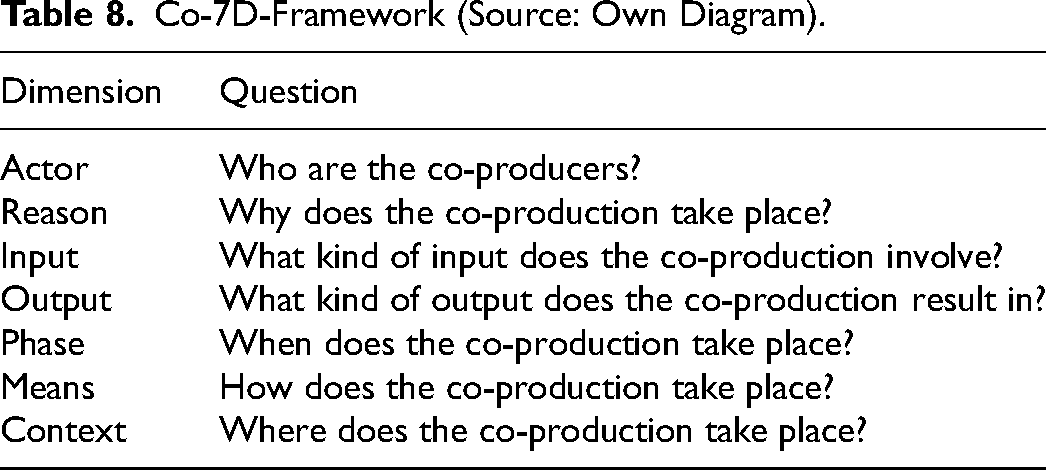
We propose the seven dimensions discussed in the findings section and related questions as a conceptual and analytical framework (named Co-7D-framework) for defining co-production in planning theory and practice (see Table 8). The intention is not to insist that the definition has to cover all dimensions. Rather, we argue that when using the term, researchers and practitioners need to reflect these dimensions and ask themselves whom to engage with, why they should engage, when to engage, how to engage, in which context to engage, what input is needed and what output is expected. This will help the involved stakeholders not only build consensus on what they understand by ‘co-production’, but also to achieve a desired outcome. In addition, the framework can be useful to compare co-production to other related concepts such as co-creation, co-design, participation and collaboration by identifying which dimensions overlap and which differ. How these concepts differ from co-production in planning literature is beyond the scope of this article, but certainly represents an important avenue for future research.
Co-7D-Framework (Source: Own Diagram).
During the analysis, a few things caught our attention. First, there was an overlap between codes. For instance, austerity (or more generally lack of capacity and resources) was mentioned both as a reason and as a context where co-production occurs. This suggests that there is no clear-cut distinction among the codes. Second, we found that some combinations of subcodes were more common than others. Even though this study touches on these patterns, analysing them deserves further research. Also, whether certain codes are especially popular for a certain type of planning (e.g., strategic or collaborative planning) or in a certain context can be researched. Lastly, while the popularity of codes and subcodes constantly changes over time, some of them appear more often in definitions than others, regardless of time. ‘Actor’ and ‘means’ are the two most frequently used codes to define co-production throughout all three phases (see Figure 6). Why a certain code or subcode is popular throughout all phases or in a certain period only could be the subject of future research.
This study has limitations. First, we used WoS only and did not involve other databases such as Scopus and Google Scholar. We are aware that WoS has limitations in terms of geographical and language coverage (i.e., priority for English). Yet we chose publications in English only due to the manual coding for the systematic literature review. Although the majority of publications were in English (12,738 publications out of 13,111), so we admit that Anglo-American bias may have occurred (Newell and Cousins 2015). The reason Google Scholar was not selected was the lack of bibliometric data as well as the absence of quality control. Also, while Google Scholar is more inclusive in terms of types of documents, the lack of a filtering function makes it difficult to exclude documents such as presentations and grey literature. Scopus does not allow for sharp filtering either in terms of the subject area, and thus was excluded. Although the subject area ‘social science’ includes a wide range of subareas including ‘urban studies’, the filtering function does not allow narrowing down to subareas.
Second, the WoS category ‘regional (and) urban planning’ is not clear enough. Indeed, during the manual screening, we realised that some publications were less relevant to planning. This is because the WoS category is journal-related rather than publication-related. 4 Another possibility for categorical filtering is called the WoS research area. Yet there is no category for regional and urban planning. The most relevant research area would be ‘urban studies’, but this is rather broad as well. Furthermore, as content analysis involves a qualitative approach, the analysis (both determining the coding framework and manual coding of definitions) is subjective. Although the bibliometric analysis itself is quantitative, the same goes for the interpretation of its result. However, an attempt to overcome this problem (at least partially) was made by involving three coders and having them constantly exchange opinions.
Supplemental Material
sj-docx-1-jpl-10.1177_08854122231219919 - Supplemental material for Defining Co-Production: A Review of the Planning Literature
Supplemental material, sj-docx-1-jpl-10.1177_08854122231219919 for Defining Co-Production: A Review of the Planning Literature by Dahae Lee, Patricia Feiertag and Lena Unger in Journal of Planning Literature
Supplemental Material
sj-docx-2-jpl-10.1177_08854122231219919 - Supplemental material for Defining Co-Production: A Review of the Planning Literature
Supplemental material, sj-docx-2-jpl-10.1177_08854122231219919 for Defining Co-Production: A Review of the Planning Literature by Dahae Lee, Patricia Feiertag and Lena Unger in Journal of Planning Literature
Footnotes
Declaration of Conflicting Interests
The authors declared no potential conflicts of interest with respect to the research, authorship, and/or publication of this article.
Funding
The authors received no financial support for the research, authorship, and/or publication of this article.

Supplemental Material
Supplemental material for this article is available online.
Notes
Author Biographies
References
Supplementary Material
Please find the following supplemental material available below.
For Open Access articles published under a Creative Commons License, all supplemental material carries the same license as the article it is associated with.
For non-Open Access articles published, all supplemental material carries a non-exclusive license, and permission requests for re-use of supplemental material or any part of supplemental material shall be sent directly to the copyright owner as specified in the copyright notice associated with the article.
