



Abstract
Despite the integration of universal design, access to urban greenspaces, which provide multiple health benefits, has been restricted among people with disabilities, particularly in developing countries. This article argues that the sole use of the seven principles of universal design is inadequate for urban greenspace planning as it consistently fails to prevent serious injuries, accommodate multiculturalism, and disregard subjective feelings when addressing people with disabilities. Additional approaches, including a safety strategy, diverse cultural behavior acceptability, and emotional design through landscape naturalness, are considered to improve accessibility, thereby reducing urban health inequalities and achieving an inclusive city.
Introduction
Urban greenspaces are one of the important aspects of the creation and development of an inclusive city, where everyone counts and all individuals have equal access to essential urban services or facilities (Asian Development Bank 2022). The presence of urban greenspaces that provide greater accessibility and safety for all, particularly for people with disabilities, can contribute in overcoming urban health inequities and help to ensure that cities of the future offer everyone the chance to improve their quality of life (Błaszczyk et al. 2020). The future of the inclusive city seems to be even further away, especially in developing nations where some of the world's lowest income populations have insufficient medical services and unfulfilled healthcare needs for those with disabilities (Elias 2019; WHO and World Bank 2011).
Urban greenspaces, such as parks, are essential for providing varied well-being, recreational, and social opportunities (Zhang et al. 2017). Accessible urban greenspaces serve to support human rights by ensuring that people with disabilities can continue to receive their health, independence, and freedom of choice when their regular healthcare providers or personal supporters (e.g., spouse, family, or close relatives) are unavailable or incapable of providing treatment (Pineda and Corburn 2020). In such cases, universal design principles as an orthodoxy imprint for equitable access can play a vital role within urban greenspace planning at this juncture.
Instead of making different designs for each individual, “universal design” is created as a standard set of principles that is suitable for all individuals, regardless of age or sex, by focusing on their abilities at various stages of their lives (The Center for Universal Design 1997). With the increase in the population of disabled people around the globe, these principles have been implemented more frequently in many countries (Crews and Zavotka 2006). The seven universal design principles are as follows: (a) equitable use; (b) flexibility in use; (c) simple and intuitive; (d) perceptible information; (e) tolerance for error; (f) low physical effort; and (g) size and space for approach and use (The Center for Universal Design 1997). By establishing these principles as the main theoretical framework for designing urban greenspaces, it proves reasonable to strengthen the methodology, particularly when the objective is to be as accessible as possible to all people. Although designs made especially for the disabled in the past seemed effective, their measurements and evolution are being re-examined, indicating that universal design concepts require re-imagining and modernization (Law et al. 2007).
When it comes to universal design, one of the common misconceptions among designers is that wheelchair users (e.g., those with physical or mobility disabilities) are the only or primary target group. This may derive from two dominant books, Human Dimension (Panero and Zelnik 1979) and Time-Saver Standards (DeChiara, Panero and Zelnik 2001), which are international design classics with several series that most practitioners have studied. However, these publications only have dimensional information about wheelchairs, and this might influence how architects perceive disabilities and how they interpret universal design in their creations. Some designs may include people with visual and/or hearing disabilities in their evaluations, but this is still far from fully inclusive because disability encompasses a wide range of conditions (e.g., temporary or permanent), classifications (e.g., mild, moderate, or severe), and impairments (e.g., physical, cognitive, or social problems) (WHO and World Bank 2011). This dearth of communication causes an impractical design that goes against its original intention of building accessibility for all.
Among the disabled population, urban greenspaces have been increasingly evidenced to enhance holistic health, including physical, physiological, cognitive, and mental well-being (Selanon and Chuangchai 2023). These advantages, unfortunately, have not been effectively addressed until accessibility is truly delivered to people with disabilities.
A Modified Approach for the Universal Design
This article argues that the seven universal design principles are insufficient for developing urban greenspaces for people with disabilities and suggests three additional approaches to improving accessibility: safety strategy, cultural acceptance, and emotional design based on nature (Figure 1). This modified approach provides positive outcomes from three significant perspectives. First, this method can extend the body of knowledge by providing an alternate solution that is specifically for people with disabilities. Second, this strategy will assist in promoting the use of urban greenspaces by individuals with disabilities, therefore improving the health of disabled communities. Third, this approach assists in overcoming urban health disparities by shortening the health gap between non- and disabled persons, which in turn enhances the quality of life of all residents in a way that creates an inclusive city where everyone's health matters and can be improved sustainably.
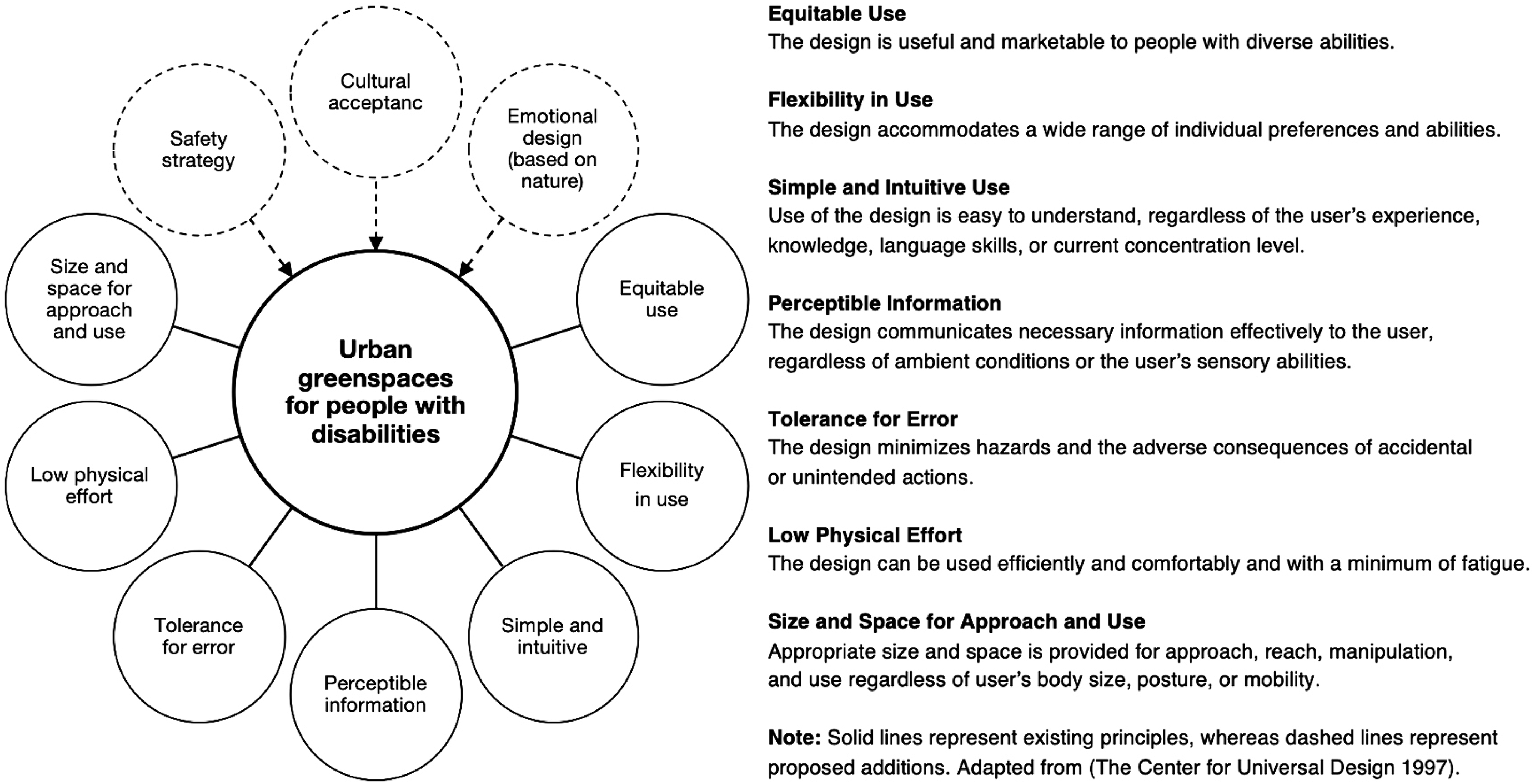
The modified universal design for urban greenspaces and people with disabilities.
Implementing a Safety Strategy to Improve Accessibility
One of the key problems with universal design is that all the principles are mainly focused on granting some access by adjusting certain features and/or minimizing risks so that users can utilize it in their own adapted ways. But the principles are often inefficient in preventing the dangers brought on by these abnormal uses, which can cause substantial injuries to people with disabilities (Horton 2017). This suggests the need for a prevention-centered safety strategy. Incidental and inadvertent usage have been frequently found among people with disabilities when participating in public spaces, where injuries tend to occur in public facilities, and some city parks contain potentially dangerous features as a result of unsafe design conditions, such as restrooms, sidewalks, or different height levels (Kapsalis, Jaeger and Hale 2022). A tradeoff between accessible and safety solutions must not be a consideration for people with disabilities since it can cause severe or long-term harm. When safety affects vulnerable sex and age groups, such as women, children, and the elderly, the design problem may be more acute. Moreover, disabled individuals should be able to use services and amenities repeatedly and for a long time without causing distress or damage, for example, under qualified staff supervision when using public fitness equipment.
By prioritizing accident prevention as a core design principle, urban greenspaces can have enhanced functionality through provision of safe services to a greater variety of users while simultaneously promoting health (Williams et al. 2020). When safety design is appropriately created, where all forms of impairments must be considered (e.g., visual, hearing, physical/mobility, intellectual, learning, autism, emotional/behavioral, and multiple limitations), people with disabilities may be encouraged to be more active and experience the facilities within urban greenspaces (Selanon and Chuangchai 2023). This safety strategy illustrates the potential of accessibility for people with disabilities while simultaneously supporting and securing other co-users, a compelling value that designers should give greater consideration to when developing designs for public greenspaces.
Allow the Use of a Diversity of Cultural Behaviors to Expand Accessibility
Although urban greenspaces provide recreational opportunities for visitors of various lifestyles, they should also accommodate the use of diverse cultures, as ethnicity and religion, or personal belief, have a profound impact on cultural behaviors, which can be reflected through the utilization of spaces (O'Hara 2003). For example, walking dogs in city parks is not a common traditional lifestyle in Turkish and Malay cultures, which are associated with their specific religious reasons, as opposed to Western cultures where dogs can be housed and played with as pets (Özgüner 2011; Sreetheran 2017). This cultural difference can have a direct effect on disabled people who use a guiding dog for navigation when accessing urban greenspaces. Regarding city park behavioral patterns, Malaysian, Indian, and Chinese cultures spend time in groups with family members or friends to relax and enjoy some fresh air (Sreetheran 2017), contrary to Western cultures that predominantly visit parks either alone or in pairs for physical activity purposes (Gobster 2002). Specifically in Muslim culture, being alone in public parks is unusual behavior and is considered taboo for females, who should remain with close members (e.g., husbands, parents, or acquaintances) to avoid creating a negative impression (Sreetheran 2017). In conjunction with the aforementioned concern, it seems that disabled single women accompanied by guide dogs who visit urban greenspaces may encounter a challenging situation.
Asian cultures, including Filipino and Chinese, exhibited a greater level of satisfaction with natural environments, e.g., natural landscapes, greenery views, and water, in comparison to Western cultures (Gobster 2002). This indicates a cultural preference for natural over built environments, such as cities or built surroundings with natural scenes (Özgüner 2011). China and Japan cultures have distinct preferences for urban greenery, with the former preferring plant qualities and densities while the latter preferring esthetic landscapes with traditional elements (e.g., shrines, temples, and cherry blossom dressing) (Liu et al. 2023).
Individuals with disabilities encounter adverse events, including social stigmatization, racial discrimination, and unprofessional conduct within public services, as a consequence of cultural diversity (Raghavan and Small 2004). This reflects serious city issues, notably within public spaces. By addressing these challenges from a cultural standpoint, benefits would be realized for people with disabilities through greenspace design. The design should assist people by providing solutions to preserve their cultural values and dignity. Another approach to promoting self-belief and being more active in greenspaces is through design that incorporates multicultural behaviors and traditions. For practical application, multicultural design can be implemented by researching, such as through questionnaire surveys (before planning), empirical observations (for improving the existing), or in-depth interviews (Özgüner 2011; Mehta and Mahato 2021). These applications have the great potential to increase the possibilities for developing and creating inclusive design that is sensitive to diverse cultures (Raghavan and Small 2004).
Addressing Emotional Design Using Landscape Naturalness to Increase Accessibility
Emotional design is concerned with how human sensory perceptions and/or physiological processes mediate subjective experiences (e.g., moods or personal feelings), whether actively or passively interacting with created spaces. Emotional design includes landscape naturalness (e.g., visual, smell, tactile, auditory, or mixed) as it fosters stress relief and a sense of calm (Zhou, Ji and Jiao 2021). Contrary to general users, people with sensory impairments must rely on emotional design since their perceived experiences are limited. The more natural stimulation options available, the more likely it is that people with disabilities can access urban greenspaces. People with disabilities have been shown to have their emotional needs ignored. Consequentially, being in nature was one aspect that motivated them to frequent urban parks (Chikuta and Saayman 2017; Steinfeld 2008).
The concept of landscape naturalness is one potential direction to incorporate this subjective factor in urban greenspaces (Opdam 2020). People with disabilities can benefit from plants that provide various sensory experiences, such as different colors (which create visual depth and contrast), a pleasant aroma, or multiple textures (Chan, Shek and Agapito 2022). The presence of diverse hues in flowers, coupled with the richness of plant species, has the potential to evoke esthetic emotions (Tomitaka et al. 2021). Some natural soundscapes are favored among people with disabilities for providing relaxation and peaceful sentiments, including running water, waterfalls, fountains, and moving leaves (Zhang et al. 2017). Conversely, certain dynamic ecological scenarios, such as the grazing of animals, abandoned greenings, and weed incursions, can be perceived as degraded rather than natural environments (Lamb and Purcell 1990). By incorporating emotional design into universal design, the guidelines will gain depth and become more than merely dimensional. Thus, the alternative use of landscape naturalness for emotional design appears to be a promising direction in urban greenspace to enhance the experiences of people with disabilities.
Conclusion
Universal design is a useful paradigm for creating environments that are accessible to people with different abilities. However, when it comes to more complex designs, such as city parks and their implications for the disabled, the universal design principles appear incapable of preventing unexpected accidents for people with disabilities. This raises the issue of the need to develop new approaches to landscape and urban design. While this article supports the use of the seven principles, it also argues that more principles (i.e., safety-focused design, multiculturalism among diverse backgrounds, and emotional design by naturalness) should be included. Additional modified approaches will be helpful in the design of urban greenspaces for increased safety, diversity, and pleasure, all of which can contribute to improved accessibility for individuals with disabilities. In the developing world, effective greenspaces can minimize health inequalities in urban areas and bring the idea of an inclusive city closer to becoming a reality.
Footnotes
Acknowledgements
This article was supported by Thammasat Postdoctoral Fellowship and the NSRF via the Program Management Unit for Human Resources & Institutional Development, Research and Innovation [No. B05F640096].
Declaration of Conflicting Interests
The author(s) declared no potential conflicts of interest with respect to the research, authorship, and/or publication of this article.
Funding
The authors disclosed receipt of the following financial support for the research, authorship, and/or publication of this article: This work was supported by the NSRF via the Program Management Unit for Human Resources & Institutional Development, Research and Innovation, (grant number B05F640096).
