



Abstract
There is extensive literature on the agency of actors in urban and regional planning which draws on a wide range of theoretical lenses and concepts. One of the recurring themes is the relationship between agency and structure—the mutual interdependence between individual actions and collective institutions, rules, and norms. This article provides a narrative overview of the wide range of literature on agency and structure in relation to spatial planning clustered around six interrelated themes: institutions, discretion, pragmatism, networks, leadership, and emotions. It identifies new avenues for research, paying particular attention to empirical, scalar, and methodological issues.
Introduction
As a future-oriented discipline and as a collaborative activity, urban and regional planning is made up of actions and interactions of many individuals and organizations. Consequently, the question of who acts on what grounds lies at the heart of research on planning theory and planning practice. Many forms of agency can be found in the planning process such as public servants developing a plan, citizens commenting on or appealing against a plan, politicians ratifying a plan, and architects developing building designs to comply with a plan. In reality, the interests and behaviors of these actors involved in planning processes are often complex, interrelated, and nonlinear. What is apparent in almost all situations is that these actors have agency (i.e., the capacity to act independently and to make their own free choices to act) at many stages of the planning process. A body of academic literature depicts planners as enjoying a substantial amount of autonomy and agency in, for example, the formulation and implementation of models of urban development (Filion 2021).
Three distinct definitions of agency can be applied to the context of planning, including: (i) the capacity, condition, or state of acting or of exerting power; (ii) a person or thing through which power is exerted or an end is achieved; and (iii) an administrative division (of a government) (Merriam-Webster n.d.). The first two definitions point to a crucial aspect relevant for planning: the term agency concerns both the actor and the capacity to act. Moreover, these two understandings cannot be viewed as entirely separate from each other, and in relation to urban and regional planning, it is essential to understand both.
Academic literature in planning characterizes actors on the one hand as humans with distinct values, goals, and character traits, and on the other hand, views actors as abstract nodes in the planning process and planning system, with certain responsibilities, authority, and legitimacy. The actor as a human is more closely related to the first definition, while the actor as node in the planning process tells us more about their capacity to act than about the actors themselves. Planning researchers have acknowledged the duality of agency and structure (i.e., the mutual interdependence between individual actions and collective rules and norms) for some time. To capture the relationship between individual actions and institutional context, many planning scholars draw on Giddens’ (1984) theory of structuration, or other theoretical perspectives derived from Giddens’ ideas (e.g., Filion 2021; Healey and Barrett 1990; Healey 1997; Jessop 2001). In this article, we illustrate that the duality of agency and structure is present in several theoretical perspectives on agency, not only those referring to the aforementioned theories.
We have three main motives for writing this article. The first motive is to view the issue of agency through various theoretical lenses, in order to provide a more detailed account of the complex relationship of agency and structure in planning. Mutual learning from various theoretical and conceptual perspectives can help to clarify a simultaneously ubiquitous and elusive subject that is often only implicitly addressed in academic literature. To this end, we introduce six themes related to agency (in “Common themes for understanding actors in planning research” section), each of which provides a different perspective on the subject. A second motive is to provide an overview of the wide variety of modus operandi and motivations of actors concerned within urban development which help to explain and understand their agency (in “Archetypes of actors in the literature on urban and regional planning” section). The third motive is to set out a synopsis of key methodological concerns related to actor-centered research (in “Methodological concerns in actor-centred research” section). The article addresses the following three interconnected research questions:
What are the common themes used to understand actors in planning research, and how do these relate to the debate on agency and structure? How are archetypes of planners (i.e., actors who are mandated to develop, implement, monitor, and/or review spatial plans) characterized in the literature? Which research methods and scales of analysis are used to understand agency?
Providing an overview of agency and structure in the planning literature has value both from academic and practice perspectives. Despite the breadth of writing touching upon the subject of structure and agency in planning, some aspects remain overlooked or under-researched. The article identifies several new avenues for future research on agency and structure in urban and regional planning (in “Research gaps and new research directions” section).
Engaging with agency and structure is important for planning practice since actors can play a crucial role in shaping processes of policy selection and design (Kalliomäki 2018), influencing the importance attached to different policies and ideas (Purkarthofer 2018b, 2020) and providing support for, or resistance to, urban development projects (Gurung and Özogul 2022). As Fox-Rogers and Murphy (2016) recognize, structural conditions create constraints on the agency of planners but these conditions do not eliminate the opportunity for planners to exercise agency in their work.
Due to the breadth of the subject, this article cannot provide a comprehensive and exhaustive review simply because agency is addressed in a very large number of articles, while their main focus lies elsewhere. In order to limit the number of source documents, we focus on articles that both explicitly and substantially address agency and actors in planning. Moreover, the emphasis lies on the agency of planning practitioners while at the same time recognizing that other key actors (e.g., citizens and politicians) also have agency in the planning process. We do not specifically distinguish between planners employed as public servants and those working indirectly for the public sector as hired consultants, as both groups find themselves in similar roles in the planning process. However, there might be fundamental differences between the agency of public sector planners and those working for private companies, as recently suggested by several scholars (Loh and Arroyo 2017; Linovski 2019), which warrant further investigation.
Common Themes for Understanding Actors in Planning Research
The topic of agency is both implicitly and explicitly present in many of the writings on planning theory and practice. However, there is no clear-cut “theory of actors” or “theory of agency” in the planning literature. The envisioned role of the planner is a defining and distinct feature of different planning theories, although some theories are more explicit about the dimension of agency than others (Olesen 2018). Although all planning theories ascribe certain attributes to “the planner,” looking beyond established planning paradigms reveals new perspectives on agency in planning.
In this article, we present a narrative review of agency in planning with the aim of identifying core concepts and research gaps based on existing scientific knowledge (Grant and Booth 2009; Ferrari 2015). Due to the breadth of the subject and the often diffuse discussion of agency, conducting a comprehensive systematic review of the literature was not feasible. Instead, we select articles illustrating the spectrum of theoretical and conceptual starting points. Where possible, we include “classic texts” from the planning literature in the review and complement them with more recent publications on the theme that add to theoretical understanding about agency in planning, and the agency and structure dialectic. As such, this article attempts to offer a broad differentiated picture of what planning literature says about agency and structure.
We inductively identify six themes from our reading of the academic literature:
institutions, structure, and agency; discretion; pragmatism and practice-orientation; networks and power; leadership; and emotions.
Without doubt, overlaps and connections between these six themes exist, and this distinction is a structuring device rather than an attempt to demarcate entirely different theoretical or epistemological approaches.
Institutions, Structure, and Agency
Among the most influential writings on agency is Anthony Giddens’ theory of structuration (Giddens 1984), which distinguishes between enduring sets of rules and resources (structure), and actions and behaviors of individuals (agency). Giddens’ core argument is that structure and agency are not independent entities but that they are intrinsically tied to each other. In what he calls the “duality of structure,” Giddens claims that structural properties are both medium and outcomes of the agent practices they recursively frame. Thus, “structure is not ‘external’ to individuals” (Giddens 1984, 25) but internalized by them through memories and social practices and, at the same time, actors have the transformative capacity to change structure over time. For Giddens, the key aspects of structure, which agents interpret and shape, are formal and informal rules (authoritative structures), resources and the way they are distributed (allocative structures) and ideas (knowledge and cultural structures) (Healey 1999).
Although Giddens’ theory has not been without criticism, especially regarding its notion of power, level of specification, and empirical applicability (see for example den Hond et al. 2012; Jessop 2001), it has gained substantial importance in planning research. It has been a major influence for researchers in explaining that individuals are neither fully autonomous nor automatons, but active agents who produce and reproduce institutions through the socially embedded choices they make (Healey 1997). Planners are not only shaped by their social situation (as the protagonists of planning cultures have for example argued) but they also actively shape it (Healey 1999).
Similar ideas can also be found in Scharpf's concept of actor-centered institutionalism (Scharpf 1997), which understands social phenomena as the outcome of interactions between individual, collective, and corporate actors that are structured by the institutional settings within which they occur. Scharpf's game-theoretical framework treats policy as the result of interactions of actors whose capabilities, preferences, and perceptions are largely, but not entirely, shaped by the institutionalized norms within which they interact (Scharpf 1997). The emphasis on socially constructed and institutionally shaped perceptions distinguishes actor-centered institutionalism from other game theories that broadly assume rational behavior among actors. According to Scharpf, different actor constellations, preferences, and modes of interaction result in different policy outcomes. Institutions are not viewed as explanatory factors themselves but as important influences and useful sources of information on actors and interactions.
Sorensen (2017) compares the three main branches of institutionalism (rational choice, sociological, and historical) and their conceptions of agency and structure. Although all three branches aim to explain how institutions shape the behavior of individuals, their view on the mechanisms varies. Rational choice institutionalism assumes that institutions are created by self-interested actors whose behavior is in turn directly shaped by these rules and norms, or otherwise sanctioned. Sociological institutionalism emphasizes that individuals interpret institutions differently and thus institutions define a range of appropriate or conceivable actions. Historical institutionalism focuses on the emergence and transformation of institutions through political conflicts over time and acknowledges that these shape agency but puts more emphasis on political systems and power relations than on agency (Sorensen 2017). In the context of historical institutionalism, actors come to the fore, especially at critical junctures, when political or institutional structures fail or falter, and as a consequence, immediate structuring forces are loosened (while larger economic, political, or ideological structures continue to exist). In these moments of crisis, uncertainty, or upheaval, actors have the opportunity to negotiate and create new institutions which in turn determine a path for future developments (“path dependence”) (Sorensen 2015, 2022). However, as historical institutionalism typically refers to political actors, it remains unclear what kind of agency public servants such as planners have at critical junctures. Discursive institutionalism, while treated as a variant of historical institutionalism in Sorensen's comparison, has a distinct interpretation of agency and structure, seeing structure as “what is said, or where and how” and agency as “who said what to whom” (Schmidt 2008, 305).
The idea of structure and agency has also framed debates on the construction of knowledge, especially in the context of sociological institutionalism and communicative planning. Sociological institutionalism understands planning as “an active social process which builds on and transforms established ways of doing things (institutional relations) and accepted ways of looking at things (policy agendas), in order to create locally new institutional capacities for influencing the future” (Healey et al. 1999, 342). Actors are creative learners and reflective beings in these processes, choosing what aspects of structure to accept and reject. In doing so, actors maintain, modify, and transform the structural forces that shape their lives (Healey 1999). Learning thus plays an important role in changing understandings and conceptions, as well as in transforming the governance landscape, including regulatory processes and resource flows.
The dialectic of agency and structure lies at the core of institutionalist research. Although the study of institutions implies a focus on structural elements, some research traditions (e.g., sociological or actor-centered institutionalism), emphasize the importance of actors and agency. Nonetheless, the relationship between agency and structure typically is only loosely defined. Moreover, institutionalism does not clarify where organizations and organizational practices stand in the dialectic of agency and structure. For example, it does not clarify whether organizations and organizational practices represent continuously reproduced structural forces or whether organizations and organizational practices are the results of individual actors’ behaviors. The research on planning cultures has paid some attention to organizational cultures but in turn sometimes overlooks the influences of individual agency by assuming conformity of actors (Ernste 2012; Purkarthofer, Humer and Mattila 2021).
Discretion
Referring to the ability and right of making choices between courses of action based on an assessment of a situation (Feldman 1992), discretion is closely linked to agency by focusing on the question “who takes decisions and with what authority” (Booth 1996, 10). According to Forsyth (1999, 6), a range of opportunities for discretion occurs where there is a complex system of rules and practices within a hierarchy or division of power which create the conditions in which “agents are at liberty to make practical judgments and choices about how to act: either how to apply rules or how to operate when rules do not exist.”
Most of the research examining discretion in planning has been in countries where the legal system is based on common law (e.g., the UK and some Commonwealth countries) since discretion is a prominent feature of the planning process in these countries. In the United Kingdom, for example, planning permission is generally decided on its own merits in relation to the content of a plan where a range of material considerations are taken into account when making planning decisions, thereby affording planning organizations and even individual officers considerable interpretive flexibility (Tewdwr-Jones 1999). This approach has the advantage of responding to unforeseeable future trends and developments and puts considerable pressure on planners, both in terms of the time and capacity needed to interpret the situation correctly and poses the potential risk of being subject to appeal (which may incur financial penalties).
Although more commonly associated with the UK and Commonwealth countries, opportunities for discretion arise in many planning systems since they are often a hybrid of both rule-based and interpretive systems (Biggar and Siemiatycki 2020; Valtonen, Falkenbach and Viitanen 2017). Even in very regulatory planning systems, discretion can exist but may go unnoticed due to its elusive character (Booth 2007). In France, for example, Booth (1996) observes the discretionary behavior of administrative officers who interpret and even sometimes circumvent rules as part of their daily work—actions that correspond to Forsyth's description of negative discretion (Forsyth 1999). Positive discretion, on the other hand, occurs when planners have some leeway or choices available to them (Forsyth 1999), such as the types of policy instruments they can employ and the settings (or calibration) of these instruments (see also Stead 2021).
Although discretion often tends to be viewed as negative in the legal sciences due to issues such as loss of accountability, manipulation, consistency, and unpredictability (Booth 1996), social scientists including planning scholars largely agree that discretion is generally both unavoidable and necessary, and that planners need some discretionary freedom in order to deal with multifaceted and complex planning issues (Booth 2007; Forsyth 1999). Discretion is also essential in the process of translating complex and potentially contradictory policy goals into variable local and regional contexts (Catney and Henneberry 2012). According to Forsyth (1999), land use planning is a paradigmatic example where discretion can be positive and advantageous since planning problems are often complex and multifaceted, where the application of very standardized rules has its limitations.
Interestingly, the policy and planning literature generally assumes that practitioners seek to increase discretion to shape policies through their initiative and judgment (Catney and Henneberry 2012). However, in the face of complexity and uncertainty, “policy implementers” are often cautious to take decisions for fear of blame and instead defer to “non-decision making tactics” (Catney and Henneberry 2012, 549). This is particularly visible in less regulated policy systems or arenas, as the increased uncertainty bears a higher risk of conflict and controversy resulting from decisions.
Discretion materializes the dialectic between structure and agency by highlighting how one cannot exist without the other. Although discretion is often associated with the absence of unambiguous rules, it can in fact only be exercised within a framework of regulation. For example, Dworkin (1977) describes discretion as the metaphorical “hole in the doughnut” which relies on a surrounding “belt of restriction.” Decisions taken through discretion are more relevant, context-sensitive, and efficient than decisions directly derived from rules. At the same time, structure (e.g., in the form of laws) is needed to increase transparency and fairness and provide security to actors taking decisions (see also Forsyth 1999).
Pragmatism and Practice-Orientation
Pragmatist literature in planning research, especially influential in the United States (Healey 2008), takes up a practice-oriented perspective with the aim to better understand “what planners do” (Hoch 1994). Actors play a central role in the pragmatist research tradition, as the basic premise is that conclusions can be drawn from observing, analyzing, and theorizing how planners approach their daily work (Forester 1999). In turn, planning practice is viewed as the key to transform theoretical and empirical knowledge into action (Friedmann 1987).
In his work on the “reflective practitioner,” Schön (1983) argues that reflection is at the core of the work of academic professionals, such as planners, architects, engineers, or lawyers, claiming that in addition to “knowing-in-action,” professionals need to be capable of “reflection-in-action.” This essentially involves understanding and mastering the “art” of dealing with “situations of uncertainty, instability, uniqueness, and value conflict” (Schön 1983, 50). According to Campbell et al. (2018), this reflective practice is not only an individual skill but something that can be institutionally embedded, contending that “some organizational cultures and certain historical moments may encourage reflection while others may interpret reflection as a sign of weakness” (p. 426).
Building on pragmatist and communicative ideas, Forester's account of “deliberative practitioners” (Forester 1999) is based on the idea that planners reflect and deliberate with others about facts, values, and strategies in planning, and exercise practical judgments in order to achieve context-dependent solutions. Without assuming that planners have autonomy in their decisions, Forester explores how they might use discretion and judgment, take risks, encourage and mobilize citizens, work creatively, and negotiate with others.
Although focusing primarily on the individual actor and their actions, the pragmatist research tradition acknowledges the role of structure in shaping the character and consequences of planners’ daily work. However, Campbell and Marshall (1998) illustrate that a practice-oriented approach toward agency is often more complex than it might seem due to the tensions planners face such as simultaneously serving the interests of their political employers, the organization, personal values, clients, the wider community, future generations, and the profession. This leads Campbell and Marshall (1998) to conclude that the organizational culture is of paramount importance for the daily work of planners, and that contradictions between individual and organizational values would undermine professional autonomy, organizational loyalty, and overall job satisfaction.
Networks and Power
Research on planning networks focuses on the relationships between actors rather than their characteristics and skills. In this context, the concept of network is subject to different interpretations. On the one hand, the term is used to describe semipermanent relations of resource exchange, collaboration, and mutual influence (Scharpf 1997), without giving any indication about the cooperative quality of the relationships and power dynamics. On the other hand, the term is used to describe situations of shared power such as nonhierarchical organizational forms (Crosby and Bryson 2005). In a network structure, no single individual or group is in charge of a problem but many actors are affected and share the responsibility to act, although power is seldom distributed equally. The intricacy inherent in the network structures that shape planning practice has constituted the establishment of complexity theories in planning studies (de Roo and Silva 2010; Innes and Booher 2018).
To characterize relationships in networks, many scholars employ theories of power. Although the scope of this article does not permit an extensive discussion on power in planning (see e.g., Flyvbjerg 1998; Forester 1989), it is recognized that there is an inherent link between agency and power, as agency refers to the capability to do something, which implies power, and includes the possibility to have acted differently at any point in time (Giddens 1984). At the same time, there is a strong element of power inherent in structure, through the history of past power relations, taken-for-granted assumptions, and deeply embedded behaviors (Healey 1999). The relationship and mutual influence of individual power and structural power mirrors the dialectic of agency and structure. However, the concept of network power, defined as a “shared ability of linked agents to alter their environment in ways advantageous to these agents individually and collectively” (Booher and Innes 2002, 225), presents an intermediate level between the two.
Academic literature on networks and power in planning frequently mentions actors as part of a relational network, although their characteristics, motivations, and interactions are seldom explored in detail. Recent studies point to this research gap by claiming that explanations of network structures have been mainly sought at the macro level, while micro- and meso-level factors have been largely ignored (Schipper and Spekkink 2015; Eräranta 2019). These studies recognize the need to address the multilevel dynamics of nested networks in planning, which bring together individual, organizational, and institutional factors (Henry, Lubell and McCoy 2011). More attention to network thinking can account for the factors that influence the work of planners while simultaneously acknowledging the influence planners have on other actors (Lyles, Swearingen White and Lavelle 2018) and can thus contribute to better understand the mutual influence of agency and structure.
Leadership
The role of professional leadership has received relatively little attention in planning research, although some accounts can be found under the terms “exemplary practitioners” and “strategic activists” (see e.g., Mäntysalo, Kangasoja and Kanninen 2015, Hysing and Olsson 2018; van Hulst, de Graaf and van den Brink 2011, 2012). A reason for this might be found in the typical work environment of planners in hierarchically organized public sector organizations, where one person or a small group of people, often elected politicians, are “in charge.” However, as Crosby and Bryson (2005) argue, planning mostly takes place in settings where “many people are partly responsible for acting on important public problems and must share power if they are to find and implement effective remedies for the problems” (p. XXI). In such shared-power settings, there is a need for assuming leadership and for leaders to foster a joint understanding of complex problems, to promote participation and collaboration between different actors, to build coalitions for policy change, to engage in political decision making, and to work persistently over a long time toward solutions.
Johnson (2018) argues that planners are reluctant to act as leaders, at least when leadership is understood as an activity of heroic individuals who aim to influence the behavior of others. However, newer definitions of leadership emphasize the process orientation of leadership and the related organizational and social skills (Hosking, 1988). Such an understanding of leadership, characterized by a strong commitment to collaboration and concern for particular places and communities—place-based leadership (Hambleton and Howard 2013), could be applied to the work of planners (Johnson 2018).
Although less prominent in planning literature, place-based leadership (or place leadership) has been explored in the regional development literature. According to Sotarauta (2016), this form of leadership represents an often overlooked form of agency that could be a missing link in understanding “how and why some places are able to adapt strategically to ever-changing social, economic, and environmental circumstances while others fail to do so” (p. 45). The activities of place leaders include looking for shared interests and opportunities to collaborate, drawing attention to or co-creating shared visions, framing issues and bringing them to the agenda, connecting various actors with different skills and positions, and mediating between them.
This breadth of activities seldom corresponds with a place leader's job description. Instead, leaders who hold a formal position of authority need to work beyond their organizational boundaries and create wider networks of influence. Leaders can also be influential without holding a formal position related to regional development. In such cases, they typically act out of conviction rather than duty and succeed in persuading and convincing other actors of their arguments (Sotarauta 2016). Such more hidden accounts of agency and leadership often remain overlooked but are no less important to understanding regional development patterns (Kurikka, Kolehmainen and Sotarauta 2020). However, the literature on leadership does not necessarily view leaders as individuals but rather as taking up a specific role in the governance system (Normann 2013; Sotarauta 2016). An exception to this view is a recent contribution by Lyles and White (2019) who discuss how planning leadership requires social, emotional, and cultural intelligence in order to enable compassion, reflectiveness, and relationship building.
The debate on leadership relates to the duality of structure and agency, as governance structures both enable and constrain leadership, and thus research on leadership needs to regard formal and informal institutions. However, the relation between structures and leaders is not deterministic, as place leaders not only show the ability to work within the system but also to change the rules of the game (Sotarauta 2016). Consequently, an appropriate balance between over-emphasizing the actions of a few individuals on the one hand and the structural factors, on the other hand, is required (Sotarauta and Beer 2017). To bridge structure and agency, Grillitsch and Sotarauta (2020) propose the concept of opportunity space to describe the limits and possibilities outlined by structural factors and the capacities and perceptions of actors.
Emotions
Another strand in planning literature seeks to humanize our view of actors and acknowledge the influence of emotions in planning processes. Aspects related to social relationships and group identity were first raised as part of the communicative and pragmatic planning traditions. However, these emotional aspects were typically associated with communities, citizens, and social groups, while planners continued to be perceived as largely neutral analysts, mediators, and facilitators. Referring to the “emotional paradox of public engagement,” Lyles and White (2019) note that planners identify emotions as motivating them to commit to the public interest but at the same time treat emotions as flaws or obstacles to be removed from their work. Consequently, while competences and skills of planners are discussed widely (see also “Archetypes of actors in the literature on urban and regional planning” section), studies on the emotions of planners and their influence on the planning process remain scarce (Ferreira 2013; Baum 2015; Mladenovic and Eräranta 2020).
Planners experience pressures in their work, especially when dealing with “wicked problems” (cf. Rittel and Webber 1973), which can originate from political conflicts, interpersonal challenges, intricate dilemmas, and demands posed by increasingly diverse goals (Ferreira 2013). These pressures tend to be even greater when planners employ discretionary judgment, as they can potentially be held accountable for their decisions (Filion 2021). According to Sturzaker and Lord (2017), planners can be “unconsciously motivated by fear—fear of losing control over development, fear of being blamed for unsatisfactory development, and ultimately fear of losing their jobs” (p. 359). As a consequence, planners may adopt risk-averse practices and behaviors (Sturzaker and Lord 2017, 365).
Emotional aspects should however not only be discussed as posing a psychological challenge for planners but also as leading to both constructive and destructive professional outputs by influencing how individuals process information and decide their course of action (Ferreira 2013). The capacity to be aware of one's own perceptions, thoughts, and emotions, to accept them, and to reflect upon them are crucial emotional skills that constitute an important factor in determining professional success and good leadership. Emotions are thus not “mysterious and dark psychological forces” (Ferreira 2013, 714), as some psychoanalytical approaches might suggest, but rather a vital element of being a human, and thus needed for sense-making, reasoning, and social interaction. This view of emotions is at odds with the prevailing perception of emotional behavior and rational behavior as opposites.
Among the first to argue in favor of integrating emotional and cognitive approaches in the context of planning, Hoch (1994) suggested that emotions can increase rationality instead of deviating from it, as commonly claimed. Emotions should thus not be treated as a source of bias or distortion that best be eliminated (Hoch 2006). Building on this argument, Lyles, Swearingen White and Lavelle (2018) combined research on emotions in planning and network thinking to understand the “ongoing interplay between individual agency in our thoughts, emotions, and behaviors and the tremendous power of social influence to shape our thoughts, emotions, and behaviors” (p. 254). Thus, while emotions relate to individuals, they are equally important in research on organizations, which are characterized by shared values, beliefs, and norms. As the work of Mladenović and Eräranta (2020) highlights, the need to understand human action and emotions are a crucial part of the complexity of the planning process, since the actions of and relationships between different actors define the planning process.
These contributions to human behavior and planning highlight the need for acknowledging emotions in planning research and practice or, in other words, “neglecting emotions in planning means that we miss an important explanatory factor in decision-making” (Sturzaker and Lord 2017, 359). Understanding emotions can clarify how individuals exercise agency and what drives them in their actions. Intuition, empathy, norms, and personal relationships are some of the aspects that could prove to be as decisive for individual behavior as structuring forces. At the same time, emotional patterns are replicated and shaped at the structural level, for example, through patterns at the organizational level (Lyles, Swearingen White and Lavelle 2018). Similarly, it can be the sense of community (rather than the sense of self) that motivates planners to show acts of kindness and compassion and strive to make a difference when there is no clear mandate for them to do so (Forester 2021).
Archetypes of Actors in the Literature on Urban and Regional Planning
In studying agency in planning, scholars have described actors’ character traits and ways of working. In this section, we term these descriptions archetypes and use them to illustrate the wide variety of modus operandi and motivations among actors concerned with urban and regional development. Expanding a comparison from van Hulst, de Graaf and van den Brink (2011), Table 1 presents an overview of the most widely used archetypes in the field of planning. What all archetypes have in common is that they describe actors who face “wicked problems” (i.e., situations of uncertainty, complexity, and conflict). However, two distinct perspectives on actor archetypes are apparent. The first group refers to the actor as individual, emphasizing the importance of person-specific character traits and capabilities. These actors excel in what they do because of their skills, position, and motivation. These characteristics only apply to a few individuals out of everyone involved in a specific process. Examples of this perspective include the front-line worker, the exemplary practitioner, and the boundary spanner. The second group refers to the actor as a representative of a profession. These archetypes capture more generalizable portrayals of practitioners, which are not reserved for outstanding individuals but describe how actors collectively approach and handle their professional life. Examples of this perspective include the reflective practitioner, deliberative practitioner, and deliberative bureaucrat.
Archetypes of Actors Concerned with Urban and Regional Development.
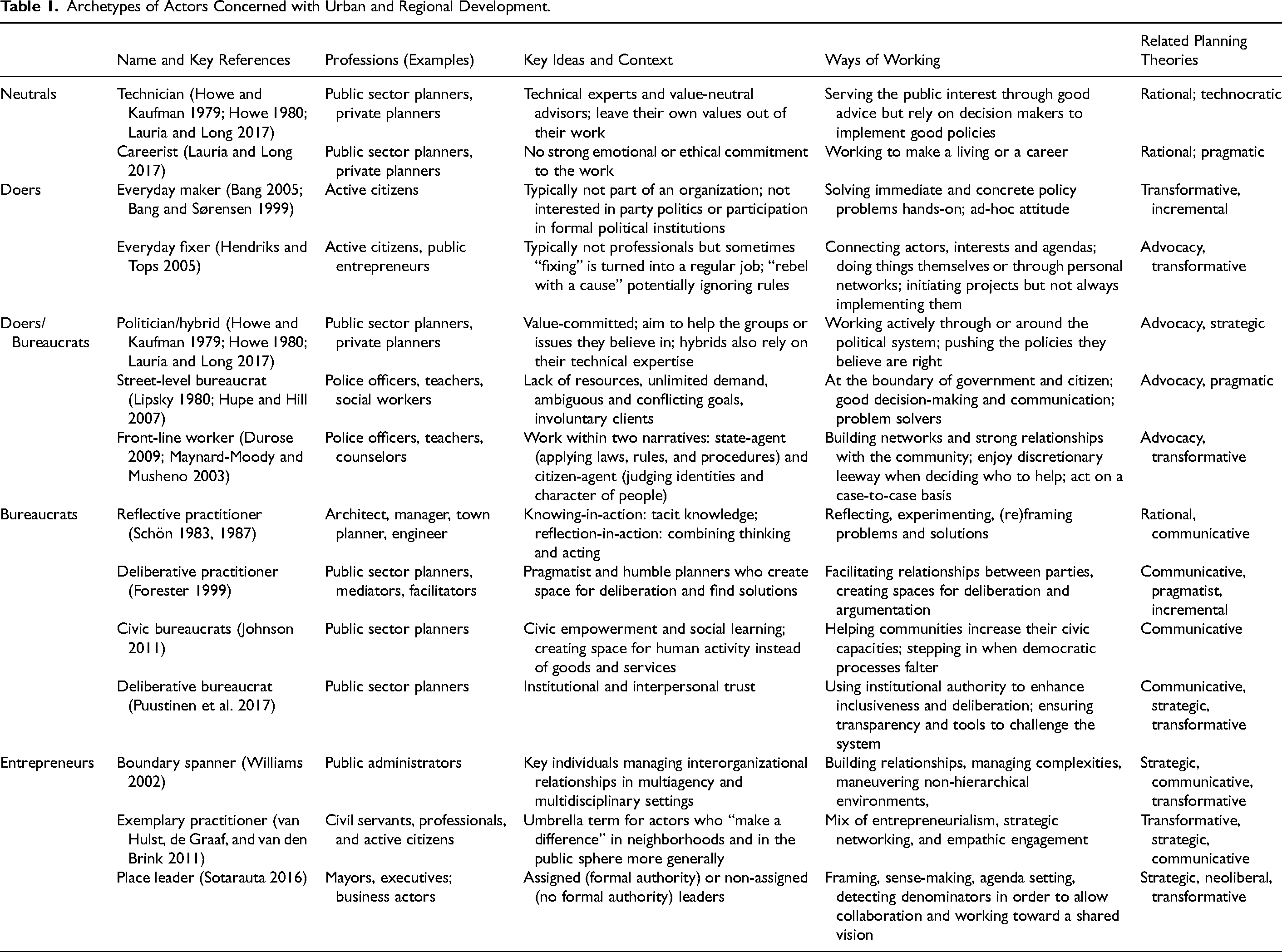
There are several common characteristics among all archetypes. First, these actors are well networked: they are familiar with relevant actors and groups, know who to talk to about an issue, and who to involve in projects and meetings. Typically, these networks extend beyond their immediate organization or community and span to include actors from various backgrounds and contexts. The actors are empowered by trust that originates from their interpersonal relationships and/or from the institutional structures and their position therein (Puustinen et al. 2017). Second, these actors usually have considerable experience in their job or task. Although this does not mean that doing exemplary things is a matter of age, it highlights the importance of learning for all archetypes. Both failures and success stories, paired with reflection and contemplation, play a crucial role in the personal and professional growth of these actors. Third, these actors are well aware of the system in which they work or are willing to learn about it. Procedural knowledge, including familiarity with institutions, rules, and organizational structures, enables them to work with or around the system toward their goals. Fourth, these actors show creativity in approaching problems and finding solutions. In response to wicked problems which do not warrant textbook solutions, they find resourceful ways to reframe the problem, form new actor coalitions, or bend existing rules to fit the challenge. This has also been described as an entrepreneurial way of doing things (van Hulst, de Graaf and van den Brink 2012). Fifth, these actors have an intrinsic motivation toward their job or task. They do things in a specific way because they care about the issue at hand, not because they are executing someone's orders, although they are usually not entirely unbound in their actions either. In other words, they might fulfill a task outlined by their employment position or role, but their way of approaching and handling this task originates from their own mind and motivation, which might in turn have been shaped by their professional enculturation. Sixth, these actors share a pragmatic attitude toward problems and solutions (van Hulst, de Graaf and van den Brink 2011). They hold the assumption that each problem, no matter how complex, can in principle be acted upon and consequently approach tasks in a case-by-case way.
Despite these shared traits, there are also considerable differences among the archetypes (as can be seen in Table 1). The most fundamental differences lie in their respective channels of influence and ways of acting. First, while some rely on formal authority, derived for example from their position in the public sector, others thrive in their role without any kind of formal position but are empowered by trust and support from their communities (Sotarauta 2016). Second, they might work in the system, around it, or even against it (e.g., public servants, business representatives, or local activists). Alternatively, or additionally, they might take up the role of mediator between the state and the public, or between stakeholders. Third, there are differences in the time perspective and commitment, between those who are primarily interested in short-term action versus those who are interested in a long-term strategy to address an issue or incrementally improve the system.
Without aiming to outline new archetypes, four groups of actors seem to emerge from the literature. The “neutrals” do not take a strong ethical stance in their work. They see themselves as technicians who can provide technical expertise when asked for it. They might commit themselves to serve the public interest by giving good advice, but they rely on decision-makers to act upon these recommendations. They might also prioritize their own career progression and job security over concerns related to what is right. The “doers” are public servants or engaged citizens working in other professions with a hands-on attitude who want to solve problems quickly and efficiently. They might sometimes be perceived as edgy or eccentric, and not everyone might agree with their ways of doing things, but mostly they are valued and appreciated among their community. The “bureaucrats” are typically public servants (and occasionally citizens) who strongly believe in the value of institutions. They want to achieve change within the administrative system or bend and transform existing rules to be more suitable to address the problem. They are concerned with fostering deliberation and aim for inclusive solutions. Their work has a long-term perspective, often supported by their relatively stable employment in the public sector. The “entrepreneurs” are public servants, private sector actors, or citizens who strive for innovation. Innovation is here not associated with economic gain but rather with creative problem-solving or innovative interpretation of existing rules (Granqvist and Mäntysalo 2020). Their maxim is to utilize networks and resources and connect actors in smart ways in order to tap existing potentials without necessarily changing formal institutions.
The implication from these archetype depictions related to the subject of agency and structure is that planners seem to be found mostly in the category of “bureaucrats.” This clearly highlights their reality of working with(in) the system rather than taking matters into their own hands, as is characteristic of the “doers.” This resonates with earlier observations that planners want to be increasingly viewed as technical experts rather than political advocates (Lauria and Long 2017), and they might not be keen to act as visible leaders (Johnson 2018). However, the depictions of bureaucratic archetypes should not be understood as apolitical, but rather as striving for value-based goals through an established system that might be bended if deemed necessary. Without doubt, this underlines the importance of structure to complement agency. Structure in the form of laws, rules, and norms can not only give backing to planners’ decisions and actions but also prevent them from acting in accordance with their own professional judgments (Fox-Rogers and Murphy 2016). Entrepreneurial organizational cultures which are open to innovation can enable planners to take risks and speak out without endangering their own career and livelihood, as opposed to production-oriented organizational cultures which emphasize efficiency and leave little room for experimentation (Johnson 2011).
Clearly, there are some overlaps between archetypes which present certain limitations to their use. For example, Durose et al. (2016) highlight the multiplicity, complexity, and hybridity in the ways that actors can make a difference in shaping urban neighborhoods. As a result, some have argued against the depiction of individual heroism in promoting change (Meijer 2014). Nevertheless, scholars tend to agree that “individual actors, through their deliberative, reflective, entrepreneurial, and pragmatic acting, can make important contributions to the way collectives try to deal with problems” (van Hulst, de Graaf and van den Brink 2011, 135). The ability to make such a contribution might, however, be undermined by structural power imbalances, resulting for example from gender, race, or ethnicity, which the archetypes mostly fail to acknowledge. The partly superficial characterization of the archetypes makes it challenging to identify them in practice or distinguish between them. However, the identification and juxtaposition of various archetypes contributes to continuous reflection on planners’ roles, motivations, and practices and consequently fosters awareness of the possibilities actors have in the planning system.
Methodological Concerns in Actor-Centered Research
Not only has agency in spatial planning been analyzed through different theoretical lenses but it has also been explored by applying different empirical research methods. An overview of empirical research methods used in actor-centered research, including examples of their application, is presented in Table 2. The contents of this table should not be understood as an exhaustive list or a detailed guide for research but rather as a broad overview of the various methods applied in actor-centered research. More detailed accounts of these methods can be found elsewhere (see e.g., Flick 2014 for an introduction to qualitative research).
Empirical Research Methods in Actor-Centered Research.
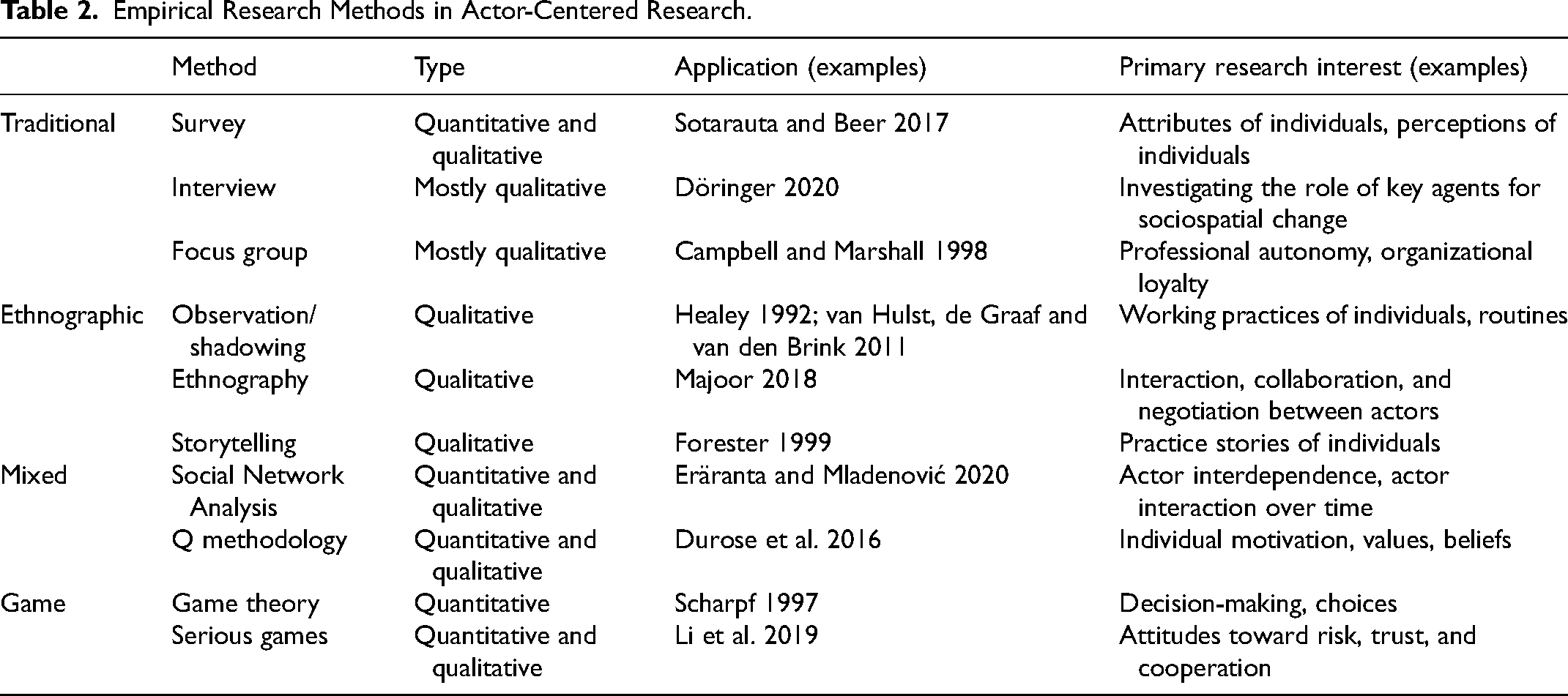
The methods contained in Table 2 can be grouped into four main categories: traditional methods, ethnographic methods, mixed methods, and game methods. Traditional methods (i.e., surveys, interviews, and focus group discussions) are the most frequently used to address research questions related to agency. In the case of expert interviews, it has been increasingly acknowledged that expert knowledge is not objective but that individual perceptions and orientations shape practices which are especially crucial when the power or influence of experts or organizational conflicts are being investigated (Döringer 2020).
Ethnographic methods, despite their widespread use in many social sciences, are still relatively rare in the context of urban and regional planning, especially when the object of study are planners themselves. Healey's “a planner's day” (Healey 1992) and Forester's “practice stories” (Forester 1999) represent early examples of the use of ethnography, storytelling, and shadowing in actor-centered planning research. Van Hulst, de Graaf and van den Brink (2011) take up a similar approach when following “exemplary practitioners” for a day and combining observations with interviews. Majoor (2018) presents an in-depth insight into planning practice through the participatory observation of a complex urban megaproject. By immersing themselves into a planning process over a longer time period, researchers can gain a deep understanding of social practices, formal and informal rules, and their interpretations, and taken-for-granted routines, that in turn can shed light on complex processes that usually take place in closed governance settings. Moreover, by empirically focusing on practice, ethnographies have the potential to overcome the divide between theory and practice in planning research (Hillier and Healey 2008).
More recently, mixed methods combining qualitative and quantitative elements have been used in actor-centered planning research. Techniques such as Social Network Analysis (SNA) and Q methodology show promise to bring new insights about the role of actors without detaching them from their environment. Social Network Analysis models complex processes as nodes (actors) and ties (relationships between actors) to contribute to the debate on how the (decision) environment influences individual actions (Dempwolf and Lyles 2012; Lyles 2015). By assigning attributes and values to the nodes and ties, different kinds of relationships can be visualized and calculated using SNA, with the aim to disentangle the relational complexities in the planning process (Dempwolf and Lyles 2012; Eräranta and Mladenović 2020). Q methodology, in turn, is not specifically concerned with the relation between agency and structure but is interesting for actor-centered research as it aims to uncover patterns of individual subjectivity (Coogan and Herrington 2011). Originally developed in the context of behavioral and social sciences (Stephenson 1953), Q methodology asks individual participants to sort opinion statements about a subject from most agree to most disagree. Contrary to other methods, Q methodology is used to highlight patterns across individuals (as opposed to examining patterns across variables) and has often been used to construct typologies of actors. Albeit still rarely used, the potential of Q methodology to uncover nuanced differences in attitudes between individuals has been demonstrated in a few studies in the context of planning and urban governance (Durose et al. 2016; Griggs et al. 2017).
Game methods focus on aspects of decision-making and are thus highly relevant in actor-centered research on planning and agency. The principles of game theory are central to the theory of actor-centered institutionalism which views actors as players making decisions on public policy (Scharpf 1997). Building on the principles of game theory, “serious games” (i.e., games applied outside the context of pure entertainment) have become increasingly popular in planning research, planning education, and citizen participation (Poplin 2014; Pojani and Rocco 2020). As serious games focus on decision-making, negotiation, and cooperation, they are suited to address actor-centered research questions. For example, Li et al. (2019) recently studied risk, trust, and cooperative attitudes of planning actors through serious games.
Level of Investigation: Scales Associated with Actor-Centered Research
In addition to the choice of research methods, the level of investigation is an important consideration in actor-centered research and warrants a brief discussion here. The first issue relates to the question of whether research on agency can be equated with research on individuals. Following the premise that although planning is institutional, human action lies at the core of planning (e.g., Mladenovic and Eräranta 2020), the individual is a logical starting point for investigation. However, the doctrine of “methodological individualism,” which aims to explain phenomena from an individual perspective, reveals several shortcomings (Jepperson and Meyer 2011). Jepperson and Meyer (2011, 56) argue that although the fact that all social processes work through the behaviors and ideas of individual persons can be considered an “ontological individualism,” it does not necessitate a “methodological individualism,” that is, the sole focus on individual-level explanations. They argue that current sociological research treats methodological individualism as categorical imperative and views theories that do not explicitly build on individuals as inherently flawed.
Although methodological individualism is not as widespread or dominant in planning research, its limitations need to be acknowledged to avoid any “cult of individualism” or “romance of human agency” (Jepperson and Meyer 2011, 69). Individual behavior cannot always provide sufficient explanations for observed phenomena and thus needs to be understood in the context of social organizational and institutional processes. At the same time, knowledge about the individual and their behavior might be necessary, in order not to rely on the assumption of cohesive attitudes and actions among collective actors such as organizations (cf. Scharpf 1997). A deeper engagement with the dialectic of agency and structure, as proposed in this article, can help to study individual behaviors, organizational practices, and institutional rules jointly. Ultimately, the level of investigation needs to be considered with the primary research interest in mind, and in relation to the broader organizational and institutional context.
A second issue concerns the question of scale, more specifically related to planning systems, administrative structures, and spatial organization. There is little discussion on the questions of scale and agency in the literature, although it becomes apparent that most actor-centered research focuses on the local level. Archetypes such as street-level bureaucrats and front-line workers clearly imply that these actors work “on the ground” and close to citizens. Exemplary practitioners and everyday makers/fixers are mostly seen as acting at the neighborhood scale. Meanwhile, place leaders, primarily discussed in the context of regional development, are often associated with the regional scale (Sotarauta 2016).
In the context of spatial planning, policy processes at higher scales (i.e., supraregional, national, or international) are rarely approached from an explicit actor perspective. Although the importance of actors is acknowledged on an abstract level, for example, in the context of the multilevel governance dynamics in the European Union (Sielker 2016a, 2016b; Dabrowski, Bachtler and Bafoil 2014), detailed studies on the characteristics, practices, and strategies of these actors are sparse. The work by Faludi and Waterhout (2002, 2005) represents a notable exception in its investigation into negotiations among the European ministers concerned with spatial development and their organizations during the making of the European Spatial Development Perspective.
Similar to the issue of research methods, it is also evident that there is no perfect scale to carry out research on agency, but that scale is one of many aspects that need to be considered in research design and analysis. Clearly, scale matters in questions related to leadership and agency (Ayres 2014) and there is a research gap to understand agency, especially in the context of higher levels of policy making, such as the supraregional and national scale, as well as in soft spaces such as city regions (Purkarthofer 2018a). Little is known about the humans behind spatial strategies and policy documents, their working practices, organizational relationships, and interpersonal skills. There are relatively few accounts of actors shaping issues relevant for spatial planning at national or European scale. Exceptions are glimpses into Jacques Delors’ influence on EU Cohesion Policy (Faludi 2009), Johannes Hahn's shaping of EU Urban Policy (Purkarthofer 2018a), and Urho Kekkonen's influence on regional development in Finland (Mattila, Purkarthofer and Humer 2020), or an in-depth investigation of Margaret Thatcher's radical reshaping of urban planning in the United Kingdom (Thornley 1991). However, most of these accounts represent single incidents and only scratch the surface of the agency debate.
Research Gaps and New Research Directions
Having presented an overview of the literature on actors in the field of urban and regional planning and highlighted the relevance of these studies for the theme of agency and structure, this section sets out four new directions for research to enhance our current understanding about the agency-structure-dialectic: (i) examining the relationships between agency and structure empirically; (ii) examining agency as ubiquitous rather than exceptional; (iii) examining agency as multiscalar concern; and (iv) examining agency through innovative research methods.
Examining the Relationships Between Agency and Structure Empirically
The importance of the dialectic relationship between agency and structure dominates literature on actors in the field of planning. Broadly speaking, the underlying argument remains the same since Giddens’ theory of structuration: Actors cannot act independently from their context, yet structural factors are not entirely deterministic for action. Nonetheless, empirical investigations of the relationship between agency and structure as well as studies discussing this relationship systematically remain sparse. Such studies would be crucial to draw conclusions that go beyond acknowledging the importance of both agency and structure. Filion (2021) has also recently highlighted this area of research, recommending further exploration of the role the professional sphere plays in shaping the collective identity of planners along with the connection of this identity to motivations driving agency. In his view, the investigation of motivations should be accompanied by a more detailed examination of how the agency of planners interfaces with the resources and constraints emanating from institutions and different political economy circumstances.
Where organizations stand in the dynamic of actors and structures is particularly ambiguous. On the one hand, organizations are often treated as actors in the planning literature, ascribing the assumption of unified action to collective actors such as city planning departments, citizen associations, or ministries. A better understanding of the relationship between individual and collective agency is needed in order to understand how individuals are influenced by the collective ethos and working cultures in their immediate environment. The dimensions of collective and individual agency play a crucial role in how policies are developed, interpreted, and implemented: organizations do not necessarily represent a single and unified will, yet, individuals cannot act without regard to their organization (Mäntysalo and Bäcklund 2018). On the other hand, the distinction between organizations and institutions often remains blurred, especially as the terms are frequently used synonymously in everyday speech (Moroni 2010). Although both entail structural elements that shape human (inter)action, Moroni (2010) understands institutions as “rules of the game” while organizations represent the “players of the game.” Further research into individual, collective, and structural factors in planning is needed, as assumptions about leadership valid for relatively single-valued corporations cannot be applied to complex spatial development and governance contexts, characterized by multiactor, multivalue, and multivision processes (Sotarauta 2016).
Future research should thus move beyond acknowledging the duality of agency and structure toward investigating the relations between individuals, organizations, and institutions. Such a focus might also give space to new research on emotions in planning without detaching planners from their work environment and the broader context sketched out by the planning system and administrative culture. Research in this area could also potentially draw on the archetypes outlined earlier in the article in an attempt to distinguish between different modus operandi and motivations among actors.
Examining Agency as Ubiquitous not Exceptional
It could be argued that the role of actors is an omnipresent element in planning processes in the same way that structure is perceived as ubiquitous. However, much research currently focuses on “best practices” and “exemplary practitioners” who succeed in making a difference and achieving remarkable things in their area of influence. Although it is certainly interesting to understand the role of these individuals and their motivations and capabilities, there is a danger of following a “misleading heroic leadership discourse” (Sotarauta 2016) and overlooking more subtle and hidden influences. Moreover, the role of actors is not always visible in extraordinary approaches. Different actors might for example follow divergent interpretations of the same objective or concept, and thus affect policies and plans through their own values, mindset, and understandings (Purkarthofer 2018b). For example, practitioners might hold considerably different understandings about broad policy objectives (e.g., sustainable urban development) and potential policy responses to them (Griggs et al. 2017; Gunder and Hillier 2009).
Studies on how actors influence planning processes and policy outcomes could make more links to research on emotions in planning. Instead of assuming that emotions should be controlled and suppressed, accepting them as normal elements of human action and interaction supports a view of planners as humans. Although there is a general consensus among planning scholars that viewing planning as purely technical and rational activity is outdated, the idea that planners themselves are “neutral” still prevails.
By viewing agency as an inherent and universal aspect of planning, practitioners can also be prepared and encouraged (e.g., through education and training) to assume responsibility for action. Changing the world is not reserved for a few ”leaders”: all practitioners have the opportunity to make choices between different courses of action. These opportunities and responsibilities need to be communicated clearly in planning education, in order to motivate future planners, foster interest in a variety of issues, and empower them to act within their position (Purkarthofer 2020; Purkarthofer and Mäntysalo 2022).
Examining Agency as Multiscalar Concern
To date, actor-centered research has largely focused on local planners (Durose et al. 2016) and has only occasionally addressed regional actors (Sotarauta and Beer 2017). Studies on actors at the national level as well as the interplay between actors at different levels of government remain limited. However, individuals at different levels of policy making may have a decisive influence on policies that remains unnoticed when researchers ascribe more importance to a single scale (Filion 2021)—something that Purcell and Brown (2005) have termed the “local trap,” arguing that research is often constrained by the fact that more importance is ascribed to the local scale simply for the reason that “the local” is preferred a priori over other spatial scales without further investigation. Consequently, future research should consider actors and agency at all spatial scales which entails looking beyond politicians taking decisions “at the top” and investigating how public servants shape policies at all levels of government. According to Brewer, Selden and Facer (2000), administrators frequently resist being controlled by elected officials, resulting in a situation where the “daily tasks of the majority of administrators […] are influenced more by internalized values and norms than political responsiveness” (Brewer, Selden and Facer 2000, 193–94). Their work serves to highlight the importance of studying the relationship between agency and structure in all its complexity.
Examining Agency Through Innovative Research Methods
Opportunities exist for future research to make use of a more varied methodological toolkit in order to explore the behaviors of actors in urban and regional planning. Planning researchers can benefit from looking to other disciplines, including organizational sciences, management studies, public administration, behavioral sciences, or psychology for inspiration about new research methods. Psychological approaches have gained popularity in planning to investigate how citizens experience the built environment (i.e., environmental psychology) but have seldom examined the perspective of the administrator or decision-maker.
Organizational, management, and administration studies have highlighted the potential of Q methodology to investigate motivations, values, and behaviors of public servants in a nuanced manner (Durose et al. 2016; Brewer, Selden and Facer 2000; Selden, Brewer and Brudney 1999), and studies in the field of planning have, for example, investigated varying interpretations of vague planning concepts (Griggs et al. 2017). Applying Q methodology could enable researchers to empirically explore subjective interpretations, individual behaviors, and organizational cultures in order to shed light on the relationship between agency and structure.
The potentials of Social Network Analysis as research method in planning have been presented in detail by Dempwolf and Lyles (2012), who argue that SNA offers tools to disentangle the relational complexity of the planning process. Ethnographic methods hold the potential to observe individuals in their work environment and might thus shed light on the complex relations between individuals, organizations, and institutions. Game methods can be used to explore individual and collective negotiating and decision-making and can thus tell us more about interactions between individuals and between different groups of actors.
These methods can enrich the research on actors and complement more traditional research methods such as interviews, focus groups, and surveys. Applying novel methods of course does not come without challenges: They are time-consuming, require new skills from researchers and not least their successful application relies on the willingness of practitioners to participate, potentially taking up a lot of their sparse time. Nonetheless, planning researchers need to expand their methodological repertoire to draw new conclusions about agency and structure and to gain insights into the attitudes and behaviors of practicing planners.
Conclusion
In this article, we have illustrated the wide range of literature on agency in the field of urban and regional planning. Agency matters when it comes to who develops visions, defines goals and measures, and proposes planning policies. However, actors are not unbound in their decisions, they are both enabled and constrained by the structure within which they work. It is thus important not to overemphasize or downplay the role of actors in planning but also explore the link between agency and structure to understand planning practice. Although the relationship between agency and structure is a recurring theme in the literature, few studies go beyond acknowledging interdependence and mutual influence between the two spheres. This article has highlighted various theoretical perspectives that can potentially advance the conceptualization of agency and structure.
Researchers drawing on institutionalist perspectives point to the social embeddedness of actors and the varied constraints different actors face within the same system. The research discourse on discretion draws attention to the leeway of individuals within the planning system, although to date it pays little attention to the role of organizational practices. Pragmatist research puts practice in the spotlight and presents examples of the transformative power of individuals who know how to work within and around the system. Studies on networks focus on the relationships between actors and underline how power is inherent to both agency and structure, while the characterization of actors themselves often remains shallow. The debate on leadership, present especially in the regional development literature, highlights the importance of individual action in complex processes involving a multitude of actors while reminding us to avoid simplified depictions of “heroic leadership.” The discourse on emotions in planning shows that enabling and constraining forces do not only originate from structural factors but also from within individuals and their relationships with each other.
This article has also introduced different archetypes of planning actors, which have been characterized with the intention to identify successful practices and to enable reflection and learning among and from practitioners. Broadly, these archetypes can be divided into four (partly overlapping) camps: the “neutrals” who focus on their technical expertise or their own careers, the “doers” who strive for pragmatic solutions, the “bureaucrats” who aim for inclusion, dialogue, and improvement of rules within an established system, and “entrepreneurs” who use creativity and networking skills to tap existing potentials.
Traditional research methods such as interviews and surveys still dominate actor-centered research, while other quantitative and qualitative methods are gaining ground in recent years with the aim to investigate actors’ behaviors, motivations, choices, and relationships. From an empirical perspective, a focus on actors brings about the danger of “methodological individualism” aiming to explain all processes through the study of individuals. This underlines the importance of considering agency and structure as interrelated aspects, and it offers ways to empirically study both at the same time. As for the scale of investigation, the majority of studies focus on local and regional actors while empirical studies analyzing national or international planning policies and strategies through the perspective of agency remain extremely rare. The agency of planners, reflected in ideas about creative thinkers who define and control their professional sphere, abounds in planning literature (Campbell and Marshall 2002) but research into how their agency and practices are shaped by the institutional, economic, and political context in which they operate is still in its early stages.
Footnotes
Declaration of Conflicting Interests
The author(s) declared no potential conflicts of interest with respect to the research, authorship, and/or publication of this article.
Funding
The author(s) disclosed receipt of the following financial support for the research, authorship, and/or publication of this article: This work was supported by the Academy of Finland (grant number 338335).
