




Abstract
Land policy influences how and by whom land is used; therefore, it impacts the efficiency and equity of land use. This paper offers an economic perspective on efficiency and equity as fundamental purposes of planning and land policy. It brings a highly needed mutual understanding between planning and economics, whilst acknowledging the limitations of the theoretical concepts of efficiency and equity in their real-world applications. The paper also provides a solid ground for analysing trade-offs between efficiency and equity of land policy interventions. Situations minimising trade-offs should be of particular interest as they provide opportunities for improvements without necessary sacrifices.
Introduction
While markets are usually good at organising economic activities, they do not always lead to optimal outcomes. A predisposition of well-functioning markets is the adequate assignment of property rights and the enforceability of contracts. Even if this is satisfied, markets also often fail in their primary task – to allocate resources efficiently. There are different causes of market failures leading to inefficiencies, such as externalities, information asymmetries and public goods. Besides efficiency of market outcomes (i.e., changes in aggregate net benefits to society as a result of allocation of scarce resources among competing uses), there are concerns about distribution of income and resources among society members (Needham, Buitelaar, and Hartmann 2019). For these distributional issues, economics uses the term equity. The term distributive justice is sometimes used as an equivalent of equity in other disciplines (e.g., Roemer 1998; Needham 2016). Together with concerns about equity, market failures build arguments for government interventions on the market. This justification of government intervention has grounds in the theories of welfare economics (Shahab and Viallon 2020) and the promotion of efficiency or equity in this branch of economics (Stiglitz and Rosengard 2015).
A justification of government intervention can also be derived from new institutional economics and its analysis of transaction costs (for a review of transaction costs in planning literature, see Shahab 2021). Its insights stress the role of institutions, including assignment of property rights to scarce resources (Webster and Lai 2003), which are created by society to mediate collective actions leading to better outcomes in comparison with isolated individual behaviour. Thereby, new institutional economics extends the efficiency analysis of welfare economics by integrating transaction costs into the analysis. Similarly, game theory and its prisoner's dilemma model show why coordinated action is needed for the avoidance of the highly inefficient outcomes of individual actions under interdependencies, such as externalities, public goods or occurrence of high transaction costs (for interconnections of game theory and planning, see Lord 2012).
Land is considered a special type of good, as it is location-specific and immovable with a total fixed amount. Property in land is among the most constitutionally protected things one can own in most countries (Hartmann and Needham 2012). Property in land and land property rights regimes vary in different countries based on established legal frameworks in place. These land regimes play a – quite literal – fundamental role in the allocation of land among conflicting land uses, distribution of benefits and burdens of land uses, and opportunities of governments to intervene by designing and adopting different policies. The differences in legal frameworks can be partly explained by the legal traditions upon which legal frameworks ground, e.g., whether they use common law or civil law. However, as Alterman (2010, 84) argues, neither the degree of restrictiveness of takings law, particularly when it comes to providing compensations to landowners whose land is adversely affected by planning decisions, or the degree of legal certainty concerning land property rights can be explained by the affiliation with these legal roots. 1
Land policy is a form of government intervention on markets related to land (Davy 2012; Needham 2006). Land policies seek to achieve various environmental, social and economic goals. These goals are not always explicitly framed as land policy goals, and they are sometimes incorporated in land-use planning or environmental policies. They include, for example, providing adequate land protection from excessive development and sprawl (Halleux, Marcinczak, and van der Krabben 2012; Liu et al. 2016; Milan and Creutzig 2016; van Vliet, Eitelberg, and Verburg 2017), densification and land thrift (Hartmann and Hengstermann 2019; Khoshkar, Balfors, and Wärnbäck 2018), providing land for affordable housing (Crook, Henneberry, and Whitehead 2015; Shahab, Hartmann, and Jonkman 2020), finding financial resources for public infrastructure provision (Medda 2012; Muñoz Gielen and Van der Krabben 2019), socially-fair distribution of land (Article 1 of the German Building Code; see also Davy 2012), providing all citizens access to amenities and decent housing (Fainstein 2017; Sadler and Shahab 2021), or preventing accumulation of disamenities in poor neighbourhoods by paying attention to spatial justice (Fainstein 2014; Soja 2013).
Land policy provides a link between planning and property (Gerber, Hartmann, and Hengstermann 2018; Shahab, Hartmann, and Jonkman 2020), affecting the allocation and distribution of land (Davy 2018). Planners often perceive their role as correcting for market failures, such as by public goods provision (Moore 1978), improving equity, enhancing social well-being and tackling inequalities within society (Rydin 2011), or searching for a balance between economic growth, environmental protection and social justice, according to Campbell's sustainability triangle of planning priorities (Campbell 1996), or for “three Es” of sustainable development, namely economy, environment and equity (Berke 2002, 30).
This conceptual paper offers an economic perspective on the role of planners and on the purposes of planning and land policy. It frames the purposes of planning and land policy with the help of welfare economics and its analysis of efficiency and equity (or justice). It handles the topic as a two-side model also incorporating environmental concerns in contrast to Campbell's three-sided sustainability model of planning priorities.
While land policies seek to achieve various policy goals, these goals can primarily be justified by increasing efficiency of land uses, increasing equity of distribution of costs and benefits connected to different land-use types (e.g., the distribution of land rent), or both. So, purposes underlie the overall justifications to pursue land policy, whereas policy goals define the content of these policies in more detail. Applying the perspective of economic theory on purposes of planning and land policy brings a highly needed mutual understanding between these disciplines. It also allows building a solid ground for an analysis of constraints under which land policy interventions do and do not lead to a trade-off between efficiency and equity, and which land policy interventions minimise these trade-offs.
The present paper expands the theory of these conflicts and opportunities for their minimisation by bringing academic viewpoints from economics, policy and planning together to push the academic debate on land policy. The debate is further complicated by the specifics of land as an immovable and fixed-amount asset, the reliance of its value on many external factors, including (dis)amenities in its vicinity, and the necessity to incorporate land rent and spatial justice into the analysis.
To demonstrate efficiency and equity as the fundamental purposes of land policies, we first define efficiency and equity and the trade-off between them. Then, we apply the perspectives of these fundamental purposes of land policies on (i) land policy goals; (ii) land policy instruments; (iii) and different frameworks proposed for instrumental evaluation; and discuss the trade-offs between efficiency and equity and possible pathways for their minimisation within land policies. The paper goes on to highlight the theoretical and practical limitations of utilising the efficiency and equity concept in planning. The final section provides an overall discussion of the main arguments followed by concluding remarks that identify future directions for the academic debate.
Efficiency and Equity
This section first outlines economic efficiency and equity concepts to provide a basic understanding of the two key concepts that feed the debate on trade-offs.
Economic Efficiency
The term efficiency has slightly different meanings in different disciplines. Within public policy analysis, Dunn (2015, 322) defines efficiency as “how much effort was required to achieve a valued outcome”. Needham, Buitelaar, and Hartmann (2019, 86) call this concept ‘policy efficiency’. Economists use the term ‘cost effectiveness’ when relating to efforts and outcomes in financial terms (e.g., Goulder and Parry 2008; Stiglitz and Rosengard 2015, 320). Cost effectiveness compares the relative costs to outcomes (effects) of interventions.
When economists speak about efficiency, economic efficiency (both these terms are used, e.g., by Stiglitz and Rosengard 2015), market efficiency (Hanley, Shogren, and White 2019) or allocative efficiency (Needham, Buitelaar, and Hartmann 2019), its meaning is more holistic. It deals with what goods and services should be produced, how and for whom. In a world of an ideally functioning market, the market outcome is efficient without the need for governments to intervene in it. In the real world, however, there is a certain space for government interventions, as markets often fail in their role to provide an efficient outcome. This notion of efficiency has its background in welfare economics.
In a narrow economic sense, efficiency is defined as gross national income per capita as a related measure to GDP per capita (Andersen and Maibom 2020). From a broader economic perspective, welfare economics also includes natural resources and ecosystem services provided by nature in the efficiency criterion, as social welfare is highly dependent also on the environmental goods and services not reflected in market transactions. Welfare economics seeks to balance marketed goods and services and those provided by the environment.
Most economists use the criterion of Pareto efficiency in order to describe an efficient outcome, which captures a situation where no one can be made better off without making somebody else worse off (Krugman, Wells, and Graddy 2011, 13). If it is possible to make somebody better off without harming anyone else, economists speak about a more efficient outcome, a higher degree of efficiency or Pareto improvement (Stiglitz and Rosengard 2015, 65). There are many possible Pareto-efficient outcomes of the market which are dependent on the initial allocation of resources among society members. Pareto efficiency, therefore, is an efficiency optimisation criterion under the constraint of redistribution avoidance.
The attempts to increase efficiency are not limited to the Pareto criterion, as not many opportunities exist for making somebody better off without making anybody worse off. Therefore, economists use the Kaldor-Hicks compensation criterion to test the possibility of compensating those who suffered from a policy by its beneficiaries. If benefits resulting from a policy action exceed damages (both expressed in monetary terms), the project is regarded as increasing the overall efficiency, as the winners could theoretically compensate the losers. The compensation does not need to take place in reality, and indeed, losers are usually not compensated 2 . This logic of the net gain in efficiency uses cost-benefit analysis.
Market failures lead to a non-optimal allocation of scarce resources and decreased efficiency levels. The most relevant forms of market failures that concern the efficiency of land markets are (i) under-provision of public goods which are not supplied by the market at all or are supplied at inadequate levels, (ii) overproduction of goods and services that cause negative externalities, (iii) under-provision of goods and services that cause positive externalities, and (iv) monopoly power. Whitehead (1983) adds other reasons for malfunctioning urban land markets and reasons for government intervention from the efficiency perspective: (v) imperfect information of market actors, (vi) differences in valuation of future costs and benefits between society and individuals, (vii) differences between society and individuals in risk aversion, and (viii) underconsumption of merit goods, consumption of which by individuals increases the welfare of others. Also, other market inefficiencies specific to land markets can be traced. They relate to the need for common action if the development of a site with fragmented ownership has enhanced efficiency but has been limited by high transaction costs (Lord and O’Brien 2017).
Land policy influences efficiency via allocation of land among conflicting land uses. From an efficiency perspective, correcting for market failures and imperfections is the essential purpose of land policy. However, efficiency can be in contrast or friction with equity considerations, i.e., the distributional aspect of land policy.
Equity
Equity encompasses different notions on income and welfare distribution in general, often meaning pro-poor redistribution (Pascual et al. 2010) or reduction of income inequality (Stiglitz and Rosengard 2015). This includes the concept of distributive justice (Roemer 1998; Needham 2006). Economic literature uses the term equity (e.g., Stiglitz and Rosengard 2015) in situations for which other disciplines refer to as justice (Sandel 2010) or fairness (Konow 2001). For economists, equity is a narrower concept related only to obtaining a fair share of the economic output by individuals (e.g., Krugman, Wells, and Graddy 2011, 13).
In the interpretation of pro-poor distribution, equity is a close companion to equality. It is important to recognise that equality refers to specific notions of distribution (i.e., striving for equality of opportunities or outcome – depending on the specific normative stance, see Sandel 2010 or Hartmann 2018). Inequality can be measured using the Gini coefficient or other measures (Buitelaar, Weterings, and Ponds 2017), and equity is a broader concept. So ultimately, it is essential to acknowledge the distinction between equity and equality.
Severe social tensions can be associated with a high degree of inequality (Stiglitz 2012). Governments usually consider the level of inequality and the impact of projects or programmes on different social classes – low class, middle class, or the wealthy (other equity issues cover equity in gender, among regions, generations and the like).
Corbera, Brown, and Adger (2007) acknowledge that access to resources, such as land, has high equity implications. In this view, equity can be touched by affecting the bundle of rights connected to land ownership in various ways (e.g., by bringing burdens or alleviating burdens on landowners, such as limiting the right to exclude others from its use) or even by changing the ownership structure. Policies limiting the exclusion of others may lead to welfare gains of some individuals from the chance of all society members to enjoy goods and services connected to land. As Okun (1975) determined, in such circumstances, political decisions intentionally pull some marketable or at least theoretically marketable goods and services out of the economic domain to the political and social domain of citizens’ rights.
In line with the scope of equity defined above, the equity considerations also involve the (re)direction of land rent. The fairness issues of whom the land value created by urban plan amendments should belong to, and who should pay for the provision of public infrastructure, have established a broad community of scholars discussing land value capture (e.g., Alterman 2012; Muñoz Gielen and Van der Krabben 2019; Crook and Whitehead 2019).
As distributive issues are highly normative and dependent on and intertwined with norms, values and cultures (Bronfenbrenner 1973), different philosophies with different notions of equity have been established (Sandel 2010; Hartmann 2018; Davy 1997). Some societies might be very concerned with inequalities among society members, and some might not be as concerned. If a society does not consider economic equality, it may only be interested in efficiency issues (Stiglitz and Rosengard 2015, 170). This view is represented by the philosophy of libertarian justice coming out from the theory of natural rights of individuals formulated by John Locke in the 17th century and related to classical liberal thinkers such as Adam Smith and David Hume. Libertarians prefer the least possible intervention in the distribution outcomes of the market, as they oppose coercive redistribution and believe that individuals should own all the fruits of their labour (a summary can be found in van der Vossen 2019). Nozick (1974) was an influential contemporary protagonist of the libertarian ideal minimal state restricting its activities to supporting the market economy and private property.
If we stick to the idea that the output of markets is not equitable and necessitates intervention, there are also different normative philosophical opinion streams that define different concepts of equity, resulting in different social welfare functions. Based on Stiglitz and Rosengard (2015, 169–172) we can refer to: (i) the utilitarian social welfare function, which sums up the utilities of all society members, where utility of wealthy individuals is worth the same as utility of poor individuals; (ii) the Rawlsian social welfare function, which merely takes account of increases in utility of the most miserable individual without placing any value on increases in utility of more affluent people (the Rawlsian social welfare function is based on the hypothetical social contract of individuals behind the ‘veil of ignorance’, leading to avoidance of poverty and help for the disadvantaged; Rawls 1971); (iii) a social welfare function placing a higher weight on the utility of poor people; therefore, to stay on the same social indifference curve (i.e., different distributions of scarce resources among society members which are indifferent to society), there has to be a significant utility gain of relatively affluent people to counterbalance a tiny utility decrease for the poor.
Ultimately, there are thus different and contradictory concepts of equity. Concepts of equity rely solely on income-led or wellbeing-led evaluation contrary to the broader spectrum of various concepts of justice. Equity does not include the discussion of different notions of ethics such as the teleological ethics of Aristotle, Kant's ideals of justice, Sen's capability approach and the like (for further reading, see Sen 1995; Sandel 2010; Davy 1997; Buitelaar, Weterings, and Ponds 2017; Hartmann 2018; Needham, Buitelaar, and Hartmann 2019). None of these approaches or understandings of equity is better or worse per se – equity is rather pluralistic, and the choice of a specific concept of equity remains a political one.
Regardless of the specific interpretation of equity or justice, land policy inevitably “makes people poorer or richer” (Needham 2006, 4) and thus affects equity. Davy, therefore, coined the phrase “essential injustice” in relation to land policy (Davy 1997). So, justice, or equity (in economic terminology), is a fundamental concern of land policy besides efficiency.
Trade-Off Between Efficiency and Equity
Since the influential contribution of Okun (1975), economists have recognised a trade-off between efficiency and equity (they conceive equity in a narrow sense of income equality, which is understood in this paper as just one form of equity). The most efficient outcome of market activities is achieved by a system encouraging the efforts of individuals and channelling them to pursue the most socially productive activities, which, in return, reward them most. Such a system inevitably creates situations in which individuals do not have the same opportunities at the initial stage of this success-seeking and money-generating endeavour and do not possess identical skills and abilities. So, neither equality of opportunities nor equality of outcome are guaranteed. When society emphasises greater equality in income as an equity issue to redistribute a portion of the income from the affluent to the poor, these transfers are often at the expense of efficiency (Okun 1975). If neither efficiency nor equality has an absolute priority, hence, neither of the extreme concepts of equity prevails, public policy needs to opt for compromises between these two factors and decide upon which decrease in efficiency it is prepared to sacrifice for the sake of higher redistribution.
In his book (1975, 91), Okun uses a leaky bucket analogy to describe the transfer of income from the rich to the poor, for example, using taxation. Due to leaking, some money will disappear in transit with the result that the poor will not receive all the money taken from the rich. Efficiency decreases due to diminishing overall product that society can utilise. Okun summarises the causes of the decrease in efficiency as follows: There are administrative costs of transferring the money from the rich to the poor. However, the economic disincentives created by this process are even more severe. The poor, to whom the money is transferred, as well as the rich, from whom the money is taken, lose incentives to pursue the most socially productive activities. The rich are punished for their achievements by higher taxation, and transfers reward the poor for nothing. These disincentives may affect the overall economic product in future. Keeping all these effects in mind, a trade-off between efficiency and equity occurs.
Okun's theory of the trade-off between efficiency and equity has been influential and seems firmly embedded in economic theory. Differences in wealth are seen as consequences of economic arrangements, although unpleasant for the well-being of various groups, such as the poor or incapable, but otherwise harmless for society and manageable in the long run thanks to the expectations of declining inequalities in society hand in hand with an increase in economic product. A theory of declining inequalities thanks to the growth of economic product was formulated by Nobel Prize laureate Kuznets (1955). According to another Nobel Prize laureate, Stiglitz (2012), this view has changed dramatically as we observe an increasing gap between the rich and the poor (e.g., Piketty 2014), which contradicts the predictions laid by Kuznets. This disparity has adverse effects on the well-being of all by threatening democracy (Stiglitz 2012) and market stability (Galbraith 2012). Concerning the origins of inequality in rich countries, mainly for the US context, Stiglitz (2015) stresses that inequality stems largely from rent-seeking, i.e., actions of powerful actors in the form of monopoly power or political influence transferring a significant share of wealth to them at the expense of the rest of society. The recognition of the harmful effects of rent-seeking, characterised by significant overall welfare losses, goes back to Tullock (1967). Stiglitz (2015) calls income from rent-seeking ‘exploitation rents’.
Other academics relativise the trade-off between efficiency and equity on the ground of externalities of inequalities (Alesina and Giuliano 2011). These include specifically higher crime rate (Rueda and Stegmueller 2016), and above all, underinvestment in the human capital of the poor by low education opportunities of the disadvantaged, leading to lower intergeneration income mobility (Corak 2013) and lower productivity of future generations (Easterly 2007; Berg et al. 2018).
As a result of all these factors, efficiency is not necessarily traded off for enhancing equality. According to many contemporary scholars, society pays a high price for inequality by contrast.
Perspective of Efficiency and Equity in Connection to Land Policies
To enable the discussion of efficiency, equity and tension between these two purposes of government interventions in connection to land policies in complexity, we explore how these fundamental purposes are related to the explicated goals of land policies and the instruments which are applied to pursue these goals, and how they are incorporated into policy evaluation frameworks.
Land Policy Goals
In many countries, land policy is not a separate policy field, but land policy aims are embedded in spatial policy and planning. Only a few countries have explicit land policy documents (such as the Netherlands; see Meijer and Jonkman 2020). So, land policies implement spatial planning and thus seek to achieve the various environmental, social and economic goals determined by spatial policy and planning.
Land is scarce, and land policy goals have to deal with the scarcity of land (Hartmann and Gerber 2018). Land has idiosyncratic characteristics, i.e., every parcel of land has its unique characteristics, which differ from other parcels, for example, in terms of location, topography, soil and surroundings (Christophers 2016; Coakley 1994). These land characteristics explain that there are different land policy goals, which for the purposes of this paper can be divided into two underlying types, namely quantitative and qualitative goals. The analytical distinction of land policy goals in these categories helps understand the intervention rationales of land policies regarding efficiency and equity. Table 1 provides examples of quantitative and qualitative aspects of land policy goals on efficiency and equity.
Examples of Policy Goals and Their Relation to Efficiency and Equity as Their Primary Goals.
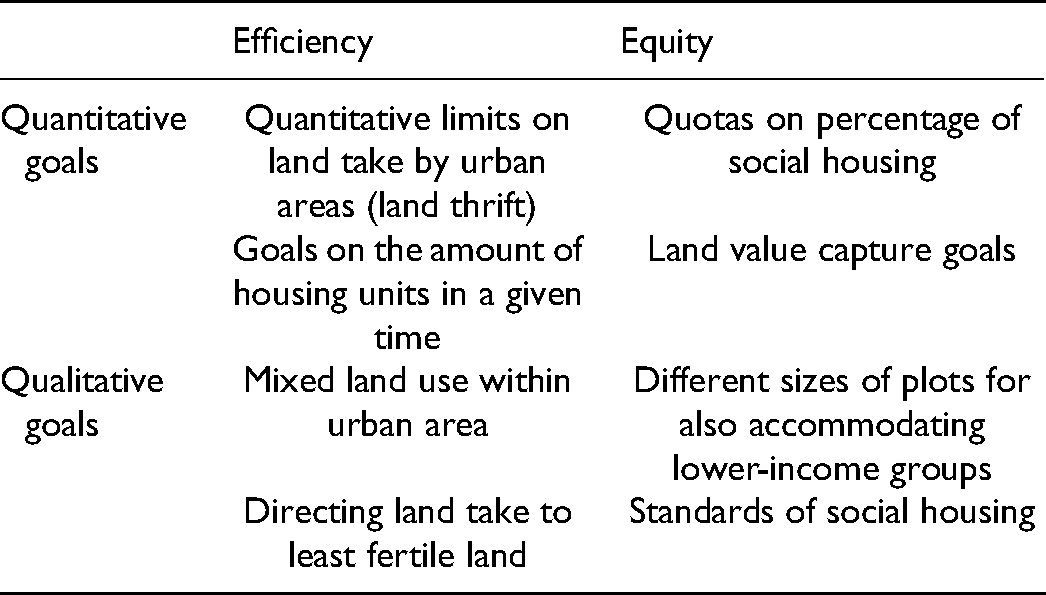
Quantitative goals often deal with the scarcity of land by assigning certain amounts of land to competing uses. Through the political system, society needs to decide on the share of different land uses in the total land supply, such as the amount of land for agriculture, residential or industrial purposes. A typical quantitative land policy goal is the number of housing units needed in an area (Shahab, Hartmann, and Jonkman 2020), such as developing 75,000 new housing units in the Netherlands annually until 2030 (Dutch Ministry of the Interior 2018). Another pressing quantitative concern of land policy goals is protecting natural or semi-natural areas from excessive land take (Liu et al. 2016; van Vliet, Eitelberg, and Verburg 2017; Bovet, Reese, and Kock 2018; Marquard et al. 2020). Germany has released the goal to reduce land take from the original 120 hectares per day to 30 hectares per day (Davy 2009); in Flanders, a ‘betonstop’, i.e., a zero land take goal until 2040, is being prepared politically (Buitelaar and Leinfelder 2020). The reduction of second homes in Switzerland following the recent planning law reform is an example of a quantitative planning goal (Gerber and Tanner 2018). All these quantitative goals seek an increase in efficiency – to allocate land to the most efficient use from the perspective of society. Efficiency can, on occasion, supposedly be enhanced by building new housing units; in other circumstances, by strict protection of non-urban land.
Other quantitative goals can be directed to equity issues. Quotas on the percentage of the provision of enough housing opportunities for low-income households are examples of such quantitative goals (Fainstein 2014; Shahab, Hartmann, and Jonkman 2020). In addition, there are goals on land value capture aiming to find resources for public infrastructure provision from private resources (Medda 2012; Muñoz Gielen and Van der Krabben 2019) or for other needs (Alterman 2012; Vejchodská et al. 2022).
The qualitative goals focus on the content of land use, i.e., the characteristics of particular land use. An example is the requirements for a mix of certain types of residential land uses within an urban area. Another example of a qualitative land policy goal is locating land conversion to land least fertile for agriculture (Vejchodská and Pelucha 2019). Goals for densification (Dembski et al. 2020; Debrunner and Hartmann 2020) also have qualitative aspects besides the quantitative one. All these goals seek an increase in efficiency – mixed dense land use provides better living conditions for urban dwellers, while land with higher fertility stays in agricultural use.
Qualitative goals can also be directed towards solving equity issues. The German Building Code entails a specific article that demands socially fair land use, having different sizes of plots within settlements to allow housing for lower-income groups (Article 1 of the German Building Code). Minimum standards for social housing units can also be considered qualitative goals aiming at equity concerns.
Table 1 does not provide an exhaustive list, but it illustrates typical land policy goals. The description of these goals illustrates that – although some goals are meant to tackle either efficiency or equity – the mutual influences and effects of these goals are apparent for both types of goals, quantitative and qualitative. Understanding the mutual effects is relevant for legitimising policy interventions, i.e., land policy instruments.
Land Policy Instruments
Land policies use a broad range of instruments to pursue previously discussed land policy goals. Traditionally, land policies rely on zoning, building regulations and master planning. In addition, there are other instruments debated in academia and practice that gain importance when new land policy challenges arrive. Examples are tax incentives, direct subsidies, negotiated agreements, offset schemes, information and advice, and transferable development rights (Hou et al. 2020). According to the purposes of land policy, instruments can be distinguished into separate groups: (i) instruments primarily seeking to increase efficiency; (ii) instruments primarily focussing on equity issues; and (iii) instruments intentionally designed to pursue both purposes at the same time.
The choice of land policy instruments is not the primary distinctive element between these groups. In other words, any land policy instrument can be categorised in any of the three groups, depending on the strategies that decision-makers adopt (Shahab, Hartmann, and Jonkman 2020). Instruments can be strategically used in different contexts for different purposes. How public authorities activate specific instruments, not their technical characteristics, is what matters. We demonstrate this view on the following examples of land policy instruments – zoning, taxes and charges, and trading schemes. Institutional arrangement highly affects the opportunities for using these instruments.
Zoning specifies the area, location and development intensity of new developable land. It does so to control overall land use to correct for market failures with better protection of open space or by limiting nuisance in the vicinity of housing units. When pursuing these goals, zoning aims to increase efficiency by solving externalities. From the transaction costs perspective, zoning increases efficiency by limiting the need for solving land-use conflicts by individuals, and therefore decreasing transaction costs (a complex view on the functions of zoning, including market externalities usually not covered by welfare economics, can be found in Lehavi 2017). If the zoning instrument is activated in other ways, for instance, by defining land for affordable housing via zoning regulations, the strategic use of this instrument is intended to pursue higher equity.
Charges and taxes are also instruments pursuing different purposes. Environmental charges, such as the charge for land loss (Nuissl and Schroeter-Schlaack 2009; Vejchodská and Pelucha 2019), primarily attempt to preserve land of high agricultural quality or environmental value. These instruments aim to increase efficiency with an implicit assumption that land preservation is at particular locations more valuable to society than development. Other taxes and charges, such as land value capture schemes, primarily deal with equity issues. These include land value taxes (Dye and England 2009), financial or in-kind developer obligations (Muñoz Gielen and Van der Krabben 2019) or taxes on added land value created by zoning like in Switzerland (Viallon 2018; Shahab and Viallon 2019). These instruments do not endeavour to affect land use but rather attempt to tackle the question of who pays for the necessary infrastructure or programmes for affordable housing and who should profit from relaxing zoning regulations with a normative presumption that private revenues from rising land value are unearned (Alterman 2012; Vejchodská et al. 2022).
Trading schemes can also be viewed as instruments that allow the achievement of both defined purposes based on the instrument design. In the United States, transferable development rights are primarily utilised for increasing efficiency of land use as they allow setting a maximum quantitative target of land utilised for development in places where the protection of agricultural land or environmentally precious areas is considered important without the necessity of financial compensation to landowners. Environmentally precious areas are defined as sending zones (from where landowners can sell development rights that they are not allowed to utilise within that zone), urban areas as receiving zones where higher development intensity is allowed upon the purchase of development rights (McConnell and Walls 2009). In the context of countries with property rights regimes not considering development rights as a part of the bundle of rights connected to landownership (many European countries), transferable development rights are often utilised for equity reasons, such as for compensating for a potential development reduction. One of them is the Dutch “space for space” policy (Janssen-Jansen 2008), which attempts to relocate developed land to more valued locations by only allowing the building of a new villa under the condition of demolishing an old building elsewhere. Besides this rationale of increasing efficiency, this policy aims to compensate for the loss of development rights as an equity issue. Another example from Italy is utilising transferable development rights to enable equal treatment of all landowners in a development area with different development opportunities on each parcel (Micelli 2002). The Italian transferable development rights policy, activated in several cities, allows landowners of a developable area to achieve the same level of land appreciation without regard to the intensity of development permitted on individual plots. This policy has therefore been applied to resolve equity issues exclusively.
As indicated earlier, land policy instruments are meant to serve the implementation of land policy goals. The discussion above and the given illustrations point to the need to consider the mutual effects of activating certain instruments for efficiency and equity. Understanding how instruments relate to the purposes of land policy is crucial not only for policy implementation but also for policy evaluation.
Frameworks for Evaluation of Land Policies
All policy interventions influence both criteria contemporaneously, as the policy outcomes of changes in efficiency and equity are inevitably interdependent (Pascual et al. 2010). A change in one area of interest is usually a by-product of seeking improvement in the other one. Scholars and practitioners have to bear in mind that efficiency and equity are often in conflict with each other. Scholars have therefore proposed evaluation frameworks to characterise and evaluate different aspects of political instrumental choice. Salamon (2002) discusses a set of criteria to define the evaluation ground for whichever public policy; Goulder and Parry (2008) discuss a set of criteria for instrumental choice within environmental policy, Hartmann and Spit (2015) and Shahab, Clinch, and O’Neill (2019) for the evaluation of planning policies. Table 2 shows a summary of the evaluation criteria of these frameworks.
Summary of Criteria of Planning and Land Policy Evaluation Frameworks.
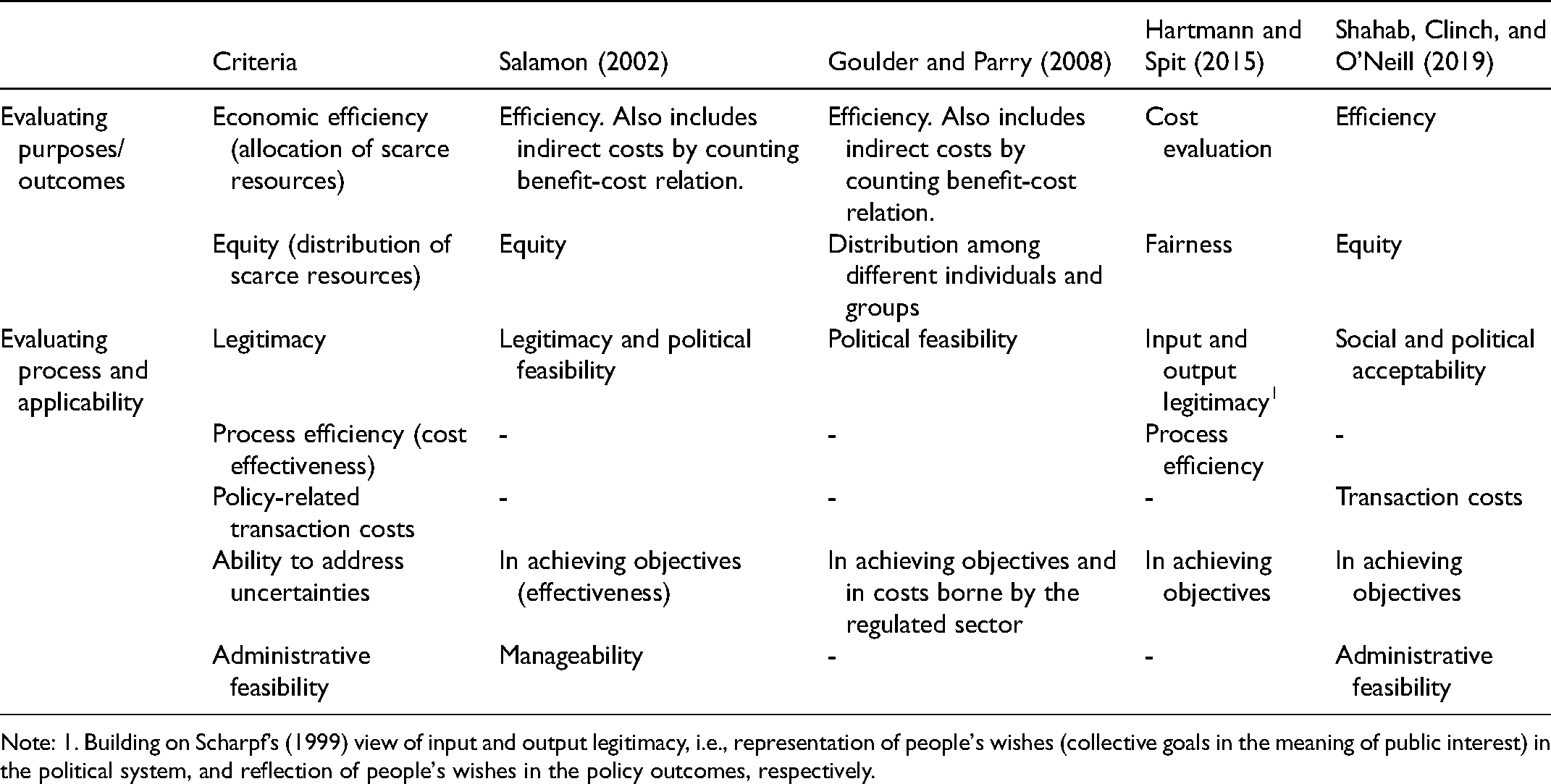
Note: 1. Building on Scharpf’s (1999) view of input and output legitimacy, i.e., representation of people's wishes (collective goals in the meaning of public interest) in the political system, and reflection of people's wishes in the policy outcomes, respectively.
These frameworks include two types of criteria. One type covers criteria evaluating policy purposes or overall outcomes, including unintentional consequences of policies. Other criteria do not tackle the purposes of policies per se, but rather effectivity of means of achieving them – suitability of paths towards or limitations to achievement of these purposes, described in short as the process and applicability.
Trade-Off Between Efficiency and Equity in Land Policies
The fundamental purposes of land policies, efficiency and equity, are inevitably interrelated. Policy goals designed to increase economic efficiency may impact on equity issues and vice versa. Though this might appear evident, it is important to recognise such interrelations when designing land policy interventions.
The typical trade-off between efficiency and equity described by Okun (1975) on the case of income redistribution is closely related to the trade-off between efficiency and higher material equality achieved by providing social and affordable housing to predefined social groups. Significant efficiency losses can be observed if social housing is provided by cities where the responsibility for building such units stays entirely in the hands of the public sector. In this scenario, the public sector needs to gather public resources by taxation and allocate them subsequently to social housing development, or to financial assistance for social housing to the poor, without any land policies shifting a part of this burden to private landowners.
On land markets, we can trace another highly topical trade-off, namely the trade-off between efficiency-enhancing measures of land thrift on the one side, such as the protection of landscape ecosystem services by keeping cities compact, and housing affordability within these cities corroded by a deepening local scarcity of land allocated for housing. This trade-off between land thrift and housing affordability seems to be a land policy dilemma that is difficult to solve.
Not all policies inevitably lead to a trade-off between efficiency and equity. This can be demonstrated on three specific examples: (i) a special approach to interventions intended to increase efficiency when correcting for market failures, (ii) interventions for enhancing equity when tackling land rent, and (iii) empowerment of poor people with secure land tenure in the context of developing countries.
Interventions intended to increase efficiency when correcting for market failures do not need to impact on equity adversely. No sacrifice of equity is usually needed under constraints of preferably helping the most disadvantaged instead of high-income individuals. If a policy does not take these constraints into account, some interventions correcting for market failures may increase efficiency by prioritising elites at the expense of the poor, as described by Anguelovski et al. (2016). However, the reality connected to efficiency of land use is more complicated. The endeavour of helping poor neighbourhoods, e.g., by provision of additional green infrastructure, leads to an increase in local property values, which can result in displacement of local tenants by an increase in rent prices, and thereby to a process called green gentrification or the green equity paradox (Anguelovski 2016). The same consequences can be observed by providing other public goods or services, as all perceived values are capitalised into local property values (e.g., Gonzalez-Navarro and Quintana-Domeque 2016). The solution “just green enough”, which pays attention to the needs of the current dwellers without aiming at more affluent newcomers (Curran and Hamilton 2012), does not seem to be plausible in the long run, as every marginal change in the quality of a space leads inevitably to marginal land value changes. At the same time, we do not need to relinquish the endeavour to make our cities greener and more pleasant for living with more recreational amenities and aesthetic values not to harm poor people and their well-being. Gentrification may be prevented by a more continuous improvement of all poor districts in cities to improve their housing standards. In Fainstein's view (2017, 139), planning with a good balance between efficiency and equity provides all citizens with a high quality of life thanks to access to amenities and decent housing where the rich pay a high price for their privileges connected to a better standard of living, thus enhancing further redistribution towards the poor. Fainstein names costly travelling by car in the city through various mobility policies as payments for privileges. Payments for privileges with a redistributive character may take the form of progressive land rent taxation.
Coming to the second example, interventions redistributing the part of wealth consisting of land rents and exploitation rents do not generally face any trade-off. Since Henry George's contribution, the taxation of land rents has been considered by many scholars a recommendable source of public revenues (e.g., Dye and England 2009). It is possibly an even more efficient source of public finance than typically applied distortionary taxes, as the land tax does not necessarily need to bring any deadweight losses or changes of land use if appropriately designed (for circumstances which lead to distortionary effects of land tax, see Needham 2000). Piketty (2014) and Stiglitz (2015) argue that land rents, besides other things, are associated with severe deepening in inequality as land ownership is concentrated in the hands of relatively more affluent individuals. Higher taxation of land rents might remedy these inequalities if property rented to third parties is taxed with higher rates than property used for own housing (the land taxation situation present in Estonia; see Wenner 2018). When analysing land taxation effects if assets of people used as their homes are taxed, the effects of such a tax start to be less unequivocal in terms of its progressivity (Plummer 2009).
Rent-seeking on land markets hampers fair competition by redirecting benefits from land development to selected actors (Pennington 2000). Exploitation rents can be observed in the land policy arena in connection to real estate moguls who are granted exclusive rights for development (Stiglitz 2015). Therefore, if institutional arrangements allow big players on the real estate market to influence the location of new development for their benefit, the situation produces conditions for yielding exploitation rents. As a remedy to exploitation rents, Stiglitz (2015) finds strongly progressive taxation of enormous fortunes in society, as he believes these fortunes could have been gained only by utilising some form of exploitation at the expense of others. As he puts it, under the model of the economy producing exploitation rents, higher taxes imposed on high-income individuals might discourage rent-seeking and thereby even enhance the economy. It follows that healthy competition on the land market and the taxation of extraordinarily high income might decrease exploitation rents and enhance efficiency.
Another area where land rents can be utilised for minimisation of efficiency losses while enhancing equity issues is redirecting them to provide social and affordable housing. The costs of social and affordable housing can be partly or fully covered by land rent, if land policies place certain conditions on development on private land. Dutch urban planning defines the location of land for social housing within urban plans (Needham 2016); German cities utilise negotiable developer obligations for conditioning development, such as by a certain percentage of social and affordable housing in newly developed areas (Vejchodská and Hendricks 2022); Spanish regions (Muñoz Gielen, Salas, and Cuadrado 2017) and Swiss municipalities (Debrunner and Hartmann 2020) define a minimum mandatory share of affordable housing to be built in newly developed areas. US municipalities that engage in inclusionary zoning, requiring a certain share of affordable housing, provide certain concessions to landowners in return for these obligations, for instance, non-financial compensation in the form of permitting higher levels of development intensity limits (Lerman 2006). These land policies have a common ground – they affect land property rights through various land policy interventions. In the planning context of countries where planning constraints on development do not need compensation, these different land policy instruments achieve the equity goals by decreasing land value increments thanks to planning decisions (such as obtaining planning permits). Developable land is still valuable, although not as much as without these additional conditions and land rights limitations. These policies achieve redirecting of a part of land rent from landowners to the social needs of society, benefitting the poor. Efficiency losses following the necessity of additional taxation and public money spending are thereby eliminated or significantly decreased.
The third situation which we discuss here as not necessitating the trade-off between efficiency and equity relates to the context of developing countries with weak land rights and insecure land tenure. Programmes there supporting equity by redistributing land rights from the rich to the poor might positively affect efficiency, even without providing the poor with full land ownership. As Banerjee, Gertler, and Ghatak (2002) show, strengthening tenants’ position in relation to landlords enhances agricultural productivity, as secure land tenure empowers tenants and increases their ability to use land more effectively (Deininger 2003; Galiani and Schargrodsky 2010). Moreover, decreasing disparities in the distribution of land rights, mainly in countries with agriculture as the cornerstone of the national economy, may help form public institutions building human capital (Galor, Moav, and Vollrath 2009), leading to higher future productivity and thereby also efficiency.
Limitations of Efficiency and Equity Considerations in Theory and Practice
The previous sections presented arguments for government interventions to enhance efficiency and equity. Governments would conduct this role comprehensively without failure provided the following conditions were met: Governments would need to operate with complete information about all circumstances on the land market, and government representatives would need to use this information for achieving the most desirable outcome from the social perspective, not from the perspective of a narrower group of stakeholders (e.g., local homeowners) or even of an individual.
One of the most prominent factors affecting the outcomes of government interventions is the lack of complete information. Precise assessment of efficiency and equity impacts is impossible due to policy interactions, which often hinder determining their real final impact (Whitehead 1983), or due to many various environmental and social effects which would need to be disentangled before their economic assessment (Lord and O’Brien 2017). Methodological difficulties further undermine the possibility of assessing efficiency impacts to calculate nonmonetary values necessary for these assessments. As some studies suggest (e.g., Winfree, Gross, and Kremen 2011), the calculated economic value of nonmonetary assets is highly methodology-dependent, leading to value differences of even an order of magnitude.
To sum up, a complex and unassailable assessment of impacts of government interventions is impossible. For this reason, it is often challenging to arbitrate where the truth stands in debates of academicians or practitioners with different viewpoints. An example is a dispute on the efficiency effects of planning between English economists and planners. Some economists (particularly Cheshire 2018) perceive planning as too restrictive and decreasing social welfare due to high housing costs as an unintended consequence of the restrictiveness. They call for relaxing planning constraints to new development. On the other hand, planners argue that planning brings more benefits to society than costs as it is complex. Besides limiting development with the aim of agricultural land protection, planning also decreases transaction costs of land development in comparison with the need for individual action in solving land-use conflicts without planning, functions as a market stimulus and boosts demand by providing people with adequate amenities and ecosystem services (Adams and Watkins 2018) or by activating land for development which would otherwise stay undeveloped, such as in the case of land readjustment policies (Lord and O’Brien 2017). A similar dispute can be traced in the US academic discussion on sprawl between environmental advocates on the one hand, arguing that too much land has been devoted for development, and economists on the other hand, who acknowledge the necessity for such a high rate of land conversion when focussing on the impact on urban dwellers’ welfare. However, the economists’ assessment usually lacks accounting for the loss of undeveloped land and ecosystem services connected with it (for the economists’ perspective, see, e.g., Glaeser and Kahn 2004, 2,486). Similar disputes can be traced in many planning areas, such as the effects of density restrictions (Brueckner and Singh 2020).
The other prominent factor limiting government from achieving the most optimal outcome from the social perspective is the government itself – its administrative capacity imposing limits on what is a feasible measure undertaken by the government (Whitehead 1983) and the behaviour of its representatives. Elected officials might make errors, decide in their own interest or the interest of a narrower group without considering broader public interests. Fischel (1999) points out that US municipal governing powers, in which local homeowners play a major role, allow less than efficient development density to protect their property. What can seem efficient for a narrower group of stakeholders, such as local homeowners, brings inefficiencies on a regional scale. The European perspective on inefficiencies supported by wrong decisions of local, regional or national governments is presented by Moroni and Minola (2019), government failures from the public choice perspective on the English planning system by Pennington (2000).
Finally, while this contribution attempts to provide objective criteria for discussing land policy, we recognise and acknowledge that equity and efficiency are normative and, therefore, not value-free concepts. They can be interpreted in a pluralistic way (see, e.g., Shahab, Hartmann, and Jonkman 2020); this accounts explicitly for equity (justice) (see, e.g., Davy 1997). However, efficiency is also subject to interpretation and social construction, as land, its use and externalities arising from the use can be interpreted differently by different scholars. Some scholars stress the functions of land more as an economic asset for development and for enhancing urban dwellers’ welfare; others stress its value as a provider of ecosystem services or territory (Davy 2020). From this perspective, efficiency and equity merely provide frameworks for discussing pluralistic notions of land policy. So, land policy can be both efficient and inefficient at the same time and equitable and inequitable – depending on the stakeholders’ perspective. This makes criteria such as legitimacy, i.e., public acceptance of policy intervention as an unwritten social contract, highly relevant for policymakers (see Needham, Buitelaar, and Hartmann 2019).
Conclusion
This paper goes back to the roots of land policy purposes and explicitly defines efficiency and equity as the two fundamental purposes of land market policy interventions. It seeks to provide a sound theoretical background on how efficiency and equity are interrelated within land policy and where trade-offs occur. The general purposes of land policy – efficiency and equity – are translated into concrete land policy goals. Policymakers design different land policy instruments to achieve these goals. We have argued that the same instrument type can be activated to seek higher efficiency, equity or both. The technical character of an instrument does not predetermine its purpose. Frameworks exist to evaluate policy instruments for assessing complex policy aspects in detail and ensuring that all their outcomes, affecting efficiency and equity, will be detected. Efficiency and equity are therefore inherent features of land policy evaluation frameworks.
Scholars and policymakers must bear in mind that a trade-off between efficiency and equity is sometimes inevitable as these purposes are interrelated. Seeking improvement in one criterion can be at the expense of the other one. On the other hand, policy interventions, for example in the form of planning and land policy, can allow avoidance or minimisation of detriment to the other criterion. All these considerations should be of particularly high interest to policymakers, as they provide opportunities for improvement without necessary sacrifices. The situation in land policies gets even more complicated when considering different property rights regimes in different countries. Nonetheless, efficiency and equity, the fundamental purposes of land policy, provide valuable theoretical insight for a better understanding of ultimate policy outcomes, their consequences and trade-offs between these fundamental purposes.
Footnotes
Acknowledgments
The network of authors was supported by COST (European Cooperation in Science and Technology) under project CA17125 Public Value Capture of Increasing Property Values.
Declaration of Conflicting Interests
The author(s) declared no potential conflicts of interest with respect to the research, authorship, and/or publication of this article.
Funding
The author(s) disclosed receipt of the following financial support for the research, authorship, and/or publication of this article: This work was supported by the European Cooperation in Science and Technology, (grant number CA17125).
Notes
Author Biographies
 ). His research focuses on strategies of municipal land policy, and the relation of flood risk management and property rights.