




Abstract
Significant scholarship has focused on accommodating diverse age groups in urban public environments. However, intergenerational approaches emphasizing engagement between generations represent an emerging area of research and practice. This review synthesizes literature from urban planning and cognate fields on the need for and benefits of intergenerational public space, as well as design and policy interventions. The results advance understanding of how public environments could meet the needs of both youth and older adults while also serving as the context for cross-generational interaction, and offer insights to planners, designers, and policymakers seeking to develop, enhance, or expand intergenerational public space.
Keywords
Introduction
As life expectancies increase, cities around the globe must better accommodate urban populations that are both aging and increasing (World Health Organization 2007). The need to develop age-inclusive urban environments supporting residents of diverse life stages and abilities becomes pressing. Thus, in the past two decades, governments have adopted age-friendly and child-friendly approaches to urban policy and planning, with the goal to offer spaces and services responsive to the needs of city dwellers at both ends of the age spectrum (Biggs and Carr 2016). Scholars in urban planning, environmental design, gerontology, and social work have published substantial literature on the need for and benefits of child- and age-friendly cities (Lang 1998; Thang and Kaplan 2012; Loukaitou-Sideris and Sideris 2010; Biggs and Carr 2015; 2016; Cortellesi and Kernan 2016; Cushing and van Vliet 2016; Loukaitou-Sideris et al. 2016; Brown and Henkin 2018), while some practitioners have integrated this research into practice, creating policies and plans to support the safety and wellbeing of children and older adults (Warner 2018; Warner and Zhang 2019).
Child- and age-friendly cities approaches focus on the risk, vulnerability, and invisibility of children and older adults in cities, and emphasize the role of the built environment in ameliorating such challenges (Biggs and Carr 2015; 2016; Manchester and Facer 2017). However, scholars have argued that much of the research to date focuses on the needs and desires of either youth or older adults rather than an intergenerational approach that explores how urban environments could appeal to diverse age groups, and foster social interaction and understanding across generations (Biggs and Carr 2016; Cortellesi and Kernan 2016; Noon and Ayalon 2018).
This paper explores intergenerational public space: designs and policies that seek to create public spaces that meet the age-based needs of different generations, while supporting interaction and engagement. We focus specifically on urban environments, even though we recognize that suburban and rural environments also face related and distinct challenges regarding planning for intergenerational needs that warrant similar attention. The term “intergenerational” relates to “intergenerational practice,” a multidisciplinary policy and planning approach that has the goal of promoting social inclusion and cohesion, health and wellbeing, and understanding across generations (Pain 2005). Intergenerational practice involves removing physical and social barriers, thus enabling participation of individuals from different generations in mutually beneficial activities, with a focus on building relationships based on learning and sharing (Buffel et al. 2014; Cushing and van Vliet 2016; Kaplan et al. 2016). As a relatively new approach that has gained visibility since the 1990s, intergenerational practice is distinct from multi-generational practice, which focuses on addressing the needs of particular age groups rather than on fostering meaningful relationships among individuals of different generations (Cushing and van Vliet 2016; Kaplan et al. 2007; Washington et al. 2019).
Despite acknowledgement that the spatial segregation of generations into same-age environments hinders their ability to interact, understand, and learn from one another (Cortellesi and Kernan 2016; Puhakka, Poikolainen, and Karisto 2015), some scholars have argued that, within intergenerational practice, the built environment has generally not been the focus of scholarly attention (Kaplan et al. 2020b). When research has focused on the built environment from an intergenerational perspective, it has examined primarily institutional settings and formal, indoor environments and activities, rather than shared, outdoor public spaces (Cushing and van Vliet 2016; Kaplan et al. 2020b; Kaplan and Haider 2015; Washington et al. 2019). Thus, there is a need to better understand how to develop, design, and program outdoor public spaces for intergenerational interaction (Washington et al. 2019).
In response, in the past two decades more research has emerged on the subject of intergenerational public space, which seeks to add a public space dimension to intergenerational practice (Biggs and Carr 2015; 2016; Bosia et al. 2017; Fu, Meng, and Zhang 2019; Haider and Kaplan 2004; Kaplan et al. 2007; Kaplan and Haider 2015; Larkin, Kaplan, and Rushton 2010; Layne 2009; Thang 2015; Thang and Kaplan 2012; Washington et al. 2019). The literature review that follows aims to systematically collect, review, and synthesize scholarly and “grey” literature on intergenerational public space, with the goal to understand the state of research and practice and inform future inquiry. Specifically, we seek to respond to the following questions:
What are the goals, demonstrated need for, and potential benefits of intergenerational public space? What strategies and interventions - in terms of design, programming, policy, and process of development - might support and enhance intergenerational interactions in public space?
We begin by discussing the difference between monogenerational, multigenerational, and universal design approaches versus intergenerational approaches. We then outline our methodology for conducting a comprehensive literature search on intergenerational public space. We highlight our findings in response to our research questions. We conclude with a discussion of the planning, policy, and design implications and offer recommendations for future research.
Definitions: Monogenerational, Multigenerational, and Intergenerational Spaces
It is important to note distinctions between monogenerational, multigenerational, and intergenerational approaches and the ways in which these approaches are reflected in scholarship and practice (Kaplan, Sanchez, and Hoffman 2017).
A monogenerational focus responds to the needs of one particular age group, often either children or older adults. Predating the more recent interest in intergenerational public space, monogenerational approaches have been critiqued for prioritizing, and in some cases misunderstanding, the needs of a single age group, and for failing to recognize overlaps and synergies between the age-specific needs of various groups (Cushing and van Vliet 2016; Thang 2015; Thang and Kaplan 2012). A case study analysis of how “age-appropriate” urban environments in Switzerland are developed and experienced found that imprecise age-related stereotypes about older adults not only shaped the attitudes of planners and designers but were woven into public space planning and design processes, influencing spatial responses that may not accurately reflect the diverse needs of this population group (Fabian et al. 2019). The influence of age-related stereotypes is also evident in spaces created for children and youth, which are often framed as a conflict between older and younger public space users, positioning youth as a source of fear and annoyance to older adults (Pain 2005). An ethnographic study of playground spaces in Athens, Greece, found playgrounds with age-specific play structures and spaces, separate and distinct from “normal” public space, reinforced the ongoing surveillance and control of children, limited children's agency, and diminished opportunities for intergenerational play (Pitsikali and Parnell 2019).
Emerging in response to monogenerational approaches that create age-segregated environments, multigenerational planning and design seek to accommodate the needs of both children and older adults, while also extending benefits to other users. A 2018 guide produced by the AARP and 8 80 Cities titled “Creating Parks and Public Spaces for People of All Ages” succinctly expresses this rationale: “If everything we do in our public spaces is great for an 8-year-old and an 80-year-old, then it will be great for people of all ages” (AARP, 8 80 Cities and The Trust for Public Land 2018, 3). However, such multigenerational approaches have been criticized for assuming that, when taken together, the needs of those on both ends of the age spectrum can encompass the needs of all public space users (Biggs and Carr 2016; Cortellesi and Kernan 2016). Others argue that such “age-friendly” approaches emerged largely in response to the needs of older adults and tend to overlook the needs of other generations (Cortellesi and Kernan 2016). Planners, whose professional activities and tools have been identified as key to enabling age-friendly built environments (Warner and Zhang 2019), have been criticized for emphasizing primarily the needs of older adults in policies and environments designed to be age-friendly (Biggs and Carr 2016; Thang 2015). By focusing on only one end of the life course, these approaches may fail to confer meaningful benefits to other age groups and risk constructing a new “universal urbanite” (Biggs and Carr 2016, 264). Bosia et al. (2017) argue that “design for all” approaches collapse differences and fail to attend to the particularities of different users of diverse ages and abilities.
This tension between the universal and the particular is reflected in the literature on universal design. Universal design, defined broadly as the design of environments to facilitate access and use by those of any age and ability (Lynch et al. 2018), is related to child- and age-friendly cities approaches in its focus on achieving better social, physical, and health outcomes by producing better built environments. However, universal design aims to accommodate the greatest range of users of all ages and abilities, rather than a defined age group (Stafford and Baldwin 2015). Several studies have explored the potential of universal design to complement intergenerational approaches, suggesting that, if accompanied by participatory, context-sensitive design and planning processes, universal and age-friendly design agendas can be successfully integrated to respond to the needs of people of diverse ages and abilities in public space design (Lynch et al. 2018; Stafford and Baldwin 2015). However, others argue that public space must not only accommodate diverse age groups, but actively promote engagement, interaction, and community, suggesting that universal design be positioned as a complement to rather than a substitute for intergenerational approaches (Thang 2015; Thang and Kaplan 2012).
Intergenerational public space is concerned with the material environment and the social and emotional wellbeing of different age groups. It aims to create spaces and resources that respond to age-based needs and enhance livability, while also creating “generationally intelligent spaces” that enable different generations to meet, interact, and understand one another through shared use of the built environment (Biggs and Carr 2015; 2016). Thang and Kaplan (2012) differentiate between multigenerational public spaces that accommodate the physical and psychological needs and abilities of various age groups and intergenerational public spaces that additionally foster meaningful interaction, communication, engagement, and connection among generations. By supporting interaction and mutual benefit (Brown and Henkin 2018), intergenerational public space may also enhance empathy and harmony between people of different age groups (Biggs and Carr 2016).
Methodology
We conducted a comprehensive search for peer-reviewed, academic publications as well as dissertations and professional or “grey” literature related to intergenerational public space. We used various keywords including “intergenerational,” “multigenerational,” “public space,” “open space,” and “park” to search a variety of online databases (see Table 1). We selected the initial search terms to yield results related to intergenerational public space but decided to broaden the search terms to also include multigenerational space as well as space for older adults and youth, and to consider not only public space design but other related spaces and processes, including quasi-public or private, indoor and outdoor spaces, and planning, design, programming, and research. While our primary interest is intergenerational public space, we recognize that this is an emerging area of inquiry that synthesizes research on planning, design, policy, and programming to support the needs of older adults, children and youth, as well as individuals of different needs and abilities across the age spectrum. Therefore, we included articles that focus on intergenerational as well as multigenerational public spaces and research on environmental design, program development, policy development, and professional practice relevant to urban public environments.
Search Terms.
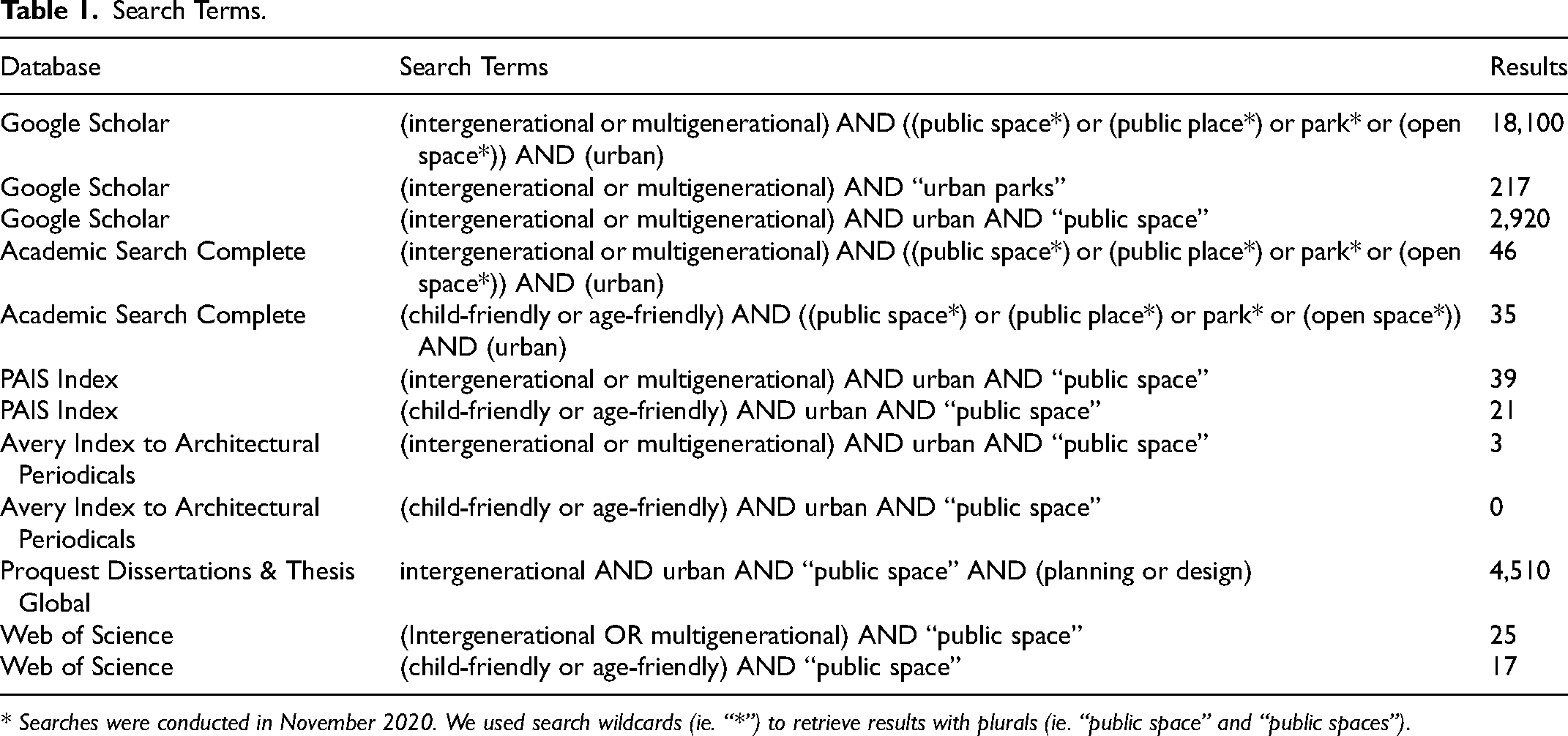
* Searches were conducted in November 2020. We used search wildcards (ie. “*”) to retrieve results with plurals (ie. “public space” and “public spaces”).
We conducted database searches and sorted the articles found by relevance based on their title and abstract. For databases that returned many results (for example, Google Scholar), we stopped reviewing results when the articles deemed relevant from the searches fell below 1% of the articles returned by the database, and when search terms began returning many duplicates. We retrieved a total of 112 articles based on a review of title and abstract. After excluding 25 duplicate articles, we undertook an initial review of the full text of the remaining 87 articles and excluded an additional 21 articles that did not meet our inclusion criteria: 1) featuring multigenerational or intergenerational perspectives (rather than one age group), 2) focusing on public or outdoor environments (rather than private residential or indoor environments), and 3) focusing on urban (rather than rural) contexts. Our search was limited to English-language literature, accessible through online sources. We did not confine our geographic scope and included relevant articles from North America, Europe, Asia, and Australasia. While we did not limit our review temporally, all but three of the articles reviewed were published after 2000, indicating the newness of the topic. Thus, this review draws primarily on literature from the last two decades.
After identifying 66 articles meeting our inclusion criteria, we conducted a closer examination of their full text and eliminated 40 articles that did not address one or more of our research questions. Additionally, we identified articles and authors particularly relevant to our research, and undertook forward and backward snowballing (hand-search) for those articles, which produced 27 more articles. Six additional articles were included based on suggestions from the study team and reviewers. In sum, we reviewed and compiled information from 59 articles (54 academic and 5 from the grey literature) (Figure 1).
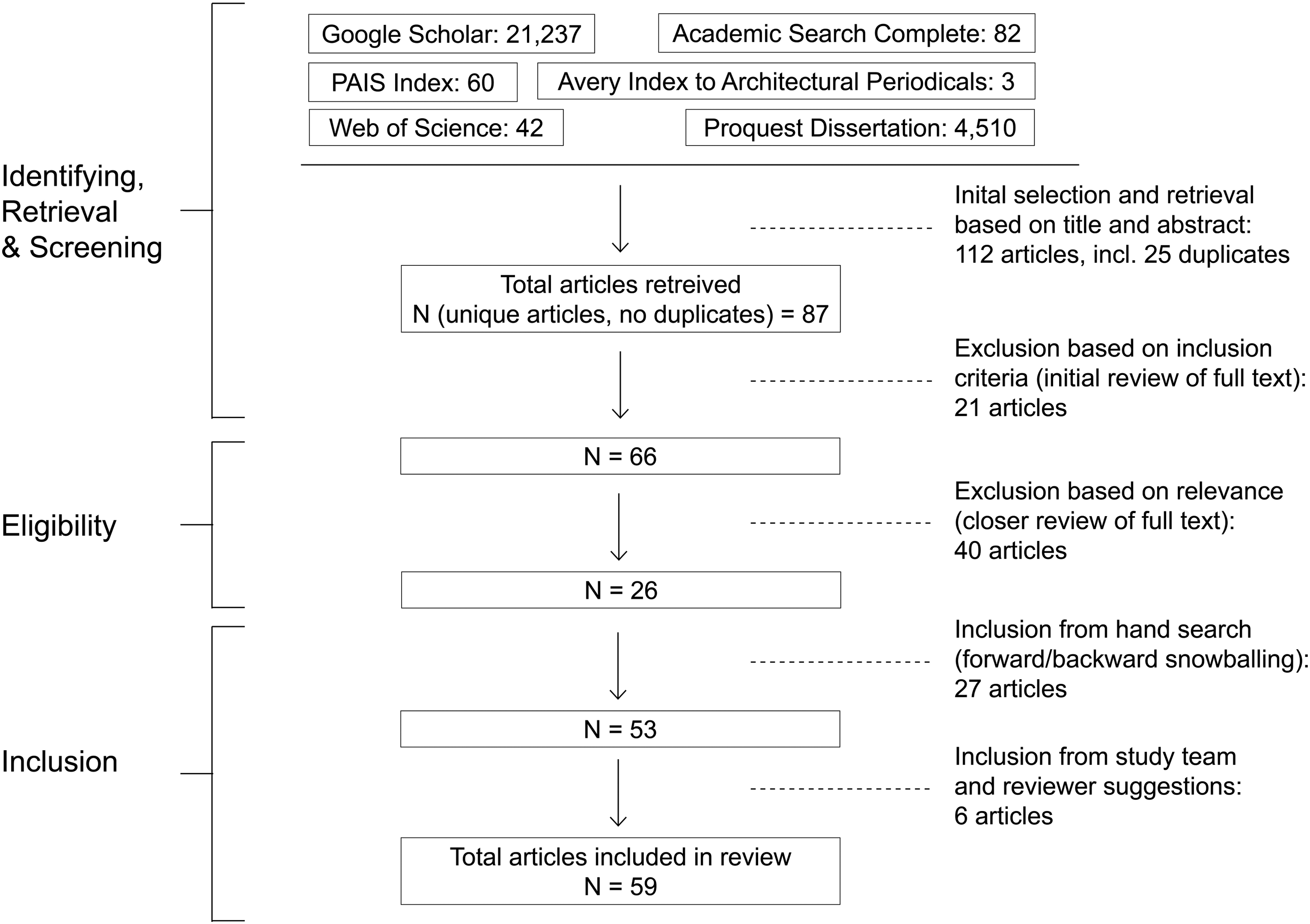
Process flow chart of systematic literature search.
Findings
Research on intergenerational public space has identified the need to connect within and across two sets of parallel research and policy approaches: age-friendly cities (AFC) with child-friendly cities (CFC), and the built environment with the social environment. The literature emphasizes the need to bridge across the CFC and AFC agendas, and connect physical and social considerations, in order to position public space as a key context for intergenerational wellbeing and connection.
Need to Connect Age- and Child-Friendly Cities Approaches
As age demographics have changed in many cities over the past two decades, both age-friendly (AFC) and child-friendly (CFC) approaches have emerged as key urban policy objectives (UNICEF Innocenti Research Centre International Secretariat for Child Friendly Cities 2004; World Health Organization 2007). Both approaches seek to improve social and material conditions for youth and older adults by reorienting policies and plans to reflect their interests and aspirations (Manchester and Facer 2017). On a global scale, the World Health Organization's (WHO) AFC initiative and UNICEF's Child Friendly Cities initiative have been instrumental in the broad dissemination and adoption of these policy agendas by local governments (Manchester and Facer 2017). WHO's AFC initiative promotes active ageing, and seeks to enhance the health and social participation of older adults by providing services and spaces that meet their needs (World Health Organization 2007). UNICEF's CFC initiative emphasizes the rights of children as a strategy to improve their immediate and future material conditions, services, and opportunities for civic participation (UNICEF Innocenti Research Centre International Secretariat for Child Friendly Cities 2004). Both aim to shift away from the historical propensity of urban planning, policy, and design processes to privilege the needs of working-age adults, towards supporting the interests of diverse age groups (Warner 2018).
Despite the shared elements and objectives of the AFC and CFC approaches, scholars argue that too often their agendas have not converged in practice (Biggs and Carr 2015; Cushing and van Vliet 2016; Thang 2015), overlooking shared goals while further inscribing stereotypes about youth and aging (Fabian et al. 2019; Manchester and Facer 2017; Pain 2005). Others argue that planners and policymakers have prioritized the needs and interests of older adults while claiming universal benefit, bolstered by the assumption that making cities livable for the aging will make cities livable for all (Biggs and Carr 2016; Brown and Henkin 2018; Warner 2018). The continued production of age-segregated spaces, in part due to the lack of integration between AFC and CFC agendas, is recognized as limiting opportunities for intergenerational interaction, learning, and solidarity (Manchester and Facer 2017). To address this stubborn separation of age- and child-friendly approaches, and leverage their complementary and mutually-reinforcing elements, scholars have highlighted the need for a rethinking of age-related divisions toward more intergenerational approaches that bridge across the aims and elements of CFC and AFC agendas (Biggs and Carr 2015; 2016; Cortellesi and Kernan 2016; Cushing and van Vliet 2016; Kaplan et al. 2007; Manchester and Facer 2017; Thang 2015; Thang and Kaplan 2012; van Vliet 2011).
Need to Connect Physical and Social Approaches
Additionally, intergenerational public space scholarship emphasizes the need to connect the built and social environments in research and practice and create time and space for youth and older adults to interact (Cortellesi and Kernan 2016; Fu, Meng, and Zhang 2019). Scholars emphasize the importance of connecting physical and social infrastructures, networks, and capital to address age-related needs (Brown and Henkin 2018; Cortellesi and Kernan 2016; Warner 2018). Bosia et al. (2017) consider the physical spaces, infrastructures, and buildings as the tangible “hardware” of age-friendliness, and the social and civic networks and communications as the intangible “software,” noting that both elements must work in tandem to meet the needs of different age groups.
While interest in intergenerational practice has grown, research on the role of the physical environment in promoting or inhibiting intergenerational interaction has been lacking (Kaplan et al. 2007; Cushing and van Vliet 2016). Where studies have focused on physical environments, they have tended to prioritize meeting various age-related needs rather than fostering engagement across age groups (Kaplan et al. 2007, 2020b). Additionally, intergenerational practitioners tend not to be design professionals, while design professionals tend not to focus on intergenerational interaction (Kaplan et al. 2007).
Recently, scholars have considered urban public space as a key site for intergenerational contact, relationships, and understanding 1 (Cortellesi and Kernan 2016; Thang 2015; Thang and Kaplan 2012), arguing that designing intergenerational public spaces is necessary to counteract the social and spatial segregation of generations into “islands of activity” (Tham, Jones, and Quinlan 2020, 229), which limit opportunities for interaction and community cohesion. But while public environments are increasingly understood as promising sites for building trust and community among generations (Almeida 2019; Manchester and Facer 2017), physical interventions alone are not sufficient to create “fully enabled environments” (Warner 2018, 19). Given the persistent age segregation of youth and older adults even in supposedly age-integrated spaces like town centers (Peace 2013), there is a need to consider the complexity of physical, social, and psychological factors that shape intergenerational public space. Planners and designers are called upon to incorporate social supports and services, public participation, and community care into planning and design practice (Peace 2013; Warner 2018), as well as connect the work of intergenerational practitioners and environmental designers (arki_lab 2017; Kaplan et al. 2007; Kaplan and Haider 2015).
A number of studies have examined if public spaces designed to accommodate intergenerational use also foster meaningful intergenerational interaction. A longitudinal study of the spatial preferences and practices of different age groups in Finland suggested that, while people still perceive their urban environments through a “generational gaze” (Puhakka, Poikolainen, and Karisto 2015, 80), creating age-friendly environments that support intergenerational engagement is still possible, emphasizing that spatial proximity is essential and requires physical public spaces where all generations can meet and interact. However, other studies emphasize that spatial proximity, while necessary, may not be sufficient to support intergenerational engagement in public space. A case study of a neighborhood in Singapore with a high proportion of older residents found that public space alone had limited capacity to affect intergenerational interaction amongst strangers, and that programming, such as activities and events, was necessary to promote engagement (Chen 2017). A study of open spaces in Israel similarly found that the mere presence of multiple generations in public space may not lead to intergenerational interaction; the majority of older adult park users remained alone, and when interaction occurred, it was primarily homogenous by age and gender (Noon and Ayalon 2018). Similar findings emerged from a case study of co-located playgrounds and fitness areas in Singapore housing estates, which observed a lack of communication and engagement amongst non-familiar users of different ages, ethnicities, and cultures (Thang 2015). The author argued that designing public spaces to support “parallel co-existence” (attracting users of various ages) may support incidental meetings but may not be sufficient to foster intergenerational interaction. To produce genuinely interactive and engaging environments that capitalize on the potential of community encounter, there is a need to conceptualize intergenerational public space design as more than just co-location (Thang 2015, 28).
Benefits of Intergenerational Public Space
Some studies have explored the benefits – realized or speculative – of intergenerational public space. Cushing and van Vliet (2016) argue that interaction between youth and older adults in public space confers direct benefits to participants, but also indirect benefits to the broader community. They categorize the benefits of intergenerational communities into individual psychological benefits (pro-social behavior, positive attitudes, and life satisfaction), individual physical benefits (active and healthy lifestyles), and community benefits (collective empowerment and increased volunteerism).
Individual health and wellbeing
While intergenerational public space is distinguished by its emphasis on collective benefits achieved through interaction and engagement among different generations, several studies have demonstrated the potential of such spaces and programs to also offer individual benefits in terms of personal health, happiness, and wellbeing. Dawson (2017) examined the experiences of older adults participating in intergenerational exercise programming in a park in Charlotte, North Carolina. Using pre- and post-test surveys to evaluate outcomes in health, physical activity and wellbeing, the author found that those participating in intergenerational programming reported increased happiness and feelings of accomplishment as well as increased rates of exercise when compared to a control group, highlighting the capacity of intergenerational programs in public space to improve individual physical and mental health and, more broadly, support active aging and community wellness.
Focusing on the other end of the age spectrum, Haider (2007) emphasizes how public spaces that facilitate children's freedom, play, and intergenerational interaction can also support children's independent spatial mobility and individual social, physical, and creative skills. In their resource guide for practitioners working to create intergenerational environments, Kaplan, Sanchez, and Hoffman (2017) note that intergenerational engagement may support individual health and wellbeing, contribute to healthy eating and active living for all ages, and support sustainable, inclusive, and cohesive communities. Indeed, age- and child-friendly communities are positioned by Forsyth (2020) as population-based lenses through which to conceive, design, and evaluate healthy places.
Social inclusion and solidarity
Several studies illustrate the potential of intergenerational public spaces to enhance the social inclusion and participation of both youth and older adults (Kweon, Sullivan, and Wiley 1998; Lang 1998; Scharlach and Lehning 2013; Wu 2020). In their review of literature on age-friendly communities in the U.S., Scharlach and Lehning (2013) demonstrate how physical interventions to enhance accessibility and increase activity space for older adults - for example, creating walkable, mixed-use communities - can promote social inclusion, support bonding, and enhance social capital by increasing opportunities for intergenerational interaction and engagement in these spaces. Wu (2020) argues that conventional “ageing in place” models that prioritize residential care fail to offer meaningful opportunities for older adults to participate in social life and society, and that shared urban public spaces are necessary to promote the inclusion and participation of various age groups. A study of green, common outdoor spaces in a public housing development in Chicago by Kweon, Sullivan, and Wiley (1998) found these spaces to be connected to modest increases in neighborhood social ties and a sense of community amongst urban older adults. However, the study emphasized that the mere presence of common outdoor space is not enough to confer these benefits, and certain key design features, such as trees, lighting, shade, and seating, are important factors for fostering a sense of community and social integration.
Other studies have explored the observed and potential benefits of intergenerational environments in promoting understanding between younger and older generations. Lang (1998) highlights how children may develop more positive beliefs about older people and strengthen their understanding about aging through contact and interaction with older adults in public spaces. Such extrafamilial intergenerational interactions can only occur in settings offering opportunities for spontaneous contact among generations, such as public environments outside the home, like playgrounds and city streets. Others have examined how this intergenerational understanding may be extended into positive attitudes and behaviors. Cortellesi and Kernan (2016) highlight the concept of “intergenerational solidarity” as a potential outcome of shared experiences between youth and older adults, defined as those processes or interactions that lead to stronger communication and a sense of shared connection, commitment, and reciprocity. Studying 21 intergenerational learning projects implemented across Europe, they find that multi-sensory, intergenerational experiences can aid multiple generations in questioning assumptions about generational “otherness,” overcoming negative views about different age groups, and enhancing social cohesion and support. Fu, Meng, and Zhang (2019) link this concept of intergenerational solidarity more closely to the built environment by proposing a conceptual framework that accounts for the influence of neighborhood physical, social, and personal factors on intergenerational solidarity-related behaviors. Using this framework, they surveyed residents of Harbin, China on their preferences for intergenerational interactions and found that respondents not only displayed a strong willingness to participate in reciprocal efforts between generations, but that many of the preferred solidarity-related activities took place in public spaces, suggesting the importance of public environments in facilitating sharing and reciprocity.
Community benefits
Other scholarship suggests that intergenerational interaction in public space may also help identify shared interests and mobilize the capacities of both youth and older adults towards broader community benefits (Kaplan et al. 2004). The relationship between intergenerational practice and community development is bidirectional: scholars have explored both the potential of intergenerational practice to contribute to the development of sustainable communities and public spaces (Pain 2005; van Vliet 2011) as well as the potential of public space and neighborhood regeneration to support intergenerational interaction (Bronfin, Liu, and Walcott 2017; Buffel et al. 2014). In a literature review and policy guide on intergenerational practice for social cohesion and neighborhood renewal in the UK, Pain (2005) concluded that, by addressing exclusion, encouraging contact, and facilitating cooperation, intergenerational practice can meaningfully counteract generational differences, segregation, and age-related stereotypes, thus fostering more sustainable communities and inclusive neighborhoods and public spaces.
There appears to be growing recognition that the participation of both youth and older adults in intergenerational activities at the community, public space, and neighborhood levels may positively influence neighborhood renewal and regeneration efforts (Buffel et al. 2014). Brown and Henkin's (2018) case study of a “Communities for All Ages” initiative in Arizona, which used an intergenerational approach toward community building, found that it resulted in increased community engagement and leadership opportunities for older adults, increased social capital across generations, and increased involvement of individuals and organizations in community visioning and change efforts. These findings suggest the capacity of intergenerational environments to translate social cohesion into social capital in a manner that supports broader community building.
Thus, engaging these populations in regeneration efforts and prioritizing inclusive and intergenerational outcomes may result in community improvements for all (Bronfin, Liu, and Walcott 2017). At the same time, networks of intergenerational solidarity can help support neighborhood improvement projects (Fu, Meng, and Zhang 2019). Finally, integrating the needs of older adults and youth into community policy and planning initiatives may yield further policy and governance benefits in terms of physical and fiscal resource efficiencies, mutually reinforcing integrated policy formation, political awareness and mobilization, and broader community support for neighborhood development (van Vliet 2011). Thus, the potential of a positive relationship between intergenerational public space and broader neighborhood and community development carries important implications for policy and planning practice.
Strategies and Interventions for Intergenerational Public Space
Many communities lack the physical contexts, infrastructures, and public space resources that meet the needs of different generations while also enabling meaningful engagement across generations (Cushing and van Vliet 2016). Intergenerational public space strategies have thus sought to develop spaces that create opportunities for engagement, moving from accommodation to integration (Kaplan, Sanchez, and Hoffman 2017). While Pain (2005) cautions against normative prescriptions for intergenerational practice, given the diversity of places and cultural settings in which it may be undertaken, the literature on intergenerational public space identifies a number of key goals. Scholars agree that intergenerational public space strategies should link physical and social factors, integrating policy, planning, design, programming, and service provision to respond to the unique needs of particular age groups, while also supporting shared experiences and interaction among users of different generations (Thang and Kaplan 2012).
The concept of “intergenerational contact zones” has emerged in the literature as a framework for conceptualizing the characteristics and goals of intergenerational public space and translating these goals into practice. The concept was first presented by Thang (2015), who positioned intergenerational contact zones as more than co-located facilities, but as genuinely interactive environments that facilitate contact between youth and older adults. Building upon this work, Kaplan et al. (2020b, 3) offer a definition of intergenerational contact zones as “spatial focal points for different generations to meet, interact, build relationships (e.g., trust and friendships), and, if desired, work together to address issues of local concern.” The authors clarify that such zones are not deterministic environments; users play an active role in producing these spaces and shaping their capacity to support intergenerational engagement (Kaplan et al. 2016, 2020b). Others emphasize that intergenerational contact zones are not simply the product of environmental design, but of the social processes and practices of different users that embed these spaces with meaning (Sanchez and Stafford 2020; Tham, Jones, and Quinlan 2020). Kaplan et al. (2020b) present intergenerational contact zones as simultaneously a conceptual tool for studying environments, a programming tool for developing activities, and a design tool for shaping spaces. As such, intergenerational contact zones can be used as a framework for fostering intergenerational interaction that can be adapted and applied in different ways by scholars and professionals of different fields (Kaplan et al. 2016, 2020b)
In the following sections, we present strategies and interventions for the development of intergenerational public space emerging from the literature, grouped broadly into design and programming, process, and policy recommendations. It is important to acknowledge the mutually reinforcing nature of many of the individual strategies as well as the considerable overlap between these categories.
Environmental Design Strategies
Design approaches for intergenerational public space focus on translating physical proximity into human connection, relationship building, and social inclusion between generations - described by Kaplan et al. (2020a) as moving from an individual to a shared generational position. Kaplan et al. (2007) offer a framework for planners and designers by analyzing a range of “intergenerationally responsive environmental applications” (Kaplan et al. 2007, 86) and translating these findings into needs, principles, concepts, and applications for the design of indoor and outdoor environments. The framework begins with person-centered needs, including social contact, privacy, awareness and orientation, autonomy and personal control, individuality and continuity of self, functional ability, and quality of stimulation, and translates these into design principles, concepts, and real-life applications. Related design principles include opportunities for informal interaction and spontaneous events, retreat and exit routes, facilitating views, opportunities for making choices, culture-based programs, prompting degrees of challenge, and providing an appropriate intensity and diversity of stimulation. Subsequent literature on intergenerational public space design strategies reflects and builds upon many of the elements of this framework, and is presented below, grouped by theme.
Opportunities for interaction
Several studies emphasize the importance of structured spaces as settings for unstructured interaction amongst individuals of different generations (Fu, Meng, and Zhang 2019; Kaplan and Haider 2015; Larkin, Kaplan, and Rushton 2010; Thang 2015; Thang and Kaplan 2012). Such spontaneous meetings between youth and older adults in public space are seen as the starting point for building meaningful relationships (Thang 2015) and trust (Manchester and Facer 2017). Social interaction is considered a central attribute of intergenerational space, indicating the need for environments that are comfortable for users to experience and navigate and which can motivate interaction between generations (Haider 2007). A 2010 study connecting environmental design with neuroscience perspectives offered design recommendations for “brain healthy environments” that are welcoming and engaging for all age groups and support positive intergenerational interaction (Larkin, Kaplan, and Rushton 2010). Spaces designed to support social interaction should create opportunities for shared tasks and experiences and remain flexible and adaptable (Larkin, Kaplan, and Rushton 2010)
Spaces of retreat
The need for spaces of retreat, where particular park users can enjoy a sense of privacy and calm, is also emphasized in the literature (Kaplan et al. 2007; Larkin, Kaplan, and Rushton 2010; Loukaitou-Sideris et al. 2016; Thang and Kaplan 2012). Several studies emphasize the importance of offering both more private and more public areas within public spaces, responding to the need for privacy from “too much” intergenerational engagement alongside spaces that invite interaction (Larkin, Kaplan, and Rushton 2010; Rigolon, Derr, and Chawla 2015; Tham, Jones, and Quinlan 2020). Linking these more private and more public spaces with threshold or in-between spaces may invite exploration, interaction, and socialization (Rigolon, Derr, and Chawla 2015; Tham, Jones, and Quinlan 2020). Some studies suggest that smaller shared spaces may support contact, communication, and interaction amongst smaller groups by maintaining an element of privacy while encouraging contact among neighbors (Bosia et al. 2017; Fu, Meng, and Zhang 2019; Larkin, Kaplan, and Rushton 2010)
Activities and features
A variety of public space features, furnishings, and activity spaces that respond to the needs and interests of multigenerational park and public space users is another key focus in the literature (Bosia et al. 2017; Layne 2009). Several scholars argue that intergenerational public spaces should offer both formal spaces and programming that actively facilitate participation and interaction, as well as informal spaces that create unstructured opportunities for engagement (Cushing and van Vliet 2016; Kaplan et al. 2020a; Larkin, Kaplan, and Rushton 2010). In a case study of public parks in Queensland, Australia, Washington et al. (2019) explored the park features that were most effective in enabling intergenerational interaction in public space. They identified teaching, playing, and observing activities as central to engagement between adults and children. Considered in this way, playgrounds, open fields, and well-maintained walking paths can be understood as key park areas with the potential to afford intergenerational interaction through shared, reciprocal experiences of teaching, playing, and observing. Another study explored the capacity of information and communication technologies in mediating intergenerational space finding that digital technologies may be a supportive tool, though not a replacement for, physical open space and outdoor programming that connects youth and older adults in public space (Almeida 2019)
Creating comfortable spaces for individuals of different generations requires balancing different and sometimes contradictory uses and activities (Biggs and Carr 2016; Loukaitou-Sideris et al. 2016). Biggs and Carr (2016) argue that designs for intergenerational public space must incorporate both the individual and shared needs of different generations, a balancing act that recognizes and accommodates distinctive requirements for public space while pursuing shared uses and activities. Research on the park preferences of older adults in Los Angeles found that the majority of respondents preferred parks created for their specific use, suggesting that intergenerational parks can work well for older adults if they privilege their use of certain infrastructure, equipment, and spaces to facilitate parallel use alongside other populations (Loukaitou-Sideris et al. 2016).
Other studies have explored the age-related park preferences of youth and older adults. A case study of a schoolyard and adjacent public park in Boulder, Colorado redesigned for intergenerational use found that, while children prioritized certain design elements like water features, natural areas, and play structures, and older adults preferred paved paths through nature and well-maintained landscapes, there was considerable compatibility between the needs and desires of both groups (Rigolon, Derr, and Chawla 2015). Others emphasize the need to include “age neutral” amenities that enable users to pursue their own interests without limiting engagement to a particular age group (Kaplan, Sanchez, and Hoffman 2017; O’Neill 2020).
Multi-sensory experiences
Several studies emphasize the importance of environmental stimuli of different types and intensities in providing an appropriate range of interest for users of public space (Haider 2007; Haider and Kaplan 2004; Kaplan et al. 2007; Larkin, Kaplan, and Rushton 2010). Creating spaces that engage multiple senses and offer interesting activities for visitors of all ages to see, feel, and explore can be achieved through a combination of aesthetic and functional elements that incorporate different colors, textures, and shapes (Haider 2007; Larkin, Kaplan, and Rushton 2010) Other studies focus on the capacity of natural elements to offer multi-sensory experiences and stimulation, and to connect diverse users with local ecologies and with one another. (Kaplan and Haider 2015; Layne 2009; O’Neill 2020; Rigolon, Derr, and Chawla 2015).
Safety and accessibility
Studies also emphasize the need for a shared sense of safety amongst multigenerational users in public space. An age-comparative environmental assessment of urban public spaces found that both youth and older adults prioritized safety in terms of public space preferences, and that a sense of belonging was closely related to perceived environmental safety (Layne 2009). Some studies emphasize the importance of awareness, orientation, and visual connections between spaces in supporting a sense of safety (Kaplan et al. 2007; Rigolon, Derr, and Chawla 2015), as well as opportunities for interaction (Fu, Meng, and Zhang 2019). Other studies highlight the need for adequate separation among uses that pose a risk to the physical safety of some park users, like ball playing and skateboarding which may be dangerous for older adults (Loukaitou-Sideris et al. 2016).
Physical accessibility is often noted as a requirement for intergenerational public space. 2 Several studies emphasize the importance of well-maintained, non-slippery paved walkways as spaces that are highly desired by users of all ages and with high potential to support intergenerational interaction (Azevedo 2020; Fu, Meng, and Zhang 2019; Rigolon, Derr, and Chawla 2015; Washington et al. 2019). Thang and Kaplan (2012) encourage the use of universal design principles to enhance accessibility for diverse users. Others argue for a broader conception of accessibility that extends beyond safely accommodating a range of abilities among users. A study analyzing how to transition parks in Portugal designed for multigenerational use into intergenerational contact zones emphasizes that avoiding fencing and supporting barrier-free, easy access between spaces as well as avoiding age-restrictive signage can promote accessibility (Azevedo 2020).
Independence, autonomy, and control
Independence, autonomy, and personal control in public space are identified as important design considerations for all age groups. This includes design elements that offer “clues” to youth and older adults on how to use the space and interact within it (Haider and Kaplan 2004; Thang and Kaplan 2012), as well as elements that allow for a degree of autonomy (Haider and Kaplan 2004). Haider (2007) argues that inclusive public spaces for children must emphasize independence and personal freedom, and territorial claims that allow for the exercise of control over public space. Several studies identify flexibility and adaptability as important elements of intergenerational space (Haider 2007; Haider and Kaplan 2004; Kaplan et al. 2007; Larkin, Kaplan, and Rushton 2010; Thang and Kaplan 2012). The capacity for transformation enables users to shape and restructure their environments, both independently and collaboratively, for new uses and activities, and opens opportunities for play and imagination (Haider and Kaplan 2004). Furthermore, offering the element of choice – a variety of programs, activities, and individuals to engage with – is an important feature of intergenerational space. Some studies emphasize the importance of spaces that enable users to follow their own interests and choose how to engage with other users (Kaplan, Sanchez, and Hoffman 2017; Larkin, Kaplan, and Rushton 2010). Others emphasize a “less is more” approach (O’Neill 2020) that offers a range of spaces that can accommodate various uses, as determined by the shared interests of users.
Shared meaning
The shared meaning, values, and memories embedded in public space is another element of intergenerational public space, which is important for both individual and community development (Biggs and Carr 2015; Tham, Jones, and Quinlan 2020). Environments should be designed as welcoming for all ages and promote a sense of shared space, experience, and identity (Haider and Kaplan 2004), which can be supported through culturally specific design and programming (Kaplan et al. 2007)
Process of Development and Participatory Strategies
While the literature offers a range of environmental design strategies to support intergenerational public space, there is acknowledgement that planners and designers must also consider the processes by which these spaces are created, not only the physical and programmatic outcomes (Buffel et al. 2014; Francis 1988; Kaplan and Haider 2015). Buffel et al. (2014, 5) argue that this requires a “shift from producing environments for people to developing neighborhoods with and by different age groups,” drawing upon the knowledge and expertise of youth and older adults, who are often the least engaged in the decision-making process (Manchester and Facer 2017). Reflecting a broader shift towards resident involvement in urban planning and policymaking, the participation of youth and older adults in planning and design processes is viewed by some scholars as a necessary condition for creating sustainable and inclusive intergenerational public space (Azevedo 2020; Buffel et al. 2014; Kaplan and Haider 2015; Manchester and Facer 2017; Sanchez and Stafford 2020); otherwise planning and design practitioners may rely on age-related stereotypes that do not accurately account for diverse user needs (Fabian et al. 2019)
Literature suggests that participation can advance new ideas and outcomes for intergenerational public space that would not otherwise be possible, and participatory processes may offer tools to successfully mediate between the preferences of different age groups (Francis 1988) and overcome generational binaries (Manchester and Facer 2017). In addition to capturing and negotiating multigenerational perspectives, the use of participatory mechanisms during the planning process may also foster public enthusiasm for the spaces and a willingness to continue to care for them after completion (Azevedo 2020)
Engagement strategies
Several empirical studies have examined participatory processes undertaken to engage youth and older adults in the development of intergenerational public space, highlighting a number of effective strategies. A survey of planners’ efforts to incorporate livable-communities-for-all-ages approaches into their work highlighted that, in addition to physical design strategies, community engagement is critical to the success of age-friendly community planning processes (Zhang, Warner, and Firestone 2019). A case study by Rigolon, Derr, and Chawla (2015) of a joint-use park and schoolyard project in Boulder, CO, identified as key factors for the project's success the engagement of various groups throughout all steps of the process; making space in the design process for “dreaming,” sharing in successes, and translating and communicating how community ideas were reflected in final plans. An account of the design and development of an intergenerational park in Western Australia illustrates how design workshops that engaged multiple generations along with opportunities to participate in planting and landscape management offered both real and metaphorical space for shared intergenerational experiences (Williamson 2016). An account of child-led neighborhood storytelling walks in Chiang Mai, Thailand demonstrated the potential of such civic engagement practices to not only support children's independent mobility and engagement in public space, but also to enable children and adults to work collaboratively, foster intergenerational cooperation, and develop a sense of shared responsibility for local public spaces (Phillips and Tossa 2017). The need to extend community participation beyond the planning and design process and continue to engage with users after a public space opens is highlighted in an analysis of intergenerational parks in Portugal (Azevedo 2020). Post-occupancy interviews with park users were useful in identifying park elements in need of improvement and supporting continued community participation and volunteerism (Azevedo 2020). Seeking feedback and supporting engagement amongst community members well beyond the planning process is, thus, critical to the success of intergenerational public space.
Designing participatory processes
Facilitating meaningful participation by youth and older adults in developing intergenerational public space involves mitigating structural barriers to participation as well as supporting active engagement. Several studies offer “toolkits” of recommended strategies to guide participatory processes for intergenerational public space (arki_lab 2017; Sanchez and Stafford 2020). A guide produced for the Danish Ministry of Immigration, Integration and Housing offers participatory process recommendations along with design recommendations to foster intergenerational interaction in urban public space, improve community cohesion, and address loneliness; it describes the planning process as a tool for facilitating age integration before a public space project is realized (arki_lab 2017). The guide recommends participation methods tailored to the needs of various age groups, arguing that youth and older adults must not be simply invited into design processes, but offered special treatment to ensure their voices are not overshadowed by more powerful stakeholders. The guide recommends an institutional approach that builds connections with age-based institutions like schools and nursing homes to recruit participants.
Sanchez and Stafford (2020) offer another toolkit with participation strategies to support effective intergenerational contact zones. Their toolkit recommends beginning any process by raising generational awareness (fostering understanding amongst participants of their own generational position as well as that of other age groups), and mapping environments, priorities, and issues through an intergenerational lens. The authors argue that the application of conventional participatiory strategies is not sufficient to counter age segregation and foster intergenerational interaction, and thus more specialized tools and strategies are required. Proposed tools include design charrettes, “city as play” activities that use toys and objects to model space, drawings, murals, and graffiti, future scenarios to visualize opportunities, generation-led tours to discuss and assess space, behavior and perceptual mapping, oral histories, photo-voice, and virtual toolkits to express ideas and feelings.
Embedding in Broader Policy Frameworks
The literature on intergenerational public space also points to the need to incorporate intergenerational approaches into broader policy efforts as well as professional practice. Despite shared objectives, scholars have noted that the activities of intergenerational practitioners and design professionals continue to be separated (Kaplan et al. 2007), while services and funding for youth and older adults continue to be siloed within public agencies (Thang and Kaplan 2012), presenting persistent obstacles to advancing intergenerational public space. In response, some have called for a more integrated, process-based approach to urban environments that incorporates the needs of multigenerational users into planning, design, and policymaking efforts undertaken by various public agencies (Stafford and Baldwin 2015; van Vliet 2011). Others emphasize the importance of timing, suggesting that incorporating intergenerational public spaces into the initial stages of city planning and urban design processes can better support integration with surrounding uses and intergenerational contact (Thang 2015).
Nevertheless, there is a noted lack of guidance for planners, policymakers, and designers seeking to create more age-integrated environments (Stafford and Baldwin 2015). In response, some have called for policies and design regulations to aid practitioners (arki_lab 2017; Cushing and van Vliet 2016; Lynch et al. 2018; Pain 2005; van Vliet 2011). Policy recommendations include removing regulatory barriers like zoning codes that prevent the development of shared, multi-use sites, as well as encouraging designs that foster social interaction, safety, and accessibility in public spaces including streets, sidewalks, and parks (Cushing and van Vliet 2016; van Vliet 2011). Other recommendations focus on the need to embed intergenerational approaches into the work of various government departments by establishing national and local policies (Pain 2005; van Vliet 2011), articulating clear visions, and setting out practical guidelines for designing intergenerational public spaces (arki_lab 2017; Lynch et al. 2018). The introduction of intergenerational objectives into public policies, along with increased research and funding for intergenerational practice, is viewed as a promising strategy to foster awareness of the need for intergenerational approaches to public space as means to address social exclusion (Pain 2005). Several scholars note the need to ensure that any policy efforts to support intergenerational public space connect to and reinforce broader social, economic, and environmental goals to create more livable cities (Stafford and Baldwin 2015; van Vliet 2011).
Professional practice
Recommendations regarding professional practice offer ideas for how practitioners can successfully translate intergenerational policies into realized public spaces and programs
Other practice recommendations focus on enhancing understanding amongst architecture, policy, planning, and design practitioners of the need for, benefits of, and strategies to achieve intergenerational public space. Some studies have explored the roles, motivations, and impacts of professional actors, including planners and policymakers, in shaping intergenerational communities (Fabian et al. 2019; Warner 2018; Warner and Zhang 2019). A study of how age-appropriate urban environments are developed in Switzerland found that planning and design practitioners rely on imprecise age-related stereotypes that often homogenize and misrepresent the diverse needs of different age groups, and that these stereotypes are woven into resulting policies and designs (Fabian et al. 2019). Another US-based study found certain professional attributes, such as resident engagement and a high degree of professionalism within public planning agencies, to be key factors in influencing age-friendly planning practices (Warner and Zhang 2019). Such findings suggest that improving education and professional capacity regarding intergenerational public space amongst practitioners may support the development of more effective interventions (arki_lab 2017; Lynch et al. 2018; Pain 2005; Warner and Zhang 2019). Some have argued that age-related perspectives should be addressed in all urban design projects, and that such an approach would build awareness and skills amongst architects and urban designers (arki_lab 2017). Others suggest that “how we talk about age-friendly communities matters” (Brown and Henkin 2018, 161), arguing that careful attention to vocabulary and messages is needed when framing intergenerational efforts to resonate with different age groups, including phrases like interdependence, reciprocity, individual worth, inclusion, equity, and social connectedness.
Conclusion
This article synthesized literature on intergenerational public space, a topic of growing interest amongst scholars and practitioners in diverse disciplines. From our review we can discern several emerging themes and patterns that illuminate the current state of research and practice.
The literature clearly underlines the need for intergenerational approaches to planning and designing public environments. While age- and child-friendly approaches have been the subject of considerable research and practice across the globe, they often remain siloed, and do not leverage the considerable overlap between their goals. At the same time, there has been a lack of integration between social and spatial approaches and the social and built environment of cities to support intergenerational public space. Thus, intergenerational public space approaches emerge in response to the identified need to bridge across both age- and child-friendly and social and spatial approaches. The literature indicates that there are multiple benefits to intergenerational public spaces, including individual health and wellbeing, social cohesion and solidarity, and community development.
Some scholars reflect on existing research and practice and assess its impact. This literature helps clarify the understanding of intergenerational public space as distinct from monogenerational and multigenerational approaches and offers a number of preliminary characteristics and goals for intergenerational public space. While not normative or prescriptive, these characteristics contribute to a concept of intergenerational spaces as physical spaces and resources, connecting social and spatial considerations, that support meaningful interaction and engagement among people of different generations.
The literature also emphasizes several key strategies and interventions for practitioners and community members seeking to create or expand intergenerational public spaces. These include environmental design interventions, participatory strategies, and policy and practice strategies that embed intergenerational understandings and resources within policy frameworks and professional activities.
Our review suggests several promising directions for further research that could support understanding and implementation of intergenerational approaches to the built environment. First, as few studies have examined the impacts or effectiveness of realized intergenerational public space projects, research is needed to develop monitoring and evaluation criteria with which to assess the impacts of intergenerational environments. A second and related recommendation is for post-occupancy evaluations of intergenerational built environments, to enable comparative assessment of the efficacy of various policy, design, and programming strategies. Third, we need reflections on the adaptability and flexibility of such policy, design, and programming strategies in various socio-political and geographical contexts. As standard, normative criteria for intergenerational public space are insufficient to address local specificities, guidance on how various strategies may be adapted and applied in a contextually responsive manner is necessary. Finally, an assessment of the success of various efforts to embed intergenerational public space approaches into public policy efforts at the local and national levels, including various funding strategies, is important.
Further research could help enhance our understanding of the benefits of intergenerational public space, broaden such understanding amongst planning and design practitioners, policy makers, advocates, and communities, and support the implementation of intergenerational public space through design and programming efforts. Such efforts have the potential to advance individual health and wellbeing, as well as community cohesion and development, for the benefit of urban residents of all ages.
Footnotes
Declaration of Conflicting Interests
The author(s) declared no potential conflicts of interest with respect to the research, authorship, and/or publication of this article.
Funding
The author(s) disclosed receipt of the following financial support for the research, authorship, and/or publication of this article: This work was supported by the University of California, Los Angeles Transdisciplinary Research Acceleration Grant.
