



Abstract
While sense of place has been increasingly used in planning literature over the last five decades, its conceptualisation varies by discipline and theoretical orientation, with disjointed elements. This study develops a three-theme conceptual framework articulating individual-community-place interrelationships by critically reviewing the literature on sense of place and place-based constructs of attachment, identity, and satisfaction. Theorising the interactions in-between contributes to theoretical debates on sense of place and developing conceptual clarity to understand the planning context, processes, and outcomes, informing decision- and policy-making. It also facilitates the analysis and synthesis of complex narratives in qualitative studies of people-place relations.
Keywords
Introduction
People shape their places, and places reshape their inhabitants (Healey 2005, 2006; Stephenson 2010). The interrelationships between people and places can take multiple forms, experienced in widely varying ways by different social groups—indicating the complexity and diversity of people-place relations (Lin and Lockwood 2014; Counted 2016; Erfani 2020, 2021). Although scholars from different disciplines may view and interpret this variation differently, they have long attempted to frame these complex relations and interdependencies in a theoretical domain. There are a variety of models and conceptual frameworks developed to map out the relationships between people and their places (Manzo and Devine-Wright 2013; Eaton et al. 2019), or draw on some critical reviews of place-based work in various environmental studies outlets (Droseltis and Vignoles 2010; Lewicka 2011; Di Masso et al. 2019), such as ecology and society (Masterson et al. 2017), landscape and planning (Cross et al. 2011; Wartmann and Purves 2018), and leisure research (Stedman et al. 2004, 2006). Manzo and Perkins (2006) developed a model to accommodate people-place relations in community participation and planning by which ‘place meaning and attachment can play a pivotal role in planning processes’ (p. 336). Scannell and Gifford (2010) proposed a person-process-place model to explain meanings attached to places in a ‘comprehensive’ and ‘structured’ manner. A recent work developed by Wartmann et al. (2021) suggested a multilevel model for conceptualising landscapes and people-place relations, aiming to inform planning practices and policy-making at national and local levels.
What these studies suggest is the diversity of definitions, conceptual frameworks, and empirical methods to study people-place relations. The clear lesson is that such diversity seems unlikely to coalesce into a single, integrated conceptual framework because so many different fields and subfields are using people-place concepts, i.e. the notion of ‘sense of place’ is often used in different ways. For example, planners and developers often include a sense of place component in their development plans as a desirable objective to improve the quality of life for the individuals living in a community. Whereas human geographers use a sense of place to explain various meanings that are individually attributed and socially constructed (Cresswell 2009, 2014), landscape ecologists discuss a sense of place in the framework of intangible cultural ecosystem services (Wartmann and Purves 2018). To a large extent, this diversity is because these different approaches reflect very different substantive, epistemological, and even normative goals and perspectives. However, combining currently disjointed elements under a common understanding is needed to advance the field. As such, this study acknowledges the diversity and proposes an overarching conceptual framework aiming to connect disjointed aspects of this field of research. This contributes to deepening the literature where ‘so little attention has been paid to development of a theory’ or a conceptual framework articulating the dynamic and multifaceted relationships between people and their places (Lewicka 2011, 226).
A frequency analysis of place-focused terms in google scholar or other research engines shows that much more has been added to the discourse of people-place relations in recent years. Searching on ‘sense of place’ in the Web of Science produced more than 2,200 published articles dating back to 1972. As Figure 1 shows, there is a rapid acceleration of journal articles on this term over time, with more than 70 per cent of all articles published between 2010 and 2020. This rapidly growing number must be much larger once books, doctoral dissertations, or other publications outside the Web of Science database are included. Although research on sense of place is wide and multidisciplinary (Convery, Corsane and Davis 2014), scholars in the environmental studies, geography, urban and planning literature have long given more attention to this topic as a relevant concern or area of research and practice (see Figure 1). However, within this extensive literature, there has remained less clarity and consistency about sense of place than about the concepts of place attachment, place identity, place satisfaction, and other place-focused cognitions and emotions. Over time the topic has expanded to include different theoretical orientations from the phenomenology of Relph and Tuan in the 1970s (Seamon 2012) to critical theory and social constructionism (Derrien and Stokowski 2014; Williams 2014), globalisation (Massey 1991; Amin 2002), mobilities and performative theory (Benson and Jackson 2013; Quinn et al. 2018), and recently assemblage and systems theory (Dovey 2020).
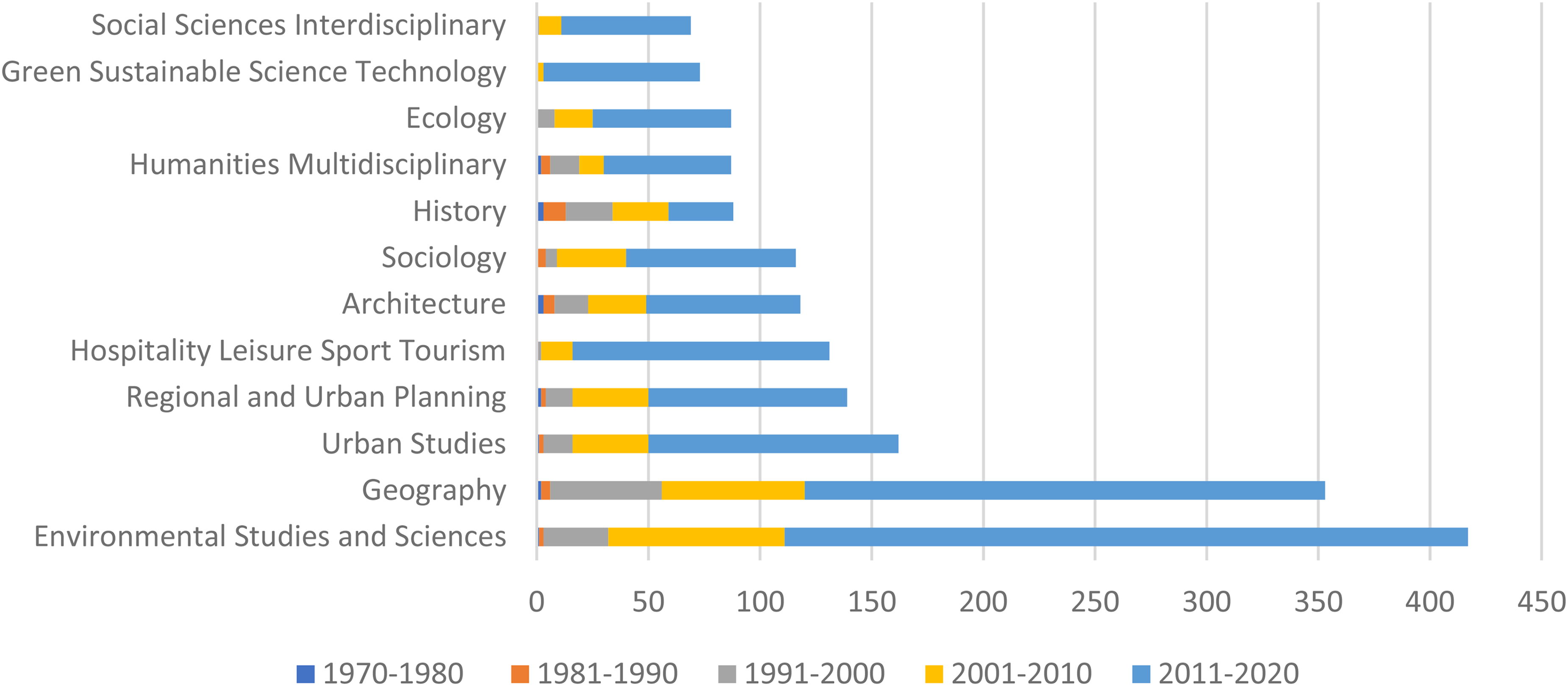
Number of journal articles on ‘sense of place’ by disciplinary area indexed in the Web of science database from 1970 to 2020.
Scholars interested in examining planning practice and research have long argued the destructive role of urban planning policies, such as urban renewal, gentrification, and commercial development, in residents’ sense of place. Bringing a preponderance of examples from New York, Jacobs (1961) discussed when urban spatial (re-)developments are far from ‘enough’ to deliver the diversity of population and uses, residents’ loyalty and urban sense of place would be disturbed. Drawing on empirical examples from the US and Europe, Whyte (1980) and Gehl (1987) have suggested that the ability of places to accommodate human activities as meaning-making processes (leading to social practices and actions) is an influential contributor to the success of urban places—and therefore to the development of the individual and collective sense of place over time. Overlooking such narrative meanings in the construction and maintenance of place can lead to the perception of displacement (Zuk et al. 2018) or placelessness as an ‘abstract geometric view of place, denuded of its human meaning’ as explained by Harvey Cox (in Relph 1976, 143). Some of these conceptions are well-established in other disciplines such as geography and more broadly in social sciences (see Massey 1991, 1993; Cresswell 2009, 2014). Human geographers use the term sense of place to describe the more dynamic subjective experiences and ‘nebulous meanings associated with a place: the feelings and emotions a place evokes’ (Cresswell 2009, 169) and how a sense of place can contribute to the success of urban regeneration practices and community well-being (Gao, Yin and Zhu 2020).
Because sense of place and place attachment are often classified in the literature under the umbrella of people-place relationships concepts, they are often used interchangeably or in overlapping ways (Trentelman 2009, 199–200). However, this fact does not mean that ‘these terms necessarily reflect the same underlying phenomenon’ (Williams 2014, 76). As such, this study acknowledges the inter-relationality of these concepts but adopts sense of place as an overarching construct comprised of a broad way of constructing people-place relations (see Hashemnezhad et al. 2013) and reviews other place-based studies, including the literature on place attachment, to encompass a wide range of meanings that people, individually and in community, attribute to their place. The study recognises that there is some uncertainty in extrapolating the findings to the sense of place construct, and therefore, there is some degree of conjecture in that extension in the literature. As will be further substantiated in the following reviews, it is also crucial to discuss how sense of place has been investigated in various contexts by scholars from different disciplines using different ways. This review discussion contributes to developing and applying the conceptual framework that this study proposes. The proposed framework reconceptualises and theorises the interrelationships between people—individual and community—and places, extending the understanding and articulation of the complex and dynamic notion of sense of place and related concepts. The complex construction of sense of place is not simply on the themes; rather, it is in-between them. The framework supports the understanding and articulation of place-based concepts, including place attachment, place satisfaction, and place identity, from an individual and community angle and their links.
The Review of Sense of Place
Much of the existing literature on people-place relations was inspired by place theorists such as Relph (1976) and Tuan (1975, 1977), who used the term ‘sense of place’ as an experiential process in which people interpret the meaning of place, insideness and outsideness, or placelessness (see Table 1). Seamon and Sowers (2008, 43) considered a key question for understanding a sense of place, building on Relph's classic study of Place and Placelessness (1976): ‘How could one study place attachment, sense of place, or place identity without a clear understanding of the depth and complexity of place as it is experienced and fashioned by real people in real places?’. They link the question of sense of place to ‘the unique character of a place’, asking what distinguishes one place from another. Scholars (Seamon 2012; Norberg-Schulz 2019) refer to it as the ‘genius loci’, i.e. the spirit of a place, and ‘the experiential attributes of a place’ (Tuan 1975): how people perceive and experience a place differently.
Research Background on Sense of Place and Place-Focused Concepts.
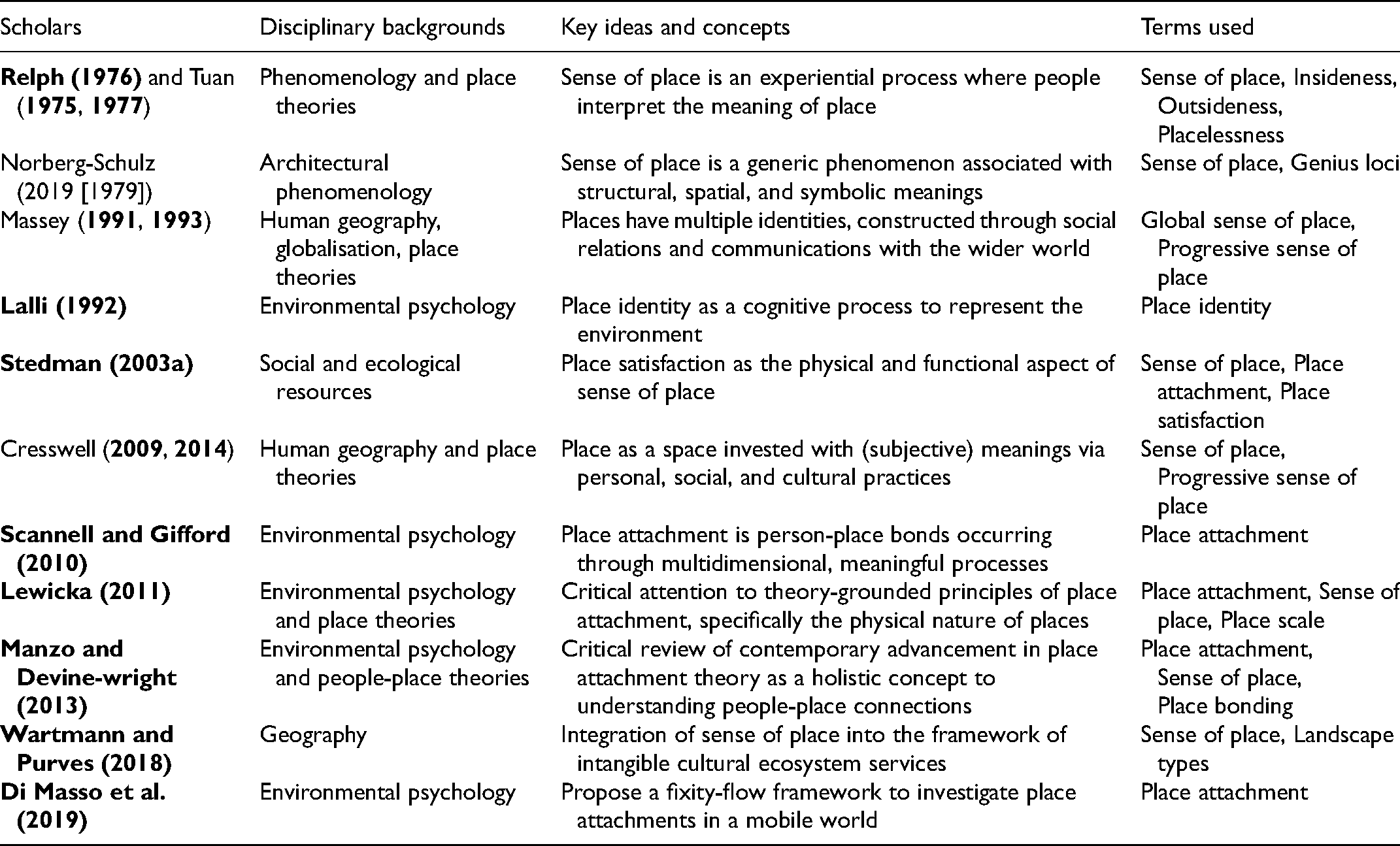
Using the Heideggerian thought of what a place as a phenomenological construct is and what it wants to be, architectural theorist Norberg-Schulz (2019) discussed the term ‘genius loci’ with two connotations: meaning and structure. Meaning connotes the subjective interpretation of place assigned by an individual, mediated by the relationships between the place and other places. Structure denotes the objective meaning of place, representing the physical aspects of place as an organisation of connections. Though the structure of place is constantly changing, its ‘genius loci’ essentially does not extinguish and remains relatively stable; hence, places conserve their identity during a specific period of time through the stability of place. Nevertheless, appreciating the ‘genius loci’ does not mean duplicating historical places and buildings. Its meaning is to preserve the identity of place and reinterpret it in the new ways of recreation and representation of places. Therefore, the stability of place identity can lead to strength in ‘place attachment’ and ‘sense of belonging’, i.e. interpreted as emotional links with a place (see Twigger-Ross and Uzzell 1996; Ujang, 2012).
However, this view of ‘stability’ of place contrasts with Massey's (1991, 1993) argument of places as moments in spaces that are never fully independent of wider socio-spatial relations of power and authority, as further discussed by Dovey et al. (2009). It is also inconsistent with the recent argument made by Di Masso et al. (2019) that considered place attachment as the dialectical dynamics of fixity and flow—all of which seek to challenge the assumption of stability of place and place-focused constructs as well.
People experience and recall memories of the places they have lived, worked, and played, including the events that occurred there with others. For the majority, the most influential and long-term memories centre around connecting with places, events, and relationships with other individuals and communities (Marcus 1992). Altogether, these shape a sense of ‘self-identity’ (Proshansky 1978). Through the interaction with place, people also represent a particular aspect of their identity (Anderson 2004), which creates ‘place identity’ as a key ‘part[s] of self-identity’ (Lalli 1992, 287). An empirical study by Twigger-Ross and Uzzell (1996) highlighted the constitutive role of place in identity processes to explain how resident groups become attached or non-attached to their local environment. As self-identity comprises specific and conscious convictions, interpretations, and evaluations of oneself, place identity is an aspect of an individual's identity, not a location of a particular place (Nanzer 2014). Hence, place identity is understood as personal experiences created by certain conditions, and an individual's understanding is involved in constructing a sense of place. Although more studies might presume a positive meaning for place identity (Manzo 2005), Broto et al. (2010, 964) argue that environmental changes in degraded areas can stigmatise place and ‘pose threats for the continuity of the residents’ identities’, which can negatively influence other place-based concepts, e.g. sense of place and attachment.
Scholars interested in community and sociological studies have weighed the social aspect of a sense of place much more than the physical (see Greider and Garkovich, 1994; Eisenhauer et al. 2000). In this approach, sense of place is mainly an outcome of common behaviour, situational and cultural processes of identity, and meaning constructions (Manzo 2003; David et al. 2005) rather than the influence of perceptual and cognitive processes embedded in physical characteristics of place (Lewicka 2011; Cao et al. 2018). Stedman (2003a) challenged this approach, considering the importantance of physical aspect to sense of place, by defining the physical and functional attachment to a place as ‘place satisfaction’. A summary of the operative evaluation of the experienced physical environment embedded within sense of place is place satisfaction. Moreover, because place satisfaction is different from place identity, it should be considered in the investigation of sense of place; for instance, a sense of cultural identity does not always mean satisfaction with the place nor the reverse. Therefore, sense of place is a broader concept composed of identity and satisfaction.
Despite the various definitions of sense of place, emotional quality, cognition, and behaviour are common features (see Jorgensen and Stedman 2001, 2006; Hashemnezhad et al. 2013). To investigate the relationship between sense of place and specific behaviour, Jorgensen and Stedman (2006, 317) underlined the ‘cognitive (e.g. beliefs and perceptions), affective (e.g. emotions and feelings), and conative (e.g. behavioural intentions and commitments) domains’. They considered sense of place to be ‘a multidimensional summary evaluation comprising place-specific beliefs (place identity), emotions (place attachment) and behavioural commitments (place dependence)’. Building on this idea, the components of sense of place are understood as place identity representing an individual belief about a place; place attachment, i.e., a (positive) feeling of individual towards a place; and place satisfaction (operative dependence) indicating a functional expectation of a place.
On the other hand, several researchers have suggested place attachment as ‘a holistic model for understanding the various attributes and perceptions of people-place relationships and experiences’ (Counted 2016, 7) or a model comprising of identity, dependence, and place as its dimensions (Manzo and Devine-Wright 2013). Scannell and Gifford (2010) offered the most comprehensive model, viewing place attachment in a three-dimensional, person–process–place organising structure. A place becomes meaningful to people through affective, cognitive, and behavioural processes. The different features of place are discussed on the spatial level, specificity, and place’s social/physical reputation. Place attachment in a social aspect holds an individual/community meaning for place, while from a physiological aspect it is a cognitive, affective, and conative attachment to place. Nevertheless, the model does not clarify the relationship between these concepts and sense of place nor the consolidation of their links.
Scholars such as Ramkissoon et al. (2013) have attempted to explain the relationships between place satisfaction and attachment to place or how dissatisfaction in environmental changes can disrupt place attachment (Brown and Perkins 1992). High dissatisfaction with a place, for instance, a constant lack of safety or unhealthy conditions, can convert place attachment to a negative sense and adversely affect the process of identification (Broto et al. 2010). However, again, it is unclear how place attachment is interrelated to, or reflects the structure of, the sense of place concept. Imagining a positive holistic concept, which can contain negative components, seems ambiguous, but as empirical evidence indicates, in place-meaning practices, undesirable experiences and outcomes can erode the sense of place and provoke negative feelings and even anger that contribute to conflictual or destructive attitudes towards a place (see Shamai, 2018; Erfani 2020; Erfani and Bahrami 2022).
Place attachment, place identity, and place satisfaction can be counted as the elements of sense of place, although these components may have various validity in social psychology. For instance, building on the views of empirical researchers, place attachment is more an emotion-based construct (Low and Altman 1992; Jorgensen and Stedman 2006), particularly when it is imagined as an overall approach to a place rather than conative- or cognitive-based. From this viewpoint, sense of place and place attachment are distinct constructs in the literature, acknowledging place attachment as a subset of sense of place (see Hashemnezhad et al. 2013).
There has been a considerable emphasis in the literature that place satisfaction can lead to place dependence, physical and social bonding, contributing to the sense of place construct (Stedman 2003a). Place satisfaction (operative dependence) is a functional reliance on a place built on the users’ physical experience of the actual place. An individual understands and interprets how well a place provides opportunities for personal development, e.g. recreation or economic income (Jorgensen and Stedman 2001; Cross et al. 2011), which is mainly dependent on place. Dependence on a place is regularly based on individuals’ experiences and favourite actions compared with existing alternatives (Williams and Roggenbuck 1989).
In addition, these components influence each other in different ways. For example, in the context of redevelopment interventions, the impacts of place satisfaction and place identity are opposite (Kyle et al. 2004). When redevelopment enhances the function and utility of places (place stratification), it interrupts the way the places were used and identified (place identity). Moreover, satisfaction with a place is linked to perceiving the place as an extension of self and identity (Droseltis and Vignoles 2010) or ‘an illustration of territoriality/protectionism’ (Ashworth 2008). Changes in these perceptions may interrupt place satisfaction. A study by Broto et al. (2010, 952) demonstrated that in environmentally degraded areas in Tuzla, Bosnia and Herzegovina, place identity was strengthened ‘by the performance of adaptive identities’ in reaction to a damaging ecological alteration whilst the residents were not functionally satisfied with the place.
However, the above-mentioned dimensions of sense of place with a composite of multi-layered interrelationships are not entirely substitutable variables. For instance, the distinctions of places affecting individual/collective behaviour may not influence emotions. Particular satisfaction with a place might also not be the key issue in beliefs about the place (Jorgensen and Stedman 2006) and varies from one socio-demographic context to another (Mazloomi et al. 2014). These variant relationships between place identity, attachment, and satisfaction demonstrate that sense of place is complex, multi-layered, and subjectively experienced in a context-dependent manner.
The interrelationships between a community and its place should also be researched because of the strong connection between producing ‘sense of place’ and the concept of community (Stedman et al. 2006; Chamlee-Wright and Storr 2009). As sense of place is individually understood and through the process of intersubjectivity is collectively imagined, the interrelationships between an individual (self), its community, and place form the sense of place. Although this collective understanding may outline community more as a place-based concept, this study acknowledges the other forms of non-place-based communities, including a community of interests, circumstances, or virtual community (Fraser 2005; Delanty 2010), which may or may not overlap with a place-based community.
Investigating Sense of Place
The literature review on ‘sense of place’ and place-based concepts (attachment, identity, satisfaction, and dependence) has shown that there is yet no consensus on theory, methods, and application to investigate these concepts (see Manzo and Devine-Wright, 2013). Different scholars have approached this concept differently. Several studies about sense of place (or place attachment) have relied on quantitative methods such as large-scale surveys followed by multivariate modelling (Bagozzi 1978; Lalli 1992; Stedman 2003b; Shamai and Ilatov 2005; Jorgensen and Stedman 2006; Halpenny 2010). These studies measured sense of place by asking how much people are attached to, identify themselves and are satisfied with a particular place. Then the responses were classified into different degrees. Studies investigating place have also shown that sense of place may be differently affected by socio-demographic variables, including age, social position, or length of residence. For instance, younger people (under 30) may consider a place more as an informal community. In comparison, older people focus on their geographical basis (Guterbock and Fries 1997) or the close-to-home milieu rather than the larger setting/community (Rowles and Watkins 1993). A study by Brown et al. (2003) revealed a significant correlation between length of dwelling time and place attachment. These studies show that people at different stages of life might have dissimilar opinions about their places (Mowl et al. 2000; Bergstén, Keskitalo and Carina 2019). Moreover, the physical attributes of place directly impact the sense of place and indirectly influence the meaning of place (Stedman 2003b).
To investigate sense of place, Stedman et al. (2004, 581) divided this concept into two different dimensions: evaluative and descriptive. The evaluative dimension has been more researched, and concerns how important a place is to a person or community. In this respect, place attachment, place dependence, and place identity are distinct notions, but all indicate a degree of attachment, dependence, and identity. Essentially, the investigation of these questions, how much a place is emotionally significant to an individual/community (place attachment) or provides opportunities to reach individual/collective goals (place dependence) or reflects self/community (place identity), points to the evaluative dimension of sense of place. In contrast, the descriptive dimension has been investigated less and covers how a person/community sees meaning in the place and why this meaning is attached to the place.
Investigating how an individual/community attaches the senses, beliefs, or behaviours to a place does not address any success or failure. Instead, studying why an individual or community forms a meaningful bond with places is an exploratory, in-depth enquiry, particularly in urban design (Carmona et al. 2010; Ujang and Zakariya 2015). This question provides a deeper understanding of the place and community, including potentially substantial implications for urban redevelopment and place-making (Ujang 2012; Authors 2021; Kortelainen and Albrecht 2021; Erfani 2021). For instance, place-based community members may view their neighbourhood as a home, workplace, childhood, religious, or meeting place. These symbolic connotations describe the meanings and ways in which the attachment between people and place has been practised and developed.
The symbolic connotations reveal that places have multi-layered meanings attached to them. Individuals elicit diverse meanings and narratives from places based on their experiential relationships with that place (see Davenport et al. 2010). An individual may apply ‘my school’, ‘our park’, or a historical element for its neighbourhood, while another might link the place with its home, river, or soundscape. Similarly, from a collective viewpoint, communities establish distinct meanings; for example, neighbours’ children may interpret their neighbourhood as a playground place, while women may attach a community meaning to the place in the neighbourhood garden. Such community meaning is not necessarily the most common sense/belief/behaviour between the (place-based) community members. Rather, the community meaning(s) of a place may vary from one resident to another, males and females, children from elders, and employees from retirees. Nevertheless, their meanings might overlap.
The literature underlines the crucial role of community engagement in constructing the shared meaning of a place. Studies on people-place relations by Relph (1976) and Ryden (1993) discuss that the people who have actually participated in collective activities and devoted more time to their place, sense the strongest attachment. Others such as Tuan (1977) emphasise the role of ‘chosen places’ in the attachment meaning of place; for instance, choosing attractive landscapes or deep experiences in a place can rapidly establish place attachment. Similarly, deep experience in a place can be constructed through social engagement and participatory practices. Although all highlighted the effect of community engagement, the impact of participation and its community reasons are not explicit (Manzo and Perkins 2006).
Reviewing the literature also shows that studies on sense of place and other place-focused concepts have typically considered the individual aspect rather than the collective, which indicates the need for further investigation on the community aspect. Community sense of place has been researched from two standpoints: first, the permanent residents’ sense of the community's socio-cultural features as social networks and community benefits, and second, a community sense of belonging to the ecological features. One community may be more dependent on the socio-cultural attributes of a place and another on the biophysical elements. However, socio-cultural factors are further highlighted than environmental factors (Stedman et al. 2004; Kopra 2006). These different features and/or priorities should be considered, particularly in the context of how urban changes may produce conflict between individuals, communities, and professionals. A deep understanding of the sense of place in the eyes of community values can minimise the degree of such conflicts among different stakeholders and maximise opportunities for them to benefit from community social and cultural values. This would facilitate the decisions and actions taken by urban planners, officials, and institutional stakeholders to improve the quality and outcomes of urban redevelopment projects as well as the process (Erfani and Roe 2020).
Scholars have studied sense of place within certain types of places, for instance, within homes (Anton and Lawrence 2014), neighbourhoods (Atkinson 2015), cities (Droseltis and Vignoles 2010), regions (Nanzer 2014), countries (Shamai and Ilatov 2005) or even a global sense of place (Massey 1991; Knox 2005). Others have explored a sense of place for rivers, forests, lakes (Beckley et al. 2004; Stedman et al. 2004; Kopra 2006; Verbrugge et al. 2019), degraded environments (Broto et al. 2010), or else to compare different landscape types (Wartmann and Purves 2018). Although these places have diverse scales and contexts, it indicates the extent and application of sense of place in studying the interrelationships between people and their physical, natural, and social environments.
Reviewing the literature revealed that to understand and investigate sense of place, there is a need to develop a wider and more expansive, relational approach that integrates cognitive-conative-affective processes between self, other people, and the natural and built environment. This review suggests that people-place interrelationships, affected by socio-cultural, institutional, and environmental contexts, are complex and dynamic. Sense of place can be studied in the eyes of the individual and community; however, the individual aspect has been more widely investigated. Therefore, this study was geared towards developing a conceptual framework that can clarify this complexity by presenting the individual-community-place links, and extending the boundaries of what is already a significant volume of literature.
Both qualitative and quantitative measures have been used to investigate the complex, multidimensional concept of sense of place. The literature review on sense of place (Stedman et al. 2004; Manzo 2008; Manzo and Devine-Wright 2013) shows that qualitative approaches are more sensitive in explaining the complicated interrelationships between humans and place than quantitative measures. More importantly, the interrelationships can be even more complex when researchers aim to investigate in-depth explanations of how and why other complex socio-economic phenomena change sense of places, e.g. participatory decision-making in urban redevelopments (Erfani 2018; Erfani and Roe 2020) or natural phenomena such as hurricane (Chamlee-Wright and Storr, 2009) and earthquake (Magee et al. 2016). Qualitative approaches deepen our understanding of the participant's perceptions and experiences regarding ‘an in-depth process’ (Creswell 2009, 13). The key questions, how and why a complex phenomenon has influenced the individual and community sense of place, can be investigated through in-depth conversations (Miles and Huberman 1994).
This study does not intend to preclude the use of quantitative measures nor analyse the potential variables constituting sense of place. Instead, building on the literature (Hummon 1992; Kruger 1996; Stedman et al. 2004), the study raises questions about how the holistic and qualitative concept of sense of place can be deconstructed and fragmented into precise, measurable variables, and then reintegrated through multivariate modelling. The typical use of quantitative models developed through statistical manipulation of isolated variables allows generalisability and application from one setting to another; the greater generalisability and applicability, the stronger the model. Nevertheless, this ‘push for generalizability has provided few precedents for using variables to discern the complexities that make places distinct’ and interesting (Paulsen 2004, 251). Significantly, as discussed prior, sense of place is a complex concept, including profound meanings associated with place and patterns in social life, notwithstanding any preferred investigation method. This study aims to contribute to the body of knowledge by developing a framework to reconceptualise sense of place as a holistic term, including other place-based concepts about place—attachment, satisfaction, dependence, and identity, from an individual and community angle, and their links. While there is a large amount of literature on sense of place, the proposed framework extends its application in reconceptualising how sense of place may relate to earlier constructs in the interdisciplinary literature. As such, it is an in-depth investigation of complex groundwork.
Conceptualised Framework for Studying Sense of Place
The literature review has led to the development of an inclusive conceptual understanding of ‘sense of place’. This study proposes a three-theme conceptual framework focusing on the multifaceted interrelationships between individuals, community, and place to articulatethe notion of sense of place from an individual and community angle, and their links with other place-based concepts. The framework includes place attachment, place satisfaction, and place identity, as illustrated in the Venn diagram of Figure 2. This will help researchers uncover the different but relevant issues within a logical structure that facilitates understanding and investigating the dynamic and multidimensionality of sense of place.
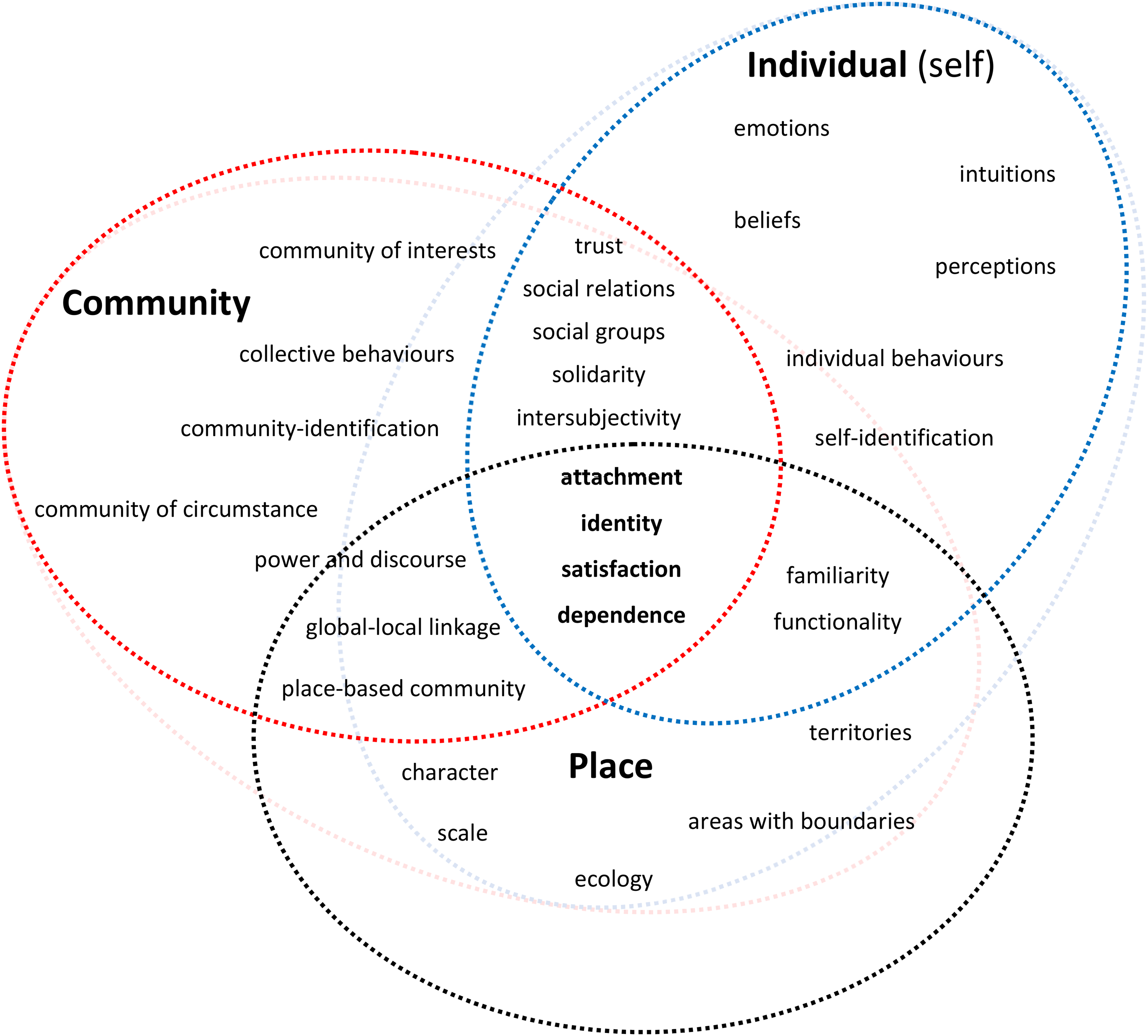
The interrelationships between individual, community, and place.
The sub-sections below detail the proposed framework's conceptualisation and help differentiate the present work from prior efforts. For example, what distinguishes this conceptual framework from the tripartite model by Scannell and Gifford (2010) lies in three aspects. First, the framework proposed by this study is much broader and includes not only place attachment but also place identity, satisfaction, dependence. In addition, this framework highlights community as a key concept in developing people-place relations, while the third dimension of the Scannell & Gifford model is process. Lastly, the framework emphasises that the construction of a sense of place is in-between individual, community, and place, not simply on them or underneath them. In a recently published study by Wartmann et al. (2021), the concepts of place attachment, place identity, and place satisfaction were jointly incorporated into the multilevel model investigating individual and landscape-level relationships. Nevertheless, despite the several references to the research focusing on sense of place, their study does not clarify the link(s) between sense of place and their suggested model, nor the place-focused concepts used in the study.
Individual: Individuals build self-boundary by sharing (or revising) their emotions, beliefs, and perceptions within continuous social relations in the global-local linkage (Massey 1991). These boundaries can be imagined at different levels: the person's sense of their own home, in a neighbourhood, city, or country. Individuals share feelings, opinions, and social interactions, to build their unique and indivisible self-identification (La Fontaine 1985) and practise territoriality as a socio-spatial control (Knox and Pinch 2010; Clark 2015) throughout their residence (Anton and Lawrence 2014). An individual also has social relations with other individuals, who have their own social ties with others, either separately or collectively. Through these social relations with other individuals, individuals build in their own family, relatives, friends, neighbours, and other socially constructed categories. From a personal (highly subjective) viewpoint, a person may imagine the self through their home, family, and workplace, identifying the person from others.
Community: A review of the community studies literature indicates the acknowledgment of ‘psychological sense of community’ as a broad theoretical construct providing a sense of belonging to a particular area, social group, identity, emotional connection, and well-being (Fisher et al. 2002). A community is neither a static phenomenon nor an inclusive notion for all citizens. Instead, a community essentially is a dynamic concept, in which citizens are constantly joining and leaving or at least claiming to do so, and understood differently in different political, theoretical, and ecological contexts (see Arai and Pedlar 2003; Gregory et al. 2009). Whenever community members share a kinship relationship and sense of solidarity based on the place, a place-based community is constructed (Fraser 2005). A place-based community is dependent on trust and familiarity among its locals, who possess kinship relations (Herbert 2005). While from the Chicago School perspective, place-based communities dictate the ecological ideas of invasion, dominance, and succession (Sampson 2002; Knox and Pinch 2010, 157), the political-economic school view is interrelated with socio-economic policies and political power (Harvey 1993; Gregory et al. 2009; Delanty 2010). The deep metamorphoses of urban environments through regeneration, gentrification, decentralisation, suburbanisation and social polarisation have led to the fragmentation of urban community networks (Delanty 2010) and residential displacement (Zuk et al. 2018). Globalisation and technological innovation (Harvey 1993; Knox 2005) have also accelerated the destruction of community networks and the change of place-based communities to non-place-based communities (Knox and Pinch 2010).
Place: After reviewing 40 years of literature on the construct ‘place attachment’, Lewicka (2011) calls for more attention to the definition of place and place-focused theories. Despite globalisation and technological advances, place is still a key element in shaping our attachments, although the literature excessively highlights the individual/community element. The term Place is conceptualised as certain moments of social relations rather than only ‘as areas with boundaries around’ (Massey 1991, 28). These moments are constructed at the intersections of social interactions, movements, and communications through economic, political, and cultural connections to the wider world that articulate the particular moment and the place, whether it is a home, neighbourhood, city, or country. This way of conceptualising and understanding how places are linked to or differentiated from each other facilitates recognising ‘a global sense of the local, a global sense of place’ (p.27)—indicating how places integrate the global and the local together. In this sense, places are institutionalised by political-economic powers in which economic and political decision-making processes transform the built environment, for instance, by supporting local institutions and organisations (see Harvey 1993; Logan and Molotch 2007). In addition, frequently, places narrate many other meanings, which may not be influenced only by individuals or a community, but the sense of place is affected. For instance, the biophysical features of a place (ecological aspect), including seasons, weather, or perceived landscape views, allow people to differentiate (and link) the differences in ‘sense of place as a cultural ecosystem service’ between different places. When unique elements and events are embedded within a place, the place constitutes cultural and symbolic meaning rather than merely a physical setting (see Vanclay 2008; Wartmann and Purves 2018).
Individual and place: An individual may apply my home, my city, or my country in their narratives to establish the link with a particular place as a way to (re)define self-identification. When an individual believes and/or perceives that a place represents the self, then the individual's identity can be expressed through the place identity. This happens when the self-identification and place identity overlap, allowing the individual to be re-identified through the place. Moreover, the emotional and intuitional links between an individual and a place construct place attachment (Jorgensen and Stedman 2001, 2006). In this case, physical and historical familiarities with the place may influence an individual's feelings about the place (see Shamsuddin and Ujang 2008). For instance, individual involvement in building a house or planting a tree can bring a sense of attachment since the person feels familiar with that place, physically and during the transformation process. Hence, individual involvement influences the individual's attachment to a place. In addition, if an individual feels that a place offers them an opportunity for personal development, they might have a desirable affection—’pride, happiness, and love’ (Scannell and Gifford 2010, 2), and dependence on the place when the place provides the individual's needs, e.g. jobs and housing.
Individual and community: Individual-individual and individual-community interactions may help build or develop trust (Payton et al. 2005). Individuals may develop thick trust through their kinship and daily relationships. The relationship between individuals and community, or even individual/community and the institutions, is weaker (thin trust) when trust is constructed through the intersubjectivity between community members or the institutions. When community members and individuals perceive similar values, attitudes, and beliefs, thin trust is created (Paxton 1999; Arai and Pedlar 2003). The above studies did not discuss the influence of familiarity with places or involvement in decision-making processes on trust and citizen actions, but other research has argued that familiarity with neighbours or local institutions can lead a resident to trust or intrust in the community (Herbert 2005).
Because the relationship between an individual and community (family, neighbours, and friends) is critical of the individual meaning of a place, it influences the individual sense of place. When a resident knows a neighbour/community/institution and can predict their behaviour and social norms, the local perceives a network of familiarity and trust between themself with others. While deep interrelationships between community members lead to individual trust, shallow connections between a person and an institution construct institutional trust (Herbert 2005; Payton et al. 2005). Thus, the construction of trust and familiarity between the individual and (place-based) community or the institution leads to an individual's sense of belonging to the community and the place itself (Stedman et al. 2006). Behaviour is fundamentally individual, but scholars distinguish between individual and collective behaviours in shaping a sense of a place. Collective actions can contribute to a sense of collective achievement (Erfani 2020), creating the potential for long-term transformative change in socio-ecological systems (Masterson et al. 2017).
Social structural phenomena at the community level can influence individuals’ perceptions, attitudes, and behaviours (Brown et al. 2003; Entwisle et al. 2007; Long and Perkins 2007). This demonstrates significant contributions of ‘community-contextual factors to individuals' experiences of community’ (Flaherty and Brown 2010, 504) and the development of a sense of community (attachment) as a multilevel, multifaceted construct (Sampson 1988; Brown et al. 2003; Long and Perkins 2007). It is limited or insufficient to understand individual-community relationships without contextualising individuals’ subjective sense of community within the wider, more objective social cohesion, communitarianism, or organisation at the community level. In addition, from a human ecological perspective, community experiences and meanings are rooted in a (macro-level) socio-ecological context (Sampson 1988, 2002). This argument resonates with the social-ecological theory, which posits that the entire social and ecological systems in which interactions occur need to be studied to understand individual-community relations (Masterson et al. 2017).
Community and place: The behavioural intentions and commitments of communities are linked to place in a way that may influence their collective behaviours (Ramkissoon et al. 2013). Places are perceived as friendly settings facilitating social relations when neighbourhood-based communities empower the kinship relationship between the residents. The residents feel a sense of solidarity based on a common place that makes them satisfied and dependent (Chamlee-Wright and Storr 2009). Indeed, when the members collectively share behavioural dependence on the place rather than a common personality, a place-based community is constructed through sharing subjectivities. Daily intersubjectivity leads to a continuous revision and reorganisation of the community. Intersubjectivity between individual community members influences the connection between place and community attachment (Lefebvre 1991; Knox and Pinch 2010). The effects are reflected in the attitudes and behaviours of community members; for example, residents may share an attachment to a place through an attachment to a local community. Indeed, satisfied involvement as a community member over time can generate a kinship relationship and spirit of solidarity from the viewpoint of an individual to the community, which can affect place attachment. One such study was by Payton et al. (2005), who revealed a significant relationship between place attachment and community actions. The qualitative study highlights the emotional and functional aspects of place, individual and institutional trust. Increasing place attachment directly raises trust and indirectly raises community involvement, and increasing trust directly raises community participation. Though in Payton's research, trust links place attachment to community involvement.
Local communities constantly develop or (re-)discover their senses of place by making and sharing meanings attributed to the place and activities. Involvement in these collective meaning-making practices contributes to the articulation of community narratives about the place, how they conceptualise and talk about the place, and how power is situated within the discourses—indicating the inclusion of discourses of power in (re-)constructing sense of place (Stokowski 2002). These practices include the interpretation of place meanings, language and discourse, material and socio-political interactions (Williams 2014), and the various aspects of place, including location, character, and scale (Jorgensen and Stedman 2001).
Applied Implications
The developed framework allows various applications in urban studies and planning processes. As detailed in the last section, planning processes that integrate and develop elements central to the in-between interactions of individual-community-place contribute to enhancing sense of place and achieving desired planning outcomes. This application supports community-led planning initiatives aiming to actively involve individuals and community groups in identifying and articulating meanings, feelings, attitudes, interests, needs, and how they should be addressed. A comprehensive understanding of place from an individual and community perspective, as the framework conceptualises, also contributes to resolving or minimising the potential conflicts and disagreements in development processes. Such understanding is crucial for informing planning researchers and practitioners involved in the decision-making and policy-making processes. In addition, as people express their interrelationships with places through the three main themes—here/there (place), others (community), and me (self)—this framework facilitates categorisation and simple thematic analysis of narratives. Along with behavioural intentions and commitments (satisfaction), potential respondents can easily express their feelings (attachment), beliefs and perceptions (identity) towards a place based on a relationship between the three themes. Their narratives, indeed, are not drawn on just one theme, but are instead in between them: individual-community, individual-place, and community-place interrelations.
Conclusion
Sense of place has recently gained increased attention in academic research, including environmental psychology, geography, urban and planning literature. In various research contexts and for different purposes, different theories and approaches have been adopted to investigate sense of place. The discussion of the contributions from a plurality of approaches deepens our understanding of sense of place, its complexity, dynamic, and multidimensionality. The conceptual framework developed in this study theorises the interrelationships between individual-community-place in constructing a sense of place and where the other place-based concepts lie. The framework, organised in a three-theme structure, has the potential to facilitate the categorisation and (thematic) analysis of qualitative narratives and accelerate progress across a wide range of fields, including planning practice and research. The framework contributes to the debate on bottom-up policy development and social planning, which would consider the perceptions and attitudes of the local inhabitants as a major factor in the planning and management of urban habitats. The framework can also stimulate directions for future research by identifying potential gaps in the existing literature and linking place-based constructs in a structural paradigm by enhancing the understanding and articulation of sense of place from an individual and community angle and their links.
Interrelationships between the individual, community, and place shape the spectrum of sense of place. The community level of sense of place is formed through the process of developing ‘intersubjectivity’ between individuals (Lefebvre 1991; Knox and Pinch 2010). Intersubjectivity as the collective intersection of people's subjectivities through time-space can lead to trust and familiarity, identifying one community from another (community-identification). Since the word place is one of the most multi-layered and multi-purpose notions in semantics, any discussion about sense of place inevitably seems complex and vague. Consequently, sense of place as a multi-dimensional and abstract term encompasses the socio-cultural and ecological attributes of a place. However, this notion is more than the statistical calculation of these components. People describe their cognitive, affective, and conative relationship with a place and others through a non-mathematical experience of place. Therefore, this qualitative concept is individually and collectively (community level) constructed through a combination of place identity, place attachment, and place satisfaction, which are in turn influenced by various contextual factors, including culture, institutional arrangements and organisations.
Place identity refers to a brief summary of an individual's sense of self in relation to a place. This cognitive-based aspect of sense of place is constructed once an individual believes that certain attributes of a place, either physical or symbolic, contribute to the sense of self-identity. If a place represents the beliefs and values that an individual believes the self and others possess, the individual considers that the dwellers can be reidentified through that place. A concise summary of a (positive) emotional bond to a specific place developed through interactions between an individual/community and the place over time, structuralises the place attachment. For instance, individuals can be attached to their neighbourhood through social ties with people living there and/or childhood memories of growing up there. Place satisfaction reflects the conative-based aspect: a summary of functional expectations and values that a place offers to an individual/community, facilitating their preferred activities and satisfying their needs. When someone is satisfied with their place of living or work, it means the place functionally provides a space for the individual's desired activities and interests. An individual may feel dependent on the place for certain facilities, such as offering a place to work and live, or expected social norms and activities from the community members. Though often discussed as a positive concept, a sense of place can conceptualise a negative or ambivalent people-place relation (see Shamai 2018). For example, an individual may develop a negative view of sense of place as certain features of place are in contrast interaction with the self-identity or because the place and community do not reflect the person's needs and values.
Footnotes
Declaration of Conflicting Interests
The author(s) declared no potential conflicts of interest with respect to the research, authorship, and/or publication of this article.
Funding
The author(s) received no financial support for the research, authorship, and/or publication of this article.
