




Abstract
The burgeoning landscape of literature on mobility inequalities has led to discrepancies between a conceptual understanding of mobility inequalities and its implementation in planning practice. Reviewing 270 publications across five decades, this article identifies intrinsic and extrinsic factors and approaches for understanding and analyzing mobility inequality. Using two thought experiments to critically locate variations in factors and approaches, dilemmas and challenges in addressing mobility inequality for the marginalized are exposed. The article concludes with future research directions for investigating mobility inequality.
Mobility inequality is pervasive, and most of us will experience some form of it in our daily lives, although the levels and intensity of the inequality experienced can vary across individuals in different spatial and sociocultural contexts. The recent COVID-19 pandemic has seen a widening of the mobility inequality gap between those with and those without access to private motorized vehicles (International Energy Agency 2020; International Transport Forum 2020) as traveling beyond walking or cycling distances is now limited or avoided at the risk of transmission. More permanent examples include segregated zones within a city produced by racialized mobility (Schuermans 2017; Sheller 2015) and gendered mobility (Hanson 2010; Ding, Loukaitou-Sideris, and Agrawal 2020), whereby difficulties to travel to a specific location are experienced disproportionately by certain groups. Often, mobility inequality results in unequal access through spatial mismatches between low-income neighborhoods and employment opportunities (Blumenberg 2004; Blumenberg and Manville 2004; Grengs 2010). These differences are associated with individual attributes and external and structural factors such as spatial and sociocultural contexts to produce mobility inequality. The complex interplay of these factors has generated a variety of conceptualizations and approaches for understanding mobility inequality in literature and in practice. This leads to difficulties in operationalizing mobility inequality for implementing solutions. A chief dilemma lies in weighing the mobility needs of marginalized groups against the overall accessibility of a majority population. Two concepts of equity underscore this dilemma: (1) vertical equity focusing on marginalized groups to compensate for the existing societal inequities and (2) horizontal equity that provides equal access to all individuals assuming all have similar abilities (Delbosc and Currie 2011d; Litman 2002). Several conceptualizations of mobility inequality tend to provide insights for a specific group (e.g., women, people with disabilities, children, older adults, low-income households and individuals) and risk being fragmented and favoring one group above another and skewing current planning policies and practices. This calls for a holistic overview on the variety of conceptualizations of mobility inequality to provide clarity for planning literature and practice.
Mobility inequality has piqued the interest of scholars, especially those in the fields of transport, planning, geography, and sociology. At the risk of stereotyping each discipline, the understanding of mobility inequality differs across these fields. Transport literature adopts a technical–functional description of different levels of mobility (e.g., travel time, distance, pattern, mode, options (Adeel, Yeh, and Zhang 2016; Banister 2018; Currie et al. 2009; Purwanto 2016). In planning and geography literature, a spatial depiction of unequal mobilities is preferred (Alberts, Pfeffer, and Baud 2016; Grengs 2010; Preston and McLafferty 2016; Pyrialakou, Gkritza, and Fricker 2016), although in-depth qualitative explanations on mobility inequality are found (see Loukaitou-Sideris 2016; McCray and Brais 2007; Uteng 2009). Within sociology, in-depth narratives explain why differences in mobility exist (Cresswell 2010; Graglia 2016; Sheller 2018). There are studies taking an interdisciplinary perspective leading to a more comprehensive reading of the causes and impacts of mobility inequality, but they remain in the minority (see Schönfelder and Axhausen 2003; Schwanen, Kwan, and Ren 2008; Shay et al. 2016).
Planning practices and policy tell a different story. International and national transport policies are increasingly focused on providing social equality and equity (United Nations 2016; European Union 2017), and access-for-all policies are popular (Silva et al. 2017). However, a high reliance on potential place-based accessibility planning instead of people-centered approaches remains (Miller 2005; Stafford and Baldwin 2018). Conventional place-based accessibility planning often succumbs to providing physical infrastructures by assuming that all individuals have similar mobility levels, thus neglecting older adults, people with disabilities, children, and women. As mobility inequality is experienced differently across individuals, we need to understand these differences and address the issue with customized and contextualized approaches. Although increasing numbers of practitioners prefer and acknowledge alternative people-based approaches, implementation remains impeded by organizational (i.e., rigid sectoral separation, unwillingness to adopt new approach) and technical barriers (i.e., not user-friendly; Geurs and van Wee 2004; Silva et al. 2017). Consequently, efforts to address mobility inequality stay business-as-usual, resulting in a lack of consideration on whether the access to transport infrastructure and services can be fully and equally utilized by all individuals, especially the marginalized.
The ethical basis for understanding mobility inequality stems from the argument that freedom of movement and access to key functions are basic universal human rights as stated in the Universal Declaration of Human Rights art. 13, 21, and 23–27 (United Nations 1948). Unfortunately, the freedom of movement and access is usually regulated for a homogenized ideal of an individual of middle-class social standing, usually male, and belonging to an ethnic majority, being able-bodied and of a productive age (Sheller 2018; Stafford, Adkins, and Franz 2020). This neglects the experiences and mobility-related difficulties of those who cannot afford transport costs, that is, women, immigrants, minorities, children, older adults, and people with disabilities. The related capability and social justice perspective show that those with socioeconomic disadvantages have less freedom and capacities to move and are prevented from actualizing potential accessibility and obtaining the intended distributive benefits of transport developments (Beyazit 2011; Sen 1992; Sheller 2018).
To untangle the various concepts of mobility inequality, this article presents a systematic review of 270 peer-reviewed articles dating from 1969 to August 2018 to offer a critical reflection of the concepts and potential approaches for operationalization through two thought experiments. Reviewing a wide array of research articles, we provide a fundamental understanding of the factors and approaches to mobility inequality across scales, geographical contexts, and sociocultural contexts. Highlighting mobility and accessibility for the marginalized, we connect discussions on a macroscale (e.g., distribution of transport benefits and costs; Karner et al. 2020) to a microscale (e.g., women’s safety in public transit environments; Ding, Loukaitou-Sideris, and Agrawal 2020). The article concludes with two thought experiments to actualize the dilemmas and challenges for addressing mobility inequalities in planning practice and provide future research directions.
Delineating the Scope
Reviewing 270 articles, we identify two major streams in conceptualizing mobility: (1) mobility as the physical act of traveling from origin to destination through various human and mechanical systems and (2) mobility as social practices. In both streams, mobility inequality is discussed as differences in the ability and capacity to move, investigating the causes and impacts of such differences. Mobility inequality, as a physical act, is often measured in technical terms, such as travel time, distance, mode, pattern, and options (Banister 2018; Olvera, Mignot, and Paulo 2004). As social practices, differences in mobility are described in relation to the freedom to travel and travel experiences as generated by and attached to sociocultural constructs (Cresswell 2010; Sheller 2018; Uteng 2006).
Mobility inequality can be defined as disadvantages to individuals and groups produced by unequal access to resources for physical accessibility. The conceptualization of mobility inequality can be broken down into two main concepts of mobility (in relation to accessibility) and inequality (socioeconomic imbalance and its effects). Mobility is bounded by individual abilities and serves as a means to accessibility (both physical and communicative accessibility, see Ferreira et al. 2012), although this relation has been well debated (for further readings on mobility–accessibility debate, see Curtis and Scheurer 2010; Ferreira and Papa 2020; Litman 2012; Preston and Rajé 2007). For example, unequal access to mobility resources as experienced by socially marginalized individuals leads to difficulties in their daily mobility, impacting their realization of potential accessibility in reaching necessary functions (e.g., schools, health care, grocery stores) and compounds into socio-economic inequalities (lack of access to employment, educational, and health-care facilities). People with disabilities and older adults experience even more limited mobility and socioeconomic participation, reducing their social well-being (Imrie 2000; Titheridge et al. 2009). Women from cultures that restrict female independence are often less mobile, limiting their access to sociocultural activities such as sport and leisure (Adeel, Yeh, and Zhang 2017; Uteng 2009).
These differences are also determined by formal and informal institutions manifesting as spatial and sociocultural constructs. The lack of sidewalks in certain North American cities adversely impacting those without private vehicles and women not being able to get driving licenses in certain Middle Eastern countries leading to social exclusion are examples. Individuals with disabilities are usually excluded if there is insufficient support from the planning system for their mobility. However, an inclusive planning system could enable their mobility and participation in society.
In planning literature and practice, mobility inequality is related to and often interchangeably used with:
transport disadvantage (Denmark 1998; Delbosc and Currie 2011a, 2011c), where individuals are disadvantaged in accessing and utilizing transport services;
transport inequality (Banister 2018), where there is unequal ability to access transport infrastructures and services across socioeconomic groups. Emphasis is on how processes and outcomes are equally important; therefore, the group addressed needs consideration (Verlinghieri and Schwanen 2020);
transport poverty (Lucas et al. 2016; Mattioli, Lucas, and Marsden 2017), where individuals are unable to afford transportation costs, have limited mobility options, and experience difficulties in accessing key functions;
transport-related social exclusion (Church, Frost, and Sullivan 2000; Kenyon, Lyons, and Rafferty 2002; Lucas 2012), where the inability to access transport infrastructures and services, as induced by individual attributes, the transport system, or mixed of both, increases the risk of being socially excluded;
transport justice (Martens 2012, 2017), where the distribution of resources via the maximax and maximin principles are discussed (Verlinghieri and Schwanen 2020); and
mobility justice, where time and scale transcending understandings of mobility (Sheller 2018; Urry 2004) are geared toward co-creation of solutions (Verlinghieri and Schwanen 2020).
The last two concepts are often adopted as synonyms. The above concepts and principles can be viewed as causes and outcomes of mobility inequality enacted upon specific demographic groups; thus, they delineate the scope for the literature review for mobility inequality in this article.
Methods and Data
Using Google Scholar to seek commonly used key words of “mobility,” “inequality,” “transport,” “justice,” “exclusion,” and “disadvantage” resulted in 4,046 English articles initially. Omitting results beyond our scope, such as virtual mobility, migration, and refugee and after reducing redundancies, 270 peer-reviewed articles remained. The scanning and review process took place from April to August 2018. The literature review is structured by identifying and categorizing the articles by their (1) contributing factors and (2) the methodological approaches according to their quantitative and qualitative nature, the data set used, and the research output. This systematic review aims to showcase the various conceptualizations of mobility inequality and accompanying complexities as manifested in planning literature and practices.
This method of literature search is limited by practical considerations such as access to literature in English, article accessibility beyond paywalls, subjective interpretation, and time constraints. First, the selected key words might overlook articles related to mobility inequality but omit these key words. Second, non-English literature that might offer colloquial and local knowledge is excluded for comparability. Third, the search is limited to journal articles and excludes non-peer-reviewed literature such as books, reports, proceedings, book reviews, and theses. Finally, the search covers articles published until August 2018, but discussions and reflections are contemporized by including articles published after these dates.
The reviewed articles stem from leading journals in transport, planning, geography, sociology, and the fields of gender studies, public health, disability studies, aging, and political sciences. Of the 270 reviewed articles, 230 articles use empirical data while 40 provide a theoretical understanding (e.g., conceptualization, review). Most cases are from developed economies (e.g., United States 18 percent, United Kingdom 11 percent, Australia 9 percent) while developing economies are in the minority (e.g., Nepal, Uruguay, Indonesia, Kyrgyzstan, and Uganda are less than 1 percent; see Online Appendix A). Some articles use multiple countries, but the distribution between developed and developing economies remains unequal. The dichotomy of developed and developing economic regions is an unfortunate limitation resulting from the existing skew in current literature. It highlights a knowledge and practical gap since mobility inequality as understood through developed economies might be incongruent with the spatial and sociocultural conditions in developing economies. The literature overwhelmingly neglects how informal and local, place-based transport systems (e.g., matatus, ojek online, or jeepneys) are prevalent in developing economies and might alleviate mobility inequality more efficiently. These grassroot transportation systems should be further researched.
Results
The review identified how previous research describe mobility inequality through an overlapping and intersection of intrinsic (i.e., individual attributes) and extrinsic (i.e., spatial and sociocultural constructs) factors. Although this binary division of intrinsic and extrinsic factors does not fully capture the complexity of their interrelations, the division is useful to separate how outcomes of inequalities were explained. Intrinsic factors describe how different individual attributes create different layers and levels of mobility, which are highly contextual. Research from developing economies focus on how having low income or being a woman impacts mobility via a lack of access to basic functions such as education and employment (see for instance Adeel, Yeh, and Zhang 2017; Lucas 2011; Ureta 2008). Meanwhile, studies from developed economies show a broader nuance of mobility inequality contributing factors such as age, disability, and migrant status. The focus of developing economies on basic developmental problems (i.e., economic growth, gender equality) might explain the knowledge gap. Interestingly, approaches for understanding mobility inequality do not differ between developing and developed economies. This may be due to the widespread adaptation of approaches from developed economies to understand developing economies. The review also identified how quantitative, qualitative, or mixed methods are employed. Data utilized include large-scale data sets such as national transport surveys, small-scale data sets from in-depth interviews, or a combination of both.
Contributing Factors
The 230 empirical studies reviewed show a wide range of intrinsic factors (i.e., directly attach to an individual) such as level of income with car ownership as a proxy, gender, age, race, disability, migrant status, and numbers of children (Table 1). Income, whether an individual could afford to be mobile, is most frequently mentioned. Gender follows as a close second factor illustrating sociocultural stereotypes influencing travel patterns and behaviors. Age, in third place, indicates physical and financial abilities to travel. These factors are then followed by race in relation to racial segregation, disability and physical limitations, migrant status, and household composition (i.e., number of children) rounding up the list as proxies for individualized mobility challenges in navigating the socially constructed built environment (Table 1).
Intrinsic Factors Influencing Mobility.
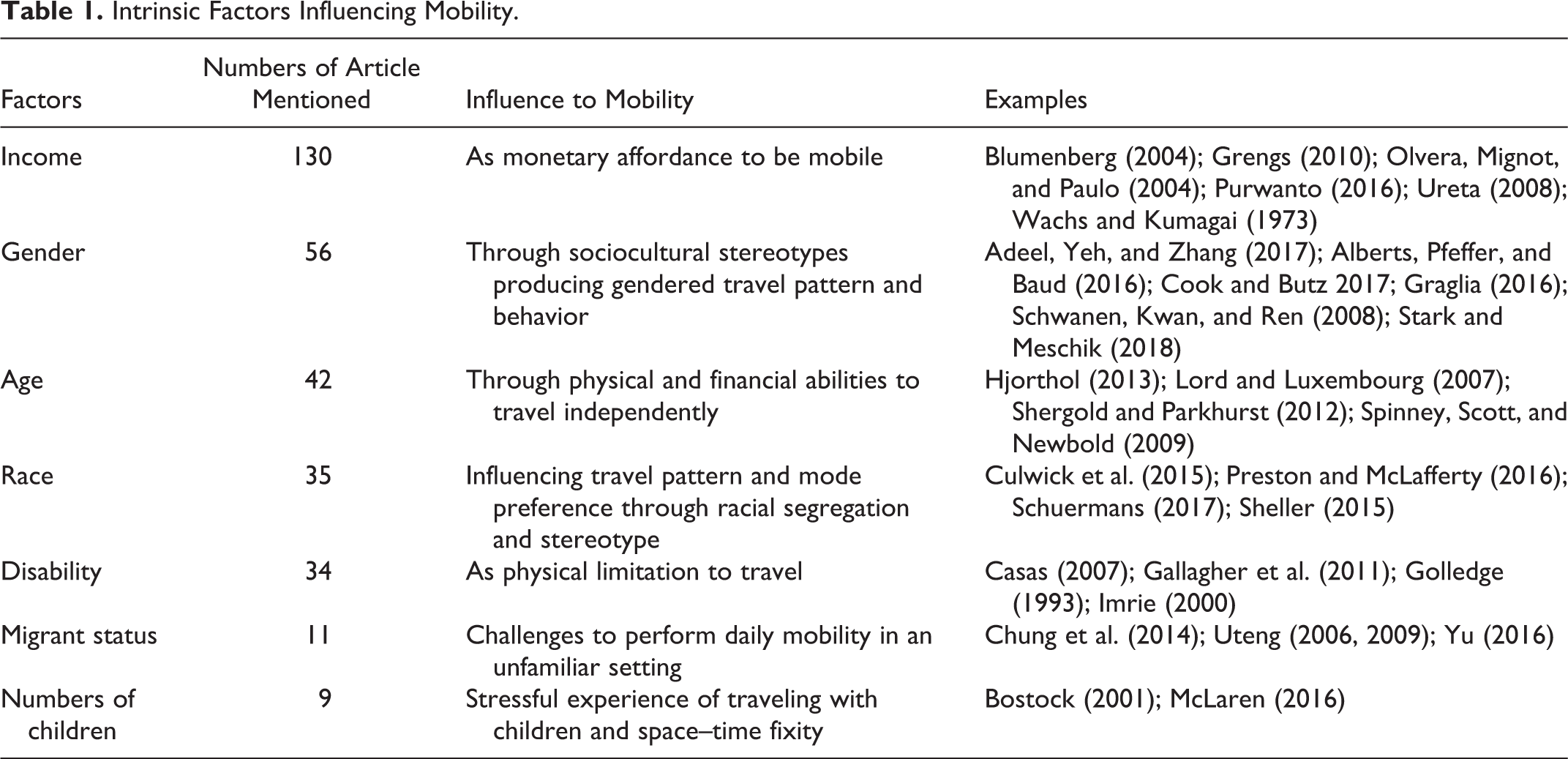
Each intrinsic factor is rarely investigated as stand-alone attributes and are usually intertwined with certain spatial and sociocultural contexts functioning as external and structural components influencing an individual’s mobility (i.e., extrinsic factor). Differences in mobility across gender and race cannot be separated from the social practices resulting from sexism and racism. The intertwined relation between intrinsic and extrinsic factors explains the varying levels and intensity of mobility inequality as experienced by individuals in different contexts. In general, low-income individuals, women, children, older adults, the racial minority, people with disabilities, immigrants, and those with children are marginalized. They have limited mobility, impeding their access to wider socioeconomic opportunities and making them more vulnerable to social exclusion (Delbosc and Currie 2011a, 2011c; Lucas 2012).
The relationship between income variations and differences in mobility is most extensively studied (see also Banister 2018). Earlier studies, such as Wachs and Kumagai (1973), found that low-income groups in Los Angeles have lower car ownership and are only able to access low-wage jobs. Three decades later, the finding still holds true as Blumenberg (2004) revealed that low-income women travel smaller distances, indicating socioeconomic and transportation barriers in their search for better employment at longer commuting distance. African American women in inner-city Detroit (Grengs 2010) experienced similar barriers. Meanwhile, in Chile, the low-income group voluntarily limit their mobility within walking distance and only travel for work, education, or daily necessities (Ureta 2008). In the French context, Olvera, Mignot, and Paulo (2004) and Purwanto (2016) suggest that the level of income is less significant than access to a car in defining mobility inequality. This might be related to extrinsic factors such as the availability of public transport, city size, and concentration of urban functions enabling low-income groups to overcome barriers to mobility.
Gender is studied in terms of women’s travel pattern, restrained mobility, and their perceived fear of traveling in public spaces (see review of gender and transport studies by Law 1999; Hanson 2010; Loukaitou-Sideris 2016). In the 1970s, geographers and transport researchers started to recognize that women have a particular travel pattern. Ericksen (1977) found that women in the United States travel a shorter distance than men, and black women travel a longer distance and are less likely to have access to cars as compared to white women. This difference in distance traveled relates to the restraints of a prescribed domestic role indicating a space–time fixity (Kwan 1999; Schwanen, Kwan, and Ren 2008). Gender-based restrained mobility varies across spatial and sociocultural contexts. Women in rural South Africa are more domestically bounded than those in urban areas (Venter, Vokolkova, and Michalek 2007), and women in a culture with strong gender role differentiation such as Pakistan and India experience less freedom for independent travel (Adeel, Yeh, and Zhang 2017; Alberts, Pfeffer, and Baud 2016; Cook and Butz 2017). Women also experience heightened safety concerns while traveling, resulting in their avoidance of certain times, routes, or modes (Ding, Loukaitou-Sideris, and Agrawal 2020; Graglia 2016; Stark and Meschik 2018). It is argued that this fear is formed by sociocultural constructs of gender socialization and victimization, exacerbated by gender-insensitive design of public spaces and transit environments (Law 1999; Loukaitou-Sideris 2016; Ding, Loukaitou-Sideris, and Agrawal 2020).
Age as a factor relates to physical and financial abilities to travel. Financial abilities to travel conveniently with more options occur between the age of 40s and 60s, when individuals are likely to have a stable income (Hjorthol 2008). Children experience various levels of limited independent mobility, especially if sociocultural marginalization (i.e., disability or racial minorities) applies (Stafford and Baldwin 2018; Stafford, Adkins, and Franz 2020). As individuals age, their physical ability to travel decreases, thus creating mobility limitation. This is especially true for older adults in a suburban car-oriented environment where transport mobility options are lacking, such as in certain North American cities (S. Kim 2011; Mercado, Páez, and Newbold 2010). For older adults, the ability to travel is directly related to their well-being and their vulnerability to social exclusion (Hjorthol 2013; Ravulaparthy, Yoon, and Goulias 2013; Spinney, Scott, and Newbold 2009). Interestingly, most older adults residing in rural areas do not experience the risk of social exclusion due to stronger community ties present (Lord and Luxembourg 2007; Shergold and Parkhurst 2012).
Race as a factor influences travel pattern and mode preference, especially in regions with explicit racial segregation. In the United States, whites are more likely to travel by car while other racial groups (i.e., Asian, Hispanic, African) tend to use public transport (Preston and McLafferty 2016). In Philadelphia, white individuals avoid traversing deprived neighborhoods in spite of additional travel time and costs (Sheller 2015). Differences in travel pattern and mode preference are deeply rooted in a history of racial segregation embedded in residential locations and wages (Preston and McLafferty 2016; Sheller 2015). In South Africa, whites travel mainly in the city center while Africans remain on the periphery as a result of apartheid policies (Culwick et al. 2015). White middle-class South Africans opt to use cars and avoid public transport due to their fear of interaction with impoverished blacks as they associate with crime (Schuermans 2017). In the Middle East, the avoidance of public transport by Emirati students plays into negative racial stereotypes of non-Emirati, low-income workers using buses (Qamhaieh and Chakravarty 2017).
Disability as a factor refers to specific mobility needs to overcome physical limitations. These physical limitations are not solely related to the personal attributes but are structurally ingrained in ableism (Stafford, Adkins, and Franz 2020). The mobility needs of people with disabilities are often neglected in the planning and design of transport systems (Golledge 1993; Imrie and Kumar 1998; Imrie 2000). When using public transport, those with reduced vision require guidance facilities (Gallagher et al. 2011), wheelchair users require ample maneuvering space (Matthews et al. 2003), and those with hearing impairments and learning disabilities (i.e., dyslexia) depend on informative signages (Lamont, Kenyon, and Lyons 2013) which are not always adequately present. Disability coupled with aging leading to reduced vision or walking ability is currently a popular research theme (Stafford and Baldwin 2018). The current transport system rarely accommodates the specific mobility needs imposed by specific disabilities, choosing to design for a nonexistent middle ground. This systematic negligence is found across several geographical contexts such as the UK (Imrie and Kumar 1998), South Korea (K. M. Kim et al. 2017), Chile (Rotarou and Sakellariou 2017), and the United States (Casas 2007). The socially constructed bias produces a dominance of exclusionary transport planning, spatial design, and infrastructure and accumulates immobility for those impacted leading to social exclusion (Hughes 1999; Stafford and Volz 2016; Stafford, Adkins, and Franz 2020).
An emerging strand of research focuses on immigrants and their mobility, such as the difficulties of familiarizing oneself in a foreign transport system (Chung et al. 2014; Yu 2016) and being excluded from the system through language or cultural barriers (e.g., difficulty to obtain driving license; Bose 2013, 2014; Reid-Musson 2018). Immigrants also display signs of voluntary immobility limiting their mobility range to neighborhoods with familiar community and amenities (Uteng 2009; Yu 2016). This tendency is highly related with a structured segregation and isolation process, which can lead to racialized mobility (Sheller 2015). Such voluntary immobility in familiar localities actually might provide higher levels of local accessibility at the cost of less freedom to move and participate in socioeconomic activities at a larger scale.
The presence of children is another factor. Walking with kids can be stressful as parents have to entertain them while keeping them safe (Bostock 2001). Similarly, when taking the public transport, parents have to be considerate of other passengers while monitoring their child (McLaren 2016; McQuoid and Dijst 2012). Women with children experience increased space–time fixity with their travel pattern more bounded to home and childcare activities (Schwanen, Kwan, and Ren 2008).
In the review, how an individual’s intrinsic attributes influence eventual differences in mobility cannot be separated from their spatial conditions and sociocultural constructs. These are extrinsic factors defined as external and systemic components that structurally influence an individual’s mobility. For instance, ableism produces mobility inequality by creating a structural and coerced immobility for those with disabilities by reproducing ableist spaces and rules (Stafford, Adkins, and Franz 2020). In a context with unbalanced gender relations, gendered mobility is amplified through negative stereotypes attached to women’s travel activities (Law 1999; Loukaitou-Sideris 2016).
The interplay of individual attributes and sociospatial conditions is reflected in mobility behaviors and patterns such as the preference (or avoidance) of certain routes, times, and transport modes (Hidayati, Tan, and Yamu 2020). Spatial conditions manifest as location, distance, urban form, transport and land-use system, and existing spatial segregation that inadvertently limit or restrain the mobility of marginalized groups. Residing in a remote area can amplify mobility inequality for those without private vehicles due to a low concentration of services and facilities and low public transit supply (Pyrialakou, Gkritza, and Fricker 2016; Shirmohammadli, Louen, and Vallée 2016). Low-income immigrants in rural areas (Reid-Musson 2018) and women (Alberts, Pfeffer, and Baud 2016; Venter, Vokolkova, and Michalek 2007) are adversely affected. In terms of urban form, a street layout prioritizing car traffic and a coarse urban grain (Crane 2000; Kandt 2018) marginalizes captive pedestrians, who tend to be low-income individuals without access to cars or transit. Most transport and land-use systems do not accommodate women’s travel patterns and their safety concerns (Ding, Loukaitou-Sideris, and Agrawal 2020; Hanson 2010; Law 1999; Loukaitou-Sideris 2016) or those with specific mobility needs (Golledge 1993; Imrie and Kumar 1998; Imrie 2000). Similar effects of spatial segregation and social exclusion adversely affect immigrants and minorities (Preston and McLafferty 2016; Sheller 2015; Uteng 2009; Yu 2016).
Meanwhile, the interplay of individual attributes and sociocultural constructs can be seen through the norms and stereotypes, mainly from gender (gendered mobility) and race (racialized mobility). Gendered mobility (Hanson 2010; Law 1999; Loukaitou-Sideris 2016) is rooted in gender socialization and victimization, generating a belief that women are more vulnerable to crime and assaults while traveling in public spaces (Ding, Loukaitou-Sideris, and Agrawal 2020; Loukaitou-Sideris 2016) or that women are not capable of driving and traveling independently (i.e., South Asian and the Middle Eastern contexts) effectively limiting their action radius and access to socioeconomic opportunities (Adeel, Yeh, and Zhang 2017; Uteng 2009). Racialized mobility (Sheller 2015) describes how sociocultural stereotypes embedded in racial segregation produce no-go zones for certain ethnicities. In the United States and South Africa, black and low-income neighborhoods are often perceived as deprived and dangerous zones to be avoided (Culwick et al. 2015; Preston and McLafferty 2016; Schuermans 2017; Sheller 2015).
Approaches for Understanding Mobility Inequality
A complimentary variety of approaches for understanding mobility inequality exist; they range from quantitative, qualitative, and mixed methods and cover large-scale, small-scale, or multiple data sources. Frequently used approaches include correlational analysis, descriptive statistics, calculation and mapping of accessibility, descriptive narratives, analysis of interviews, and focus groups (Table 2). Generally, differences in levels of mobility (e.g., travel time, distance, mode) are analyzed using quantitative methods with large-scale data sets such as the national census tract (Blumenberg 2004; Culwick et al. 2015; Delbos and Currie 2011a, 2011c; Grengs 2010; Olvera, Mignot, and Paulo 2004; Purwanto 2016; Preston and McLafferty 2016), while travel experiences and freedom to travel are described using in-depth qualitative studies (Bose 2013; Bostock 2001; Cook and Butz 2017; Graglia 2016; Ureta 2008; Uteng 2009; Yu 2016). Studies utilizing mixed methods and data sets exist but are in the minority, such as the use of space–time analysis to identify space–time fixity differentiated by gender and occupation (Kwan 1999; Schwanen, Kwan, and Ren 2008; Neutens et al. 2014) or a qualitative mapping to visualize mobility patterns for certain socioeconomic groups (Alberts, Pfeffer, and Baud 2016; McCray and Brais 2007; Shay et al. 2016). In these approaches, time budget as a mobility measurement is discussed in terms of accessibility and flexibility. More travel is not always desirable unless it yields greater accessibility or more freedom to travel.
Table 2 provides a holistic overview and the possible combination of methods. For example, Shay et al. (2016) utilizing maps of transport disadvantaged from socioeconomic profiles with an analysis of in-depth interviews and focus groups is registered as using three different methods, namely qualitative mapping, analysis of interviews, and analysis of focus groups.
Approaches for Understanding Mobility Inequality.
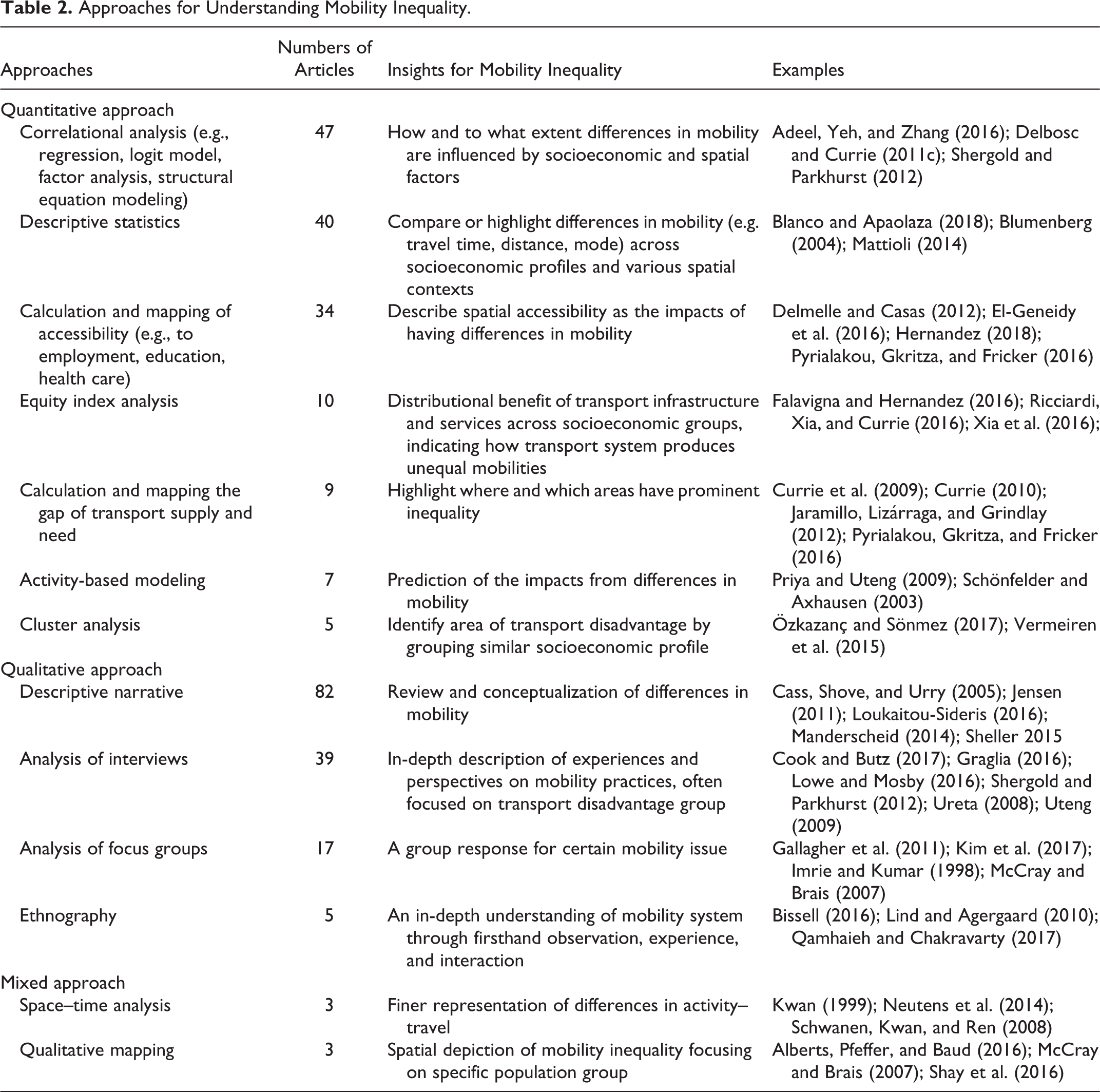
Among quantitative approaches, correlational analysis is most frequently used to investigate how and to what extent differences in mobility are influenced by socioeconomic and spatial factors. Findings, however, should be cautiously interpreted within the local sociocultural contexts. For example, Delbosc and Currie (2011b) found that in Australia, being transport disadvantaged is correlated with well-being but not with social exclusion. Shergold and Parkhurst (2012) reported that transport-disadvantaged older adults living in rural South England and Wales risk social exclusion. Adeel, Yeh, and Zhang (2016) show that Pakistani women are less likely to participate in social and leisure-based activities as compared to men, indicating higher social exclusion risks.
Descriptive statistics are also commonly used and draws from large-scale data sources (e.g., national travel survey or census data) to compare or highlight differences in travel behavior and choices across socioeconomic profiles and various spatial contexts. Blumenberg (2004) compared trip purpose, transport mode, travel distance, and time between average working adults and low-income single parents in the United States. Mattioli (2014) highlights travel distance by transport modes and area types (i.e., city center, suburb) for non–car owners in the UK. Blanco and Apaolaza (2018) used a national census and mobility survey to compare the number of trips, car ownership, possession of driving license, access to public transport, and travel time across income groups in Argentina. This approach provides a general pattern of mobility across socioeconomic groups but neglects individual differences and attributes.
The mapping and calculating of accessibility are often used as proxies for mobility inequality. Here, socioeconomic profiles are often aggregated to identify the spatial distribution, but there are contextual differences. The underlying assumption here is that people with transport disadvantages have low mobility leading to reduced accessibility which is measured as reduction of cumulative opportunities. Pyrialakou, Gkritza, and Fricker (2016) mapped areas with high concentration of transport disadvantage and juxtaposed them with access to hospitals, schools, recreational facilities, and public transport. Delmelle and Casas (2012) mapped access to hospitals, recreational sites, and libraries in Colombia and analyzed them across income groups. Hernandez (2018) mapped access to schools and jobs and identified that low-income neighborhoods have fewer cumulative access to education and employment opportunities. However, El-Geneidy et al. (2016) found that the lowest socioeconomic group enjoyed higher accessibility to jobs in Canada. This approach depicts the potential but not the realized accessibility that is greatly influenced by individual attributes and sociocultural constructs (e.g., Delmelle and Casas 2012; El-Geneidy et al. 2016; Geurs and van Wee 2004).
Other common approaches include equity index, activity-based modeling, calculating transport supply and need gaps, and cluster analysis. Equity index analyzes the distributional benefit of transport infrastructure and services across socioeconomic groups showing how transport institutions reproduce mobility inequalities especially for the marginalized (Karner et al. 2020). Examples include inequitable public transport supply in Australia (Ricciardi, Xia, and Currie 2016; Xia et al. 2016) and in Latin America (Falavigna and Hernandez 2016). Activity-based modeling explores and quantifies when and where activities of individuals take place and further analyzed in relation to individual intrinsic factors (i.e., gender, age; see Schönfelder and Axhausen 2003) or mobility options (i.e., driving license; see Priya and Uteng 2009). This approach has the potential for predicting the risk of social exclusion by linking mobility options and available socioeconomic opportunities through the proxy of individual activity patterns. Transport supply is derived from public transport infrastructures and services data and sociodemographic profiles (e.g., census tract) indicating transport need is used for analyzing the transport supply and need gap. Currie et al. (2009) and Currie (2010) highlight this gap for socioeconomically disadvantaged groups in Australia to suggest mismatched transport investment priorities. Similar investigations are found in North America (Pyrialakou, Gkritza, and Fricker 2016) and Latin America (Jaramillo, Lizárraga, and Grindlay 2012) where areas of high level of illiteracy and unemployment correlate with low public transport services. Similarly, cluster analysis is used to identify socioeconomic clusters and compare their mobility patterns in terms of transport difficulties (Özkazanç and Sönmez 2017; Vermeiren et al. 2015).
However, the above approaches generating findings from large-scale data sets at a national or city-wide level are often proprietary. The drawbacks here include barriers to finding and utilizing the data (e.g., the data are not being consistently gathered or interpreted across different contexts) and the risk that the findings are interpreted from a governmental or political perspective. Due to the sheer number of samples, these data sets are also limited in how sensitive they are to individual attributes and mobility needs.
In terms of qualitative approaches (see Table 2), the descriptive narrative approach is most preferred, followed by analysis interviews, focus groups, and ethnographic observation. The descriptive narrative approach provides in-depth examination on specific topic, for instance, on racialized mobility (Sheller 2015), gendered mobility (Law 1999; Hanson 2010; Loukaitou-Sideris 2016), and discourses of mobility of people with disabilities (Imrie 2000). Cass, Shove, and Urry (2005), Jensen (2011), Manderscheid (2014), and Kwan and Schwanen (2016) also discuss the relation of mobility and inequalities in general terms. The analysis of interviews is frequently used to provide in-depth descriptions of mobility experiences of specific transport-disadvantaged groups (Bose 2013; Cook and Butz 2017; Graglia 2016; Lowe and Mosby 2016; Ureta 2008; Uteng 2006, 2009; Yu 2016). Typical questions include mobility patterns, constraints, difficulties, and frightening (or positive) experiences. The interviews are often analyzed through coding or providing relevant quotations to support specific arguments. Interviews are also employed to analyze perspectives on mobility practices with expert respondents (Richardson and Jensen 2008; Shay et al. 2016). Focus groups are also commonly used offering time efficiency for data collection or to verify initial findings (McCray and Brais 2007; Shay et al. 2016), especially for respondents who are difficult to interview independently such as people with disabilities (Gallagher et al. 2011; Imrie and Kumar 1998; Kim et al. 2017; Lamont, Kenyon, and Lyons 2013). The focus groups are often recorded, transcribed, and analyzed using similar methods for analyzing the interviews. Another common approach is ethnographic observation to understand the mechanisms of a mobility system through the researcher(s) firsthand observations, experiences, and interactions on various modalities and contexts which might not be captured in large-scale databases such as experiences of bus passengers in Abu Dhabi (Qamhaieh and Chakravarty 2017) or South Africa (Bissell 2016). The ethnographic observation is often described in an in-depth narrative form.
The above qualitative approaches are instrumental in providing context-specific insights and findings. However, the intricacies of these methods make them difficult to reproduce and replicate across various contexts. There is also an overemphasis on specific populations (i.e., low-income women, migrants, and refugees) while failing to abstract insights for a larger segment of the population.
Combinations of both quantitative and qualitative methods are rare (15 of 301 counts). Space–time analysis that depicts finer representation of activity–travel (i.e., where and when activity takes place) taking data from travel diaries with varying sample sizes differentiated by individual attributes, for instance, by gender or employment (Kwan 1999; Schwanen, Kwan, and Ren 2008; Neutens et al. 2014) is one example. Another is qualitative mapping combining interviews or focus groups with spatial analysis of the mobility experiences of specific population groups (Alberts, Pfeffer, and Baud 2016; McCray and Brais 2007).
The approaches for understanding mobility inequality depend rightfully on the purpose of study, which defines how mobility inequality is operationalized (e.g., whether to describe differences in mobility level across sociodemographic profiles, mobility challenges of certain groups, spatial distribution of differences, or a combination thereof) and the data availability. Interestingly, the spatial approach (i.e., mapping of accessibility, transport supply–need, qualitative mapping, cluster analysis, space–time, and activity-based modeling) is underused, being applied 61 times of a total of 301 (e.g., Currie et al. 2009; Currie 2010; El-Geneidy et al. 2016; Jaramillo, Lizárraga, and Grindlay 2012; Kwan 1999; McCray and Brais 2007; Pyrialakou, Gkritza, and Fricker 2016; Schwanen, Kwan, and Ren 2008). This can be attributed to spatial data collection and analysis techniques being previously unfeasible before the 1980s. This presents a challenge and opportunity to fill the knowledge gap on how the interplay between spatial conditions and sociocultural constructs in combination with intrinsic factors influences mobility inequality.
Reflection: Dilemmas and Challenges for Addressing Mobility Inequality
Despite the identification of contributing factors and approaches for understanding mobility inequality, the operationalization and addressing of mobility inequality in policy and practice remain elusive. To clarify and illustrate the dilemmas and challenges inherent in this implementation gap, two thought experiments using common daily mobility scenarios are presented to provoke and engage readers with imaginary scenarios (Gendler 2000, 2004) to enable an understanding of mobility experiences from different perspectives. Thought experiments also illustrate and highlight the intertwined relation of intrinsic and extrinsic factors in producing mobility inequality (Figure 1). The scenarios capture the most common mobility inequalities in the reviewed articles. The first scenario depicts an individual without access to a private motorized vehicle (carless) in a car-oriented environment, and the second scenario describes an individual with a migrant background in a racially segregated environment. The first scenario assumes a visible form of mobility inequality from limited transport mobility options while the second scenario shows implicit mobility limitations resulting from cultural connotations and the burden of being “other” while engaging in mobility.
For both scenarios, the following questions are asked: (1) what kind of mobility limitations or difficulties are experienced by the individual, (2) how could those difficulties be described and analyzed, and finally comparing the scenarios on (3) how the individual difficulties can be addressed in policy and practice.
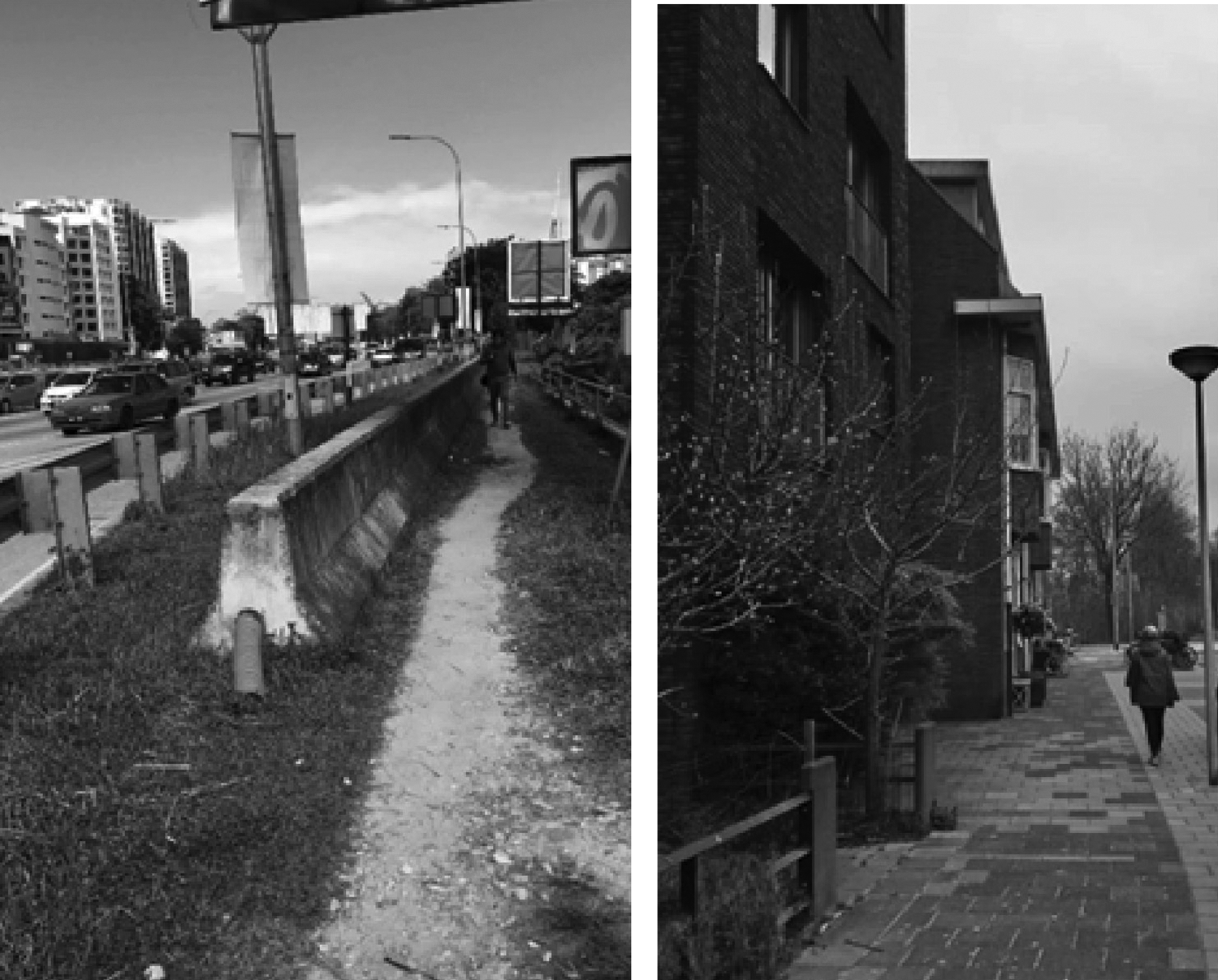
Illustrative context for scenario 1 (left) and scenario 2 (right).
1. Scenario 1: A “carless” individual in a car-oriented environment.
These individuals tend to be from a low-income background. They could be women who opted out or are excluded from having access to a car, children, older adults or people with disabilities who cannot drive, immigrants with no driving license, or a combination thereof (Blumenberg 2004; Lucas 2012; Mattioli 2014). Mobility inequality as experienced can include reduced mobility (i.e., only able to access socioeconomic opportunities within walking or cycling ranges or within public transport network) and safety concerns (e.g., more vulnerable to street crimes and traffic accidents) resulting in less freedom due to limited travel distance, physical and financial inconveniences, longer travel time, and feelings of fear and exclusion. These issues are amplified in car-oriented environments characterized by a disproportionate amount of road surfaces for cars and not people (i.e., enormous highways instead of sidewalks), monofunctional land use with large block sizes, dispersed key functions, and unreliable public transport. Moreover, such environments tend to glorify car ownership and use, associating it with higher social and financial status or personal freedoms.
In this scenario, mobility inequality is usually measured using large-scale data sets (i.e., national travel surveys) in relation to measuring accessibility and levels of mobility (e.g., travel time, distance) and less frequently with in-depth qualitative approaches. The quantitative approaches (e.g., descriptive statistics, correlational analysis, mapping accessibility, or analysis of transport supply–need gap) can highlight how carless individuals (treated as an aggregate from socioeconomic data) fare less in terms of mobility and accessibility. This approach, however, is less sensitive to specific mobility experiences (e.g., mobility difficulties experienced by carless women differ from older adults who are carless). Although there have been increasing efforts to incorporate behavioral variables in travel survey, nuances of individual mobility experiences remain difficult to capture. Here, in-depth qualitative approaches such as interviews, focus groups, or ethnography can be utilized to furnish a detailed understanding of mobility experiences of specific groups but reduce the ability to validate and generalize the data and are bounded by context specificity. Combined methods, such as space–time analysis and qualitative mapping, can be used to incorporate both general and in-depth insights of mobility experience, but they require a case-specific data collection protocol. In practice, defining which approach to use depends on data availability and operationalization capacities to interpret the findings for policy (Geurs and van Wee 2004; Silva et al. 2017). For instance, developing economies might have limited data availability and less capacity for sophisticated methods, but they might have invaluable local knowledge.
2. Scenario 2: An immigrant in a racially segregated environment.
An individual with a migrant background is usually associated with being a minority (i.e., in terms of race, income level) and with no access to private motorized vehicles due to difficulties in obtaining a driving license (Reid-Musson 2018; Uteng 2006, 2009). They can be blue-collar worker, female students who do not have a car, or an older adult refugee. Mobility inequality as experienced by an immigrant can, in certain cases, be subtle and implicit (e.g., not being able to read or understand the languages used in public transport) to aggressive and explicit (e.g., being turned away from car-sharing services or public transport due to physical attributes (Yu 2016). An unfamiliar system and environment can incite discomfort and an overly cautious behavior when walking around, asking for direction, or taking public transport. This fear is amplified, especially if the sociocultural constructs in that context associate immigrants as crime perpetrators. This is especially so in a racially segregated city where certain ethnicities recognize or create no-go zones out of avoidance or clustering (Sheller 2015). Mobility inequality here can manifest in terms of (voluntary) limited mobility through avoidance of certain routes and times as acutely experienced by immigrant women from a background of gender inequality (Uteng 2006, 2009).
In this scenario, the qualitative or combined approaches offer sensitivity in revealing the subtle mobility difficulties experienced. In practice, however, such difficulties are rarely registered due to lack of data or privacy issues and are not usually considered or prioritized in the planning process (Bose 2013; Uteng 2009). In fact, most mobility policies tend to aggregate the user as a homogenized group and shy away from differences (i.e., gender, age, or migration background) in addressing their mobility needs.
In both scenarios, we can identify the differences in factors and approaches in understanding mobility inequality. A practical challenge remains when considering what and how mobility inequality is measured, and consequently, defined via indicators or measurements in addressing the issue. The dilemma here is to balance the representativeness of a large-scale data set and analysis with insights and nuances of in-depth qualitative approaches. Additionally, the role of context is instrumental in interpreting the data and determining the analysis of findings. This requires that the researchers have or can access local knowledge and insights or that the data sets be calibrated across different contexts for comparison.
Both scenarios show that mobility needs are subjected to individual attributes and experiences, such as the perceptions of safety. Consequently, mobility inequality is experienced at varying levels and intensity by different individuals in different spatial and sociocultural contexts. This necessitates a robust analysis to avoid overlooking the different forms and nuances of mobility inequality experienced by different groups. Hence, analyzing mobility experiences requires an in-depth investigation on individual mobility behavior and the psychological factors behind them. A general indicator such as level of income is hardly applicable. Efforts on quantifying mobility needs have been proven to work at an aggregated scale (Currie 2010; Bocarejo and Oviedo 2012) or when only focused on specific groups (Casas 2007; Uteng 2006, 2009) instead of across the whole system. Here, another practical challenge presents itself in the need to unfold the sociospatial interplay that amplifies the mobility inequality as experienced by the marginalized. Spatial analysis linked with the understanding of sociocultural constructs can be a solution here. Space–time analysis and qualitative mapping are great starting points, although both approaches require extensive data collection and interpretation.
The scenarios are of course reductions of reality and neglect the overlapping of factors such as being a migrant woman with no access to a car. Here, the quantitative approaches fall short as overlapping intrinsic characteristics such as age, gender, or ethnicity are separated. In addition, both scenarios reflect the intersectionality of personal, spatial, and sociocultural factors that produce mobility inequality through structural oppression. Researcher(s) and planner(s) will need to be mindful of the intersectionality of challenges instead of having a tunnel vision of certain factors or population groups.
In terms of conceptual challenges, the perceived importance of mobility inequality is another impedance to implementation. In scenario 1, the mobility inequality as experienced by a carless individual is considered inconsequential in a car-oriented environment resulting from pro-automobile transport and land-use policies. The difficulties experienced by the carless have been normalized and internalized (Manderscheid 2014; Sheller 2004; Urry 2004). In scenario 2, the established mobility systems and the needs of the majority of the population can adversely affect immigrants or the minorities (Sheller 2015). Herein lies another dilemma, most public transport networks and general transportation systems and infrastructures are conceived to serve as a system for the masses and are financed (mostly) by public investments and through the majority rule democratic process. Unless the mobility needs of those marginalized are institutionalized to achieve transport equity and justice (Karner et al. 2020), there will be limited positive change. Prioritizing the elimination of mobility inequality is crucial, but as initial “access-for-all” policies show, they are usually relegated to providing physical solutions such as barrier-free paths that only address certain marginalized groups and ignore subtler forms of mobility inequality as experienced by others. For example, door-to-door mobility service policies offered for people with disabilities in the United States come with an extra service cost, excluding those with low income (Casas 2007). In the UK and Australia, public transport fare policy only subsidizes certain groups according to government policies, such as older adults, students, and people with disabilities, while excluding low-income immigrants (Lucas 2012).
Context specificity and sensitiveness of sociocultural constructs present another challenge. Scenario 2 is a result of (in)voluntary immobility due to different and often conflicting sociocultural perspectives. Uteng’s (2006, 2009) findings regarding non-Western immigrant women who hold on to a belief that they should not travel without a (male) guardian in a North European context highlight this dilemma which is not easily resolved through transport policies. Likewise, in scenario 1, the preference for car ownership and usage despite counter arguments in terms of resource and cost-effectiveness impacting sustainability is irrational but socioculturally embedded and self-replicating (Manderscheid 2014; Sheller 2004; Urry 2004). As society attaches certain values to certain modalities, there are political and social transactional costs in introducing mobility policies that alleviate the situation for the carless.
Conclusion and Further Research Directions
Mobility inequality discourse encompasses the causes and impacts of differences in mobility, in terms of physical transport movement and as related to spatial and social practices in accessing key functions. This article reviewed 270 research articles to identify intrinsic and extrinsic factors, analyzed various methodological approaches to investigate mobility inequality, and provided two thought experiments to highlight the dilemmas and challenges in operationalizing concepts of mobility inequality for policy and practice.
Articles relating to mobility inequality span the fields of transport, planning, geography, and sociology and include the fields of gender, public health, disability, aging, and political sciences. Of the factors identified, intrinsic factors (i.e., individual attributes) most frequently studied are income, gender, age, race, disability, migrant status, and numbers of children in descending order. These factors are intertwined with extrinsic factors (i.e., spatial conditions and sociocultural constructs) to generate mobility inequality. The interplay of intrinsic and extrinsic factors defines and characterizes the scope of mobility inequalities in different contexts. Following this definition, approaches to analyze mobility inequality differ. The use of quantitative methods and large-scale data sets is beneficial for understanding correlations and quantifying impacts of mobility inequalities but lacks a nuanced understanding of intrinsic factors and the sociocultural constructs influencing it. This is remedied in a few articles with the combination of qualitative methods, in which specific marginalized groups are the focus of data collection and research. The drawback here is the external validity and generalizability of such nuanced insights. In both approaches, data availability and consistency are major concerns. Large-scale data sets are not always available due to proprietary data restrictions or differences in data collection across different nations or regions. In addition, these data sets are usually held by governmental authorities that bring into question the perspectives taken in research. Nuanced, in-depth qualitative data collection can be labor-intensive and might not be replicable across different cases. Interestingly, there is a lack of spatial analysis as a method in the articles reviewed.
Taking two commonly discussed scenarios in the articles reviewed as thought experiments—(1) a carless individual in a car-oriented environment and (2) an individual with a migrant background in a racially segregated environment—this article identifies the challenges and dilemmas of identifying, describing, and analyzing mobility limitations. Comparing the scenarios to solutions in policy and practice, practical challenges are identified such as the constraints of generalizing findings from large-scale data sets while maintaining the sensitivity of in-depth insights. Here, a dilemma exists regarding whether mobility policies, as dictated by public funding and infrastructure, should cater for the general public or prioritize the marginalized. A conceptual challenge here is how to reconcile the importance of context specificity in researching mobility inequality. Context, relevant to and interdependent from how society attaches value to mobility, is crucial in determining the impact of mobility inequality. How can this sensitivity be introduced in the conceptualization of mobility inequality for policy and practice?
Further research should focus on the intersectionality of personal factors and related spatial and sociocultural constructs instead of measurable factors such as income, time, and age. The understanding of overlapping factors (and the multiplier effect) helps in constructing a holistic view of the complex production of mobility inequality. In practice, this translates into the need for novel approaches such as mixed methods related to spatial conditions and multidisciplinary frameworks across various disciplines.
In conclusion, a conceptualization of mobility inequality from the perspective of the marginalized should consider the complex interplay between intrinsic (i.e., individual attributes) and extrinsic factors (i.e., spatial conditions and sociocultural constructs). Integrating spatial and sociocultural approach can offer a framework to combine the quantitative and qualitative methods to analyze and measure mobility inequalities. For instance, identifying the spatial distribution of transport disadvantages or negative mobility experiences across a range of socioeconomic profiles in a given sociocultural context are important future steps forward. It would be beneficial to perform more investigations on mobility inequalities in developing economies to complement and enrich the current body of literature mostly focused on developed economies. In practice, addressing mobility inequality does not equate to facilitating unlimited mobility but rather to cater to the needs of the marginalized by ensuring their access to key functions. More travel cannot be justified unless it generates better access to everyday socioeconomic functions or resulted from greater freedom to travel. As mobility inequality is experienced in different forms and nuances by individuals in different spatial and sociocultural contexts, a one-size-fits-all approach and strategy will not work. Combining top-down national transport survey with bottom-up focus groups and interviews with the marginalized to validate and define where and what type of transport infrastructure is needed serves as a good first step. Here, the inclusion of low-income individuals, women, people with disabilities, children, older adults, and the minority groups in the planning process and policy design of urban and transport systems is required. A potential framework to interpret and implement solutions to address mobility inequality in planning practice could include the lenses of distributive justice (Martens 2012, 2017) and ethics of care (Till 2012; Williams 2017) while emphasizing the basic mobility needs thresholds of the marginalized to combat the mobility inequality gap.
Supplemental Material
Supplemental Material, sj-pdf-1-jpl-10.1177_08854122211012898 - Conceptualizing Mobility Inequality: Mobility and Accessibility for the Marginalized
Supplemental Material, sj-pdf-1-jpl-10.1177_08854122211012898 for Conceptualizing Mobility Inequality: Mobility and Accessibility for the Marginalized by Isti Hidayati, Wendy Tan and Claudia Yamu in Journal of Planning Literature
Footnotes
Declaration of Conflicting Interests
The author(s) declared no potential conflicts of interest with respect to the research, authorship, and/or publication of this article.
Funding
The author(s) disclosed receipt of the following financial support for the research, authorship, and/or publication of this article: This work was supported by LPDP (Indonesia Endowment Fund for Education) scholarship, Indonesia.

Supplemental Material
The supplemental material for this article is available online.
References
Supplementary Material
Please find the following supplemental material available below.
For Open Access articles published under a Creative Commons License, all supplemental material carries the same license as the article it is associated with.
For non-Open Access articles published, all supplemental material carries a non-exclusive license, and permission requests for re-use of supplemental material or any part of supplemental material shall be sent directly to the copyright owner as specified in the copyright notice associated with the article.
