

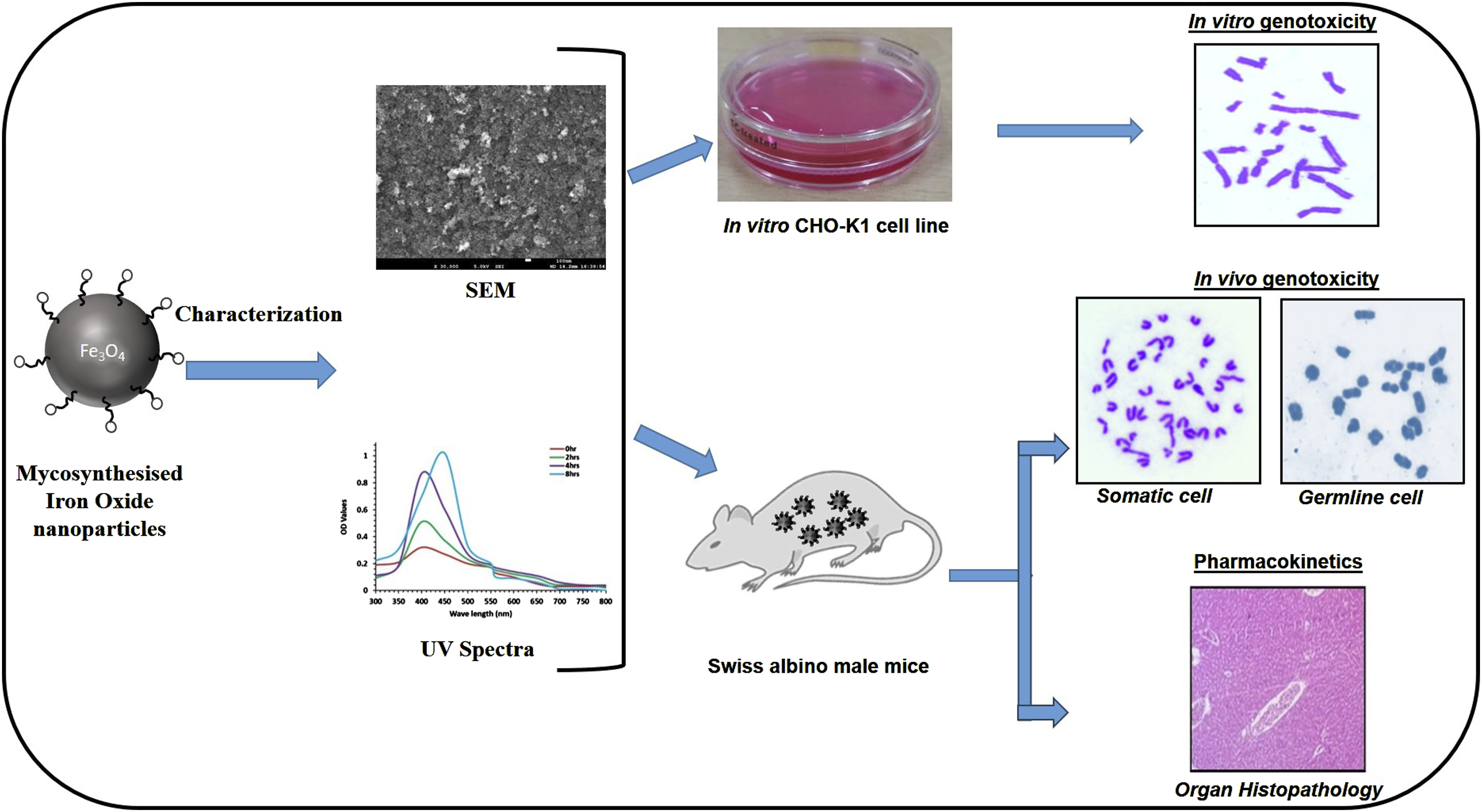
Iron oxide nanoparticles (FeONPs) have promising biomedical applications but are limited by potential cytotoxic and genotoxic risks. This study addresses these concerns by synthesizing mycosynthesized FeONPs (M.FeONPs) having angiogenic properties using Apiospora aurea, a mangrove-derived fungus, to enhance biocompatibility and reduce toxicity. The results showed that chemically synthesized FeONPs induced oxidative stress, cell cycle arrest, and apoptosis, whereas M.FeONPs exhibited lower toxicity and better compatibility in CHO-K1 cells. In vitro, genotoxicity assessments further revealed that FeONPs caused significant chromosomal aberrations and DNA damage, while M.FeONPs had reduced genotoxic effects. In vivo studies using Swiss albino mice confirmed that M.FeONPs induced minimal systemic toxicity, maintaining stable hematological and biochemical profiles, unlike FeONPs, which triggered immune stress and mild organ inflammation. In vivo, genotoxicity studies also demonstrated that M.FeONPs caused lesser clastogenic, mitotic, aneugenic, and teratogenic effects than chemically synthesized FeONPs. Hence, these findings confirm the potential of M.FeONPs for biomedical applications, particularly in reproductive health and therapeutics applications.
Janik-OlchawaNDrozdzARyszawyD, et al.The influence of IONPs core size on their biocompatibility and activity in in vitro cellular models. Sci Rep2021; 11: 21808.
2.
MengYQShiYNZhuYP, et al.Recent trends in preparation and biomedical applications of iron oxide nanoparticles. J Nanobiotechnol2024; 22: 24.
3.
WahajuddinA. Superparamagnetic iron oxide nanoparticles: magnetic nanoplatforms as drug carriers. Int J Nanomedicine2012; 3445: 2.
4.
GaldamesARuiz-RubioLOruetaM, et al.Zero-valent iron nanoparticles for soil and groundwater remediation. Int J Environ Res Public Health2020; 17: 5817.
5.
BiftuWKRavindhranathKRamamoortyM. New research trends in the processing and applications of iron-based nanoparticles as adsorbents in water remediation methods. Nanotechnol Environ Eng2020; 5: 12.
6.
AhmadTPhulRKhanH. Iron oxide nanoparticles: an efficient nano-catalyst. Curr Org Chem2019; 23: 994–1004.
7.
HatinogluDLeeJFortnerJ, et al.Superparamagnetic iron oxide nanoparticles as additives for microwave-based sludge prehydrolysis: a perspective. Environ Sci Technol2023; 57: 12191–12200.
8.
MorganJBellRJonesAL. Endogenous doesn’t always mean innocuous: a scoping review of iron toxicity by inhalation. J Toxicol Environ Health B Crit Rev2020; 23: 107–136.
9.
KornbergTStueckleTAntoniniJ, et al.Potential toxicity and underlying mechanisms associated with pulmonary exposure to iron oxide nanoparticles: conflicting literature and unclear risk. Nanomaterials2017; 7: 307.
10.
MoenAJohnsenHHristozovD, et al.Inflammation related to inhalation of nano and micron sized iron oxides: a systematic review. Nanotoxicology2024; 18: 511–526.
11.
LewinskiNGraczykHRiedikerM. Human inhalation exposure to iron oxide particles. BioNanoMaterials2013; 14: 5–23.
12.
BiJMoCLiS, et al.Immunotoxicity of metal and metal oxide nanoparticles: from toxic mechanisms to metabolism and outcomes. Biomater Sci2023; 11: 4151–4183.
13.
LuZYuDNieF, et al.Iron nanoparticles open up new directions for promoting healing in chronic wounds in the context of bacterial infection. Pharmaceutics2023; 15: 2327.
14.
UzhytchakMLunovaMSmolkováB, et al.Iron oxide nanoparticles trigger endoplasmic reticulum damage in steatotic hepatic cells. Nanoscale Adv2023; 5: 4250–4268.
15.
MouYZhouJXiongF, et al.Effects of 2,3-dimercaptosuccinic acid modified Fe 2 O 3 nanoparticles on microstructure and biological activity of cardiomyocytes. RSC Adv2015; 5: 19493–19501.
16.
LuZYuDNieF, et al.Iron nanoparticles open up new directions for promoting healing in chronic wounds in the context of bacterial infection. Pharmaceutics2023; 15: 2327.
17.
MahmoudiMSantSWangB, et al.Superparamagnetic iron oxide nanoparticles (SPIONs): development, surface modification and applications in chemotherapy. Adv Drug Deliv Rev2011; 63: 24–46.
18.
MisraSChoudhuryRC. Vitamin C modulation of cisplatin-induced cytogenotoxicity in bone marrow, spermatogonia and its transmission in the Male germline of Swiss mice. J Chemother2006; 18: 182–187.
19.
LynchMRate, molecular spectrum, and consequences of human mutation, rate, molecular spectrum, and consequences of human mutation. Proc Natl Acad Sci U S A2010; 107: 961–968.
20.
ParveenSWaniAHShahMA, et al.Preparation, characterization and antifungal activity of iron oxide nanoparticles. Microb Pathog2018; 115: 287–292.
21.
KhalilATOvaisMUllahI, et al.Biosynthesis of iron oxide (Fe 2 O 3) nanoparticles via aqueous extracts of Sageretia thea (Osbeck.) and their pharmacognostic properties. Green Chem Lett Rev2017; 10: 186–201.
22.
VeeragoniDDeshpandeSSSinghV, et al.In vitro and in vivo antimalarial activity of green synthesized silver nanoparticles using Sargassum tenerrimum - a marine seaweed. Acta Trop2023; 245: 106982.
23.
ChoudantePCMamillaJKongariL, et al.Functionalized tin-loaded mesoporous silica nanoparticles for targeted therapy of triple-negative breast cancer: evaluation of cytogenetic toxicity. J Drug Deliv Sci Technol2024; 94: 105502.
24.
DeshpandeSSVeeragoniDRachamallaHK, et al.Anticancer properties of ZnO-Curcumin nanocomposite against melanoma cancer and its genotoxicity profiling. J Drug Deliv Sci Technol2022; 75: 103703.
25.
OECD. Test No. 474: mammalian erythrocyte micronucleus test, OECD guidelines for the testing of chemicals, section 4. OECD Publishing, 2016.
26.
OECD (2000). Guidance document on the recognition, assessment and use of clinical signs as humane endpoints for experimental animals used in safety evaluation, OECD Environment, Health and Safety Publications, Series on Testing and Assessment No. 19. OECD Publishing.
27.
GhoshMManivannanJSinhaS, et al.In vitro and in vivo genotoxicity of silver nanoparticles. Mutat Res, Genet Toxicol Environ Mutagen2012; 749: 60–69.
28.
DeshpandeSSVeeragoniDKongariL, et al.Synthesis of biocompatible chitosan coated TiO2-curcumin nanocomposites shows potent anticancer activity towards melanoma cancer cells. J Drug Deliv Sci Technol2023; 85: 104592.
29.
KillmannS-AÅCronkiteEPFliednerTM, et al.Mitotic indices of human bone marrow cells. III. Duration of some phases of erythrocytic and granulocytic proliferation computed from mitotic indices. Blood1964; 24: 267–280.
30.
HayashiM. The micronucleus test—most widely used in vivo genotoxicity test. Gene Environ2016; 38: 18.
31.
CardinaleFBruzziPBolognesiC. Role of micronucleus test in predicting breast cancer susceptibility: a systematic review and meta-analysis. Br J Cancer2012; 106: 780–790.
32.
ChoudhuryRCPaloAKSahuP. Cytogenetic risk assessment of etoposide from mouse bone marrow. J Appl Toxicol2004; 24: 115–122.
33.
DasariRMisraS. Zoledronic acid induces cytogenetic toxicity in male germline cells of Swiss albino mice. Drug Chem Toxicol2019; 42: 371–377.
34.
EvansEPBreckonGFordCE. An air-drying method for meiotic preparations from Mammalian testes. Cytogenetics (Basel)1964; 3: 289–294.
35.
LoweXO’HoganSMooreD2nd, et al.Aneuploid epididymal sperm detected in chromosomally normal and Robertsonian translocation-bearing mice using a new three-chromosome FISH method. Chromosoma1996; 105: 204–210.
36.
WyrobekAJBruceWR. Chemical induction of sperm abnormalities in mice, chemical induction of sperm abnormalities in mice. Proc Natl Acad Sci U S A1975; 72: 4425–4429.
37.
NethiSKBaruiAKBolluVS, et al.Pro-angiogenic properties of terbium hydroxide nanorods: molecular mechanisms and therapeutic applications in wound healing. ACS Biomater Sci Eng2017; 3: 3635–3645.
38.
SinghNJenkinsGJSAsadiR, et al.Potential toxicity of superparamagnetic iron oxide nanoparticles (SPION). Nano Rev2010; 1: 5358.
39.
HusenASiddiqiKS. Phytosynthesis of nanoparticles: concept, controversy and application. Nanoscale Res Lett2014; 9: 229.
40.
AlharbiFAAlarfajAA. Green synthesis of silver nanoparticles from Neurada procumbens and its antibacterial activity against multi-drug resistant microbial pathogens. J King Saud Univ Sci2020; 32: 1346–1352.
41.
SathishkumarMSnehaKWonSW, et al.Cinnamon zeylanicum bark extract and powder mediated green synthesis of nano-crystalline silver particles and its bactericidal activity. Colloids Surf B Biointerfaces2009; 73: 332–338.
42.
ChauhanSYallapuMOthmanS, et al.Curcumin-loaded magnetic nanoparticles for breast cancer therapeutics and imaging applications. Int J Nanomedicine2012; 1761.
43.
ChandranPRiviereJEMonteiro-RiviereNA. Surface chemistry of gold nanoparticles determines the biocorona composition impacting cellular uptake, toxicity and gene expression profiles in human endothelial cells. Nanotoxicology2017; 11: 507–519.
44.
AlbaneseATangPSChanWCW. The effect of nanoparticle size, shape, and surface chemistry on biological systems. Annu Rev Biomed Eng2012; 14: 1–16.
45.
KastanMBBartekJ. Cell-cycle checkpoints and cancer. Nature2004; 432: 316–323.
46.
ZhuoZWangJLuoY, et al.Targeted extracellular vesicle delivery systems employing superparamagnetic iron oxide nanoparticles. Acta Biomater2021; 134: 13–31.
47.
RamanaKVSrivastavaSSinghalSS. Lipid peroxidation products in human health and disease. Oxid Med Cell Longev2013; 2013: 1–3.
48.
Patrón-RomeroLLuque-MoralesPALoera-CastañedaV, et al.Mitochondrial dysfunction induced by zinc oxide nanoparticles. Crystals2022; 12: 1089.
49.
SiddiquiMAWahabRSaquibQ, et al.Iron oxide nanoparticles induced cytotoxicity, oxidative stress, cell cycle arrest, and DNA damage in human umbilical vein endothelial cells. J Trace Elem Med Biol2023; 80: 127302.
50.
LiuTXiaoBXiangF, et al.Ultrasmall copper-based nanoparticles for reactive oxygen species scavenging and alleviation of inflammation related diseases. Nat Commun2020; 11: 2788.
51.
ZhuoZWangJLuoY, et al.Targeted extracellular vesicle delivery systems employing superparamagnetic iron oxide nanoparticles. Acta Biomater2021; 134: 13–31.
52.
AhamedMAlhadlaqHAAlamJ, et al.Iron oxide nanoparticle-induced oxidative stress and genotoxicity in human skin epithelial and lung epithelial cell lines. Curr Pharm Des2013; 19: 6681–6690.
53.
AlarifiSAliDAlkahtaniS, et al.Iron oxide nanoparticles induce oxidative stress, DNA damage, and caspase activation in the human breast cancer cell line. Biol Trace Elem Res2014; 159: 416–424.
54.
ZhuM-TWangYFengW-Y, et al.Oxidative stress and apoptosis induced by iron oxide nanoparticles in cultured human umbilical endothelial cells. J Nanosci Nanotechnol2010; 10: 8584–8590.
55.
WenHDanMYangY, et al.Acute toxicity and genotoxicity of silver nanoparticle in rats. PLoS One2017; 12: e0185554.
56.
MohammadinejadRMoosaviMATavakolS, et al.Necrotic, apoptotic and autophagic cell fates triggered by nanoparticles. Autophagy2019; 15: 4–33.
57.
LaffonBFernández-BertólezNCostaC, et al.Cellular and molecular toxicity of iron oxide nanoparticles, 2018, pp. 199–213.
58.
ValdiglesiasVKiliçGCostaC, et al.Effects of iron oxide nanoparticles: cytotoxicity, genotoxicity, developmental toxicity, and neurotoxicity. Environ Mol Mutagen2015; 56: 125–148.
59.
WangYDingLYaoC, et al.Toxic effects of metal oxide nanoparticles and their underlying mechanisms. Sci China Mater2017; 60: 93–108.
60.
SukhanovaABozrovaSSokolovP, et al.Dependence of nanoparticle toxicity on their physical and chemical properties. Nanoscale Res Lett2018; 13: 44.
61.
WanRMoYFengL, et al.DNA damage caused by metal nanoparticles: involvement of oxidative stress and activation of ATM. Chem Res Toxicol2012; 25: 1402–1411.
62.
FenechMKnasmuellerSBolognesiC, et al.Molecular mechanisms by which in vivo exposure to exogenous chemical genotoxic agents can lead to micronucleus formation in lymphocytes in vivo and ex vivo in humans. Mutat Res Rev Mutat Res2016; 770: 12–25.
63.
DreadenECAlkilanyAMHuangX, et al.The golden age: gold nanoparticles for biomedicine. Chem Soc Rev2012; 41: 2740–2779.
64.
DowdingJMDasSKumarA, et al.Cellular interaction and toxicity depend on physicochemical properties and surface modification of redox-active nanomaterials. ACS Nano2013; 7: 4855–4868.
65.
KuloğluSSYalçinEÇavuşoğluK, et al.Dose-dependent toxicity profile and genotoxicity mechanism of lithium carbonate. Sci Rep2022; 12: 13504.
66.
SinghN. Conference scene - nanotoxicology: health and environmental impacts. Nanomedicine2009; 4: 385–390.
67.
MahmoudiMSimchiAImaniM, et al.A new approach for the in vitro identification of the cytotoxicity of superparamagnetic iron oxide nanoparticles. Colloids Surf B Biointerfaces2010; 75: 300–309.
68.
FujitaMSasanumaHYamamotoKN, et al.Interference in DNA replication can cause mitotic chromosomal breakage unassociated with double-strand breaks. PLoS One2013; 8: e60043.
69.
WangG-FDongQBaiY, et al.Oxidative stress induces mitotic arrest by inhibiting Aurora A-involved mitotic spindle formation. Free Radic Biol Med2017; 103: 177–187.
70.
SoenenSJHHimmelreichUNuyttenN, et al.Intracellular nanoparticle coating stability determines nanoparticle diagnostics efficacy and cell functionality. Small2010; 6: 2136–2145.
71.
BuliakováBMesárošováMBábelováA, et al.Surface-modified magnetite nanoparticles act as aneugen-like spindle poison. Nanomedicine2017; 13: 69–80.
72.
GuoXLiYYanJ, et al.Size- and coating-dependent cytotoxicity and genotoxicity of silver nanoparticles evaluated using in vitro standard assays. Nanotoxicology2016; 10: 1373–1384.
73.
HabasKDemirEGuoC, et al.Toxicity mechanisms of nanoparticles in the male reproductive system. Drug Metab Rev2021; 53: 604–617.
74.
AitkenRJ. Reactive oxygen species as mediators of sperm capacitation and pathological damage. Mol Reprod Dev2017; 84: 1039–1052.
75.
WangYFuXLiH. Mechanisms of oxidative stress-induced sperm dysfunction. Front Endocrinol2025; 16. DOI: 10.3389/fendo.2025.1520835, Epub ahead of print 5.
Supplementary Material
Please find the following supplemental material available below.
For Open Access articles published under a Creative Commons License, all supplemental material carries the same license as the article it is associated with.
For non-Open Access articles published, all supplemental material carries a non-exclusive license, and permission requests for re-use of supplemental material or any part of supplemental material shall be sent directly to the copyright owner as specified in the copyright notice associated with the article.