



Abstract
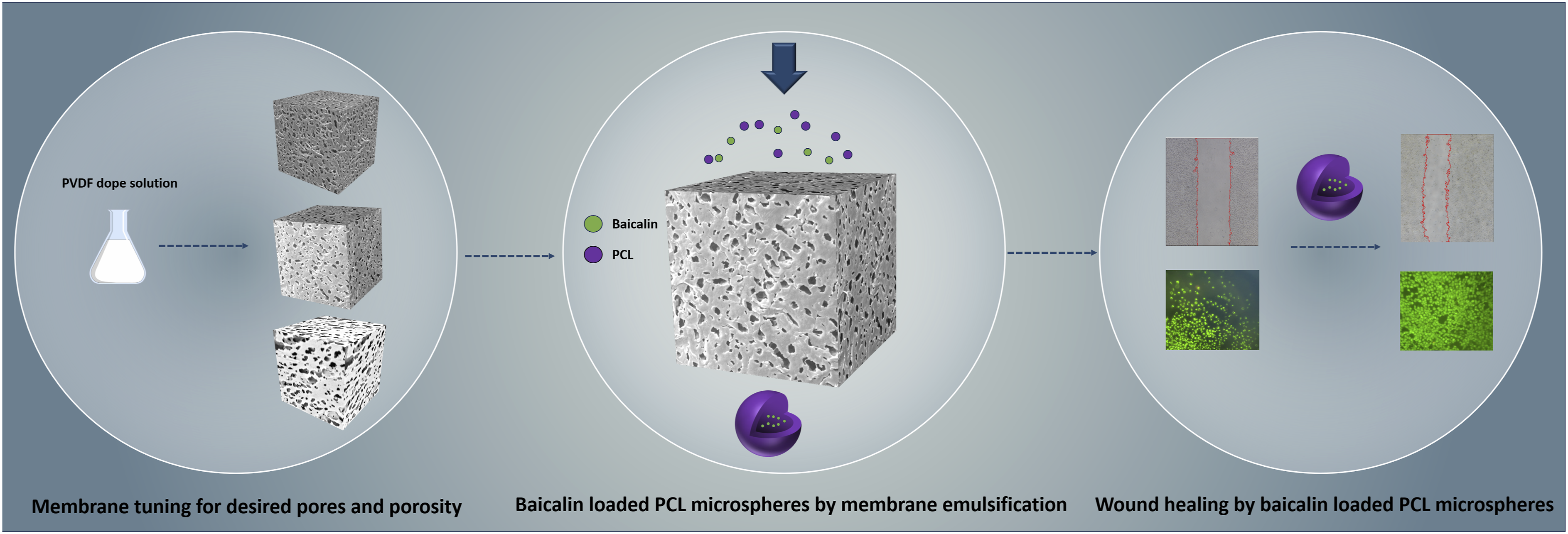
The development of injectable bio-stimulating polycaprolactone (PCL) microspheres for wound healing has strict requirement on size and morphology control, particularly favoring microspheres within the range between 20-50 µm. PCL microspheres with smaller sizes are phagocyted at rapid rate while larger microspheres could cause inflammation. Homogenization can be regarded as an irreversible process to generate microspheres of particular size range while it still remains as the most common approach for microspheres production. Membrane emulsification technology shows great potential in fine tailoring of microspheres while still holds promising ability for scale-up production. Membranes with uniform large pores and dual hydrophilicity might be capable of the production of large microspheres via emulsification with tailorable size distribution. The aim of this study is to verify the feasibility of PVDF membranes with large pores on the generation of PCL microspheres via the combined crystallization diffusion (CCD) approach. The effect of dope solution concentration and PVDF molecular weights on membrane morphologies and the corresponding microspheres characteristics were investigated. Results showed that concentration of 20 wt% produced microspheres at desirable size of 24.14 µm and the optimal span of 0.53. Microspheres with narrow distribution showed the highest drug loading efficiency of baicalin at 8.42 %. The baicalin loaded PCL microspheres presented gradual release of drug release over 33-day of in vitro testing and significantly improved cell growth rate of 111.67 % as compared to the ones prepared by homogenization approach. The wound healing ability was enhanced after the treatment of baicalin-loaded PCL microspheres as compared to empty loaded PCL microspheres.
Get full access to this article
View all access options for this article.
References
Supplementary Material
Please find the following supplemental material available below.
For Open Access articles published under a Creative Commons License, all supplemental material carries the same license as the article it is associated with.
For non-Open Access articles published, all supplemental material carries a non-exclusive license, and permission requests for re-use of supplemental material or any part of supplemental material shall be sent directly to the copyright owner as specified in the copyright notice associated with the article.
