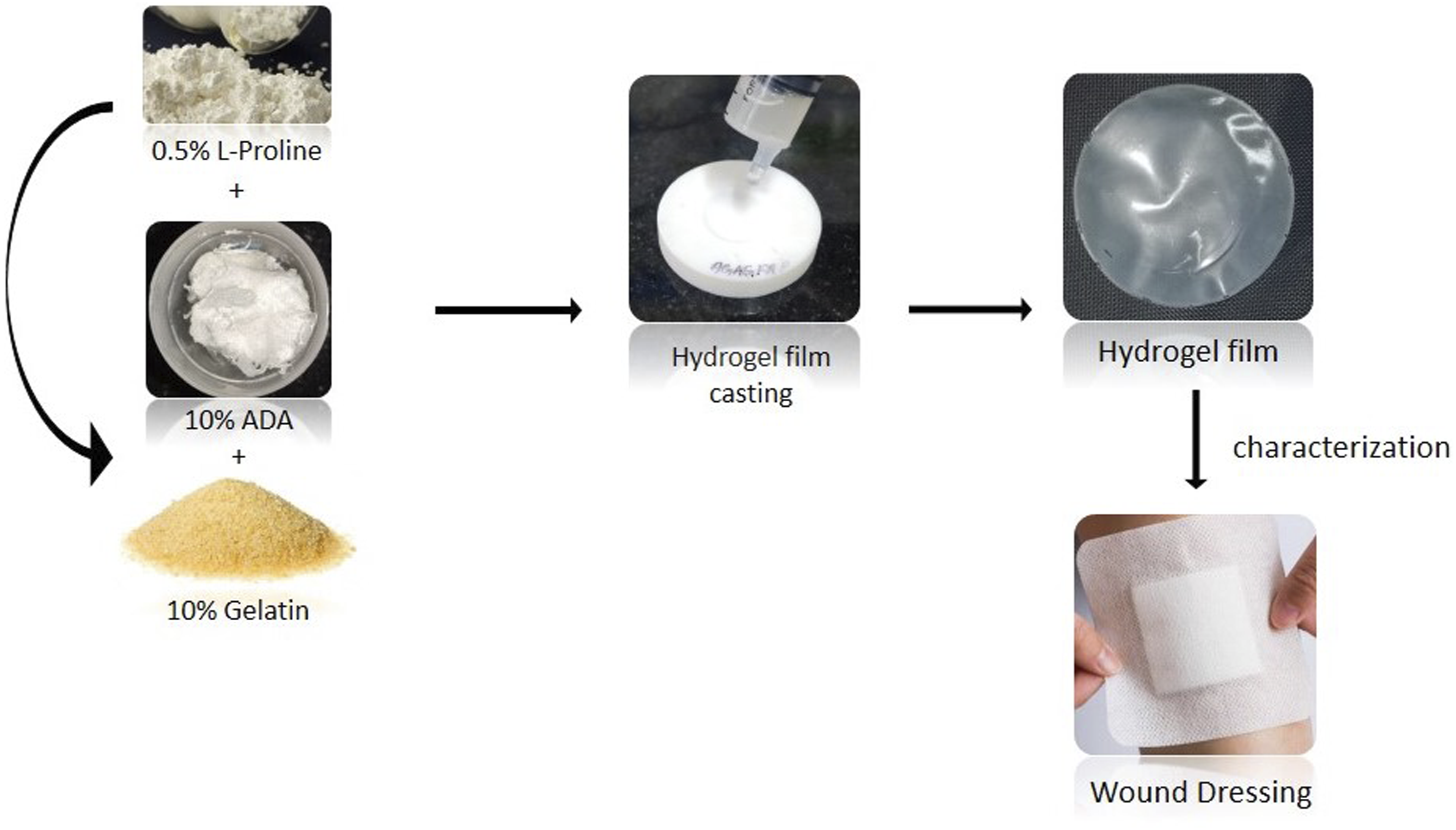
Hydrogel-based wound management systems represent a promising avenue in tissue engineering for restoring and preserving the normal functionality of damaged tissues. Incorporating active components into hydrogel matrices enhances their suitability for biomedical applications. In this study, we investigated the integration of l-proline, a nonessential imino acid with largely unexplored roles in living systems, into alginate dialdehyde-gelatin hydrogel for wound healing purposes. Physicochemical properties of the resulting hydrogel film, termed ADAGLP, were meticulously evaluated, including wound healing efficacy in vitro and anti-biofilm activity against Gram-positive and Gram-negative microorganisms. Fourier-transform infrared spectroscopy (FTIR) analysis provided insights into the interaction between l-proline and ADAG. Films incorporating 0.5% l-proline were selected for comprehensive investigation. Comparative analysis revealed prolonged gelation time and increased water holding capacity of ADAGLP compared to ADAG films. Moreover, ADAGLP exhibited a significantly higher degradation rate (69.5 ± 3.2%) compared to ADAG (35.2 ± 1.6%). Remarkably, ADAGLP demonstrated cyto-compatibility, non-toxicity, and facilitated migration to the scratch area in vitro conditions. Notably, it exhibited potent anti-biofilm properties. Our findings suggest that ADAGLP hydrogel holds promise as a biomaterial for wound care, offering prolonged drug delivery and maintaining optimal moisture levels in wound areas. The incorporation of l-proline in the wound microenvironment may contribute to enhanced tissue remodeling, by inhibiting biofilm formation, further highlighting the potential of this hydrogel system in wound healing applications.
PatriarcaEJCermolaFD’AnielloC, et al.The multifaceted roles of proline in cell behavior. Front Cell Dev Biol2021; 9: 728576.
2.
BeniasPCWellsRGSackey-AboagyeB, et al.Structure and distribution of an unrecognized interstitium in human tissues. Sci Rep2018; 8: 4947.
3.
WuGBazerFWBurghardtRC, et al.Proline and hydroxyproline metabolism: implications for animal and human nutrition. Amino Acids2011; 40: 1053–1063. DOI: 10.1007/s00726-010-0715-z.
MeenaMDivyanshuKKumarS, et al.Regulation of L-proline biosynthesis, signal transduction, transport, accumulation and its vital role in plants during variable environmental conditions. Heliyon2019; 5: e02952, Available from: https://www.sciencedirect.com/science/article/pii/S2405844019366113
6.
PonrasuTJamunaSMathewA, et al.Efficacy of L-proline administration on the early responses during cutaneous wound healing in rats. Amino Acids2013; 45: 179–189.
7.
MdC. The temporal change in amino acid concentration within wound fluid-a putative rationale. Prog Clin Biol Res1991; 365: 205–222.
RumaisaFMiniS. Hydrogel scaffolds in diabetic wound healing: a mini review. Res J Biotechnol2022; 17: 143.
13.
LeeKWYoonJJLeeJH, et al.Sustained release of vascular endothelial growth factor from calcium-induced alginate hydrogels reinforced by heparin and chitosan. Transplant Proc2004; 36: 2464–2465.
14.
YamamotoMTakahashiYTabataY. Controlled release by biodegradable hydrogels enhances the ectopic bone formation of bone morphogenetic protein. Biomaterials2003; 24: 4375–4383.
DranseikieneDSchrüferSSchubertDW, et al.Cell-laden alginate dialdehyde–gelatin hydrogels formed in 3D printed sacrificial gel. J Mater Sci Mater Med2020; 31: 31, Available from: DOI: 10.1007/s10856-020-06369-7.
17.
ŁabowskaMBCierlukKJankowskaAM, et al.A review on the adaption of alginate-gelatin hydrogels for 3D cultures and bioprinting. Mater (Basel, Switzerland)2021; 14: 858.
18.
RottensteinerUSarkerBHeusingerD, et al.In vitro and in vivo biocompatibility of alginate dialdehyde/gelatin hydrogels with and without nanoscaled bioactive glass for bone tissue engineering applications. Materials2014; 7: 1957–1974.
TomićSLBabić RadićMMVukovićJS, et al.Alginate-based hydrogels and scaffolds for biomedical applications. Mar Drugs2023; 21(3): 177.
21.
BalakrishnanBLesieurSLabarreD, et al.Periodate oxidation of sodium alginate in water and in ethanol–water mixture: a comparative study. Carbohydr Res2005; 340: 1425–1429, Available from: https://linkinghub.elsevier.com/retrieve/pii/S000862150500128X
22.
AnjaliSResmiRPerumalR, et al.Journal of Drug Delivery Science and Technology Ferulic acid incorporated anti-microbial self cross-linking hydrogel : a promising system for moderately exudating wounds. Journal of Drug Delivery Science and Technology. 2022;73:103446.
23.
NguyenT-PLeeB-T. Fabrication of oxidized alginate-gelatin-BCP hydrogels and evaluation of the microstructure, material properties and biocompatibility for bone tissue regeneration. J Biomater Appl2012; 27: 311–321.
24.
GuptaNVShivakumarHG. Investigation of swelling behavior and mechanical properties of a pH-sensitive superporous hydrogel composite. Iran J Pharm Res (IJPR)2012; 11: 481–493.
MosmannT. Rapid colorimetric assay for cellular growth and survival: application to proliferation and cytotoxicity assays. J Immunol Methods1983; 65: 55–63.
27.
SurendranathMRajalekshmiRRamesanRM, et al.UV-crosslinked electrospun zein/PEO fibroporous membranes for wound dressing. ACS Appl Bio Mater2022; 5: 1538–1551. DOI: 10.1021/acsabm.1c01293.
ThangavelPRamachandranBKannanR, et al.Biomimetic hydrogel loaded with silk and l-proline for tissue engineering and wound healing applications. J Biomed Mater Res B Appl Biomater2017; 105: 1401–1408.
30.
T SomasekharanLKasojuNRajuR, et al.Formulation and characterization of alginate dialdehyde, gelatin, and platelet-rich plasma-based bioink for bioprinting applications. Bioeng (Basel, Switzerland)2020; 7: 7030108.
31.
AdhavVASaikrishnanK. The realm of unconventional noncovalent interactions in proteins: their significance in structure and function. ACS Omega2023; 8: 22268–22284.
32.
PiperJAAlHNJansenMI, et al.L-proline prevents endoplasmic reticulum stress in microglial cells exposed to L-azetidine-2-carboxylic acid. Molecules2023; 28: 4808.
33.
S KBajpaiMBajpaiF FShah, et al. Alginate dialdehyde (AD)-crosslinked casein films: synthesis, characterization and water absorption behaviour. Des Monomers Polym. 2016; 19: 406–419.
34.
RResmiSUnnikrishnanL KKrishnanKrishnan VKalliyana. Synthesis and characterization of silver nanoparticle incorporated gelatin-hydroxypropyl methacrylate hydrogels for wound dressing applications. J Appl Polym Sci. 2017; 134.