




Abstract

Introduction
Interventional Radiology (IR) is a growing subspecialty offering minimally invasive strategies to improve patient outcomes. 1 Despite this, awareness of IR amongst patients and clinicians remains an opportunity for improvement. 2 Publications in reputable journals remain key to educating clinicians on the latest advances in IR. Bibliometric analysis is a powerful tool providing insight into the dynamics of scholarly production, identifying emerging trends and informing future directions for researchers and institutions. 3 A 2018 bibliometric study of Journal of Vascular and Interventional Radiology (JVIR) revealed a persistent gradual increase in IR publications. 4 The purpose of this bibliometric analysis is to identify publication trends pertaining to IR in the CARJ from 2015 to 2023, specifically comparing July 2015-June 2019 to July 2019-June 2023 following major changes in editorship.
Methods
Using PubMed with the search terms “Interventional Radiology,” “IR,” and “Image-guided,” we identified IR-related articles published in the CARJ from July 2015 to June 2023. Non-IR articles were excluded. Using the JVIR analysis as guidance, articles were categorized based on content and type. Web of Science and Scopus were used to collect the following: Publication year, country of publication, and citation metrics. Analysis was performed using Microsoft Excel and the R language based Bibliometrix software package to produce information and figures on citation trends, geographic contributions, and keyword trends, specifically focusing on the periods July 2015 to June 2019 and July 2019 to June 2023 for comparison.5,6
Results
The search yielded 83 publications, with 53 remaining after exclusion of non-IR articles, including 27 original articles (51%), 21 review articles (40%), 4 editorials (8%), and 1 letter (2%). The average number of IR publications per year rose by 52% from July 2015-June 2019 to July 2019-2023 (4.2 to 6.4 publications per year). Considering total citations since publication, average annual citations per article has grown by 11% between the 2 periods (1.37 to 1.52). Figure 1 illustrates this trend, showing average annual citations by publication year. However, this metric is confounded by the varying duration the articles have been available for citation. To provide a fairer comparison, total citations for IR articles published in each period were calculated for comparable corresponding 5-year timeframes (Citations made in 2015-2019 and 2019-2023 respectively). Total citations rose from 46 to 140, corresponding to a doubling of average per-paper citation from 2.2 to 4.4 for each 5-year timeframe. Contributions were made from authors in various countries with majority contributions from Canada followed by the U.S. in both periods.

Number of IR-related publications and average yearly citation for articles published in each corresponding year.
Content-wise, the most notable finding is an increase in publications on quality improvement from 4 to 15 (Table 1). Keyword analysis (Figure 2) reveals increasing emphasis on error reduction, guidelines, education, and a new focus on uterine artery embolization.
Total Number of Manuscripts Published by Content and Type Each Year.

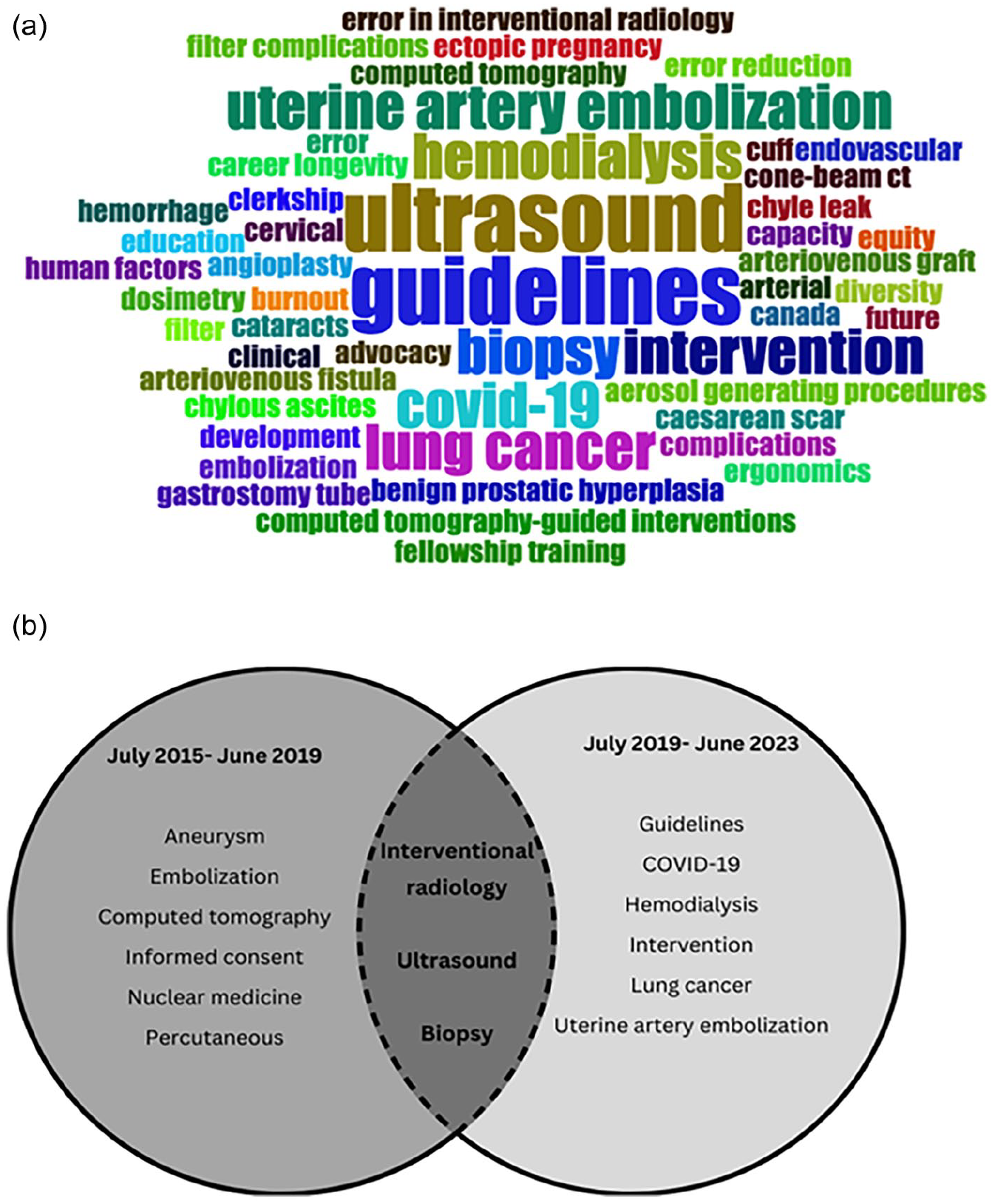
(A) shows commonly used keywords in IR publications in the latter period of July 2019 to June 2023. (B) is a Venn diagram representing changes in the key terms selected by authors for a minimum of 2 publications between 2015-2019 and 2019-2023 to highlight emerging themes.
Discussion
Our analysis reveals a general increase in the number of IR-related publications in the CARJ over time with a concomitant increase in the average number of annual citations per article. The trend is in keeping with publication trends of all radiology articles in the CARJ which has seen the total number of publications grow by 70% and its impact factor grow from an average of 1.3 to 2.9 over the same period.
Thematic analysis reveals 2 notable trends: (1) Increased publications related to uterine artery embolization may reflect increased interest in alternative, minimally invasive solutions for prevalent gynecologic conditions. (2) A shift in trends to education, quality improvement, and error reduction reflecting a strong interest in refining future practice.
Overall, bibliometric trends in IR-related publications in the CARJ reveal a strong positive trajectory with new emerging themes reflecting the ever-evolving nature of the specialty. A focus on increasing contributions from non-Canadian institutions can help expand the journal’s global reach in the coming years.
Footnotes
Declaration of Conflicting Interests
The author(s) declared no potential conflicts of interest with respect to the research, authorship, and/or publication of this article.
Funding
The author(s) received no financial support for the research, authorship, and/or publication of this article.
