




Abstract
This is a visual representation of the abstract.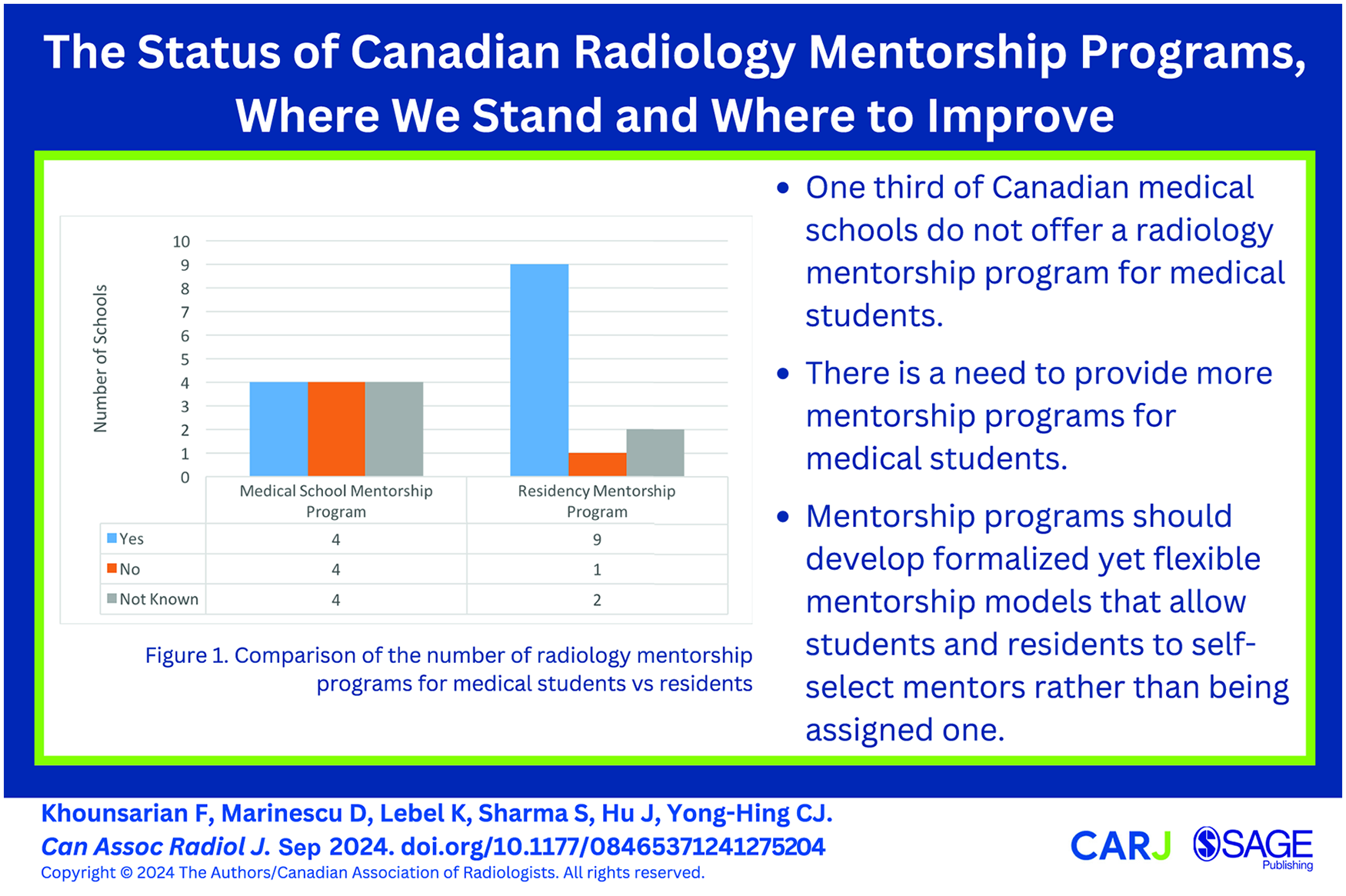
Introduction
Mentoring is the process of providing psychosocial support and informal knowledge transmission from a person with greater relevant experience, wisdom, or knowledge (the mentor) to a person who is perceived to have less (the mentee) in relation to career, work, or professional development. 1 Mentorship plays a significant role in fostering confidence and inclusivity within medicine as it revolves around cultivating relationships, intending to promote comprehensive personal and professional development in individuals.2,3
Mentoring programs within medical schools are beneficial for students and have been implemented on a global scale. 2 In addition to promoting student growth, these programs also nurture interest in clinical specialties, instill enthusiasm for research, and provide career guidance. 2 Mentors play a pivotal role in supporting students academically by assisting with studies and materials, thereby enhancing the likelihood of success in classes, clerkships, and board exams. Furthermore, mentors offer invaluable personal support, aid in navigating challenges, provide guidance on residency applications, and provide interview coaching. 4 Resident Doctors of Canada recommends all programs provide mentorship opportunities to support professional development. 5 In the context of residency, individuals pursuing specialized training benefit significantly from the guidance and expertise provided by seasoned mentors in academic, personal, and career pursuits.6,7
Given the numerous benefits of mentorship programs, it is essential to understand the current status of radiology mentorship programs in medical institutions. With radiology being one of the least diverse specialties in medicine, radiology trainees with intersectional identities often encounter unique challenges due to the interplay of multiple aspects of their social identities, such as race, gender identity, sexual orientation, and disability status. 8 Finding role models and mentors with similar backgrounds within radiology departments and institutions may be difficult for these trainees, as historically marginalized groups have been underrepresented in the field, leading to a scarcity of relatable and diverse figures in leadership positions. 9 To address these challenges and enable these individuals to excel in their radiology careers, developing targeted mentorship programs that cater to specific needs and connecting individuals with mentors who share similar backgrounds is imperative.10-12
The current literature that is published mainly centres around mentorship advice.13,14 However, there is a lack of quantitative literature on the status of radiology mentorship programs in Canada. Therefore, we conducted this survey to assess the current status and existence of radiology mentorship programs for Canadian medical students and radiology residents and to evaluate existing mentorship programs’ specific goals, structure, and success. We also explored whether there is a correlation between education level (medical students vs residents) and the availability of radiology mentorship programs.
Method
In December 2022, after ethics approval from a Canadian university (H22-02619), a survey with qualitative and quantitative questions was emailed to 16 Canadian radiology program directors to determine their views on mentorship programs. One month after the initial email, January 2023, program directors received a reminder email, and the survey was closed in February 2023. Participation in the survey was optional, and participants had the choice to refrain from answering any questions or withdraw from the survey at any point. The survey utilized Qualtrics software to collect responses, and no identifying information was gathered. The chi-square test was used to analyze quantitative data. Using IBM SPSS modelling software, the chi-square test was performed, and a P-value of .05 was considered statistically significant. The null hypothesis being tested was that “Medical students and residents have similar radiology mentorship opportunities.”
Results
A total of 12 responses were received (a response rate of 12/16 = 75%), and the results were divided into quantitative and qualitative categories.
Quantitative Response
For radiology mentorship programs for medical students, 4/12 (33.3%) participants confirmed having them (“Yes”), 4/12 (33.3%) expressed uncertainty (“Don’t know”), and 4/12 (33.3%) reported not having them (“No”). In terms of mentorship programs for radiology residents, 9/12 (75%) program directors confirmed to have such programs (Yes), 2/12 (16.7%) expressed uncertainty (Don’t know), and 1/12 (8.3%) reported not having such programs (No; Figure 1). Of these 12 programs, 9 (75%) had formal mentorship programs, and 3 (25%) did not.
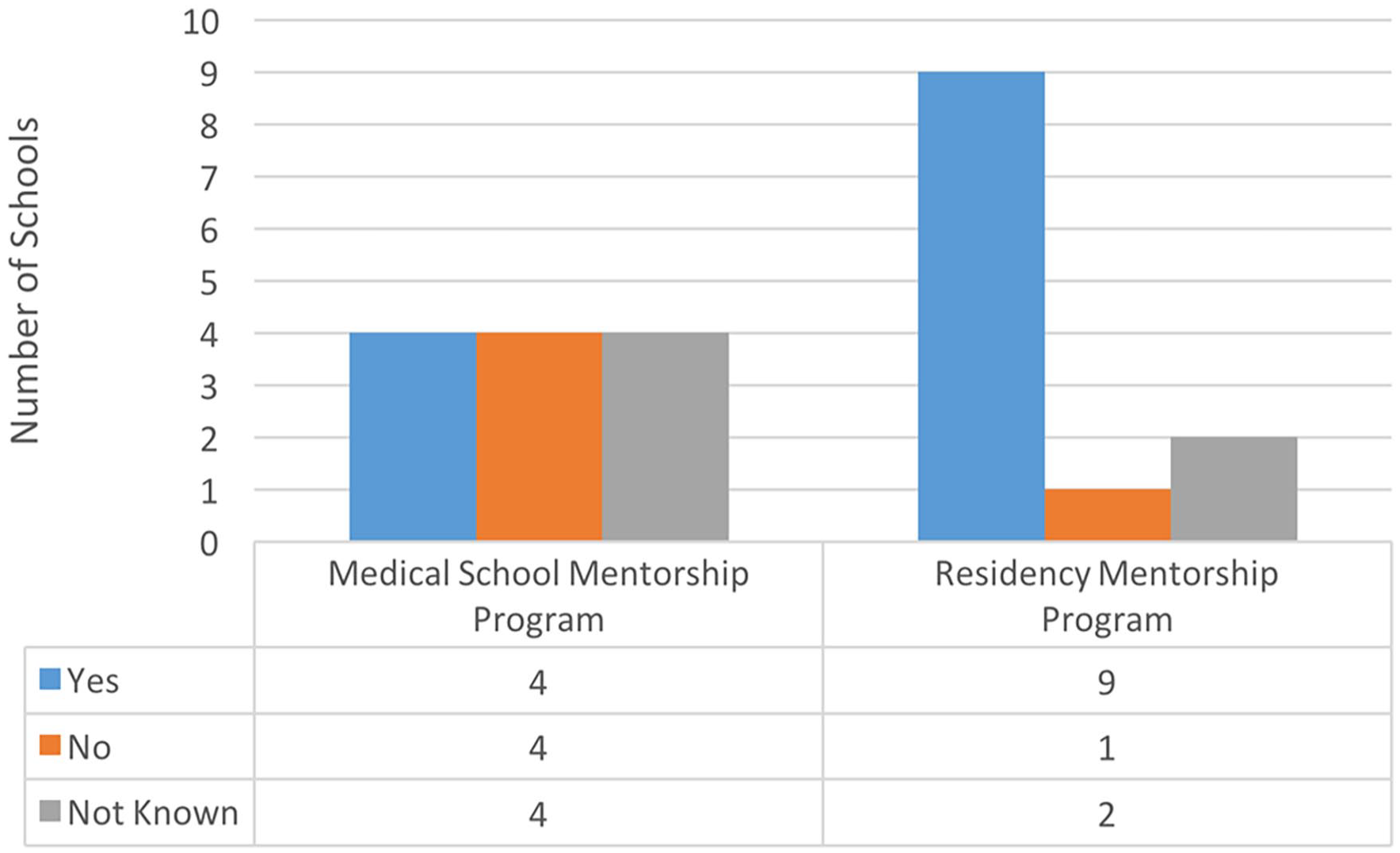
Comparison of the number of radiology mentorship programs for medical students versus residents.
A Chi-Square test was performed to compare the availability of mentorship programs for medical students and residents. Our null hypothesis, “Medical students and residents have similar mentorship opportunities,” was not rejected because the P-value = .11 was larger than the significance value of .05. Based on the analyzed data, radiology mentorship opportunities for medical students and residents are the same.
Qualitative Response
Based on the 4 open-ended questions we asked about the goal, structure, evaluation method, and outcome of mentorship programs, we categorized the qualitative responses into 4 major themes. Two reviewers independently examined all qualitative responses to develop a preliminary set of codes, which were then finalized through discussion to ensure consistency and reliability. For mentorship program goals, responses were coded based on the objectives for both medical students and residents. The program’s structure was coded by examining the different pairing strategies. For the evaluation method, we identified objective and subjective evaluation methods. Similarly, we coded the mentorship program’s outcomes as objective and subjective outcomes (Table 1).
Qualitative Responses.
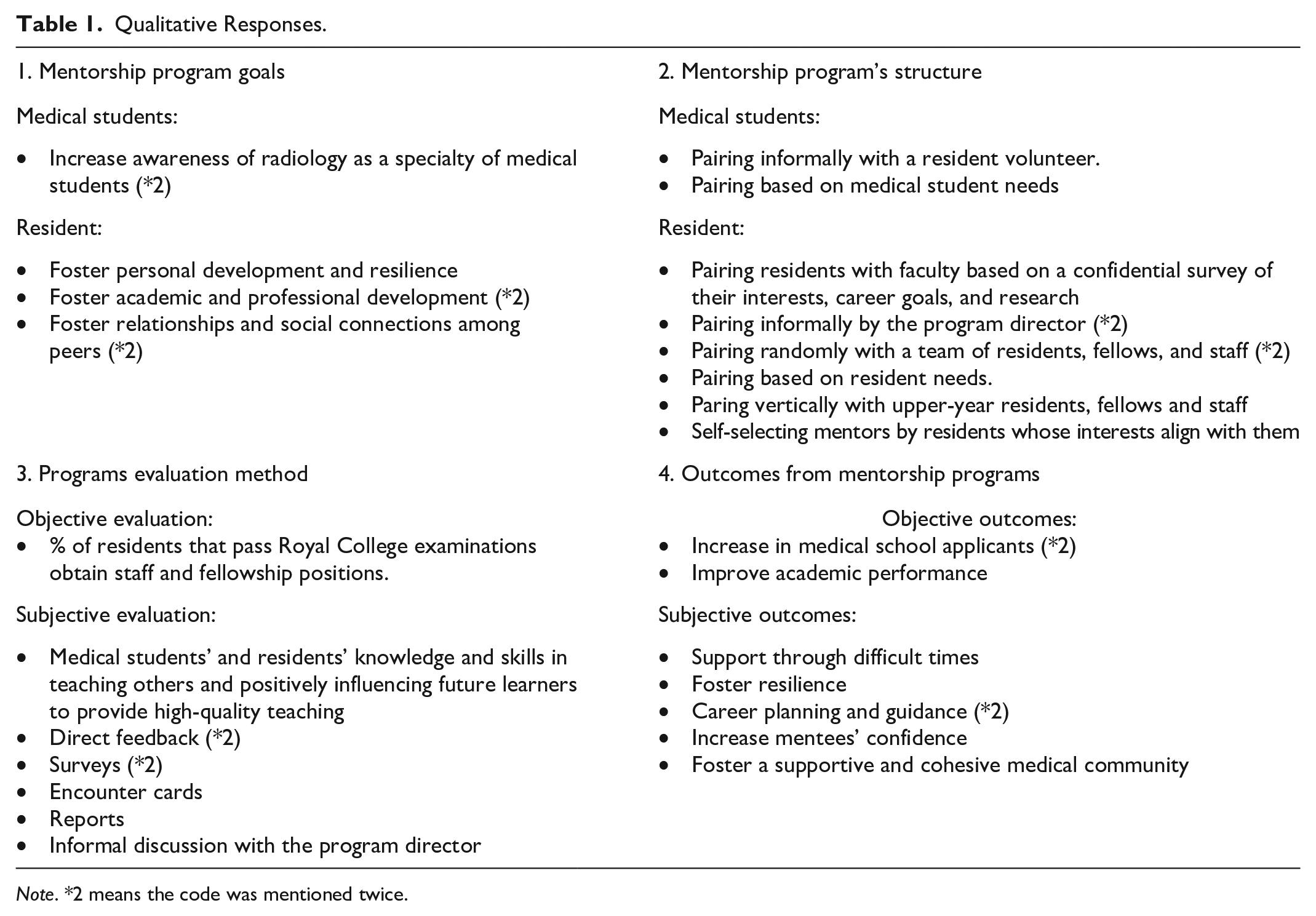
Note. *2 means the code was mentioned twice.
Discussion
Our study shows that there is no statistically significant difference in the number of radiology mentorship programs available for medical students compared to residents in Canada (P-value = .11 > .05). Based solely on the statistical analysis of the data, medical students and residents have similar radiology mentorship opportunities. However, the power of the study is affected by various factors, such as the relatively small number of radiology programs in Canada (N = 16) and the lack of responses from some universities. Observing the trends reveals that one-third (4/12) of Canadian medical schools do not offer a radiology mentorship program for medical students, representing a potentially significant opportunity to improve and provide more mentorship for students.
Early-year mentoring programs within medical schools can cultivate interest in particular specialties and, as mentioned in our qualitative responses, “increase awareness for radiology as a specialty of medical students,” which can lead to an “increase in medical school applicants.” Research indicates that mentorship has a more pronounced impact on shaping the interests of women medical students in radiology compared to their male counterparts. 15 The influence of mentorship at this crucial stage of medical education has the potential to improve students’ chances of successfully matching into their desired specialties and narrow the radiology gender gap. 16
In an article by Amorosa on mentoring medical students interested in radiology, it is recommended that mentors should cover the following topics: residency, fellowships, and practice types, including academic, research, or private practice. 17 Other essential discussion points that need to be discussed with the mentee are current and future job prospects, objective evaluation of the applicant, suggestions for improving their credentials, what radiology residency programs are looking for, and radiology research opportunities for medical students. 17 Additionally, a thorough review of the applicant’s personal statement and curriculum vitae by radiology faculty can be beneficial, given that these materials are critical components of the application process. 17
Qualitative analysis of mentorship programs shows that they provide multiple benefits to residents. Mentors can provide timely and constructive feedback to enhance residents’ clinical and technical skills, 18 and also noted in our analysis, improve “academic performance” and “mentee’s confidence.” Radiology is a field that constantly evolves through research and technological advancements. A mentor can create an environment that supports residents in navigating the vast landscape of academic radiology, encouraging research and scholarship. 18 Building professional networks is essential for career advancement. A mentor can provide introductions to key figures within the radiology community, facilitating networking opportunities, collaboration, and exposure to diverse perspectives. 18 Furthermore, mentors assist residents in understanding organizational and institutional culture, 18 and as mentioned in our survey, they “foster a supportive and cohesive medical community.” Radiology residents often face decisions regarding sub-specialization, career paths, and job opportunities. A mentor can offer insights based on their own experiences, helping residents develop through “career planning and guidance” 18 and fellowship choices. 19 The demanding nature of radiology training can expose trainees to stressors such as performance feedback and new clinical situations. 20 Mentors can provide “support through difficult times,” “foster resilience,” and serve as advocates for work-life balance. Mentorship programs are successful and cost-effective initiatives that contribute to combating rising concerns over burnout and enhance residents’ overall resilience. 20
According to our study, 75% of residency programs offer formal mentorship programs, similar to a recent survey among Canadian radiology residents. 21 Although no studies support the benefits of one mentorship style over another, formalizing the process can further cultivate a culture of mentorship. 22 It is imperative to organize structured programs that reflect mentor availability, the size of the program, and mentees’ needs. Before implementing mentoring programs, pilot programs should be used to refine their objectives based on feedback. 23 In our qualitative analysis, we found that programs use a variety of subjective and objective evaluation methods; however, utilizing validated assessment methods would further improve the structure. 23 In addition, implementing clear, measurable objectives that follow the mentee through an extended period of time can lead to continued improvement and long-term success. 23
Qualitative analysis shows that mentorship programs exhibit varying methodologies for assigning mentors with mentees, such as “pairing randomly” or permitting mentees to “self-select” their mentors autonomously. A study found that radiology residents who self-selected their mentors had substantially greater overall satisfaction with the mentoring program than those with assigned mentors. 24 In our qualitative response, one program director mentioned that mentorship programs with assigned mentors were unsuccessful as often the relationship was not a “good fit,” and allowing trainees to choose their own mentor is a “better alternative” than being assigned a mentor. To maximize the benefits of the mentor-mentee relationship, developing a formalized mentorship model that allows residents and medical students to self-select is recommended. For example, programs can provide lists of available mentors for trainees to choose from or consider residents’ subspecialty or research interests when assigning mentors to them. It is also important to offer inclusive programs by creating a network of diverse mentors to support the advancement of all trainees.
The lack of formal academic recognition and financial incentives for the time and effort required for mentorship have emerged as prominent barriers to mentorship.25,26 Many institutions do not prioritize or value mentoring as an essential element of the academic job portfolio. 16 As a result, the time that faculty members dedicate to mentorship initiatives is frequently excluded from academic promotion criteria. 16 Academic institutions must work together to recognize the importance of mentoring and take active measures to support mentorship, such as by providing protected time for mentee meetings 21 and acknowledging excellence in mentorship through awards. Institutional and department policy changes should be implemented to consider mentoring activity in curriculum vitae and educator portfolios. Through these changes, academic institutions can strengthen the appeal of mentoring and foster a culture that recognizes the value of mentoring.
Our study has limitations to consider. The first is response bias, as the program directors who were more interested in mentorship might have been more likely to respond to our survey. The second limitation is that our paper examined the program directors’ perspectives on their mentorship program, which might not reflect the experiences of mentees or mentors, which is an area suitable for further study. Finally, while our study focuses on Canada, future research could examine radiology programs across North America to provide a more comprehensive analysis.
This study demonstrates no statistically significant difference between the number of radiology mentorship programs for medical students and residents in Canada. However, the observed trend shows that one third of Canadian medical schools do not offer a radiology mentorship program for medical students, highlighting a potentially significant opportunity for improvement. Mentorship programs should also focus on developing a formalized yet flexible mentorship model that allows students and residents to self-select mentors rather than being assigned one.
Footnotes
Declaration of Conflicting Interests
The author(s) declared no potential conflicts of interest with respect to the research, authorship, and/or publication of this article.
Funding
The author(s) received no financial support for the research, authorship, and/or publication of this article.
