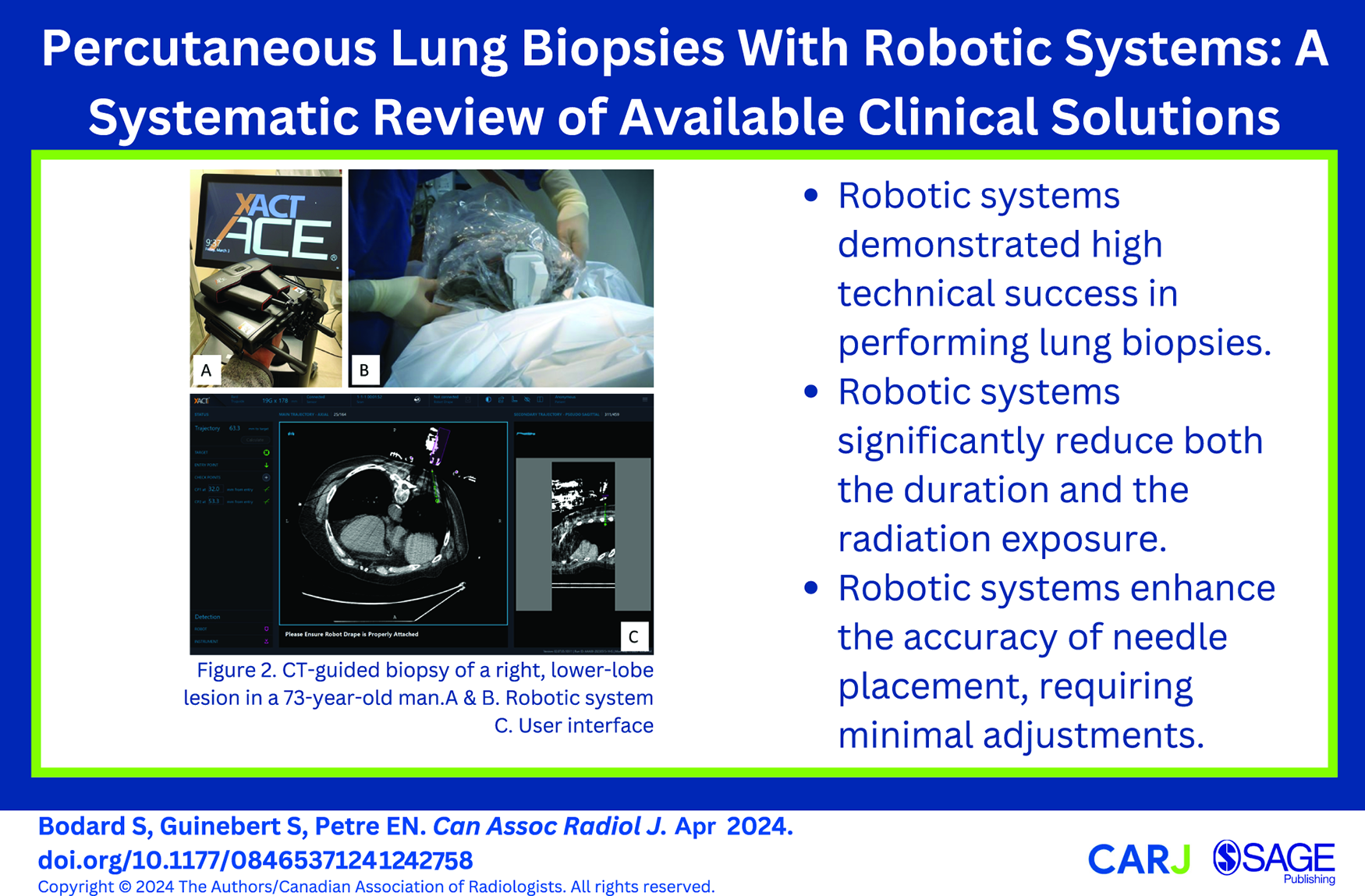
Objectives: This systematic review aims to assess existing research concerning the use of robotic systems to execute percutaneous lung biopsy. Methods: A systematic review was performed and identified 4 studies involving robotic systems used for lung biopsy. Outcomes assessed were operation time, radiation dose to patients and operators, technical success rate, diagnostic yield, and complication rate. Results: One hundred and thirteen robot-guided percutaneous lung biopsies were included. Technical success and diagnostic yield were close to 100%, comparable to manual procedures. Technical accuracy, illustrated by needle positioning, showed less frequent needle adjustments in robotic guidance than in manual guidance (P < .001): 2.7 ± 2.6 (range 1-4) versus 6 ± 4 (range 2-12). Procedure time ranged from comparable to reduced by 35% on average (20.1 ± 11.3 minutes vs 31.4 ± 10.2 minutes, P = .001) compared to manual procedures. Patient irradiation ranged from comparable to reduced by an average of 40% (324 ± 114.5 mGy vs 541.2 ± 446.8 mGy, P = .001). There was no significant difference in reported complications between manual biopsy and biopsies that utilized robotic guidance. Conclusion: Robotic systems demonstrate promising results for percutaneous lung biopsy. These devices provide adequate accuracy in probe placement and could both reduce procedural duration and mitigate radiation exposure to patients and practitioners. However, this review underscores the need for larger, controlled trials to validate and extend these findings.
GouldMKDoningtonJLynchWR, et al. Evaluation of individuals with pulmonary nodules: when is it lung cancer? Diagnosis and management of lung cancer, 3rd ed: American College of Chest Physicians evidence-based clinical practice guidelines. Chest. 2013;143:e93S-e120S. doi:10.1378/chest.12-2351
2.
BaiCChoiC-MChuCM, et al. Evaluation of pulmonary nodules: clinical practice consensus guidelines for Asia. Chest. 2016;150:877-893. doi:10.1016/j.chest.2016.02.650
3.
MazzonePJLamL. Evaluating the patient with a pulmonary nodule: a review. JAMA. 2022;327:264-273. doi:10.1001/jama.2021.24287
4.
MacMahonHAustinJHMGamsuG, et al. Guidelines for management of small pulmonary nodules detected on CT scans: a statement from the Fleischner Society. Radiology. 2005;237:395-400. doi:10.1148/radiol.2372041887
5.
BorghesiAMicheliniSNocivelliG, et al. Solid indeterminate pulmonary nodules less than or equal to 250 mm3: application of the updated Fleischner Society guidelines in clinical practice. Radiol Res Pract. 2019;2019:7218258. doi:10.1155/2019/7218258
6.
MacMahonHNaidichDPGooJM, et al. Guidelines for management of incidental pulmonary nodules detected on CT images: from the Fleischner Society 2017. Radiology. 2017;284:228-243. doi:10.1148/radiol.2017161659
7.
FarjahFMonsellSESmith-BindmanR, et al. Fleischner Society guideline recommendations for incidentally detected pulmonary nodules and the probability of lung cancer. J Am Coll Radiol. 2022;19:1226-1235. doi:10.1016/j.jacr.2022.06.018
8.
TunaTOzkayaSDiricanAFindikSAticiAGErkanL. Diagnostic efficacy of computed tomography-guided transthoracic needle aspiration and biopsy in patients with pulmonary disease. Onco Targets Ther. 2013;6:1553-1557. doi:10.2147/OTT.S45013
9.
LalHNeyazZNathABorahS. CT-guided percutaneous biopsy of intrathoracic lesions. Korean J Radiol. 2012;13:210-226. doi:10.3348/kjr.2012.13.2.210
10.
KimGRHurJLeeSM, et al. CT fluoroscopy-guided lung biopsy versus conventional CT-guided lung biopsy: a prospective controlled study to assess radiation doses and diagnostic performance. Eur Radiol. 2011;21:232-239. doi:10.1007/s00330-010-1936-y
11.
ProschHStadlerASchillingM, et alCT fluoroscopy-guided vs. multislice CT biopsy mode-guided lung biopsies: accuracy, complications and radiation dose. Eur J Radiol. 2012;81:1029-1033. doi:10.1016/j.ejrad.2011.01.064
GrassoRFFaiellaELuppiG, et al. Percutaneous lung biopsy: comparison between an augmented reality CT navigation system and standard CT-guided technique. Int J Comput Assist Radiol Surg. 2013;8:837-848. doi:10.1007/s11548-013-0816-8
14.
GuiuBDe BaèreTNoelGRonotM. Feasibility, safety and accuracy of a CT-guided robotic assistance for percutaneous needle placement in a swine liver model. Sci Rep. 2021;11:5218. doi:10.1038/s41598-021-84878-3
de BaèreTRouxCDeschampsFTselikasLGuiuB. Evaluation of a new CT-guided robotic system for percutaneous needle insertion for thermal ablation of liver tumors: a prospective pilot study. Cardiovasc Intervent Radiol. 2022;45:1701-1709. doi:10.1007/s00270-022-03267-z
17.
TacherVde BaereT. Robotic assistance in interventional radiology: dream or reality?Eur Radiol. 2020;30:925-926. doi:10.1007/s00330-019-06541-w
18.
BodardSGuinebertSN PetreE, et al. Percutaneous liver interventions with robotic systems: a systematic review of available clinical solutions. Br J Radiol. 2023;96:20230620. doi:10.1259/bjr.20230620
19.
CornelisFTakakiHLaskhmananM, et al. Comparison of CT fluoroscopy-guided manual and CT-guided robotic positioning system for in vivo needle placements in swine liver. Cardiovasc Intervent Radiol. 2015;38:1252-1260. doi:10.1007/s00270-014-1016-9
20.
BeyerLPWiggermannP. Planning and guidance: new tools to enhance the human skills in interventional oncology. Diagn Interv Imaging. 2017;98:583-588. doi:10.1016/j.diii.2017.07.004
21.
WitkowskaALevySRothI, et al. Feasibility and accuracy of a novel hands-free robotic system for percutaneous needle insertion and steering. Surg Technol Int. 2022;41:sti41/1624.
22.
PottPPScharfH-PSchwarzMLR. Today’s state of the art in surgical robotics. Comput Aided Surg. 2005;10:101-132. doi:10.3109/10929080500228753
23.
KettenbachJKronreifG. Robotic systems for percutaneous needle-guided interventions. Minim Invasive Ther Allied Technol. 2015;24:45-53. doi:10.3109/13645706.2014.977299
MatsuiYKamegawaTTomitaK, et al. Robotic systems in interventional oncology: a narrative review of the current status. Int J Clin Oncol. 2023;29:81-88. doi:10.1007/s10147-023-02344-8
26.
McInnesMDFMoherDThombsBDMcGrathTABossuytPM; the PRISMA-DTA Group. Preferred reporting items for a systematic review and meta-analysis of diagnostic test accuracy studies: the PRISMA-DTA statement. JAMA. 2018;319:388-396. doi:10.1001/jama.2017.19163
27.
RileyRDMoonsKGMSnellKIE, et al. A guide to systematic review and meta-analysis of prognostic factor studies. BMJ. 2019;364:k4597. doi:10.1136/bmj.k4597
28.
AnzideiMArgiròRPorfiriA, et al. Preliminary clinical experience with a dedicated interventional robotic system for CT-guided biopsies of lung lesions: a comparison with the conventional manual technique. Eur Radiol. 2015;25:1310-1316. doi:10.1007/s00330-014-3508-z
29.
AlexanderEPetreENBodardSMarinelliBSarkarDCornelisFH. Comparison of a patient-mounted needle-driving robotic system vs. manual CT fluoroscopy to perform percutaneous CT-guided lung biopsies. J Vasc Interv Radiol. Published online March 4, 2024. doi:10.1016/j.jvir.2024.02.023
30.
RadhakrishnanRKMittalBRGorlaAKR, et al. Real-time intraprocedural 18F-FDG PET/CT-guided biopsy using automated robopsy arm (ARA) in the diagnostic evaluation of thoracic lesions with prior inconclusive biopsy results: initial experience from a tertiary health care centre. Br J Radiol. 2017;90:20170258. doi:10.1259/bjr.20170258
31.
NathAPrashanthALalHKumarSBaraiSGambhirS. Robotic-assisted computed tomography-guided 18F-FDG PET/computed tomography-directed biopsy for diagnosis of intra thoracic lesions: an experience from a tertiary care centre in North India. Nucl Med Commun. 2020;41:246-251. doi:10.1097/MNM.0000000000001148
32.
ZhangPLiuJ-MZhangY-YHuaRXiaF-FShiY-B. Computed tomography-guided lung biopsy: a meta-analysis of low-dose and standard-dose protocols. J Cancer Res Ther. 2021;17:695-701. doi:10.4103/jcrt.JCRT_1274_20
33.
LiG-CFuY-FCaoWShiY-BWangT. Computed tomography-guided percutaneous cutting needle biopsy for small (≤ 20 mm) lung nodules. Medicine (Baltimore). 2017;96:e8703. doi:10.1097/MD.0000000000008703
34.
MbalisikeECVoglTJZangosSEichlerKBalakrishnanPPaulJ. Image-guided microwave thermoablation of hepatic tumours using novel robotic guidance: an early experience. Eur Radiol. 2015;25:454-462. doi:10.1007/s00330-014-3398-0
35.
LevySGoldbergSNRothI, et al. Clinical evaluation of a robotic system for precise CT-guided percutaneous procedures. Abdom Radiol (NY). 2021;46:5007-5016. doi:10.1007/s00261-021-03175-9
36.
Tovar-ArriagaSTitaRPedraza-OrtegaJCGorrostietaEKalenderWA. Development of a robotic FD-CT-guided navigation system for needle placement-preliminary accuracy tests. Int J Med Robot. 2011;7:225-236. doi:10.1002/rcs.393
37.
YanofJHaagaJKlahrP, et al. CT-integrated robot for interventional procedures: preliminary experiment and computer-human interfaces. Comput Aided Surg. 2001;6:352-359. doi:10.1002/igs.10022
38.
KoetheYXuSVelusamyGWoodBJVenkatesanAM. Accuracy and efficacy of percutaneous biopsy and ablation using robotic assistance under computed tomography guidance: a phantom study. Eur Radiol. 2014;24:723-730. doi:10.1007/s00330-013-3056-y
39.
SuL-MStoianoviciDJarrettTW, et al. Robotic percutaneous access to the kidney: comparison with standard manual access. J Endourol. 2002;16:471-475. doi:10.1089/089277902760367421
40.
SchulzBEichlerKSiebenhandlP, et al. Accuracy and speed of robotic assisted needle interventions using a modern cone beam computed tomography intervention suite: a phantom study. Eur Radiol. 2013;23:198-204. doi:10.1007/s00330-012-2585-0
41.
KrückerJXuSGlossopN, et al. Electromagnetic tracking for thermal ablation and biopsy guidance: clinical evaluation of spatial accuracy. J Vasc Interv Radiol. 2007;18:1141-1150. doi:10.1016/j.jvir.2007.06.014
42.
von JakoCRZukYZurOGilboaP. A novel accurate minioptical tracking system for percutaneous needle placement. IEEE Trans Biomed Eng. 2013;60:2222-2225. doi:10.1109/TBME.2013.2251883