




Abstract
Purpose:
To assess the diagnostic utility of clinical magnetic resonance spectroscopy (MRS) and diffusion-weighted imaging (DWI) in distinguishing between histological grading and isocitrate dehydrogenase (IDH) classification in adult diffuse gliomas.
Methods:
A retrospective analysis was conducted on 247 patients diagnosed with adult diffuse glioma. Experienced radiologists evaluated DWI and MRS images. The Kruskal-Wallis test examined differences in DWI and MRS-related parameters across histological grades, while the Mann–Whitney U test assessed molecular classification. Receiver Operating Characteristic (ROC) curves evaluated parameter effectiveness. Survival curves, stratified by histological grade and IDH classification, were constructed using the Kaplan–Meier test.
Results:
The cohort comprised 141 males and 106 females, with ages ranging from 19 to 85 years. The Kruskal-Wallis test revealed significant differences in ADC mean, Cho/NAA, and Cho/Cr concerning glioma histological grade (P < .01). Subsequent application of Dunn’s test showed significant differences in ADC mean among each histological grade (P < .01). Notably, Cho/NAA exhibited a marked distinction between grade 2 and grade 3/4 gliomas (P < .01). The Mann–Whitney U test indicated that only ADC mean showed statistical significance for IDH molecular classification (P < .01). ROC curves were constructed to demonstrate the effectiveness of the specified parameters. Survival curves were also delineated to portray survival outcomes categorized by histological grade and IDH classification.
This is a visual representation of the abstract.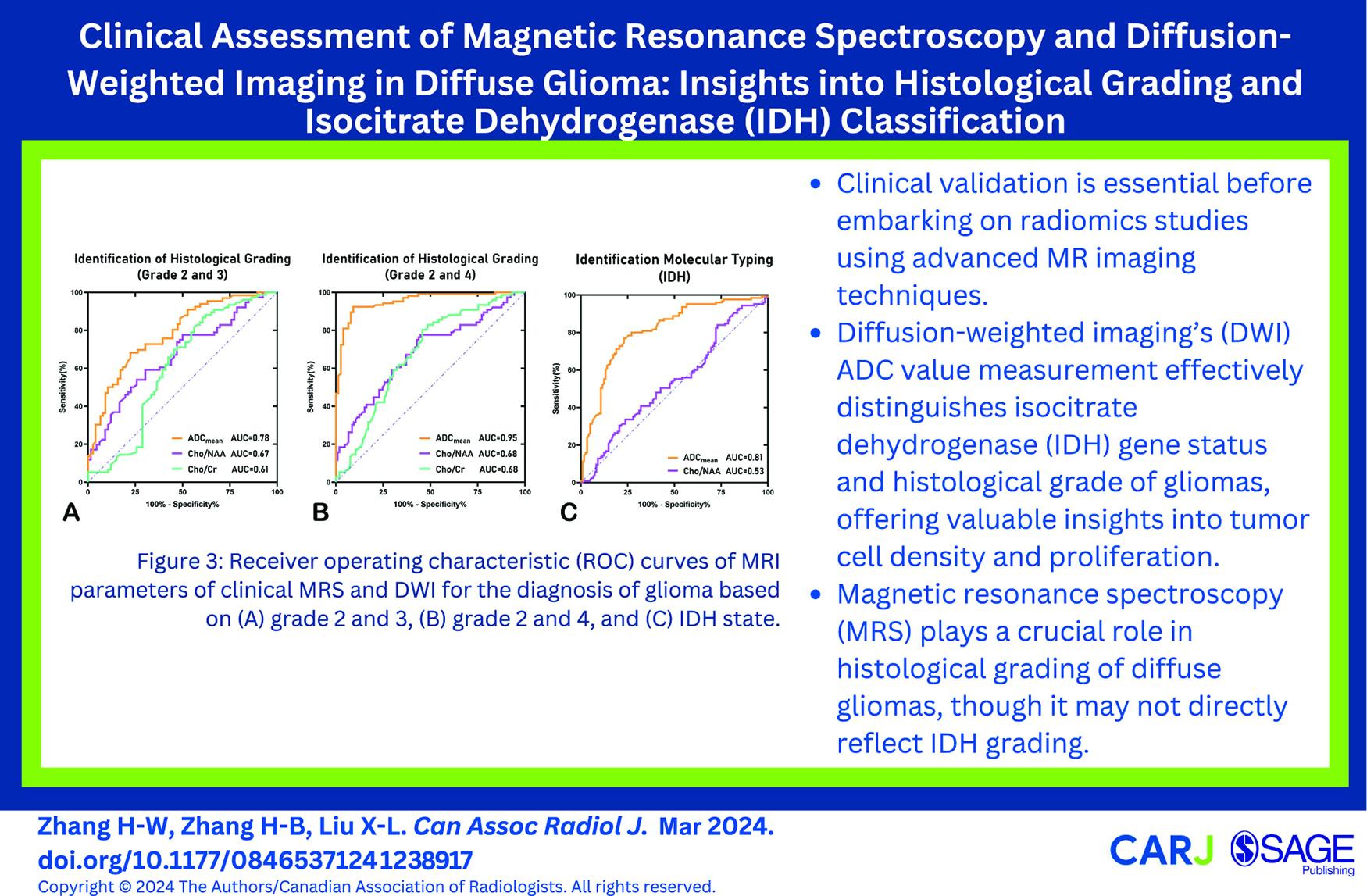
Get full access to this article
View all access options for this article.
References
Supplementary Material
Please find the following supplemental material available below.
For Open Access articles published under a Creative Commons License, all supplemental material carries the same license as the article it is associated with.
For non-Open Access articles published, all supplemental material carries a non-exclusive license, and permission requests for re-use of supplemental material or any part of supplemental material shall be sent directly to the copyright owner as specified in the copyright notice associated with the article.
