




Abstract
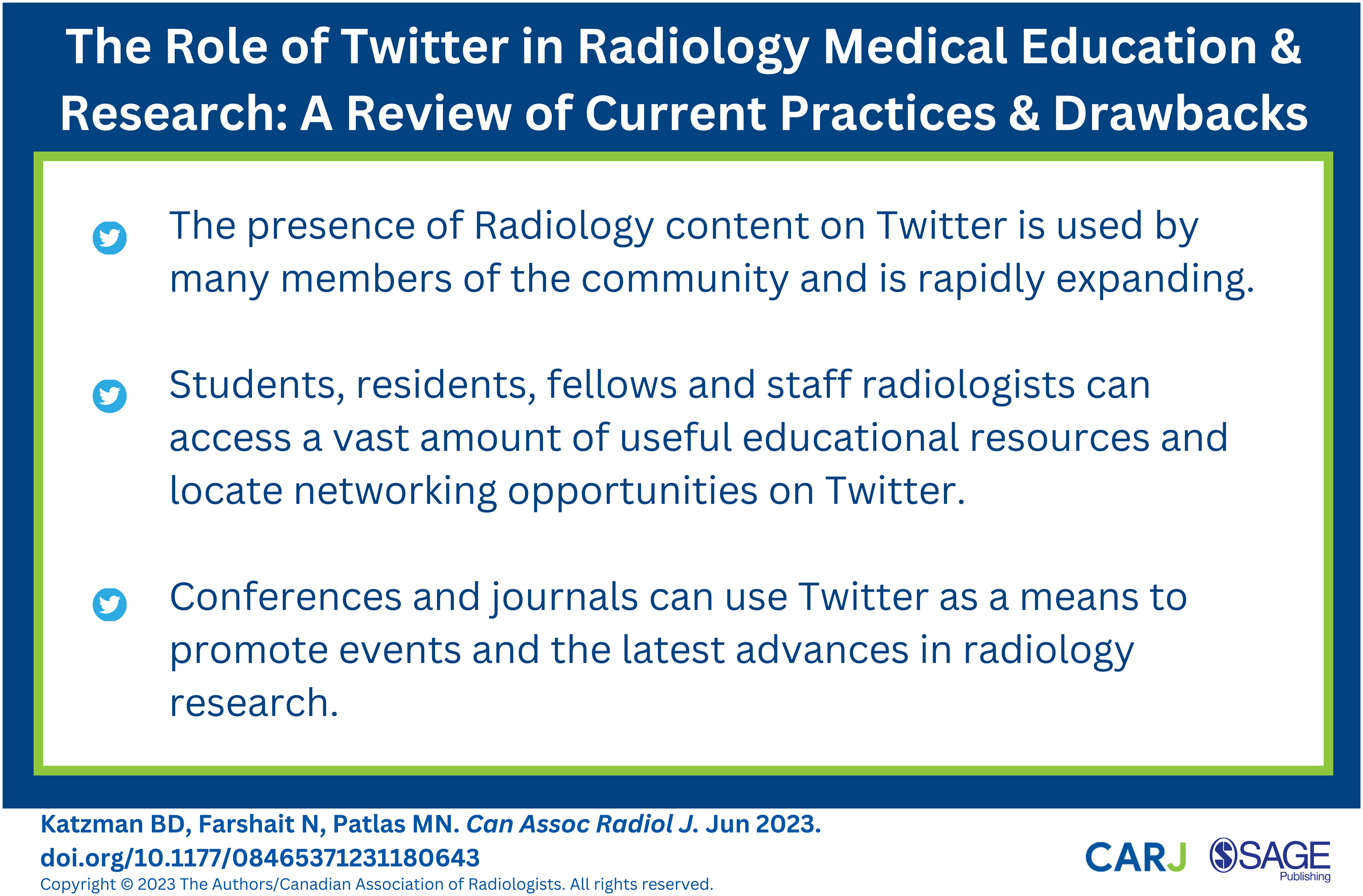
The trends in society have provided favourable conditions for the rapid growth of radiology on social media, specifically there has been an expanding presence on Twitter. Currently, simple searches on Twitter yield a plethora of radiology education resources, that may be suited for medical students, residents or practicing radiologists. Educators have many tools at their disposal to deliver effective teaching. Over time, strategies such as including images and scrollable stacks often are more successful at gaining popularity or clicks online. Journals and authors can use Twitter to promote their new scientific work and potentially reach audiences they couldn’t have prior. Attendees at conferences can get involved in the conversation by tweeting about the meeting and engaging with other attendees with mutual interests. Interested medical students, residents and even practicing radiologists can use Twitter as a means of networking and connecting with other scholars all around the globe. Within its glory, Twitter does carry some drawbacks including privacy concerns, equality, and risk of misinformation. Above all, the future of Twitter is bright and promising for all who are currently on it and plan to use it for their education, research, or professional advancement.
Introduction
The relentless advancement of technology in modern-day society is perpetually creating exciting opportunities, particularly in the realm of social media. Consumption of social media is generally facilitated by smartphones, tablets, and computers, or colloquially known as “screens.” There has undoubtedly been a societal increase in “screen time” that has been steadily rising and has since grown exponentially as a consequence of social isolation mandates and work-from-home jobs. 1 Adults across all age groups use social media several times per days, and Twitter is amongst the top sites visited. 2 Twitter’s platform generally permits up to 280 character messages (or “tweets”) that can be sent by users and may include text, internet links, images or videos. The restriction on length forces users to communicate a concise message.
Healthcare workers are generally encouraged to join social media channels and contribute to online content and conversations. 3 With increasing screen time and social media use, Twitter is used for more than just news articles, humorous clips and day-to-day messaging. Often, Twitter is being used by academics to share new scientific data or research, stimulate debate amongst the community and provide tools to further education and professional development. 4-6 The radiology community is no exception, offering a rather large wealth of information for the readers, particularly in the realm of medical education. Twitter’s accessibility allows for direct contact between physicians, fellows, residents and medical learners and permits an exchange of ideas and collaboration that may not have otherwise been possible. 7,8 The current trends in social media suggest that the role of Twitter in radiological education will only continue to grow. 9,10 In 2015, the RANSOM survey was conducted and strived to determine specifically how radiologists use social media. Approximately 85% of respondents use social media (e.g., Facebook, Twitter and LinkedIn) and 82% endorsed knowledge of the educational possibilities of social media. 11
This review serves to highlight several examples of effective utilization of Twitter for stakeholders involved with radiology-related medical education and research. Applications including optimal learning/teaching opportunities, professional advancement/networking, radiology journal and conference promotion are discussed. Finally, an analysis of drawbacks and threats to Twitters utilization in this realm are included.
Successful uses of Twitter for Radiology
Radiology Medical Education on Twitter
A recent survey of radiologists, residents and medical students across 65 countries evaluated current social media practices for radiology. In this survey, 85% stated that their most important goal on social media was education and advancing their own learning. 12 Twitter is an uncomplicated platform to use and navigate, allowing for professionals in the radiology community to simply provide teaching and learners to further their knowledge base. 13-16 Twitter permits educational resources and media to be instantly shared globally to anyone with a Twitter account. Radiologists and students can subscribe to (or “follow”) users who share educational content, scholarly journals, and conferences to tailor their Twitter home page (or “feed”) to receive the materials they wish to view. 7 Though within this user-friendly program, there are tools and strategies that allow for an optimal outreach for educators to reach their intended audience.
The earliest and many of the current approaches to medical education on Twitter involve strictly text-based tweets, but with increasing user proficiency, Tweeters are now adding media files and occasionally polls. 17,18 Educators may also opt to tweet static images followed by several discussion questions that may be taken up at a later date. Investigations have been conducted to answer a basic question, are radiologists utilizing technology optimally? 19 Twitter’s versatility allows for sharing of images, infographics, videos, etc., but some methods are superior to others. A group evaluated their Twitter platform and determined the most effective methods to gain readership statistically. Tweets that contained news links, or links to other sites, received the fewest impressions, retweets, and likes by users on the platform. On the other hand, scrollable videos (e.g., CT stack) had highest impressions, retweets and likes. Cases that contained images had the highest amount of clicks by Twitter users. 20 Using these tools, educators can optimize their approach for the greatest possible uptake and clicks by learners.
Hashtags (abbreviated “#”) can index words to allow the user to click on the text to lead to other tweets that contain the same word. 21 #FOAMRad or “Free Open Access Meducation” for radiology is just one of many hashtags used on Twitter to promote content for medical education. The other most commonly encountered hashtags include #radiology, #imaging, #MRI and #ultrasound. 22 Including these words accompanied with a hashtag increases the opportunity for students to discover the tweet and related content.
Searching #FOAMRad on twitter presently yields countless images of interesting findings provided by the community that may have good teaching potential. Various accounts even offer a “Case of the Week” where the learner is presented with a clinical history and corresponding image, and the task is to interpret the images. Other accounts, such as @TheRadRoom, recently launched a series titled “#MedStudentMondays” where tweets often showcase basic anatomy and its imaging correlate, targeted specifically for medical students.
A more advanced series of cases are available courtesy of The American College of Radiology (ACR). On twitter, the ACR (@RadiologyACR) has a daily series called #ACRCaseinPoint, which tweets case presentations with associated imaging. 23,24 These cases promote discussion amongst radiologists and trainees online. A 2007 survey reported that when radiology residents are using the internet to learn radiology, 22% utilize the ACR Case in Point series. 25 Occasionally, @RadiologyACR tweets review questions targeted for those studying for board exams. Similar to their daily cases, there are images presented. The tweets also contain multiple choice options for the answer. Readers are encouraged to comment their answer and explanation for others to see.
The Radiological Society of North America (RSNA) operates a Twitter account, @RCC_editor (RSNACaseCollection_Editor), that tweets cases from their case collection weekly. Similarly, the cases are made available with associated imaging to all those interested. The tweets also contain a link to their site with detailed explanations on the radiographical findings, differential diagnosis, and final diagnosis. The account may also tweet links to “microlearning modules” which direct the reader to YouTube videos created by practicing radiologists to provide specialized, more advanced, image interpretation (e.g., CNS lymphoma).
Medical students can receive great value from having access to Twitter and the content shared within. The vast supply of educational resources is available for no cost. The limits on tweet length force educators to provide concise radiological education that can be easily comprehended. 26,27 Simply searching Twitter for common hashtags provides learners with access to thousands of images and discussions that is accessible for all. Results can further be filtered by the learner to suit their own personal learning needs and objectives. Students can become involved in the discussions, and even ask questions to radiology educators globally. 28
A noteworthy accelerant of Twitter-based radiology education was undoubtedly the COVID-19 pandemic and associated global transition to virtual learning. The pandemic eliminated nearly all in-person and hands-on learning opportunities for medical learners for a substantial period of time. This limitation prevented medical students partaking in radiology electives to have an opportunity to directly work with and observe a practicing radiologist and impeded a chance for hands-on learning. 12,29 The original solution developed by educators involved was creating virtual radiology electives for medical students and self-directed learning for residents. 30,31 Twitter (and other social media channels) rapidly became a convenient outlet for medical students and residents to successfully access medical education resources. 32 A 2021 study conducted by Lazaga et al gathered all tweets in a 10-month period during the COVID-19 pandemic that contained #Radiology and were associated with COVID-19 content. The authors concluded that sharing of information increased significantly during the pandemic within the radiology community. 33
Radiology education on Twitter is not limited to learners pursuing a medical degree. Gonzalez et al conducted a study on the utility of Twitter for the teaching and learning of oral and maxillofacial radiology for second-year dental students. Twitter accounts were created and offered a question and answer format to assist with content delivery in their radiology curriculum. The feedback was overwhelmingly positive and the teaching was well received by the students. 34 Evidently, the approaches and strategies for delivering radiology education on Twitter are widely applicable and not limited to M.D. learning.
Research and Conferences
Access to basic radiological knowledge is crucial for medical learners to grasp the fundamentals of radiology. However, our knowledge is continuously evolving and building with ongoing research. In response to the rise of social media, many radiology journals have developed an active presence on Twitter and other social media outlets. 35 With Twitter, journals can disseminate new research articles and editions quickly to interested parties, and allow the radiology community to learn from new advances. 9
The impact factor of a journal is a metric used to evaluate the relative strength of a journal within its field and provide a quantitative approximation of the frequency of citation of articles within the journal in a set time period. 36 A recent analysis of the top 50 radiology journals by Kelly et al found that only 14 had dedicated Twitter accounts, 25 had accounts affiliated with societies and 11 had no twitter account whatsoever. In general, journals with Twitter profiles had statistically higher impact factors than those that did not. Once seven of the 11 journals created a Twitter account, they experienced an increase in impact factor. There was also a positive correlation between number of Twitter followers and journal impact factor. 35 In a related study, Pozdnyakov and coworkers investigated the relationship between Twitter activity and number of citations in radiology journal. They concluded that radiology articles with higher citation rates had an association with more Twitter activity. 37 Though more studies are necessary to conclude causality, it appears there may be a link between research article exposure and promotion on Twitter. Tweeting about new articles allows for the radiology community on Twitter to locate emerging evidence and use it to inform their practice, and aid in their own education.
The journal RadioGraphics, a subsidiary of RSNA, launched a Twitter account @RadG_editor in May 2021. The journal has garnered a reputation of contributing to medical education and developed this social media channel with several objectives, including promoting new authors and providing supplementary content to stimulate discussion. The latter is achieved through continuing medical education (CME) questions and “tweetchats” moderated by a journal-appointed team. 38,39 RadioGraphics creates visual abstracts that attract attention on social media from the artistic excellence. The design process is elaborate, but authors can retweet the visual abstract and increase viewership and promote education. 40 The team behind @RadG_editor analyzed its social media metrics from 2021. The most noteworthy statistic was that including “#RGphx” in RadioGraphics tweets resulted in over 18 million impressions and more than 24000 engagements. Over 1300 unique authors tweeted the hashtag nearly 7000 times in the year. Many of the authors were from the United States of America, but there were several authors who utilized it from South America, Europe, Africa, Australia and Asia as well. The future goals suggest that their intent is to reach a wider and more international audience to increase the outreach of the page and enable easier access to medical education resources for all who wish to utilize them. 41
Studies of Twitter activity in more specialized radiology journals has also been analyzed. Wadhwa and coworkers evaluated tweet characteristics and features that increase user engagement of content in the American Journal of Neuroradiology (AJNR). This 2017 study examined tweets between 2015-16. The authors found that tweets with the highest level of engagement and activity contained an image and/or a hashtag, and also those that were tweeted in the morning hours. 42 In a more recent 2022 study, Twitter engagement for the American Society of Head and Neck Radiology was assessed over a three year period, overlapping with the COVID-19 pandemic. In general, the viewership of this society’s content and global outreach increased significantly during the stated time period. 43
Hawkins et al conducted a randomized prospective control trial, in part, to evaluate the impact of the tweeting account on Twitter engagement in the Journal of the American College of Radiology (JACR). The results showed with statistical significance that utilizing twitter accounts of editorial board members to promote journal content was more effective than standard, lesser known, user Twitter accounts or even the official journal account. The bottom line of this study is that in order to promote research and viewership, it is most optimal to use known and identifiable Twitter accounts rather than generic journal titles as the user. 44
Conferences are useful forum to share new and exciting research ideas with a group of link-minded peers. Deployment of social media, specifically Twitter, has become nearly universal for the promotion and sharing of content related to scientific and medical conferences. 45-48 Meetings and conferences often create a hashtag that users can include in tweets that can link together a collection of tweets and research related to the conference. This fosters accessibility as obtaining content from a conference is no longer restricted to those in attendance in-person. Learners and practicing radiologists can search for the conference hashtag and access learning materials and interact with the authors and those attending the conference. 49 One of the first studies of Twitter use at radiology conferences was conducted by Hawkins et al in 2014. The group quantitatively and qualitatively assessed Twitter use at the RSNA annual meetings by looking at tweets containing the meeting hashtags. Between the annual meetings of 2011 and 2012, Twitter use increased over 30%. This study showcased potential for engagement of conference attendees to improve communication about the exhibits and collaboration amongst peers. 50 In addition, medical students and residents can join societies and then follow Twitter accounts for access to specialized resources. 51
Specialized fields of radiology, such as interventional radiology (IR), have a Twitter presence to share interesting cases, advertise webinars and share news that is relevant to IR physicians and learners. Further, medical students could connect with educators that are geographically distant. This outreach will inevitably contribute to and stimulate interest in IR. 52-55 Senior medical students have even written a letter on the need for increased IR exposure in medical school, and suggested Twitter as a potential vehicle. 56 The Society of Interventional Radiology has encouraged Twitter use, in particular with regards to its annual meeting to allow members to connect with each other during these large gatherings. 57,58 IR and diagnostic radiology society’s Twitter activity has also been studied comparatively and they are generally comparable in terms of Twitter engagement. 59
Polling on Twitter is used to ask a multiple-choice question and tabulate the responses. A study in 2016 by Rosenkrantz and coworkers assessed Twitter polls as a means to gather perceptions and opinions of radiology-related content while at the 2016 ACR annual meeting. Two radiologists posted the polls, and the mean number of responses was significantly larger for the user with more Twitter followers. Questions ranged from gaining perception on radiologist pay to whether artificial intelligence could replace radiologists. A meeting-specific question asked whether the keynote address would change the general practice of the responding radiologists, to which 50% answered yes. Overall, this Twitter polling feature can provide meeting organizers quick feedback on the content of the meeting, and give the planners targeted methods to enrich and develop the content for future meetings. In addition, the discussions and associated learning surrounding the research and public perceptions can be incorporated. 60
There are several cases of Twitter being used as a means to unofficially bring together peers to form groups to discuss radiology and related research. The vast potential of the website makes it simple to form a group of like-minded peers globally to come together and form journal clubs. 61,62 Case conferences have been organized by abdominal and cardiothoracic radiologists, who gather virtually to discuss interesting and impactful cases and their respective imaging findings and differential diagnoses. Generally, these sessions are held on video conferencing software, but the groups turn to Twitter for promotion of viewership and dissemination of information to recruit interested radiologists. 63
Twitter for Professional Development and Networking
Professional opportunities are available for learners and those engaging in education and research on Twitter. Students are encouraged to join Twitter to access a large volume of learning resources, but there is a plethora of alternative opportunities for professional advancement, personal branding, networking for residency/future jobs. In a 2017 survey, 60% of responding radiologists claim they also use social media for professional purposes. 64
There is certainly a large role for program directors (PDs) for radiology residency program and radiology departments to have an active presence on Twitter. 65,66 PDs can promote their radiology training program to and network with future applicants. Examples include sharing recent awards, published articles or other academic successes of their radiology residents or staff. 65 Residency programs can also use their platform to engage with students to promote equity, diversity and inclusion for prospective residents. 67 Similar to brand-building for radiology training programs, radiologists can use Twitter to build their own personal presence on social media. 68
In addition, learners globally are encouraged to join Twitter to network with professionals and connect with potential mentors in radiology. 26,51,69,70 Finding a mentor on Twitter can be accomplished by locating professionals with (or who previously had) similar goals to yours, and reaching out via direct message or by replying to a tweet. Utilizing common hashtags such as #FutureRadRes can assist in advertising one’s interest in radiology and intention to pursue the career. 71
Challenges
The possibilities on Twitter for learning, teaching and research are numerous and growing. There are copious benefits to using social media for healthcare professionals, but there are several notable risks. 72,73 With radiology still building its presence on Twitter, and research is being conducted to optimize its use, there are several challenges to its widespread uptake. The following are issues and barriers that all users on Twitter (and other social media channels) must be aware of.
A challenge for all healthcare professionals in the age of technology and social media is patient privacy. A simple error by tweeting content without reviewing for patient identifiers, or sending a message to the wrong healthcare professional can result in a catastrophic breach of confidentiality. Basic patient characteristics are often necessary to contextualize a case for discussion on Twitter, but measures must be taken to be certain that the patient cannot be identified. While unfortunate, it is often necessary to omit discussing cases about rare findings on social media to protect confidentiality. Information on the internet and over social media can spread rapidly; on Twitter, the spread of information is greatly facilitated with the “retweet” function. This function can serve a great advantage for a good cause but can also result in inadvertently tweeted information to be seen by many. Strategies to avoid these errors include sending “test” messages to trusted recipients or engaging in “peer-review,” where one can ask a colleague to confirm the content you are sharing is appropriate to post on Twitter. 17,74-76
Unlike research published in respected journals, education and resources posted to Twitter may not be peer reviewed, and there may not be measures in place to avoid errors and subsequent dissemination of the false information. Information shared from private accounts should always be scrutinized for accuracy and mistakes should be reported back to author to protect vulnerable readers and early learners. 77,78 Measures can be taken by authors to prevent mistakes or misinformation by employing a quality control process prior to tweeting content.
At meetings, it can be perceived as poor etiquette to be concentrated on a hand-held device during a session/presentation, even if utilizing Twitter for the event. For the user, it can cause divided attention and elements of the presentation may be missed. Other attendees and the presenter may be distracted by an attendees device usage. 79
Accessing Twitter and other social media outlets is conditional on having a reliable internet connection. This overlooked privilege can create a barrier for those in low-income communities or countries who do not have access to reliable internet.
All members of the radiology community must be vigilant and cognisant of their Twitter use and how it may be perceived by others and the general public. For this reason, a large proportion of the research and reports of Twitter utilization by radiologists outline the basics of Twitter use and may even include a section on the “Do’s and Don’ts” of Twitter. With proper and responsible use of Twitter, it can be an optimal atmosphere for professionals. 4,13,21,79,80
Conclusion and Outlook
The last several years have affirmed that the role of Twitter in radiology education and research is crucial and continuously growing. What was once a platform to share daily thoughts and read the news, Twitter is now a premier destination for medical education and learning. Educators are evolving their methods to deliver content that is attractive and easily grasped by the intended audience. The resources available on Twitter can be enjoyed by a large global audience, facilitating inter-continental discussions and even mentorship. Twitter is an outlet for scholars to share and promote their scientific work to be viewed and enjoyed by all in the community. Attendees at conferences have an added layer of engagement after being encouraged to “join the conversation” by conversing with presenters and other attendees on Twitter. For those interested, Twitter may act as a realm for learners to acquire mentorship and network.
Though there are inherent drawbacks to social media, the future of radiology on Twitter is exciting. With more research, methods will continue to be optimized. In an age where society is becoming more reliant on technology, and screen times are rising to record highs, accessing radiology content on social media should only grow in popularity in the future.
Abbreviations
American College of Radiology
American Journal of Neuroradiology
Computed tomography
Free open access meducation for radiology
Interventional Radiology
Journal of the American College of Radiology
Magnetic Resonance Imaging
Program director
Radiological Society of North America
Footnotes
Author Contributions
All authors attest that they meet the current International Committee of Medical Journal Editors (ICMJE) criteria for Authorship.
Declaration of Conflicting Interests
The author(s) declared no potential conflicts of interest with respect to the research, authorship, and/or publication of this article.
Funding
The author(s) received no financial support for the research, authorship, and/or publication of this article.
Informed Consent
The authors declare that this report does not contain any personal information that could lead to the identification of the patients.
