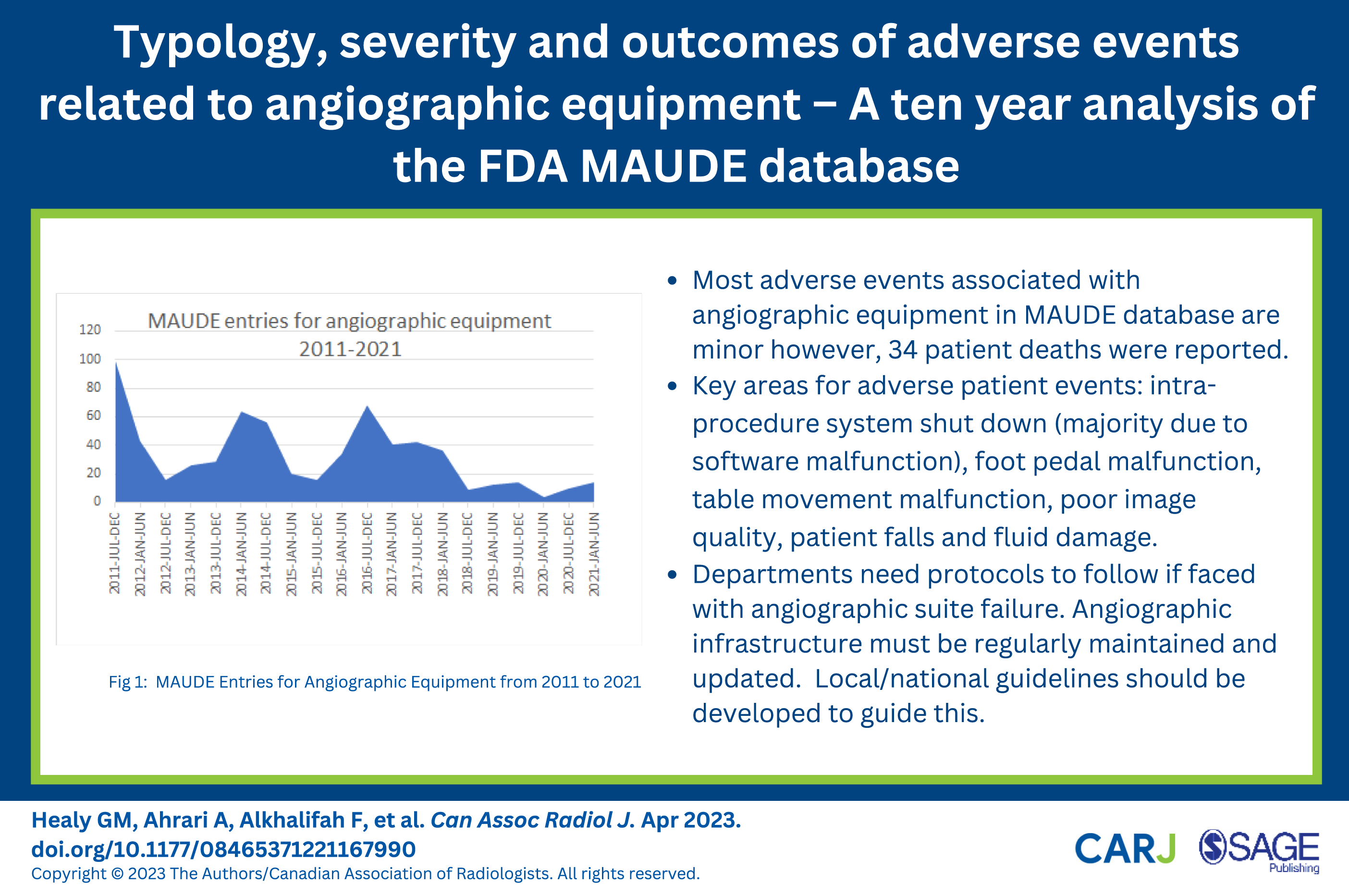
Purpose: Angiographic equipment is a key component of healthcare infrastructure, used for endovascular procedures throughout the body. The literature on adverse events related to this technology is limited. The purpose of this study was to analyze adverse events related to angiographic devices from the US Food and Drug Administration’s Manufacturer and User Facility Device Experience (MAUDE) database. Methods: MAUDE data on angiographic imaging equipment from July 2011 to July 2021 were extracted. Qualitative content analysis was performed, a typology of adverse events was derived, and this was used to classify the data. Outcomes were assessed using the Healthcare Performance Improvement (HPI) and Society of Interventional Radiology (SIR) adverse event classifications. Results: There were 651 adverse events reported. Most were near misses (67%), followed by precursor safety events (20.5%), serious safety events (11.2%), and unclassifiable (1.2%). Events impacted patients (42.1%), staff (3.2%), both (1.2%), or neither (53.5%). The most common events associated with patient harm were intra-procedure system shut down, foot pedal malfunction, table movement malfunction, image quality deterioration, patient falls, and fluid damage to system. Overall, 34 (5.2%) events were associated with patient death; 18 during the procedure and 5 during patient transport to another angiographic suite/hospital due to critical failure of equipment. Conclusion: Adverse events related to angiographic equipment are rare; however, serious adverse events and deaths have been reported. This study has defined a typology of the most common adverse events associated with patient and staff harm. Increased understanding of these failures may lead to improved product design, user training, and departmental contingency planning.
The HPI SEC & SSER patient safety measurement system for healthcare. HPI white Paper Series 2020.
2.
SariABASheldonTACracknellA, et al.Extent, nature and consequences of adverse events: Results of a retrospective casenote review in a large NHS hospital. Qual Saf Health Care. 2007;16(6):434-439.
3.
BrennanTALeapeLLLairdNM, et al.Incidence of adverse events and negligence in hospitalized patients. Results of the Harvard Medical Practice Study I. N Engl J Med. 1991;324(6):370-376.
4.
WilsonRMRuncimanWBGibberdRWHarrisonBTNewbyLHamiltonJD. The quality in australian health care study. Med J Aust. 1995;163(9):458-471.
5.
BakerGRNortonPGFlintoftV, et al.The Canadian adverse events study: the incidence of adverse events among hospital patients in Canada. CMAJ (Can Med Assoc J) : Canadian Medical Association journal = journal de l'Association medicale canadienne. 2004;170(11):1678-1686.
6.
HoppesMMitchellJVendittiEBuntingR. ASHRM White Paper Series. Serious Safety Events: Getting to Zero; 2012.
7.
BeregiJPSerorOWengerJJCaramellaTBoutetCDacherJN. Early results of a French care-related adverse events database in radiology. Diagn Interv Imaging. 2022;103(4):201-207.
8.
HigginsMCSSHerpyJP. Medical Error, Adverse Events, and Complications in Interventional Radiology: Liability or Opportunity?Radiology. 2021;298(2):275-283.
9.
MafeldSMusingELSConwayAKennedySOreopoulosGRajanD. Avoiding and managing error in interventional radiology practice: Tips and tools. Canadian Association of Radiologists journal = Journal l'Association canadienne des radiologistes. 2020;71(4):528-535.
10.
UrquhartAYardleySThomasEDonaldsonLCarson-StevensA. Learning from patient safety incidents involving acutely sick adults in hospital assessment units in England and Wales: a mixed methods analysis for quality improvement. J R Soc Med. 2021;114(12):563-574.
11.
LiebelTCDaughertyTKirschAOmarSAFeuersteinT. Analysis: Using the FDA MAUDE and Medical Device Recall Databases to Design Better Devices. Biomed Instrum Technol. 2020;54(3):178-188.
12.
McCaugheyCHealyGMAl BalushiH, et al.Patient radiation dose during angiography and embolization for abdominal hemorrhage: the influence of CT angiography, fluoroscopy system, patient and procedural variables. CVIR Endovasc. 2022;5(1):12.
13.
MafeldSOreopoulosGMusingELSChanTJaberiARajanD. Sources of Error in Interventional Radiology: How, Why, and When. Canadian Association of Radiologists journal = Journal l'Association canadienne des radiologistes. 2020;71(4):518-527.
14.
BorregoDYoderCBalterSKitaharaCM. Collar Badge Lens Dose Equivalent Values among United States Physicians Performing Fluoroscopically Guided Interventional Procedures. J Vasc Interv Radiol. 2022;33:219-224.
15.
MettlerFAJr.KoenigTRWagnerLKKelseyCA. Radiation injuries after fluoroscopic procedures. Semin Ultrasound CT MR. 2002;23(5):428-442.
16.
MillerDLBalterSDixonRG, et al.Quality improvement guidelines for recording patient radiation dose in the medical record for fluoroscopically guided procedures. J Vasc Interv Radiol. 2012;23(1):11-18.
EnsignLGCohenKB. A Primer to the Structure, Content and Linkage of the FDA's Manufacturer and User Facility Device Experience (MAUDE) Files. EGEMS (Washington, DC). 2017;5(1):12.
19.
HsiehHFShannonSE. Three approaches to qualitative content analysis. Qual Health Res. 2005;15(9):1277-1288.
20.
von ElmEAltmanDGEggerMPocockSJGøtzschePCVandenbrouckeJPSTROBE Initiative. The Strengthening the Reporting of Observational Studies in Epidemiology (STROBE) statement: Guidelines for reporting observational studies. Lancet (London, England). 2007;370(9596):1453-1457.
21.
KhalilzadehOBaerlocherMOShynPB, et al.Proposal of a new adverse event classification by the society of interventional radiology standards of practice committee. J Vasc Interv Radiol. 2017;28(10):1432-1437.
22.
TsaoCWAdayAWAlmarzooqZI, et al.Heart Disease and Stroke Statistics-2022 Update: A Report From the American Heart Association. Circulation. 2022;145(8):e153-e639.
23.
RosenkrantzABFriedbergEBPrologoJDEverettCDuszakRJr. Generalist versus Subspecialist Workforce Characteristics of Invasive Procedures Performed by Radiologists. Radiology. 2018;289(1):140-147.
24.
Al-HijjiMALennonRJGulatiR, et al.Safety and risk of major complications with diagnostic cardiac catheterization. Circ Cardiovasc Interv. 2019;12(7):e007791.
25.
VoycheckC. The Relationship between Medical Device Recalls and the Volume of Medical Device Reports (MDRs) Submitted to FDA. Johns Hopkins Bloomberg School of Public Health; 2017.
ECRI. Executive Brief: Top 10 Health Technology Hazards for2017.
28.
KimMOCoieraEMagrabiF. Problems with health information technology and their effects on care delivery and patient outcomes: A systematic review. J Am Med Inform Assoc. 2017;24(2):246-250.
29.
RonquilloJGZuckermanDM. Software-Related recalls of health information technology and other medical devices: Implications for FDA regulation of digital health. Milbank Q. 2017;95(3):535-553.
30.
Lifecycle Guidance for Medical Imaging Equipment in Canada. Canadian Association of Radiologists; 2013.
31.
KhalidNAhmadS. Use and Application of MAUDE in Patient Safety; 2021. StatPearls [Internet] Treasure Island (FL).
32.
FuksD. Early results of a French care-related adverse events database in radiology: A step toward excellence. Diagn Interv Imaging. 2022;103(4):189-190.
33.
WaldropWBMurrayDJBouletJRKrasJF. Management of Anesthesia Equipment Failure: A Simulation-Based Resident Skill Assessment. Anesth Analg. 2009;109(2):426-433.
34.
ZiapourBZaepfelCIafratiMDSuarezLBSalehiP. A systematic review of the quality of cardiovascular surgery studies that extracted data from the MAUDE database. J Vasc Surg. 2021;74(5):1708-1720.
35.
YoonCNamKCLeeYK, et al.Differences in perspectives of medical device adverse events: observational results in training program using virtual cases. J Korean Med Sci. 2019;34(39):e255.
Supplementary Material
Please find the following supplemental material available below.
For Open Access articles published under a Creative Commons License, all supplemental material carries the same license as the article it is associated with.
For non-Open Access articles published, all supplemental material carries a non-exclusive license, and permission requests for re-use of supplemental material or any part of supplemental material shall be sent directly to the copyright owner as specified in the copyright notice associated with the article.