




Abstract

Introduction
Although the training pathway to become an interventional radiologist in Canada traditionally consisted of a 5-year diagnostic radiology (DR) residency followed by a 1-year interventional radiology (IR) fellowship, the Royal College of Physicians and Surgeons of Canada (RCPSC) has recently accredited 5 IR residency programmes. 1 Despite the creation of this new training paradigm, exposure to IR during the final year of medical school has not been evaluated. A national assessment will uncover opportunities for standardization and aid advocacy efforts for adequate exposure to IR in the medical school curriculum.
The purpose of this study was to assess the prevalence of IR clerkship electives offered by Canadian medical schools. We hypothesized that exposure to IR during clerkship would be limited across Canada.
Methods
A list of Canadian medical schools was obtained from the Committee on Accreditation of Canadian Medical Schools. 2 On 25 September 2022, each medical schools’ website, including the radiology department website, was queried for radiology clerkship electives, IR residency programmes, and IR fellowship programmes. Screening was conducted by a fourth-year medical student (DL) and a fellowship-trained interventional radiologist (ADB). This study was exempt from research ethics board review since all data is publically available.
We define electives as a continuous clinical experience lasting 2 or more weeks. Single observerships or unofficial elective experiences were excluded. Radiology electives were classified as DR or IR electives based on the elective title, description and/or objectives. DR electives were further segmented into those with and without exposure to IR where exposure was defined as explicit opportunities to participate on the IR service.
Results
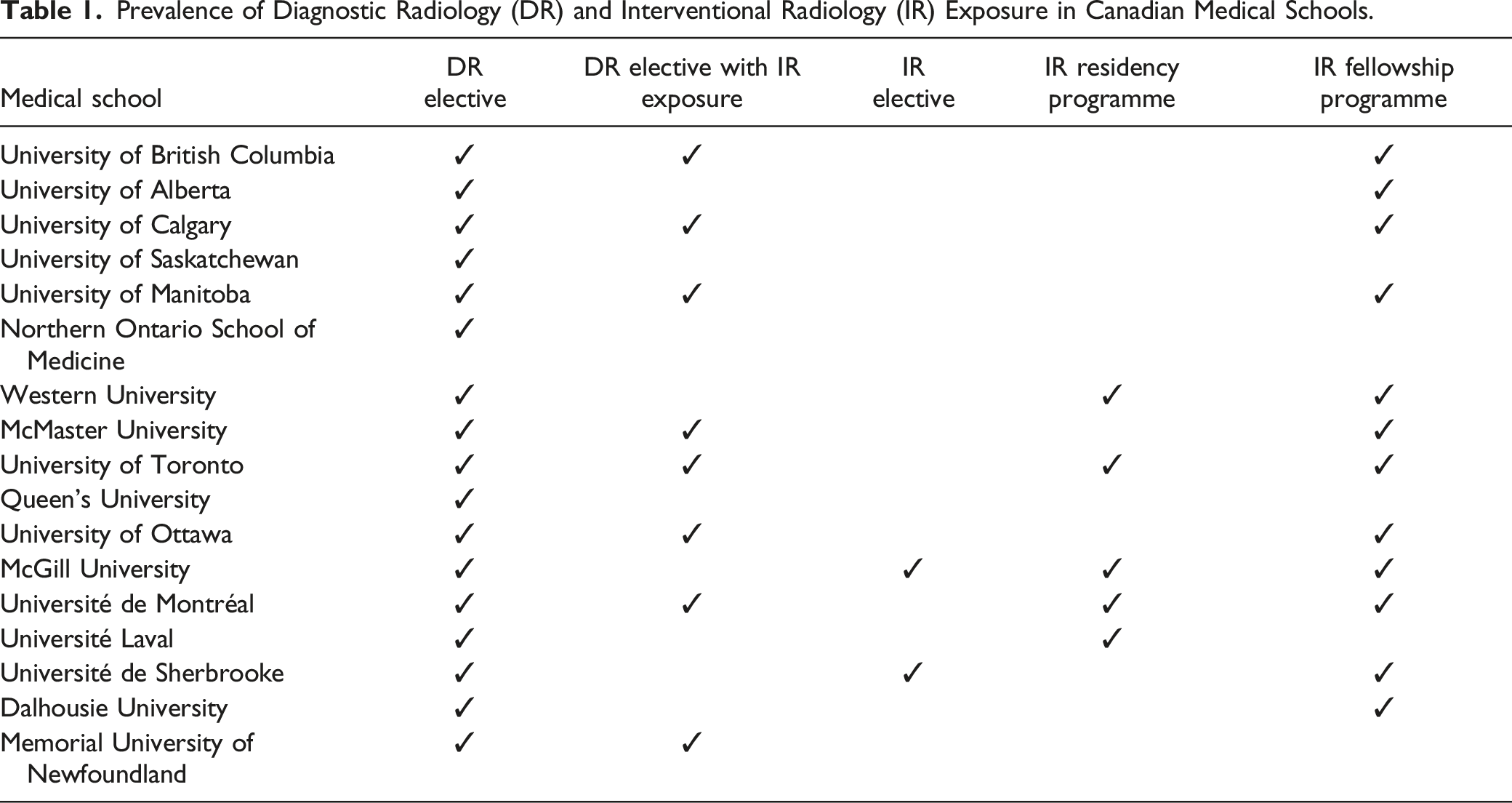
Prevalence of Diagnostic Radiology (DR) and Interventional Radiology (IR) Exposure in Canadian Medical Schools.
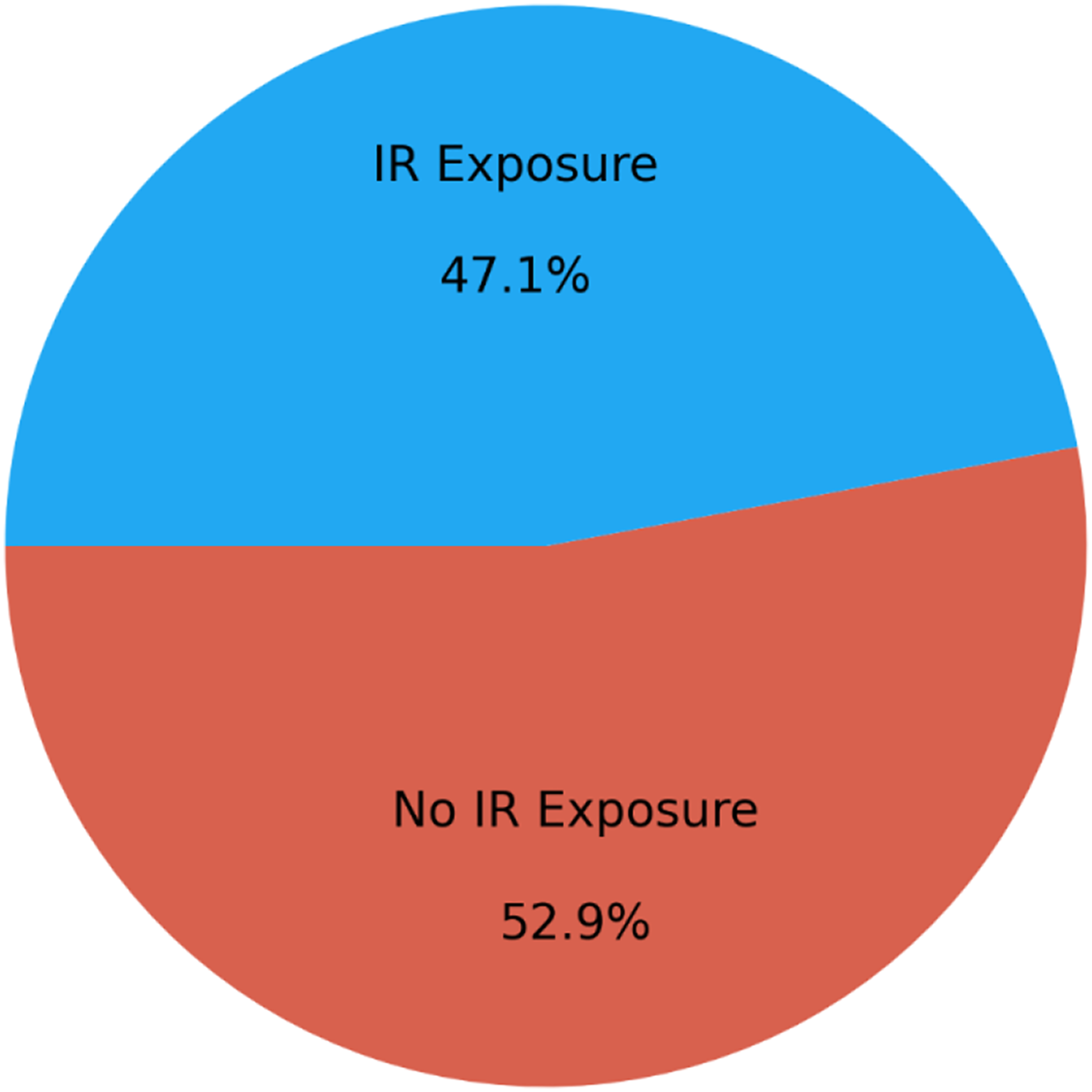
Exposure to interventional radiology during diagnostic radiology clerkship electives in Canadian medical schools.
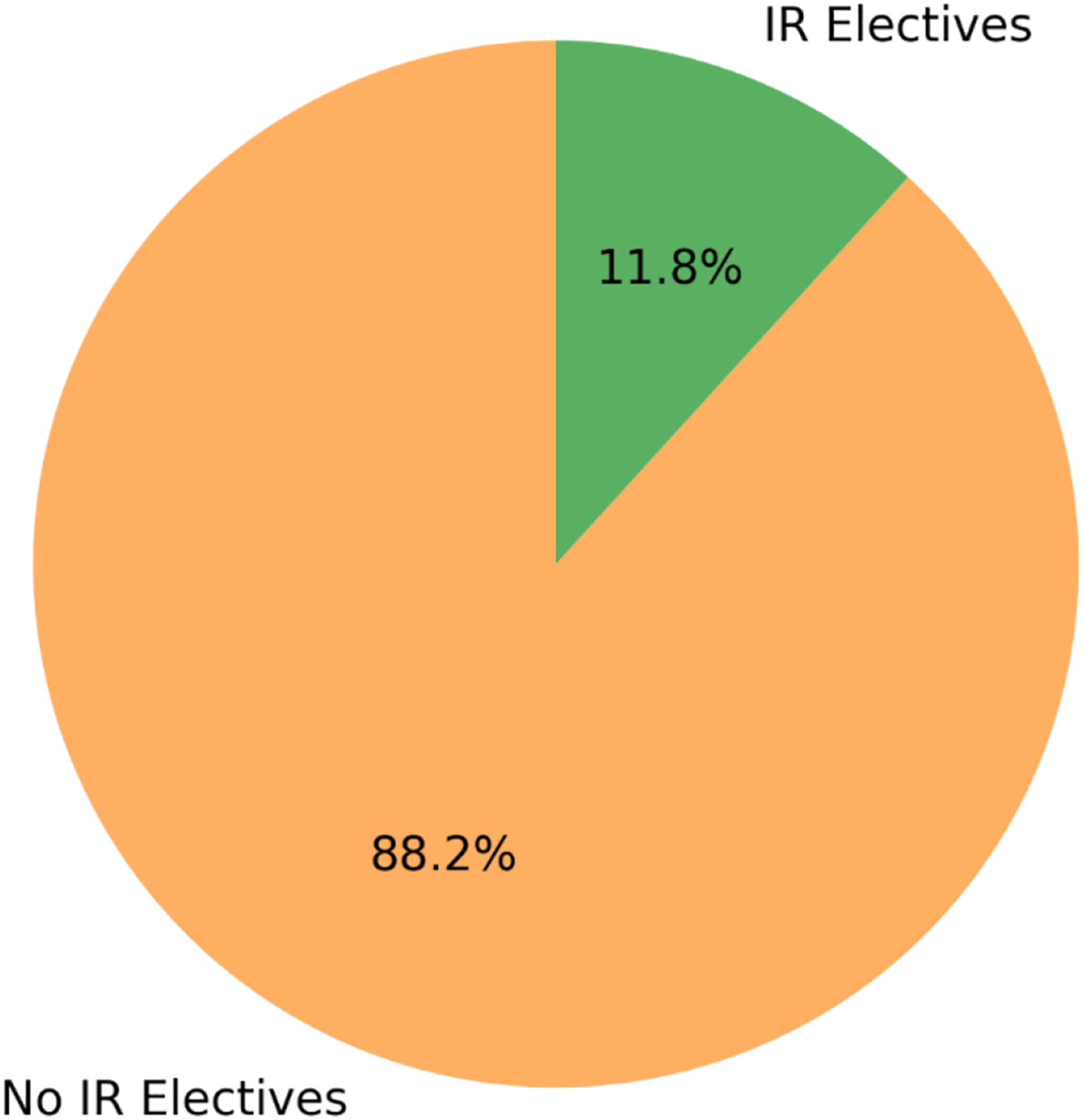
Prevalence of interventional radiology clerkship electives in Canadian medical schools.
Discussion
Interventional radiology has grown rapidly in Canada over the last 30 years. 3 The training paradigm to become an interventional radiologist is transitioning from a fellowship-based model to a residency-based model. 4 However, the access to official senior medical student electives in IR has not been studied. The present study demonstrates that exposure to IR during DR electives was uncommon and official IR electives were rarely offered in Canada.
Less than half of Canadian medical schools offered exposure to IR during DR electives. This limited exposure to IR is congruent with a study by O'Malley and Athreya 5 where 33% of survey respondents at a 3-year Canadian medical school reported no exposure to IR. Despite five accredited IR residency programmes and 12 IR fellowship programmes across the country, IR electives for medical students were only offered by two medical schools. Furthermore, Canadian medical schools lag counterparts in countries such as the United States where 70.5% of medical schools offered IR electives. 6 Based on our findings, there are several opportunities to increase exposure to IR during clerkship by expanding existing DR electives or creating novel IR electives.
As more IR residency programmes become accredited in Canada, it is crucial for medical students to be exposed to and involved in all clinical aspects of IR. Future physicians will likely collaborate with interventional radiologists at some point during their careers while providing patient care. Increased exposure to IR during clerkship would likely spur interest in the speciality and help IR residency programmes recruit highly qualified applicants. Even if students decide to pursue a career in another speciality, a greater awareness of the benefits of performing minimally invasive procedures with imaging guidance could strengthen referral bases and translate into better outcomes for patients.
In conclusion, exposure to IR during medical school is limited across Canada and concerted efforts should be made to offer medical students more exposure to the speciality.
Footnotes
Declaration of Conflicting Interests
The author(s) declared no potential conflicts of interest with respect to the research, authorship, and/or publication of this article.
Funding
The author(s) received no financial support for the research, authorship, and/or publication of this article.
