




Abstract
Background
Understanding the career motivations and stress experiences of Generation Z (born after 1997) nursing students is essential for developing effective recruitment, retention, and support strategies in nursing education. Despite global evidence on career motivation in healthcare, limited research has examined these factors within the Canadian context, particularly in the province of New Brunswick.
Purpose
This study aimed to assess the factors influencing Generation Z nursing students’ decisions to pursue nursing as a career, examine sociodemographic differences in these factors, and explore associations between sociodemographic variables and perceived stress levels.
Methods
A cross-sectional survey was conducted among undergraduate nursing students in New Brunswick, Canada (n = 261). Data were collected using the validated Healthcare Career Choice Scale and a single-item stress measure. Descriptive and inferential statistics were performed to explore relationships between career choice factors, sociodemographic variables, and stress levels.
Results
Students were primarily motivated by intrinsic and social utility values, including working with patients, professional growth, and contributing to society. Significant sociodemographic differences were observed across gender, age, race/ethnicity, origin, and educational background. Participants reported moderate to high stress levels; however, stress was not significantly associated with any sociodemographic variables.
Conclusion
Findings highlight the predominance of altruistic and socially driven motivations among Generation Z nursing students and the need for supportive, inclusive, and wellness-oriented educational environments. Addressing structural and psychosocial barriers may enhance student well-being, retention, and long-term workforce sustainability.
Introduction
Globally, the demand for qualified healthcare professionals continues to rise in response to population aging, increasing chronic disease burden, and regional workforce shortages. The World Health Organization (WHO) estimates a global deficit of 10 million health workers by 2030, underscoring the need for sustained investment in nursing education and workforce development (WHO, 2024). Within Canada, nursing workforce shortages remain a persistent concern, particularly in provinces such as New Brunswick, where the combined effects of outmigration, faculty shortages, and regional disparities in healthcare access have strained the system's capacity to meet growing care demands (Canadian Institute for Health Information [CIHI], 2024; Tomblin Murphy et al., 2022). Understanding why students choose nursing as a career and what factors influence their retention in their chosen program and career are essential for building a sustainable workforce responsive to Canada's evolving healthcare needs.
Choosing nursing as a career is a multifaceted decision shaped by a combination of intrinsic, extrinsic, and social factors (Ali et al., 2024; Yasin et al., 2024). Intrinsic motivations such as altruism, compassion, and a desire to contribute to society are consistently identified as strong drivers for entering the nursing profession (Salminen-Tuomaala & Herttuala, 2022). These motivations reflect the personal value students attach to helping and improving the health outcomes of others. Extrinsic influences, including job security, income stability, and the perceived social status of nursing, also play critical roles (Marznaki et al., 2021). In addition, social networks, particularly encouragement from family and peers, can strongly shape students’ career decisions (Anieche et al., 2021; Lommi et al., 2024).
Research internationally has shown that perceived work values are not static but can vary by generational cohort (Tan & Chin, 2023; Tussing et al., 2024). Generation Z (i.e., persons born after 1997) constitutes 27% of the global workforce in 2025 (Koop, 2021), underscoring the practical importance of aligning educational and organizational strategies with their preferences. Further to this, Generation Z now represents the majority of undergraduate nursing students (Hampton & Keys, 2017). This generation has grown and matured in a digital and globalized environment, with distinct expectations for flexibility, professional growth, and technological integration in education and work (Singh & ji, 2022). The COVID-19 pandemic further accelerated this shift, as many students transitioned from predominantly in-person learning to online and hybrid education models (Kehyayan et al., 2023; Yasin et al., 2023). Compared to prior generations, they tend to value work–life balance and meaningful engagement, and are less tolerant of rigid or hierarchical workplace structures (Hodges, 2024). Understanding how these generational characteristics interact with traditional motivations for pursuing nursing is essential for developing recruitment and retention strategies that effectively resonate with today's learners and future healthcare professionals.
Generation Z is the newest generation to enter the nursing workforce. Despite extensive international research on nursing career motivations, Canadian evidence, particularly focused on Generation Z nursing students, remains scarce. New Brunswick, a bilingual and demographically diverse province, faces specific recruitment challenges due to outmigration, limited program capacity, and rural practice distribution (New Brunswick Nurses Union, 2025). Exploring the motivational patterns and stress experiences of nursing students in this context provides valuable insight into regional factors influencing both career choice and academic retention. Although Generation Z is now entering the nursing workforce, Canadian retention and interprovincial mobility analyses are more commonly reported by jurisdiction rather than generational cohort, limiting the availability of Generation Z–specific workforce estimates (CIHI, 2026). This underscores the value of examining motivations and stress among Generation Z nursing students as upstream factors that may influence future workforce retention and mobility.
Conceptually, this study is guided by Factors Influencing Teaching Choice (FIT-Choice) framework (Watt & Richardson, 2008), which has been previously applied in research on career choice among nursing students (Almutary & Al-Moteri, 2020; Yasin et al., 2024). The model integrates intrinsic value (interest and passion for the career), personal utility value (job security, salary, and advancement), and social utility value (helping others and contributing to society), while also accounting for external influences such as social prestige, prior experiences, and persuasion by others. This framework provides a comprehensive lens for examining the multifactorial nature of nursing students’ career motivations and differences across demographic and geographic groups.
Given these considerations, the present study focuses on Generation Z nursing students in New Brunswick and aims to:
Assess the factors influencing their decision to pursue nursing as a career choice; Examine potential sociodemographic differences in these influencing factors; and Explore sociodemographic differences in self-reported stress levels among nursing students.
By addressing these objectives, this study may contribute empirical evidence to inform educational, institutional, and policy strategies for nursing recruitment and retention in Canada. Findings are expected to guide regionally responsive interventions that strengthen the nursing pipeline fueling the healthcare system, enhance student well-being, and retention.
Methods and Procedures
A cross-sectional survey design was used to explore the demographic characteristics, perceived stress levels, and factors influencing the decision to pursue nursing among undergraduate nursing students in New Brunswick, Canada. This design provided a descriptive snapshot of students’ experiences across multiple nursing programs within the province.
Data Collection
Data were collected between July and September 2025 using both online and paper-based surveys. The online version of the questionnaire was created and administered through LimeSurvey, while paper copies were distributed to participants at nursing campuses in cities called Fredericton, Saint John, and Moncton to ensure accessibility and higher participation. The study targeted Generation Z undergraduate nursing students currently enrolled in a nursing program in New Brunswick. To be eligible, participants had to meet the following inclusion criteria: (1) be enrolled in an undergraduate nursing program in New Brunswick; (2) be born after 1997; (3) be studying in any year of their program; and (4) be English-speaking and attending an Anglophone university. To enhance engagement and improve response rates, participants who completed the survey were invited to enter a raffle draw to win one of 100 gift cards, each valued at $25. The recruitment message, distributed through university mailing lists, course announcements, and posters, included the survey link and a brief explanation of the study's purpose, confidentiality measures, and the optional incentive.
A sample size calculation was performed using G*Power (Version 3.1) to determine the minimum number of participants required for adequate statistical power (Faul et al., 2007). Assuming a medium effect size (F = 0.25), an alpha level of 0.05, and a power of 0.80 for between-group comparisons with a maximum of five groups, a minimum sample of 200 participants was required. The final sample exceeded this threshold, with 261 complete and eligible responses collected, thereby ensuring sufficient statistical power to detect meaningful differences and relationships across variables. However, it is worth noting that, following data collection, several sociodemographic variables were recoded into dichotomous categories to address small subgroup sizes.
Instrumentation
The survey instrument consisted of three main sections designed to gather data relevant to nursing students’ career choice. The first section gathered demographic and socioeconomic information, including age, gender, marital status, race or ethnicity, employment status, income, place of birth, high school location, and current year of study.
The second section assessed factors influencing career choice using the Healthcare Career Choice Scale (HCC-Scale), a validated instrument designed to measure multiple dimensions of motivation for pursuing a healthcare career (Almutary & Al-Moteri, 2020). The HCC-Scale comprises 12 factors including: Contribution to Society, Social Status, Career Value and Perceived Abilities, Work with Patients, Satisfaction with Choice, Job Security, Prior Experiences, Qualities, Social Influences, Fallback Career (not first choice), Difficulty (perceived difficult and challenging), and Social Dissuasion. They are rated on a five-point Likert scale (1 = strongly disagree to 5 = strongly agree). Previous studies have established the reliability (Cronbach's α = .91) and construct validity of the HCC-Scale through factor analyses (Almutary & Al-Moteri, 2020). In the current study, internal consistency reliability was examined using Cronbach's alpha. The overall HCC-Scale demonstrated good internal consistency (α = .874). Subscale reliability coefficients ranged from α = .480 to α = .859. Subscales with lower alpha values contained a small number of items (two to three items) and were interpreted with caution.
The third section included a single-item measure of perceived stress, in which participants rated their current stress level as nursing students on a 10-point scale (1 = lowest, 10 = highest). The use of a single-item scale to measure stress has been shown to be a feasible and valid approach for identifying perceived stress (Vinstrup et al., 2021).
Data Analysis
Data analyses were conducted using IBM SPSS Statistics, Version 31. Data were first screened for completeness and accuracy, and incomplete or ineligible responses were excluded from analysis. Descriptive statistics (frequencies, percentages, means, and standard deviations) were computed to summarize participants’ demographic characteristics, socioeconomic variables, and scores on HCC Scale, as well as their self-reported stress levels.
Given that the assumption of homogeneity of variances was violated for several variables, Welch's t-test were employed to compare mean differences across sociodemographic and groups. These methods provide robust estimates when variances are unequal or sample sizes differ between groups (Delacre et al., 2017; Delacre et al., 2019). Associations between continuous variables were examined using Spearman's rank-order correlation, as several variables were not normally distributed. Statistical significance was established at p < .05 for all inferential tests.
Ethical Considerations
This study received ethical approval from two institutional review boards: the University of New Brunswick Research Ethics Board (REB 2025-105) and the Toronto Metropolitan University Research Ethics Board (REB 2025-254). Participation in the study was entirely voluntary. For the online survey, consent was implied through completion and submission of the questionnaire, while for the paper-based survey, returning the completed form was considered evidence of consent. To ensure confidentiality, no identifying information was collected within the survey itself. Participants who wished to enter the raffle draw for one of 100 gift cards (each valued at $25) were directed to a separate link using a QR code, preventing any connection between survey responses and raffle entries. All data were stored securely on password-protected computers accessible only to the research team. The study adhered to the ethical principles outlined in the Tri-Council Policy Statement: Ethical Conduct for Research Involving Humans (TCPS 2), including respect for persons, concern for welfare, and justice.
Results
A total of 261 undergraduate nursing students participated in this study (M = 20.10 years, SD = 2.57). Most identified as female (87.4%), were single (60.2%), and were employed on a part-time or casual basis (65.9%). Other common income sources included government support (44.1%), scholarships (41.0%), and family support (39.8%). The mean annual income was CAD 15,530 (SD = 16.87).
Most respondents identified as White (68.2%), followed by Black or African descent (8.4%), Southeast Asian (6.1%), and smaller proportions from other groups. The majority were born (74.3%) and educated (87.4%) in Canada, and most spoke English at home (75.9%). Over half lived with family (54.8%), and nearly half were in their first year of study (44.1%). A minority reported having a disability affecting learning (16.5%) or receiving academic accommodation (13.4%). Overall, the sample represents a predominantly young, female, and Canadian-born cohort of Generation Z nursing students, most of whom are studying full-time while balancing part-time employment and multiple sources of financial support. See Table 1 for more information.
Demographic Characteristics of Participants (N = 261).
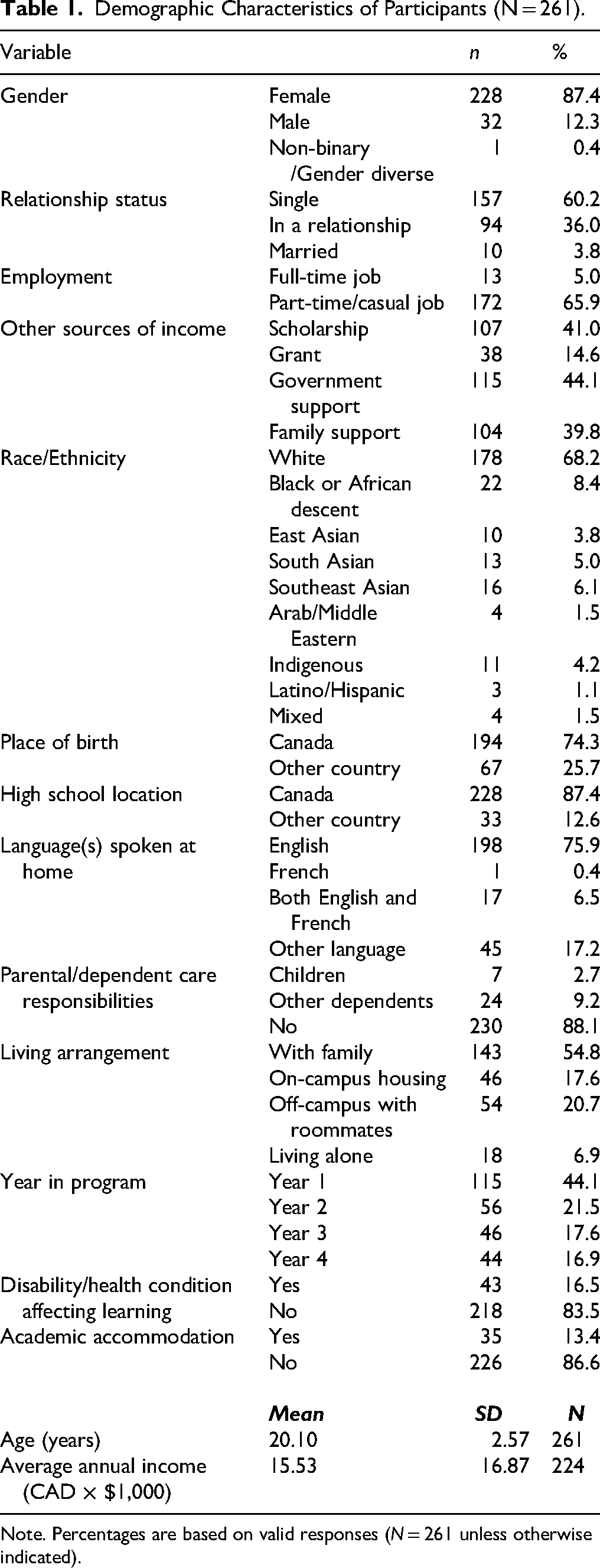
Note. Percentages are based on valid responses (N = 261 unless otherwise indicated).
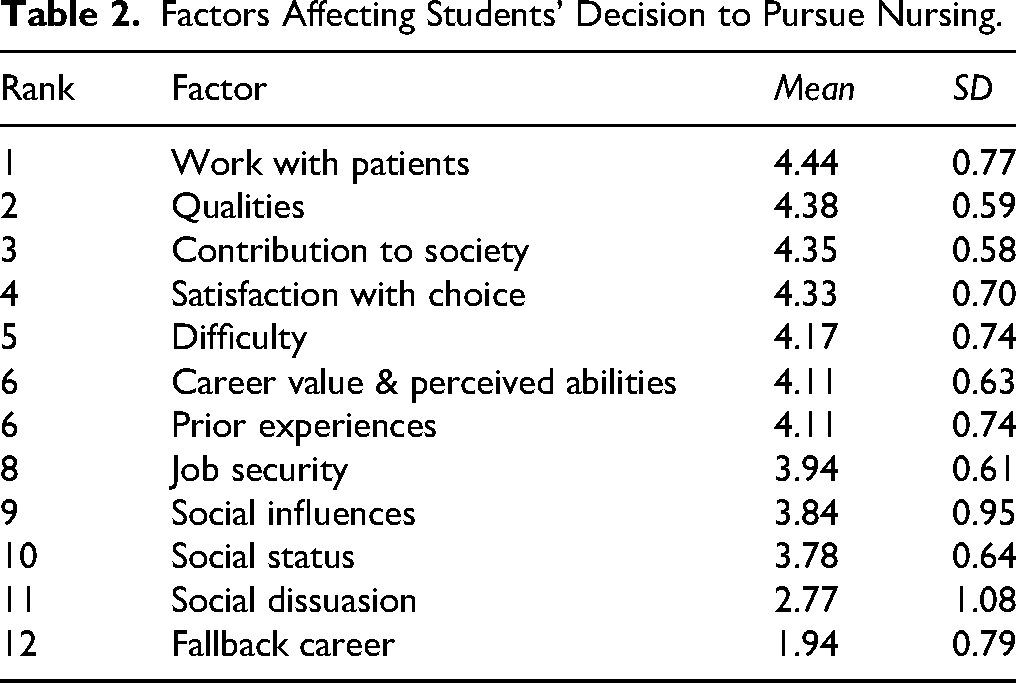
Descriptive statistics were performed for the 12 factors influencing students’ decision to pursue nursing as a career. As shown in Table 2, working with patients (M = 4.44, SD = 0.77), career qualities (M = 4.38, SD = 0.59), and contribution to society (M = 4.35, SD = 0.58) were the highest-rated motivators. Other important considerations included satisfaction with choice (M = 4.33, SD = 0.70), perceived difficulty (M = 4.17, SD = 0.74), and career value and perceived abilities (M = 4.11, SD = 0.63). In contrast, fallback career (M = 1.94, SD = 0.79) and social dissuasion (M = 2.77, SD = 1.08) received the lowest mean scores, indicating they were not major influences in students’ career decisions. Overall, results suggest that intrinsic and social utility motivations outweighed personal utility value pressures in shaping students’ nursing career choices.
Factors Affecting Students’ Decision to Pursue Nursing.
Sociodemographic Influences on Nursing Career Choice Factors
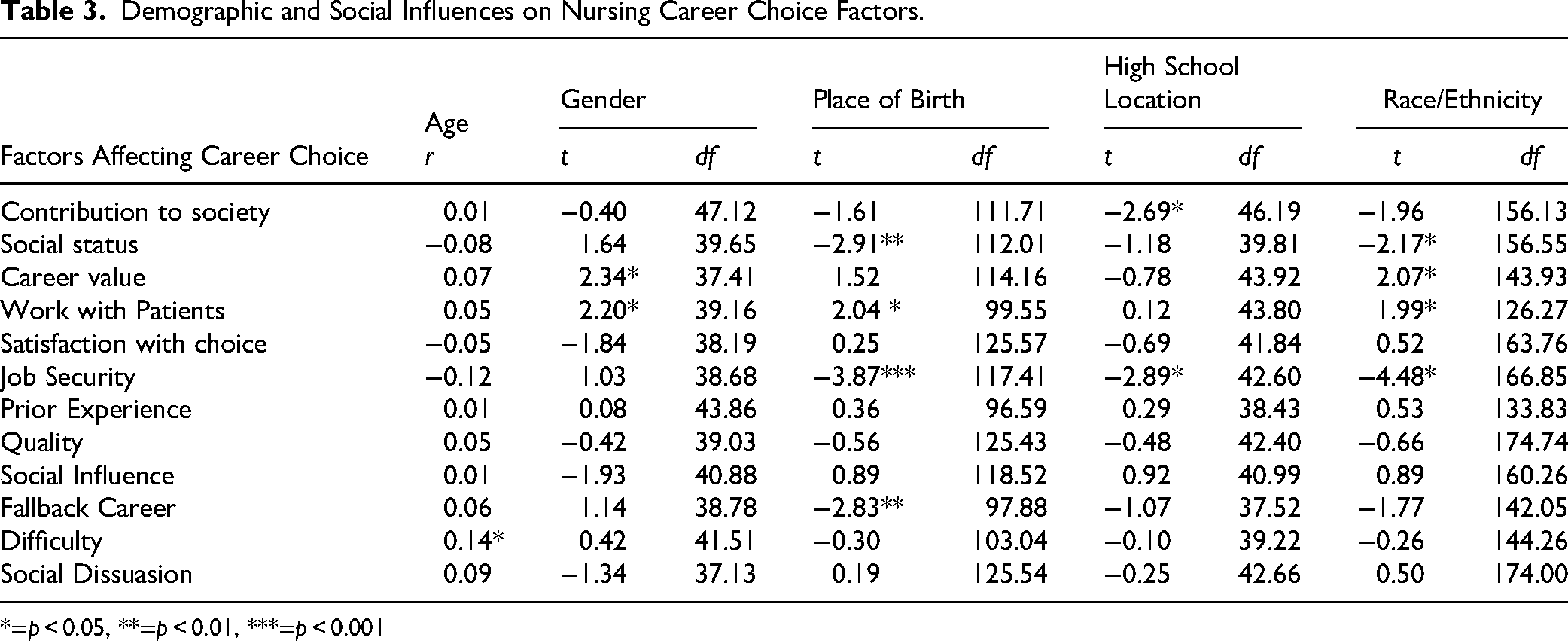
Spearman's correlations and Welch's t-tests were conducted to examine associations between sociodemographic characteristics and the 12-nursing career-choice factors (see Table 3). Age showed a small but significant positive correlation with perceived difficulty, r = .14, p < .05. Gender differences were observed for career value, and working with patients, t(37.41) = 2.34 and t(39.16) = 2.20, respectively, p < .05, with female students scoring higher.
Demographic and Social Influences on Nursing Career Choice Factors.
*=p < 0.05, **=p < 0.01, ***=p < 0.001
Students born outside Canada scored higher on social status, job security and fallback career, t(112.01) = –2.91, t(117.41) = –3.87, t(97.88) = –2.83, respectively, p < .05, whereas those born in Canada scored higher on working with patients, t(99.55) = 2.04, p < .05. Similarly, students who completed high school outside of Canada rated contribution to society and job security higher than students who completed their high school in Canada, t(46.19) = –2.69 and t(42.60) = –2.89, respectively p < .05. Furthermore, racial/ethnic differences emerged: non-white students rated social status, t(156.55) = –2.17, p < .05, and job security, t(166.85) = –4.48, p < .05 higher than white students. In contrast, white students rated career value t(143.93) = 2.07, p < .05 and working with patients t(126.27) = 1.99, p < .05, higher than non-white students.
Stress Level Among Undergraduate Nursing Students
Participants reported moderate to high levels of stress overall (M = 6.8, SD = 1.69) on a 10-point scale. Preliminary bivariate analyses were conducted to examine associations between students’ self-reported stress levels and demographic or socioeconomic variables, including age, gender, marital status, race/ethnicity, employment status, place of birth, high school location, caring responsibility, and disability/health condition. None of the variables were significantly associated with stress levels (p > .05), although age, marital status, and high school location met the inclusion threshold (p ≤ .25) for multivariate testing (Bursac et al., 2008). A subsequent multiple regression model including these predictors did not reach statistical significance, F(3, 257), p > 0.05, and explained a negligible proportion of the variance in stress scores (adjusted R2 ≈ 0). These results suggest that no single sociodemographic factor significantly predicted stress levels among undergraduate nursing students in this sample.
Discussion
The present study examined the factors influencing Generation Z nursing students’ decisions to pursue nursing as a career in New Brunswick and explored demographic and geographical differences in both career motivations and stress levels. Overall, the results revealed that students were primarily motivated by intrinsic and social utility values, such as working with patients, pursuing a high-quality profession, and contributing to society. Age, gender, place of birth, high school location, and race/ethnicity were found to have significant effects on specific career choice factors. Participants reported moderate to high levels of stress; however, no sociodemographic variable significantly predicted perceived stress levels.
Our findings are congruent with those of Yasin et al. (2024), who examined factors influencing career choice among healthcare students—predominantly from Generation Z—and found that intrinsic and social utility values ranked among the top factors considered when choosing a career. Research on Generation Zs’ career choices, particularly the intrinsic and social utility values motivating work with patients, quality, and societal contribution, has emerged as a critical area of inquiry due to this generation's growing presence in the workforce and distinct value systems. However, controversies persist regarding the relative weight of these factors across geographical regions and cultural contexts. For example, some studies emphasize the dominant role of family and societal expectations in collectivist cultures, while others highlight individual interests and intrinsic motivations in individualistic settings (Akosah-Twumasi et al., 2018; Qonitatin et al., 2023). Moreover, conflicting findings exist regarding the influence of external factors such as parental support, peer groups, and socioeconomic status (Pratiwi & Salim, 2025; Puson et al., 2024). Therefore, despite some shared characteristics of Generation Z, the factors that affect their career choices may vary depending on cultural and geographical context.
Sociodemographic variations observed in this study highlight the complex interplay between age, cultural background, gender, and prior educational experiences in shaping nursing students’ career motivations. Our findings indicate that older Generation Z students were more likely to choose nursing because they perceived its higher level of difficulty. Older Generation Z participants may perceive nursing as an opportunity for continuous learning, a source of challenge, skill-building, and career advancement (Chacko et al., 2023). Previous research has indicated that Generation Z often prefer stimulating, growth-oriented work environments that allow for creativity and continuous learning (Westover, 2026; Zebua & Pasaribu, 2025). However, our findings indicate that this preference is not homogeneous across the entire generation, being more pronounced among the older cohort.
Our findings indicate that female students placed greater emphasis on career value and working with patients, reflecting the enduring association of nursing with caregiving, empathy, and relational engagement, traits traditionally aligned with feminine socialization and professional identity (Muldoon & Reilly, 2003; Trotter, 2017). This can be explained as female students internalizing traditional gender roles linked to caring and nurturing, while males emphasizing leadership and technical roles (Myklebust, 2020; Prosen, 2022).
Furthermore, in our study, students born outside Canada prioritized social status, job security, and fallback career, suggesting that nursing may be viewed as a pathway to socioeconomic stability and upward mobility among internationally educated or immigrant populations. Similarly, job security was one of the main motivators for students who completed high school outside of Canada to pursue nursing. Furthermore, our findings indicate that non-White students chose nursing based on social status and job security. These findings are aligned with previous work showing that nursing career motivations vary across cultures, with some contexts demonstrating stronger patriarchal constraints (Elmorshedy et al., 2020; Mallah et al., 2018; Myklebust, 2020; Yasin et al., 2024). A noteworthy finding is that students who completed high school outside Canada were also motivated by the desire to contribute to society, which may reflect their willingness to demonstrate commitment to the community in which they have immigrated. This finding aligns with previous research suggesting that immigrants often express social commitment through creative, economic, and civic contributions (Hirschman, 2013; Kazemipur, 2012).
Our findings also indicated that Generation Z nursing students reported moderate to high levels of perceived stress. We did not find significant associations between perceived stress and sociodemographic factors, implying that stress is a general phenomenon among Generation Z nursing students. This finding aligns with previous work among Generation Z nursing students, where academic workload and assignments were identified as the most common stressors (Hammond-Ritschard, 2024). Perceived stress among Generation Z students has been found to be associated with self-distraction, denial, substance use, instrumental support, behavioral disengagement, venting, self-blame, and humor (Ningthoujam et al., 2021). Therefore, targeted interventions by educational leaders and policymakers are needed to help mitigate stress among nursing students and promote well-being.
Strengths and Limitations
This study offers several notable strengths. It represents one of the few investigations focusing on Generation Z nursing students in the province of New Brunswick and in Canada as general, providing valuable insights into their motivations, stressors, and sources of support within contemporary nursing education. The use of validated instruments, such as the HCC Scale, and robust statistical techniques, including Welch's t-test and ANOVA, strengthened the study's analytical rigor and internal validity.
However, several limitations should be acknowledged. The use of a cross-sectional design restricts the ability to infer causal relationships between variables. Self-reported data may also be subject to recall bias or social desirability bias, potentially influencing how participants rated their motivations and stress levels. Although efforts were made to recruit broadly across three campuses, participation was limited to nursing students in one province, which may affect the generalizability of findings to other regions or educational contexts.
Implications
The findings of this study have important implications for nursing education, policy, and future research. Educational programs should foster intrinsic motivation, professional identity, and social responsibility among Generation Z nursing students by integrating experiential and technology-enhanced learning that supports interactive and meaningful engagement. Curricula emphasizing the societal contribution and humanistic value of nursing can strengthen altruistic motivations, while wellness and resilience-building activities may help mitigate the moderate-to-high stress levels reported. Mentorship and peer-support initiatives are especially valuable for internationally educated, racialized, and male students who may experience additional challenges related to belonging and cultural adaptation.
At the policy and management level, culturally responsive and inclusive recruitment and retention strategies are needed to reflect the diverse motivations of contemporary nursing students. Institutional leaders should also prioritize mental health supports, flexible scheduling, and early interventions to reduce academic and clinical stress. Strengthened partnerships between nursing schools, professional associations, and health authorities can ensure that workforce strategies align with Generation Z's expectations for challenging, growth-oriented, and meaningful careers. Future research should examine longitudinal patterns in students’ motivations and well-being across educational and professional transitions, as well as evaluate the effectiveness of mentorship and stress-management interventions in promoting retention and success in nursing education.
Conclusion
This study provides valuable insights into the motivations and stress experiences of Generation Z nursing students in New Brunswick, offering a nuanced understanding of how sociodemographic and contextual factors shape career choice. The findings indicate that students are primarily driven by intrinsic and social utility values while also recognizing the importance of job security and professional growth. Although moderate to high stress levels were reported, no significant associations were found between perceived stress and demographic or socioeconomic characteristics, suggesting that stress is a pervasive experience across the student population.
The results emphasize the importance of fostering educational environments that strengthen students’ sense of purpose, professional identity, and well-being. Integrating experiential and technology-enhanced learning approaches, alongside mentorship and wellness initiatives, can enhance engagement and resilience among nursing students. At the policy and institutional level, culturally responsive recruitment and retention strategies that acknowledge the diverse motivations and backgrounds of Generation Z learners are critical for sustaining a strong and inclusive nursing workforce. Overall, this study contributes to the growing body of evidence on generational influences in nursing education. By aligning educational practices and workforce policies with Generation Z's intrinsic motivations for meaningful, challenging, and socially impactful work, nursing programs can better support student success and long-term professional commitment.
Footnotes

Ethical Consideration
This study received ethical approval from two institutional review boards: the University of New Brunswick Research Ethics Board (REB 2025-105) and the Toronto Metropolitan University Research Ethics Board (REB 2025-254).
Consent to participate
Participation in this study was entirely voluntary. Completion of the online survey was considered to imply informed consent to participate.
Author Contributions
Funding
The authors disclosed receipt of the following financial support for the research, authorship, and/or publication of this article: This study is funded by the Harrison McCain Foundation (Grant Number: HMF-YS-2025-11). The funder had no role in study design, data collection and analysis, decision to publish, or preparation of the manuscript.
Declaration of Conflicting Interests
The authors declared no potential conflicts of interest with respect to the research, authorship, and/or publication of this article.
Data Availability Statement
The data that supports the findings of this study are available from the first author upon reasonable request.
Disclosure Statement
During the preparation of this work the authors used ChatGPT in order to improve readability and language. After using this tool, the authors reviewed and edited the content as needed and took full responsibility for the content of the publication.