




Abstract
Background
Mega sporting events rely heavily on volunteers, yet limited evidence exists on nursing students’ motivations, a group central to health and public safety at mass gatherings such as the 2026 FIFA World Cup.
Purpose
To examine nursing students’ motivations to volunteer at the 2026 FIFA World Cup and identify implications for health-focused volunteer programs.
Methods
A cross-sectional survey was conducted with nursing students at a large urban Canadian university in Toronto (n = 241). A validated motivation scale assessed career orientation, expression of values, interpersonal contact, extrinsic rewards, patriotism, and love of sport, alongside demographics and prior volunteer experience.
Results
Career orientation, expression of values, and extrinsic rewards were the most strongly endorsed motivations, while patriotism and love of sport were least endorsed. Prior volunteer experience was not significantly associated with overall motivation. Students identifying as Middle Eastern/North African reported higher patriotic motivation than White students; other demographic differences were minimal.
Conclusions
Nursing students’ motivation to volunteer at a mega sporting event is driven primarily by professional development and prosocial values rather than event fandom or national sentiment. Health-focused volunteer programs should emphasize career-relevant benefits, define clear supervised clinical roles, and provide targeted training, including simulation. Addressing structural barriers such as scheduling may further enhance participation. Findings inform nursing education and public health preparedness for FIFA 2026 and future mass-gathering events.
Introduction
Volunteerism is widely recognized as the backbone of mega sporting events, as large-scale gatherings such as the Olympics, Commonwealth Games, and FIFA World Cup could not be delivered successfully without the dedication of volunteers (Dickson et al., 2014; Hoye & Cuskelly, 2009). Volunteers perform essential tasks ranging from logistics and hospitality to medical services and fan engagement, usually in unpaid roles, yet their collective contributions generate immense operational, social, cultural, and economic value (Angosto et al., 2021). Beyond their immediate roles, volunteers embody the spirit of participation, cultural exchange, and civic pride, making them indispensable not only for the functionality, but also for the symbolism, of mega sporting events. Healthcare student volunteering activities related to health services during pandemic or mega events build practical skills and confidence, support community health, and grow professionally (Umar et al., 2022); for instance, pharmacy students reported increased confidence in patient care after volunteering at football games (Doty et al., 2015).
Nursing-student volunteering advances professional development and community engagement by offering practical exposure, empathy-building, and identity formation (Jin & Kang, 2024). During COVID-19, nursing students gained crisis-management skills and healthcare insight, while specialty contexts (e.g., pediatric palliative care) provided direct patient interaction (Fithriyyah & Alim, 2024; Jin & Kang, 2024; Seah et al., 2021). Participation varies by demographics and is shaped by motivations and barriers, including altruism, identity, and concerns about preparedness (Prashar & Sharma, 2024; Seah et al., 2021). Overall satisfaction from volunteering among nursing students is tied to learning gains, indicating that targeted support and training can reduce hesitation and enhance engagement (Hernández-Martínez et al., 2025). Factors such as age, marital status, and educational background significantly affect nursing students’ willingness to volunteer, highlighting the need for tailored support strategies (Prashar & Sharma, 2024).
Literature highlights that mega-event volunteerism extends well beyond operational support and produces significant individual, community, and organizational legacies. At the individual level
Compared with community volunteering, which is often grounded in altruism and solidarity, volunteering at mega sporting events is frequently shaped by instrumental motives such as career advancement, skill development, networking, and participation in a once-in-a-lifetime global experience (Fairley et al., 2014; Johnson et al., 2017). This blend of personal and professional incentives positions mega-event volunteerism as a distinct phenomenon, where individual aspirations intersect with broader contributions to global sport culture. Consequently, research on motivational factors influencing volunteers, especially students at mega sporting events has become an important area of inquiry, as understanding these drivers is critical for both event success and sustainable legacy creation (Bang & Ross, 2009; Dickson et al., 2014).
Over two decades, research moved from broad motive categories to validated, event-specific scales, spanning personal growth, career goals, social connection, values, patriotism, extrinsic rewards, and love of sport (Bang & Ross, 2009; Koutrou & Pappous, 2016). Building on this work, a study by Nordin et al. (2023) found that patriotism, voluntarism, and perceived empowerment significantly predict undergraduate event management students’ community engagement in sport events, with patriotism the strongest predictor. Recognizing these motives enables organizers to tailor recruitment, training, and retention strategies that enhance volunteer satisfaction and optimize event outcomes(Chen et al., 2022; Kim et al., 2020).
Among all mega sporting events, the FIFA World Cup stands out for its global visibility, cultural significance, and scale of volunteer recruitment. Both the 2018 FIFA World Cup in Russia and the 2022 edition in Qatar mobilized tens of thousands of volunteers across diverse roles, highlighting the global reach and logistical complexity of the event (Diop et al., 2025; Suharkova, 2021). Unlike many other tournaments, FIFA volunteers are strongly motivated by sport passion and patriotism, with the “love of football” consistently emerging as a distinctive driver (Bang & Ross, 2009; Giannoulakis et al., 2015). Furthermore, the World Cup fosters intercultural exchange, as volunteers from multiple countries work side by side, creating opportunities for cultural learning, language practice, and global networking (Bang et al., 2019; Bang & Chelladurai, 2003; Bang & Lee, 2014; Bizen & Ninomiya, 2022).
For health student volunteers, sport-related opportunities such as FIFA are particularly attractive because they combine professional development with the prestige of participating in one of the most recognized global sporting brands (Holdsworth, 2010; Lu et al., 2019; Wang & Yu, 2015). Volunteering at FIFA events is often framed as a “resume booster,” offering students a chance to acquire transferable skills, enhance employability, and explore career pathways in sport management, healthcare, and hospitality (Johnson et al., 2017; Teixeira et al., 2023). On the other hand, barriers impeded health students’ involvement include, fear; inadequate training/knowledge; PPE shortages; poor preparedness/role clarity; and lack of interest, support, or protection (Susanti et al., 2023). To optimize contributions, programs should embed structured volunteer preparedness (training, safety, clear roles) into the curriculum for future pandemics (Susanti et al., 2023). These experiences may also shape long-term volunteering intentions, demonstrating the broader societal impact of FIFA volunteer programs on both professional and civic trajectories (Bang et al., 2019).
Nursing students are uniquely valuable at mega events because they sit at the intersection of clinical skill, public health, and community engagement. Their motivation to volunteer is shaped by complex interactions between individual demographics, prior experiences, and event contexts. Despite consistent evidence of multiple motivational domains, motivational profiles vary across demographic groups and are shaped by prior experiences. For example, experienced volunteers not only report higher satisfaction but also show stronger links between motivation and behavioral outcomes (Bang et al., 2019; Rozmiarek et al., 2023). National survey evidence around the FIFA 2022 World Cup in Qatar similarly demonstrates that prior service and football interest predict volunteering interest, suggesting a cumulative “volunteer career” effect (Diop et al., 2025). From a gender perspective, gender differences in volunteer motivation remain mixed across contexts. Some studies suggest that men emphasize love of sport more strongly, while women prioritize social or altruistic factors (Mahmood & Pa, 2023; Pereira & Cavalcante, 2019; VanSickle et al., 2015). Others, however, report no statistically significant gender differences once role assignments and event contexts are taken into account (Rozmiarek et al., 2023). Age and educational stage also influence motivation. Younger and student volunteers frequently prioritize career orientation, employability, and skill acquisition, while older or more experienced cohorts more often report values-based and community-centered motives (Holdsworth, 2010; Nichols & Ralston, 2016). Cultural and event-location factors add further nuance; patriotism and event uniqueness tend to be more salient in Olympic contexts, while legacy and community pride emerge more strongly in certain FIFA host nations (Dickson et al., 2014; Giannoulakis et al., 2015; Suharkova, 2021).
With Canada co-hosting the 2026 FIFA World Cup, Toronto and other host cities will depend heavily on a diverse volunteer workforce, with nursing students expected to play a major role. Understanding nursing student motivations is therefore essential not only for effective recruitment and retention but also for designing sustainable volunteer legacies that extend beyond 2026. Yet, despite a growing body of scholarship on sport event volunteerism, there remains a significant gap in knowledge regarding the nuanced motivational drivers of nursing student volunteers in the FIFA World Cup context. The literature on nursing students’ motivation to volunteer at mega sport events, particularly the FIFA World Cup is scarce; to our knowledge, this is the first study to examine nursing students as prospective FIFA World Cup volunteers.
This study makes three key contributions to the literature on volunteer motivation, nursing education, and mass-gathering preparedness. First, it extends Self-Determination Theory by empirically applying a validated international sport-event motivation framework to nursing students, a health-professional group that remains underexamined in mega-event research. Second, by situating nursing students within the context of the 2026 FIFA World Cup, the study advances conceptual understanding of volunteering at the intersection of professional identity formation, public health preparedness, and large-scale event delivery. Third, the study moves beyond descriptive accounts of student volunteering by demonstrating how distinct motivational profiles can inform theory-guided recruitment, training, and role design for health-focused volunteer programs at mega sporting events. Together, these contributions strengthen both the theoretical grounding and applied relevance of volunteer motivation research in nursing and mass-gathering contexts.
Research Questions
Is there a difference in nursing students’ ratings across the seven motivational domains for volunteering (Expression of Values, Patriotism, Interpersonal Contacts, Career Orientation, Personal Growth, Extrinsic Rewards, and Love of Sport)?
Does prior volunteer experience influence nursing students’ overall motivation to volunteer at the 2026 FIFA World Cup?
Are there differences in motivation to volunteer across the seven motivational domains based on nursing students’ demographic factors including age, gender, education level, marital status, ethnic background, and employment status?
Theoretical Framework
This study is guided by Self-Determination Theory (SDT), a well-established motivational framework that explains human behavior based on the degree to which actions are autonomously versus externally regulated (Deci & Ryan, 2008, 2012; Ryan & Deci, 2024). SDT posits that motivation exists along a continuum ranging from intrinsic motivation (engaging in an activity for inherent interest or satisfaction), through extrinsic motivation (engaging for instrumental or external reasons), to amotivation (Deci et al., 2017). Central to SDT is the premise that motivation is strengthened when three basic psychological needs are supported: autonomy (a sense of choice and volition), competence (feeling effective and capable), and relatedness (feeling connected to others) (Deci et al., 2017; Deci & Ryan, 2012).
In volunteering contexts, SDT has been widely applied to explain why individuals initiate, sustain, and derive satisfaction from unpaid service (Adams et al., 2017; Wu et al., 2016). Volunteering that supports autonomy, competence, and relatedness is associated with more self-determined forms of motivation, greater engagement, and stronger intentions to continue volunteering (Wu & Li, 2019). Within mega sporting events, motivations such as value expression and personal growth reflect more autonomous regulation, whereas motivations related to extrinsic rewards or credentials reflect more controlled forms of motivation (van Schie et al., 2019).
Applying SDT to nursing students volunteering for the 2026 FIFA World Cup enables a theoretically grounded examination of how professional development, altruistic values, and external incentives jointly shape motivation. Nursing students represent a distinctive group whose volunteering decisions are closely linked to professional identity formation, skill acquisition, and preparedness for complex health-care roles. Guided by SDT, this study examines how different motivational domains reflect varying degrees of self-determination and how these patterns inform the design of volunteer roles, training, and support structures that foster sustained engagement and readiness for mass-gathering health contexts.
Methodology
Study Design
This study employed a cross-sectional design using an online survey to explore factors influencing motivation in nursing students to volunteer for the 2026 FIFA World Cup. The cross-sectional design allowed for the assessment of relationships between demographic characteristics, prior volunteer experience, and motivation to volunteer at a single point in time, providing a snapshot of pre-event volunteer motivation patterns (Sedgwick, 2014). A convenience sampling strategy was used to recruit participants because it is a quick, easy, and cost-effective way to gather data when resources are limited (Golzar et al., 2022).
A convenience sampling approach was used to recruit nursing students from a large, urban university in Toronto, one of the official Canadian host cities for the 2026 FIFA World Cup. All currently enrolled undergraduate and graduate nursing students who met the inclusion criteria (aged 17 years or older and able to complete an online survey in English) were eligible to participate. Recruitment was conducted through institutional email distribution lists allowing broad access across year levels and program streams. The final sample (n = 241) was diverse in terms of age, gender, employment status, and ethnic background, reflecting the multicultural composition of nursing programs in large Canadian urban settings.
Although the use of convenience sampling limits statistical generalizability, this approach is appropriate for identifying motivational patterns within a specific population of interest (Golzar et al., 2022) —nursing students in a FIFA 2026 host city—who are likely to form a key component of the volunteer workforce. The sample size exceeded a priori power requirements, supporting the robustness of the statistical analyses.
The sample reflects demographic patterns commonly reported in Canadian undergraduate nursing programs, including a predominance of women, early-career students, and substantial cultural diversity. As participants were recruited from a single large urban university in Toronto—a host city for the 2026 FIFA World Cup—the cohort is particularly relevant for examining motivations within a population likely to be targeted for event-related volunteering. However, while the sample aligns with typical nursing program demographics, it cannot be assumed to be fully representative of nursing students across Toronto or Canada, where program structures, regional contexts, and volunteering opportunities may differ.
Data Collection
Data were collected between August and September 2025 using LimeSurvey, a secure, open-source web-based survey platform that supports customizable questionnaires and secure data capture (Engard, 2009). The study was situated at an urban university in Toronto, one of the official Canadian host cities for the 2026 FIFA World Cup. Toronto's selection as a host city positions it at the center of significant volunteer recruitment efforts, making it a relevant and timely context for examining pre-event motivations. Nursing students at this university were selected as the target population because they represent a large, diverse, and socially engaged nursing student body, many of whom already participate in volunteerism as part of their academic and professional development. As Toronto is one of the host cities, these students form a skilled volunteer workforce at the health–crowd-management interface for mass gatherings.
Eligible participants were required to be currently enrolled as nursing students at an urban university in Toronto, aged 17 years or older, and able to complete a 10-min in length online survey in English. To encourage participation, all students who completed the survey were given the option to enter a draw to win one of six Amazon gift cards valued at $100 each.
An a priori power analysis was conducted using G*Power 3.1 for a repeated-measures ANOVA with seven within-subject factors (Faul et al., 2009). Assuming α = 0.05, power = 0.80, and a medium effect size (Cohen's F = 0.25), the analysis indicated that a minimum of approximately 60 participants would be required to detect meaningful differences across motivational domains. Our final sample of 241 participants exceeded this requirement, providing excellent statistical power (> 0.95) to detect small-to-moderate effects in both within- and between-subject analyses.
Instrumentation
The survey consisted of three main sections. The first section captured sociodemographic information, including participants’ age, gender, education level, marital status, employment status, ethnic or cultural background, and the number of dependents living in the household. The second section assessed volunteer history using a single dichotomous item asking participants whether they had any prior volunteer experience (Yes/No). The third section measured motivation to volunteer using the Volunteer Motivation Scale for International Sporting Events (VMS-ISE). This validated instrument was originally developed by Bang and Chelladurai (2003) and later revalidated with the addition of a seventh domain, Love of Sport, to capture motivations specific to international sporting events (Bang et al., 2008). The scale assesses seven motivational domains: Expression of Values (5 items), Patriotism (5 items), Interpersonal Contacts (4 items), Career Orientation (5 items), Personal Growth (4 items), Extrinsic Rewards (2 items), and Love of Sport (4 items). All items were rated on a 7-point Likert scale ranging from 1 (strongly disagree) to 7 (strongly agree). Domain scores were computed by averaging responses to the items within each domain, with higher scores reflecting stronger endorsement of that motivational dimension. An overall motivation score was calculated by averaging responses across all items, providing a composite measure of general motivation to volunteer.
Data Analysis
Data were first examined for completeness, accuracy, and plausibility (Longford, 2008). Participants with more than 10% missing data across study variables were excluded from analyses, resulting in the removal of 87 cases and a final analytic sample of 241 participants. Little's MCAR test was conducted to assess the pattern of missing data (Li, 2013) across age, gender, education level, marital status, employment status, and number of dependents. The results were nonsignificant, χ2(10) = 7.66, p = 0.662, indicating that data were missing completely at random and justifying the use of imputation procedures. Missing values for continuous variables (e.g., age) were replaced with the sample mean, whereas missing values for categorical variables were imputed using the mode for each variable for 11 participants (<5%).
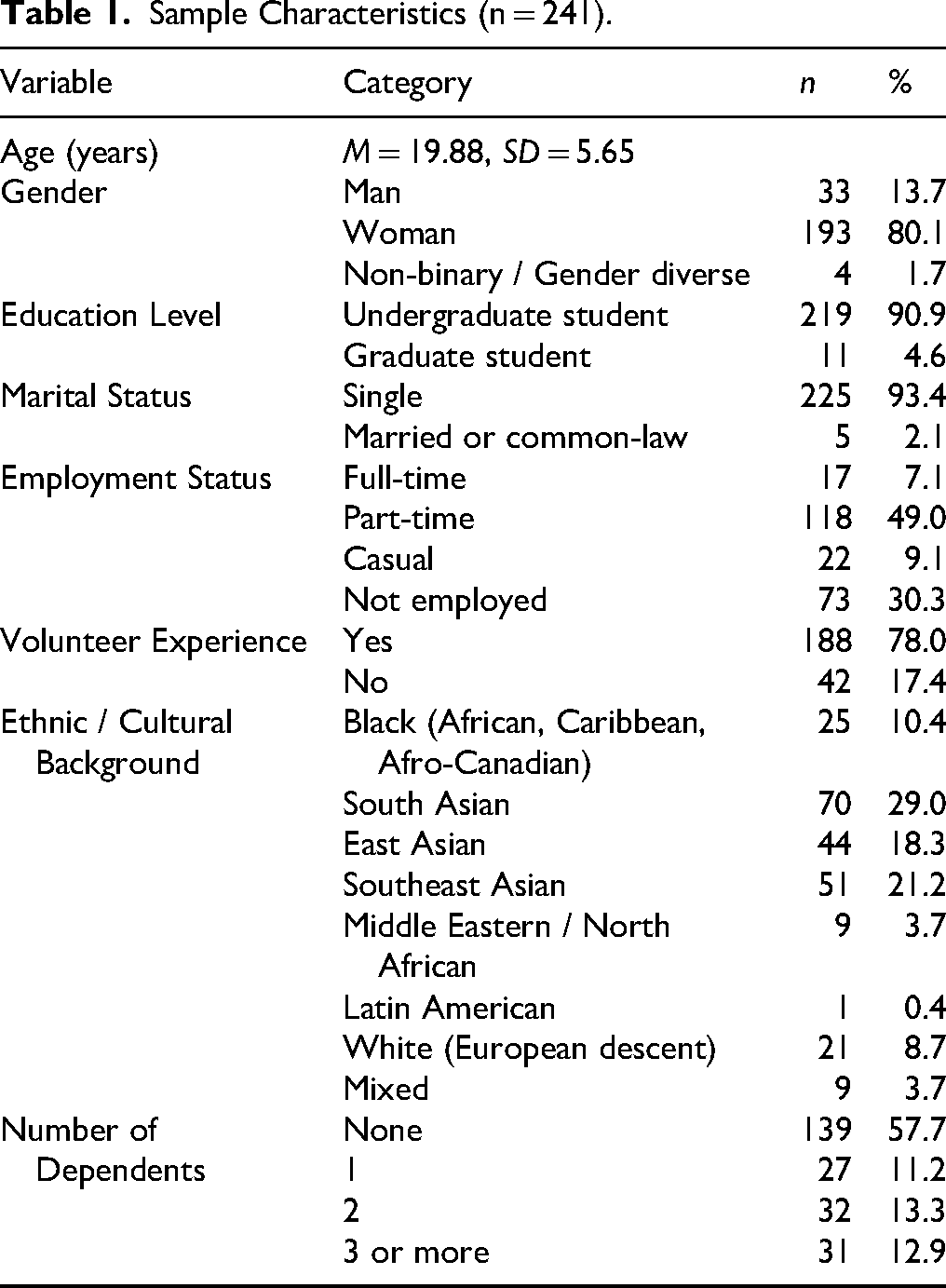
Descriptive statistics were computed to summarize sample characteristics (see Table 1). To address the first research question (RQ1: relative importance of motivators), descriptive statistics were used to find the mean and SD for each motivational domain. Then, a repeated-measures ANOVA with Greenhouse–Geisser correction was used to compare mean scores across the seven motivation domains: Expression of Values, Patriotism, Interpersonal Contacts, Career Orientation, Personal Growth, Extrinsic Rewards, and Love of Sport. The use of repeated-measure ANOVA is justified as the same participants rated all motivational domain. The second research question (RQ2: impact of prior volunteer experience) was examined using an independent-samples t-test comparing overall motivation scores (averaged across the seven domains) between participants with and without prior volunteer experience. Finally, to answer the third research question (RQ3: influence of demographic variables on motivational profiles), a mixed-model repeated-measures ANOVA was conducted with “Motivation Type” as the within-subjects factor and age (continuous), gender, education level, marital status, employment status, and ethnic background as between-subjects factors. Bonferroni-adjusted pairwise comparisons were performed where significant interactions were observed. Statistical significance was evaluated at α = 0.05, and effect sizes were reported using partial eta squared (η2).
Sample Characteristics (n = 241).
Ethical Consideration
Ethics approval was obtained from the Toronto Metropolitan University Research Ethics Board (TMU REB) (Protocol # 2025–273) in accordance with TCPS 2 and the Declaration of Helsinki; all participants provided informed consent to participate in the study and to publish the findings.
The study was conducted in accordance with the principles of the Declaration of Helsinki and followed institutional and national guidelines for research involving human participants.
Participation was voluntary. Participants were provided with an online informed consent form before beginning the survey. The consent form explained the purpose of the study, procedures, potential risks and benefits, data confidentiality, and participants’ right to withdraw at any time without penalty. No signature was required on the consent form from the participants as participant progression and completion of the survey was an indicator of participants consenting to take part in the study. All Participants were provided their consent to publish study findings as well. No identifying information was collected, and all responses were anonymous. Data were stored securely on password-protected institutional Google drive account, accessible only to the research team.
Results
Sample Characteristics
A total of 241 participants completed the survey. The mean age was 19.88 years (SD = 5.65). The majority of participants identified as women (80.1%), followed by men (13.7%) and a small proportion identifying as non-binary or gender diverse (1.7%). Most respondents were undergraduate students (90.9%) and reported being single (93.4%). Regarding employment status, nearly half (49.0%) were employed part time, 30.3% were not currently employed, 9.1% were casual workers, and 7.1% worked full time. A substantial proportion (78.0%) reported previous volunteer experience. Participants represented diverse cultural backgrounds, with the largest groups being South Asian (29.0%), Southeast Asian (21.2%), and East Asian (18.3%); smaller proportions identified as Black (10.4%), White (8.7%), Middle Eastern/North African (3.7%), or Mixed (3.7%). More than half of the respondents (57.7%) reported no dependents living in their household, while 13.3% had two dependents and 12.9% had three or more. See Table 1 for more details.
Motivation to Volunteer Across Domains
Career Orientation (M = 5.84, SD = 1.38) emerged as the most important motivator, followed closely by Expression of Values (M = 5.70, SD = 1.29) and Extrinsic Rewards (M = 5.56, SD = 1.50). Patriotism (M = 4.65, SD = 1.69) was the least endorsed motivator and was lower than all other motivators except Love of Sport. A repeated-measures ANOVA was conducted to compare mean ratings across seven motivators for volunteering at the FIFA 2026 event. The results revealed a significant main effect of motivation, F(4.56, 1095.20) = 52.55, p < 0.001, η2 = 0.18, indicating that participants rated the importance of motivators differently. Bonferroni-adjusted pairwise comparisons confirmed that Career Orientation was significantly higher than Patriotism, Interpersonal Contacts, Personal Growth, and Love of Sport (p < 0.001).
This pattern indicates that nursing students place greatest emphasis on motivations related to professional development and values-based service, while affective ties to the event itself (e.g., patriotism and love of sport) are comparatively less influential. The moderate effect size (η2 = 0.18) suggests that differences across motivational domains are not only statistically significant but also meaningful in practical terms for understanding how nursing students prioritize reasons for volunteering. (See Table 2).
Motivators Differences (n = 241
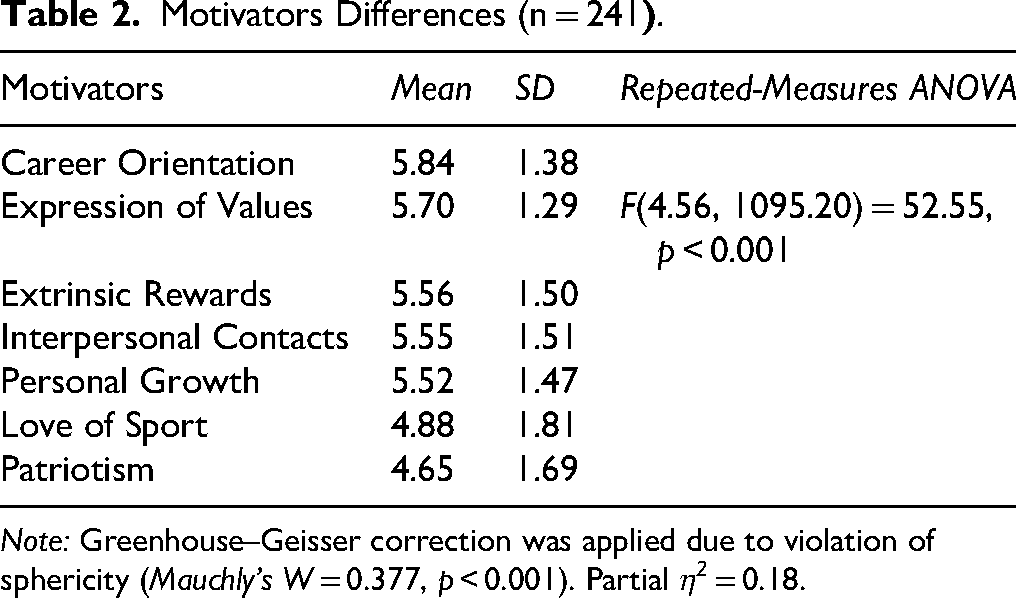
Note: Greenhouse–Geisser correction was applied due to violation of sphericity (Mauchly's W = 0.377, p < 0.001). Partial η2 = 0.18.
Influence of Prior Volunteer Experience
An independent-sample t-test was conducted to compare overall motivation to volunteer between participants with and without prior volunteer experience. The results indicated no statistically significant difference in motivation scores between those with prior experience (M = 5.41, SD = 1.23) and those without (M = 5.31, SD = 1.25), t(228) = 0.50, p = 0.619, 95% CI [–0.31, 0.52], Cohen's d = 0.08. These findings suggest that prior volunteer experience did not significantly influence participants’ overall motivation to volunteer for the 2026 FIFA World Cup. Practically, this finding suggests that both students with and without prior volunteer experience report similar overall motivation to volunteer for the FIFA 2026 World Cup, indicating that recruitment efforts may successfully engage novice volunteers as well as experienced ones.
Motivational Profiles by Demographic Characteristics
A mixed-model repeated-measures ANOVA was conducted with Motivation Type (seven domains: Expression of Values, Patriotism, Interpersonal Contacts, Career Orientation, Personal Growth, Extrinsic Rewards, Love of Sport) as the within-subjects factor, and age (continuous), gender, education, marital status, employment status, and ethnic background as between-subjects factors. The main effect of Motivation Type was not significant, F(4.58, 1030.76) = 0.91, p = 0.469, partial η2 = 0.004. See Table 3.
Mixed-Model Repeated-Measures ANOVA: Motivation × Demographics.
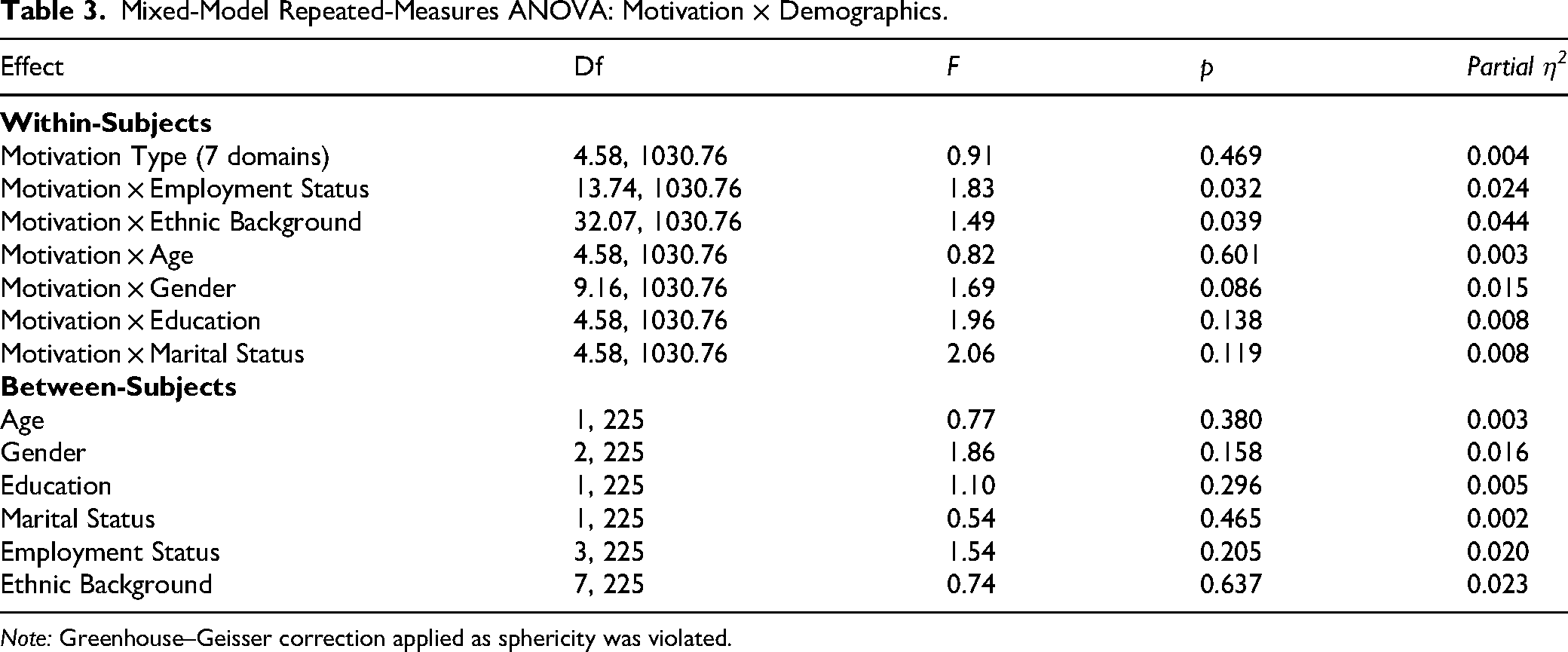
Note: Greenhouse–Geisser correction applied as sphericity was violated.
The Motivation and Ethnic Background interaction was significant, F(32.07, 1030.76) = 1.49, p = 0.039, partial η2 = 0.044. Post-hoc tests (Bonferroni) identified one specific significant contrast: on Patriotism, participants identifying as Middle Eastern/North African scored higher than those identifying as White (p = 0.013). All other ethnic-groups contrast within domains were non-significant after correction. Descriptively, some groups (e.g., Latin American on Interpersonal Contacts) showed higher means, but wide CIs reflect small cell sizes and these differences were not statistically significant. Although limited to one motivational domain, this difference suggests that cultural background may shape how specific motivations such as patriotism are experienced, even when overall motivation levels remain comparable across groups.
There was a significant Motivation and Employment Status interaction, F(13.74, 1030.76) = 1.83, p = 0.032, partial η2 = 0.024. However, Bonferroni-adjusted pairwise comparisons within each motivation domain did not yield any significant employment-group differences (all adjusted p's ≥ 0.059). Estimated marginal means suggested small, non-significant trends (e.g., higher Career Orientation for full-time vs. not employed; higher Love of Sport for casual/part-time vs. not employed), but these did not survive multiple-comparison correction. From a practical standpoint, these results indicate that employment status does not substantially alter nursing students’ motivational profiles, suggesting that volunteering interest spans students with varying work commitments.
Interactions of Motivation with age, gender, education, and marital status were not significant (all p > 0.05), indicating these characteristics did not alter motivational profiles. Finally, analyses of overall motivation (averaged across domains) showed no significant main effects of age, gender, education, marital status, employment, or ethnicity (all p's > 0.15), suggesting demographic factors were related to specific motivational domains rather than to overall motivation levels. This finding implies that motivation to volunteer is broadly shared across demographic groups within the nursing student population, supporting inclusive recruitment strategies rather than demographic-targeted approaches. Together, these results suggest that motivational differences among nursing students are more domain-specific than demographic-driven, emphasizing the importance of aligning volunteer roles with key motivational priorities rather than focusing on student characteristics. See Table 3.
Discussion
The present study offers insight into the motivations and demographic profiles of nursing students considering volunteerism at the 2026 FIFA World Cup. The sample was predominantly composed of young, single undergraduate women with diverse cultural backgrounds and prior volunteer experience. Career Orientation, Expression of Values, and Extrinsic Rewards emerged as the most influential motivators, while Patriotism and Love of Sport were least endorsed. Although overall motivation did not significantly differ by prior volunteer experience or most demographic variables, nuanced differences were observed in ethnic background. Additionally, employment status showed minor trends in motivational emphasis, though these did not reach statistical significance after correction. The absence of a significant association between prior volunteer experience and overall motivation contrasts with findings from much of the volunteerism literature and warrants careful interpretation. Methodologically, this result may reflect limited variability in the sample, as a large proportion of participants reported some form of prior volunteering, thereby reducing the ability to detect meaningful differences between groups. In addition, prior volunteer experience was assessed using a dichotomous measure, which may not have captured important distinctions in the type, intensity, duration, or relevance of previous volunteering to a mega-event context such as the FIFA World Cup. Conceptually, from a Self-Determination Theory perspective, prior experience alone may be less influential than whether volunteering opportunities support autonomy, competence, and relatedness; thus, both novice and experienced students may report comparable motivation when anticipated roles align with professional development goals and perceived preparedness.
These findings are congruent with other studies that explored students’ motivations and volunteerism at mega sport events such as FIFA World Cup. For instance, several studies concluded that career orientation drives students volunteering at mega sport events offering skills, networks, and employability and strongly predicts satisfaction and retention, especially among sport-management students and those seeking professional growth (Bang & Ross, 2009; Johnson et al., 2017; Pierce et al., 2014; Rozmiarek et al., 2023). Several scholars highlighted that expression of values, reflecting altruism and the desire to contribute to society or community, was a core intrinsic motive tied to volunteer commitment and satisfaction, giving the work meaning beyond material rewards across diverse contexts (Khoo & Engelhorn, 2011; Teixeira et al., 2023; Zainuddin et al., 2020). Extrinsic motivators such as tangible rewards, recognition, or career-related incentives influence volunteer participation, while economic rewards and psychosocial recognition have been found to impact volunteer continuance and satisfaction (Bańbuła, 2017; Kang, 2012; Ranjan, 2016). For instance, Hernández-Martínez et al. (2025) concluded that the overall satisfaction from volunteering among nursing students is tied to learning gains and proper training can reduce hesitation and enhance engagement.
The study finding around Love of Sport is congruent with previous study findings. Passion for sport or specific event themes served as a significant motivator, particularly notable in sport management and mega-event volunteers (Johnson et al., 2017; Koutrou & Pappous, 2016; Pereira & Cavalcante, 2019; VanSickle et al., 2015). While it strongly motivated initial engagement, it was less predictive of long-term satisfaction and retention compared to career or social factors (Johnson et al., 2017; Koutrou & Pappous, 2016; Pereira & Cavalcante, 2019; VanSickle et al., 2015).
With regards to Patriotism and National/Community Pride, the study finding is consistent with previous studies in the field of volunteering in sport events. While patriotism and pride in representing one's country or community motivate volunteers, especially in mega events such as FIFA World Cup or Olympics, such motivation intersects with expression of values and community involvement, with cultural and regional differences influencing its salience (Diop et al., 2025; Hallmann et al., 2018; Hallmann & Harms, 2012; Ye et al., 2022).
Our study revealed that Middle Eastern/North African participants reported significantly higher patriotic motivation compared to White participants. This finding is consistent with previous studies that concluded that motivational profiles vary by cultural context, type of sporting event, demographic characteristics, and differences between Western and non-Western contexts and among various mega events (Diop et al., 2025; Hallmann & Harms, 2012; Suharkova, 2021). The study concluded that motivation did not significantly differ by prior volunteer experience. This finding is inconsistent with previous research where prior volunteering experience positively influences motivation levels and likelihood of future engagement and experienced volunteers demonstrate higher value-driven motivations and better alignment with volunteer roles, enhancing satisfaction and retention (Rozmiarek et al., 2021; Rozmiarek et al., 2023; Zainuddin et al., 2020). This discrepancy may reflect event-specific structures, volunteer role clarity, and their prior volunteering was often non-mega-event, so skills and motives didn’t transfer to FIFA roles which could muting experience effects. Additionally, nursing students tend to focus on health related volunteering opportunities to gain practical insights into healthcare, enhance their empathy, and develop a sense of professional identity (Fithriyyah & Alim, 2024; Jin & Kang, 2024; Prashar & Sharma, 2024; Seah et al., 2021).
Employment status showed minor trends in motivational emphasis, though these did not reach statistical significance after correction. Previous studies concluded that social motivations, including making new friends and networking, play a role in volunteer engagement, although often less influential than career or altruistic motives (Ali & Abd Hamid, 2020; Bang & Chelladurai, 2009; Johnson et al., 2017; Pierce et al., 2014; Schlesinger & Gubler, 2016). These findings highlight the importance of aligning volunteer recruitment strategies with nursing students’ career aspirations and value-driven motivations; while recognizing how cultural identity, prior volunteer experience and employment may shape specific motivational dimensions.
The findings of this study contribute to self-determination theory by clarifying how established motivational domains operate within a health-professional student population in a mega-event context. While prior research on sport-event volunteering has emphasized motivations such as patriotism (Nordin et al., 2023), love of sport, and event prestige (Johnson et al., 2017; Koutrou & Pappous, 2016; Pereira & Cavalcante, 2019; VanSickle et al., 2015), the present study demonstrates that, for nursing students, professional development and values-based motivations are more salient drivers of engagement. This suggests that existing motivation frameworks require contextual interpretation when applied to health-focused volunteers, whose participation is closely tied to professional identity formation and anticipated clinical competence.
Conceptually, positioning nursing students at the intersection of education, public health, and mass-gathering preparedness extends existing volunteer motivation scholarship beyond sport management paradigms. The results highlight volunteering not merely as episodic event participation, but as a developmental and preparatory pathway through which future nurses acquire skills, confidence, and exposure to large-scale public health operations. In this sense, the study bridges volunteer motivation scholarship specifically the SDT with nursing education and disaster-preparedness literature, offering a more integrated understanding of how student volunteers contribute to and are shaped by mega events.
Finally, the study advances applied theory by illustrating how motivation profiles can inform the design of health-focused volunteer programs. Aligning recruitment messages, training structures, and role assignments with nursing students’ dominant motivations offers a theoretically grounded approach to strengthening volunteer satisfaction, preparedness, and retention. These insights underscore the value of motivation-informed strategies for developing sustainable volunteer legacies that benefit both future nurses and mass-gathering health systems.
Implications for Policy, Practice, Education and Research
The results of this study have important implications across several domains. From a policy perspective, findings highlight the need for host cities like Toronto to integrate nursing student-centered strategies into volunteer management frameworks for the 2026 FIFA World Cup. Policymakers and event organizers should consider incentives and pathways that link volunteering to nursing students’ employability outcomes, ensuring that opportunities are structured to support diverse nursing students, including those balancing work and academic commitments. Event organizers and volunteer managers should prioritize career development opportunities and the expression of personal values in recruitment and retention strategies for student volunteers, as these factors consistently predict satisfaction and continued engagement (Bang & Chelladurai, 2009; Johnson et al., 2017; Lovegrove & Fairley, 2018). Embedding equity considerations into volunteer recruitment such as recognizing cultural influences on motivations will be essential in a multicultural setting like Toronto.
For practice, volunteer programs should emphasize the career-oriented benefits of participation, including skill development, networking, and exposure to large-scale event operations by recognizing diverse student volunteers motivational profiles, enabling the design of customized roles, communication, and incentives that align with specific volunteer needs and expectation (Angosto et al., 2021; Kim et al., 2020; Schlesinger & Gubler, 2016). Organizers should design recruitment campaigns that explicitly frame volunteering as a resume booster while also providing recognition through certificates, references, or digital badges. Equally important is the development of inclusive and supportive volunteer environments that acknowledge and accommodate the varied cultural backgrounds and employment pressures of nursing student participants who also have to balance clinical practicums, shift work and a heavy course load. In terms of research, the study identifies opportunities to expand investigation into how motivational patterns evolve as mega-events approach, and how these motivations might translate into long-term civic engagement or professional trajectories. Future studies could adopt longitudinal designs, explore discipline-specific differences across student groups, or examine cross-cultural comparisons between different host countries. Future research should consider designing a health-focused nursing volunteer program for mass gatherings, defining supervised roles (i.e., Triage support, mobile first-aid, heat/smoke response, accessibility) and competencies (rapid assessment, CPR/AED, bleeding control and first aid, infection prevention, escalation and culturally safe communication). More research should test simulation-based training, clarify scope, supervision, and integrate public health and evaluate outcomes to inform scalable models of volunteering.
For education, educational institutions and event organizers should collaborate to integrate volunteer placements into curricula, emphasizing skill development, networking, and practical experience to maximize the career-oriented motivations of student volunteers and improve employability outcomes (Johnson et al., 2017; Lovegrove & Fairley, 2018). Additionally, volunteer management must address emerging challenges related to crowd management and mass public gathering safety concerns, volunteer confidence, and resource allocation to sustain volunteer engagement in mega sporting events, necessitating adaptive strategies that balance health protocols with motivational incentives (Chutiphongdech et al., 2024; Power & Nedvetskaya, 2022). The study findings underscore the value of integrating volunteer opportunities within academic programs, particularly in health-related fields like nursing. Faculty and institutions can collaborate with event organizers to provide credit-bearing or co-curricular recognition for participation, positioning crowd management during mega-event volunteering as a platform for experiential learning, leadership development, and community engagement. Such integration may strengthen both professional identity formation and civic responsibility among students.
Strengths and Limitations
This study draws strength from its large and diverse sample of 241 nursing students, which provided robust statistical power and reflected the cultural diversity of Toronto, one of the FIFA 2026 World Cup host cities. The use of a validated multi-domain tool for measuring motivation enabled a nuanced assessment of student perspectives, offering valuable insights for organizers and volunteer organizations preparing for a major global event.
However, this study is not without limitations. The cross-sectional design of the study captured motivations at a single point in time, limiting insights into how motivations may shift as the event draws nearer or between events. The focus on nursing students at one urban university in Toronto, while relevant to the host-city context, restricts generalizability to other disciplines or geographic regions. Convenience sampling may also have introduced selection bias, as students with greater interest in volunteering might have been more inclined to participate. In addition, some ethnic subgroups were underrepresented, making statistical comparisons across cultural backgrounds less reliable.
The use of a single-institution, convenience sample limits the generalizability of results to nursing students in other universities, regions, or non–host-city contexts. Second, the high proportion of participants reporting prior volunteer experience suggests potential self-selection bias, as students with existing interest in volunteering may have been more inclined to participate in the study. This bias may have influenced overall motivation levels and attenuated differences between experienced and inexperienced volunteers. Future research using multi-site sampling, probability-based recruitment, or longitudinal designs is warranted to further assess representativeness and examine how motivations evolve over time and across institutional contexts. Finally, reliance on self-report measures may have introduced social desirability bias, particularly in the reporting of altruistic or values-based motives.
Conclusion
This study provides timely evidence on the motivations of nursing students in Toronto to volunteer at the FIFA 2026 World Cup, with findings showing that career orientation, values, and extrinsic rewards are the most salient drivers, while patriotism and love of sport are less influential. The absence of significant differences based on prior volunteer experience suggests that both novice and experienced students can be engaged effectively, expanding the potential volunteer pool. While modest differences were observed across cultural and employment groups, the overall picture highlights the importance of tailoring recruitment and management strategies to reflect Toronto's diverse nursing student population. The study findings call for developing a health-specific volunteering program for mega sport events and mass public gatherings. Such programs could leverage the skills, knowledge, and civic orientation of nursing and other health students to address crowd care, first aid, health promotion, and community engagement, ensuring that their professional expertise contributes directly to both event safety and participant well-being. Embedding health-focused volunteer pathways into future mega-event planning would not only enrich student learning but also leave a meaningful legacy for public health and community resilience.
Footnotes
Acknowledgments
The author gratefully acknowledges the contributions of the participating nursing students and the insights shared by co-authors, whose collaboration and feedback strengthened the development of this manuscript.

Ethical Approval and Informed Consent Statements
Ethics approval was obtained from the Toronto Metropolitan University Research Ethics Board (TMU REB) (Protocol # 2025–273) in accordance with TCPS 2 and the Declaration of Helsinki; all participants provided informed consent to participate in the study and to publish the findings.
Author Contributions
AA served as the lead author and was responsible for conceptualization, ethics approval, data collection and analysis, drafting, and finalizing the manuscript. KM and YY contributed as co-authors, conducting analysis, providing critical input, revisions, and intellectual guidance throughout the development of the manuscript.
Funding
The authors received no financial support for the research, authorship, and/or publication of this article.
Declaration of Conflicting Interests
The authors declared no potential conflicts of interest with respect to the research, authorship, and/or publication of this article.
Data Availability Statement
De-identified survey data are available from the corresponding author on reasonable request, subject to institutional approvals and a data-sharing agreement.