




Abstract
Background
Health researchers in urban centers recognize the need to engage with inner-city community-based organizations. Funding for face-to-face engagement is often limited because most work done by agencies and academics now focuses on the use of digital technology.
Purpose
This article presents reflections from a grant project aimed at establishing community engagement between academic health researchers and interdisciplinary inner-city community health and social service providers.
Method
This study utilized a community-based participatory action approach. This study included a 1-day collaborative meeting to promote academic-agency engagement. During this meeting, the research participants brainstormed research priorities and used colored stickers to rank them. The research team met the following day to debrief the meeting and to begin analyzing the data together.
Results
The findings from this project have stimulated dialogue among the agency partners and project team researchers with respect to current collaborations, services provided, and research priorities. Although digital or virtual meetings have their place, fostering community engagement through a face-to-face meeting proved invaluable to the participants.
Conclusions
The success of this Canadian Institutes of Health Research-funded project demonstrates the value of academic-agency partnership, the positive aspects of gathering community, and engagement in better meeting the research needs of inner-city organizations.
Keywords
It is well known that inner-city community-based organizations play a fundamental role in promoting the health and social well-being of community members. The Canadian public health system aims to reduce health inequities among various populations. It is well recognized that health disparities are most prominent within inner-city neighborhoods. Therefore, it is critical to develop social justice-based initiatives that can address health inequities and, ultimately, enhance the efficiency and responsiveness of our health-care and social systems (Frohlich et al., 2006).
Community-based participatory action research (community-based PAR) is a useful research method for reducing health disparities, engaging communities, promoting social change, and building scientific knowledge (Jessell, Smith, Jemal, & Windsor, 2016; Johnson, Diaz, & Arcury, 2016). Community engagement can effectively rectify inequities by demonstrating respect for the community’s members while recognizing their inherent value and interests (Holzer, Ellis, & Merritt, 2014). This article is limited to describing the early stages of a community-based PAR project, in which academic researchers and a group of community health and social service providers representing 21 different inner-city agencies met to discuss future research priorities.
In recent years, the work of nurses (Richards, 2001), academics (Caron, 2013), and nonprofit agencies (Briones, Kuch, Liu, & Jin, 2011) has become largely dependent upon digital technology. Although previously published research has used computer technology for facilitating community-based PAR (Jessell et al., 2016), the present study was purposefully conducted using telephone contact with each agency and ultimately culminated in a face-to-face meeting of agency representatives. Direct voice contact was used to collect data for the environmental scan and to conduct the meeting with all 21 inner-city agency representatives. Even though each of the participating agencies serves a similar population, they may often have no direct involvement with one another. Therefore, the researchers wanted all participants to meet as a collective group to facilitate brainstorming, prioritize the research needs and strategies of the agencies, and develop plans for future research endeavors. Some elements of technology were used in planning this project, specifically for managing the invitations and responses; however, the researchers’ primary objective was to conduct face-to-face meetings and promote engagement that would potentially foster new relationships and strengthen existing connections.
Background and Purpose
This project stemmed from a prior pilot study conducted by three of the four researchers involved in this study. The pilot study explored the collaboration between two inner-city organizations in the same neighborhood: a mid-sized community health center and a small community ministry (Scruby, Ferguson, & Gregory, 2010). The focus of the pilot project was to examine the interaction between two community organizations in the inner-city of Winnipeg, highlight any challenges they may have encountered, and determine the potential for future collaborations within the context of primary care.
Statement of the Problem
Findings from the pilot study were widely circulated within the academic and community settings and generated interest for further research collaboration. The pilot study clearly demonstrated a need for further research to support the work of Winnipeg’s inner-city organizations. In addition, the research team recognized an equally significant need for academics to engage with agency staff to determine processes for future research collaboration.
The researchers devised a plan to host a meeting where they would ascertain research priorities from the perspectives of Winnipeg’s inner-city health and social organizations. With support from the Manitoba Centre for Nursing and Health Research (MCNHR), the research team received funding from the Canadian Institutes of Health Research (CIHR) in the form of a Planning and Dissemination Grant. Because this funding opportunity is only available on a biannual basis, the CIHR’s support of this project demonstrates the value of developing research priorities through the formation of interdisciplinary teams (CIHR, 2016).
Goals and Objectives
The long-term goal of this collaborative research project was to improve access to community health services in the Inner-city. This project had the following specific objectives: (a) conduct an environmental scan of services offered by the participating inner-city agencies and share the findings in a meeting with the participants; (b) host a day-long meeting between the academic research team and the participating inner-city agencies, in the presence of the community advisory committee (see below), to establish future research priorities for organizational collaboration and improved access to services; (c) hold a follow-up meeting to allow the research team to debrief and analyze findings from the collaborative meeting; and (d) implement a plan for knowledge translation, including a website that would provide participants with a summary of findings from the meeting and environmental scan. The CIHR’s Planning and Dissemination grant also enabled the researchers to invite an international consultant to attend the participants’ meeting as well as attend the separate meeting with the research team the following day.
Method and Procedures
Ethics
Ethical approval was received from the University of Manitoba’s Education/Nursing Research Ethics Board. Verbal voluntary consent was obtained over the phone from the agencies who agreed to participate in the environmental scan. Consent was verbal during the environmental scan because the interview occurred over the phone and the questions focused on facts about the agency that were in the public domain. Involvement with the environmental scan was separate from participation in the meeting; thus, not all agencies who participated in the environmental scan sent a representative to the meeting. All participants attending the meeting gave voluntary written informed consent by signing a consent form. The agencies were not compensated for participating in the project; however, we advertised that lunch and two refreshment coffee breaks would be provided. Importantly, the value-added outcomes of engaging the agencies as a community were noted.
Study Design
Community-based PAR is a recognized research approach which includes community representatives in each step of the research process (Johnson et al., 2016). Action research describes a family of research approaches which are distinct from each other (Chenail, St. George, Wulf, & Cooper, 2012) with significant variation existing in how community-based PAR is conducted (Jonson et al., 2016). PAR is a specific subtype of community-based research which aims to include the perspectives of other groups instead of pursuing research projects determined by the dominant group (Pavlish & Pharris, 2008). The aim of this project was to explore and identify research priorities of inner-city agencies from the perspectives of participating staff. There was therefore excellent fit between this project, and the chosen methodology as the engagement between academics and nonacademics facilitates the knowledge translation and uptake of research findings into practice, which is the goal of PAR (Langlois, Goudreau, & Lalonde, 2014). Consistent with PAR principles, the project team included community representatives throughout the research process. This included the project planning phase, which involved the collaboration between the academic research team and a five-member community advisory committee. The research phase included participants from 21 inner-city agencies in Winnipeg, who, in addition to attending the meeting, provided feedback on part of the data analysis process by prioritizing their identified research priority needs. Through these engagement efforts, the research team attended to the tenets of PAR.
Key Players in the Project
Academic research team
Three of the four academic research team members in this project had collaborated with one another on the earlier pilot study. The fourth research team member was a visiting academic, the Researcher in Residence at the College of Nursing (University of Manitoba), in the year prior to the initiation of this project. This research member was invited to participate in the project as an international consultant because of her expertise in research involving marginalized and American Indigenous populations.
MCNHR
The MCNHR at the University of Manitoba played a key role in this project. The MCNHR is housed in the College of Nursing and thus facilitated easy access and consultation for the research team. The MCNHR director attended the second day of the project and participated in planning the next steps. The MCNHR’s summer internship program facilitated the hiring of an undergraduate summer student for this project; work completed by the undergraduate student was paid from the CIHR grant.
Community advisory committee
The community advisory committee consisted of five members, all of whom had prior working relationships with each other from their involvement as community activists, volunteers, health-care providers, or religious leaders. Four of the members of the community advisory committee were also members of the advisory group in the earlier pilot study and thus had an existing working relationship with the academic research team. The community advisory committee was valuable in many ways including the selection of inner-city agencies to participate in the project. The community advisory committee members, along with graduate nursing and social work students, served as facilitators during the group discussions.
Setting and Sample
Winnipeg, Manitoba, and inner-city issues
This project took place in the summer month of July in the city of Winnipeg, which has an estimated population of over 720,000 residents and is the capital of the Province of Manitoba (City of Winnipeg, 2016). The Canadian Centre for Policy Alternatives’ (CCPA, 2014) annual “State of the Inner-city Report” highlights many inequities that disproportionately affect downtown Winnipeg residents when compared to those living in other areas of the city. The following are recent examples of issues that continue to burden inner-city residents: unemployment, poverty, crime-related violence, dependency on welfare, and housing insecurity (CCPA, 2014). The individuals who work with affected residents on the front lines are in an ideal position to identify research priorities and determine the agenda for future action and were contacted to participate in this study.
Participating inner-city agencies
The community advisory committee and research team initially compiled a list of 22 inner-city health and social service organizations to be included in the environmental scan. To ensure inclusivity, the researchers supplemented their existing knowledge with an online search as well as by outreach to other organizations (domino effect) and through discussions with community advisors. These efforts led to the addition of eight new agencies. A total of 30 agencies were contacted and agreed to participate in the environmental scan. These agencies represented employment services, family resource centers, population and public health programs, social planning programs, neighborhood and community development programs, community ministries, community health clinics, and low-income housing and emergency shelter programs. Populations served by these agencies included immigrants, refugees, and indigenous populations; low-income families; and homeless and marginalized populations. In addition to their participation in the environmental scan, each agency was invited to send a representative, such as a planner, manager, or executive director, to the 1-day meeting with the research team. Twenty-one of the agencies participated in the 1-day meeting.
Data Collection Procedures
Environmental scan
The first collaborative activity was an environmental scan, conducted by the undergraduate nursing student summer intern via telephone interviews with agency representatives. The environmental scan included an inventory of services and description of current collaborations, including front-line, programmatic, and board connections. A resource guide was developed within a few weeks of the 1-day meeting, based on analysis of data from the meeting and environmental scan. The resource guide was distributed by the research team to all participants and was also made available online. The researchers intended for the agencies to use this information to further their collaborative efforts.
Meeting Day 1
A 1-day interactive meeting was held at a local hotel at the Forks on Treaty One territory. This meeting provided agency representatives who serve inner-city populations with an opportunity to meet each other face to face as they sat in one of the seven prearranged small interdisciplinary table groups. The academic research team sat together at another table to oversee the total process working and be available for problem solving. An indigenous elder opened and closed the meeting with prayers and words. Activities for the all-day meeting included presentations, small group sharing, and large group discussions. The meeting began with a presentation that focused on relevant previous research. Small group sharing was encouraged and was centered on collaborative activities and the meaning of organizational collaboration in the inner-city. This was followed by a large group discussion to allow each of the smaller groups to report their perspectives to the larger community. During the lunch break, the international consultant provided a presentation about her community-based research with American indigenous peoples. The remainder of the meeting consisted of small group discussions focused on the identification of research priorities.
Data Analysis Procedure
Meeting Day 1
The notes from the morning group discussions were saved for reflection by the research team on Day 2, the debriefing. In the afternoon of meeting Day 1, the participating inner-city agency staff identified their research priorities and then engaged in a collective priority setting task. Each group’s suggested research priorities were written on chart paper and taped to the wall. Each participant individually ranked their top six research priorities, with a different colored dot sticker to signify the ranking of importance. For example, a red sticker meant first priority, yellow meant second priority, green meant third priority, and a blue sticker meant fourth priority. The final portion of this meeting involved bringing all the attendees together to share their ranked research priorities and identify strategies to promote collaboration.
Debriefing Day 2
Future Research Priorities and Strategies.
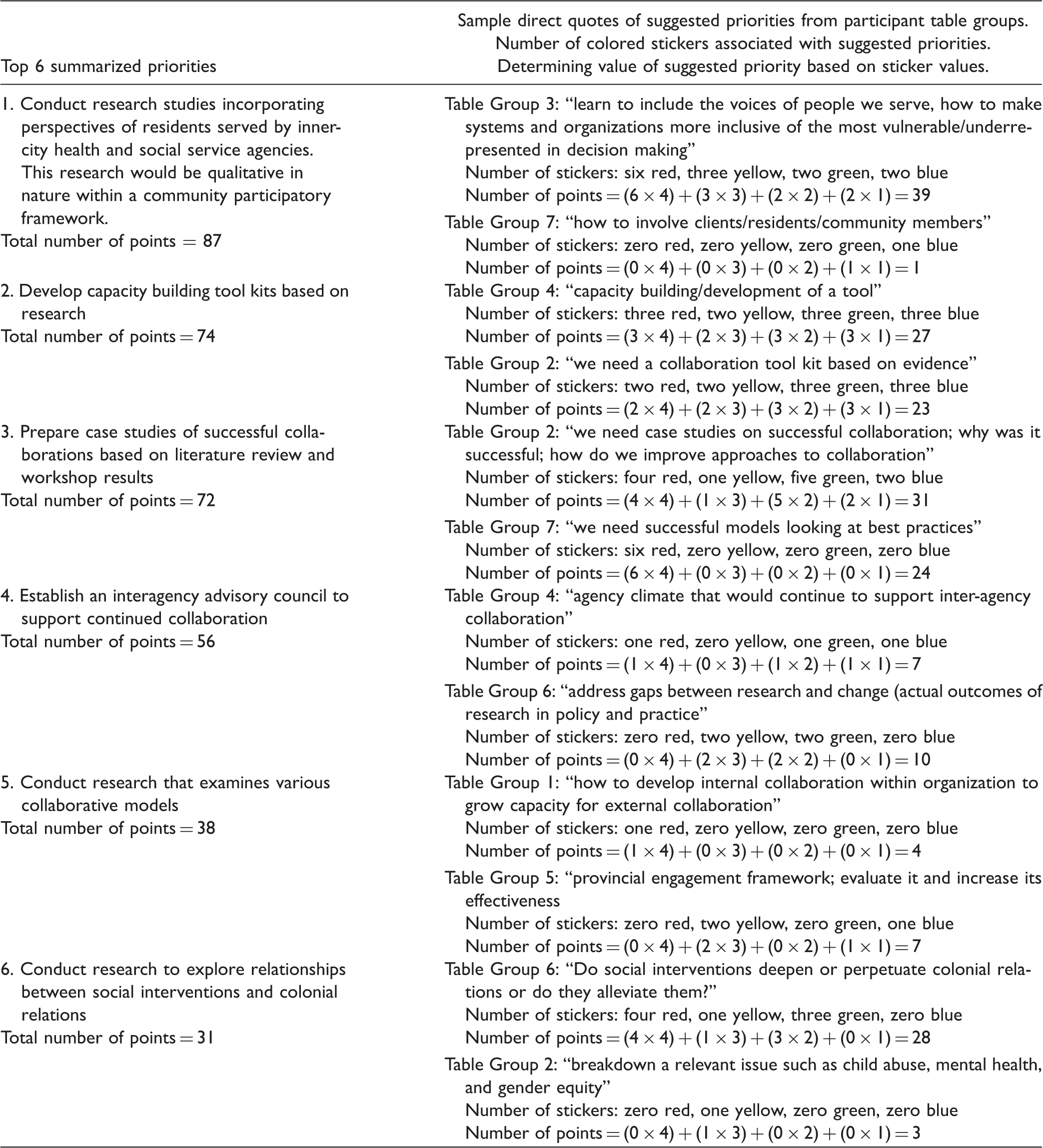
Note. Key: Red sticker—First priority and worth 4 points, yellow sticker—second priority and worth 3 points, green sticker—third priority and worth 2 points, blue sticker—fourth priority and worth 1 point.
The team arrived at the six main research priorities and strategies through looking at the data and grouping similar ideas, counting frequencies, and trying to achieve consensus among the seven table groups. Next the summer intern, under supervision, typed verbatim the flip chart data, including all the suggested priorities and the associated number of colored stickers; calculated the value of each suggestion; grouped the suggestions under the appropriate heading; and calculated the total value of each of the six headings.
Enhancing Trustworthiness
The methods of enhancing the trustworthiness of this study are described using Lincoln and Guba’s (1985) framework (Pavlish & Pharris, 2012). The credibility of this project’s findings was enhanced through the use of a participatory data collection strategy. Having the participants of the project identify and rank their research priorities and strategies using colored stickers establishes confidence in research participants’ goals for future collaboration with the academic research team. Also, the inclusion of multiple voices in the meeting (vocal plurality), as the participants were representatives of 21 different inner-city agencies who held varying levels of responsibility with the agencies, facilitated the triangulation of data from multiple sources. The criterion for transferability was met through the detailed description of the setting and participants, which can facilitate the research consumer making an accurate decision about the transferability of our findings to their setting. The detailed description also enables researchers working with inner-city agencies to replicate the PAR process with their own communities. In terms of dependability, the research team maintained an audit trail which includes the agenda for the meeting, the questions posed to the research participants, the raw data (flip charts and evaluation forms), and the academic research team’s reflections. The criterion of confirmability was enhanced also through the maintaining of an audit trail and the academic research team’s inclusion of multiple key players including the students, the MCNHR director, and the community advisory committee. These key players provided additional perspectives which made the research team aware of the different perspectives and how they can influence the study process. These considerations to enhance the trustworthiness of the findings maintained the rigor of this project throughout the data collection and data analysis phases of this research project.
Results
Overall, the results of this project were positive. The environmental scan proved to be a powerful resource for the agencies to learn about each other. The grant-supported workshop effectively brought various groups, including researchers, inner-city agency staff, and undergraduate nursing students and graduate nursing and social work students, together to engage in productive, collaborative discussions. It was especially valuable for the research team to meet on the second day and debrief future priorities for collaborative research efforts. The findings identified by the participating agencies support the future research priorities and strategies as listed in Table 1. This table also includes examples of selected quotations of suggested priorities and strategies, the number of colored stickers the participants placed next to the suggestion, and calculation of the value of the suggested priority.
Discussion
General Overview
The research priorities and strategies identified during the meeting clearly highlight that inner-city agency staff want more opportunities to build their collaboration capacity (see Table 1). Academics working directly in collaboration with inner-city agency staff members may facilitate the uptake of research findings into practice (Langlois et al., 2014). Furthermore, academic researchers are wise to engage with agencies and address the priority areas identified in collaborative discussions.
The top priority identified through meeting discussions was the need to conduct research which incorporates the inner-city residents who are accessing the services provided be the participating inner-city agencies. The meeting participants were also interested in building capacity and learning more about successful collaborations. The establishment of an inter-agency advisory council was ranked as the fourth priority. Community-based PAR requires equal involvement of all partners throughout the entire process (Pavlish & Pharris, 2012), and establishing an inter-agency advisory council would facilitate the inner-city agency staff members to have a more equitable partnership role with the academic research team in working toward addressing the identified future research priorities. Furthermore, establishing an inter-agency advisory council would support members of this project to gain further competency in collaborative practice, such as interprofessional communication and team work (Pardue, 2015), which relates to the participants fifth priority which was to examine various collaborative models.
The last priority on Table 1 reflects the meeting participants interest in exploring the relationships between social interventions and colonial relations. This priority may have come about through the design of this project such as the inclusion of an indigenous elder and a researcher whose expertise was on American indigenous populations. Canada’s history of using social interventions to violate the rights of indigenous peoples has also been part of national conversations (Truth and Reconciliation Commission, 2015). This finding supports the use of community-based PAR and face-to-face dialogue to explore the impact of colonial relations on indigenous people.
Strengths of Community-Based PAR
Interdisciplinary models of collaboration are often discussed during the education of professional and allied health students (Nassif, Herrington, Delaney, Carr, & Deshotels, 2003; Ziegler, Rigassio Radler, Heir, Cohen, & Touger-Decker, 2013). This same model of interdisciplinary collaboration can be extended to include collaborative research among academics and students, across all faculties and disciplines. In this project, we learned that inner-city agency staff also wanted to be included in designing future studies. We propose that future studies use community-based PAR as a methodology to formally include inner-city agency staff (Pavlish & Pharris, 2012). PAR is already recognized as beneficial in continuing interprofessional education in workplaces (Langlois et al., 2014); thus, it is a suitable methodology to use for facilitating inner-city agency staff to pursue their identified research priorities and strategies. A PAR approach to interprofessional learning can also create an environment facilitating inner-city staff from different agencies and an academic research team “learning together to work together” (Barr, 2013, p. 4).
Challenges
A limitation of this study is that the meeting and debriefing days were not audio recorded. Transcribing the interactions among the participants would have facilitated a more rigorous and systematic method of analyzing qualitative data generated by the research. However, this was deemed not feasible for this project given that there were 21 inner-city agency participants, four academic researchers, as well as five community advisors, sitting at eight tables during the meeting day. Conducting a focus group with a smaller group of inner-city agency participants would be better suited to an audio recorded, verbatim transcribed, qualitative research project.
Conclusion
In this increasingly digitalized world, face-to-face engagement still holds promise for identifying and reducing persistent health inequities. Bringing inner-city agencies together to identify research priorities is recognized as an important and worthwhile goal. Access to funding through the CIHR Planning and Dissemination Grant was essential to the success of our project. Using community-based PAR principles enabled successful achievement of goals and objectives including an environmental scan of services and the establishment of future research priorities.
Footnotes
Acknowledgments
The authors wish to acknowledge all participants, including the 21 inner-city agencies, service providers, undergraduate students, and graduate students who made this project a success. Appreciation is extended to the five individuals in the community advisory panel who facilitated early details of this study. Recognition is given to Anisa Isse, Kristina Janzen, and Kristine Popick for their research assistance and the Manitoba Centre for Nursing and Health Research.
Declaration of Conflicting Interests
The author(s) declared no potential conflicts of interest with respect to the research, authorship, and/or publication of this article.
Funding
The author(s) disclosed receipt of the following financial support for the research, authorship, and/or publication of this article: This study has been supported by Canadian Institutes of Health Research, Institute of Health Services and Policy Research, Planning and Dissemination Grants.