




Abstract
This article seeks to challenge dominant narratives surrounding the Great Hunger in Ireland (An Gorta Mór, 1845–1852) by focusing on the often-overlooked aspect of marine resource exploitation. Traditional historiography of the famine typically centres on the failure of the potato crop, British colonial policies and the resulting socio-economic devastations. However, this narrative largely omits the daily survival strategies and forms of resistance employed by the Irish populace, particularly in their interaction with the marine environment. This study explores how coastal communities turned towards the sea as a resource for sustenance, autonomy and resistance against oppressive conditions imposed by the crop failures and British colonial rule. By critically engaging with the role of colonial control, external aid efforts and local resistance in primary accounts, the authors argue that marine resources played an important role in the everyday survival of Irish communities in the face of systemic failures.
Introduction
The Great Hunger (An Gorta Mór, 1845–1852), also known as the Great Irish Famine and referred to in this article alternately as the Great Hunger and Famine, is perhaps one of the most thoroughly studied events in Ireland's history. This emphasis makes sense when considering the impact on Ireland's population: the Famine resulted in a demographic decline of 10–18 per cent through combined mortality and emigration, and has yet to recover. 1 While the potato blight (Phytophthora infestans) that decimated the subsistence food of the rural poor was the immediate cause of the Great Hunger, British colonial policies that prioritized laissez-faire capitalism magnified the scale of the devastation. While many studies on the topic thus far have focused on British agricultural and relief policies, legislation regarding maritime practices similarly hindered Ireland's coastal residents’ ability to exercise autonomy and acquire subsistence from marine resources. This does not mean that Irish coastal dwellers abided by British fishing laws, however. Rather, primary evidence from correspondence, newspaper articles, maps and oral histories demonstrates that many people continued to employ vernacular practices to fish and subvert colonial maritime surveillance. This article argues that, despite British attempts to exercise control over the material culture and spatial relationships associated with Irish fishing practices as a means of colonial economic rule, Irish coastal residents resisted these efforts through traditional, everyday maritime traditions.
Historical studies of everyday resistance
The impact of the Famine on Irish society in the nineteenth century has been the subject of considerable interdisciplinary historical inquiry. Researchers have largely focused on British legislative and policy decisions that magnified the scale of the disaster, 2 international and local aid efforts, 3 Irish agricultural and subsistence strategies, 4 population decline due to mortality and emigration, 5 and acts of overt resistance by the local populace. 6 These studies provide varied perspectives on the causes of, responses to and consequences of the Famine, underscoring the role of British imperial policy in undermining Ireland's ability to respond to crop failures.
There have been fewer archaeological studies on the Famine. There are notable exceptions, including bioarchaeological and dietary stable isotope research by Geber and Murphy, Beaumont et al. and Geber et al.; tenant-farmer cottage excavations by Orser; and a maritime cultural landscape study of Achill Island by Meide and Sikes. 7 These projects indicate the potential for employing material remains as a means of complicating written records, particularly in a context where surviving documents were typically written by an English-speaking elite rather than the Irish in their native language. Ó Gráda estimates that the number of Irish speakers on the eve of the Famine was somewhere in the region of 3.5 million, although the figure may indeed have been higher, with a considerable bias towards the western part of the country. 8 It is estimated that in the decade between 1841 and 1851, as many as 1.5 million native Irish speakers either died or emigrated. 9
Employing the material record is one way of interrogating how individuals shaped everyday life experiences during the Famine. Hauser has defined the ‘everyday concerns that marginalized people have to resolve’, particularly those caused by dominant structures, as ‘predicaments’. 10 In the case of the Famine, historians have established that British imperial policy created the conditions for the level of devastation (whether from malicious neglect or intentional genocide is an ongoing debate), and focusing on the material record provides a framework for interpreting how the Irish responded to these predicaments, offering a valuable means to interrogate everyday experiences of the Famine from a ‘bottom-up’ perspective. Meide and Sikes’ study on Achill Island, for instance, reveals how local choices in boat construction and the usage of vernacular watercraft like currachs and yawls were acts of defiance against British maritime policies aimed at economic control. 11 Their research highlights the role of these indigenous boats in sustaining traditional ways of life and resisting colonial interventions, thereby providing a tangible context to our analysis of marine resource procurement as a form of everyday resistance.
Narratives of the written past tend to centre on broader processes recounted by those in power – people who had the means, knowledge and ability to transcribe their versions of contemporary events. Additionally, the long-term processes of archival curation create further bias in what is preserved and who is remembered in the archival record. 12 Consequently, narratives of the past that take written records at face value overlook the lived experiences of people whose voices are not active participants in the archive.
The Haitian anthropologist Michel-Rolph Trouillot famously details this process in his text Silencing the Past, interrogating how unequal power structures function on multiple scales to create silences in the archives and shape not only how history is remembered, but also who matters in those remembrances. 13 The anthropologist James Scott is another scholar who has interrogated how those with less power exercise resistance. In Weapons of the Weak: Everyday Forms of Peasant Resistance, he found that Malaysian villagers adopted strategies including sabotage, arson and work evasion to challenge changes to farming practices. 14 Scott extended this analysis in subsequent studies to describe how subordinated groups feign deference in public settings while simultaneously developing subversive discourses in private, which he terms ‘infrapolitics’. 15 Challenging these narratives, and recentring the experiences of those neglected, erased and misrepresented in the written record, requires a ‘reading against’ the archive. 16 The methodologies employed by historical archaeologists, particularly putting material and archival records in conversation with each other, offer the opportunity to challenge the dominant narratives produced and reproduced in the written archive.
Robin advocates for an everyday approach to understanding the past because ‘in daily life the micro (self, interaction, experience) and the macro (institutions, power relations, societies) intersect’. 17 In time periods where the written record is abundant, the macro is readily apparent through legislation, contracts, tax records, land deeds and narratives of the literate, while the micro is often obscured. What archaeological approaches demonstrate, however, is that these micro-narratives are not separate from or subservient to large-scale political processes. Rather, the actions of everyday lives are essential aspects in how more visible power structures are instituted, operate and change over time. 18 Any studies of power and institutions, then, ought to take seriously evidence of everyday life.
One avenue of research that historical archaeology has been particularly attentive to is the topic of resistance. If we understand ‘resistance’ to mean not only overt acts of rebellion but, equally, individual and community refusal to accept the imposition of unjust conditions at face value, it is clear to see that where there is power, there is resistance, even in situations where it went unrecognized by those enforcing their will. 19 This perspective is important because it acknowledges the agency of those who were not in a position to take part in overt and violent acts of resistance; just because someone did not take up arms against their oppressors does not mean that they were passive subjects in their own subjugation. While the archive most frequently records overt actions of opposition, like armed rebellions, historians and archaeologists have begun to characterize the everyday ways that people expressed their dissatisfaction with authority, forcing those in power to alter their own expectations, behaviours or perspectives through actions that may not have been considered important enough to note in the written record.
For example, in her analysis of North American plantations, Camp argues that ‘[t]urning our attention to the everyday, to private, concealed, and even intimate worlds … does not merely add to what we know; it changes what we know and how we know it’. 20 By challenging these boundaries in everyday actions and engaging in short-term flight, Camp suggests that women facilitated the truancy and absenteeism of others. 21 Covert forms of resistance can include myriad actions, from food theft to idling and the intentional sabotage of labour tasks. In American colonial contexts, Ibarrola summarizes these actions, stating that African diasporic people, Indigenous Americans and other marginalized people in the colonial system ‘resisted the colonial structure by conducting illicit trade, forming anti-colonial alliances, practicing alternative religions, maintaining non-European customs, speaking African and Indigenous American languages, and actively subverting the system of slavery and white supremacy’. 22 These actions, which outwardly may have even appeared as compliance, were often small acts of resistance because they allowed people to forge their lives and communities in a political system designed to sow division and crush freedom. 23
Other authors have thoroughly investigated the role of subsistence politics and the moral economy of rural protest and agrarian crime. Beginning with Thompson, who framed eighteenth-century food riots in England as a ‘highly-complex form of direct popular action, disciplined and with clear objectives’, historians and anthropologists have reframed how they interpret such acts of resistance. 24 Bohstedt, for example, has effectively argued that ‘provision politics’ served as a negotiation over scarcity and effectively acted as a forerunner to the welfare state by pressuring wealthy citizens to provide relief. 25
Another means of interpreting everyday life is through critical cartography. Like other forms of archival documentation, cartography is not neutral and was created with a particular agenda. 26 For example, the historian Tiffany King argues that colonial mapping practices were deliberately employed to erase Black and Indigenous bodies from the landscape, as well as obscure white colonists’ lack of knowledge or control of those places. 27 In the context of plantation landscapes, Camp explains the deliberately alternative use of plantation landscapes by enslaved Africans as ‘rival geographies’, defining this as ‘alternative ways of knowing and using plantation and southern space that conflicted with planters’ ideals and demands’. 28 King further argues that historical cartography where colonial borders and structures are intentionally visible and African and Indigenous landscapes are marginalized or absent reifies ideas of white domination and Black and Indigenous absence, and was a purposeful act to obscure geographies that surveyors were unable or unwilling to map. 29 By centring actions of spatial resistance in the everyday, archaeologists can contribute to studies of how past people challenged cultural landscapes by defying stated boundaries. 30
The long-term impact of colonial violence on local populations has been described by Nixon as ‘slow violence’ or ‘a violence that occurs gradually and out of sight, a violence of delayed destruction that is dispersed across time and space, an attritional violence that is typically not viewed as violence at all’ because it occurs over such an extended period of time and so insidiously that it is embedded in the structure of a society. 31 Nixon uses this idea primarily to highlight the vulnerability, displacement and other harms from climate change, garbage dumps, oil spills and war that are disproportionately shouldered by those not in power. In the context of the Famine, the decades of British-enforced potato monoculture in Ireland that resulted in the devastation borne by the Irish population is an example of this concept. This article argues, however, that this slow violence was countered by slow resistance, or actions developed over equally long periods of time that sustained the Irish and challenged British policy 32 – in this case, traditional fishing and marine-resource-acquisition techniques that directly defied capitalist practices.
Paying attention to myriad forms of evidence of everyday life, then, broadens our understanding of both micro- and macro-historical processes. If we do not actively seek out the experiences of those who did not leave their own written records, ‘dominant groups in contemporary society are free to depict them in any way they please’. 33 Here, we argue that reading against the archival grain with particular attention to material and spatial politics indicates that residents employed the maritime environment as a means of ameliorating subsistence crises during the Famine and challenging British colonial rule.
Maritime material culture and Famine resistance
The material aspects of coastal subsistence and British colonial policies in Ireland are inextricably linked. Colonial legislation of Irish fisheries was overtly concerned with regulating what types of nets, boats and spears fishermen could use; what times of day and the year they could use them; and the spatial distribution of piers, curing houses and coastguard stations. These laws were not incidental; they sought to exercise control over the kinds of fishing the Irish could partake in, forcing even small-scale subsistence fishers into capitalist frameworks and surveilled waterscapes. Primary evidence, however, suggests that many continued to employ traditional strategies, despite the legal consequences, challenging British authority over maritime practices.
Social and legal context
Understanding the societal context in pre-Famine Ireland is crucial for grasping the various forms of resistance that emerged in the years surrounding the failure of the potato crop. Central to this understanding is the issue of land ownership and access rights. The social hierarchy in Ireland was predominantly, if not exclusively, shaped by socio-economic relationships that were deeply intertwined with the control and access to land. This stratified social structure played a pivotal role in defining social positions. 34 At the turn of the nineteenth century, the settlement of Anglo-Irish landlords on Irish estates, a consequence of the Cromwellian invasion, and the application of British colonial governance across Ireland remained structurally robust. These estates maintained control by partitioning and leasing land to a middle class of tenant farmers. These farmers generated income from their agricultural produce and further augmented their earnings by subleasing parts of their holdings to the predominantly landless rural poor. 35 By the mid nineteenth century, the potato blight, which devastated the crop essential to the Irish tenant population's subsistence, led to evictions becoming a common form of politically sanctioned violence. 36
This practice of evicting tenants for failing to pay rent was not halted at the onset of the Great Hunger in 1847. In fact, some landlords, already inclined towards eviction for rent arrears, intensified this practice during the Famine. 37 Resistance to the demands of landlords for rent payment and their encroachment on communal lands often culminated in the formation of clandestine organizations. These groups characteristically engaged in aggressive resistance strategies. 38 This also occurred at a time when the British ruling class was deeply entrenched in ‘improvement’ thinking, as critically examined by Orser. 39 This ideology, deeply rooted in Enlightenment and capitalist thought, aimed to transform the Irish landscape and industrial or commercial practices for increased economic productivity. While ostensibly aimed at agricultural advancement, these ‘improvements’ served as a mechanism for various forms of symbolic violence. Irish tenant farmers were coerced into adopting new social and economic structures aligned with colonial and capitalist norms, subtly reshaping the dynamics of power and social relations in rural Ireland.
Similarly, this pattern of exploitation and manipulation under British rule extended beyond the agricultural fields of the interior into the coastal regions and waters of Ireland. Population increases between 1821 and 1841 in coastal districts highlight significant demographic shifts that predate the Famine. 40 This trend can largely be attributed to the availability of economic opportunities. As all of Ireland's major urban centres are situated in coastal regions, they drew populations from more remote inland areas seeking sustenance and employment. Despite this migration, and perhaps partly because of it, coastal centres experienced high mortality rates during the Famine, driven by disease, overcrowding and the limitations of local economies to support the influx of impoverished populations. The demographic shifts and resulting pressures in coastal regions during this period also reflected broader sociopolitical dynamics. Nineteenth-century Irish fisheries offer a compelling example of how these dynamics were mirrored in the exploitation and systemic neglect of another vital sector of the Irish economy.
Fishermen along the Irish coastline often possessed small landholdings and predominantly engaged in fishing as a supplementary occupation. Regular organized fishing activities were confined to a few coastal towns and largely seasonal in nature, focusing on catching herring. 41 While the vast majority of these fishermen depended on local markets, additional support was available in certain areas – notably, Galway and Killybegs in County Donegal, where fish-curing facilities were established. 42 Nevertheless, these facilities were too few in number and not strategically well positioned to have a positive effect on the Irish fisheries as a whole. Irish fishermen were also constrained by limited boat types and capacities. The most common types of boat were seine boats (open rowing boats), currachs and Galway hookers (the bád mór, leathbhád, gleoiteog and púcán), each suited to specific regional conditions and fishing practices (Figure 1). Seine boats, common in the early part of the nineteenth century, were largely replaced by currachs, traditional lightweight rowing boats with a frame covered in animal hides or canvas, which were prevalent along the west coast, for instance. Their design facilitated beach-launching and shallow-water navigation without the need for a pier, but their small size and fragility limited their fishing range and capacity. Galway hookers, which were larger and sturdier, were more seaworthy but less accessible to poorer fishermen due to their cost. 43 As a result, and despite an abundance of marine wealth, deep-sea fishing was largely inaccessible to the majority of those engaged in fishing in Ireland.
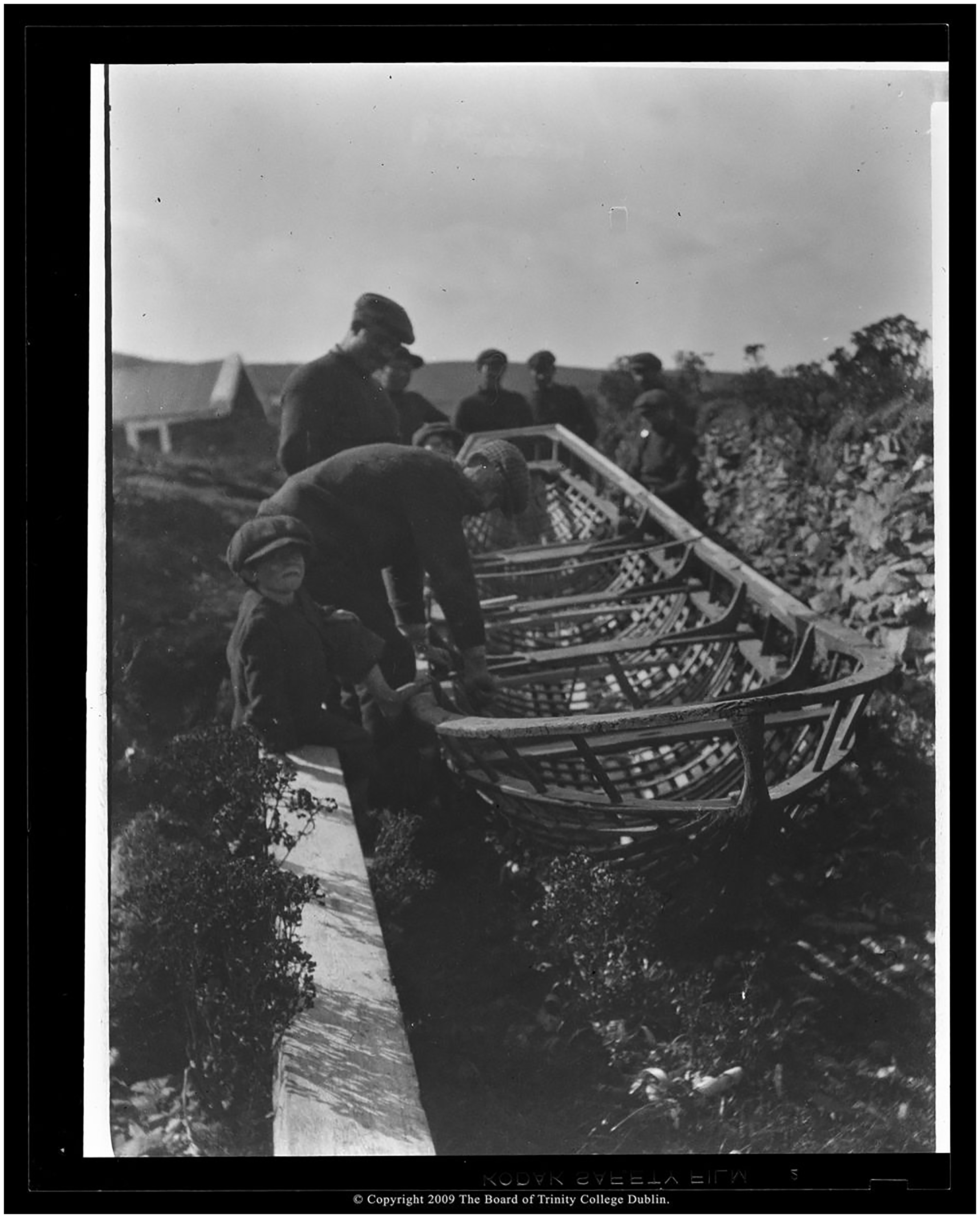
Repairing or constructing a currach on the west coast of Ireland.
The early part of this century marked a departure from the modest support the Irish fishing industry had begun to receive from the British government, leading to its gradual neglect. The establishment of the Irish Fisheries Board in 1819, along with a system of bounties that provided financial incentives for improved vessels and increased catch, initially yielded a positive response. This is most obviously reflected in the increase in the number of fishing boats and individuals employed in Ireland between 1821 and 1830, from 4,889 fishing boats employing 21,400 persons to 13,119 fishing boats employing 64,771 persons. 44
These modest supports were soon discontinued, however, in line with the ideas of Adam Smith and the principles of laissez-faire economics, which saw government subsidies, tariffs or direct aid as destabilizing forces in the free market. This attitude was bolstered by Thomas Malthus's philosophy that indiscriminate poor relief only exacerbated poverty and population growth – a theory that underpinned nineteenth-century Poor Laws in the United Kingdom. 45 Consequently, the British government adopted an attitude that the cause of economic distress was primarily due to political intervention rather than the inherent dynamics of markets or the activities of traders. From this perspective, government interference, through actions like over-regulation or restrictive trade policies, could significantly disrupt the natural balance of supply and demand, and such disruptions were more likely to lead to resource scarcity and economic hardship. 46
In an 1836 report into the state of the Irish fisheries, the number of fishermen in Ireland was recorded as 54,119, with a fleet of 10,761 boats. This represented a significant decline in the number of individuals engaged in fishing, a concerning trend given the concurrent increase in population. This was linked with the broader pattern of the collapse of small-scale industries in Ireland due to a ‘growing commitment in Westminster to “non-interference” in economic affairs’. 47 Notably, this decrease in the fishing workforce also occurred at a time when the expanding markets in Liverpool and Manchester had substantially increased the demand for products from Irish fisheries. This sharp decline in the fishing sector, occurring in an era marked by overall economic growth and heightened demand, points to severe localized hardships and underscores the critical disconnect in the sector's development. 48
By the mid nineteenth century, Ireland's fisheries were chronically underdeveloped relative to those in Britain. Despite the wealth of marine life in Irish waters, Irish fisheries were crippled by a lack of capital investment in essential infrastructure, such as ports and vessels, which was further exacerbated by inadequate transportation systems. 49 The transportation network, especially in the west, severely restricted the Irish fish trade. Eastern regions had limited road and rail links, but western Ireland generally lacked such infrastructure. 50 Additionally, few shipping services connected western ports to eastern Irish or English markets, further restricting fish transportation. In contrast, Scotland's fishing industry thrived, benefiting from an established trade, expertise in curing and government bounties. At times, this situation was further compounded by high tariffs on salt. Although the salt tax had been repealed by the 1820s, the poor transport infrastructure and continued high cost of imported or high-quality salt during the 1840s meant that preservation remained prohibitively expensive for most Irish fishing communities. 51 This disparity in support and infrastructure meant that the Irish fisheries could not fully capitalize on the island's marine wealth, as large catches often went to waste or were used only as fertilizer, underlining calls for the repeal of salt duties to boost the Irish fishing industry. 52
The Fisheries (Ireland) Act of 1842 was a significant legislative development in the regulation of Ireland's fishing industry, repealing earlier restrictive Acts and aiming to implement more liberal fishing policies. While the Act granted fishermen access to waste shores and certain limited legal rights for fishing, prohibition against the use of fixed nets and permanent structures on these shores could be seen as limiting, restricting their ability to establish stable long-term operations. Additionally, the Act's provisions allowing fishermen to cross adjacent lands were constrained by prohibitions like not crossing enclosed gardens or tillage lands, potentially hindering access to optimal fishing spots or complicating catch transportation. Moreover, the Act curtailed public access to salmon fishing. 53 This shift in access rights also adversely affected local farmer-fishers while favouring landowners, and led to shortened seasons for catching migratory fish. 54 Irish fishermen belonged, for the most part, to impoverished communities that grappled with broader issues of severe poverty, lack of infrastructure and limited market access. Consequently, while the 1842 Act provided some liberalizing measures, it fell short of addressing the deeper socio-economic challenges that hampered the Irish fisheries. The absence of substantial investment in fishing infrastructure, such as harbours or curing facilities, meant that fishermen's legal rights to fish were not supported by the necessary resources to maximize these opportunities. Writing in 1848, Brabazon identified the lack of capital investment as the chief factor underlying the poor state of Irish fisheries. 55
With the failure of the potato crop, Irish fishermen faced severe financial distress, often pawning essential items like nets, boats, clothing and tackle for food. Additionally, fishing in inland waters required a licence costing 30 shillings – a significant sum at the time – and the enforcement of this regulation was stringent, even amidst the Famine conditions. Fishermen caught without a licence or found in possession of fishing equipment faced harsh penalties, including fines and, in cases of non-payment, two-month jail sentences. 56 Tensions also arose within the fishing community, particularly regarding the use of netting in bays and estuaries. Line fishermen opposed this practice, arguing that it destroyed the spawning beds, which were crucial for maintaining fish populations. This conflict escalated to the point of violence, prompting the fisheries commission to conduct hearings to address these issues. 57
Enforcement and resistance
British imperial fishing policies centred, first and foremost, on controlling the activities of imperial subjects, with the stated goal of maximizing overall yields. These regulations focused on limiting what types of fishing equipment fishermen (and fisherwomen) could use to capture water-based resources – and particularly where, when and how. The material objects people use to access and interact with bodies of water are a critical means of taking full advantage of maritime life and are often developed through practical experience. Colonial regulation of Irish maritime activities, then, which strictly controlled net mesh, spears, lobster traps and water access, was not only an imposition of imperial capitalist priorities, but also a legal invalidation of established local systems. By the time the Famine set in, there was already a legacy of emergency legislation enacted to control political resistance and lawlessness. This came in the form of habeas-corpus suspension, the creation of new offences, the removal of trial by jury or any right to trial at all, and exceptional abilities granted to police forces. 58
British colonial governance in Ireland deployed law as a strategic tool to suppress dissent and reshape economic life – a practice increasingly theorized as ‘lawfare’. 59 Lawfare refers to the instrumentalization of legal structures to achieve military or political objectives, especially through legalistic suppression rather than overt violence. This resonates strongly with how emergency legal measures were enacted in nineteenth-century Ireland, including the frequent suspension of habeas corpus. These legal regimes were not aberrations; rather, colonial rule often depended on a state of legal exception. 60 Ireland was governed under emergency as much as under legality – a pattern that is observable in other colonial theatres.
In this context, legal interventions into Irish fisheries – limiting net mesh sizes, banning trammel nets during daylight, requiring expensive licences – must be read as elements of a broader legal architecture of control. As scholars of colonial law have shown, such regimes frequently diverged from the metropolitan legal order and justified extraordinary measures under the guise of liberal governance. 61 The imposition of British-mandated fishing practices, enforced through surveillance and punitive fines, operated within this ideological framework of liberal imperialism. In this way, Irish fishers were governed as colonial subjects through what may initially appear, on the surface, to be neutral legal interventions. When framed through a lens of everyday resistance, the decision by Irish fishermen to knowingly risk legal punishment to maintain traditional practices can be viewed as a challenge to British colonial authority.
Investment in fisheries and relief
Nineteenth-century British attitudes towards traditional Irish fishing practices, which tended to be kin-based and small scale, were overwhelmingly negative, and contemporary observers often characterized these operations as destitute and unproductive. 62 Many did, however, see the potential for both capitalist exploitation of marine resources and ameliorating widespread suffering during the Famine, particularly on the west coast. 63 One concerned citizen, for example, wrote to the Kerry Evening Post that ‘among the industrial resources with which this island is blessed, but which unhappily have been unsought by the capitalist, and unworked by the people, are her most productive fisheries’, while another asserted that ‘fishing establishments can be firmly founded upon this coast … which is not only sufficient to supply the present exigencies of this destitute people, but if persevered in will render a returning famine impossible’. 64 Observations such as these contributed to many privately, and some publicly, funded efforts to improve Irish fisheries in the second half of the 1840s. A common theme among these initiatives was financially investing in the material trappings of large-scale fishing, such as seagoing watercraft, curing houses, piers and trammel nets. 65
The Society of Friends (hereafter, Quakers) was notably dedicated to improving Irish fisheries in the years during and immediately following the Famine – efforts that have been noted by other researchers. Hatton, for example, details the long-term pattern of Quaker aid in Ireland. Hatton argues that these efforts were notable for their consistency, emphasis on social justice and absence of religious proselytization. 66 Hatton also argues that Quaker aid was distinctive because it rejected not only the laissez-faire economic policy of the Treasury, but also the religious and moral distribution justification of other private aid efforts, instead focusing on identifying and combating the underlying causes of the Famine. 67 Historical evidence, however, indicates that these efforts were not entirely divorced from the political and economic attitudes of the time.
Beginning in 1848, Quaker representatives met with fishermen in Galway on the west coast and the Claddagh, a separate community of fishermen who lived adjacent to Galway city, to determine the local needs for establishing large-scale fishing activities (Figure 2). 68 They began by assisting fishermen with recovering fishing equipment from pawnbrokers (many fishermen pawned their equipment at the beginning of the Famine to purchase food); distributing flyers on methods for curing fish so that food could be preserved longer; and ascertaining the infrastructural needs for commercial fishing. 69
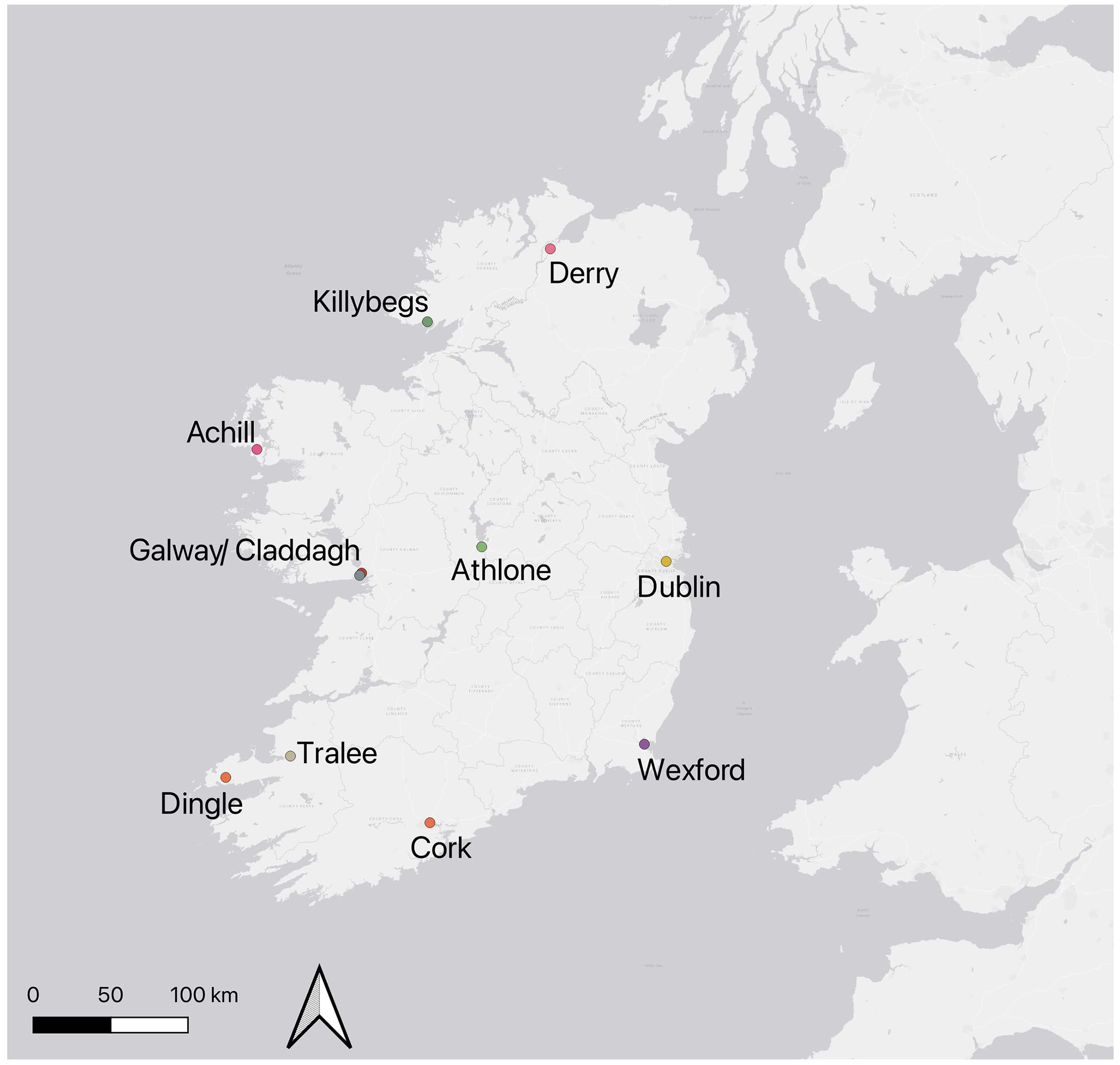
Reference map for the places discussed in this article. Source. Emily Schwalbe, map created using the Free and Open Source QGIS, 2024.
The Quakers were quick to comment on the disparity between regulations imposed on Irish fishermen compared with their counterparts in England and Scotland. One example they repeatedly returned to was the use of trammel nets. Trammel nets, which are mesh drift nets most often used to catch herring and salmon, were legally only allowed to be used during the hours of darkness by Irish fishermen. Such restrictions were much looser elsewhere, and one Quaker representative in Galway remarked that it was ‘very
In addition to lamenting the legal restrictions imposed on Irish fishermen, the Quakers noted a lack of infrastructural support for large-scale activities. This was an area where they were able to take immediate concrete action, providing loans to fishermen to acquire boats and tackle. They also decided that a curing house was necessary to increase fish sales in the region following conversations with Galway and Claddagh fishermen. One agent reported such an interaction with Claddagh fishermen, asking, ‘suppose … that some Person would build a Curing House and Salt House[?]’ – to which the fishermen allegedly responded: ‘that is what wee [sic] want … if that was the case we could catch plenty more fish in the season’. 71 After these reports, the Quakers formed a plan to build a curing house in Galway, which they would loan to local fishermen on the condition that they use it with ‘order regularity and cleanliness’. 72 The intention was that if the curing house (along with all the other equipment provided by the Quakers) was provided on loan rather than given freely, the fishermen were more likely to ‘avoid disputes or quarrels about the right of using it’ and ‘overcome their unaccountable + proverbial indolence, which keeps them in poverty’. 73
The potential for self-sufficiency was a major selling point for relief efforts targeted towards fishing. Not only did large-scale fisheries have the potential to supplement imperial income, but they would also lessen the burden on government assistance.
74
In one case, British officials reported that during the late distribution of food under the Relief Act, the fishermen … were the only persons who dispensed with government alms … We tell those who have a right to encourage the industry of their dependents on the coasts, that they must depend on themselves.
75
Those committed to ‘improving’ Irish fisheries under a capitalist model, then, saw multiple benefits: alleviating the immediate effects of the Famine on individuals; mitigating the devastation of future famines; and reducing the economic burden on imperial agents.
This is not to say that Irish fisheries were strictly non-capitalist, rather that they functioned on different scales and with different primacies than what was prioritized under British rule. Consequently, efforts and suggestions to ‘improve’ Irish fishing tended to focus on commercial fishing practices – in other words, if fishermen were not making a financial profit from their catches, the system was ineffective and needed to be reformed to conform to capitalist ideas of productivity. 76 In this way, British legislation and privately funded relief attempts were very similar. Many external Famine aid efforts focused on increasing the amount of revenue fishing communities generated by investing in infrastructure, while fundamentally changing local methods for harvesting marine resources in the process. In certain cases, aid for fishermen was contingent on changing their practices to conform with British standards. When the Quakers worked with the Claddagh community, for example, they coordinated to send fishing ‘instructors’ to bring Claddagh fishing practices in line with capitalist modes of production. 77 The Claddagh fishermen were reluctant to change their approach, however, with one Quaker representative remarking that ‘they fear they would loose [sic] their means of subsistence by the more sweeping take … hence they oppose it violently’. 78 This observation seems to indicate that, after employing British investors’ methods of fishing and subsequently catching a larger haul, the Claddagh fishermen were reluctant to continue using these techniques. Instead, they preferred a pattern of fishing with which they were familiar. Contemporary perspectives about Irish idleness were used to invalidate these concerns, and external aid organizations continued to emphasize the material expansion of infrastructure as the superior means of achieving self-sufficiency.
Acts of resistance
There is a long legacy of protest based on access to land and sea, however, which included theft, boycotting, maiming livestock, destroying crops, attacking authority figures and razing fences separating lands. The British expected violent crime to increase dramatically during the Famine years. However, the predicted riots and looting did not occur. Instead, crimes relating to destitution and subsistence grew rampant, with livestock and provisions being the subject of stealing, and violent occurrences were most prominent surrounding the transport of provisions. 79
It is important to note here that when discussing actions of resistance against the British, we are talking about systems of British colonial rule in which individuals of varying social, cultural and ethnic backgrounds were implicated. What is central to these discussions of resistance and colonial systems is how large-scale policies shape everyday experiences, and how individuals respond to and resist those effects. Not all acts of theft were intentionally targeted at British government officials; rather, they were motivated by and directed towards the situations, or ‘predicaments’, created by colonial policy. The results of these actions did not only impact British officials – for example, landowners descended from English land grantees were oftentimes born in Ireland but maintained control of Irish land as part of British rule. Consequently, although considered Irish by some, as managers of landed estates they were active participants in British colonial control of Ireland. Local raids on estate oyster beds, then, did not directly target British government officials specifically, but did act as a mode of resistance against the dispossession of Irish Catholics through generations of colonial policy.
In the context of maritime restrictions, rebellious actions ranged in scale from everyday behaviours, like collecting seaweed from privatized beaches to supplement the diet, to raids on fishing vessels and oyster beds. Actions that either violated British laws or rejected capitalist ‘best practice’ ideas of fishing are most visible in the historical record via newspaper accounts and court cases because they often held the potential for punitive action and were therefore documented by colonial officials On the evening of the 13th inst., as the thrawlers [sic] belonging to the Royal Irish Fishery Company arrived at the Dingle pier head after their day's fishing, a number of the strand fishermen jumped into the boats, seized on the fish, and made off with their prey. Some of the parties were arrested and committed to prison, informations [sic] were had against the rest. Such an outrageous act cannot be the impulse of hunger, as the Rev. E. O'Sullivan with his Coadjutors, handed over the Mr. M’Kenna, the Dingle Relieving Officer, a pound to purchase meal to relieve the most distressed of the them and the rest who sought the house were admitted. It is hoped the offenders will be severely dealt with.
80
In this case, which was similar to the one tried before the Assistant Barrister at the last January sessions of Galway, the prisoners stood indicted for having feloniously stolen from the oyster bed of Rusheenkoone, in the county Galway, the property of Thomas B Martin, Esq. 200 of oysters against the form of the statute. … His Lordship then addressed the prisoners, and said – You have been indicted for stealing oysters from the oyster bed of Rusheenkone the property of Thomas B Martin, Esq. It is right that you should understand that oysters, lying upon a bed the property of another, and marked out and known as such, are as much private property as oysters in a man’s house, and that you cannot take them without being guilty of a very great crime.
82
It is interesting to note that local tradition in Ireland frequently links coastal shell middens with the Famine period. Shellfish, generally viewed in a negative light, were commonly referred to as bia bocht or ‘poor man's food’. It has been suggested that, in at least some cases, coastal shell middens may represent a material record of local Famine-era resistance to British restrictions governing access to oyster beds, although there is some evidence that smaller Irish coastal communities utilized their local oyster beds as a more common form of sustenance, not limited to just the poor population. 83 Ease of access may have made oysters and other shellfish particularly attractive to those without access to watercraft or specialized fishing equipment.
Many rejections of British policy took place on a small scale. There are numerous cases reported in contemporary newspapers about the use of banned weirs and nets, which oftentimes resulted in a fine for the offender. For example, a case was brought against a group of men in Derry in the north when a colonial official reported that he discovered them using a net with too small mesh, along with a boat full of mullet, which he deduced they had caught using the illegal equipment. 84 In County Kerry, a Mr M. J. Foley was fined 10 shillings for fishing with an illegal net in a lake. 85 A case in Tralee several years later resulted in three men being prosecuted for illegally installing fishing weirs below the low-water line, with the conclusion that the fishery should be guarded. 86 In some instances, the illegal equipment did not even need to be in use for the court to dole out punishment. In Athlone on the River Shannon, for example, Thomas Malone and Michael Duffy were fined by the court for merely ‘having illegal Fishing Nets in their possession’. 87 While these were instances where people were caught violating fishing laws, there were undoubtedly many more cases that went undetected.
Another way that Irish fishermen repudiated British fishing policies was by continuing traditional practices after receiving aid from external agencies. Although assistance was often contingent on Irish fishermen adopting capitalist modes of resource exploitation, contemporary observers continued to despair that native residents persisted in their original methods. In Wexford on the south-east coast, for example, new methods for trapping lobster were abandoned after ‘the jealousy of the neighbouring inhabitants’, which can be read as a local rejection of imported approaches imposed at the expense of traditional methods. 88 On the west coast, the Quakers equally encountered resistance by the Claddagh to conform to new methods of fishing. In 1848, representatives reported debating with fishermen about their methods, and insisting that the Claddagh change their bait from fresh to salt herring, throwing back small fish rather than giving them to widows and children, and fishing more frequently. 89 Two years later, however, newspaper reports dampened enthusiasm for the success of recent Claddagh herring hauls by stating: ‘it is to be regretted that the Fishermen do not abandon their old nonsensical custom, and proceed to sea every night, which they are now only in the habit of doing every alternate evening’. 90 Fishermen's reluctance to adopt new technology is not necessarily unique to Irish fishermen. However, in this context, the Claddagh's refusal is significant because the adoption of new technology was, firstly, attached to aid during a time of extreme deprivation and, secondly, inextricably linked with colonial systems and expectations. Despite receiving infrastructural support from the Quakers, then, the Claddagh managed to retain at least some of their traditional practices against both the explicit demands of the Society of Friends and the capitalist priorities of the British Empire.
The Irish also did not entirely adopt specific forms of infrastructure, particularly the larger seagoing vessels, piers and curing houses insisted on and funded by external actors. There were multiple reasons for these kinds of investments: in addition to generating more wealth for investors, they were easier for colonial authorities to control than traditional smaller-scale watercraft and fishing practices. Seagoing vessels need deeper berths than smaller craft, and the necessary piers and boathouses were often built so that they could be under the scrutiny of British coastguard stations. 91 Returning to the example of Galway, Ordnance Survey maps from 1839 show that the harbour coastguard station was constructed in a location where travel to and from the water would be within surveillance. The station was situated between the Claddagh community, jetty, docks, fishery and main boathouse, meaning anyone venturing to the water would pass the colonial outpost (Figure 3).
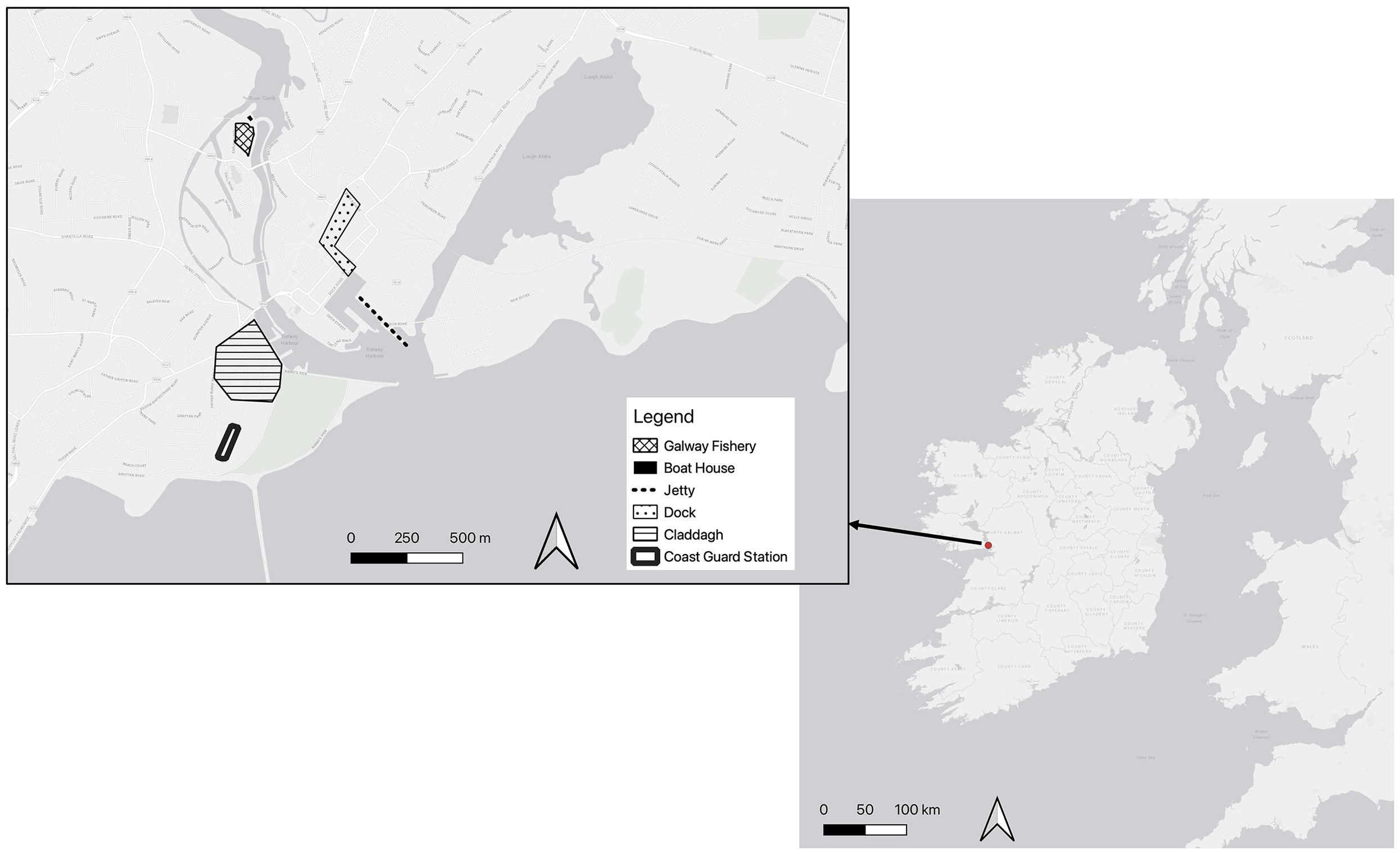
Locations of maritime infrastructure, as well as the Claddagh community, according to a British Ordnance Survey map c. 1838.
Officially recognized landing sites and curing houses meant that takes of fish could be more easily monitored by colonial officials, ensuring the Empire could maximize profit from Irish fisheries. Vernacular Irish watercraft, however, did not require as much infrastructural investment and could be managed with less direct oversight. Currachs (oftentimes called ‘canoes’ in colonial documents, as a way of distinguishing them as indigenous watercraft) and yawls, in particular, were smaller light-draft vessels and did not require large crews or piers to operate. Rather, an individual or small group could operate the vessels and pull them up onto shore wherever there was clear shoreline available (Figure 4). 92
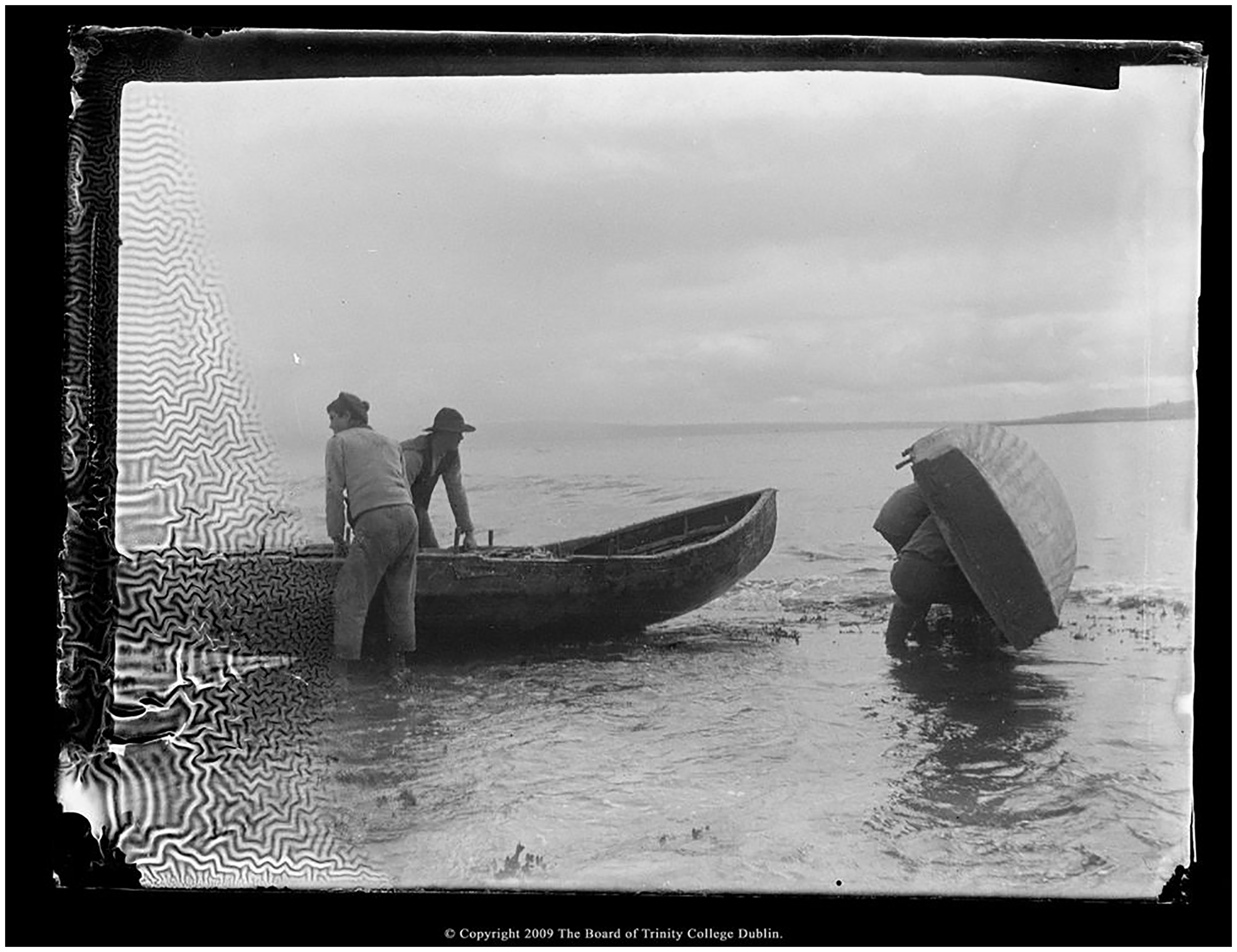
West-coast fishermen launching two currachs from the shore.
Outside observers recognized that fishermen who used currachs and yawls operated in vastly different ways than capitalist approaches. 93 The comparative freedom of these vessels presented a threat to British authority by allowing boaters to access maritime products without directly profiting the Empire. Consequently, legislative and aid policies directly targeted the use of these boats, with archaeologists noting that fishermen's difficulty in accessing marine resources during the Famine was ‘also brought about by boat confiscations resulting from the British government's deliberate changes to maritime policy’. 94 Despite these policies, Irish mariners continued to operate yawls and currachs, although British observers disparaged them as ‘imperfectly found in every respect’. 95 For example, in 1847, a man in Cork complained that a group of men in yawls were setting trammel nets to catch near-shore herring outside the legal hours, as a direct challenge to the larger fishing boats anchored nearby. 96 These traditional practices, conducted in direct contrast to methods considered acceptable by British standards, offered an opportunity to access resources that the Empire attempted to strictly control.
Other acts of resistance certainly took place without being observed by contemporary courts or law enforcement, and those in charge of managing fisheries and catching wrongdoers were concerned about their ability to enforce the law. In one discussion about how to address illegal fishing, a colonial official noted that, occasionally, fishermen would accidentally catch a salmon out of season while fishing for herring. One of his colleagues responded that the fishermen should just throw the salmon back into the ocean, to which the original speaker commented that he ‘did not think they [the Irish fishermen] were so patriotic as to do that’. 97 Acts like keeping out-of-season fish contrary to fishing legislation were less likely to be documented in the historical record but were clearly occurring and a source of frustration to colonial authorities. Moreover, it appears that they recognized these behaviours were borne out of apathy, if not outright resentment of British rule.
A great deal of legislation, aid and changes to fishing practice during the Famine centred on professional fishermen. This vocational emphasis, however, overlooks others who could have used the water to supplement their food sources in everyday contexts. Currachs and yawls, for example, did not necessarily need to be crewed by professional mariners. Scholars have noted that in Achill, County Mayo, they were often used by landless tenants to seasonally supplement farming in the nineteenth century. 98 It is reasonable to assume that these practices would have continued where possible during periods of deprivation, like the Famine, and were more likely to escape the scrutiny of colonial officials, who were preoccupied with fisheries on a commercial scale.
Even without equipment, living in a maritime society can impart specialized knowledge of the environment that can be used to subvert authority, including knowledge of the waterscape and how to procure resources. 99 Throughout Irish colonial history, people caught fish contrary to British laws and supplemented their diets with a broad range of marine resources, including mussels, oysters and herring. 100 During the Famine specifically, Irish oral histories recount that people living on the coast foraged for seaweed and oysters to mitigate hunger (Figure 5). 101 Additionally, many raids and other illegal activities took place under cover of darkness, indicating that those involved took advantage of environmental knowledge of the coastline to acquire resources without daylight. While these activities were more commonly recorded due to their scale and clearly rebellious intent, other night-time procurement of water resources almost certainly occurred that was less easily monitored and controlled by colonial officials.
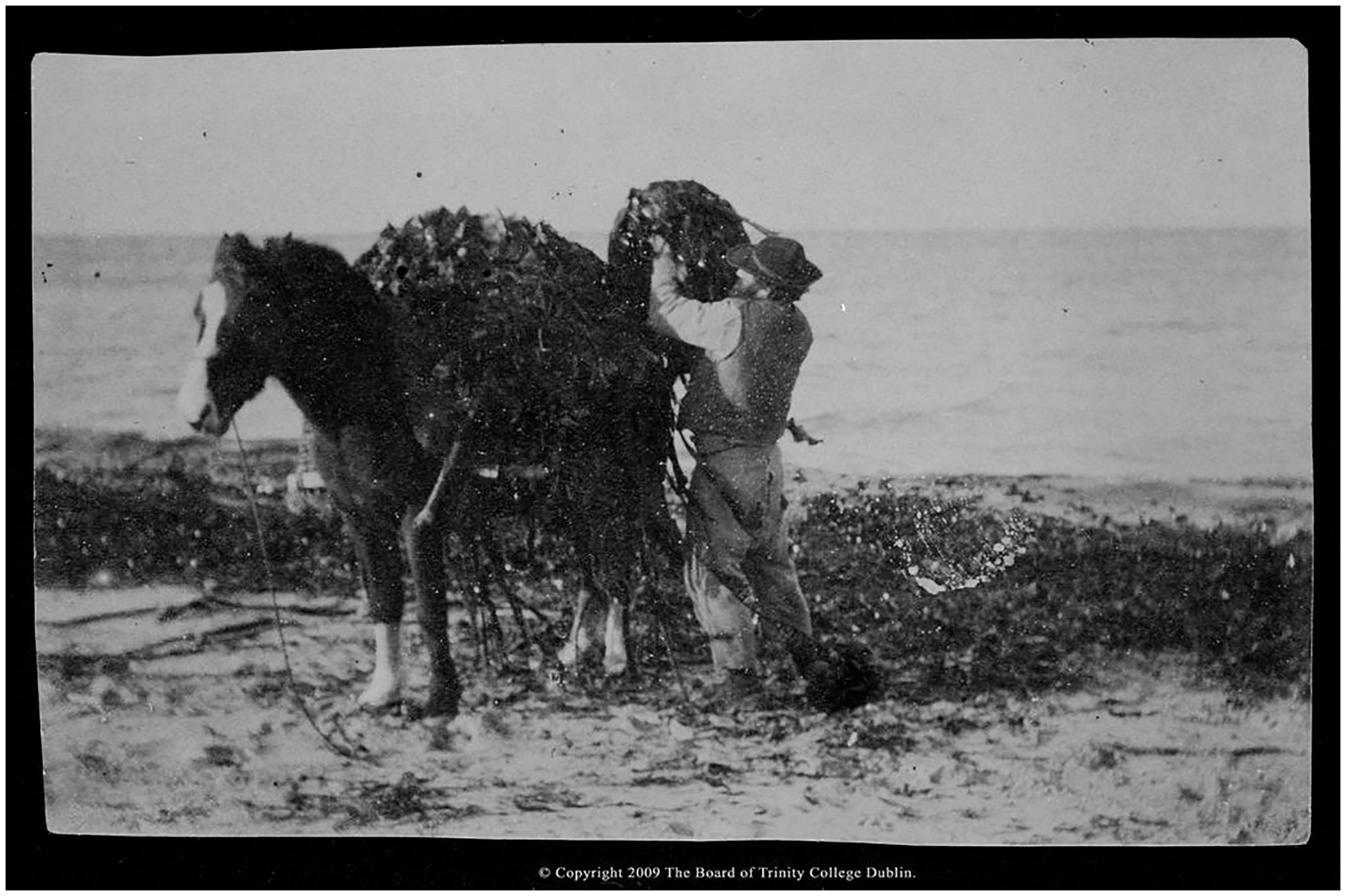
A man on the west coast collecting seaweed and loading it onto a pony for transportation.
Historical documents clearly indicate that, despite colonial efforts to control and mould Irish fisheries within a capitalist framework, the Irish found ways to challenge the new policies by rebelling, maintaining traditional practices and taking advantage of specialized knowledge of the environment. While British authorities and aid organizations attempted to manage fisheries through strict control of the material culture associated with capitalist practice, the Irish challenged this authority by using both new and customary equipment to their own ends. In a context where legislation and control of marine resources was designed to minimize the autonomy of native residents and profit the imperial centre, each of these actions can be framed as a distinct form of resistance.
Conclusion
Acts of resistance are often framed in terms of violent or overt challenges to dominant power structures. In instances where the population faces a basic struggle for survival, however, acts of subsistence and the refusal to accept imposed legal frameworks of acquisition can be viewed as everyday forms of resistance. During the Great Hunger, British legal policy prioritized imperial capitalist gain over the survival of the Irish. Whether a result of malicious neglect or intentional genocide, the effect was devastating. Although Irish was spoken by an estimated 3.5 million people on the eve of the Famine, most surviving historical records from the period are in English. These were produced by British officials or English-speaking elites, meaning that the perspective of the Irish-speaking population is largely absent. This necessarily skews interpretations of the Famine towards those of the colonial authorities. Even these records, however, indicate that the Irish were resisting British policy through everyday actions.
In the face of unyielding authority, however, many Irish residents employed traditional maritime practices to acquire marine resources. Central to these efforts was the use of material culture: watercraft that could be launched outside the view of coastguard stations, nets that did not conform to legal mesh size, and the rejection of capitalist overfishing practices, to name a few. These actions, which could result in severe legal action, illustrate how Irish coastal populations were able to resist British colonialism during the Famine by using traditional knowledge and practices.
Footnotes
Acknowledgements
We would like to thank the anonymous reviewer whose comments greatly strengthened the article. We would also like to thank Francis Ludlow for his comments on an early draft, as well as the staff of the Friends Historical Library Dublin for their research assistance and access to primary sources.
Funding
This work was supported by the European Research Council (grant number 4-OCEANS 951649).

Notes
Author biographies
Emily Schwalbe is a research fellow in the Centre for Environmental Humanities at Trinity College Dublin.
Rory Connolly is a research fellow in the Centre for Environmental Humanities at Trinity College Dublin.
Sophia Chapple is a PhD student in Environmental History at Trinity College Dublin.
Poul Holm is Professor of Environmental History at Trinity College Dublin.