




Abstract
When Portuguese sailors confirmed that there was an all-sea route to South Asia from Europe, they introduced new ship designs and building methods to the Indian Ocean World. They found sophisticated maritime skills and a long history of trade over water, both local and long distance. The meeting of the two successful technologies led to some borrowing of different methods and materials, and European use of vessels of Asian design. There were cases of borrowing specific design features, mostly by Asian shipbuilders, but there was surprisingly little melding of aspects of construction. There was some specialization, with Europeans concentrating on building and using larger seagoing cargo carriers. The arrival of steam propulsion for ships after 1800 changed all maritime technologies beyond recognition.
In 1400, in all aspects of navigation, Indian Ocean sailors and shipbuilders had a clear advantage over their European counterparts. Vessel types with origins in South East Asia had ventured as far as Madagascar, often enough to colonize the island and continue trade there as well as in East Africa and Arabia. Vessels from China made regular voyages to South East Asia, and local ships were able to carry massive quantities of trade goods from China to the Middle East, as an excavated wreck from around 850 found off the island of Belitung in Indonesia showed. In Europe, regular voyages from one end of the Mediterranean to the other were possible, as were voyages between that southern sea and the Low Countries, although those had only started very recently and were infrequent. Voyages down the coast of West Africa were limited to a short distance, and the open ocean saw few European ships.
In 1800, the picture was very different. A broad range of vessels from Asian shipyards continued to carry goods and people around the Indian Ocean. European ships eclipsed them in longer-distance voyages and in a number of tasks in seas that were dominated by local ships four centuries before. Dramatic advances in European shipbuilding led to vessels with greater and also different capabilities, which in turn created new or changed trading patterns. Despite abundant opportunities for the exchange of knowledge and skills, and some melding of technologies once sailors made the all-sea voyages between Europe and the Indian Ocean, there was little transfer of designs of ships or building practices between the two zones. Vessels of European design found use on certain routes where they excelled, while ships of Asian design continued to dominate routes where they had long proved their worth. Those traditional designs did see some changes, borrowing certain features from European ships. For the most part, what had worked before remained in place.
Ships are designed to deal with the conditions of the seas where they will travel, with the goods they will carry and with the existing navigational skills of those who will sail in them. These constraints always applied. Ships were the largest indivisible investment in premodern economies. Investors sunk considerable capital into ships. ‘Sunk’ is perhaps a bad choice of word in this case, but shipbuilders were constantly aware of the dangers at sea, and so of the consequences of imperfections in design and construction. They were, therefore, careful about committing to revolutionary or sweeping changes. Deviations from past practice usually involved small adjustments that, combined, could over time create advances. ‘Technology, like art, is the physical expression of an abstract concept’. 1 While there might have been features that were subject to change, the abstract concepts that lay behind the conception and design of Asian vessels apparently remained unchanged. Ships travelling to unfamiliar places automatically brought with them new information for shipbuilders. The inherent conservatism dictated by the circumstances of ship use, combined with unchanging conceptions of design, proved a potent barrier to innovation and to borrowing, despite the existence of obvious avenues of exchange. The variety of circumstances also dictated the, sometimes confusing, variety of vessels in Indian Ocean waters.
Shipbuilding around the Indian Ocean, and in Oceania as well, typically relied on the lashed-lug technique. 2 There were protruding cleats or lugs on the inside of the planks. Holes in the lugs allowed the planks to be lashed to the ribs or to the transverse thwarts. The rotan or other vines used for lashing would expand along with the planks in the water. When taken out, all would shrink as the planks and lashing dried. When the vessel went back in the water, the vines expanded, and so the hull became watertight again. Rather than lashed, at times boats were sewn in various ways to create a tight hold. Sewing required more control of the work and more precision. It could even be used in conjunction with mortise and tenon joints, where little tenons were fitted in small holes cut for them in two abutting planks; the tenons were typically held in place in the mortises by nails or treenails, which created a watertight seal. The lashed-lug method was especially popular in the Pacific and in the western Indian Ocean, where it is still used. The first place Portuguese seamen mentioned ships built without nails and planks, but held together by stitching, was in Mombasa, and they remarked on the lack of nails as late as 1573. 3
In Indonesia and the Indian Ocean, as in the Pacific, shipbuilders traditionally fashioned hulls using the lashed-lug technique. 4 Northern European shipbuilders had abandoned the method by the early Middle Ages, long after Mediterranean shipbuilders had stopped using it. That difference between practices in Asia and Europe would fade over time as Indian Ocean shipbuilders gave up the old method. By the last century of the Middle Ages, they were increasingly using mortise and tenon joints. Inserting tenons or dowels in holes in upper and lower planks was standard practice in southern Europe in the Roman era, but was becoming outmoded in the Mediterranean when Indian Ocean shipbuilders took it up.
Indian Ocean vessels could range from 350 to 500 tons and be as much as 35 metres long. The Belitung wreck was carrying goods from China to markets in the western Indian Ocean when she went down. She had a single large side rudder, which had origins in India. Two steering oars, one on each side, were the norm, although an axial rudder at the stern had appeared on Indian Ocean ships by the thirteenth century. The rig had one or two masts, with a sail on each. The vessel also had some attributes of practices in the Arab world. 5
By the fourteenth century, a new Arabo-Indian type emerged in the western Indian Ocean, one with Malay roots but also Arab and Persian sources. The dhow was long, with a high ratio of length to width. It was double-ended and typically small – rarely over 100 tons, with the largest being as much as 200 tons. Dhows were open boats, with single axial rudders fixed to posts at the sterns to carry them. There was one mast with a dipping lug or canted square sail. The former was trapezoidal and so handled much the same as the latter. It would be some time before the dhow took on the lateen sail. Triangular, it was a fore-and-aft sail – that is, set in the same direction as the hull of the ship. The delay in accepting it may have been because it was impossible to increase in size, required a sizeable crew and was not very good in contrary winds. The dhow gained acceptance for regional voyages in the western Indian Ocean, 6 and though it remained, and remains, popular there, its use did not spread more widely over the Indian Ocean. In part, this was because of the competition it faced.
While the dhow was not the type of vessel for long forays beyond sight of land, the jong or dejong was the open-ocean trader in the eastern Indian Ocean. Jongs could trace their origins to Malaysia and what is now Indonesia, and were built in yards around the Java Sea. The jong was not a junk. The two differed in design in a number of ways, but the similar name suggests that the two were related, with the influence going from South East Asia northward to China. Jongs could be large, averaging 400 to 500 tons, with the largest over 700 tons. Presumably, the hull was smooth, with the planks fitted edge to edge and held in place by dowels. Builders added frames inside the hull after they set the planks. They did not use iron in the process, even using wooden dowels to attach the frames to the hull. Steering was with two side rudders near the stern. There were typically two to four masts, with a canted square sail on each.
In the eighth century, builders combined traditions of South East Asia and northern China to produce the ocean-going junk, a vessel that was capable of dominating nearby waters and even parts of the Indian Ocean. The reigning Ming emperor's unprecedented projection of power in the early years of the fifteenth century into South East Asia and lands along the shore of the Indian Ocean was short-lived, but the presence of junks in the region was permanent. 7 A flat bottom, a transom stern, in some cases a transom bow, and an axial rudder with a large central plank acting as something like a keel, along with heavy bulkheads creating watertight compartments, were characteristics of the hull. The planks and frames were nailed in place. The multiple masts, typically five or more, carried quadrilateral balanced lug sails, the larger ones stiffened with battens. A junk could be of varying sizes, some of them possibly very large.
Meanwhile, in the closing years of the Middle Ages, European shipbuilders made significant technical strides. Combining Mediterranean construction methods with the shape of northern European vessels and the rigs of both northern and southern European types, builders in Iberia created the full-rigged ship – a new technology that was to have long-term worldwide impact. The full-rigged ship carried at least three masts, two with square sails and the one near the stern having a triangular lateen sail. This combination made it possible to sail closer to the direction of the wind and to relatively easily vary the quantity of canvas set. For the hull, shipwrights set up the major frames first and then nailed the hull planks to the frames. Strength came from the internal structure rather than a stiff and tightly built exterior hull.
‘The transition from shell-first to frame-based construction could be characterized as an evolutionary and experimental process of compromise between strength and stiffness’. While frame-based construction decreased stiffness, it was not necessarily that much stronger than relying on the shell for strength, at least in smaller vessels. 8 The advantages of frame-first building became more obvious as ships grew in size. Steering was with an axial rudder. This type could be built more quickly than its predecessors and more easily repaired. The greater manoeuvrability made the full-rigged ship more agile. Above all, it needed fewer sailors than its predecessors and so could sail further without the need to stop and replenish supplies. 9 Over time, the large single mainsail evolved into a number of smaller square sails on the fore- and mainmasts. The divided sail plan spread out the work of setting the sails, and so made possible an even further reduction in crew size. The type was well suited for the more efficient transportation of goods.
There were other products of European shipyards with certain advantages. The caravel, for example, with one or two masts carrying lateen sails, could sail closer to the wind. It proved to be well suited for making the slow trip south along the West African coast, as well as for the faster return over the ocean out of sight of land. It was the vessel of choice for Portuguese traders until they reached the Indian Ocean completely by sea. Then, caravels lost their prominent place in Portuguese fleets and full-rigged ships came to dominate Portuguese expeditions to the East. Galleys, in use in the Mediterranean, were oared vessels. They could, and did, carry guns in the bow, but it was full-rigged ships that had the advantage when it came to firepower, since they could mount a variety of guns and many more of them. The full-rigged ship proved to be a solid gun platform, with the number of cannon limited by the size of the ship and weight of the armaments. Improvements in metallurgy, which also generated more durable tools for shipwrights, made iron guns as effective as heavier bronze ones, so vessels could carry more. Europeans used a variety of ships, both of familiar and of Asian design, in the Indian Ocean but the vessel that gave them an advantage in any fight at sea, and also in carrying goods over long distances, was the full-rigged ship.
Indian Ocean ships impressed the Portuguese sailors arriving by an all-sea route from 1498 onwards. There were remarks about their speed and, implicitly, about their seaworthiness, as well as the quality of shipbuilding practices in Asian ports. It was not as if, automatically, one tradition was overwhelmingly better than the other. The competitiveness of local shipping and their own limited resources meant that the Portuguese chose, in imitation of Venetian practice in the Adriatic, to impose taxes on local shippers and ships. Indian Ocean traders evaded the taxes, and the Portuguese tried to enforce them by attacking ports and shipping in the Arabian Sea. By closing trade through Cairo, Alexandria and Venice, they hoped to monopolize the pepper trade from India. The Europeans enjoyed advantages in visiting violence at sea for a number of reasons, though not universally. The Ottoman Empire turned eastward early in the sixteenth century, conquered Egypt and Syria, the lands in between and Mecca, and so reinforced claims to be the leader of all Islam. It did not give up on its ambitions to move further into Europe but was able to form a formidable force in the Indian Ocean. Indigenous traders limited and even neutralized Portuguese efforts to prevent them from making their way to Arabia and the Mediterranean. Facing Portuguese encirclement, the Turks became involved in resistance to the European plan, along with local rulers. 10
Starting from the first voyages in 1498 through to the sixteenth century, the Portuguese cargo-carrying carracks, those full-rigged ships, got bigger. While the average in the early sixteenth century was about 400 tons, the vessels of the Portuguese commercial fleet grew. By the 1570s, the relatively small cargo carriers had been replaced by ships of 1,500 tons and more. Monsoon winds confined these giants to travel at specific times of the year, plus the quality of construction deteriorated in the late sixteenth century, so these vessels became increasingly unreliable. 11 Around 1600, the arrival of ships from the ‘maritime states’, as the Dutch Republic and England came to be known, presented a new and bigger challenge to traditional Portuguese shipping and Portuguese plans for trade. The Dutch ships, when they arrived in the Indian Ocean in 1595, found themselves competing against ships of, for the day, massive tonnage. The Dutch made faster voyages by going further south and increased the value of their trade by sailing directly to Indonesian waters.
The northern Europeans relied on relatively smaller ships. The difference became more marked after the Dutch East India Company decided, in the 1630s, to enter the Indian Ocean carrying trade, as a way to earn exchange for purchasing goods to carry back to Europe. It was a strategy that the Portuguese tried but at which the Dutch were more successful. The shift over time to intra-Asian trade was dramatic. 12 The English East India Company learned that lesson as well, even before its reorganization in 1657, not because of the ships they used but, in part, because of complaints about the Company exporting bullion from England to buy goods in Asia. 13
Frequency of Europe–Asia and intra-Asia Dutch East India Company shipping (number of voyages between destinations).
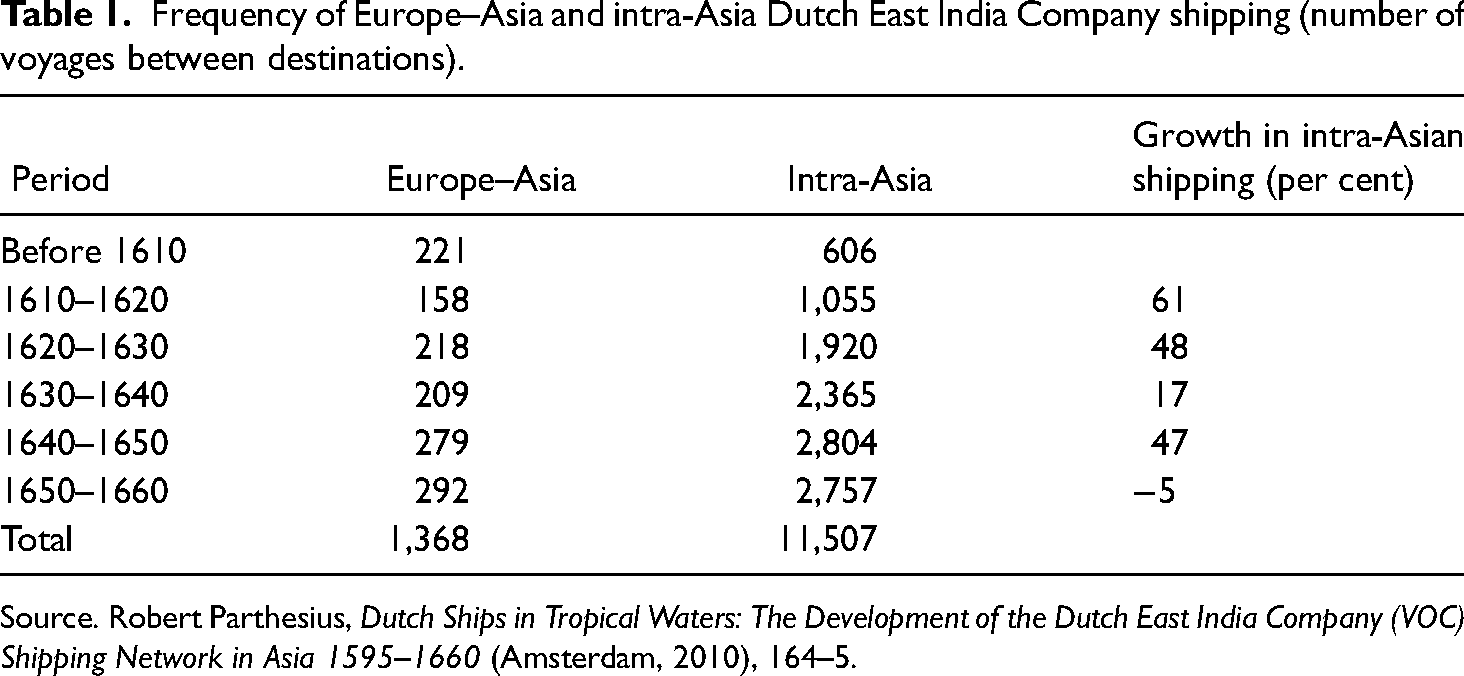
Source. Robert Parthesius, Dutch Ships in Tropical Waters: The Development of the Dutch East India Company (VOC) Shipping Network in Asia 1595–1660 (Amsterdam, 2010), 164–5.
Once established, the Dutch, over time, developed various types of vessels that proved effective, while also adopting vessels of local design. Their yards in the Netherlands turned out large and well-armed East Indiamen, like those of other European states. They also used warships built like those in Europe and other big ships – that is, (often considerably) over 250 tons. For internal trade, they used a few superannuated East Indiamen and a wide range of other vessels, including yachts, which went down to 100 tons or less. The name yacht implies that these vessels were relatively fast. They also had small crews because they had fore-and-aft sails, often on a single mast. The Dutch also introduced, from Europe, the flute, which was a highly successful low-cost carrier, and a type that was simple, slow and required few sailors. With this array of vessels, they competed successfully on a number of longer-distance routes in the Indian Ocean and China seas. A few European ship types proved competitive for regional voyages. 14 Before and through the eighteenth century, junks still carried tea from China to Java and so to Dutch traders. Despite their comparative success in the ‘country trade’, as it was called, the Dutch did not drive local ships out completely. While Portuguese practice in the sixteenth century, after some naval victories, 15 had been to regulate and tax local shipping, the northern Europeans, and especially the Dutch, forced their way into ports and so opened the carrying trade for their own ships. That, combined with the use of a variety of ship types, led to a rapid expansion in their shipping within the Indian Ocean (Table 1). While the Portuguese, by a system of licences, tried to squeeze trade so they could then generate monopoly profits for themselves, the Dutch did better by controlling the supply of trade goods at their source in the ports.
There were many ways and places for the transfer of technical knowledge between Asian and European shipbuilders. Soon after establishing themselves in Goa in 1510, the Portuguese set up a shipbuilding yard that was definitely producing ships in 1530. They also built ships in the Portuguese style in Bassein and Cochin. At Goa, a separate part of the town was designated as the dwelling place of shipbuilders. Already by 1523, there were enough locals trained in European methods that no more skilled workers needed to travel from Europe. Some of those who did come were happy to work in local shipyards beyond Goa and so pass on European practices. The naus, larger ships of an average of 200 to 250 tons, which came from Indian yards, were valued for their durability. This came from the high quality of the wood, which was especially valued because it was cheaper than wood in Portugal. 16 The Dutch did set up shipyards in Asia in their early days but, by the 1640s, had abandoned the idea of extensive construction in the East because of problems controlling costs. The Dutch East India Company and the English East India Company settled on building the largest and best armed of their ships in Europe. The Dutch East India Company owned yards and had work done there. From the mid seventeenth century, the English East India Company contracted with private yards to produce the ships it needed. The English company did not own yards and had most construction done around London, rather than employing indigenous yards in Asia.
On the other hand, Aceh in northern Sumatra produced galleys of Mediterranean design with knowledge coming from European or Turkish shipbuilders – the latter apparently sent by the Sublime Porte in the 1570s to help a Muslim ally in wars against Portugal. In the first year of the seventeenth century, an English visitor observed that the ruler of Aceh could mobilize ‘a great number of gallies’ if he just had four or five months’ warning. 17
Shipyards became theatres for the cross-fertilization of methods. Learning by doing, under the supervision of the knowledgeable, was the source of the transfer of skills. European supervisors taught local builders, while learning from those they trained about local practices and features of ships not known at home. Since information exchange was not formalized, there is little to no record of any transfer. Knowledgeable local workers with shipbuilding experience were aware of the benefits and shortcomings of local supplies – the obvious example being wood, but also materials for ropes. Often delegated to simpler tasks, there were limitations on developing complex skills. By the seventeenth century, frame-first construction predominated in Europe. Learning how to design a large vessel from scratch was more difficult than with its predecessor, shell-first building – but by no means impossible.
The impact of the arrival of European ship carpenters, with their novel ideas, appears to have been meagre, even though in the long run, through to the nineteenth century, European practices overtook many local ones, especially in the building of larger ships. In the sixteenth century, local merchants and shippers almost immediately bought the products of Portuguese shipyards, getting ships of European design. These vessels could sail closer to the wind than indigenous vessels and could be built larger, so the Portuguese naus were useful for Muslim merchants on routes where large cargoes were common. 18 Vessels of established designs did not disappear. Practices around the Indian Ocean showed considerable resilience, especially with smaller vessel types used in a limited area. It is difficult to fix the dates and places where technical borrowing took place, although, over time, some transfer did become obvious.
Dhows got bigger and so were more sturdily built. The change of sails to lateen ones may have been nothing more than logical evolution, although Portuguese ships and Mediterranean vessels did offer abundant examples of lateen rig. While batten lugsails remained the standard on larger Chinese junks, the sails on jongs in South East Asia may have looked more like European square sails. Locally built ships from East Africa to India to South East Asia, in a number of cases, took on more of the appearance of European ships. The baghla, the largest seagoing dhow, had a sternpost rudder and a hull that may have been influenced by European design, although it is possible that the inspiration came from Chinese junks. The Yemeni sanbūq got its square stern after European contact in the sixteenth century. In the Indonesian archipelago, a type called a chialoup was a common carrier among the islands, and its name and design undoubtedly had European roots. The expansion and prosperity of Indian shipping up to the mid seventeenth century may owe something to improvements in the design of locally built ships that came in the prevailing atmosphere of cross-fertilization.
Europeans used nails, and a lot of them, to attach pieces of wood to each other. There was a shortage of iron in the western Indian Ocean, but it appears that Indian shipbuilders had already gone over to the practice of nailing, even before sailors from Portugal landed at Calicut and they faced the European example. The Venetian traveller Ludovico de Varthema, who visited the port in the first decade of the sixteenth century, said that carpenters built open ships of 180 to 250 tons with smooth sides and the planks abutting, and used ‘an immense quantity of iron nails’. The practice probably came from China before Portuguese ships visited India in considerable numbers. Above all, he was impressed by the quality of the work and the resulting watertightness of the hulls. 19 Varthema's description is consistent with an abandoning of lashed-lug construction. This was another tendency that started well before the opening of the all-sea route. There is every reason to believe that seeing European ships and the hiring of European carpenters to work in yards in Asia accelerated a process that was already underway. Construction in Asia apparently remained unlike that in Europe in that the internal frames were added later in the building process, so they did not define the shape of the ship and were there simply for reinforcement. The shift to skeleton construction did not require any change in the appearance of vessels or the way sailors handled them, but the Europeans had found a way to produce more durable ships. For Asian shipwrights, staying with shell-first building meant less deviation from traditional practices.
Early on, Europeans identified Vietnam as a promising location for shipbuilding, in part because of the supply of suitable wood. By the latter half of the eighteenth century, Vietnam had a thriving shipbuilding industry. Local builders produced ships of both traditional and European design. The Saigon River was the site of many yards, some of considerable scale. This was not the only shipbuilding site, however. The skilled labourers came from varied backgrounds. They built a broad range of types, from junks for Chinese buyers to schooners of European design for local buyers. A similar industry emerged in nearby Thailand, thanks to the migration of shipwrights from Vietnam. In Thailand, as in Vietnam, builders could produce ships of traditional European or Asian design at lower prices than Chinese shipbuilders. 20
By 1800, even though European designs and methods were well known, there were traditional Asian practices that survived. Despite the sustained influence of imported skills and practices, lashed-lug construction did not disappear. Some ports held onto the long-standing form of fastening and even sewed planks together for ships of up to 150 tons. Lashed-lug construction was rare, but in some places and cases continued into the twentieth century. In short, there was much in Asian shipbuilding that stayed the same. One reason for the muted influence may be that the number of European ships was small. The Dutch sent examples of their building prowess from Europe on average 21 times a year, and this was by far the highest number of any Europeans trading in the Indian Ocean. The French East India Company, founded in 1664, began by sending out two to three vessels per year. That number rose to about 12 annually by the late eighteenth century, which put it close to the English. The Danish East India Company, chartered in 1616, had its first ship arrive in Asia in 1618. From then on the Company sent out one ship a year – that is, except when France and England were at war and the Scandinavians could take advantage of their neutrality. There was a long tradition of low numbers. The Portuguese sent on average less than seven ships per year from 1500 to 1635 – years when they saw little competition from other European states. After 1635 down to the later years of the eighteenth century, there were about five departures for the Far East annually from Lisbon. There were many years of just two or three departures. 21 Most of these ships were large, heavily armed types, which were of little use for Asian buyers. These big European East Indiamen tended to go to larger ports, so few shipbuilders had a chance to see them – circumstances that lessened the transfer of knowledge. At least the greater number of non-company, privately owned European ships that frequented the Indian Ocean in the later eighteenth century mitigated the long-standing lack of exposure to European designs.
In many Indian Ocean ports, knowledge was difficult to obtain because of the kinds of ships used; the waters, which created constraints on designs; and the cargoes the ships carried. The proportion of larger vessels – so, more likely to be European-built or after European designs – that the Dutch East India Company used for shipping varied, depending on the trade. In the Arabian Sea, the percentage of large ships – that is, greater than 170 lasts of 3,000 pounds per last – between 1595 and 1660 was 64; 22 in the south and east China trade, it was 52; to the Spice Islands, 47; for what is now Malaysia and Singapore, 40; and to Sumatra, 38. It was for trades involving longer voyages to and from their trading centre at Batavia (Jakarta) that the Dutch preferred to use the largest of their ships. In trades that involved shorter voyages, they relied on smaller ships, including ships of traditional local design. In the trade to China, for example, the proportion of vessels under 70 lasts was only 23 per cent, while in the Spice Islands it was 47 per cent. 23
In Europe, the impact of Asian shipbuilding practices was limited. For their own ships and especially those on long-distance routes between Europe and Asia, Europeans kept to what they knew. They did learn to exploit new raw materials they found in Asia, the most obvious being novel kinds of wood such as teak. There is one ship design feature that is commonly identified as likely having been transferred from Asia to Europe. The familiar leeboards on Dutch inland craft – one on each side, which sailors could raise and lower depending on the depth of the water and direction of the wind – served to keep the boats on course when prevailing winds came from the side. That ability was an asset in the narrow waterways where Dutch inland craft operated. Variants that served the same purpose had long existed in Asia, and leeboards were often illustrated and discussed in the seventeenth century after the publication of the popular travel account of his time in Asia by Jan Huygen van Linschoten in 1596. Evidence shows leeboards on Dutch boats well before that date, however. It appears that the device was a product of independent invention, with sailors both in the delta country of the Yangzi in central China and the delta country of the Rhine stumbling on the solution because of the common conditions, and Chinese sailors in some parts of the country taking to leeboards earlier than in the Netherlands. 24
Any idea that European ships were so superior to Asian vessels that they swept the Indian Ocean after they arrived is, in a word, wrong. 25 Many Asian vessel types, local or imported, continue in use, now serving for the pleasure of tourists as well for carrying goods and local travellers. European ships expanded the scope of shipping services but did not destroy all the practices that had existed before 1498. Trade between the Indian Ocean and Europe rose, especially after Dutch and English ships entered the competition, compared to what it was when trade between Europe and eastern Asia included sometimes lengthy portions of travel overland. As for internal trade around the Indian Ocean, it is unclear if Europeans just displaced existing shipping or supplemented it. It is certain that Europeans did bring new types of ships, which increased the range of options for shippers. Although it is impossible to measure with any acceptable level of accuracy, intra-Asian trade did increase in volume and value through the later years of the age of sail. Ships of European and Asian design functioned side by side. The people who built those ships borrowed characteristics from other building traditions, even if not extensively.
The prominent ships – the big ships, the flashy ones – were European, which obscures the widespread use of smaller vessels of local design. The big ships made the long trips, connecting parts of the world that had not been connected before completely by sea, and carried more goods. They were novel and unique. The resistance to change on both sides of the geographical coin came for the origins of designs in the conditions – climatic and commercial – that prevailed in the Indian Ocean and European waters. Supplies of materials and labour were among the circumstances that shaped responses to novel techniques. ‘Technology, like art, is the physical expression of an abstract concept. Ships and paintings both begin as ideas that must be realized through the application of tools and materials available to the craftsman or the artist.’ 26 The geography of Asia did not change, nor did the prevailing winds and currents in Asian waters, so the constraints that existed before largely stayed the same. In some cases, the supply of raw materials and their uses did change, and so opened the door to experiment and improvement. The opening of new trade routes also contributed to the shape and character of technical innovation. The European adoption of a divided sail plan was, in part, to keep down the number of crew members on long trips. No such change came in Asia. The longer voyages Europeans faced, along with their higher labour costs, made reducing the crew size critical for success. The issues and opportunities Asian shipbuilders and shippers faced were not the same. It was, ultimately, it seems, in the superiority of the vessels making those long-distance voyages where European designs prevailed, and it is largely those voyages that draw the most attention. Limited though the melding of technology may have been, there were gains from the exchange of knowledge at many sites over the centuries between the arrival of Vasco da Gama and the adoption of steam propulsion around the Indian Ocean after 1800.
Footnotes
Funding
The author received no financial support for the research, authorship and/or publication of this article.

Notes
Author biography
Richard W. Unger holds a PhD in Economic History from Yale University. He has written extensively on the evolution of ship design in Europe and elsewhere from the Roman Empire to the end of the age of sail, as well as on the history of brewing in Europe in the Middle Ages and Renaissance, and on quantities of different forms of energy use in Canada in the twentieth and twenty-first centuries.