




Abstract
The balance of power is among the foundational principles in international relations. This principle, however, has been analysed mostly in relation to land powers on the European continent, while the historiography has failed to appropriately recognize its naval aspect so far. This article compares the English and Dutch sea powers or fleets during the three Anglo-Dutch Wars (1652–1674). Warships or ships of the line were the main instruments of naval warfare, and hence key to any measurements of sea power. Detailed tables of the fleets with the number of warships and guns for the major engagements show the balance of sea power at the time. Attaining and maintaining the balance of (sea) power in the early modern era was not just an abstract idea, but also an interactive process, based on numerical analysis. The author argues that there was a real or naval balance of sea power between the fleets or alliances of fleets; that the balance of sea power was acknowledged in the international alliance treaties; and that the balance of sea power became an element of early modern political discourse.
Keywords
Introduction
I can therefore conclude that at some unexpected moment the enemies of France managed to stir up the whole of Europe to destroy the sole counterweight capable of guaranteeing its [Europe's] continental and maritime balance, so the international law no longer exists, [although] it existed in the previous period.
1
This article presents, from a comparative perspective, the balance-of-sea-power practices and thinking during the Anglo-Dutch Wars. Although thinking about sea power has been ubiquitous, and although the balance of power has been analysed in depth, these two concepts have not yet been combined to properly consider the balance of sea power in the early modern era. 3 Both concepts have been studied separately for centuries, so it is key to understand the basic elements of both terms to gain insight into the mindsets of contemporaries. Since no one has yet examined early modern naval history through the prism of the balance-of-power principle, it is necessary to clarify these two key concepts – the balance of power and sea power.
The Swiss jurist Emmerich de Vattel defined the balance of power as ‘such a disposition of things, as no power is able absolutely to predominate, or, to prescribe laws to others’. 4 This broad and vague definition perfectly reflects the broad and vague interpretations of the balance of power in the early modern era. The balance of power was used in opposition to universal monarchy, 5 which did not mean the actual possession of the whole world, but the predominant power or state, which could force or dictate the laws and rules to other states. This article does not try to define the balance of power any better than Vattel, but I highlight its international spread, its discursive value and its increasing importance.
Sea power was a key tool of the developing state structures. The building of sea power was tied to the economic consolidation of states and the newly established standing navies. The most famous contemporary definition comes from John Evelyn's unfinished history of the just-finished Anglo-Dutch Wars. Evelyn wrote that ‘whoever Commands the Ocean, Commands the Trade of the World, and whoever Commands the Trade of the World, Commands the Riches of the World, and whoever is Master of That, Commands the World itself’. 6 The intention of this quote is to show the interrelatedness of the ‘command of the seas’ or ‘ocean’ with the command of trade and wealth. When early modern Europeans talked about sea power, they thought of one or both of these elements – that is, the naval fleet and the merchant marine.
Since the end of the nineteenth century, historians have been analysing sea power from a strategic perspective, in addition to its cultural role. 7 The book that is still central to studies of sea power is Alfred T. Mahan's The Influence of Sea Power upon History, 1660–1783. Mahan started his book in 1660 or, as he put it, ‘when the sailing-ship era, with its distinctive features, had fairly begun’. 8 Mahan's sea power, although never explicitly defined, was based on battle fleets, large open battles and the limited effectiveness of privateering. Mahan's detractors criticized him for emphasizing the influence of sea power over land power. 9
Cognizant of the importance of technological changes and different types of naval warfare, Sir Julian Stafford Corbett presented Some Principles of Maritime Strategy. If Mahan's theory relied on the concentration of battle fleets in order to destroy enemy fleets in a decisive battle, Corbett's argument could be summarized as either securing control of the sea by destroying enemy warships or preventing the enemy from gaining control of the sea through a naval blockade. 10 On the other end, Admiral Sir Herbert W. Richmond defined sea power as ‘that form of national strength which enables its possessor to send his armies and commerce across those stretches of sea and ocean’. 11 Such military interpretations of sea power, based at least in part on the experience of the Second World War, referred to amphibious action and the projection of military strength across the sea.
In his book The Rise and Fall of British Naval Mastery, Paul M. Kennedy explicitly challenged Mahan's view of the influence of sea power on British and international history. Kennedy wanted to encompass the wider national, international, economic, political and strategic framework of sea power. British economic prosperity based on global trade and a strong debt system were key to the rise of the Royal Navy. However, Kennedy also recognized that there were many restrictions with regard to British sea power, even at its peak in the nineteenth century. He understood the limits of sea power in stating that ‘command of the sea never implied a total possession of oceanic waters: this is both physically impossible and strategically unnecessary’. 12 ‘Command of the sea’ implied the control of the routes to colonies and ports; more importantly, it meant being able to prevent the passage to your enemies. Therefore, Kennedy, also building heavily on Corbett's work, provided a more ‘balanced’ view of the influence of sea power in the international relations of the last 500 years.
To discern whether there was a balance of sea power in the early modern era, I focus on arguably the greatest naval conflict of that or any time in history. I present the Anglo-Dutch Wars through the balance-of-sea-power prism. Among other things, sea power was primarily measured by the number of warships and the number of guns on the warships. I have drawn up detailed tables of the fleets, showing the number of warships and guns for the major open-sea battles of the three wars. 13 Commercial competition promoted vigilance and cooperation in an international alliance system and balanced the two most powerful early modern sea powers. 14 I argue that there was a real or naval balance of sea power between the fleets or alliances of fleets; that the balance of sea power was acknowledged in the international alliance treaties; and that the balance of sea power became an element of early modern political discourse.
Early modern warships
The most powerful instrument of sea power in early modern Europe was the warship or the ship of the line. The literature often contains the phrase that the ‘warships were the most complex industrial products of the seventeenth century’. 15 In the mid seventeenth century, the so-called ‘military revolution afloat’ took place, when merchant ships converted into warships eventually became obsolete, 16 and the line-ahead battle tactics were introduced. 17 Sturdy state warships could take heavy firing and were seldom sunk in open battles; they were more likely to fall victim to storms, fire or explosions than to cannon fire. There were other types of vessels used by navies, such as fireships, 18 frigates, ketches and yachts, but none of them defined sea power in early modern Europe as much as the warship.
In the era of sailing warships, state navies were compared based on the number of warships, their size and their firepower. 19 The idea that a higher number of ships with bigger guns equates with stronger fleets was a fairly consistent assumption, especially after the development of the line-ahead tactics. Following the line-of-battle tactics and excluding other unquantifiable factors (experience, leadership, weather, training, morale), the fleet with the most warships, as well as more and heavier guns, would win an open battle. 20 Recently, Dagomar Degroot has argued that even the changing climate during the Little Ice Age decisively influenced the outcome of sea battles. 21 However, as the influential Prussian general and military theorist Carl von Clausewitz stated, ‘superiority of numbers admittedly is the most important factor in the outcome of an engagement’. 22
Another factor that is overlooked by researchers when comparing the relative strength of the two fleets is the speed of warship construction. At the time, the Dutch generally built their (smaller) warships faster and could complete ships in less than a year, while the English often took two years or longer. 23 Another advantage the Dutch had was that the Zuiderzee was the centre of the European timber trade, so they could build ships 40 to 50 per cent cheaper than the English in the seventeenth century, and their contemporaries understood this imbalance. 24 In comparison with the already strong state navies in England and the Dutch Republic, the French fleet became a threat only by the Third Anglo-Dutch War, as it was known that ‘on the Ocean … both their Shipping and Traffique have been alike trivial’. 25
Another factor to be considered is the weight of the guns’ shots. In general, the more guns a ship had, the more heavy guns it had. 26 Every warship had a variety of calibres, but in the interest of stability, the largest guns had to be located on the lower decks. The English generally had more and larger guns with heavier shots than the Dutch. Therefore, the English warships generally fired heavier broadsides than the Dutch. However, because the heavier English warships had larger guns, the lowest deck and gun ports were closer to the waterline. Thus, even in moderate winds, the largest guns on the lee side were useless. 27 On the Dutch ships, on the other hand, the lower gun decks and gun ports were slightly higher above the waterline (Figure 1). This was sufficient to allow them to be used in less agreeable weather. 28 Moreover, because the larger guns were more difficult to handle and slower to load, the Dutch had a slightly higher rate of fire. In summary, the warship design and firepower did not provide a decisive advantage for either side.
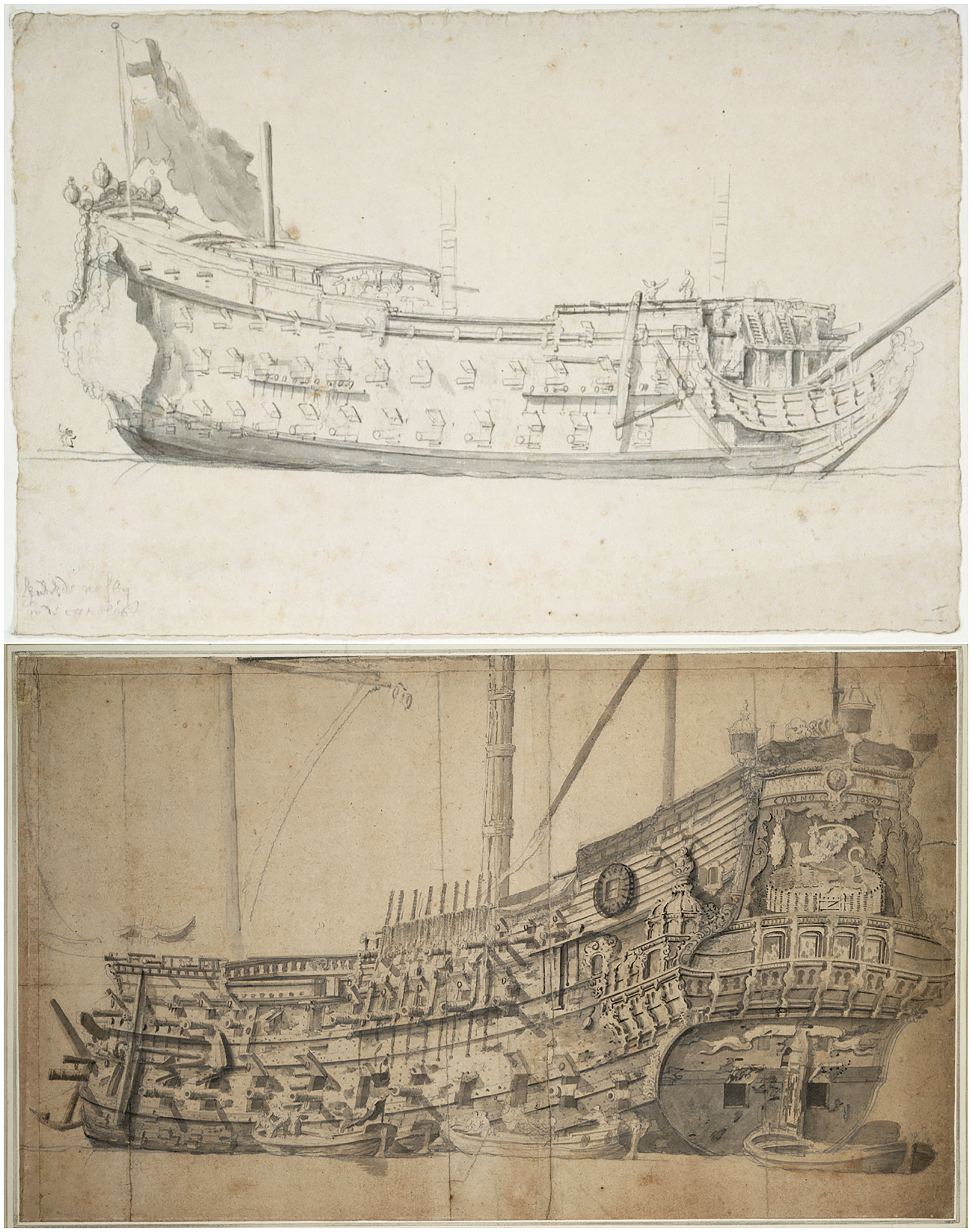
Comparison of an English and a Dutch warship of similar firepower, both launched in 1655 – the 80-gun Royal Charles, formerly Naseby (top), and the 72-gun Eendracht (bottom) – as depicted by Willem van de Velde the Elder.
In the second half of the seventeenth century, warships below a certain tonnage gradually became too weak to withstand the firing of big guns and too light to hold enough heavy guns to respond efficiently. As an analysis of the ship lists shows, there was an increase in the size and minimum number of guns that warships had to have in order to be fit for combat. 29 Thus, I counted all the ships in the First Anglo-Dutch War in the 1650s, when the line of battle was gradually introduced and battles often ended in messy melees. Thereafter and until 1667, I only counted warships with more than 30 guns, then, from 1668 to 1672, based on the 1668 Triple Alliance treaty, I counted only warships with more than 36 guns. By 1673, this jumped to only warships with more than 42 guns (Table 1). 30 Obviously, it was realized during the first year of the Third Anglo-Dutch War that bigger warships with more guns were needed, and the smaller ships with less guns practically do not even appear in the battle formations.
Gradual increase in the minimum number of guns needed for warships to be battleworthy.

Naval warfare was a battle of attrition, both tactically and strategically. Every battle depended on the combatants taking out or eliminating as many of the enemy’s ships, guns and seamen as possible, and protecting their own. If a significant number of seamen and guns were eliminated on a warship, it was less effective in fighting back. It eventually had to sail away or be towed away if its rigging had been damaged and it had not already sunk. 31 Moreover, naval warfare was limited strategically by the lack of state funds for both materiel and manpower. In the three Anglo-Dutch Wars in the second half of the seventeenth century, due to the high financial costs of maintaining the fleets, the open-sea battles always took place within the first two campaign seasons, so neither nation could rely on building new warships and using them during the ongoing conflict.
The Anglo-Dutch Wars
The English are going to attack a mountain of gold; we have to face one of iron. 32
Adriaan Pauw (1585–1653), the Grand Pensionary of Holland and the key negotiator of the Treaty of Münster in 1648, captured the true nature of the Anglo-Dutch conflict. In the spring of 1652, Pauw was in London trying to find a peaceful resolution, when he remarked on the key distinction between the two states. This distinction referred to the two elements of sea power – gold for money or trade and iron for guns or warships. The Anglo-Dutch Wars in the seventeenth century were fought due to the imbalance of sea power. Recently, Steven Pincus has challenged the view that the main casus belli was mercantile by emphasizing the ideological reasons in both states. 33 The so-called integrated understanding prevails today, incorporating all the potential, and not mutually exclusive, factors that led to the conflict. 34
The battles between the most prominent maritime states at the time were fought almost exclusively at sea in a series of three wars (1652–1654, 1665–1667 and 1672–1674). All three lasted ‘only’ around two years or had two campaign seasons, since it was too expensive to maintain the operational fleets in action, especially for England. What follows is not a complete operational overview of the wars, 35 or of the multiple and complex causes that led to them, 36 but their presentation through balance-of-power practice and theory. Even though the main theatre of the wars was the Channel and the North Sea, important operations also took place in the Baltic and the Mediterranean.
The aim is to present the basic tenets of the opposing fleets during the main battles. I have compiled tables for the fleets for the major open-sea battles, with the total number of warships and guns, and the average number of guns per warship. Although influential, there are no tables for Holmes's Bonfire and the Raid on the Medway, as they were not open-sea battles. I have also surveyed the diplomatic correspondence for relevant letters containing the balance-of-power idea as it related to sea power. The shifting of the balance of sea power in England's favour in the late seventeenth century was partly decided due to geography – that is, the Dutch exposure to the French land invasion. I argue that attaining and maintaining the balance of sea power in the seventeenth century was not just an abstract idea, but also an interactive process, based on numerical analysis.
The First Anglo-Dutch War (1652–1654)
Despite presenting or perceiving themselves as the superior sea power, both nations entered the war without a predetermined strategic scheme. The English privateers extended their seizure of Dutch merchant ships, from 12 vessels taken in 1648 to 22 in 1649, 50 in 1650, 126 in 1651 and 106 in the first months of 1652. 37 In March 1652, the States General aimed to safeguard Dutch shipping in the English Channel by hiring and outfitting 150 merchant ships as warships, and the English even claimed that the Dutch planned to equip 300 warships against England. 38 Although this aim was unrealistic in such a short time and for the five fragmented Dutch admiralties, it was a provocative programme and additional impetus for the coming conflict. The Dutch protected their programme by claiming that ‘the preparation of Shipe in England proceded those of Holland’. 39 As in any arms race, it mattered less who started it, but that no one was willing to back down.
There were many indecisive skirmishes during the first year of the First Anglo-Dutch War, and the enemies constantly gained and lost the upper hand. At the Battle of Kentish Knock on 8 October 1652, 40 the fleets were evenly matched in numbers, but the English fleet, with its superior firepower and weather gauge, defeated the internally divided Dutch fleet under Admiral Witte de With. 41 The English were so confident of their success that they sent 20 ships to the Mediterranean. However, the Dutch lost only two or three ships and were able to repair the rest within a few weeks and sail out into the Channel. Shortly thereafter, Admiral Maarten van Tromp managed to win the Battle of Dungeness. 42
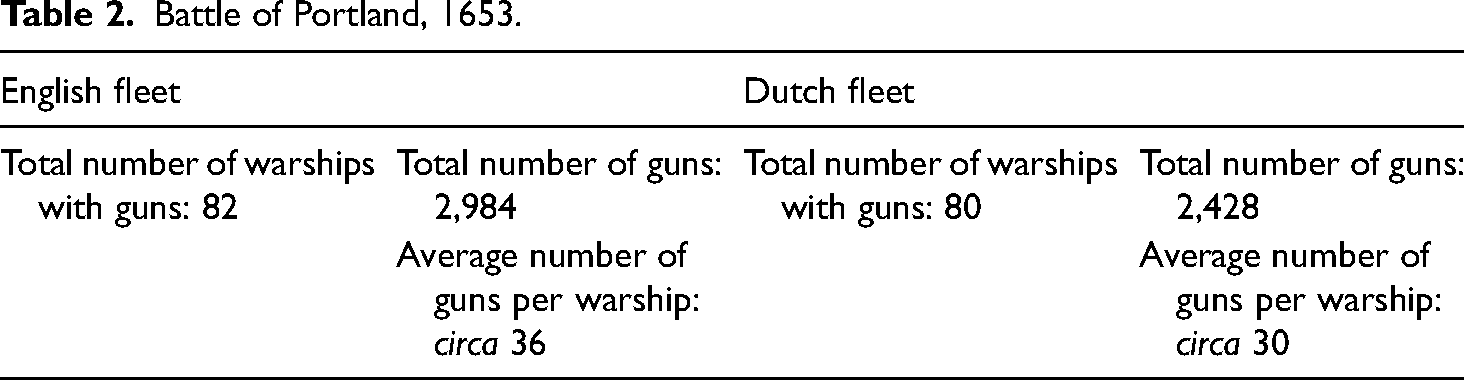
An important ‘invention’ that is often associated with the First Anglo-Dutch War is the line-ahead tactic. The English decided to replace some naval captains with generals at sea, who were more familiar with artillery formations. Thus, a corollary of the broadside – the line-ahead tactic – was ‘invented’. The English used it effectively during the three-day Battle of Portland from 28 February to 2 March 1653, when both fleets were evenly matched in the number of ships but the English ships had, on average, six guns more than the Dutch (see Table 2). In March, the gunnery expert and general at sea Richard Deane wrote the Fighting Instructions, where it was recommended that, in an attempt to use superior firepower to their advantage, ‘all ships of every squadron shall endeavour to keep in line with the chief’. 43 These Fighting Instructions (Laws of War and Ordinances of the Sea), with minor revisions, remained in force until 1749. 44
Battle of Portland, 1653.
The Fighting Instructions, however, had limited impact at the time. In fact, they were a collection of orders almost wholly dedicated to the discipline of officers in battle. A longer period of tactical adjustment was required to fully indoctrinate and adopt the line-ahead tactic. 45 The chaotic nature of the sea battles can be seen in paintings by Willem van de Welde the Elder and Willem van de Welde the Younger, some of the earliest war correspondents in history, who were actually present or nearby during many of the battles – see, for example, The Battle of Terheide (Scheveningen) in the Rijksmuseum (Figure 2). The line-ahead arrangement was very difficult to achieve because when a fight commenced, gun smoke filled the air and it was hard to deliver messages between ships, let alone follow an ideal tactic.
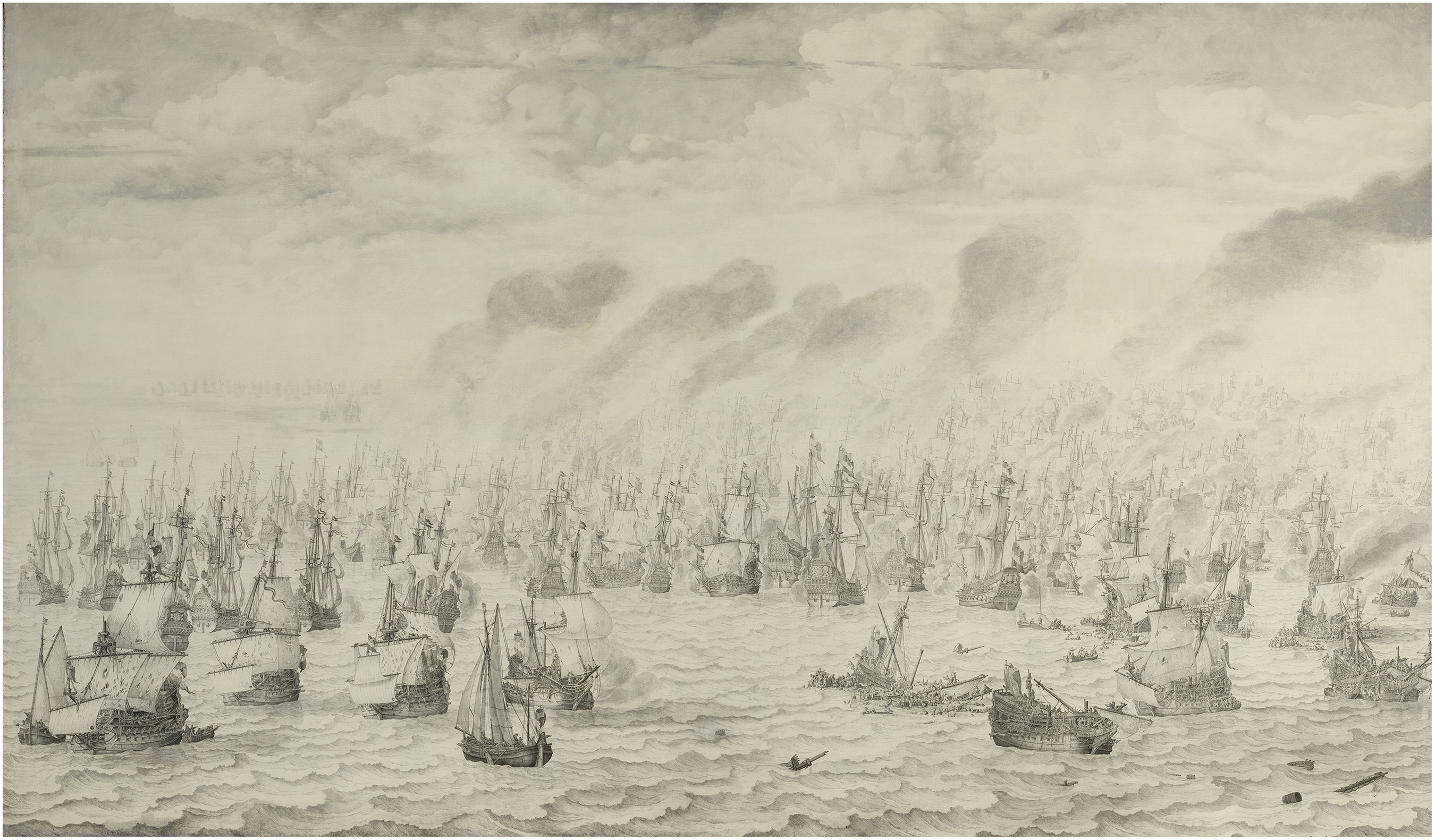
Willem van de Welde the Elder, The Battle of Terheide (Scheveningen) in 1653 (drawn in 1657).
The three-day Battle of Portland is usually understood as the watershed of the sea war. The English fleet managed to blockade the Dutch shore and prevent the return of the lucrative Dutch East India Company (Vereenigde Oostindische Compagnie or VOC) merchant fleet. Nevertheless, the Dutch Republic tilted the balance in its favour in other regions. On 14 March 1653, the Dutch commodore Johan van Galen won the Battle of Leghorn (Livorno) off the Italian coast, although he lost his life in the process. Following this victory, the Dutch Republic controlled the sea trade in the Mediterranean, which threatened England's trade with the Levant. The news of the defeat even caused a minor market crisis in London. 46
Admiral Tromp understood the consequences of the change in tactics. As long as the English fleet maintained its line-ahead formation, the less heavily armed Dutch were at a disadvantage. On 14 June 1653, Tromp wrote to the States General that he was in a ‘great necessity of ammunition’, since England possessed ‘far above one hundred stout ships of war’. 47 Such a high number was no longer a complete exaggeration. A few weeks later, Tromp again stated that ‘the ships and guns of our fleet are too slender and small in comparison of those of the enemy, and so we want greater ships and greater guns, as also number of men’. 48 Tromp obviously did the math and saw that it did not add up to an even match.
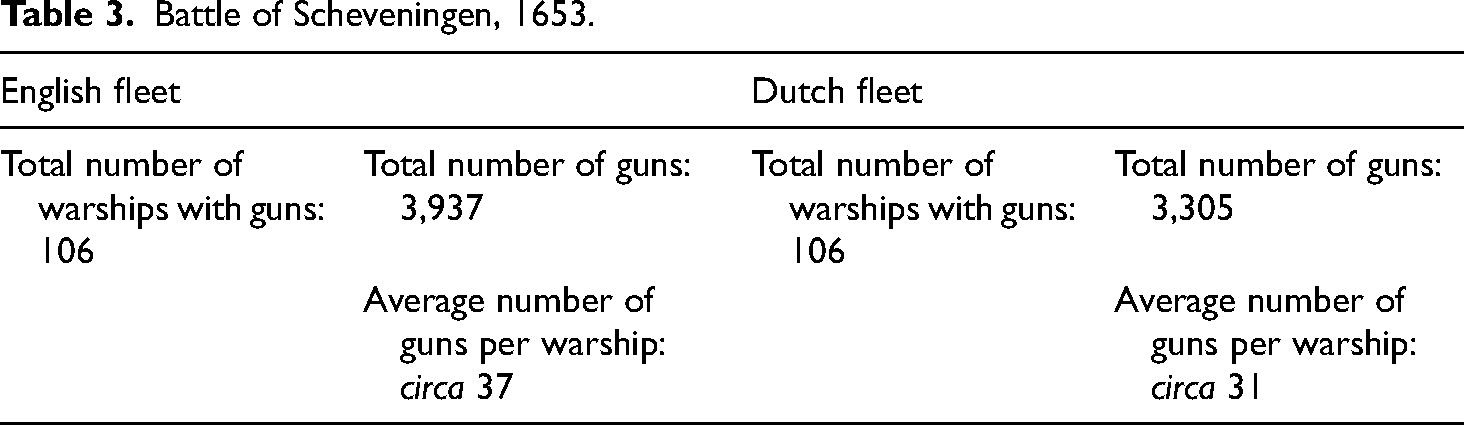
In the final battle of the First Anglo-Dutch War, the Battle of Scheveningen on 10 August 1653, the fleets were evenly matched in numbers of ships, but the English ships averaged about six guns more than the Dutch (see Table 3). Tromp tried to use different types of ships to his advantage, as he sought to break the English line by using fireships. Following the initial successes of this asymmetrical warfare, the English were able to crush the Dutch fleet with superior firepower and kill Tromp. 49 Aside from the quantitative losses, the qualitative loss of an experienced and skilled admiral was immeasurable. Dutch Admiral Witte de With told the States General: ‘I can and must say that the English are now our masters and command the sea’. 50 England, however, only won a pyrrhic victory. The English fleet had to repair its warships and temporarily lifted the blockade, which allowed the lucrative VOC ships to return to their home ports.
Battle of Scheveningen, 1653.
The Treaty of Westminster of April 1654 ended the war. It established ‘a true, firm, and unalterable peace … [,] a more intimate and nearer alliance’, an amnesty for all injuries during the war, and a provision that ‘the ships of the United Provinces shall strike their flag to the men of war of the republic of England in the British seas, as has been heretofore accustomed’. 51 Immediately thereafter, England signed trade treaties with Sweden, Portugal, Denmark and France. In the latter treaty, the logic of the balance of trade was present, as ‘free and impartial equality shall be preserved in the commerce of the two nations’. 52 This again corroborates how trade was an important element of sea power and the discussions of the balance of sea power.
The Dutch Republic and the Commonwealth of England also reached a secret deal to exclude the House of Orange from ruling in the Dutch Republic. When the Act of Seclusion became known, the Grand Pensionary of Holland, Johan de Witt, defended himself and Holland within the Netherlands by publishing Deductie (Deduction). De Witt presented the history of the Dutch Republic and showed how the new Act did not violate the Union of Utrecht. He argued that hereditary power was contrary to ‘de Ware Vrijheid’ (‘True Freedom’). Among other things, De Witt wrote that ‘navigation and commerce [are] the soul and sheer subsistence of the state’. 53
The countries of Europe were following the outcome of the war. After England won the Battle of Portland, the French resident in London, de Bordeaux, wrote to the French Secretary of State, Henri-Auguste de Loménie, Count of Brienne, on 10 April 1653, concerning Cromwell potentially attacking Spain as an ally of France. According to him, ‘we should consider England as a state capable of tilting the balance’. 54 In an intelligence letter from the Dutch Republic, John Adams wrote on 24 April 1654 that ‘some wise men are of opinion that there will be no balance without a new war’. 55 This was a perfect summary of the inherently ambiguous balance of power. The smoke from the cannons had not yet cleared, and Adams was already predicting that a new war would be waged because the balance had not yet been struck. As always with the balance-of-power theory and practice, what constituted a just balance depended on one's perspective and interests.
The Second Anglo-Dutch War (1665–1667)
In 1662, the most important Dutch Golden Age propaganda text, The Interest of Holland, was written by the Leiden clothier and radical republican, Pieter de la Court, with some notes from De Witt himself. When considering the Dutch relationship with England, Court recognized that ‘this mighty Island’ was ‘situated in the midst of Europe’, so home-bound vessels from the colonies could not avoid it. England was, by ‘its exceeding convenient Situation, to have the Dominion of the Sea’. However, it was in the English interests to keep peace with Holland and maintain trade. The Dutch could limit the English trade to the East Indies and in the Mediterranean. Court concluded ‘that the English cannot make War upon us but by Sea’ – it would be too expensive, as ‘those [naval] Wars must be carried on purely with Mony, because Naval Power cannot subsist by plundering, and quartering in an Enemys Country’ – and ‘that our only Safety is grounded upon the increase of our Naval Strength to such a Degree, that the English Fleets may either be over-ballanced by ours, or not able to hurt us’. 56 So, Court explicitly considered how to balance the enemy’s sea power by increasing the Dutch’s own sea power or ‘Naval Strength’.
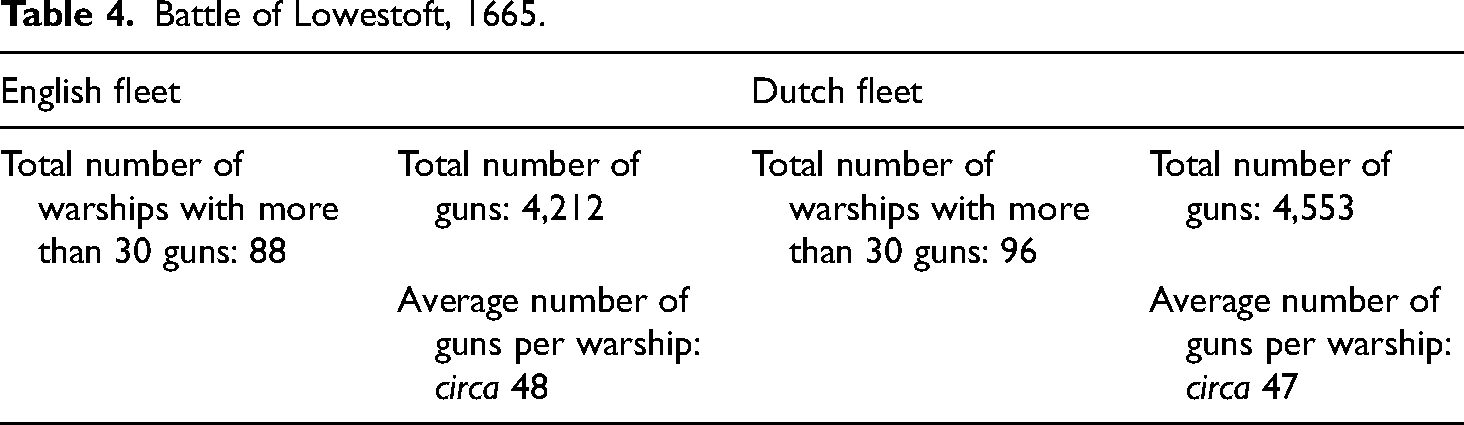
War was officially declared in early 1665, although there had been skirmishes in West Africa before then. At the Battle of Lowestoft on 13 June 1665, the English fleet had 88 warships with more than 30 guns and the Dutch fleet had 96 warships with more than 30 guns; the average warship of both fleets had 48 and 47 guns, respectively (see Table 4). Therefore, they were more or less equal in strength. However, constant good weather allowed the English to use their heaviest guns. Seventeen Dutch warships were sunk or seized, and more than 5,000 men were killed, wounded or captured. 57 The battle aroused great interest in Europe, and England again considered itself a superior sea power. However, Charles II’s Lord Chancellor, Edward Hyde, disapproved of this ‘very foolish discourse of many of getting dominion of the whole seas’. 58 Educated contemporaries were aware of the shifting balance of sea power.
Battle of Lowestoft, 1665.
The Dutch lost the battle but not the war and were far from decisively defeated. In less than a month after their defeat, De Witt set sail with a new Dutch fleet. 59 The Dutch Republic was the leading world trader and had almost limitless financial capital. 60 The Dutch economic base had to be the next target, so England tried to ally with Sweden and Denmark. The English understood that, if they closed the Baltic, it could be catastrophic for the Dutch economy. With an oral agreement of alliance with the Danish King, Friderick III, the English navy attacked a convoy of VOC vessels. These vessels were blocked in the neutral port of Bergen. However, Friderick changed his mind and his navy did not attack the VOC ships. Moreover, the Danish commander of the fortress in Bergen was not aware of any oral agreement, so the Danish soldiers fired on the English ships, which eventually had to retreat to resupply. 61
The Dutch Republic had been allied with France since 1662, but France played a double game, as did all states and statesmen. France feared a possible maritime coalition between the Dutch Republic and England. Nevertheless, the English understood the limits of French sea power at the time. As the first secretary of the Royal Society and one of the foremost intelligencers, Henry Oldenburg, wrote to the famous natural philosopher and founder of the Royal Society, Robert Boyle: ‘I am apt to believe, that France will prove a broken reed to them [the Dutch]; and that at last, seeing the Seapower of England, they will strike in with them, for a share in Trade’. 62 France declared war on England only in January 1666. However, even then, the French fleet was a ‘phantom fleet’ during the Second Anglo-Dutch War, as it did not actively participate in any open-sea battle. Louis XIV even explicitly warned his admiral and cousin, the duc de Beaufort, in a letter of 28 September 1666 that his main goal was to keep his newly built and growing fleet ‘safe’ (‘en sureté’) and avoid direct confrontation with England. 63
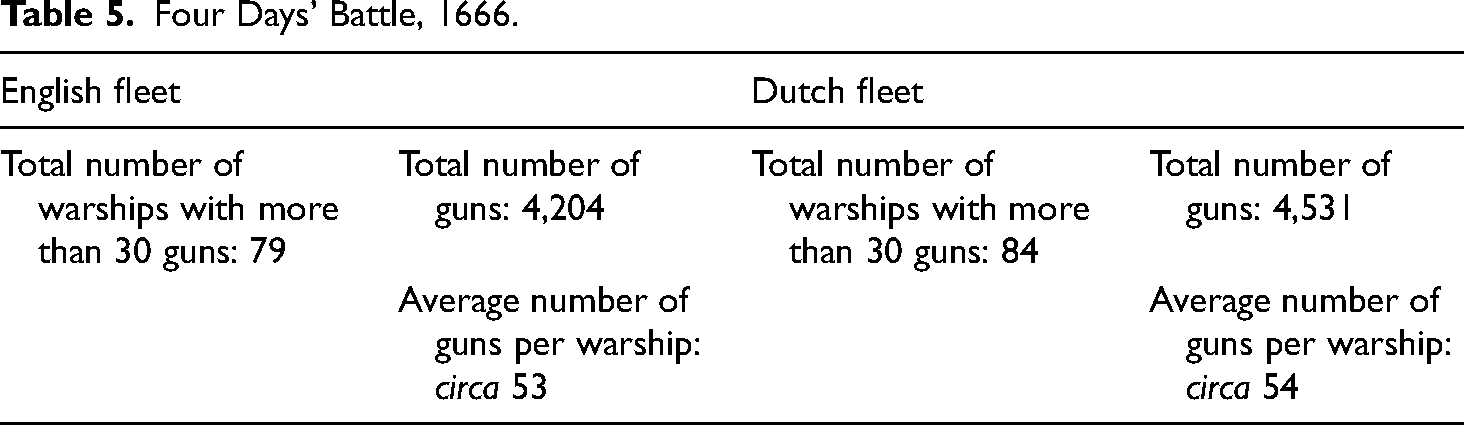
In early June 1666, the English and Dutch fleets engaged in the major Four Days’ Battle, which involved over 160 ships, although not all at the same time, as one English squadron was waiting to intercept the French ‘phantom fleet’, which never arrived. The English fleet had 79 warships with more than 30 guns and the Dutch fleet had 84 warships with more than 30 guns; the average warship of both fleets had around 53 and 54 guns, respectively (see Table 5). The Dutch gradually gained the advantage and won, but they, too, had to repair their warships after the battle. The remaining English fleet had to flee into the fog, although both fleets had used up all their ammunition. During the battle, ten English ships were sunk or captured, about 2,500 men were killed or wounded, and 2,000 were taken prisoner; on the Dutch side, four ships were lost and 2,500 men were killed or wounded. 64
Four Days’ Battle, 1666.
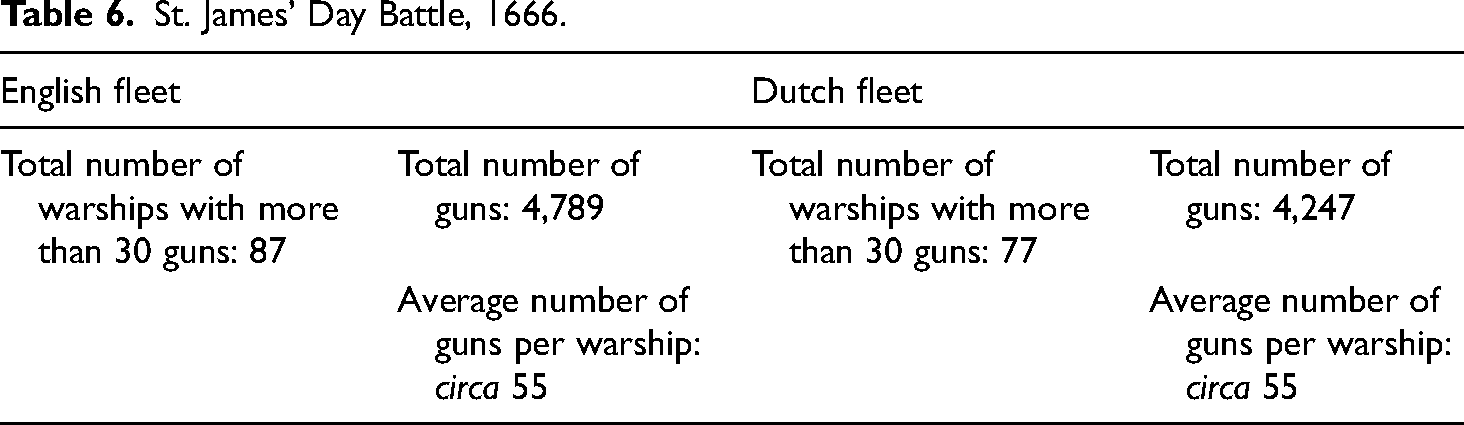
The Dutch ‘victory’ was not decisive and the English refitted their fleet relatively quickly. On 4 August 1666, exactly two months after the Four Days’ Battle, during the St. James’ Day Battle or Two Days’ Battle, the English fleet had 87 warships with more than 30 guns and the Dutch had 77 warships with more than 30 guns; both fleets averaged 55 guns per warship (see Table 6). The English fleet, under the command of Prince Rupert and George Monck, won a victory over the Dutch fleet led by Lieutenant Admiral Michiel de Ruyter. 65 Although the Dutch casualties were initially deemed enormous, it turned out that the Dutch only lost two ships and 1,200 killed or seriously wounded. 66
St. James’ Day Battle, 1666.
Since the distinction between combatants and non-combatants was less than clear in the early modern era, a legitimate goal was also the enemy's commerce. On 19 August 1666, the fleet of Robert Holmes wrecked around 150 Dutch merchant vessels in what became known as Holmes’s Bonfire (Figure 3). 67 As N. A. M. Rodger concluded, this was ‘by far the most effective English economic warfare against the Dutch in the three seventeenth-century wars’. 68 Notwithstanding this economic success, England was hit by the twin disasters of the Great Plague and the Great Fire of London, leaving the state and the Royal Navy short of funds to put the fleet to sea in 1667.
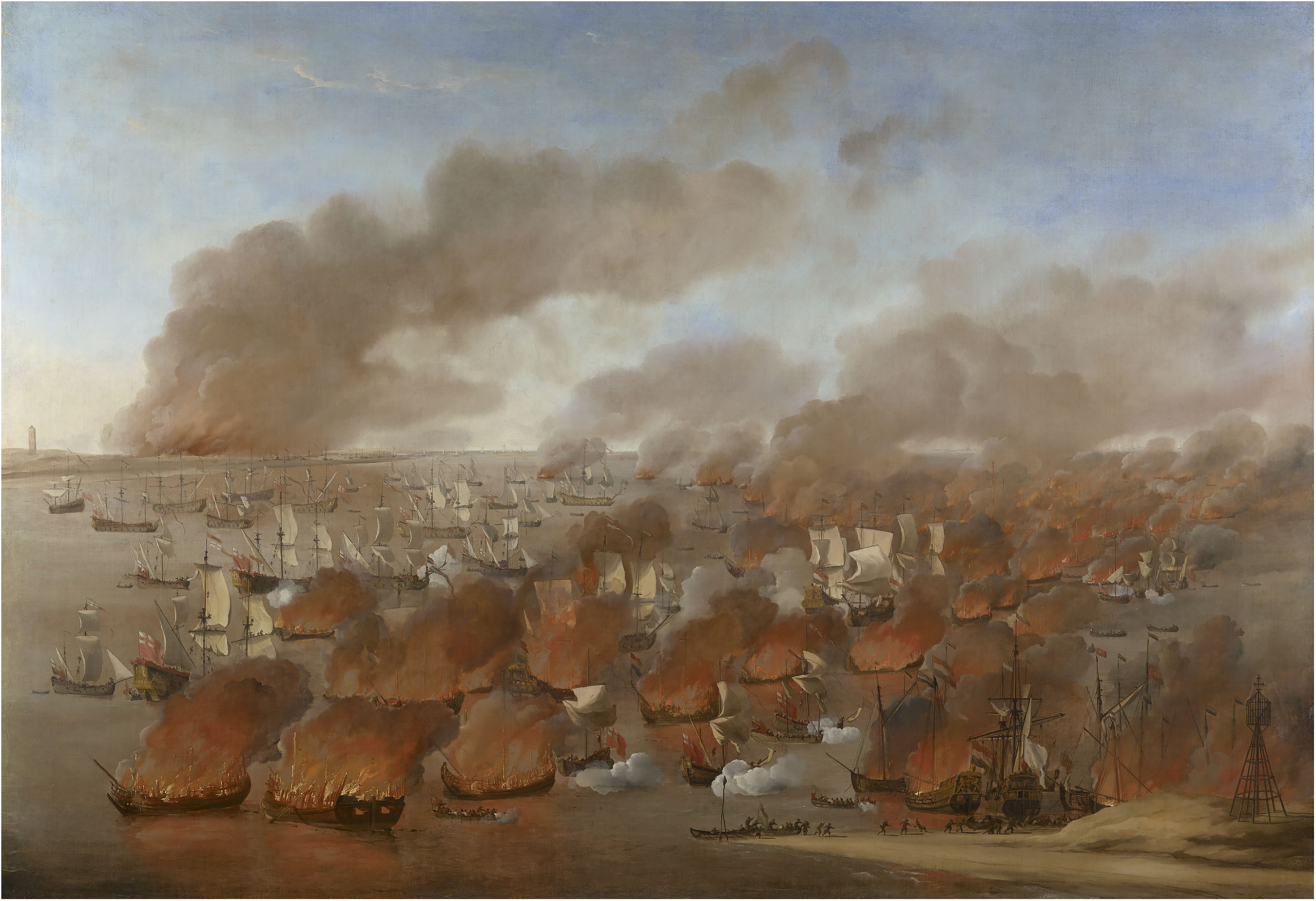
Willem van de Velde the Elder, Holmes's Bonfire in 1666 (painted in 1676).
Across the Atlantic, ‘satellite’ campaigns were taking place. The West Indies was the sole theatre of war in which the French were involved, but not the French state navy. An anchored French merchant fleet was attacked at Fort St. Pierre in June 1667 by English warships under Admiral Sir John Harman. The English won and practically destroyed the whole French merchant fleet in the Caribbean. This happened only weeks before the Treaty of Breda was signed, after which England took Suriname and Cayenne. 69 In the early modern era, privateers were not an alternative to state navies – they supplemented the state fleets, and statesmen often used privateers and letters of marque to (indirectly) operate in distant seas, and put pressure on enemies’ economies.
When they received information that the English could not sail with their fleet in June 1667, the Dutch seized the opportunity. Dutch warships navigated up the River Medway, burned and sank the three largest English warships (Royal James, Loyal London and Royal Oak), and captured the Royal Charles, which was moored off Chatham Dockyard. The Clerk of the Cheque at Chatham, Edward Gregory, told Samuel Pepys that ‘the destruction of these three stately and glorious ships of ours was the most dismal spectacle my eyes ever beheld, and it certainly made the heart of every true Englishman bleed, to see such three Argos lost’. 70 A month after the raid, on 19 July 1667, Pepys noted in his diary that the Surveyor of the Navy, Sir William Batten, cried out in despair: ‘by God, I think the Devil shits Dutchmen!’ 71 Ten days later, on 29 July 1667, Pepys wrote that ‘in all things, in wisdom, courage, force, knowledge of our own streams, and success, the Dutch have the best of us, and do end the war with victory on their side’. 72
The Treaty of Breda contained the typical articles of ‘a true, firm, and inviolable peace, a more sincere friendship, a closer and stricter friendship, a closer and stricter alliance’, free trade (in Europe) and amnesty for the damages done during the war. 73 The statesmen again considered the balance of trade in the appendix commercial treaty. Neither state had the time ‘to weigh in an Equal Balance, and thereby exactly to adjust all and every thing’. The treaty argued that ‘it may be feared, the Inhabitants and Subjects of both Parties may fall back again into new Quarrels and Dissentions, and the Differences now composed may bleed afresh, if they be not bound up by some certain Laws about those things which concern Navigation and the use of Trade’. 74 Thus, they at least nominally wanted to set a fixed balance of sea power to prevent wars, which was impossible in the (early) globalized world.
The expansionist tendencies of Louis XIV encouraged thinkers to reflect on the nature of the broader balance of power, and it became the mainstream of European political discourse. The most prominent Habsburg diplomat, François-Paul de Lisola, wrote Bouclier d’estat (The Shield of the State). He referred to the influential French thinker and writer, Henri II, Duke of Rohan, but explained that it was no longer Spain but France under Louis XIV that threatened the ‘European balance’ because it supposedly aspired to ‘universal monarchy’. Lisola went on to say that European statesmen should form a strong anti-French alliance and maintain the balance between France and Spain if they wanted to preserve their autonomy and peace in Europe. 75
Lisola's ‘balanced’ ideas caused European and English public opinion to shift from anti-Spanish to anti-French. 76 In 1668, Slingsby Bethel published a pamphlet criticizing Oliver Cromwell. When Cromwell went to war against Spain instead of France in the mid 1650s, after the First Anglo-Dutch War ended, he ‘broke the balance betwixt the two Crowns’. 77 Bethel called for a dynamic foreign policy without fixed alliances and following the common-sense approach of always going against the most powerful. He criticized Cromwell directly, but also, indirectly, Charles II, who supported Louis XIV. 78 Bethel pointed out that England was not strong enough to oppose France alone and therefore had to seek allies to maintain the balance. This was part of the interactive process of attaining and maintaining the balance of (sea) power.
In 1668, Parliament urged Charles II into the Triple Alliance with Sweden and the Dutch Republic to stop France's ‘universalist’ goals. The ‘perpetual Defensive League’ specified the materiel and men that each state had to provide to deter ‘such Attempts, and acts of Hostility’. Among other things, England and the Dutch Republic were obliged ‘to assist … with forty Ships of War well equipped, of which 14 to carry between 60 and 80 Guns, and 400 men apiece one with another; Fourteen others, from 40 to 60 Guns, and at least 300 men apiece one with another; and none of the rest to carry less than 36 Guns, and 150 men’. 79 Another printed edition of this alliance treaty, published in London, also specified the financial costs that each state had to contribute for maintaining such a fleet at sea.
This treaty of the ‘perpetual Defensive League’ of 1668 is an explicit contemporary recognition of the balance of sea power between England and the Dutch Republic. As already seen from the analysis of the ship lists, only warships with a certain number of guns were considered capable of fighting in a line of battle. By distributing the potential war effort equally between the two partners in terms of materiel and men, the naval balance of sea power was accepted between England and the Dutch Republic. In this way, the states numerically estimated the force necessary to limit the potential threat from France. Moreover, the treaty was published so that France would receive a not-too-subtle message of deterrence.
Dutch and English statesmen and diplomats wrote about the balance-of-power idea. De Witt and William Temple, the architect of the Triple Alliance, corresponded in French, and discussed the alliance and mutual ‘equality’, which was a ‘true foundation of goodwill and friendship’. 80 Although allied, they were vigilant. Temple understood the interactive balance-of-power politics that operated within the larger European interstate system. He foresaw that other states could lawfully control and attack England if it violated the ‘balance’. Temple cautioned Charles II against the threat that a powerful France posed to Europe by implying the balance-of-power idea. Gradually, England became a ‘balancer’, or bouncer, on the European continent. 81
The Third Anglo-Dutch War (1672–1674)
Despite the work that Temple had put into the Triple Alliance, Charles II concluded the Secret Treaty of Dover with Louis XIV in 1670, creating an offensive alliance against the Dutch. They agreed ‘to declare and wage war jointly with all their forces by land and sea … to reduce the power of a nation which … even has the insolence to aim now at setting itself up as sovereign arbiter and judge of all other potentates’. 82 Charles II argued that ‘the States of Holland are England's eternal enemy, both by interest and inclination’; that the States General were ‘the common enemies to all monarchies’; and that the Dutch aspired to a ‘universal empire as great as Rome’. 83 As mentioned above, the concept of a universal monarchy was often invoked in opposition to the balance of power in the early modern era.
The balance of power did not allow for any trade dominance, as it usually translated into more money, more warships, and ultimately more sea power. Although the trade deficit was not the primary reason for the outbreak of the Third Anglo-Dutch War, it was important. The English mercantilist writer, Roger Coke, published A discourse of trade in 1670 and contrasted the ‘decaying English trade’ with the ‘prospering Dutch trade’. 84 When comparing the raw numbers, the Dutch definitely had the upper hand in trade and especially shipping. War was officially declared in the spring of 1672 because of the feud over the ‘sovereignty of the seas’ and ‘Dutch ingratitude’. 85 This was also the start of the Franco-Dutch War (1672–1678) or, as it is also known in the Dutch historiography, the Dutch Forty Years War (1672–1713). 86
England and France combined their fleets, with England leading the offensive by sea and France attacking the Dutch Republic on land; 6,000 Englishmen were supposed to eventually land on Dutch shores. De Witt did not understand that the war on land against France would be more important than the war at sea against the combined Anglo-French fleet. Louis XIV knew how disorganized the Dutch army was and, when the French army attacked in May 1672, the frontier collapsed within weeks. It was an absolute failure for De Witt. He and his brother Cornelis were forced out of office, publicly massacred and possibly even cannibalized in The Hague in August 1672. The Dutch nominated William of Orange as stadtholder. 87 The Dutch Republic needed to concentrate its forces on land, so it had to land some sailors and guns from its ships.
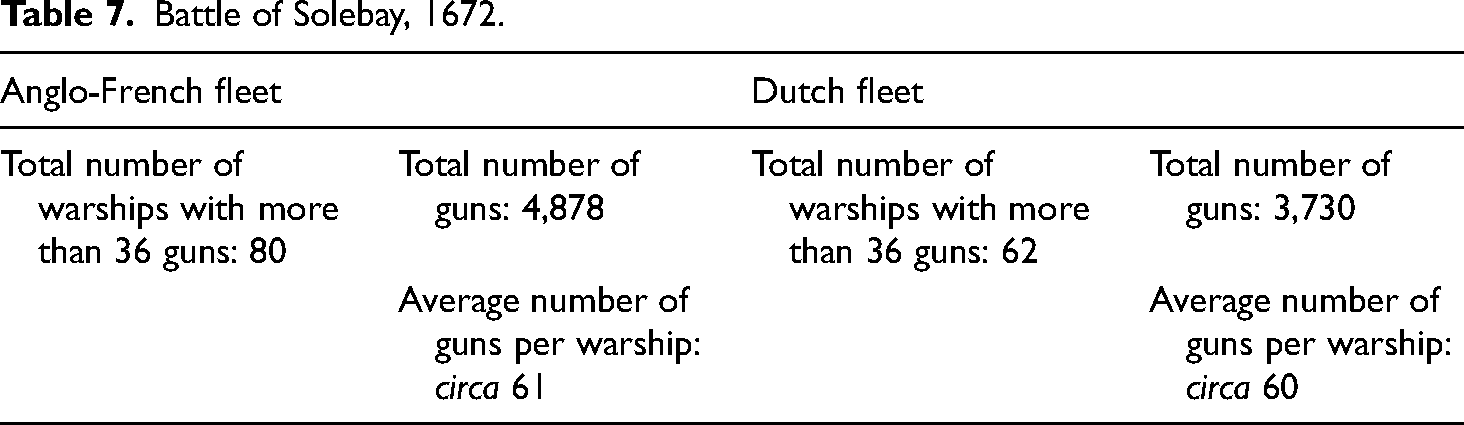
However, even with a numerically inferior fleet, De Ruyter, the Dutch lieutenant admiral, managed to keep the Anglo-French fleet at bay and thwart the English invasion, as in the Battle of Solebay on 7 June 1672. In this first sea battle of the Third Anglo-Dutch War, the fleets were still fairly balanced compared to later battles. The Anglo-French fleet had 80 large warships with more than 36 guns and the Dutch fleet had 62 large warships with more than 36 guns; on average, the Anglo-French warships had 61 guns against 60 guns on the Dutch warships (see Table 7). No further sea battles occurred in 1672 because of the persistently bad weather during the summer. 88
Battle of Solebay, 1672.
England’s naval strategy was similar to that of the earlier wars – namely, the destruction of the Dutch fleet and the blockade of the Dutch coast against international trade. However, the Dutch naval strategy was very different from the earlier wars. De Ruyter had to avoid large, open battles, hold his fleet and prevent a potential invasion from the sea. 89 Mahan holds that the Dutch were pressed into this tactic ‘by the desperate odds under which they were fighting; but they did not use their shoals as a mere shelter – warfare they waged was the defensive-offensive’. 90 To maintain the balance of sea power, De Ruyter adapted his strategy to more asymmetrical tactics.
The naval alliance with France proved to be of only limited direct use to England. Louis XIV gave orders to his admiral, Comte d’Estrées, to guarantee coordinated cooperation. He wanted the French fleet, officers and seamen ‘to surpass them [the English] in bravery, steadiness and the knowledge of everything relating to naval warfare’. 91 This attitude was a marked departure from his instructions in the Second Anglo-Dutch War, when France was a nominal ally of the Dutch but remained at a safe distance, to protect the newly built warships. However, the obvious impracticalities and logistical problems of coordinating tactical movements with different languages, signals and fighting instructions diminished the numerical advantage.
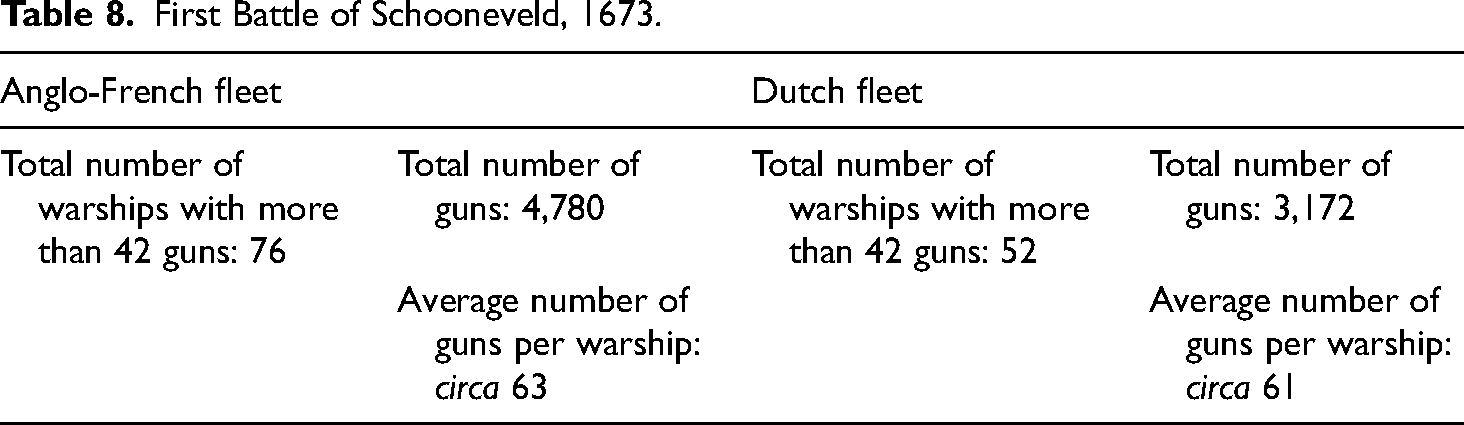
The Anglo-French cooperation was far from ideal, and the image the English had of their ally quickly deteriorated. In the First Battle of Schooneveld in 1673, the Anglo-French fleet, which now had 24 more large warships than the Dutch and was more heavily armed, tried to destroy the Dutch fleet (Table 8). Nevertheless, De Ruyter's defensive–offensive tactics worked and he succeeded in maintaining the balance at sea. The English admiral Prince Rupert argued that the French intentionally did not attack at sea so that England and the Dutch Republic could harm each other and France could become the superior sea power. 92 As the pamphlets show, public opinion in England was turning against France. 93 Moreover, Lisola issued an Appeal to England as early as 1673, urging England to join the new anti-French coalition in order to restore the European balance. 94
First Battle of Schooneveld, 1673.
In February 1674, the (separate) Treaty of Westminster was signed. Many articles were more or less identical to those of earlier treaties, such as concluding ‘a firm, sincere and inviolable peace, union and friendship’. 95 Thomas W. Fulton noted that the article on the flag had been included in many Anglo-Dutch treaties until 1784, but was only a formality. 96 England also allowed the flow of contraband arms to aid the Dutch Republic in its ongoing war against France. Charles II not only signed a separate peace treaty, but also paved the way for the Glorious Revolution of 1688. He eventually sealed an alliance by marrying the Duke of York's daughter, and his niece, the future Queen Mary, to William of Orange, the future King William III.
The Dutch were still at war with France. The navigation engineer Andrew Yarranton wanted England to ally with the Dutch Republic, as he believed that ‘the Balance [was] now broke’, and he warned that ‘the great danger might ensue in breaking the Ballance of Europe, it being then so indifferently settled’. 97 In an alliance treaty between England and the Dutch Republic signed in 1678, both states agreed to work together ‘with all their united force’, but the former ‘shall furnish one third more by sea than the States [of Holland], and they one third more by land than his Majesty’. 98 This proves how practical and interactive the manifestation of the balancing process had become by that time. Because the Dutch had to direct their defensive capabilities to the land to counter the French onslaught, they now had to provide one-third fewer naval forces and one-third more land forces. The balance of sea power gradually shifted in England's favour, as the Dutch Republic had to invest in its army and land defences.
However, in 1680, an anonymous author, in describing the recent rise of the (sea) power of France and how to counter it through the balance-of-power concept, argued: ‘that which is the Crown of this perfection [of France], and may be the strongest stay of it, is the Naval force now added to the other strengths of that powerful Monarchy’. This ‘Naval force’ now ‘equals, if it be not an overballance to, either England or Holland’. Moreover, ‘there was never before any example upon Earth of a Triumvirate of mighty Nations in a vicinity of neighbourhood one to another, and bordering upon the same Seas, equally powerful in Naval strength’. 99 Thus, this anonymous author suggested that the sea power of France equalled the sea powers of England and Holland, explicitly arguing for a tripartite balance of sea power.
The question of alliances was essential. The anonymous author warned that France ‘had grow to an over-ballance to England in Naval force’ and that ‘there is no separate Kingdom or State in Europe sufficient to ballance the weighty Body of the French Monarchy’. In his opinion, France was already a greater sea power than England at the time. Thus, ‘there must be a new fond of Power and Interest raised up, sufficient to keep the ballance of Europe from being called back into a Chaos, out of which the French may form an Universal Monarchy’. He concluded that ‘this can by no means better be done than by England and the United Provinces, entring into a new League, for the mutual and reciprocal defence of themselves, and their Confederates … and for restraining the further growth and increase of the French Monarchy.’ 100 Sea power was indeed part of the balance-of-power discourse.
Conclusion
Coming back full circle to the beginning, was there a balance of sea power in the early modern era, as Hauterive declared? Although his motives were clear to his contemporaries, Hauterive raised an interesting question, which has so far been neglected in the historiography. When discussing the early modern sea powers or power politics in general, the transfer of (sea) power from one state or metropolis to another has always been the focus, as famously illustrated by Ferdinand Braudel and Immanuel Wallerstein. While these traditional analyses and syntheses are not wrong, they tend to miss the periods or aspects of power politics when the outcome was far from certain. Although the concepts of the balance of power and sea power have been studied extensively, no one has combined them to analyse the balance of sea power in the early modern era, when supremacy was by no means definitely determined.
I have sought the balance of sea power on three levels – the naval, the diplomatic and the discursive. The analysis of the ship lists for the major sea battles in the studied period shows that, in many battles, there was indeed a relative numerical balance between the fleets or the alliances of fleets. The First Anglo-Dutch War was an exception, when England had a clear advantage in its number of warships, and especially its number of guns, compared to the Dutch Republic. Acknowledging this disparity, the large Dutch shipbuilding programme of the 1650s and 1660s brought the two navies to parity by the start of the Second Anglo-Dutch War in 1665. Since it was expensive to maintain a fleet at sea, considering the financial and workforce limits, there were also limits to the size of the battle fleets.
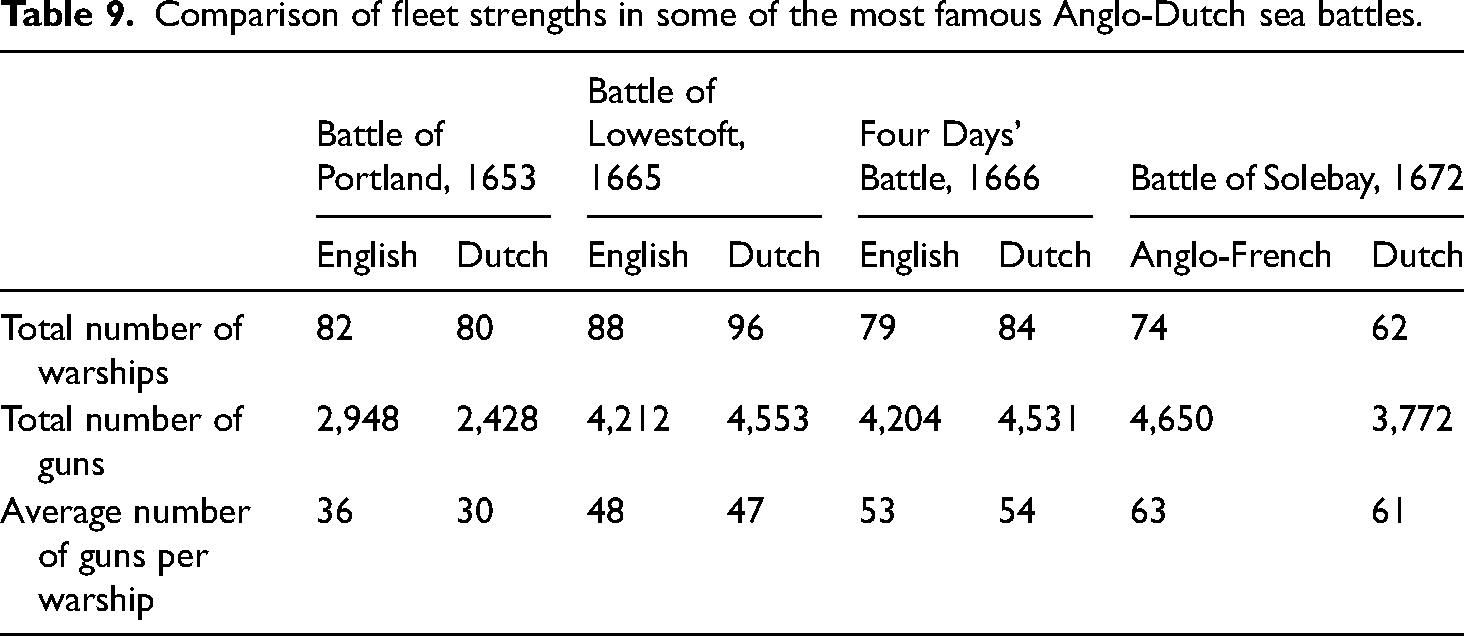
The analysis of the ship lists also shows that the number of guns needed on warships gradually increased in the second half of the seventeenth century, practically doubling in 20 years from the First to the Third Anglo-Dutch War. Before the line-ahead tactics became predominant in the 1650s and 1660s, practically all ships could potentially participate in open-sea battles. However, after the new tactics became common, the standards for allowing a warship into the line of battle were higher, as every ship had to maintain the heavy broadsides by the enemy warships so it would not break the line and expose the whole fleet. Although there were fewer warships in total participating in the battles, they had more guns and could withstand heavier broadsides for longer (see Table 9).
Comparison of fleet strengths in some of the most famous Anglo-Dutch sea battles.
The balance of sea power was also recognized diplomatically. Several alliance treaties established the numerical requirements for allies, using an interactive process of searching for the necessary forces to thwart the potential or actual threat. These usually listed the number of armed forces, the money required to maintain them and the duration of their enlistment. When it came to the naval elements, the primary focus was on the number of warships and guns, although the number of seamen and the funds required were also sometimes listed. For example, the Triple Alliance of 1668 recognized the exact balance of sea power between England and the Dutch Republic, as they both had to contribute the same number of warships to thwart France. However, it gradually started to fall in favour of, or as the responsibility of, England.
Pamphlet writers, jurists and philosophers also discussed the balance of sea power. This was usually a part of broader discussions around the balance of power in Europe. One of the main questions related to power politics at the time was alliance-building and alliance-breaking, which several jurists and philosophers tackled. However, the discussions also specifically touched on sea powers. Two aspects of sea power were recognized in the early modern era: iron for warships and gold for trade. Often, the shipbuilding programme in one country stimulated the shipbuilding programme in another – not unlike the modern arms race.
If I may paraphrase the medieval historiographical concept, the perceived translatio imperii maris between sea powers has often been used by the great historians – the power shifted from Venice and Spain to the Netherlands and Great Britain, or their dominant capitalist cities. However, I have shown how the situation was far more complicated and the transition less than definitive. The nature of naval warfare and navies in the long seventeenth century drove sea powers towards an implicit and sometimes explicit balance. I argue that the balance of sea power was a practical and naval reality, that it was acknowledged in the international alliance treaties, and that it became an element of early modern international relations discourse.
Footnotes
Acknowledgements
I wish to thank László Kontler, Andrew Lambert and David Parrott for their generous suggestions and feedback on earlier drafts of this article. I am grateful to Hugh Murphy, Alan James, Erik de Lange and Alexander Pickering for participating in discussions and organizing the King's Maritime History Seminars at King's College London, where I presented my research. I also want to thank the participants at the 2023 McMullen Naval History Symposium, hosted by the US Naval Academy in Annapolis, for their insightful ideas, especially Ryan Mewett and Evan Wilson.
Funding
The author received no financial support for the research, authorship and/or publication of this article.