




Abstract
The export of antiquities from Egypt to the United Kingdom during the mid nineteenth century required an extensive network of cultural, diplomatic and mercantile actors, including private shipowners. While much previous research has focused on the political stakeholders in the process, as well as the archaeologists conducting excavations in Egypt, the attempted export of Menkaure's sarcophagus from Giza to the British Museum in 1838 allows for a closer examination of one of the private shipowners who was involved in this process – namely, Captain Richard Mayle Whichelo of the merchant vessel Beatrice. This article investigates the diplomatic processes that were required for the export of the sarcophagus and provides an overview of the history of the Beatrice and of Captain Whichelo, placing this within the broader context of the transport of antiquities during the nineteenth century.
Colonel Vyse at Giza
The export of antiquities from Egypt to various western private and public collections began in earnest following the surrender of the French forces at Alexandria in 1802. This surrender, in turn, led to an influx of ancient Egyptian artefacts to the British Museum (including the Rosetta Stone). 1 The appointment of ardent collectors such as Henry Salt and Bernadino Drovetti to posts in, respectively, the British and French diplomatic services in Egypt, 2 as well as the organization of state-sponsored expeditions to Egypt to secure ancient artefacts for national collections (such as the Lepsius Expedition in 1842), 3 led to a significant increase in ancient Egyptian artefacts being exported to Europe during the first half of the nineteenth century.
While much scholarship has focused on the excavators or collectors working in Egypt, 4 there has been less analysis of the private shipowners who provided key logistical support for the export of Egyptian artefacts. The attempted export of the newly uncovered sarcophagus of the Fourth Dynasty Egyptian ruler Menkaure in 1838 provides a significant case study for addressing this aspect of the historical antiquities trade. Not only are the political and diplomatic actions that led to the export of the sarcophagus well evidenced, but the vessel used for the export of the sarcophagus, the Beatrice, as well as her captain are also associated with a great deal of archival material.
The attempted export of the sarcophagus of Menkaure begins with its discovery. Its discoverer, Richard William Howard Vyse (1784–1853), did not originally arrive in Egypt with the expectation of undertaking archaeological excavations. Rather, the notion of Vyse conducting archaeological exploration while in Egypt was raised with him by Charles Sloane, the chancellor of the British consulate in Cairo and vice consul in Alexandria. 5 Sloane had worked in Egypt for more than a decade, during which time he had engaged with archaeologists, such as the noted Scottish Egyptologist Robert Hay (1799–1863) in 1824, and archaeological excavations. 6 Sloane proposed a cooperation between himself, Vyse and the consul general, Patrick Campbell (1779–1857).
Finding the sarcophagus of Menkaure
During the spring and summer of 1837, Vyse and his excavators worked all across the Giza plateau, including around the Pyramid of Menkaure, where explorations began on 31 May 1837. On 1 August 1837, Vyse and his colleagues reached the burial chamber of the pyramid, although, as evidenced by the Arabic graffiti in the chamber, they were by no means the first post-pharaonic people to have visited it. 7 Undoubtedly, the most significant of the finds in the burial chamber was the basalt sarcophagus of Menkaure himself, which Vyse described in great detail. 8
According to Vyse's own memoires, he decided to send the sarcophagus of Menkaure to the British Museum, allegedly to prevent damage to the artefact should it remain in situ. 9 Vyse established contact with Edward Hawkins, the Keeper of Antiquities at the British Museum, on 16 January 1838 by letter, suggesting to him that the sarcophagus would make a good addition to the British Museum’s collections. The following day, Hawkins wrote a letter to Josiah Forshall, the Keeper of the Manuscript Department at the British Museum. 10 Hawkins warmly supported Vyse's notion that the sarcophagus should be moved from Giza to Alexandria, and from there be shipped to the United Kingdom without delay, arguing that the sarcophagus was an ‘interesting monument’ that would enhance the Museum's collections (Figure 1).
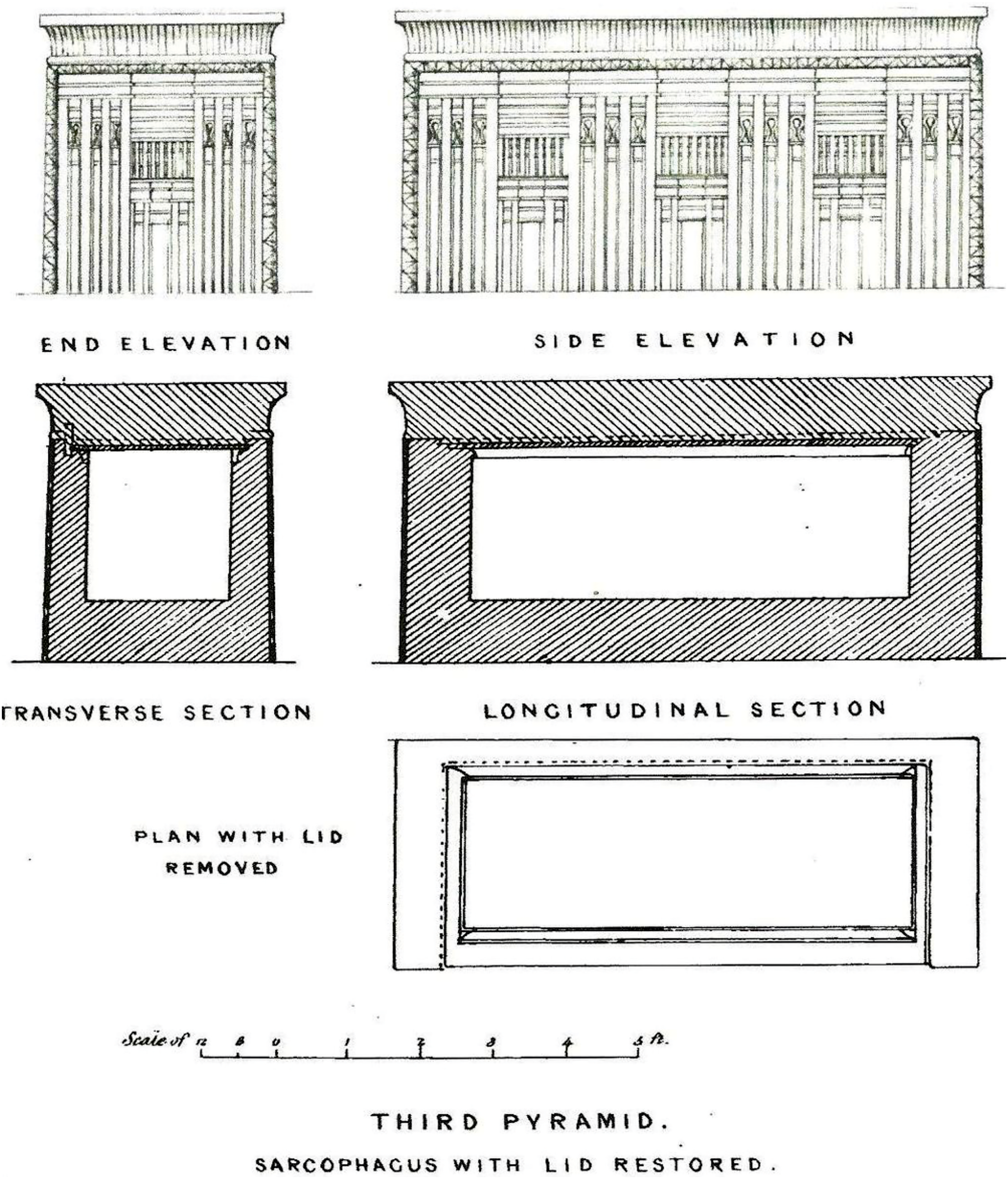
Sketch of the sarcophagus found in the burial chamber of the Pyramid of Menkaure.
On the basis of Hawkins’ recommendation, the trustees of the British Museum, meeting on 27 January 1838, directed the committee secretary to accept the donation and instruct the consul general, Patrick Campbell, via the Foreign Office to arrange its transport. 11 The board of trustees also authorized the expenses of £150 for the transport of the sarcophagus from Giza to London.
Less than two weeks later, on 17 February 1838, John Bidwell, the superintendent of the Consular Service, wrote on behalf of Lord Palmerston, the foreign secretary, directly to Campbell in Alexandria, instructing him to organize the transport of the sarcophagus and the relevant firman for its export from the Egyptian government
12
– a requirement following the passing of the first law aimed at preventing the export of antiquities from Egypt in 1835.
13
On 18 May 1838, Campbell replied to Lord Palmerston's instructions: My Lord, In reply to Your Lordship's Consular No. 3 of 17th February, on the subject of the transport from Gizeh to Alexandria and from thence to England of a sarcophagus presented by Col. Vyse to the British Museum, I have the honour to state to Your Lordship that I have taken the necessary steps for that purpose and that Mr Hill, one of the persons mentioned by Col. Vyse as qualified to superintend the transport of the Sarcophagus has undertaken to convey it to Alexandria for the sum of £150. I have the honour to transmit to Your Lordship the copy of the contract of Mr Hill for the removal of the sarcophagus to Alexandria.
The transport of the sarcophagus from Giza to Alexandria had been accomplished by the end of the summer, and from there the final leg of its journey would be a voyage by sea. For this stage of the transportation, Campbell or one of his deputies contacted a British merchant sailor already in Alexandria, and even though no contract or letters between these two individuals have survived, a letter from Campbell to Josiah Forshall at the British Museum, dated July 1838, confirms that the vessel hired for the transport of the sarcophagus to the United Kingdom was the Beatrice, which was owned and commanded by Captain Richard Mayle Whichelo (Figure 2). 15
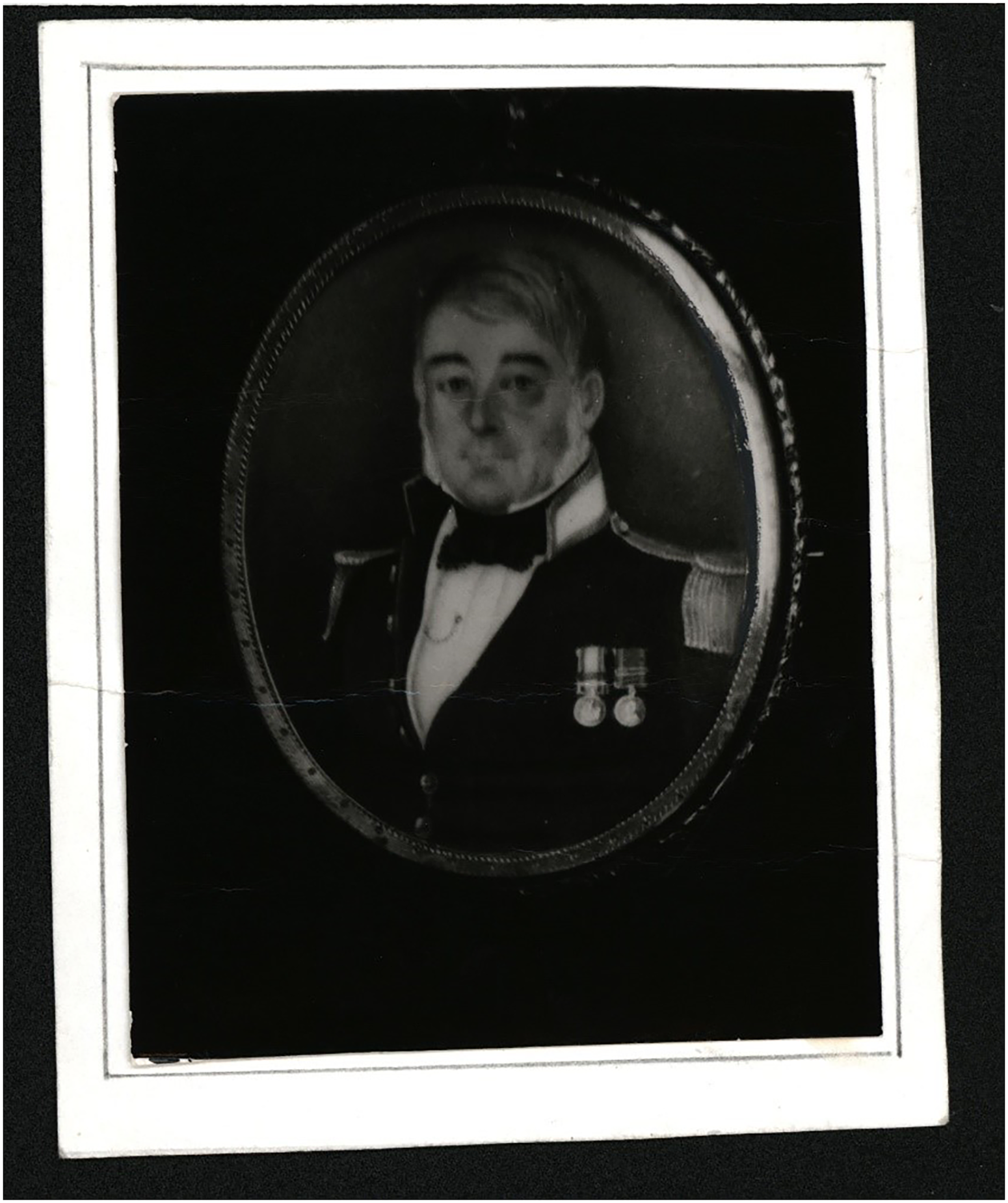
Miniature painting of Richard Mayle Whichelo.
Shipping the sarcophagus
The Beatrice was built in Quebec in 1827 by the shipwright John Bell, 16 and first owned by a Mr Evans, about whom no further information is preserved. 17 The Beatrice remained in the ownership of Mr Evans until 1834, 18 when she was purchased by Richard Mayle Whichelo, who had already functioned as her captain since at least 1830. 19 While the Beatrice initially ran a route between London and the Caribbean, 20 Whichelo sailed her primarily between the ports of Liverpool and Alexandria, calling at a number of locations between the two – most commonly La Valletta on Malta, 21 but also Gravesend, Milford, Cardiff, Genoa, Istanbul and Civito Vecchia. 22
In terms of cargo, the Beatrice mostly transported cotton from Alexandria to Liverpool during the latter half of the 1830s, but as is clear from an advertisement in the Liverpool Standard and General Commercial Advertiser published on 1 September 1837, the ship also transported other goods. The advertisement announces a sale of goods imported on the Beatrice from Alexandria, which include ‘1023 bales cotton … 6 cases natural history. 1 case saddles … 1 case natural history … about 15 tons Cyprus earth, 3 tons old junk … 1 box samples gum … 4 jars preserves … 8 bales ginger’. The reference to cases of ‘natural history’ could potentially include ancient artefacts, 23 and so it is possible that Captain Whichelo already had experience transporting artefacts from Egypt to the United Kingdom by the time he was approached to convey the sarcophagus of Menkaure in 1838. The nineteenth-century import of ancient Egyptian artefacts alongside other trade goods reflects the prevailing contemporary view that antiquities were in themselves trade goods, and sometimes, although not always, they were perceived as a luxury good. A prime example of this dichotomous view is the arrival of several tons of mummified cats at the port of Liverpool on 4 February 1890 on board the steamship Pharos. 24 While some of the mummified cats were sold ‘for fancy prices, such as 40 s [shillings] 6d [pence] for a head and 5 s 6d for a perfect body without the head’ to local collectors and learned institutions, 25 the majority of the mummies were ‘knocked down to Messrs Leventon and Co’ to be ground up and utilized as fertilizer. 26
Richard Mayle Whichelo was born in 1783 in Sussex and was the older brother of the painters John and Henry Mayle Whichelo. 27 He served first as a midshipman in 1804 on board HMS Britannia during the Napoleonic Wars, before being appointed to the position of ship's clerk. He took part in the Battle of Trafalgar on board the Britannia in 1805 and, in 1807, received a promotion to paymaster and purser on board the 26-gun sloop-of-war HMS Egeria. On board the Egeria, he participated in action in the North Sea and Baltic Sea, including an 1809 engagement with a Danish convoy that resulted in the capture of four Danish vessels. 28 Whichelo's movements between 1815 and 1830 are somewhat unclear. An advertisement from 1822 records him as the captain of the Dash, a brig lying at anchor at Irongate wharf in London and headed for Sicily. 29 Six years later, Whichelo served as captain on board the Borneo, a convict ship that transported 73 female prisoners from London to Hobart, 30 before first being attested as the captain of the Beatrice in 1830. During the 1830s, two of Whichelo's sons also worked with him on the Beatrice as the ship's first mate and second mate. 31
The Beatrice left her home port of Liverpool for the last time on 28 November 1837, setting a course for the Italian port of Civito Vecchia. 32 She arrived in Italy on 18 January 1838, 33 spending only a short time in port before leaving again for Alexandria, where she arrived in March 1838, 34 a little over a month after the British Museum’s board of trustees had accepted the sarcophagus and authorized the payment for its transport to Alexandria. There is no direct documentary evidence to illuminate under what circumstances Captain Whichelo was approached to organize the transport of the sarcophagus from Alexandria to Liverpool. It is likely that it was organized either directly by Patrick Campbell or, alternatively, by his representative in Alexandria, Charles Sloane. Even though no record exists to directly evidence it, it is, however, likely that Campbell or one of his representatives paid some additional money to Captain Whichelo in order to guarantee that his ship remain in Alexandria awaiting the arrival of the sarcophagus coming overland from Giza. The Beatrice remained in the port throughout the spring and summer of 1838 – a far longer period of time than the ship and crew had spent in the city on previous journeys. 35
The crew of the Beatrice on its final voyage from Alexandria is not known. The last full crew list of the Beatrice to survive does so in the National Archives of Malta. 36 These records show that the Beatrice arrived in the port of Valetta on 30 March 1836 and, on this voyage, her crew comprised a total of 13 men: her master, Richard M. Whichelo (aged 49 at the time); the first mate and captain's son, John R. Whichelo (aged 22); the sailors Thomas Goodwin (21), William Thompson (24), William Fenah (22), Richard Baker (23), Spencer Williamson (25), John Clark (20), John Williams (24) and William Gittan (30); and the ship's youngest crew member, whose surname is unclear in the records but whose first name was Neil, aged 17. In addition, there were two further crew members whose names are sadly illegible due to the state of the records (Figure 3).
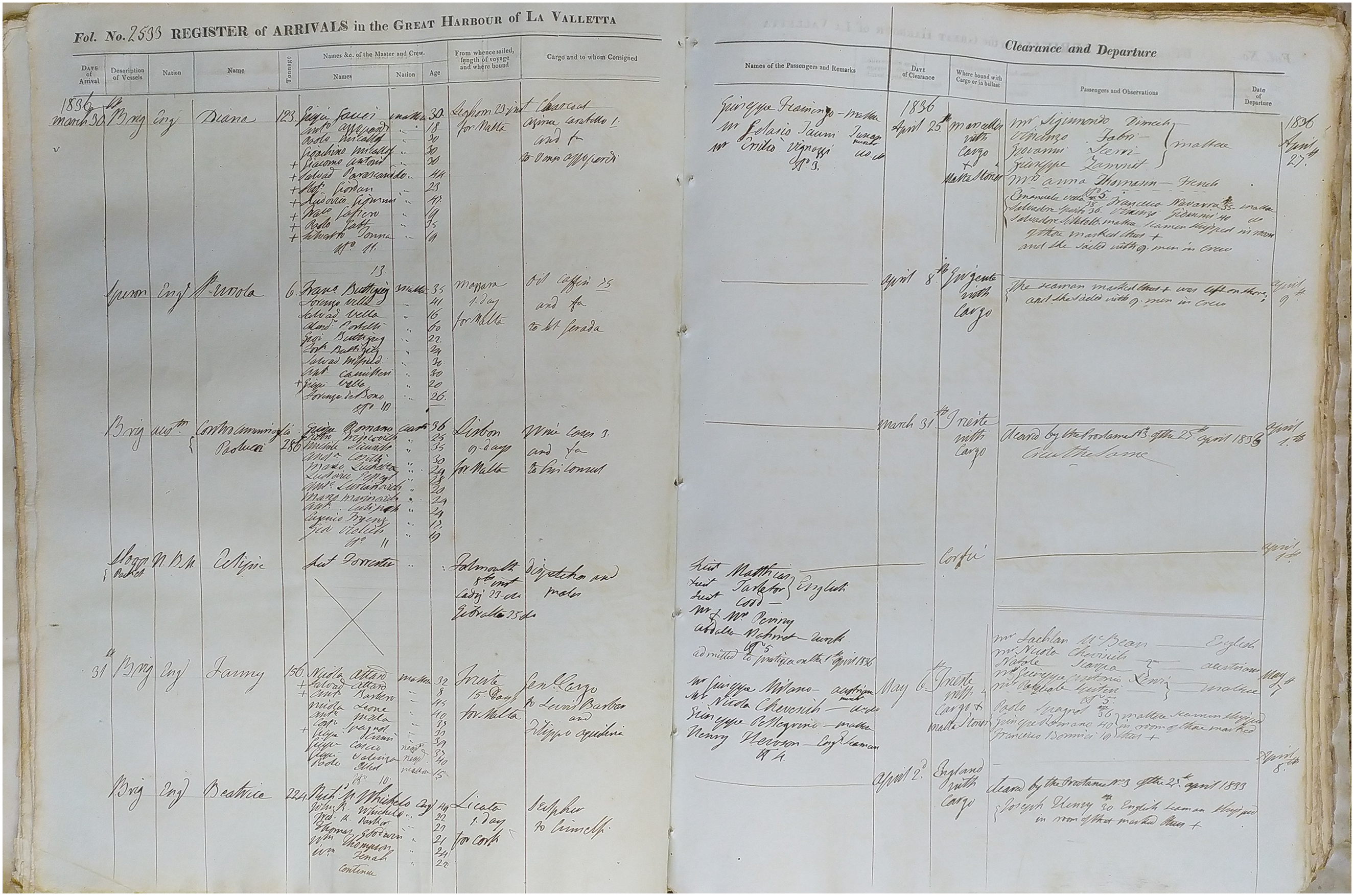
‘Register of Arrivals in the Great Harbour of La Valetta’.
The sinking of the Beatrice and the aftermath
The return voyage of the Beatrice from Alexandria to Liverpool via Malta was unusual not just because of the cargo it carried – an Old Kingdom royal sarcophagus destined for the British Museum. It was also unusual because the Beatrice did not sail under the command of her usual captain. For unknown reasons, Richard Mayle Whichelo had remained behind in Alexandria when the Beatrice left on 20 September 1838. Possibly he had become ill or he was simply delayed on other business. The command of the ship fell to her first mate, Whichelo’s son, John.
Captain Whichelo himself left Alexandria some days after the departure of the Beatrice on board the steamship Blazer, and is recorded as arriving in Malta on 14 October 1838 in the Maltese newspaper Il Mediterraneo (Figure 4). 37 The same newspaper article also records the Beatrice, captained by F. R. Whichelo (most likely a misprint of J. R. Whichelo), departing Malta on 13 October 1838. This is curious, as the otherwise extensive and detailed customs records produced by the harbour master in Valetta do not record either the arrival or the departure of the Beatrice in 1838. This suggests that either the customs records are incomplete or the reporter gathered this shipping information by simply asking the arriving passengers in the port. This may, then, reflect the arrangement as Richard Mayle Whichelo understood it – that the Beatrice was to wait for him in Malta and leave the port for Liverpool if he had not arrived by 13 October – rather than the reality of the situation, which leaves open the possibility that the Beatrice sank even before reaching her first port of call in Malta.
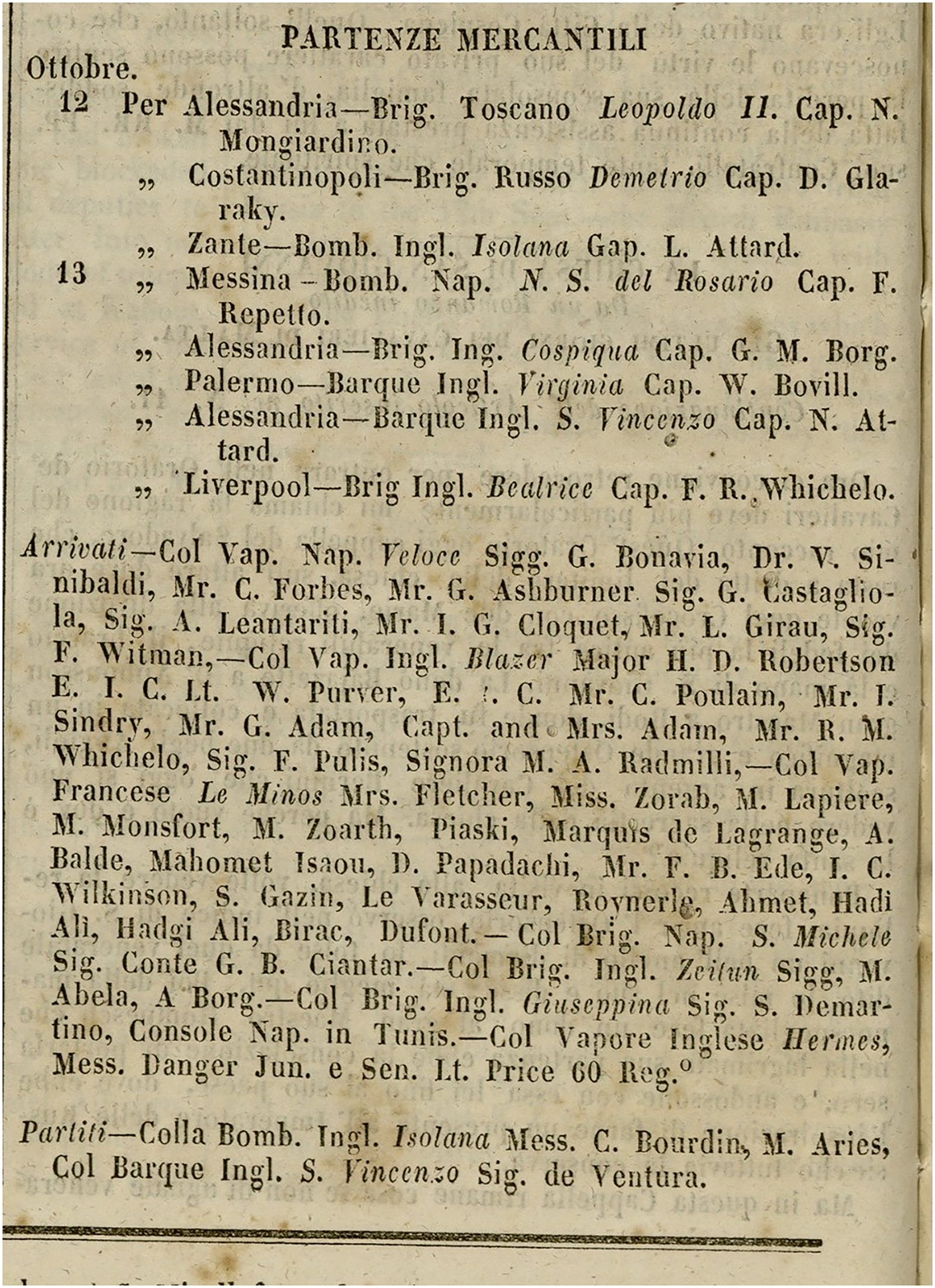
Il Mediterraneo: Gazzetta di Malta, 17 October 1838.
By the New Year, Whichelo – who had by that time arrived in Liverpool – and his family, as well as the families of the sailors on board the Beatrice, must have begun to suspect that some terrible accident had occurred. Official confirmation of the sinking of the Beatrice with all hands would not come until 5 February 1839, when the Liverpool Albion curtly reported: ‘Beatrice, Whichelo, for this port, which sailed from Alexandria Sept. 20 and from Malta Oct. 13, has not since been heard of’.
The loss of the Beatrice also meant the loss of the sarcophagus of Menkaure. Fortunately, from the point of view of the British Museum’s trustees, their expense of £150 for its transport had been insured and, during a meeting of the standing committee of the board of trustees on 29 June 1839, it was recorded that the secretary of the board had received a cheque for £148 from the shipping agents Francis & Co., ‘being the net amount of the insurance on the sarcophagus lost in the Beatrice’. 38
The discovery and transport of the sarcophagus of Menkaure in 1837–1838 highlights the degree to which the export of pharaonic artefacts from Egypt during the first half of the nineteenth century was conducted not only by archaeologists, but also by an intricate network of private and state actors, including representatives and trustees of the British Museum, the foreign secretary and the consular network in Egypt, represented in this instance by Patrick Campbell, who also played a double role as the initial sponsor of the excavations that unearthed the sarcophagus. The final group of individuals involved were the private shipping actors – both the shipping agents of the British Museum, Francis & Co., and primarily the shipowner and captain, Richard Mayle Whichelo.
This system of private and state actors working together to export antiquities from Egypt would continue throughout the nineteenth century and become even more formalized after the British invasion of Egypt and the establishment of the British protectorate in Egypt in 1882. These political developments would directly pave the way for the establishment of the Egypt Exploration Fund (later Egypt Exploration Society) and the excavations, notably, of Flinders Petrie throughout Egypt, which would, in turn, lead to the wholesale furnishing of hundreds of thousands of ancient Egyptian artefacts to museums throughout the United Kingdom, Europe and the United States.
Footnotes
Acknowledgements
The author would like to thank the following people for their assistance with providing access to relevant archival material related to Vyse's excavations and the Beatrice: Melvin Caruana (National Archives of Malta), Jeremy Debono (National Library of Malta), Tom Davies (King's College Archives), Peter Williams and Francesca Hillier (British Museum Archives), and Sally Mason (Buckinghamshire Archives). The author would also like to thank Hamada Hussein (University of Sadat City) for his comments on earlier drafts of the article.
Declaration of conflicting interests
The author declared no potential conflicts of interest with respect to the research, authorship and/or publication of this article.
Funding
The author received no financial support for the research, authorship and/or publication of this article.

Notes
Author biography
Nicky Nielsen is a Senior Lecturer in Egyptology at the University of Manchester. His research focuses on material culture of the New Kingdom and Late Periods as well as the reception of ancient Egypt and the historical development of Egyptology as a discipline.