




Abstract
In the aftermath of the Second World War, states across the world sought to expand industrial fishing to both feed and employ their populations. This article examines the structure of the post-war fishing political economies in two countries separated by the Cold War divide: the Soviet Union and Norway. Their political-economic organization and governing ideologies differed, yet many of the goals and objectives of resource management were similar. The mechanisms to enforce regulation, however, were widely divergent, reflecting varying configurations of state power and social control.
In 1949, the United Nations Scientific Conference on the Conservation and Utilization of Resources convened in Lake Success, New York to discuss the state of the world's natural resources and the possibilities for better utilizing them in service of economic development. In the Wildlife and Fish Resources section, a group of fisheries scientists and state officials met for the presentation of scientific papers on topics ranging from fisheries in traditionally heavily fished waters to less harvested fish populations in waters off Chile, Egypt and the Netherlands, as well as scientific studies on hatcheries and other methods to spur growth in fish populations. Much of the concluding discussion focused on the production of a map of so-called ‘Latent Marine Fishery Resources’ across the world (Figure 1). The map, along with most of the papers in the session, highlighted specific fisheries around the world that were at the time ‘underfished’ and could provide urgently needed economic development and food – especially animal proteins – worldwide. 1 All of the papers argued for expansion, including among fish stocks that had long been harvested intensively. Underfishing appeared to be a bigger threat than overfishing. 2
Fishing, as scholars have noted, is a particularly complex industry as it depends on wild stocks, often extends over international borders, and involves objects of both economic and geopolitical importance. 3 The conference of 1949 highlighted the challenge that states the world over faced in the early post-war period. Fishing could play an important role in improving human welfare and should be expanded. But how best to organize and develop a fishing industry? And what mechanisms would states use to limit fishing, when the time came, in conditions of limited maritime sovereignty and often limited state capacity?
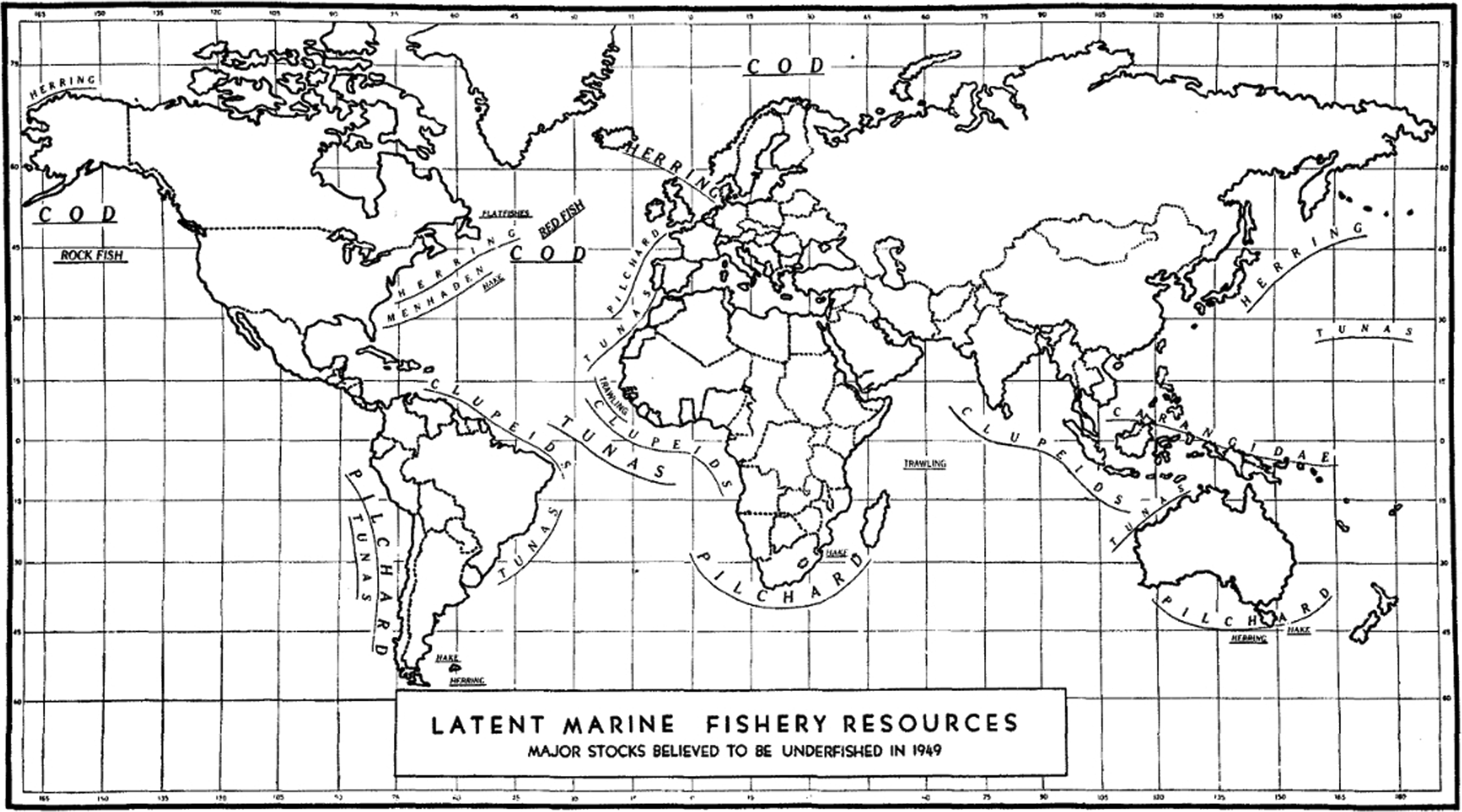
‘Latent Marine Fishery Resources’.
This article examines how state policymakers and regulatory officials, in parallel with fishing interest groups, attempted to solve these problems in the decade and a half after the Second World War in Norway and the Soviet Union. The comparison of two quite different cases has parallels to what is often called Most Different Systems Design for comparative research in the social sciences: units of comparison are selected that are as different as possible so that similarities in outcome are unlikely to be due to underlying resemblance. 4 This approach is especially well suited to inductive exploration. 5 Norway and the Soviet Union were among the world’s leaders in fish harvests, but they featured contrasting political economies and internal political orders, in addition to, by the late 1940s, finding themselves in opposite camps of the increasingly hostile Cold War. These features – political, economic and biological – significantly influenced the way the Norwegian and Soviet states grappled with and answered questions raised by the 1949 conference. Yet, as this article will show, there were certain similarities between the Soviet and Norwegian development of ‘rational’ fishing industries. At the same time, vastly divergent structures of state power – often deriving from the political-economic organization of the industry – led to differing mechanisms for the enforcement of fisheries regulations.
The strong connection between politics and the scientific study of fisheries is one of the best-researched topics in fisheries history of the twentieth century. Some of the most incisive and critical work in this area has argued that political interests in fishing have often been pushed through under the guise of science. 6 Other approaches to the history of fisheries and fisheries management have pointed to technocratic hubris as leading to unprecedented overexploitation and collapse in certain fisheries. 7 Yet other work has shown a more positive picture of fisheries science as the scene of not only international conflict but also cooperation. 8 Moreover, recent work has shown how fisheries science and industry was mobilized in colonial settings as a way both to shore up peripheral finances and to strengthen colonial claims to cultural and commercial supremacy. 9 A common theme running through these works is the role that science has played in determining fisheries regulation.
In contrast, this article focuses on the economic structures of post-war fishing and the concrete mechanisms of regulatory enforcement. First, it compares the instantiation of the technology boom in the immediate post-war period that vastly increased human capacity to remove fish from the ocean in the contexts of the Soviet and Norwegian industries. The institutional and physical structure of the industries in the two countries proceeded along particular ideological and practical trajectories, yet with certain clear parallels regarding the ideas of what a rational fishery should look like and the role of the state in supporting it. Second, the article demonstrates how configurations of political-economic organization, state power, and fish life cycles generated different kinds of regulatory enforcement mechanisms on the ground. In some cases, natural resource management was parallel to – or even a direct outgrowth of – tools to manage human populations. At other times, tools associated with the management of natural resources, such as quotas, arose as solutions to problems of international geopolitical order as much as resource management. Regulatory regimes took shape at the nexus of political economies and existing instruments of state power.
Political economies of fishing
The post-war years witnessed a global expansion of fishing activity, enabled by technological advances that allowed producers to vastly increase the supply and delivery of fish products. At the same time, new methods of farming and changing consumption patterns increased the demand for fish as both livestock fodder and food. The exploitation of fish stocks worldwide expanded to levels heretofore unknown. Fishing had undergone a first wave of industrialization in the late nineteenth century associated with steam- and later coal-powered ships, steam winches for drawing up nets, new synthetic materials for making nets, and otter boards to increase trawling efficiency. 10 The ‘second industrialization’ that began in the wake of the Second World War consisted of new types of trawlers and factory ships that were able to process fish at sea; sonar that allowed fishers to locate schools deep underwater; the hydraulic power block; and nets made out of nylon, which were stronger and easier to use than cotton, thereby permitting larger nets, heavier catches, and more efficient operation in the open sea. 11
In Norway, fish had been exported since medieval times, and fishing remained a sizable portion of the national economy well into the twentieth century. In the latter half of the nineteenth century, fishing amounted to 36–42 per cent of commodity exports, while 12–15 per cent of the population was engaged in one of the two largest traditional Norwegian fisheries: cod and herring. 12 In the 1920s, in the wake of a weak economy, the Norges Fiskarlag (‘Norwegian Fishers’ Association’), a union representing the interests of all Norwegian fishers, was formed with government support. 13 The union, in turn, was a key promoter of the organization of fish sales, which would centralize sales of fish raw product and, thus, stabilize prices and guarantee fishers a certain level of income. These moves were part of a broader interwar shift from a more liberal state to social democracy, in parallel with the growing pre-eminence of the Labour Party, which had reformulated its original revolutionary Marxism into a ‘technocratic governing ideology anchored in the apparatus of the nation-state’. 14 So fully did the party dominate the subsequent political arena that the post-war decades have become known as the period of the ‘Labour Party state’ (arbeiderpartistaten). 15
The fishing industry was remade in a series of state acts in the 1930s. The 1938 ‘Raw Fish Law’ (Råfisklov) gave fishers a monopoly on first-hand sales of fish through mandated salgslag (‘sales agencies’). All major fisheries were subject to these controls. Fishing activity was limited to those already active in the industry and trawling was restricted by a system of concessions. These actions ensured the continuity of the traditional, small-scale, decentralized fishing industry, particularly in northern Norway. 16
The outbreak of war only hardened the resolve to trade markets for politics. 17 The state ‘Price Directorate’ (Prisdirektoratet) was given the supreme authority to regulate prices. Imports and exports were centralized. This centralized, government-managed economy – lasting until Nazi invasion in April 1940 and itself succeeded by even greater planning and command under occupation – would be a model for the post-war years. 18 On 8 May 1945, with the capitulation of the Nazi regime and liberation of Norway from German occupation, the Norwegian government in exile in London promulgated a law that would become known as the ‘Lex Thagaard’, after its principle author Wilhelm Thagaard, who sought extensive state control over prices and production. The subsequent debate only ended in 1953 with legislation establishing a mixed economy that would feature a major role for the state but also respect the inviolability of private property. It established the Norwegian corporatist system on the principle of ‘trusting and systematic co-operation between state and private interest’. 19 Industry-level committees became an active coordinating element in the Norwegian economy. 20
The issue of technocracy and the coming to power of the supposedly unbiased expert – the cand. oecon. (economist, PhD) – is a well-covered theme in Norwegian historiography. 21 These experts represented themselves as ‘objective’ economist-technocrats simply administering state business but not engaged in politics. As Francis Sejersted put it, this sort of engineering mentality arose in the wake of the First World War and, following the Second World War, led to shifting priorities of the Labour Party to economic inidactors and away from cultural factors. 22 Members of the old school could be heard to whisper about ‘the crowd of young, highly intelligent cand. oecon. that have been set loose upon a helpless society’ while spreading their ‘learned abracadabra’. 23
The Norwegian post-war economy, therefore, would be not communist but democratic capitalist, in the form of administrative management of a private property-based economy by economist-bureaucrats as apolitical managers. The rational management of fisheries, in this technocratic conception, implied moving away from the traditional combined occupation of fisher-farmer that had been typical of Norwegian coastal dwellers for hundreds of years. Labour Party technocrats held this to be an ‘irrational’ form of production based on small-scale, labour-intensive methods of fishing and farming. Disavowing the city-and-country socialism of the interwar period that was the context for the Raw Fish Law in 1938, the post-war Labour Party focused on industrialized fisheries: larger boats, the expansion of trawling, and year-round dedicated fishers. Rationality, in this sense, came to be synonymous with the large-scale and ‘plan-managed’ (planstyrt). 24
Petter Holm has called the post-war Labour plan for fisheries the ‘industrial model’ (industrimodellen), as opposed to a rural-development model that had motivated pre-war legislation. The industrial model trumpeted after the war diagnosed the concentration of employment in low-productivity sectors as a major problem of Norwegian society. Fishing and agriculture, dominated by small-scale and seasonal workers, failed to take advantage of economies of scale and suffered from low productivity due to low levels of capitalization. Bigger ships, more powerful mechanization and consolidated industries would, according to the industrial model, create more stable and economically efficient yields. 25
In 1947, the government created the ‘Rationalization Committee’ (Rasjonaliseringskomite) for fisheries. Its most important member was the head of the Fisheries Directorate in Bergen, Klaus Sunnanå, a Labour Party member, former general secretary of Norges Fiskarlag, descendant of fishers, and modernizing technocrat. Sunnanå led the majority seeking expansion of industrial fishing and increased state authority in granting trawling concessions. Norges Fiskarlag had spearheaded a general prohibition on trawling in 1945 and, while it had allowed resumption the following year on a limited basis, the union wanted to limit trawling in the interests of small-scale fishers and their local communities. It opposed what one of its members called the ‘asphalt experts’ (asfaltsakkyndige) seeking to industrialize everything, who ‘speak of trawling and rationalization but many times have never seen the ocean’. 26
Mandated salgslag played the central coordinating role in the post-war Norwegian fishing economy. Mandated sales agencies were organized by region and by type of fish caught. To take just one example, the Feitsildfiskernes Salgslag (for fat herring) was based in Trondheim and operated between the coastal regions of Sogn og Fjordene in central Norway and Finnmark in the north, and included all fishers who caught certain types of fat herring, capelin and sprat. Membership was automatic, and indeed compulsory, for anyone engaging in fishing these species. Fish coming under the salgslag’s purview could not, by law, be sold to any other party. 27 The salgslag established rules for the delivery of fish; price paid for different kinds of fish given the equipment with which it was caught; sales fees for buyers and sellers; conditions under which fish should be stored and delivered; criteria for the classification of fish into commercial categories; and mechanisms for resolving disputes. Provisions were also in place for the salgslag to make cash advances to fishers before the delivery of a catch. 28 The salgslag was led by representatives of its members and a board with an administrative director selected from board members and approved by the Ministry of Fisheries. The 28 members represented each region, as well as the two major types of fishing boat used: net fishing boats and seiners. 29
The state played a major role in the setting of prices by monitoring the industry; conducting studies of the market, including costs and profits; and offering financial loans and other subsidies to support prices. The state Price Directorate, even in its weakened form, was a significant actor in the coordination of the Norwegian economy. The Directorate’s Wage and Price Department administered ‘Price Regulation Funds’ (Prisreguleringsfond) for fish. The fund regulating herring had 12 members – the head and three others who were representatives of the state, four who represented fishers and four who were producers. The fund monitored and supported prices to ensure that they were maintained at an adequate level to compensate fishers and producers. Such funds sought to stabilize prices through subsidies, which were funded by accumulated fees from exporters, who were liable for a tax when export prices were over a guaranteed minimum. 30
The driving logic was to maintain a fair and steady wage for everyone, regardless of changes in international export prices or fluctuations in fishing yields. Thus, in November 1957, fund member Øystein Gjelsvik argued that the state should order an increase in the guaranteed price paid for large herring and spring herring of 0.5 kroner per hectolitre. In order to maintain all other margins through the rest of the supply chain, he suggested that the prices paid by factories could be either left the same and subsidized directly by the fund or the fund might allow increased prices for finished products, which would mean, in the end, reduced profits for exporters and would thus, indirectly, also be a cost borne by the fund. 31 The increase was calculated for different quality categories and different months given differences in fish fat content at different times of the year. It also took into account and sought to moderate – though did not completely remove – differences in price for similar goods in the north and south of the country. Thus, while Norway had rejected a planned economy, state actors were deeply involved with planning ‘rational’ fisheries, which equated rationality with large-scale, industrial exploitation seeking efficiency in production per unit of human labour input. Through corporativist arrangements involving the state, capital owners, and workers, prices were managed for the good of producers as much as for consumers.
Soviet theoreticians and economists of the communist planned economy, on the other hand, viewed their system as a fundamentally different type of political economy. In Soviet ideology, capitalism – because of the fundamental contradiction between ‘the social character of production and the private form of appropriation’ 32 – was held to be anarchic and feature the irrational use of labour, materials, and natural resources. It was also thought to be uniquely prone to crisis and lack the capacity to support steady, constant growth. 33 The socialist law of planned and proportional economic development demanded that the economy be managed as a ‘single organism’ so that all of its parts developed proportionally. This was thought to be possible only if planning was centralized. 34
Ideally, the planned economy was to be organized to provide social welfare and the maximally rational use of resources. Soviet literature frequently pointed out the overconcentration of Russian imperial fishing – two-thirds of the fish harvested before 1917 had come from the Caspian Sea. 35 Soviet analysts found the industry to have been undercapitalized, and noted that what little industrial infrastructure existed was located at significant distances from the most productive fishing grounds. Soviet economists deemed this sort of inefficient clustering to be the result of chaotic and unmanaged flows of capital, which were prone to boom–bust cycles and attendant economic waste, as well as occupation by large capital enterprises that extracted value with little benefit to the local populations where the fish were caught. Profits might determine where there was monetized demand, but not where there was social demand. The socialist fishing industry, in contrast, was, theoretically, to be planned and organized to maximize output and best meet social need. 36
In the post-war planned economy, the federal Ministry of the Fishing Industry had responsibility for both the fishing industry and its regulation. The ministry was divided into republican sub-ministries, which were then split into geographical sections. These sections directly conduced fishing operations, owning both factories and fishing fleets. 37 Individual factories also might possess their own fleets. Together, these fishing fleets were known as goslov (‘state fishing’) as opposed to the kolkhozy (‘collectivized fisheries’) that had resulted from the collectivization of fisheries at the same time as agriculture had been moved to the collective principle beginning in 1928. 38 The kolkhozy prior to 1957 did not own their own equipment, for which they relied on ‘motorized fishing stations’ (motorno-rybolovnye stantsii). 39 While the motorized fishing stations that supplied the kolkhozy were subordinate to the regional ministry representatives, the kolkhozy themselves were not. Centrally planned contracts regulated relations between the kolkhozy, on the one side, and the factories, motorized fishing stations, and ministry, on the other. Reports and audits of the kolkhozy reveal constant disagreements and accusations of broken or unfulfilled contractual obligations between the two. These were, first and foremost, kolkhozy accusations of the delayed acceptance of fish at the factories themselves, which could easily lead to the spoilage of all or part of a catch. 40
Planning in the Soviet Union had always been a top-down affair, with only limited input from the local level. Roughly stated, the formulation of a plan began with the top levels of the party and state articulating general priorities for the upcoming planning periods, which were then turned over to Gosplan (the State Planning Committee). Gosplan looked at past performance and assessed opportunities for improvement in production, then, taking into account the priorities of the new plan, sent down draft ‘control’ figures to the ministerial hierarchies for disaggregation and distribution to individual enterprises. The individual enterprises and hierarchies subsequently had the opportunity to give feedback on the plan before Gosplan drafted the final version. 41 The plan for an enterprise set out targets in overall output and for all sorts of smaller categories and indicators, both for enterprises as a whole and for individual units of production such as fishing ships.
Gosplan also communicated with scientific organizations regarding the amount of fish that could be expected to be caught in the upcoming year. These numbers – ‘forecasts’ (prognozy) for fisheries – were one of the principal duties of the institutions of fisheries science, headquartered in Moscow at the All-Soviet Scientific-Research Institution of Fisheries Science and Oceanography (VNIRO) and made up of regional and local affiliates. Every year, the scientific institutions provided estimates for how much yield could be taken in a certain region of a certain species, and the plan would outline how much fish, and of what sort, should be caught in that region. The two figures were by no means always the same. Sometimes, enterprises or kolkhozy were able to out-produce their planning targets, for which there were rewards, monetary and otherwise. At other times, forecasts overestimated possible catches. Asking for a decreased plan target was no simple process. Scientific commissions representing local and central fisheries, and oceanography and meteorological teams, might be sent to investigate and confirm whether the problem was, in fact, out of the hands of the fishing enterprises. Even then, Gosplan was reluctant to decrease planning targets and preferred, when necessary, to reduce the plan amount for only the individual affected fishery. Aggregate fishing targets would remain the same, with other regions or types of fish expected to take up the slack. To change the total planning figure would require the recalculation and adjustment of higher-level material balance calculations, which would, in turn, have a cascading effect on the plan targets of all organizations either supplying or receiving supplies from the affected enterprises. 42 Even when scientific institutions revised their yield forecast for the upcoming year downwards – sometimes drastically so – based on new information, a corresponding adjustment of planning targets from Gosplan was unlikely. 43
In 1957, Nikita Khrushchev, the party secretary, led a major restructuring of the Soviet economy. Designed to reduce inefficiencies due to excessive centralization in republican and all-union ministries, the sovnarkhoz reforms sought to decentralize decision-making. The economy thereafter was to be administered by sovnarkhozy (‘regional economic organs’) rather than centralized sectoral ministries in Moscow. 44 The Ministry of the Fishing Industry, among many others, was liquidated for the years of the sovnarkhoz system, which lasted until 1965.
Yet the extreme centralization of authority and decision-making capacity continued, as problems in coordinating with both the kolkhozy and the state fishing firms of neighbouring sovnarkhozy now cropped up. An example came in June 1957 when the head of the Kamchatka sovnarkhoz, Nikolai Vaniaev, wrote to Alexei Kosygin, then head of the Council of Ministers of the government of the Soviet Union, and recalled Kosygin’s ‘personal order’ to increase the production of lightly salted salmon products. The problem was that the Far Eastern fleet of refrigerated container ships, which went by the pithy abbreviation Vostokrybkholodflot, was subordinated to a neighbouring region’s sovnarkhoz and its vessels were not accepting deliveries in a timely manner for distribution. The refrigerators in Kamchatka were already full. ‘Such a transport situation with a highly profitable [rentabel’nyi] good dooms our enterprises to future loss-making operations’, complained Vaniaev. 45 Six weeks later, Vaniaev again wrote to Kosygin: some seven million cans of fish conserves had spoiled but, at the request of the republican Ministry of the Fishing Industry, their sale at a 50 per cent discount had been approved. The federal Ministry of Trade, however, was slow to arrange delivery and no one was willing to accept them. Seven million cans of spoiled fish were now a hot potato that no one wanted to be caught holding. Vaniaev asked Kosygin to compel the receiving agents to accept delivery. The answer came four days later from the deputy of the federal Ministry of Trade. Health officials had approved the sale to retail stores of four million cans showing signs of deformation and rust. Three million cans that showed more serious indications of spoilage might be sold to special institutional buyers, but every can would need to be inspected individually to determine edibility. 46 But at least Vaniaev had got rid of them.
In many cases, the issue of price was raised. As was well known, in the Soviet Union, prices were not an instrument of allocating goods or a signal of relative scarcity. 47 Instead, economic planners used them for control and audit purposes, as well as for measurement and social welfare. As a result, loss-making enterprises and sectors made frequent requests to central planners to raise the price of their products. After all, if prices were simply ‘cost per unit’ (sebestoimost’), a ‘tax on turnover’ (nalog na oborot) plus some percentage profit, who was to say that it was not the enterprise’s fault that profits were so low, but the plan’s fault that prices were not high enough? 48
The capitalist social democratic model of Norway and the planned communist economy of the Soviet Union demonstrated fundamental differences in the levels of centralization, planning and organization of their respective fishing industries. The means of calculation and establishing prices diverged but, in both instances, price was far more than simply an indicator of relative scarcity. Both systems focused on average, rather than marginal, prices and profits, and price was used as an instrument of national social welfare and seen to represent something more than the result of supply and demand, emphatically so in the Soviet case, but also in Norway. Furthermore, the important concept of ‘rationality’ also took on different, but perhaps surprisingly similar, forms. Both Norwegian Labor Party technocrats and Soviet economic planners saw rationality to be obtained in the large-scale, planned development of the industry based on the most recent technologies for maximizing yields. At the same time, the organization of the industry varied widely. The Soviet industry was centralized, essentially under one ministry, and ordered by a top-heavy plan. Distrust and frayed relations frequently occurred with organizations outside the authority of the fishing industry ministry, including kolkhozy and neighbouring ministries. The so-called sovnarkhoz reforms of 1957 only deepened these problems, as now fishing production depended on numerous enterprises that were subservient to other sovnarkhozy. In Norway, by contrast, the fishing industry was organized into salgslag, with the fishermen’s union and organs of a corporativist state acting as important points of coordination and administration. These institutional circuits of power would have significant effects on the structure and types of regulatory regimes instituted.
Regulation and control on the ground
The power to enforce regulations on fisheries flowed through very different circuits in Norway and the Soviet Union. In the Soviet Union, the organ of fisheries inspection was called Glavrybvod (‘Main State Inspection for Conservation of Fish Stocks and Regulation of Fishing’). The inspectorate was based in Moscow and directly subordinate to the federal Ministry of the Fishing Industry, while, between 1957 and 1965, it was under the successive federal authority of Gosplan, the Council of Ministers of the Soviet Union, the All-Soviet Sovnarkhoz and, finally, an autonomous federal state committee. 49 Glavrybvod employed inspectors and fisheries scientists across the country. Its main jobs were to monitor fish stocks and fishing activity, ensure compliance with the rules of fishing, and prevent poaching. The latter, in particular, could be a dangerous job. Poaching was a much bigger issue in the Soviet Union than in Norway partly because of the characteristics of many Soviet fisheries. Anadromous fish (those that hatch and spawn in freshwater rivers but live most of their lives in saltwater) and partially anadromous fish formed some of the Soviet Union’s oldest and richest fisheries – sturgeon and others in the Caspian Sea basin, salmon in the Far East. These fish were particularly vulnerable to low-tech, small-scale poaching.
Activities to find and detain violators figured prominently in all the reports of the inspectorate agencies. In a 1959 report, the federal fisheries inspectorate wrote that three inspectors had been killed and several others seriously injured during 1958 in the course of enforcing fishing regulations. 50 Given this, it is perhaps understandable that inspectors complained about frequently having to do their duty unarmed due to the police, which was ‘extremely unwilling to give [fisheries inspectors] permission to carry weapons due to lack of appropriate storage space at the inspectorates and insufficiently vetted inspectors’. 51 Fisheries inspectors often reported being hamstrung by their own equipment. Some inspectorates complained that the police, prosecutors, and courts did not assist them in prosecuting and punishing violators when caught. Furthermore, the inspectorates often did not possess adequate storage facilities, meaning that inspectors could not even confiscate illegal equipment and boats when discovered. 52
It is difficult to know exactly how big the threat of poaching was to fisheries, but it occupies a large place in all the reports of the fishing inspectorates, the trade press, and popular nature publications throughout the Soviet period. At issue was control over the fisheries and the degree to which the state was able to firmly enact kontrol’ – meaning the power to make decisions involving fisheries as well as surveillance over fisheries. In this respect, while individual poachers were excoriated, fisheries inspectors sometimes admitted that the biggest poachers were the fleets and fishers of state enterprises themselves. The problem here was of both an official and a semi-official character. Units of collectivized fishing (kolkhozy) and the fishing fleets of state enterprises (goslov) sometimes received ‘bonuses’ (premii) for exceeding their planning targets, even when they were in serious violation of the rules of fishing. 53 On an individual basis, too, kolkhozy and goslov brigades were the best equipped to engage in violations of fishing regulations. Glavrybvod complained that even when it exposed such violation of fishing rules, kolkhozy and state enterprises refused to fire the individuals responsible and the problem continued. 54 The biggest issue was almost certainly not enforcing the rules among non-state actors but controlling actors employed and equipped by the state. In these matters, the bureaucratic weakness of the fisheries inspectorate was clearly felt, as well as the underlying priority that the plan came first. All other considerations were a distant second.
The methods used by Glavrybvod to try, nevertheless, to establish control over river basins often significantly resembled Soviet mechanisms for social control. In salmon-producing rivers of the Soviet Far East, Glavrybvod was tasked with surveilling and ‘keeping account’ (vesti uchet) of commercial fisheries by building and operating ‘control observational points’, which enabled inspectors to count the number of fish passing through. These points allowed Glavrybvod to establish kontrol’ over a basin. 55 Glavrybvod also conducted the ‘passportization’ of rivers in major fishing areas. A passport contained information on a river’s physical characteristics, location of fishing grounds, yearly fish runs, and fishing activity. Fishers – kolkhozy, goslov or ‘minor fishers’ (in Kamchatka, for instance, these were indigenous populations who fished primarily for salmon to feed their dogs) – were required to have an official document entitling them to fish in a given location as well as the passport of the fishing grounds in their possession whenever fishing. 56 This had more than just superficial similarity to the Soviet passport system for its human population. Scholars have argued that the Soviet internal passport system in its initial form in the 1930s was established less as a means for all-encompassing control over population flows or stemming rural exodus to the cities than as a mechanism the regime could use selectively for kontrol’ – in both senses of the Russian word – over its population. 57 It empowered the Soviet ‘police’ (militsiia) rather than statistical and demographic bureaus. 58 In fisheries, too, the passportization of fishing grounds was a mechanism for selectively increasing the leverage of fisheries inspectors on fishing grounds both in relation to ‘minor fishers’, whose rights to fish were frequently suspended, and with regard to goslov and kolkhozy.
The fishing regulations that Glavrybvod enforced, as elsewhere, were focused in the early post-war period on traditional methods – closed seasons and closed areas to protect spawning, and the mesh size of fish nets. By 1959, voices from within the Soviet fisheries inspectorate were beginning to advocate for ‘quotas’ (kontingenty). At a meeting of some 280 local and federal fisheries inspectors in Moscow, the head of the Kamchatka office of Glavrybvod, G. Ia. Korneichuk, argued that Kamchatka fisheries, in the usual language of the time, needed to be ‘rationally’ exploited. To achieve rational fisheries exploitation, however, Korneichuk made the unusual suggestion of establishing a quota on catches. 59
Quotas might have been on Korneichuk’s mind because, as head of the Kamchatka office, he was one of the few Soviet fisheries inspectors who dealt with them – not for Soviet fishing, but for Japanese industry in waters covered by the Soviet–Japanese Fisheries Convention. After the Second World War, Japan had begun to rebuild its fishing industry and return to its previous fishing grounds, including waters off Soviet territory. The Soviet Union aggressively defended its claims to exclusive use of these areas, especially against Japanese interests at a time when the countries had not yet normalized relations following the war and subsequent border dispute. The Soviet Union assiduously patrolled its self-proclaimed maritime border and frequently arrested Japanese fishing boats accused of violating its territorial sovereignty. 60 In February 1956, after the failure of yet another round of negotiations to normalize diplomatic relations between Japan and the Soviet Union, the Soviet Union tried a new tactic: it unilaterally declared its right to regulate the salmon fishery hundreds of miles into the Pacific Ocean off the coast of Kamchatka. It further announced a limit on Japanese fishing harvests conditional on permission from Soviet fishing authorities. This was a legally dubious move to get Japan back to the negotiating table, but it worked. 61
For the previous three years, Korneichuk had been on the front lines of the Soviet Union’s concerted effort to monitor and limit Japanese catches to a quota, usually called a ‘catch norm’ (norma vylova), which was set yearly in negotiations between the two countries. He was thus responsible for overseeing fisheries conservation within Kamchatka as well as the Japanese fleet, which was to be kept to a strict limit on harvests. 62 Indeed, it is noteworthy that the first major experiment with quotas anywhere in the world – the US–Canadian Halibut Commission in the 1920s – also took place in an interstate context. Quotas and yield limits by no means enjoyed unanimous support among fisheries scientists. 63 They were, instead, initially useful tools in solving geopolitical and diplomatic problems just as much as biological or economic issues.
In Norway, there was no inspectorate that was comparable to Glavrybvod. The country’s main fisheries were open-sea fisheries, thus there was not the same concern that one net thrown across a river for several weeks could destroy an entire season’s worth of spawners. While there would be no quotas until the 1970s, issues of stock regulation were addressed through laws on allowable equipment, together with regulations about when and where different sorts of equipment could be used, which was of particular importance to fishing grounds that became crowded. 64 Questions of equipment, furthermore, even those connected to the use of equipment in rivers or small areas that could do significant damage to a population, were debated often in social terms – between rich entrepreneurs and poor fishermen (in other words, capitalists and proletarians). 65 When the national Fisheries Directorate was organized in the early twentieth century with its base in Bergen, the country’s fisheries regulators had already long been organized, with mostly local responsibility for making regulations and enforcing them, often by fishermen themselves in coordination with local ‘police’ (lensmenn). When salgslag came into being in the interwar and post-war period, they, too, provided localized peer enforcement of the rules for participation in fishing. 66 Here also, the mechanisms of social control were the backbone of fisheries regulations, which, indeed, themselves regulated relations between humans rather than between humans and fish. 67 The first inspectors were charged with numerous duties, including organizing fishers and planning experimental fishing in new zones, as well as overseeing fishing and collecting statistics. Expanding the fishing industry and regulating it were almost indistinguishable from each other. 68 This was a different model of power than in the Soviet Union – more diffuse and decentralized. While the Soviet Union’s fisheries minister urged the Soviet fisheries inspectorate to be ‘the master [khoziain] of the fishing grounds’, there was simply no counterpart institution in the Norwegian context. 69
Instead, a civilian state ‘supervisory organ’ (oppsynssjefen) under the Ministry of Fisheries monitored fishing grounds for the presence of foreign ships, mostly from the neighbouring countries of Sweden, Denmark, Great Britain, and Germany. At times, it detained crews and confiscated equipment, which it handed over to the local police. By the early 1950s, however, the Norwegian Navy was conducting patrols on the grounds of the winter herring in Norwegian waters, enforcing laws limiting trawling and foreign participation in the fishery. 70 Fishing officials strenuously argued that enforcing regulations was not merely of sectoral concern but also of national importance. In response to the sighting of a group of 100 Soviet herring boats and two fish-processing floating factories in 1957, the head of the Fisheries Directorate, Sunnanå, appealed to the navy that this ‘was not merely a fisheries question, but a subject of general and national meaning’. 71 Guarding and patrolling fishing grounds was as much a question of national sovereignty as protecting a biological resource.
Conclusion
In his magisterial classics The Fur Trade in Canada and The Cod Fisheries, Canadian economic historian Harold Innis detailed how the natural and physical characteristics of resources and geography provided the background that drove early Canadian economic history. 72 The works begin with the life cycles, habits, and migration patterns of the beaver and the cod, respectively, which formed the context in which European powers entered North America. They subsequently developed new technologies, which, together with geographical considerations and political and cultural preferences, shaped the economic and geopolitical structures of European colonialism in present-day Canada. As a range of multidisciplinary scholars have subsequently noted, Innis’s approach was materialist but not reductionist – an approach one writer has described as ‘ecological holism’. 73 Innis showed that the fur trade and cod fishery influenced, but did not overdetermine, global imperial rivalries as well as the structure of the eventual Canadian state. 74
This article has followed Innis’s lead, if not exact methodology, with the aim of exploring the interface between regimes of exploitation of fisheries and their regulation. Both the Soviet and Norwegian states in the immediate post-war period grappled with questions of human welfare, economic rationality and resource exploitation. The shared objectives of modernization and economic development given technological advances meant that understandings of concepts such as rationality to a great extent coincided in Norway and the Soviet Union. The state planners in both countries saw the benefits of the intensive use of industrial fishing technologies that could leverage economies of scale to increase productivity. There was even significant overlap in how communist Soviet planners and social democrat technocrats understood price as quite divorced from notions of markets and scarcity.
The structure of the fishing political economies in post-war Norway and the Soviet Union was to some extent shaped by the biological characteristics of the resource; yet, in contrast to Innis’s ‘staples’, which played such a central role in Canadian economic and political development, the structure of the Norwegian and Soviet fishing industries was mostly determined by existing economic structures and ideologies of decentralized social democratic corporatism and a rigidly hierarchical planned economy. 75 In turn, the mechanisms for enforcing regulations and maintaining control over fisheries flowed out of configurations of state power. In the Soviet Union, a centralized organ was charged with enforcement. Oftentimes, the offending parties were not individual outlaws but state-owned enterprises or collectives acting according to the logic of the plan. As a result, the agencies tasked with the enforcement of fishing regulations turned to instruments including those of state power developed to control human populations and used by organs of the state to leverage their power vis-à-vis other state agencies. Norway, by contrast, had more diffuse and decentralized enforcement that mirrored its economic organization and was based on local police and the organs of corporatism. Finally, just as domestic channels of power shaped fisheries regulation at home, international power relations also spurred regulators to think differently about their resources when foreign fishing vessels appeared on the horizon. The management of natural resource extraction was in many ways the management of social relations – domestic and international – by other means.
Footnotes
Funding
The author received no financial support for the research, authorship and/or publication of this article.

Author biography
Gregory Ferguson-Cradler is an associate professor in the International Studies programme at the Inland Norway University of Applied Sciences.