




Abstract
Most of the existing research on Georgian Liverpool's whaling activities has focused on the northern whaling trade around the Arctic and Greenland. However, this article sheds new light by exploring the port's other whaling activities – namely, the southern whale fishery. In doing so, this short research note expands the geography of Liverpool's whaling industry and suggests that it may have had ties to the port's most notorious activity – transatlantic slavery.
During the second half of the eighteenth century, the port of Liverpool in north-west England participated in the northern whale fishery. This activity – which involved the hunting of marine species – was concentrated primarily in Arctic waters off Greenland and, to a much lesser extent in Liverpool's case, the Davis Straits. Unsurprisingly, then, this aspect of the port's trading portfolio has received attention from historians. Amongst the various themes addressed have been the patterns of the said trade; the degree to which Hanoverian Liverpool contributed towards the Arctic whaling business as a whole; the lives of those serving on board these craft; how Liverpool's parliamentary commercial lobby supported Arctic whaling; and how whaling shaped the port's built environment. 1
Nevertheless, further engagement with extant sources reveals that the Arctic was but one part of Liverpool's whaling portfolio. Whereas most of the existing literature focuses on Georgian Liverpool's whaling activities off Greenland, this short research note reveals that some craft from Liverpool hunted cetaceans in the southern whale fishery too (admittedly with limited success). Essentially, the southern whale fishery was the area south of 59° 30’ North, and therefore could potentially include the South Atlantic, the Southern Ocean, and parts of the Pacific and Indian oceans. 2 Moreover, it will also be argued that some of Liverpool's merchants who engaged in the transatlantic slave trade, which operated between Africa and the Americas, had a mixture of direct and indirect ties to whaling. Presumably, these slavers diversified their businesses to include whaling as a means of reducing financial risk. These discoveries are significant on several levels, not least in that we can now paint a larger canvas and acquire a fuller knowledge of Liverpool's whaling heritage. In the process, we expand the geography of the port's whaling concerns during the late eighteenth and early nineteenth centuries, and re-evaluate the ways in which it operated.
Background: Liverpool and Arctic whaling, circa 1750–1781
Liverpool's links to the whaling industry stemmed from humble beginnings in 1750, when only one craft from the port sailed to the Arctic. However, as the decades went by, what began as a minor concern gradually mushroomed. By 1773, the annual number of vessels departing from Liverpool for Greenland rose to double digits. (Liverpool, with 10 such craft, was second only to London that year, and so outperformed key rivals such as Hull and Whitby. This arguably made Liverpool England's ‘second’ whaling port – at least in certain years.) There were several factors underpinning this growth, not least that Liverpool's Arctic whaling trade was financed by several prominent local mercantile families, such as the Tarletons and the Hardmans. Second, two of Liverpool's Members of Parliament at the time – Sir William Meredith and Richard Pennant – actively worked in Westminster to extend the whaling bounty, which acted as a financial incentive. Additionally, there was domestic demand for whaling-related products in Liverpool. Indeed, blubber was boiled down into oil at a facility on the aptly named Greenland Street, which was near Liverpool's waterfront. Consequently, the number of whaling vessels sailing northwards from the port reached a peak of 20 in 1776. Significantly, this crest was reached during a time of war. The previous year, tensions between Britain and the 13 American colonies had erupted into open hostilities. As a result, warfare, combined with Westminster's retaliatory actions against the rebels, made the importation of colonial whale oil into Britain more difficult. This, in turn, encouraged British ports like Liverpool to send out more whaling vessels themselves. Even so, this increased interest in whaling did not last indefinitely. Not only did the war drag on, but it also began to escalate beyond the confines of North America, as the French, Spanish and Dutch gradually became belligerents against Britain. Henceforth, British vessels were increasingly subject to harassment by enemy vessels. By 1781 – the year when British General Cornwallis surrendered to American forces at Yorktown, Virginia – the number of ships sailing from Liverpool to Greenland plummeted to two. This was obviously a major reversal for Liverpool's whalers after the heady days of 1776, and so it is not surprising that, in such adverse circumstances, these individuals began seeking alternative hunting grounds. 3
Georgian Liverpool and the southern whale fishery, 1781–1821
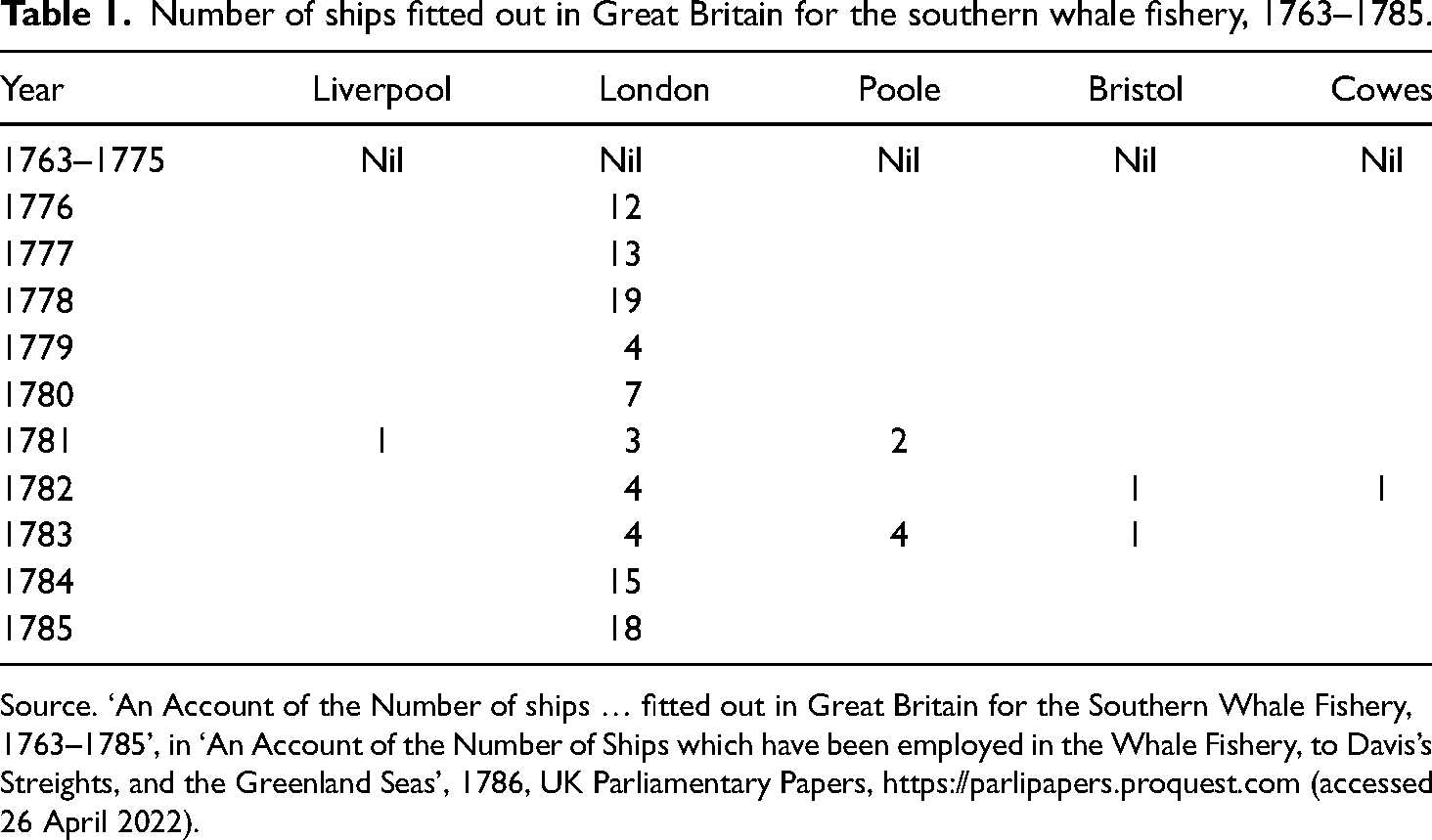
Britain's southern whale fishery – essentially the area south of 59° 30’ North – partly owed its existence to Nantucket whalers. Driven by either lingering loyalism to Britain or a desire to find their place in a post-Revolutionary Atlantic, several of these ‘American’ whalers relocated to Britain. Whilst there, they found willing merchants and politicians seeking to make money, gain access to oils, and rebuild London's prestige after the bruising American War. 4 Tables 1 and 2 detail the number of ships leaving for the southern whale fishery annually circa 1763–1822.
Three trends stand out in this data. The first is that London was the key English port partaking in the southern whale fishery during the late eighteenth and early nineteenth centuries. The capital annually dispatched whaling craft southwards between 1776 and 1785, and again from 1801 to the early 1820s (London was probably involved during the intervening years, but these records were lost in a fire). London's pre-eminence is hardly surprising, as the metropole had long served as the financial nerve centre of the British Empire. 5
Number of ships fitted out in Great Britain for the southern whale fishery, 1763–1785.
Source. ‘An Account of the Number of ships … fitted out in Great Britain for the Southern Whale Fishery, 1763–1785’, in ‘An Account of the Number of Ships which have been employed in the Whale Fishery, to Davis’s Streights, and the Greenland Seas’, 1786, UK Parliamentary Papers, https://parlipapers.proquest.com (accessed 26 April 2022).
Number of vessels engaged in the southern whale fishery, 1793–1822.
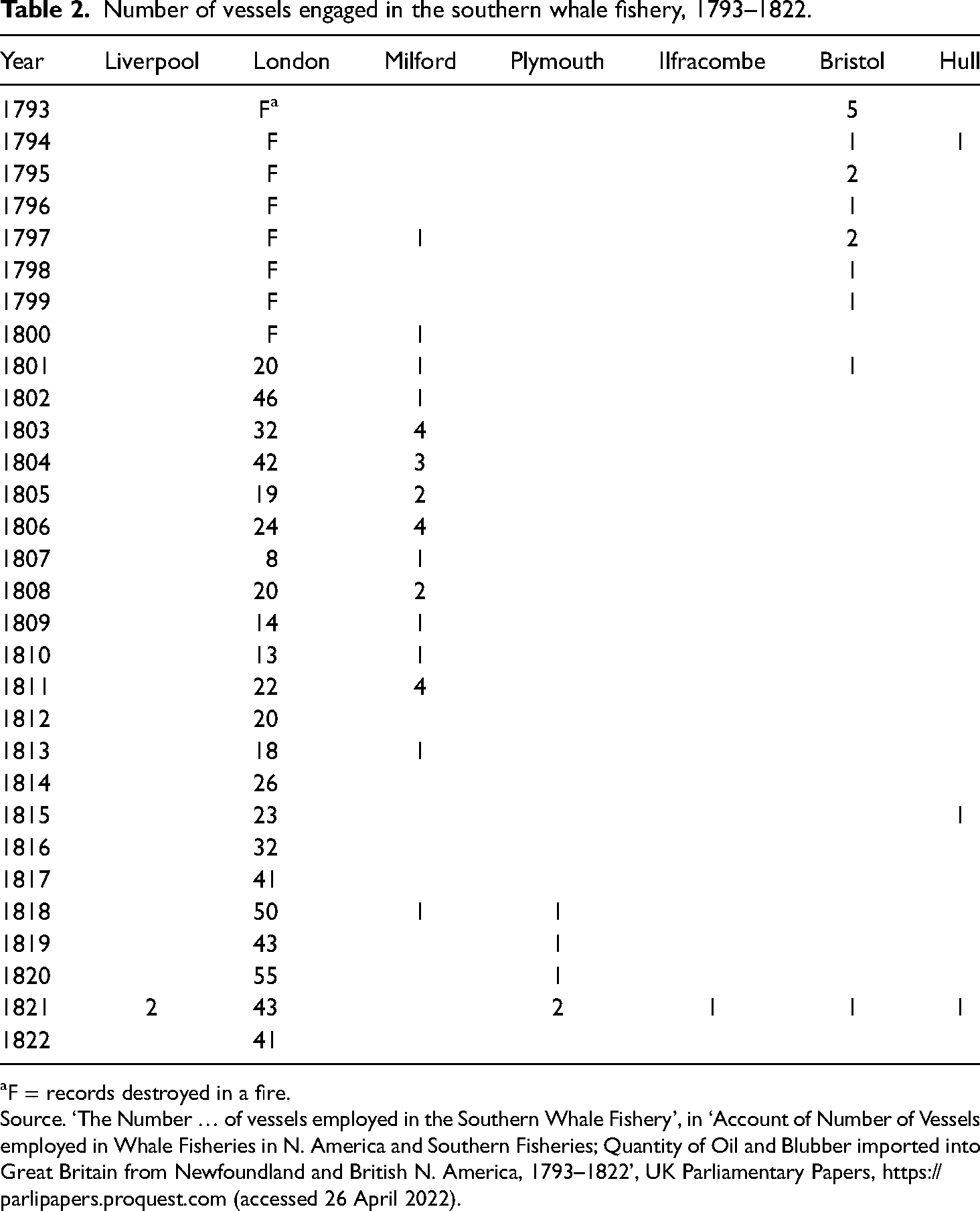
F = records destroyed in a fire.
Source. ‘The Number … of vessels employed in the Southern Whale Fishery’, in ‘Account of Number of Vessels employed in Whale Fisheries in N. America and Southern Fisheries; Quantity of Oil and Blubber imported into Great Britain from Newfoundland and British N. America, 1793–1822’, UK Parliamentary Papers, https://parlipapers.proquest.com (accessed 26 April 2022).
Second, and more importantly to this article, is that Georgian Liverpool was involved in the southern whale fishery too – something that is rarely appreciated in the existing literature, which traditionally focuses on Liverpool and the Arctic. Certainly, Tables 1 and 2 show that Liverpool dispatched a vessel to the southern whale fishery in 1781, and then two more in 1821. Granted, Liverpool did not enjoy much success in this field, as evidenced by the small number of its vessels sailing to the southern whale fishery compared to counterparts from other ports.
Third, of all the ports initially dispatching vessels to the southern whale fishery between 1776 and 1785, Liverpool was the only northern English harbour involved. According to Table 1, the other ports engaged in this trade during these years were London, Poole, Bristol and Cowes – all of which are based in southern England. Still, Liverpool's unique status did not last indefinitely. Table 2 shows a fellow northern English port – Hull – becoming increasingly involved in the southern whale fishery between the 1790s and 1820s. This was surely a reflection of Hull's increasing prominence in the whaling industry. 6
Why was Liverpool the first northern English port to become involved in the southern whale fishery? The current known archival record in this respect is patchy, and so any answers must remain highly speculative. What can be said with greater confidence is that Liverpool's decision to enter the southern whale fishery in 1781 was not especially surprising. As noted above, by 1781 the port's Greenland portfolio was in a poor state, as evidenced by the fact that there were a mere two sailings to the Arctic from Liverpool that year. This was partly a result of the economic fallout from the American Revolutionary War (1775–1783). Thus, it probably encouraged Liverpool's whalers to seek alternative hunting grounds.
Regardless, once engaged in the southern whale fishery, Liverpool's involvement in the trade remained highly sporadic through to the 1820s. There were several obvious reasons for this – not least that voyages to the southern hemisphere (especially beyond the Cape of Good Hope) were longer, and hence costly. Moreover, whaling expeditions off South America ran the risk of annoying the Spanish. And, as if that were not enough, whaling voyages to the east of the Cape of Good Hope and west of Cape Horn could invite opposition from the monopolistic East India Company. Nevertheless, these problems evidently did not stop London's whalers from exploiting the marine resources of the southern hemisphere. After sabre-rattling events like the 1789–1790 Nootka Sound incident (and another on Penguin Island off Patagonia), accommodations were reached with Spain. Likewise, the East India Company was known to issue licences to craft, and successive renewals of the Company's charter provided some flexibility for whalers. 7 Added to that, the overall picture for the southern whale fishery – at least up to the late 1790s – was a positive one. Not only did the overall number of vessels clearing out from Britain for the southern whale fishery rise from 18 in 1785 to 64 in 1791, but sperm whale oil – often procured in the southern fishery – was worth more than ‘common’ whale oil. 8
Thus, the ultimate reasons for Liverpool's lacklustre performance in the southern whale fishery lie elsewhere. Part of the explanation was the temporary improvement in Liverpool's Greenland fortunes in the decade after 1783, which was a more tried-and-tested destination compared to the southern hunting grounds. Indeed, the number of craft leaving Liverpool for the Arctic rose from two in 1781 to 13 in 1786. 9 Such a turnaround was facilitated by several factors, including that peace with America had been reached by 1783, Dutch mercantile competition had been weakened by the Fourth Anglo-Dutch War of 1780–1784, and, for a time, the whaling bounty was increased in 1782. 10 Consequently, Liverpool's whalers had little need to sail to more distant southern waters. Regardless, the long-term viability of Liverpool's whaling trade – be it in the Arctic or the southern hemisphere – was far from secure. Despite some annual fluctuations, the overall trajectory was downwards: 11 ships sailed from Liverpool to the Arctic in 1793, but by 1822 this figure had collapsed to two. Evidently the French wars between 1793 and 1815 had proven disruptive. Moreover, the gradual decline of the East India Company's commercial monopolies in India and China between the 1810s and 1830s presented Liverpool with alternative economic opportunities. But perhaps the most important reason for the decline of Liverpool's whaling industry was that there were major structural changes in the trade. Whale oil was gradually being displaced as a fuel by coal gas and, in 1824, Parliament did not renew the bounty for the Arctic trade. Hence, 1823 was the last year that a Liverpool ship sailed to the Arctic, and none apparently sailed southwards either. 11
Liverpool's transatlantic slave trade and whaling
It is well known that eighteenth-century Liverpool became the leading British port engaged in the transatlantic slave trade between Africa and the Americas. Indeed, Liverpool accounted for over half of the slaving voyages leaving Britain between circa 1751 and 1807. This, in turn, raises the question as to whether or not there were any links between Liverpool's slaving and whaling interests. After all, in the words of one historian: ‘Liverpool's involvement in the slave trade was connected to … other branches of foreign commerce’. 12
Some of the evidence that could shed light on a possible link is ambiguous to say the least. Take the curious case of Roger Fisher and his sons from Liverpool. In 1775, they petitioned authorities in London for permission to ‘export certain military Stores to the Coast of Africa for the purpose of Trade’. Most significantly, the same document also referred to the fact that the ‘Vessel mentioned in their Petition is fitted out for the purpose of a Whale Fishery on the Coast of Africa’. 13 Despite such a tantalizing reference, this source raises more questions than it answers. First, did the vessel actually sail to Africa? It is not certain if this voyage went ahead, although it seems possible, given that the commissioners ‘had no Objection to … the Exportation of Arms & Ammunition for Trade, provided Security be first given to the Commissioners of His Majesty's Customs in treble the Nature of the said Arms’. 14 Assuming that the craft departed Liverpool, was it engaged in slaving? This petition refers to Fisher and his sons as being ‘merchants’, and other well-informed sources record Fisher as being a slave merchant. 15 But the aforementioned petition did not directly mention slaves, only suggesting that there was the desire to trade in Africa. Finally, regardless of whether or not this was a slaving craft, could the vessel have gone whaling? The data does not provide a conclusive account of the outcome of the petition, but it does suggest that there was at least an intent to go whaling. What we can say with greater certainty is that American whaling craft from the 1780s onwards did sail to the coast of Africa, where they sighted and captured both humpback and sperm whales. 16 Little is known of Fisher's craft, except that it contained four-pounder guns and swivels. 17 It is conceivable that the ship could have been modified to accommodate a whaling voyage, as Fisher was one of the principal shipwrights in eighteenth-century Liverpool. 18 However, we cannot be certain. Overall, this example, whilst certainly suggestive, does not provide clear-cut evidence of a direct link between Liverpool's slavers and whalers.
In contrast, there are other pieces of evidence that link some of Liverpool's slave merchants more directly to whaling. William Davenport was born in London in 1725 and, by 1741, had been apprenticed to William Whaley, a Liverpool merchant and slave trader. In due course, Davenport became a slaving merchant in his own right – a status that lasted through to the 1790s. 19 In June 1772, Davenport received a letter from one Thomas Hodgson regarding an incident that had taken place on board the Jenny & Polly. The vessel had recently arrived in Liverpool from Greenland ‘with no less than Nine whales’. Significantly, the vessel contained ‘so considerable a quantity of Blubber’ that the captain was obliged to ‘throw part overboard’. This, in turn, prompted Hodgson to write to Davenport, noting that the decision to destroy these whaling-related products left Davenport's ‘interest much concerned’. In due course, the matter was taken to legal counsel. 20 That a Liverpool slave merchant would have ties to whaling is not surprising. As an analysis of Davenport's own records reveals, individual slaving voyages could result in mixed financial outcomes, producing profits of over £2,000 as well as losses of over £5,000. 21 Thus, as one historian has observed: ‘The slave trade was a risky business, and the diversification of trade helped to mitigate that risk’. 22 Evidently, whaling helped reduce the risk for some of Liverpool's leading slave merchants.
There are other examples of Liverpool's slave merchants having ties to whaling, although admittedly to lesser degrees. Take the case of Arthur and Benjamin Heywood. Their family hailed from northern England and Ireland, and both arrived in Liverpool between the 1730s and 1740s. By the 1760s, they were in business together as merchants. Between them, they dabbled in privateering and eventually went into banking by the 1770s. Crucially, they were involved in the African trade and are listed as slave merchants. 23 Although it is not clear if the Heywoods were directly involved in whaling, it is still noteworthy that one of the brothers – probably Benjamin – had a notebook, and in it (amongst other things) he recorded data on the state of the port's Greenland trade in 1773. Such details stated the names of the ships involved, identified the owners, and listed the figures for the fins, seal skins and ‘fish’ (whales) taken. 24
Conclusions
The purpose of this short research note has been to expand knowledge of Georgian Liverpool's whaling trade. Previously, historians have concentrated on the port's northern whale fishery in Arctic waters during the late eighteenth and early nineteenth centuries. But now we know that this was only one part of the picture; this article has shown that Georgian Liverpool engaged in the southern whale fishery too. Granted, Liverpool's whalers did not pursue both trades with equal vigour. To briefly illustrate this, let us recall that, at a peak in 1776, there were 20 craft sailing from Liverpool to Greenland. In sharp contrast, the port dispatched only two craft to southern waters in 1821. There are multiple reasons why Liverpool's southern whale fishery proved to be on a smaller scale than its northern counterpart, including that voyages southwards were longer, as well as the fact that Liverpool's Greenland whale fishery was more established. Still, by the 1820s, both of these lines of the port's commerce had declined. This was due, in part, to falling demand for whale oil, as well as the end of the whaling bounty. In addition, this article has shown that Liverpool's whaling interests had some ties, be they formal or informal, to Hanoverian Liverpool's most notorious activity: the transatlantic slave trade. The fact that slave merchants took either observational or financial interest in the whaling trade was, presumably, a strategy to offset the risks associated with slaving. Overall, then, we have boosted knowledge of Liverpool's whaling heritage up to the 1820s. We have expanded the geography of the port's whaling industry, as well as developed our understanding of how it operated. Clearly, the whaling trade deserves to feature more prominently in future maritime histories of Liverpool.
Footnotes
Acknowledgements
The author thanks the International Whaling Commission for suggesting further reading, as well as the peer reviewer for their feedback.
Declaration of conflicting interests
The author declared no potential conflicts of interest with respect to the research, authorship and/or publication of this article.
Funding
The author received no financial support for the research, authorship and/or publication of this article.
