




Abstract
The transition of sea power from the battleship-dominated Royal Navy of the First World War to the carrier-dominated United States Navy of the Second is a much discussed topic in current historiography. This article investigates a small but important part of that transition, elements of which have been previously researched but where important connections have not been made and where, in current British historiography, the full picture has perhaps been hidden behind the achievements of one man – Guglielmo Marconi. The contribution of wireless to the transition of sea power had its roots in the immediate aftermath of the First World War. This research reveals that it involved a somewhat clandestine effort by the United States Navy to undermine British dominance in global communications, at that time based on submarine cables. It reveals how Britain's imperial obligations and a post-war need for greater control over their communications by Britain's colonies also contributed to undermining the Royal Navy position. By a thorough review and new interpretations of existing historiography, plus some additional archive material, this work identifies connections between geography, economics, technology and political will that were key in the United States Navy attaining a superior post-war position in wireless technology. It shows how these connections enabled the United States Navy to benefit from Marconi's discovery of the practical use of short-wave radio.
Keywords
Introduction
At the Paris Peace Conference in 1919, President Wilson, confiding to Rear Admiral Bullard, a member of the United States delegation, remarked ‘that he considered three areas crucial to global influence: petroleum, transportation and communications’. 1 Existing research has explored the role of the United States in the development of petroleum, both in domestic production and in global political influence. 2 In transportation, historical texts and widely viewed Hollywood movies paint a picture of entrepreneurship and pioneering in automobiles and aviation, often shown to start with a need by isolated communities to reach out to the greater world, leading in aviation to barnstorming and mail-service pioneers. 3
Regarding the third element on Wilson's list – that of communications – the interwar period witnessed the growing power of the United States and its leadership in many areas of technology. No small part of this effort was the connection made between communications, sea power and access to trade. Although allied with the British Empire in the First World War, this article explores a situation where the Royal Navy and British hegemony over global communications was a combination that the United States felt was a barrier to fulfilling its global trading ambitions, and it needed to remove this barrier. 4 Post-war advancements in technology created an opportunity to do this, and wireless technology was at the forefront of its thinking.
Much of the current historiography on the United States' contribution to communications development concentrates on content rather than carriage. 5 The United States built a virtual empire on the basis of media and the spread of textual, visual and audio culture, promoting power and influence in the world and supplanting European physical empires. Even today, Yahoo, Google and Facebook represent the United States' role in media and communications. Almost hidden, and certainly taken for granted, are developments in the technologies of carriage that made these media monoliths possible. During the transatlantic-wireless-transmission centennial celebrations in 2001, a connection was made between Guglielmo Marconi and the Internet but, to the public, wireless pioneers still remain relatively obscure. 6 In naval historiography, the exploits of Bletchley Park in the U-boat battle of the North Atlantic and the decoding of Japanese wireless signals – for example, where they indicated an attack on Midway – have been given wide exposure. 7 Both highlight the recovery of information encrypted within a wireless transmission. In contrast, developments in wireless technologies that have proved critical to naval operations have received relatively little attention.
What follows is an investigation into the development of wireless and its impact on naval operations. The objective is to identify how post-war political priorities, technology decisions and economic realities in Britain and the United States contributed to a transition of sea power from the battleship-dominated Royal Navy of the First World War to the carrier-dominated United States Navy of the Second. Adding to an existing wide body of research on this transition, 8 the following shows how Marconi's revelation of the long-distance ability of short waves, facilitated by the ionosphere, created pressures from both within and outside the British Empire, undermining Britain's former leadership in global communications.
Given the relevance of Britain's pre-First World War hegemony in communications to our understanding of the post-war motivations of the United States, this article first covers this subject and period. It then reviews early wireless developments in both Britain and the United States before addressing the important post-First World War period.
Submarine cables and Britain's communications hegemony
The mid years of the nineteenth century would see two technological advances have a major impact on naval operations, particularly the Royal Navy's role of securing and protecting British Overseas Territories. The first of these was the introduction of steam as the primary motive power for Royal Navy warships. This resulted in coaling stations in distant locations such as Aden, the Falkland Islands and Fanning Island, as well as more substantial steam-maintenance bases in Malta, Halifax, Sydney and Hong Kong. British historian Steven Gray, in his doctoral thesis, makes the connection between steam and overseas coaling ports, and, in particular, explores the social aspects of sailors experiencing regular visits to unusual and sometimes exotic locations. 9
The historians Paul Kennedy, Andrew Lambert and Daniel Headrick are three of a number of scholars who have implied a connection between the introduction of steam propulsion and a second major technology advancement – the introduction of long-distance communications by the medium of submarine cables. 10 This enabled the linking of these distant locations with the Admiralty in London, and it was a combination of these two technologies that reinforced the Royal Navy's imperial power in the closing years of the nineteenth century.
Given this imperial connection, it was appropriate that the first successful experiment to demonstrate underwater telegraph transmission took place in India. William Brooke O'Shaughnessy, a physician in the Bengal Army, laid three kilometres of insulated wire under the Hooghly River and successfully passed a current through it using the river as a return circuit. O’Shaughnessy published the results of his experiment in the Journal of the Asiatic Society of Bengal in September 1839. 11 The first experiments with undersea cables were conducted by Samuel Morse across New York Harbor and by Charles Wheatstone across Swansea Bay during the period 1842 to 1844. 12 These early experiments proved an ability to transmit messages by submarine cable, but the insulation materials then available did not last long, and so thoughts of even short-distance commercial operation were not possible. 13 The major discovery that enabled a practical waterproofing insulator for submarine cables was that of gutta-percha, 14 and it was a lieutenant in the Prussian Artillery, Werner von Siemens, who laid the first successful gutta-percha-insulated submarine cable across Kiel Harbour in 1848. 15 But British manufacturing skills, a virtual monopoly on gutta-percha (only available from a British protectorate, Malaya) and available financing ensured an early British lead in the technology of submarine cables. 16
A global cable network and the All Red Line
The introduction of submarine cable telegraphy in the second half of the nineteenth century coincided with an era of prosperity in trade and commerce, with much of this centred on the London financial markets. British investment focused on its colonies, presenting it with a unique problem of not only needing to send instructions rapidly to alert colonial authorities or remote naval bases of threats, but also to be rapidly informed of threats identified by one of its remote colonies. 17 In these circumstances, the British government soon realized the importance of secure cable communications.
Not wishing to be seen to own cables, the British government, either with direct financial support, services in kind or diplomatic pressure, supported British-based commercial cable enterprises. The major beneficiary of this policy was John Pender, a Member of Parliament and the Colonial Defence Committee. Pender used his political influence to create a number of companies, which he eventually merged into the Eastern Telegraph Company. 18 By 1892, Eastern owned nearly 50 per cent of the world’s cable length and, together with other British interests, raised British ownership to over 66 per cent. 19 With Pender being obliged to give priority on these cables to British government needs, this resulted in British hegemony in cable communications, often referred to as the All Red Line. 20 This was a cable network which spanned the British Empire with cables that only landed on British territory (see Figure 1). 21
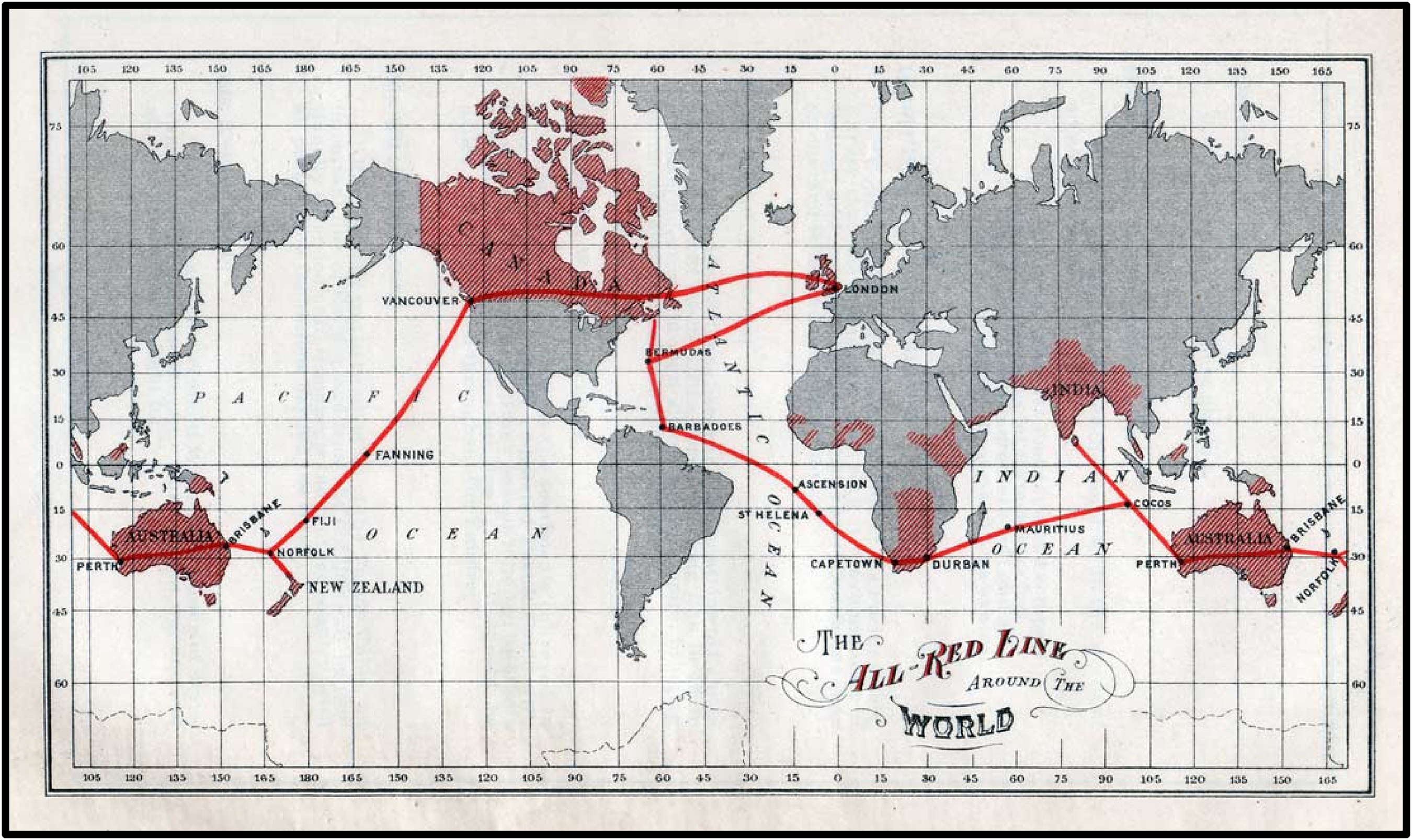
Key cable routes in the British All Red Line, 1902.
Early wireless telegraphy
Marconi dominates the current historiography on early wireless developments. For example, Headrick covers the personal achievements of Marconi, and Canadian media historians Dwayne Winseck and Robert Pike document the growing power of the Marconi Company in both wireless technology and services. 22 A recently released account of Marconi's life, including him being drawn into politics by the Italian Fascist Party, has been written by Canadian researcher Marc Raboy. 23 Raboy's work, a massive undertaking (850 pages), is the result of many years of research in Marconi archives in the United Kingdom, North America and Italy.
Although these accounts of Marconi's life and work are crucial in the understanding of early wireless development, there is so much more to be understood regarding the history and impact of the discovery of wireless. This is important in gaining a full understanding of the development of naval wireless, the role of wireless in undermining the British hegemony in communications, and its subsequent impact on the balance of power in media and communications. The following therefore considers the introduction of wireless to naval operations and the as-yet-understated contribution of both the Royal Navy and the United States Navy not only to the use of wireless, but also to the science and development of wireless telegraphy.
The Royal Navy
A full acknowledgement of the role of the Royal Navy in the development of wireless telegraphy has perhaps been limited by the restrictions of the Official Secrets Act. 24 Using recently released information, British author Roland Pocock has produced an account of the role of the Royal Navy in wireless developments, particularly in the pioneering years between 1895 and 1905. 25 A more recent and very noteworthy contribution has also been made by historian Elizabeth Burton. Her historical account complements Pocock's more technical approach and describes how the Royal Navy not only became a Marconi customer, but was also involved in the development of wireless equipment and undertook trials that paralleled Marconi's developments. 26
In any review of the Royal Navy’s contribution to early wireless telegraphy, one man looms large. Henry Bradwardine Jackson (1855–1929) joined the Navy as a 13-year-old cadet through HMS Britannia in 1868. Jackson's education record reveals the importance that the Royal Navy attached to the education of its officers in the sciences. His report card on his Torpedo Lieutenant examinations reveals not only his standing as head of his class, but also the large percentage of marks attached to the sciences, including physics, chemistry and mathematics. 27
After qualification, Lieutenant Jackson was assigned to the Royal Navy torpedo and mines establishment at HMS Vernon. 28 This was the centre for the emerging discipline of electrical engineering in the Royal Navy, and therefore the natural place to further the Navy's work on wireless communication. Promoted to captain in 1895, Jackson was appointed to command the torpedo training ship HMS Defiance, stationed in Devonport, and it was here that he proved the abilities of wireless in connecting HMS Defiance to another vessel over a distance of three miles. 29
The most significant meeting for the future of Royal Navy wireless took place at the War Office on 31 August 1896. 30 Invited as the Royal Navy’s representative to review Marconi's trial successes, Jackson soon realized that Marconi was performing development work in parallel with his own efforts. From this point on, Marconi and Jackson exchanged ideas, with Jackson offering advice to Marconi on suitable modifications to wireless equipment for shipborne use. 31 Under Jackson's guidance, the staff at HMS Vernon designed and built transmitters and receivers that were deployed operationally on a number of Royal Navy ships for manoeuvres in July–August 1900. In addition, the Royal Navy signed a contract with Marconi's Wireless Telegraph Company for delivery of 32 wireless telegraphy sets commencing in September 1900. 32 Orders of this Marconi equipment and orders to HMS Vernon meant that, by 31 December 1901, 75 Royal Navy ships and 12 shore stations were scheduled to receive wireless, covering the global operations of the Royal Navy (see Table 1).
Scheduled deployment of wireless telegraphy sets by December 1901.
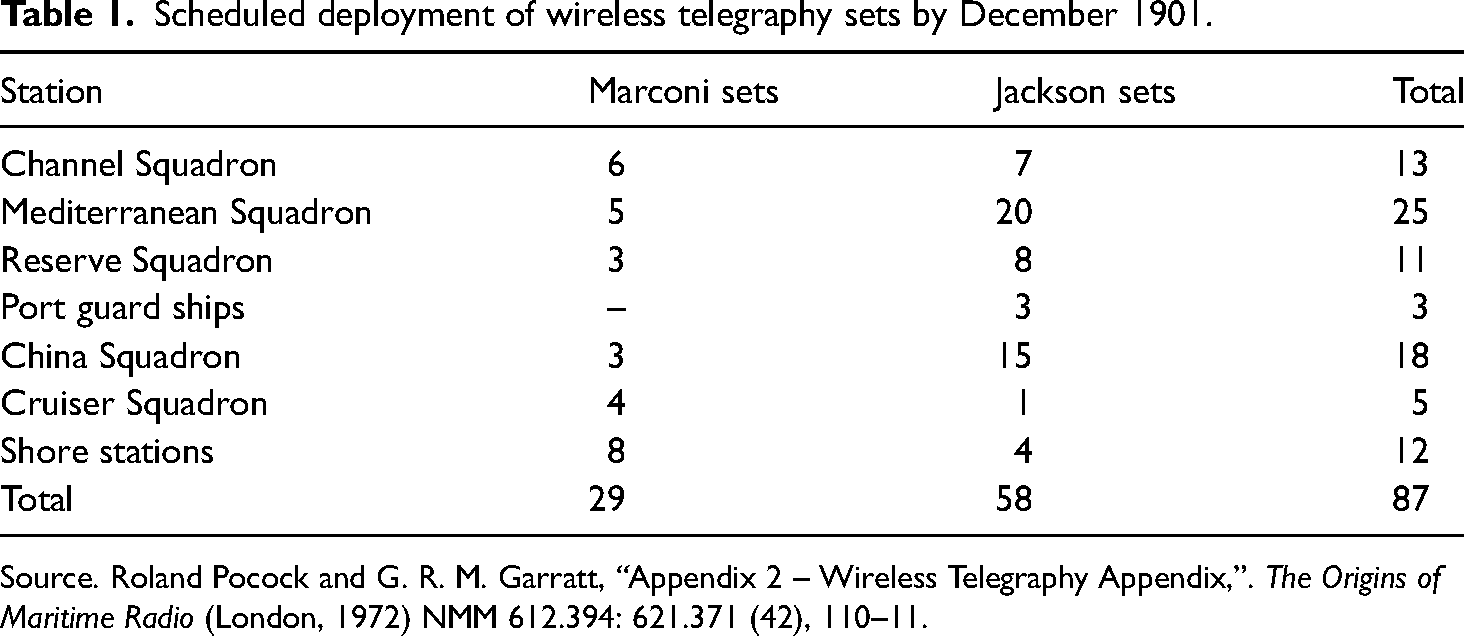
Source. Roland Pocock and G. R. M. Garratt, “Appendix 2 – Wireless Telegraphy Appendix,”. The Origins of Maritime Radio (London, 1972) NMM 612.394: 621.371 (42), 110–11.
The United States Navy
Although Marconi's early time in Britain and his connection with the Royal Navy is well recorded, less well known is his connection with the United States Navy and the events that set the United States and the United States Navy on a conflicting course with Marconi's interests. Initially, having seen reports of Marconi's successful trials in Britain, the United States Navy requested to trial his equipment when he brought three wireless sets to New York in 1899 to allow the press to obtain the results of the America's Cup races. The Navy placed these sets on three vessels: USS New York (an armoured cruiser), USS Massachusetts (a battleship) and USS Porter (a torpedo boat). These ships communicated with a commercial shore station near the entrance to New York Harbor. 33 Although these trials were successful and resulted in a recommendation to create more shore stations and ship installations, the United States Navy was unable to negotiate reasonable terms with Marconi, who was not prepared to sell, but only lease, the equipment through his new company, the Marconi Wireless Telegraph Company of America – the only company authorized to use Marconi patents in the United States. 34 This impasse with Marconi ultimately led, after further tests with alternative European sources, to the Navy placing a contract with the German Slaby–Arco company for a total of 47 wireless sets in 1903. 35
To increase the range of its existing shipborne wireless communications capabilities, the United States Navy decided to build a high-power long-wave transmitter in Arlington, Virginia, and released a tender in 1908 calling for a station capable of transmitting within a 3,000-mile radius of Washington, DC. 36 The Navy awarded this contract in 1909 to the National Electric Signaling Company (an American company). The contract was contested by Marconi, who claimed that no other company had the experience to meet the distance requirement, and that the National Electric Signaling Company was not the lowest bidder. 37 In fact, the Navy’s decision was based on its desire to work with an American company, and it preferred the National Electric Signaling Company’s rotary spark discharger, an invention of the Canadian Reginald Fessenden, over the Marconi-proposed unquenched spark-gap solution. 38 Fessenden would eventually evolve the rotary spark discharger to continuous-wave operation, and as he had already demonstrated the capability of voice transmission, 39 this decision would have a significant impact on the United States Navy’s position relative to the Royal Navy as wireless developments progressed. 40
Having deployed a high-powered station and with a number of warships fitted with Slaby–Arco wireless equipment, the United States Navy embarked on a series of trials in 1910. After calibrating its system by connecting to USS Birmingham and USS Salem in Provincetown harbour, the Navy proceeded to carefully plot the signal strength received from the Arlington transmitter as each of these ships sailed an agreed course in the Atlantic. The transmitted power was kept at 100 kilowatts, and two frequencies – 300 kilohertz and 80 kilohertz – were employed. These results were tabulated, and a formula for best fit of power received versus distance from the transmitter was derived. 41 In this formula, the key components were that the received signal strength decayed exponentially with distance from the transmitter and with the reciprocal of the square root of wavelength. 42 This then became the basis on which long-wave stations were designed and how calculations of power versus distance were achieved, driving the design of long-wave stations to higher and higher powers, and antenna arrays to be larger and set at a greater height.
The beginnings of wireless regulation
Marconi's attitude on patents and service provision created concern not only in the United States that his efforts were aimed at creating a proprietary standard for wireless. These concerns led to Germany calling a number of interested nations to the first Radio Telegraphic Conference in Berlin in August 1903. Although Kaiser Wilhelm cited ‘the preservation of world peace and free enterprise’ as the reason for calling the conference,
43
the British were under no illusions as to the military reasons for this action: The facts that the German government has taken the lead in endeavouring to bring about an international agreement on certain lines, and that the value of wireless telegraphy for purposes of war are thoroughly understood by the expert advisors of that Government, should cause us to be exceedingly careful before becoming committed in any way to arrangements that may prove prejudicial to our interests. There can be no doubt that every aspect of this question – and especially the naval aspect – has been thoroughly studied in Germany.
44
Attending the 1903 conference, the United States was keen to force interoperability due to the desire for American shore stations to be able to connect with transatlantic liners carrying non-Marconi-manufactured equipment. 45 But for the United States, by far the biggest impact of attendance at this conference was that, as an apparent minor participant, the United States delegation saw first-hand how European governments were starting to view wireless and wireless spectrum as a strategic asset. This resulted in the United States Navy becoming more active in the deployment of wireless, 46 and the Roosevelt government beginning a process of participation in wireless regulation with the formation, in June 1904, of the Interdepartmental Board of Wireless Telegraphy, on which the United States Navy was well represented. 47
This increased focus led to the United States taking a longer and more strategic view of wireless development, aligning with Germany as an advocate for international rules to thwart Marconi's monopoly, and leading to the first international radio regulations being agreed at a second Berlin conference in 1906.
48
These regulations ratified the three main recommendations of the 1903 conference
49
:
The principle of inter-communication to be compulsory for all systems in the case of ship-to-shore messages; All technical details necessary to secure inter-communication to become the property of the contracting powers; A scale of tariffs to be fixed.
Although the British government signed the 1906 protocol, it made reservations on its implementation, initiating a major parliamentary debate where the terms of the convention were ratified by a single vote. 50
A further significance of the 1906 conference – particularly, as we shall see, with regard to the United States Navy’s influence – was that for the first time interference between wireless systems was discussed, addressing the problem of uncontrolled access to wireless spectrum. In a response that demonstrates the diverging positions of Britain and the United States, a British report referred to the dangers of facilitating ‘promiscuous use of untried, possibly inferior methods’ – a clear reference to discouraging new continuous-wave techniques, and thus attempting to protect the Marconi ‘brute-force’ implementation of spectrum-inefficient spark-gap wireless telegraphy. 51
A third wireless conference was held in London in the summer of 1912. The Titanic disaster and the role of wireless in the rescue of 700 passengers in April 1912 contributed to the delegates, including the British delegation, fully accepting the principle of maritime inter-communication. 52 A characteristic of the 1912 conference was recognition of the need for spectrum regulation, both within national boundaries and internationally, beginning a regulatory process that is now the constant focus of national and international expert bodies, the recommendations of which are addressed at the World Radiocommunication Conferences, held regularly at intervals of three to four years. 53
Post-war Britain and the Empire
The First World War had far-reaching economic and social impacts on western society. At the outset of the war, the British Empire covered a quarter of the earth’s land surface and had a combined population of 425 million, and Britain was a financial and industrial powerhouse. 54 Lambert identifies the connection between the financial interests of the City of London, the importance of new technologies and trade, and the security offered by the Royal Navy in arriving at this pre-war condition. 55 At the end of the war, it was estimated that the British Empire had expended $23 billion (at 1913 prices) and mobilized 9.5 million men for the war effort. In contrast, the United States had expended $17.1 billion but only mobilized 3.8 million men (see Appendix 2). 56 This set in place a change in cross-Atlantic attitudes based on a reversal of the economic and industrial power of Britain and the United States. 57
The Royal Navy: post-war austerity, mandates and social conflicts
In the immediate years after the First World War, the Royal Navy was preoccupied with government budget priorities (see Appendix 2) and their impact on force size. 58 These challenges were magnified by the political and public attitudes that prevailed in post-war Britain. Before the war, the Royal Navy was seen as the anchor for Britain's imperial power and a bulwark against the rising land power of European nations, particularly Germany. Organizations such as the Navy League, with branches formed throughout the Empire, ensured that constant pressure was exerted on the British government whenever naval expenditures were under debate. 59 This all changed at the conclusion of the war when the public discourse and political focus changed to social issues such as welfare and housing. 60 Anti-war organizations such as the League of Nations Union dominated the political debate. 61 Although there was still a recognition of the importance of the Royal Navy for the protection of trade, thoughts turned to the control of naval expenditure by arms limitations and treaties. 62
Despite being allies in the war, a major concern of the Admiralty in the immediate post-war years was potential conflict with the United States. In the United States Navy, the Royal Navy now had a major naval power to contend with, one whose numbers of ships were below those of the Royal Navy but, due to wartime-initiated construction programmes, would soon be more modern and capable: ‘In the opinion of the Board of Admiralty, the only Navy for which we need have regard, and in respect of which we desire a decision of the Government, is the Navy of the United States of America’. 63 A desperate political need for accommodation with the United States resulted in the British government agreeing to the terms of the Washington Naval Treaty in 1922, where, based on proposals from the United States, it agreed to battleship-number parity with the United States Navy. 64
It became clearer, later in the conference that resulted in the Naval Treaty, that the United States may have seized on a trend that perhaps the Royal Navy had not fully appreciated – that of the looming threat to the battleship from airborne capabilities. 65 There is an ongoing debate with diverging opinions on the relative positions of the Royal Navy and the United States Navy regarding the speed of adoption of new sub-surface and airborne technologies. 66 Irrespective of this, this article reveals the priority that the United States Navy placed on investment in the new technology of wireless at a time when the Royal Navy was still wrestling with imperial obligations, where battleships and hull numbers were a priority. 67 There was also the thought in Britain that the battleship was still key in the process of the naval theatre: ‘grey guardians roaming the sea lanes of the world was still etched on the British national consciousness, and on that of its Empire’. 68
Britain's imperial wireless dilemma
Beyond the United States, the end of the war revealed yet another change in relationships that the British government would need to address. Having contributed to the war effort, including 198,000 war dead (see Appendix 2), the British colonies were looking for more independence and visibility with regard to the decisions being made in London on their behalf. 69 They demanded and obtained separate representation at the Paris Peace Conference, applied their own signatures to peace documents and obtained separate seats in the League of Nations. 70 For New Zealand and Australia, the Peace Conference process also meant that they obtained control over many German Pacific Island territories, and became concerned with communications to and protection of their own island protectorates. 71
This internal pressure meant that while the United States was taking an assertive post-war position on wireless, Britain busied itself with endless debates in a number of parliamentary and imperial committees on an imperial wireless system. In March 1919, Godfrey Issacs, the managing director of the Marconi Company, submitted an offer to construct, maintain and operate a network of wireless communications throughout the British Empire. 72 In response to this, the Imperial Wireless Committee was created under the chairmanship of Sir Henry Norman, a former journalist and a Member of Parliament. This committee, which included representation from the Post Office, Admiralty, War Office and Colonial Office, revealed the long-standing antipathy shown by the Post Office towards the Marconi Company. As an example, in September 1918, the Marconi Company had successfully sent a message from its commercial high-powered station in Carnarvon, Wales, to an experimental station in Sydney. 73 This was widely reported in Australia and was used by Marconi to promote the idea of wireless as a cheaper alternative to cable telegraphy. 74 However, the Post Office was unimpressed by Marconi's success, believing that a Marconi direct connection to Australia would be expensive and unreliable for operational use and, perhaps most tellingly, would threaten the cable companies. 75
The Norman Committee therefore proposed an alternative plan where the Post Office would erect smaller stations that would rely on relays for any connection greater than 2,000 miles.
76
The colonial governments hated the idea of being on the end of a relay chain and were convinced that the Marconi idea of direct links was practical. In response to the committee's proposal, they indicated that they were prepared to go alone with a commercial service. This was expressed in a memorandum sent to the Cabinet by Winston Churchill, then Secretary of State for the Colonies: ‘The Governments of Australia, India (and probably the Union of South Africa) desire to establish direct communication with the United Kingdom instead of by 2,000 miles steps as proposed in the scheme of the Imperial Wireless Chain now approved’.
77
To this memorandum Churchill annexed selected comments made at an Imperial Conference by the prime minister of Australia, Billy Hughes, which clearly showed his frustration with the current proposal and lack of action: I am not going to deal now with the recommendations of that committee. I say, however, this, that nothing has followed upon either the decision of any of the conferences or the recommendations of the Norman Committee … Now if I am asked what scheme I prefer, I say I prefer any scheme which will get itself done … we will put up a plant in Australia which will communicate directly with you, and every other dominion can do the same.
78
The Norman Committee, on further reflection, recommended that a 240-kilowatt high-power long-wave station be erected in the United Kingdom that would enable direct connection with Australia and South Africa, but it was to be built, owned and operated by the Post Office. 79 Based on this recommendation, a standing subcommittee of the Committee of Imperial Defence was appointed to determine the location of this station. A survey was undertaken by Dr Eccles and L. B. Turner of the Wireless Telegraphy Sub-Committee on 21–22 October 1922 and, with suggestions from the intended operator, the Post Office, they chose a site near Rugby in Warwickshire. 80 In the end, the government paid over £49 million to acquire 920 acres of land in the parish of Hillmorton, and the station opened for service on 1 January 1926. 81
Building the Rugby station was a major engineering feat. Complete with 12 aerial masts, each 850 feet tall, and a buried earth mat of 100 pounds of copper wire, operating on 16 kilohertz (18,740 metres), the output from a vacuum-tube-based transmitter was over 350 kilowatts. 82 Although soon overtaken by short waves in its intended role of imperial telegraphy, the Rugby transmitter (call sign GBR) proved very flexible, offering global time and frequency standards. 83
The post-war United States
By the last two decades of the nineteenth century, with an expanded industrial infrastructure supported by telegraph and railway networks and a growing middle-class ability to speculate new capital, the United States found itself in a situation of domestic overproduction. 84 This fuelled a desire to seek overseas markets, beginning a process that Martin Sklar has termed ‘capitalist investment imperialism’. 85 Together with other European nations (particularly Germany) with their own increased imperial ambition, the United States viewed British communications hegemony, in the form of the All Red Line, with suspicion. Not only was it used by Britain for advantage in global influence, but its virtual monopoly also forced many of the United States’ own government and trading transactions to be sent over British-controlled, and no doubt monitored, cable systems. For these nations, this was an issue that begged an alternative communications solution, and, for them, the discovery of wireless was very timely.
Industrial production, trading ambitions and innovation
As a result of its industrial activity in the First World War and limited domestic disruption compared with Europe, the United States had in 1920 increased its production of manufactured goods by 20 per cent over pre-war figures, compared with a fall in Europe of 30 per cent. 86 Much of this wartime production capability was taken up by domestic consumer demand, led by cars, household appliances and, as we will see, radios, with some production dedicated to buildings and roads. 87 However, manufacturers and banks led a strong drive for overseas trade, which immediately set the United States at odds with the British Empire.
Although the British government may have considered the United States as a potential rival in post-war trade and global influence, actual military conflict between the countries was a prospect addressed by military planners but, as Christopher Bell summarizes, unthinkable.
88
It was, however, clear that a post-war relationship was growing between the United States government and corporations, together viewing British communications dominance as a barrier to progress in the areas of communications access and media distribution, particularly within South America and Asia.
89
For example, at the Paris Peace Conference, President Wilson received a memorandum from the United States Postmaster General, A. S. Burleson, regarding the repatriation of German cables: Our ships and merchant marine now have to depend upon the courtesy of foreign controlled means of communication to get home connections … The United States is connected on one side only. A new system should be developed with the United States at the centre.
90
It is a matter of common knowledge that the highly efficient cable system of Great Britain is so closely co-ordinated with the diplomatic and commercial interests of that country that no message which might be of value to either the British Foreign Office or the British Board of Trade is assured of secrecy if at any point in its journey it passes over a British line.
91
In the immediate post-war period, the United States Navy continued to be the first user of innovative wireless technology. It sought new transmission techniques based on continuous waves, in the first place using a high-speed alternator proposed by Fessenden and implemented by a General Electric engineer, D. F. Alexanderson, for whom General Electric would name its alternator. The Alexanderson Alternator, using multiple magnetic poles and rotating at a very fast rate, was capable of producing a sine wave up to 50 kilohertz. 92 Driving the transmitter directly, it produced a very pure transmission within a narrow frequency band. This was unlike a spark technique, which polluted the spectrum over a wide frequency range. 93
The United States Navy was also the first to adopt vacuum tubes in wireless receivers based on the invention of Lee De Forest and, in the early post-war period, with selective procurements and industry forums, sought to encourage further development of high-power vacuum tubes within United States industry. 94 The Navy also made an early decision not to purchase any more spark- or arc-based equipment, and was active in specifying standard designs for receivers that could be provided by multiple commercial suppliers. 95 Most importantly, determined to prevent United States wireless being controlled by a foreign entity (The Marconi Wireless Telegraph Company of America), the Navy used all of its political influence to initiate a debate in Congress in 1918, which was designed to give the Navy full control over wireless in the United States. 96 When that failed, supported by President Wilson, it encouraged General Electric, the owner of the Alexanderson Alternator patent, to refuse Marconi's request for access to this technology and to eventually buy out the British interest in The Marconi Wireless Telegraph Company of America. 97
In October 1919, using the assets of The Marconi Wireless Telegraph Company of America, General Electric formed the Radio Corporation of America, a ‘100 Percent American Commercial Company’. 98 The final episode in these actions, all designed to secure the United States Navy’s influence over the American wireless industry, was the inclusion of Admiral Bullard on the board of the Radio Corporation of America as the representative of the United States government. 99
The growth of American broadcast radio
One of the benefits of an American focus on continuous-wave wireless was that it paved the way for audio transmissions on broadcast radio,
100
and the ability to reach every American with this capability.
101
It is interesting that plain geography had a large influence on the respective spectrum priorities of Britain and the United States. Whereas Britain concentrated on long-distance point-to-point use, because of the imperial requirement, the United States soon found itself dealing with spectrum issues caused by the explosion of local broadcast radio stations. At the opening of a United States domestic radio conference in 1921, the Secretary of Commerce, Herbert Hoover, remarked: We have witnessed in the last four or five months one of the most astounding things that has come under my observation of American life. This department estimates that today more than 600,000 persons possess wireless telephone receiving sets, whereas there were less than 50,000 such sets a year ago.
102
Given this situation, it was clear that the government had to move to ensure more spectrum was made available to broadcasting, but in a way that all transmissions were spectrum-efficient. A Third National Radio Conference, convened in Washington, DC, on 6 October 1924, was instrumental in setting a domestic spectrum plan and, at the same time, the United States Navy took this opportunity to draw up and lobby for its own complete Radio Frequency Plan, which was approved by the president. A key element of the United States’ and United States Navy’s frequency plans was the encouragement to abandon spark transmitters and introduce regulations that required more stable and accurate channel spacing. 103
The result of this internal regulatory work was that it enhanced the United States’ ability to influence the Fourth International Radio Conference, held in Washington, DC, in October 1927. Here, the United States was in a strong position to propose and have accepted a spectrum-allocation plan based on its own regulations. The influence of the United States Navy was obvious, both in the work towards the conference and at the conference itself. Apart from having a member of the United States delegation, seven senior Navy officers acted as technical advisors. It is not, then, surprising that one resolution passed at this conference was the proposed discontinuation of non-continuous-wave transmissions from land-based stations by 1 January 1935. 104
The discovery and development of short waves
Short waves had been considered by many scientists as of no use for long-distance communications. They reasoned that such high frequencies would act like a beam of light, not follow the earth’s curvature and be lost in space. In fact, the International Wireless Conference of 1912 had considered short waves to be of no commercial use, and the spectrum above 1 megahertz (300 metres) was assigned to radio amateurs. 105
Marconi and short waves
As he considered further progress in wireless telegraphy, Marconi feared that continuation with long waves would lead to unrealistic demands on power output and antenna dimensions, and he was pleased to accept an opportunity with the Italian Navy to investigate short-range communications between ships using short waves. In these experiments, he worked closely with C. S. Franklin, a long-time associate who would be one of the key men in the development of short-wave communications. 106 Marconi and Franklin were encouraged by the success of their Italian experiments and, when they returned to the United Kingdom in 1917, conducted experiments over increasing distances up to 100 miles, including both telegraphy and telephony transmissions. 107
Despite this wartime activity, immediately after the war, Marconi seemed to disappear from the public scene of wireless, leaving much of the endless debate on imperial wireless to others, with his point man being Godfrey Isaacs. Marconi appeared to retreat into his social world by purchasing a yacht – one that had been previously used by the Royal Navy as a minesweeper in the North Sea, which he renamed Elettra. 108 In fact, encouraged by his wartime experiments, the main purpose of his many voyages around the Mediterranean and Atlantic was to enable him to further his research on short waves in a laboratory that he had provided for himself on board.
As part of this research project, Marconi and Franklin built a 12-kilowatt short-wave transmitter in Poldhu, Cornwall. Franklin set this transmitter to operate at around 97 metres (3.1 megahertz) and Marconi sailed out into the Atlantic, constantly comparing the Poldhu reception with that of the 100-kilowatt transmission from his long-wave station in Wales. The long-wave reception performed as expected, fading rapidly with distance from the transmitter. However, whereas up to 1,250 miles the short-wave transmission faded, at a distance of 2,000 miles the reception was better than the long-wave reception, even when the Poldhu transmitter was reduced to 1-kilowatt power. 109 Although he did not realize it at the time, Marconi was observing the fading of the ground-wave transmission from Poldhu up to 1,250 miles, but at the greater distance (equivalent to the skip distance), he was receiving the Poldhu sky wave. 110 Marconi also observed differences between short-wave transmissions during the day and night. Later, using a number of different wavelengths between 32 and 92 metres (3.3–9.4 megahertz), 111 he convinced himself that short waves were the answer to the imperial wireless service and he backed this up with demonstrations of almost continuous transmission to Sydney, Australia. 112
The Imperial Beam System
Success with his short-wave experiments enabled Marconi to offer the British and colonial governments a different scheme for imperial wireless telegraphy – one that promised much lower costs than the previous long-wave solutions. 113 Finally, after years of divisive debate, the Marconi Company came to an agreement with the Post Office to share the spoils of Marconi's discovery. The Post Office and the colonial governments would own and operate short-wave services between Britain and the dominions, and the Marconi Company would be free to exploit the benefits of short wave by owning and operating short-wave services between Britain and other nations. 114 In addition, the Post Office would pay the Marconi Company a royalty in recognition of the patents that had long been an impediment to full use of wireless by the government and Royal Navy. 115
On 25 October 1926, the first operational link in what would become known as the Imperial Beam System was initiated between a Post Office station in Bodmin, Cornwall, and a Canadian-government-owned station in Yamachichi, Quebec. 116 Key to this successful transmission were transmitters designed by the Marconi Company and beam directional antennas designed by Franklin, which were a major engineering achievement. For the Canadian service, five masts, each 287 feet high, were erected on a baseline of over a quarter of a mile, with the baseline being at an exact 90-degree relationship to the great-circle path to the receiver. An array antenna was then strung between the masts, creating a narrow beam that followed the great-circle route precisely to Canada (see Figure 2). 117
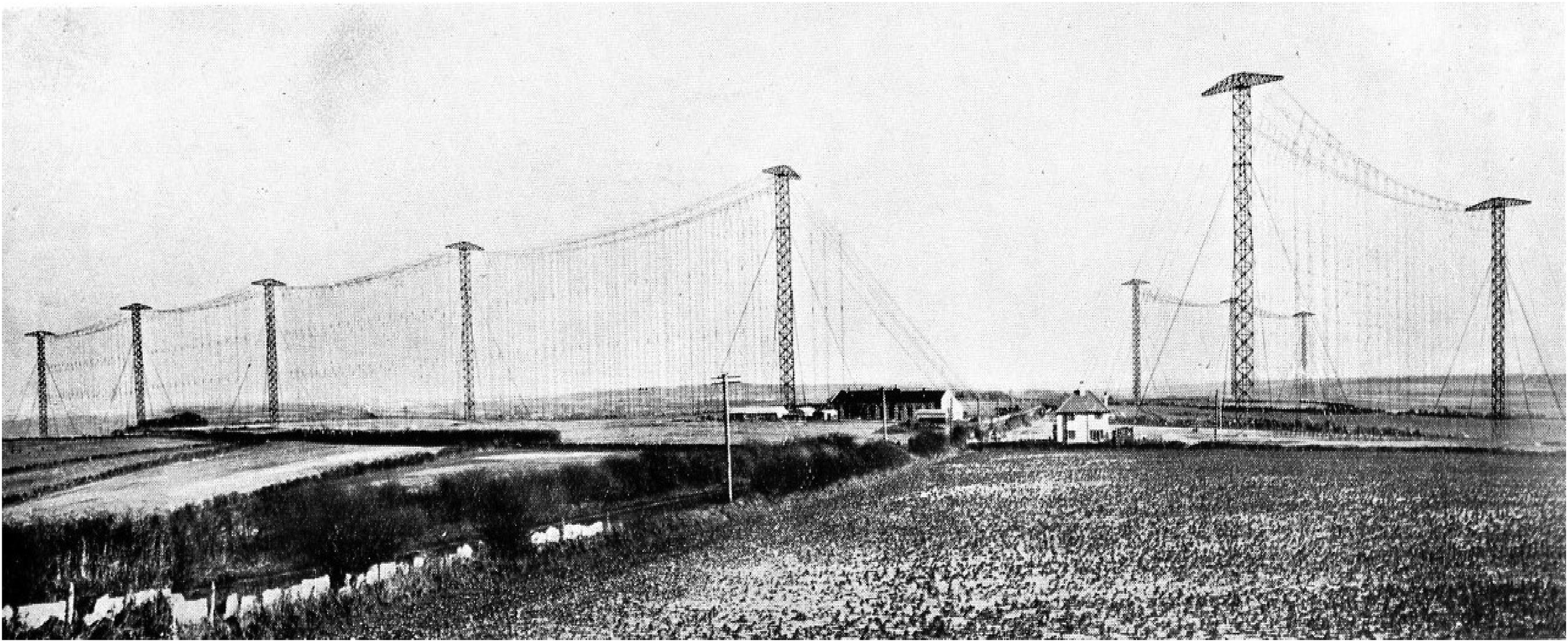
Beam-antenna array at Dorchester Radio Station, UK (the five-mast array to the left is the United States’ service).
Naval activity in short-wave radio
Despite Marconi's public claim to the discovery of the operational utility of short waves, it is significant that amateur radio operators, particularly those in the United States using newly available vacuum tubes, were the first to demonstrate the potential of low-power short-wave transmissions over great distances. 118 These amateurs, through their association, the American Relay League, cooperated with the Naval Research Laboratory and, by 1924, the United States Navy had an active research and trials programme in short wave. 119 In 1925, a short-wave radio set was installed on the USS Seattle, and experiments on short-wave communications were conducted when the Seattle cruised to Australia. Although the tests revealed the same propagation issues of daytime and night-time frequency use that Marconi would experience, communication was successfully set up between Washington and the Seattle, moored in Melbourne harbour, at night-time. The Navy immediately added short wave to its fleet frequency plan and aimed to equip 28 coastal stations with transmitters, with an upper frequency limit of 18 megahertz (16.6 metres). ‘Within a few years the U.S. fleet was provided with far more reliable equipment than any fleet in the world’. 120
With the advent of short-wave radio, the Royal Navy faced a dilemma. Not only were budgets tight, but it determined that short wave was still experimental, operated with unfamiliar vacuum-tube-based technology, and appeared to support directional rather than broadcast transmissions. To the Admiralty, the long-wave station at Rugby still appeared to best meet the Navy's requirements, using ‘brute-force’ energy to communicate globally with the fleet on a single broadcast transmission. An Admiralty memorandum dated 29 April 1924 declared: ‘These stations must transmit equally in all directions. Stations utilising reflection systems … are of little value for Naval purposes’. 121
Despite the Royal Navy’s concerns, short waves had a major impact on naval operations as they developed during the interwar years. They enabled lower-power ship installations and long-distance ship-to-shore communications. A further impact of an increased use of short waves was to potentially reveal the presence and location of naval operations, contributing to the development of a new operational art – that of signals intelligence. 122
The science of the ionosphere
By the time of the first commercial transmission within the Imperial Beam System in October 1926, despite much experimental activity in this band by radio amateurs, Marconi and the United States Navy, the science of the ionosphere was still a fascinating mystery. Over time, it was discovered that daytime frequencies would need to be in the higher range (around 18 megahertz) and night-time frequencies in the lower range (around 9 megahertz). 123 In the Marconi beam system, this meant that, on the large beam arrays, there needed to be two complete antenna systems – one tuned to the daylight band and the other to the night-time band. 124 Experience with the United Kingdom–Canada connection would also uncover fading due to the influence of sun-spot activity and significant Aurora Borealis activity over northern latitudes. 125 Over a more extended period, issues connected with the 11-year solar maximum cycle would also appear. All of these propagation issues needed to be understood, particularly for naval use, where at least one end of the link was moving. There was also concern about the impact of these complexities on radio operation and the competence required of the signalman operating the equipment.
Admiral Jackson and the Radio Research Board
A major contribution to research into short-wave propagation was made by an organization that originated in 1920 and was named the Radio Research Board. 126 Together with its coordinating role of radio research within Britain and the Commonwealth, the Radio Research Board conducted its own research in facilities at Ditton Park, Slough, where, in 1924, all British radio research was merged into an existing small Admiralty direction-finding laboratory. 127
The first meeting of the Radio Research Board took place in February 1920 under the chairmanship of Admiral Henry Jackson. The composition of the board, with half of the members from the Admiralty, War Office and Air Ministry, demonstrated the important role that wireless was now playing in the area of defence. The Radio Research Board initially created four subcommittees in the areas of propagation of waves, atmospherics, directional wireless and thermionic valves. 128 The minutes of the meetings of the Committee A: Propagation of Waves show the constant attendance and contribution of Admiral Jackson until his retirement in 1928 and, from 1923 onwards, the major contribution of Edward Appleton, 129 who would in 1947 receive the Nobel Prize for his theoretical and experimental work on identifying the various layers of the ionosphere. 130 These layers, together with changes in electron energy levels within the ionosphere over a 24-hour period, explained the behaviour of short-wave transmissions and the impact of solar activity on propagation. 131
One impression gained from reviewing the minutes of the various Radio Research Board subcommittees is their great interest in work that was being undertaken in the United States. In a meeting of the Committe A. Propagation of Waves held on 15 June 1925, Dr E. E. Rayner, chairman of the committee, gave a full report on his recent visit to the United States. 132 This included visits to industrial facilities such as General Electric and also government organizations such as the Bureau of Standards. During these visits, his clear preoccupation was the progress of developments in vacuum tubes and crystals in the United States, and how this combination would enable much more precise and stable oscillators, thus contributing to the United States’ leadership in spectrum efficiency, which was key to their position on spectrum regulations. 133
Conclusion
Two separate observations – one made on the day the First World War ended and the other on the day the Second World War ended – would have revealed a major transition in the relative strengths of the Royal Navy and United States Navy. This research has revealed just one significant and previously unappreciated element of that transition, concentrated in the period immediately following the First World War. This was a period when there was an erosion of British global communications dominance, at the time based on submarine cable systems, and the gradual emergence of the United States as a dominant power in wireless, changing the balance of power between the two as the interwar period progressed. Several factors in this transition have been identified – some based on the post-war economic and social fortunes of the home nations and some specific to decisions made on wireless developments.
The first of these factors can be best described as geography in that, in the post-war era, Britain focused on long-distance telegraphic communications due to its imperial responsibilities and having to deal with increasingly independent-minded colonial governments, whereas the United States was forced to deal with the needs of a scattered population over a great land mass, with the inevitable attraction of broadcast radio bringing news and entertainment to isolated communities. This was shown to lead the United States Navy towards wireless technology solutions that had greater innovation, where they showed a willingness to make a connection with the amateur radio population, whose contribution to short-wave wireless progress in the United States proved equal to that of the barnstormers in aviation developments.
The second, and key, factor was technology decisions made in Britain and the United States. In this regard, although Marconi is rightfully lauded for his early transatlantic telegraphy work and his revealing over 20 years later of the commercial potential of short waves for long-distance communications, between that time, his influential stature in Britain, his apparent absence from innovation and his patent arsenal drove his company, and therefore the British Empire, towards a ‘brute-force’ approach based on spectrum-inefficient spark-transmission methods. In contrast, the United States Navy's early grasp of continuous-wave techniques, their application to commercial broadcast and the development of spectrum-efficient transmissions, based on vacuum-tube technologies, positioned it not only to embrace short waves, but also to establish itself as a key influencer on the use of radio spectrum, ensuring that any move in the international regulatory forum would protect and promote its interests.
The third factor was the British perception – or perhaps hope – at the time that the United States was a reliable and complete ally in all things. It can be seen that the United States, while appearing to seek force parity, was quietly moving to dominate in both technology and regulations on the wireless front. Also, the United States Navy benefited from a president who saw emerging sea power and communications as a key ingredient for national status and trade. He ensured that continuous-wave technologies were made available to the Navy and were prohibited from being shared with Marconi. The United States government also encouraged secret agreements between major United States corporations on patent pooling – a process involving the sharing of important wireless patents – while signing agreements on market segmentation in the broadcast radio and telephony field, in effect reducing direct competition. 134 In comparison, a major issue that halted progress in British wireless development was the stand-off between the government, represented by the Post Office, and the Marconi Company – one that was manifested in personal egos and patent rights.
While parts of this process have been previously explored, this work has revealed two significant elements that change our understanding of the period directly following the First World War – that is, two major items that must be added to the current historiography of the period. The first is the impact of the British Empire's adherence to the Marconi way, based on the dominance of the Marconi Company and its influence on imperial communications. Marconi himself may have been regarded as the inventor of wireless, but his 20-year absence from technology innovation ultimately led to Britain falling behind the United States. Canadian scientist and author John Belrose went as far as to credit Fessenden as ‘the greatest wireless inventor of the age’. 135 This is a little harsh and maybe born of patriotism, but Fessenden's work on continuous waves and heterodyning certainly was a major factor in the United Sates Navy’s strength in this post-war era. The second item is political will, as it can be seen from this work that, although in naval matters the United States appeared to be seeking parity, it was quietly moving to dominate in both technology and regulations on the wireless front, while the Royal Navy, in an era of austerity and changed social priorities, was hobbled by endless debates on imperial responsibilities, patent matters and commercial against government ownership of spectrum.
In summary, this research strongly closes connections between geography, economics, technology and political will, and provides a new and unique understanding of an important technology-enabled geopolitical development in the interwar years, highlighting a subtle and underappreciated but important part of how the United States steadily rose to its dominant global position by 1942. This development had its roots in the pre- First World War era and continues to cast a mighty shadow over naval operations today. 136
Supplemental Material
sj-pdf-1-ijh-10.1177_08438714221145772 - Supplemental material for The ionosphere: Undermining Britain's imperial power: Wireless and its impact on geopolitics and naval operations (1919–1927)
Supplemental material, sj-pdf-1-ijh-10.1177_08438714221145772 for The ionosphere: Undermining Britain's imperial power: Wireless and its impact on geopolitics and naval operations (1919–1927) by Peter Garland in International Journal of Maritime History
Footnotes
Acknowledgements
I would like to acknowledge the British Commission of Maritime History in recognising the merit of this work within my Master's dissertation and encouraging this journal submssion. My thanks go out to Cynthia Culley in my local Beaconsfield (Quebec) library for her magic in securing inter-library loans for me throughout my studies. Also, thanks to Matthew Wild, who gave me access to the basement at The Rutherford Appleton Labaratories, which holds the many treasures of the Ditton Park Archives. Thanks go to the staff at the National Archives in Kew and the Caird Library at the National Maritime Museum for their patience and helpful guidance. My appreciation goes to my wife Daveen, for her encouragement, and to my three lovely daughters, who cheered me on. Finally, a thank you to the University of Portsmouth for giving me the chance to fulfil a long-desired ambition, particularly Cathryn Pearce for her patient help and Matthew Heaslip for his guidance as supervisor for my dissertation and for reviewing this article. I dedicated my Master’s work to my late father, Alfred Garland (Chief Petty Officer Stoker, Royal Navy, 1926–1948), veteran of the San Demetrio incident (HMS Arrow), the Pedestal convoy (HMS Indomitable) and sweeping the beaches into Normandy (HMS Llandudno).
Declaration of conflicting interests
The author declared no potential conflicts of interest with respect to the research, authorship and/or publication of this article.
Funding
The author received no financial support for the research, authorship and/or publication of this article.

Supplemental Material
Supplemental material for this article is available online.
Author biography
Notes
Supplementary Material
Please find the following supplemental material available below.
For Open Access articles published under a Creative Commons License, all supplemental material carries the same license as the article it is associated with.
For non-Open Access articles published, all supplemental material carries a non-exclusive license, and permission requests for re-use of supplemental material or any part of supplemental material shall be sent directly to the copyright owner as specified in the copyright notice associated with the article.
