




Abstract
The Konstruktionskommissionen (Construction Committee), which was responsible for shipbuilding in the eighteenth-century Danish navy, was established in 1739 after a period of tension. The naval constructor Knud Nielsen Benstrup had been held personally accountable for an error in his design and imprisoned, and the following trial debated French and English shipbuilding methods – a hot topic. For decision-making in shipbuilding, historians have often discussed the physical requirements for a warship, whereas maritime archaeologists have also studied the psychology of and bias in shipbuilding. Through an example of a design from this period (Grønland, launched in 1756), this article analyses the work and responsibilities of the Konstruktionskommissionen. This ranged from the creation of a good sailer, with a shallow draught yet steady fighting platform, to making decisions on the aesthetics of a warship, all at a time when the Danish navy experienced no battles and the success of the warships was difficult to gauge.
Keywords
Eighteenth-century naval shipbuilding was a complicated process. From the order was placed to the ship was launched, multiple decisions were made by different people, each with their own area of expertise, responsibilities, and agendas. Shipbuilding was (and still is) a very complex and expensive trade, and this combination made it a high-risk business. N. A. M. Rodger describes ship design as a process of several stages, each involving different people with different expertise and different requirements to consider. Naval officers, constructors and politicians all made different requests for warships, and they were not always compatible. 1
In the eighteenth century, Danish naval shipbuilding was run by Konstruktionskommissionen (the Construction Committee), a committee under the Admiralty. It had been established in 1739 after a long period of tension. The naval constructor Knud Nielsen Benstrup had been thrown in prison for an error in his design of Christianus Sextus, a mistake for which he was held personally accountable. A six-year trial followed, which did not mainly discuss Benstrup's wrongdoings; it focused more on which shipbuilding method to use in the Danish navy, with the option being to follow the English 2 or the French methods. Danish officers and shipbuilders had strong opinions on the matter – opinions that were also highly political. Eventually, Benstrup was released from prison and from his duties as a naval constructor. 3 Konstruktionskommissionen was established in the same year as a solution to try to settle this ideological battle, and to create a forum for discussions regarding shipbuilding methods, with less risk for individual constructors like Benstrup. This created a more stable shipbuilding climate, with the members of the committee collaborating. Issues arising from the competition that, however, still remained were resolved internally with a limited effect on the committee's work.
Meanwhile, in Britain, the Navy Board had existed since 1662. 4 This group of master shipbuilders, clerks, dockyard officers and master shipwrights shared the responsibility for naval shipbuilding, and for errors and accidents. 5 The tension lay between the Admiralty and the subordinate, executive Navy Board. The Admiralty's high-ranking officers voiced their concern that the Navy Board lacked comprehension of being at sea and fighting naval battles, and therefore that practical seamanship and navigation were divorced from warship design. As Members of Parliament, some of the Admiralty members shared Parliament's sensitivity to naval expenditure that could cause problems for the government. The qualities in a warship required by naval officers – within a reasonable budget demanded by politicians while also allocating a sufficient workforce in the dockyards – proved difficult to combine for the Navy Board, and their work was highly contentious. 6
When Konstruktionskommissionen took charge of Danish naval shipbuilding in 1739, it was a joint responsibility, like the Navy Board in Britain. It was a forum for discussing shipbuilding and repairs and was constituted by members from various backgrounds. As such, the combination of naval officers, mathematicians and a master shipwright also resembled the French model, which was implemented in 1671 by the reformer of the French navy, Jean-Baptiste Colbert. The French concept of Conseils de Construction aimed to bring together the expertise of theorists and practitioners to secure experience from all aspects of shipbuilding, including navigation, the complicated calculations involved in hydrological designs, and the actual craft of constructing a vessel. 7 Furthermore, although Konstruktionskommissionen was a subcommittee of the Admiralty, it ultimately answered to the King. In the most autocratic monarchy in the world, the King had the last word, but relied heavily on the expertise of the Admiralty and, when it came to shipbuilding, specifically on Konstruktionskommissionen. The three stages of ship design that Rodger refers to were, in Denmark, all handled by one committee, which was relied on and supported by the Admiralty and the King. As such, Konstruktionskommissionen may have officially had an advisory role, but in practice it was an executive role, and it may very well have been the most powerful and independent of the shipbuilding committees in eighteenth-century Europe. The committee included mathematicians, shipbuilding theorists and practitioners, and masters in navigation and naval battle. Because of this strong team of experts – expertise that was highly respected and valued – the committee’s decisions were rarely questioned. New designs were thoroughly discussed within the committee, and the designer (usually a constructor but occasionally a master shipwright) was questioned about his choice of methods, especially if he was unknown to the committee members. 8 After the Benstrup-case, it appears that objections to a design needed to be explained empirically or argued in terms of experience or scientific knowledge.
In 1756, a ship was launched in the harbour of Copenhagen, which attracted the usual public attention. 9 The King and his family were present to witness the hull run down the slipway. His Danish Majesty's ship, Grønland, named after the Danish possession in the North Atlantic, was a pioneering blend of designs from Denmark's naval neighbours. It is an example of the Danish eighteenth-century approach to technology, knowledge, science and, critically, shipbuilding administration and decision-making. It represents the transfer of shipbuilding technology and knowledge between the European navies and, in essence, provides an example of the work of Konstruktionskommissionen during its first 20 years.
Rodger describes eighteenth-century Denmark as the ‘world leader in technical intelligence’ – a label he awards after comparing Danish shipbuilding to that of France, the Netherlands, Spain and Britain. 10 Denmark developed a well-organized system of industrial espionage and the implementation of intelligence in naval shipbuilding. The twentieth-century term ‘industrial espionage’ is here applied broadly to the activity of collecting intelligence in secret from foreign dockyards. ‘Educational voyages’ (Dannelsesrejser), as these endeavours were referred to by contemporaries, were already common in the seventeenth century, and not only in the navy. Well-educated men from all over Europe travelled abroad as part of their studies in everything from architecture to botany, but not all fields of study involved the same level of secrecy as naval shipbuilding. Danish naval officers travelled abroad as part of their training as naval constructors, and this essentially took the form of espionage. These voyages were systematically orchestrated by Konstruktionskommissionen. 11 Also, the case of Grønland was a combination of shipbuilding from several foreign navies: her hull under the waterline was a copy of an English warship; her upper works, or the hull above the waterline, were inspired by the French; and her stern challenged established designs based on an example from a Swedish prize taken during the Great Nordic War several decades earlier. Grønland was, therefore, like many other ships of the mid-eighteenth-century Danish navy, a combination of foreign shipbuilding technology from three European states flying the colours of a fourth.
Warships were ‘the most complex machine[s] of the preindustrial era’, 12 and the study of the ideas and technology that went into these machines, as much as the administration of naval shipbuilding, is relevant for naval historians and archaeologists alike. The administration of naval shipbuilding has generally received attention in Denmark, Sweden, Britain and France. 13 Eighteenth-century knowledge transfer between navies is recognized in general; the use of copper sheathing is the most prominent example among historians. 14 More specifically, the methods of knowledge transfer – including Britain's practice of capturing French and Spanish prizes and surveying their design – are well known to most naval historians. 15 Also, the occasional French visits to English dockyards in a more or less clandestine fashion (depending on the political climate) have been covered by French as well as British historians. 16 Scandinavian practices, including espionage as well as naval officers going into foreign service, have also been studied in detail. 17
This article discusses the reasoning and decision-making involved in naval shipbuilding as part of an analysis of the work of Konstruktionskommissionen. Maritime archaeology scholars have been studying this through various theories and models since the field emerged in the 1970s as ‘the philosophy of shipbuilding’, which was first suggested by a pioneer in the field, Richard Steffy. 18 It reminds us that the bias of the shipbuilders, administrators and decision-makers in the Danish navy inevitably affected the choices of warship design. Where naval historian Rodger talks about the requirements in shipbuilding, another maritime archaeology scholar, Jonathan Adams, refers to these as ‘constraints’, and lists seven that are the key controls influencing ship design and construction. 19 Combined with the rich source material that Konstruktionskommissionen's protocols provide, these models give an opportunity to analyse the thought processes behind Danish ship design. 20 While the French and British exchanged cannonballs and naval designs, Denmark grabbed the best of both worlds, and created a technologically advanced navy at a time when Denmark, an agricultural country with few raw materials and an underdeveloped monetary economy, was experiencing a long period of relative peace. This example, therefore, represents the administrative process of collecting and applying shipbuilding knowledge in times of peace, but with a great need for a strong naval defence.
Ship design in the eighteenth century
While Denmark experienced political instability, it managed to stay out of the various and continuing eighteenth-century wars, and the 80-year period from the end of the Great Northern War (1720) has been referred to as the Long Peace. Nevertheless, Denmark still needed a strong navy to ensure the continuation of its trade and the protection of its territories. The Long Peace came to an abrupt end when Denmark could no longer maintain its neutrality. In 1801, Britain’s toleration of Denmark's control over the trade of timber, tar and masts came to an end and, shortly thereafter, in 1807, the British sailed off with the entire Danish fleet and put an effective stop to Denmark's control of vital war supplies from the Baltic, at the same time avoiding the Danish fleet falling into the hands of Napoleon.
During the Long Peace, Danish warships undertook various missions and, as such, Danish shipbuilding was highly affected by the ships’ purpose as well as the environment they were operating in. Apart from navigating the stormy North Sea and the treacherous waters of the sounds and belts, the Danish navy crossed the Atlantic to the colonies in the Caribbean on a regular basis, and made journeys around the Cape of Good Hope in order to reach the colonies in Asia. Cruising in the Baltic and in the North Atlantic around the then Danish territories of Iceland, the Faroe Islands and Greenland resulted in a navy whose ships needed to cater for all kinds of environmental eventualities. Danish ship design was therefore an attempt to combine fast cruisers with stable, seaworthy ships – a light construction for speed with a sturdy timbering that could withstand the dangers of icy waters. Moreover, the constructions needed to protect the ship and crew against the breaking waves of the open seas yet be well ventilated in the tropical heat and damp air of the colonies. The long journeys called for large holds for storing provisions and equipment, and the political situation demanded a heavily armed ship.
Danish shipbuilding was therefore seeking to combine features from various ship designs. The English design was known in Denmark for its relatively wide hull, which created a more stable ship and a steady fighting platform. The French design, on the other hand, could sail closer to the wind, would heel more and was made for speed. 21 These two qualities were both desirable, but they were also mutually exclusive.
An English hull
Grønland was launched in 1756, but her story starts several years earlier. In 1735, the naval officer Andreas Gerner was sent to England to study shipbuilding, like so many of his colleagues before and after him. 22 A decade later, Gerner returned to England on a different mission. It was during this time that he observed Augusta and acquired the knowledge that she was said to be one of the ‘best sailers in England’. 23 Where Gerner got his information from is unknown, but it could have been from the contacts he made during his stay in the 1730s. Augusta had been launched and initially commissioned in 1736 in Deptford and, in 1738, was used for service in home waters. 24 By 1743, she would have had plenty of time to gain a reputation.
After he was called back to Denmark, and having spent a few years as an active member of Konstruktionskommissionen, Gerner was ordered by the secretary of the navy, Count Frederik Danneskiold-Samsøe, to create a design for a 50-gun ship based on the drafts of Augusta – a ship later launched under the name Fyen. Danneskiold-Samsøe had also studied in England, and his fondness for English naval design was apparent. 25 He was, however, also the one who had suggested the establishment of Konstruktionskommissionen in order to be able to have objective discussions about shipbuilding methods following the Benstrup case. 26
How exactly Gerner managed to get hold of the plans of Augusta is unknown, as is the case for many of the Danish naval officers who went to England and France and brought home technical drafts of foreign ships. Occasionally, if the writing on a draft is in French or English, it reveals it to be an original (or a copy of an original), rather than one that was made by the naval officer himself after measuring the ship. Likewise, if the measurements are given in English or French feet, rather than in Danish feet, the draft is most likely an original taken from a shipyard. Gerner may have produced the plan himself. Several plans of foreign ships with Danish writing and measurements exist in the Danish National Archives (Rigsarkivet). Another conjecture is that Gerner befriended or indeed bribed dockyard workers to give him the plan. In any case, Gerner's plan of Augusta no longer exists. The only evidence that it was brought to Denmark and was shown to Konstruktionskommissionen can be found in the committee's protocols, where it is referred to when the committee examined Gerner's new design and compared it to that of Augusta. 27 Based on the knowledge that Augusta was one of the ‘best sailers’ in the British Royal Navy, the committee was interested in the two ships being as close in design, and thus in qualities, as possible. The protocols do not go into detail about the specific design characteristics. Danneskiold-Samsøe's partiality to the English design method may have been the reason for ordering a copy of Augusta in the first place. But Konstruktionskommissionen's reason for approving the design is likely to have been affected by the simple fact that Augusta was allegedly a good sailer.
A few years later, Konstruktionskommissionen examined yet another design for a ship with the underwater hull lines of Fyen, the Danish warship produced from the lines of Augusta. This time, the head of the navy, Admiral Suhm, had requested a 70-gun ship, but the committee members were sceptical. Fyen’s hull was already sitting relatively deep in the water, and increasing the size of the ship would make the draught of water increase with it. The Danish waters are shallow, and as it was the responsibility of Konstruktionskommissionen to ensure an efficient fleet for the navy, it took these measurements very seriously. Twenty-two feet (approximately seven metres) was the maximum a ship was allowed to draw in the Danish navy. More than that and it would not be able to pass through the shallow area of sandbanks south of Copenhagen, and thus enter the Baltic. The 70-gun-ship design that Konstruktionskommissionen was presented with sat at 21.5 feet deep. Not only was this dangerously close to the upper limit for all Danish naval ships, but it was 1.5 feet deeper than what was allowed for 70-gun ships according to established dimensions. For the 70-gun ship, the environmental constraints were simply too determining. Instead, Konstruktionskommissionen pulled out some existing plans from 1745, and two ships were launched a couple of years later (Dronning Juliane Maria and Cron Prinsen). These two followed the standards and had a draught of only 20 feet.
As such, the English design had found its limitations. While it was highly useful for ships of 40–60 guns, it was of no use in the shallow Danish waters for bigger vessels. The 50- and 60-gun ships with an English underwater hull, however, seemed to fit well with the Danish navy's environmental constraints, as they offered relative stability in the sometimes rough northern waters while still not exceeding the maximum depth.
French aesthetics
Gerner's design was approved by Konstruktionskommissionen in 1745, and Fyen was launched the year after. 28 Fyen also proved to be a good sailer, inheriting all the qualities of Augusta. Therefore, another two ships were ordered after Fyen’s design a couple of years later (Stormarn and Island, launched in 1751). 29 They were to be slightly larger – 60 guns to Fyen's 50. Furthermore, whereas Fyen was built strictly after Augusta's design, the new ships underwent changes in the design of their upper works, the hull above the waterline. While the underwater hull was to the committee's satisfaction, the hull above the water did not receive unanimous approval. One member called for different upper works, and though the rest of the committee found that ‘neither the gallery nor the sides of Fyen are beautiful, and it is possible that a change [of these] will not displease the eye’, they also stated that this was an aesthetic matter only, and would not affect the sailing qualities of the ship. 30 Therefore, the committee members claimed that this was a question for the shipbuilder and notKonstruktionskommissionen. However, the head of the navy disagreed. He wanted strict instructions for the shipbuilders to follow, and ordered the committee to design the upper works for every ship, even if it had no effect on the sailing qualities. 31 Although this decree never resulted in official changes to the responsibilities of Konstruktionskommissionen, the committee dug into its collection of previous designs. It was decided that the upper works should comply with designs by the late constructor Benstrup. While no specific ship was mentioned in the decree, the communications between the constructors and Konstruktionskommissionen frequently came with an enclosed copy of Benstrup's 50-gun ship Delmenhorst, suggesting that she was setting the example for the design of future upper works. The French upper works typically had a larger tumblehome, and it is likely that it was this feature that the committee found would ‘not displease the eye’.
Delmenhorst (launched in 1735) was much inspired by French shipbuilding methods. Her upper works were, according to the Konstruktionskommissionen's protocols, more beautiful than those of the English and caused no inconvenience to the sailing qualities provided by the English-inspired hull. 32 Evidently, designing a warship was not solely a matter of practicalities. The sailing qualities of the French ships were in this case of no importance, but it was the aesthetics of the upper works that made the committee members suggest this change to the original design. The fact that the aesthetics of warships fell under the responsibilities of Konstruktionskommissionen was thus, for the first time, made clear.
Delmenhorst was designed by Benstrup, the constructor whose error and subsequent imprisonment had created such tension in Danish shipbuilding and in turn led to the establishment of Konstruktionskommissionen. The French-inspired designs that he brought into Danish shipbuilding, and which he strongly advocated, were both novel and controversial. Ironically, throughout the 1740s and 1750s, the Danish navy experienced a revival of Benstrup's work. The French designs that he had introduced were later adopted by several constructors. The master shipwright Turesen, who was behind the designs derived from Augusta and Fyen, was an apprentice under Benstrup and carried on many of his tutor's principles, and thus French ship designs became increasingly more common in Danish shipbuilding throughout the 1740s, 1750s and 1760s. The French design was truly recognised after Benstrup's dismissal as it represented fast and seaworthy ships with large storage spaces for long-distance voyages and sufficient armaments – qualities that worked around the challenges that Danish shipbuilding faced. 33 In this particular case, however, it was none of these aspects, but the beauty of the upper works, that attracted Konstruktionskommissionen.
The French emphasis on the aesthetics of warships is often associated with Louis XIV and his creation of the French navy's impressive image, which was to represent him and his power. 34 It is also entirely possible that it was the remains of the warships built under the Sun King that caught Benstrup's eye when he studied shipbuilding in France as part of his training as a naval constructor in the 1720s. Through the warships of the 1750s, Benstrup's approach lived on in Danish shipbuilding, and the Benstrup-case, which was so heavily entwined with the ideological battle raging in Danish shipbuilding at the time, meant the downfall of a man but, critically, not of the use of French design in Danish shipbuilding.
The stern of a Swedish ship
In the process of designing the two aforementioned 60-gun ships (Stormarn and Island), drafts were sent back and forth between the constructors and Konstruktionskommissionen in an attempt to create the best possible design. 35 The committee complained that one of the designs did not fully comply with the established dimensions, as the rake of the sternpost did not resemble that of Nordstiernen. This Swedish ship, which was taken as a prize during the Great Northern War, was, in other words, still influencing Danish shipbuilding 40 years after her capture.
The date of this regulation regarding the rake of the sternpost is unknown, and so is the motivation for choosing this particular ship to be the example to follow. The raking of sternposts was widely discussed in the eighteenth century, but this debate began with the first treatise in naval architecture in 1188. It is still discussed by shipbuilders and yacht enthusiasts today. While the present-day debate centres around hydrodynamics, it was probably based on a mix of experience and tradition in the eighteenth century. 36 Ultimately, it is difficult to say why the raking of the sternposts of Danish naval ships followed that of Nordstiernen, and equally what it meant for ships to divert from the established dimensions.
The Swedish naval constructor Fredrik Henrik af Chapman suggested that a rake in the sternpost would sink the aft part of the ship deeper, allowing the rudder, and thus the ship, to steer better. 37 In the 1950s, naval engineer Harold Saunders suggested that the shape of the stern gallery or the raking of the stern affects the deck area: the larger the rake, the further the decks can extend past the keel (see Figure 1). The choice of Nordstiernen to set the example in the first place, as well as the later choice to divert from this design, however, is very interesting and puzzling.
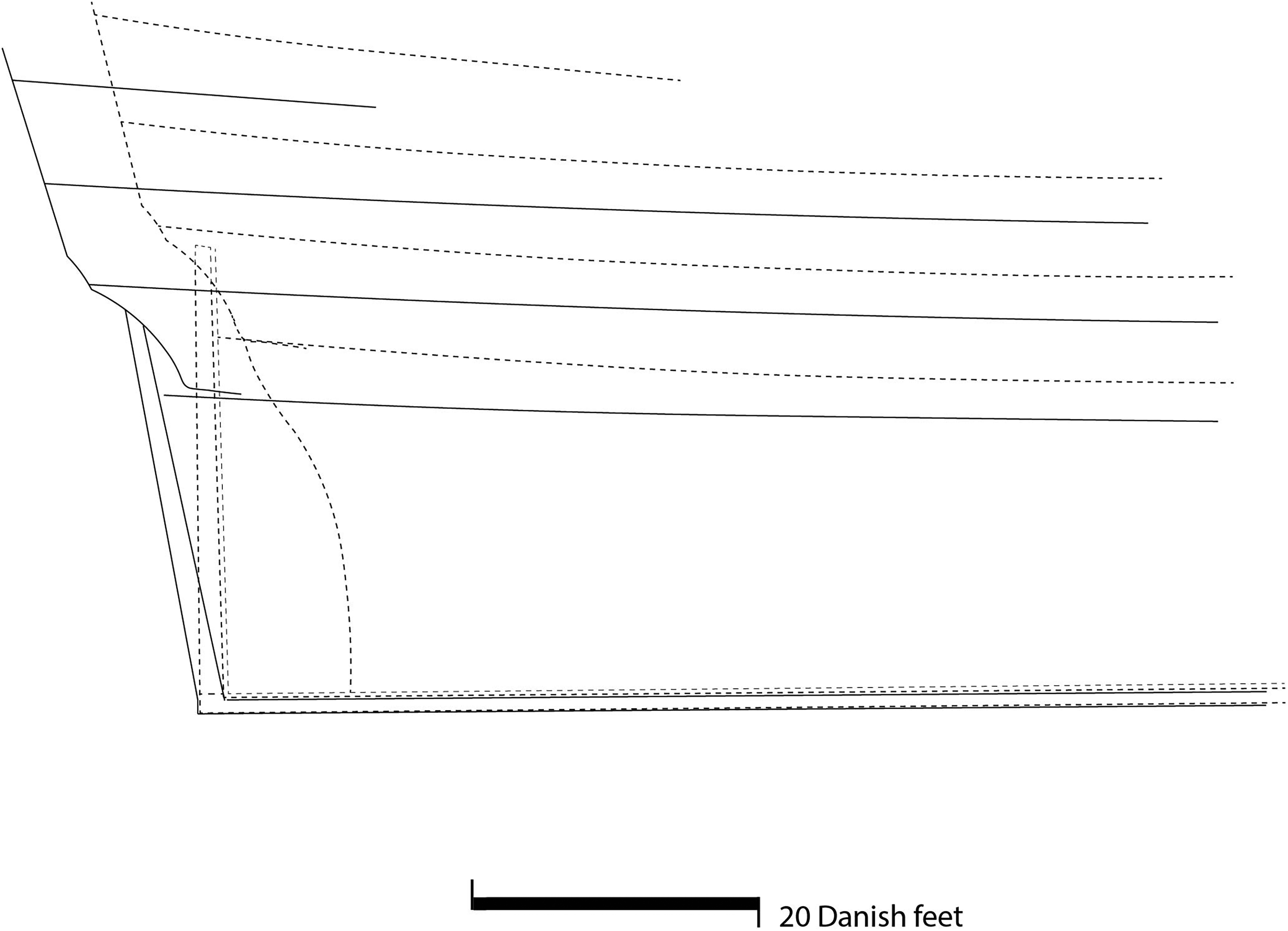
The keel, sternpost and decks of Nordstiernen (1702/1746, solid line) and Jylland (1759, dashed line). The latter is an example of a perpendicular sternpost and emphasizes Nordstiernen's sternpost raking.
Designed in 1702 and launched the following year, Nordstiernen was a Swedish ship that was taken by the Danes during a battle in Fehmarn in 1715. She was an impressive combination of shipbuilding knowledge. Her constructor, Charles Sheldon, was born in Sweden into an English dynasty of shipbuilders. He had studied shipbuilding in England in 1685–1688, but his designs were also highly influenced by the Dutch shipbuilding tradition, which was advocated by the head of Swedish naval shipbuilding, Admiral Wachtmeister. 38 There was also a contentious issue in Sweden shipbuilding. 39 Nordstiernen was extensively rebuilt in 1746–1747, but nothing suggests that Nordstiernen’s stern was changed during the rebuilding project. The galleries were left much like they had been and, although they were temporarily removed during the repair, this was only to straighten the frames and renew the planking and ceiling. 40 The decision to copy aspects of a 50-year-old design seems in itself surprising, as much as the fact that Nordstiernen was continually repaired and rebuilt, and served in the Danish navy until she was finally broken up in 1785. 41
The success of a warship
Denmark was in a rather unique position in the eighteenth century: for eight decades, the Danish navy did not engage in any battles. It is difficult to assess a warship that has seen no battles. As Rodger notes, a ship should be assessed on how efficiently the designs meet requirements. 42 But what are the requirements for warships in times of peace?
This article has presented an example of Konstruktionskommissionen's work in the middle of the century and analysed the various aspects of ship design that appear to have been important at the time. Yet another crucial part of the committee's work was quality control: overseeing the work at the dockyard while the ships were being built and testing them once they had been launched. The former proved easy enough, as the naval dockyard was only a short walk from Konstruktionskommissionen's office; the latter proved more complicated.
When Konstruktionskommissionen was established in 1739, it produced a list of six criteria according to which a warship could be assessed on a test sail immediately following its launch. 43 While the list was compiled by members of Konstruktionskommissionen – that is, a combination of experts in warship design, warship construction and navigating Danish waters, as well as large oceans – the ships were tested by their commanding officers. How their observations were translated into design and construction by Konstruktionskommissionen is an unanswered and crucial question for further research. Nevertheless, this was how Konstruktionskommissionen maintained a close relationship, based on mutual respect, with the serving naval officers, whose experiences with and opinions of the warships were taken into consideration – at least in theory.
Conclusion
The launch of Grønland in 1756 was the culmination of a decade of refining a design. Fyen’s English underwater lines proved to be good for the sailing qualities of the vessel. Benstrup's French upper works were, by Konstruktionskommissionen's admission, more pleasing to the eye and of no inconvenience with regard to the sailing qualities of the ship. What exactly the Swedish rake of the sternpost brought to the Danish design table is unknown. The fact that aspects of Nordstiernen’s 50-year-old design were utilised in new constructions, only to be challenged later for no explicit reason in the protocols, is still a mystery.
The process of these designs is a prime example of Danish shipbuilding practice in the 1750s, naval administration and knowledge transfer. The establishment of Konstruktionskommissionen in 1739 allowed for a combined shipbuilding effort by its members, with their different backgrounds (naval officers, constructors and master shipbuilders). The design process allowed for shipbuilding to be continuously optimised through shipbuilding knowledge collected in foreign dockyards, and applied broadly but also kept for future use. As such, Danish shipbuilding was based on knowledge obtained at various points across time and space. In Britain, most of the foreign shipbuilding knowledge came from war prizes and, in the latter half of the eighteenth century, these had a significant influence on the British navy's ship designs, albeit to a lesser extent than in Denmark, and there is no evidence of hybrid designs like Grønland. In France, knowledge transfer from foreign dockyards was common, but the decentralised shipbuilding and autonomy of the constructors meant that a French ship reflected only the knowledge obtained by the individual who designed it.
Gerner's trip to England, Benstrup's to France and, critically, the efforts of Konstruktionskommissionen resulted in three 60-gun ships, one 50-gun ship and a frigate of 40 guns, all with underwater hulls based on Fyen (that is, Augusta), some with the upper works of Delmenhorst (that is, a French design) and none with the stern raking of Nordstiernen (the old Swedish prize).
In the mid 1750s, there was a new head of shipbuilding and, from here, Danish naval shipbuilding took a different direction. Friderich Michael Krabbe had spent several years travelling around Europe, collecting intelligence and learning about shipbuilding in England, France, Italy and the Netherlands. Returning to Denmark, he was keen to implement his ideas, and Konstruktionskommissionen was all ears. Fyen's successful underwater hull lines and Benstrup's upper works, which had been combined and fine-tuned throughout the 1740s and 1750s, were now forfeited, and Grønland was the last ship to be built according to this hybrid design – but only to give way to new experiments, which were still catered for by the committee of shipbuilding experts, a highly organised body for collecting and applying knowledge from abroad. Compared to other countries where shipbuilding was either static, 44 problematic, 45 or mainly developed in individual experiments divorced from naval shipbuilding as a collective, 46 Konstruktionskommissionen, as the centre of Danish naval shipbuilding, continuously collected, discussed, utilised, tested and altered shipbuilding technology through the Long Peace in a way that was beneficial not only to each ship, but also to future designs and developments.
Grønland served for 45 years. She saw service in home waters and in the colonies. She took scientists to explore the flora and fauna of the Arabian Peninsula. 47 She saw the British take one of the merchant ships she was convoying in the Mediterranean during the Seven Years’ War. 48 In many ways, Grønland was tangible evidence of the situation in the Danish navy in the mid-eighteenth century. Her design was the product of shipbuilding studies in foreign countries and a highly modern administration at home, but just as much a lack of science that allowed for tradition, ideology, and cultural biases to affect decision-making. Her service was affected by the political instability in Europe, the Long Peace in Denmark and the blossoming Danish trade that arose from these circumstances, as well as by an inquisitive attitude towards the world. Grønland provides evidence that Danish shipbuilding in the mid-eighteenth century was nothing if not international, and reflects the work of Konstruktionskommissionen in acquiring and applying the designs of several nations – an English underwater hull, French upper works and a Swedish-inspired sternpost – while flying the Danish colours.
Footnotes
Acknowledgements
Warm thanks go to my PhD supervisor, Cathryn Pearce; to James Davey, Roger Knight and Chris Standish for feedback on the manuscript; and to Niklas Eriksson, Larrie Ferreiro, Fred Hocker and Jakob Seerup for valuable discussions.
Funding
This work was supported by the University of Portsmouth.
