




Abstract
In the 1990s Charles Foster claimed that a commercial Cheshire cheese trade began in 1650, the year when the first coastwise cargo from Chester was recorded in the London port books. One purpose of this research note is to embellish Foster's claim by suggesting that an even greater influence on this trade was the adoption from the early 1840s by England's state-appointed victuallers of Cheshire cheese as one of their standard commodities. They then supplied it in bulk to the navy and also to army garrisons in theatres of war such as Ireland and Scotland. The victualler who played the principal role in this provisioning from the 1640s to the 1670s was Denis Gauden. His career is followed, and his final downfall, which was caused by inadequate and chaotic government financial systems.
The projection of British military power has always depended on a sufficient and well-organized supply of food to the armed forces. Cheese might not appear to be an obvious weapon of war, but most of the cheeses native to England were ideal for transportation and storage. They were salted, hard-pressed and long-lasting, and could be stowed in the hold of a ship for delivery overseas, or for use by the ship's company. The realization of this advantage came as early as Henry III's reign, when the commissariat ordered 20 weys of hard cheese for his maritime expedition to Gascony in 1253. 1
England's State Papers in subsequent centuries frequently mention the supply of cheese to garrisons – for instance, Berwick, the Channel Islands, Calais and the Irish ports, all of which depended on seaborne provisions, especially for stocking up against the possibility of a siege or for the need to support landward campaigns. Replenishing a strategic coastal garrison required frequent sailings, even at a time of peace, because the merchant vessels available for hire in the medieval period were small.
Calais had further significance because Edward III captured it from the French in 1347 and, 16 years later, in 1363, a staple was established there. It was the legal requirement that certain goods, when exported, had to be shipped there as the first port of call. Cheese was on and off the staple for the next 200 years, until Calais returned to French control in 1558. In a petition to Richard II in 1379, Parliament complained that cheese exports had ‘long since’ been withdrawn from Calais and sent elsewhere, including to Flanders. 2 To correct matters, observance of the original charter was restored, but this again slipped from time to time, perhaps because traders had the nature of the product in mind, but also no doubt because they wanted to avoid the Crown's levy, charged at one-quarter pence per wey. One reason cited by the export cheesemongers in 1380 was that they were ‘greatly impoverished’ because they ‘customarily exported to the Easterlings and the Flemish, yet now they are deprived of it because they are not allowed to sell their merchandise anywhere other than Calais’. 3
Another problem with the staple was that merchants were able to buy licences from the Crown to circumvent its monopoly. The Calendar of Patent Rolls contains many examples of licences to export cheese, especially to Flanders and Zeeland in the fourteenth century. The average cargo was about 200 weys and the largest 1,000 weys (about 100 tons). 4 There is an inkling of this in 1397 when there were complaints that foreign merchants were now having goods delivered directly to them by the licensees rather than troubling themselves to visit Calais. 5 The entrepôt function of the staple was therefore being undermined. This licensing system continued, however, because it meant revenue for the Crown without the complexities and leakiness of the normal tax-gathering system.
What cheese was being used in maritime transport? It seems that the products of East Anglia were the first choice in the medieval period. 6 We know, for instance, of a contract to supply Essex and Suffolk cheese to the people of Calais after the Treaty of Leulinghem (1389) ended the war with France. 7 This date corresponds with the findings of Mark Bailey, who noted the growing importance after circa 1350 of dairying in Suffolk, where ‘conditions generally favourable to pastoralism led to the further growth of commercialized dairy farming and stock fattening in most central, southern and eastern parts’, and by 1500 there was a ‘marked increase in the degree of specialization of agrarian production’. 8
The proximity to London and the number of accessible ports were factors in East Anglia's favour, but so also was the availability of two types of cheese. Essex ewe's-milk cheese had been made in abundance since at least the eleventh century. There is extensive evidence of this in the many place names in Essex that end with ‘wic’, an Anglo-Saxon suffix usually associated with a dairy in a remote location. These places correlate with the Domesday Book's recording of large flocks of sheep in and close to the coastal marshes.
Essex cheese, however, was less popular than the cow's-milk product from Suffolk. The latter was preferred for naval supply right through to the middle of the eighteenth century, and it was also shipped in large quantities coastwise to London. 9 It came from the ‘wood pasture’ area of High Suffolk, 10 to 30 miles from the North Sea coast. 10 The likelihood is that Suffolk cheese was made from whole milk until the seventeenth century. Then farmers began to realize that a greater profit was possible by making butter from the cream and cheese from the skimmed milk. 11 Both were marketable in London and the navy took its share. As a result, Suffolk dairying prospered in the face of competition from more distant counties with lower production costs: the Fenlands for butter, for instance, and Cheshire for cheese.
From the sixteenth century onwards, we have more evidence of state procurement of cheese for victualling the army and the navy. Apart from Calais, other garrisons required seaborne supplies, such as Berwick (where cheese was first mentioned in the State Papers in April 1524) and Ireland (with a first account in April 1597). 12 From the 1540s, there are regular mentions of cheese being sourced in Suffolk for the armed services. 13 In January 1586, for instance, Suffolk was the only county thought to have sufficient cheese (600 weys) immediately available for the Earl of Leicester's expedition to the Netherlands, 14 and in October 1595 the Suffolk Justices of the Peace were instructed to give the navy victualler first choice of cheese, with all other sales to be held back. 15 Soon after, in April 1597, the navy seems to have had its own cheesemonger, Thomas Sawell, along with 11 others named in London, who arranged for these supplies to be shipped. 16
In times of peace, it was the London cheesemongers who bought up the best Suffolk cheese, making several trips there by sea in a season. 17 But right at the end of the sixteenth century, the pseudo-monopoly of Suffolk in the naval market was punctured. In 1597, Cheshire cheese was supplied to garrisons in Ireland, and the following year Dutch cheese was also considered a viable alternative. Suffolk cheese was not only disliked by sailors and soldiers; at 62 shillings a wey, it was also more expensive than its Dutch rival at 55 shillings. Writing to Lord Burghley, Robert Arden commented that, in his view, ‘in goodness three pounds of the Holland is better than 4 pounds of Suffolk’. 18
The price rates for naval purchases are recorded from 1559, when cheese was 1.5 pence per pound purchased from intermediary cheesemongers. This rate rose to twopence in August 1576 and this remained the contract price from 1602 to 1634. According to William Beveridge, the period from 1635 to 1649 saw fluctuations in the base price, coming to rest at four pence per pound in the latter year. The years 1649 to 1652 were chaotic, with various state institutions panic buying in order to supply the Commonwealth's fleet, field armies and garrisoned strongholds. It was not until 1663 that we know of long-term contracts being negotiated for supplies to the victualling ports of London, Dover, Portsmouth and, later, Plymouth. 19 The navy victuallers’ preference continued to be for Suffolk cheese up until the 1750s, when they finally switched to Cheshire, which was more expensive but of more reliable quality.
By the time Daniel Defoe visited Suffolk in 1724, its cheese had become notorious. The skimmed-milk, or ‘flet-milk’, cheese had the reputation of being dry and so hard that it was difficult to cut, let alone eat and digest.
20
In fact, it became a matter of shared national hilarity: [The] very name alone engenders smiles; Whose fame abroad by every tongue is spoke, The well-known butt of many a flinty joke.
21
For Defoe, Suffolk produced ‘the best butter, and perhaps the worst cheese, in England’. 22 Trade was increasingly concentrated in a few of the larger ports, especially Woodbridge, but by 1729–1730 Suffolk had slipped to only the fourth-largest source of cheese for the London market. The top-three sources were, first, Cheshire; second, the barge traffic along the Thames from Wiltshire; and, third, the Humber ports, drawing their supplies down the Trent from Derbyshire and adjoining counties. 23
By comparison with Essex and Suffolk, Cheshire cheese was a relative newcomer. It was as late as 1607 that William Camden commented: the grasse and fodder there is of that goodnesse and vertue that cheeses be made heere in great number of a most pleasing and delicat tast, such as all England againe affourdeth not the like, no, though the best dayriwomen otherwise and skilfullest in cheese making be had from hence.
24
Gradually, Cheshire acquired a reputation for good quality, which was said to be due to the pastures found there and the skill of the dairymaids. William Webb was convinced of both: that special gift which God hath bestowed on the soyl in and neer to that place, for the excellency of the Cheese there made; which, notwithstanding all disputations, and all the tryalls that our ladies make in their Dairies in other parts of the County and Kingdome, yet can they never fully match the perfect relish of the right Namptwich Cheese, nor can that Cheese be equalled for pleasantnesse of taste, and wholesomenesse of digestion, even in the daintiest stomachs of them that love it.
25
The presence of local brine springs was also a crucial factor in Cheshire's cheese history. They provided the cheap salt that is an essential part of the cheesemaking process and would have encouraged local experiments from an early date. But Cheshire cheese did not become a popular variety in national commerce until the middle of the seventeenth century.
Charles Foster found that, for the Cheshire estate of Arley Hall near Northwich, cheese was not a prominent output before 1650. 26 Indeed, probate inventories show only enough to cover household needs. Nevertheless, cheese was commonly made in the early seventeenth century across the region, providing a skilled craft foundation upon which both the naval supply and London commercial trades could be built. David Hey found that two-thirds of north Shropshire inventories mention cheese and the proportion is even higher – at over 80 per cent – in Cheshire. 27
Foster identified a ship that arrived in London with 20 tons of Cheshire cheese in October 1650 as being the pioneer commercial sailing, but there are so many gaps in the series of port books surviving for Chester and Liverpool that it is possible that there may have been shipments before then. A stable series of port books begins in 1674, when between them the two cities shipped 878 tons of Cheshire cheese to the capital. In the later 1670s and 1680s, this increased to an annual amount of over 1,000 tons, but it was not until 1717 that a total of 2,605 tons eclipsed Denis Gauden's shipments of 1651–1652. William Maitland's celebrated estimates for 1729 have Cheshire as the principal supplier of cheese to London, mainly by sea. In that year, the county shipped 5,766 tons of cheese to the capital, and in some years it also supplied 1,800 tons to the navy. 28 The archival trace of probate inventories indicates that much of the rapid increase in cheese productivity came on small tenanted farms of about 10 to 50 acres, where production gradually evolved into specialization. 29
We can estimate the average output of cheese per Cheshire cow in the middle of the seventeenth century to have been about 1.5 hundredweights per annum, rising to 2 hundredweights by the 1720s. If we take the export by sea from the county in the early 1650s to be 1,000 tons for the navy and perhaps 100 tons going to the London cheesemongers, then we can say that approximately 15,000 cows would have been required to fulfil those orders. In addition, farmers were producing for local markets and for their own consumption, so a total of 20,000 cows devoted to producing milk for cheesemaking seems reasonable. 30 By the 1720s, the seaborne trade to the south of England of 7,500 tons needed 75,000 cows, but this extraordinary number was probably nearer 100,000 if demand from the burgeoning regional industrial and urban markets is included. ‘Cheshire’ cheese was also made in several surrounding counties, and the economic growth it engendered was therefore shared in North Wales, south Lancashire, Staffordshire and north Shropshire.
Cheshire cheese, unlike the Suffolk cheese of the seventeenth and eighteenth centuries, was made with whole milk. There was not much of a local butter trade in the county in the 1660s when the first surviving recipe for making the cheese was reported to the Royal Society by William Jackson, so the eating quality would have been noticeably better than cheese made with skimmed milk. 31 As far as we can tell, Cheshire cheese at this time had a flaky consistency and a mild but full flavour. It also had several characteristics that made its manufacture far from straightforward. First, it required a great deal of labour to separate the curds from the whey. Jackson describes the need for three to six ‘thrutchers’, whose job it was to kneed the curd and press out the whey for the making of one cheese. For small farmers, deploying this amount of labour on a daily basis would have been a problem.
Second, the cheesemongers and naval agents required large cheeses in order to minimize shrinkage en route to the warehouse and facilitate cutting into standardized portions on board ship or at the final destination. A cheese of 60 pounds (27.2 kilogrammes), which was common in the late eighteenth and nineteenth centuries, would have used the milk of 30 cows. 32 But the average herd size was only six in Cheshire in 1664, and this neatly matches the average weight of cheeses shipped to London in the same year: 12.2 pounds. Had they been any larger, the farmers would have had to hold milk back over several days until sufficient had accumulated. The obvious drawback of such a system was ‘off’ flavours in the final cheese due to souring, especially in hot summer weather. There is evidence of collective efforts in the seventeenth century, when some farmers were said to deliver their own milk to a mutually convenient location with a view to making one large cheese per day. 33
Third, large Cheshire cheeses required pressing, again to expel whey. Jackson indicated the use of three hundredweights, which at this date may well have been a large stone fixed to a screw device to enable its raising and lowering. We know that such presses existed and were valued because they appear in probate inventories. It seems likely that Cheshire was one of the counties where this engineering solution was first adopted, although more research is required to establish how and when the innovation spread. What is clear is that, without sufficient pressing and salting, Cheshire cheese would not have been a success in either naval provisioning or commercial trade to London, and this may explain why it was forced to develop on a large scale later than its Suffolk equivalent.
Janet Macdonald is dismissive of the idea that naval provisioning made an impact on regional agrarian development. 34 But the evidence from Cheshire in the seventeenth century suggests otherwise. It can reasonably be argued that, in the 1650s, the sheer scale of cheese procurement sustained the existing dairy economy in Suffolk and was instrumental in encouraging the nascent trend to cheesemaking in Cheshire. Several individuals facilitated this.
In November 1644, William Harris and partners were paid £833, 16 shillings and 11 pence to take Cheshire cheese to Ireland – the first shipment of the Civil Wars to have had a named source. 35 Previous shipments had just been called ‘cheese’. In 1646–1650, there were cheese shipments from Chester and Liverpool to Dublin and Derry, which were presumably of Cheshire cheese. These were shipped by various parties, including John Davies and Charles Walley. 36
Among the crowd of other merchants jostling for the opportunity to profit from cheese shipments, the name of Denis Gauden (also known as Dennis Gawden) stands out. The first mention I can find of him in relation to cheese is on 30 September 1640 in the Calendar of State Papers. 37 Here we learn that he had bought up the butter and cheese surplus to requirements after the First Bishops’ War, and the Privy Council now, a year later, instructed Lord Treasurer Juxon to facilitate its transport. The supplies were no longer fit for army use and were presumably to be disposed of on the retail market.
Gauden then played a minor role in supplying Royalist troops in the First Civil War (August 1642–June 1646). Because of its portability, cheese was important in the commissariat of both sides. In 1646, he and two colleagues proposed shipping cheese at their own risk to the English garrisons in Ireland. They wanted £3,000 at three and three-quarter pence per pound (approximately equal to 85 tons). 38 They did not specify a source of the cheese but their rival, John Davies, suggested sending £1,500 worth of Lancashire and Cheshire cheese at the slightly higher rate of four pence per pound. These offers were discussed first in the House of Lords in 1646 and then in the Commons the following year. 39
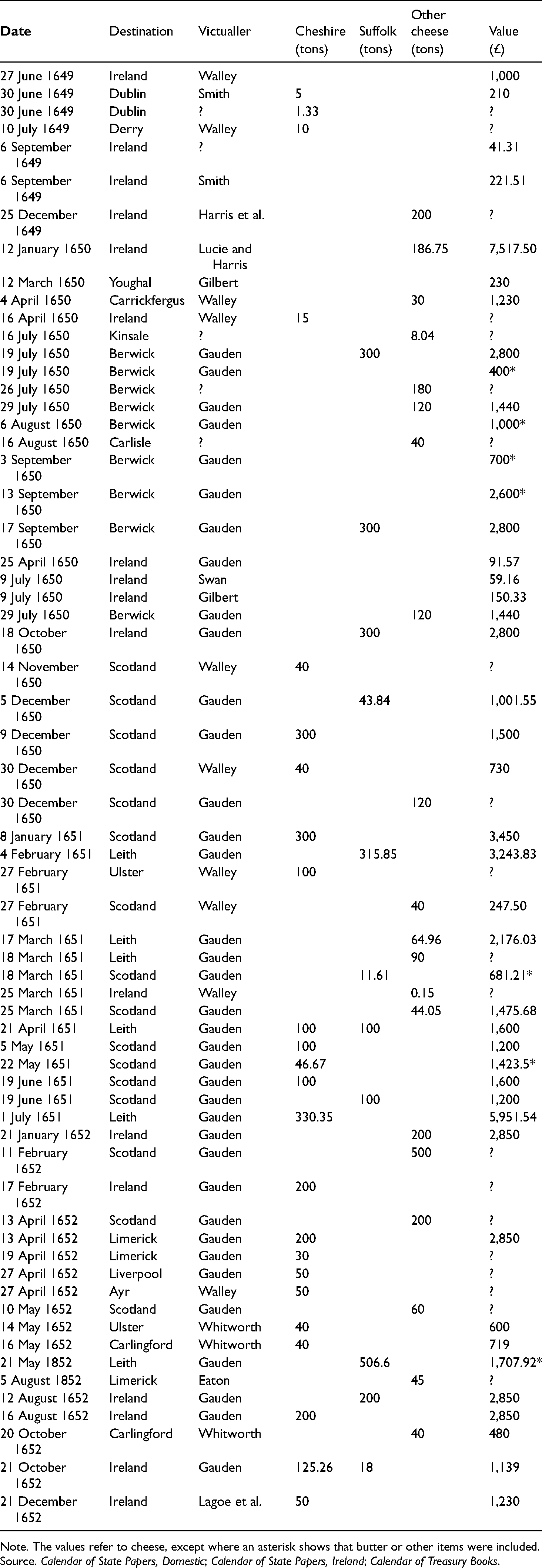
Gauden's main chance came later, however, with much activity recorded in the State Papers between April 1650 and October 1652. In 1650, he became the dominant supplier of cheese among the five recognized naval victuallers. He was appointed to weigh and receive into the stores the cheese of other merchants and ‘also to take warehouses, and employ persons to dress and look to the same until shipped for Ireland, and also to hire vessels to transport the cheese, and to set carpenters on work to fit the vessels’. 40 He became the main supplier of cheese to the armies in Scotland and Ireland, some of which was ‘upon his own adventure’. 41 He shipped 7,000 tons and more to Leith, Berwick, Dublin, Limerick and other ports, to a total value of over £70,000. 42 The two main sources, at over 2,000 tons each, were Suffolk and Cheshire (Appendix 1). Each of the ships used for victualling in the 1650s averaged a burden of 145 tons, so this must have meant a complex sailing plan in order to optimize delivery. 43 Foster suggests that the ketches conducting the coastwise trade from Chester to London carried only 20–30 tons each, so that particular branch of trade must have involved even more sailings back and forth. 44 The gross yield for Gauden from cheese in this period was £56,828 but we cannot be sure how much profit he made. He bore much of the risk, which was considerable, given the possibility of shipwreck, piracy and delays due to adverse weather. 45
In a different context, Joan Thirsk commented on the ‘resilience’ of the Cheshire cheese industry and its ability to react to these contracts at short notice. The figure she quoted of 200 tons was only a fraction of the full amount listed in Appendix 1, but her argument was correct: [Supplying] the army enhanced the specialization of regions. The appearance of merchants negotiating bulk contracts always sent up local prices sharply, a fact which producers noted for future reference. And when relying on food bought locally, the military had to adapt their demands to what the neighbourhood could supply. Again this could have the effect of intensifying specialization.
46
One risk for Gauden was the possibility that he might not be able to procure the cheese in the vast quantities required. In this he had help from Captain Whitworth, newly appointed in 1650 as commissary at Chester and Liverpool. 47 Gauden also worked with Timothy Liveing and Francis Chaplin, the government's agents in Cheshire and Lancashire for shipping cheese and meal to the army in Ireland. 48
Gauden continued with his duties throughout the 1650s and, after the Restoration, was appointed the ‘surveyor general of all the victuals to be provided for His Majesty's ships and maritime causes’.
49
But cracks in the system had already become apparent in the transition from the Commonwealth to the new government. Just two days after Charles II was proclaimed king by Parliament, Gauden was complaining about not being paid: my disappointments in the timely receipts of what have been already paid, has not only been the occasion of a very great loss and damage to me, but also rendered me incapable of giving supplies to the ships when they called for victuals, which has been an injury to the provisions in store, and prejudicial to the service, as the ships were not timely dispatched, and occasioned an extra charge in victualling them elsewhere.
50
The new government was short of cash from the outset but, somehow, it had to keep supplies flowing. An example of the lateral thinking required was the 1662 sale of Calais to the French for four million livres. Of this, £10,000 was allocated to Gauden for victualling the navy. 51 But the commencement of the Second Dutch War in March 1665 proved to be an overwhelming logistical problem. 52 To save the day, over Gauden's head, Samuel Pepys was made surveyor general of victualling in October 1665 and, although there was some improvement under his guidance, there were nevertheless many complaints that the fleet was underprovisioned and that the quality of the rations was poor. 53 These failures of naval victualling were mocked by Edmund Waller in his 1665 poem ‘Instructions to a Painter’, where he asserted that ‘To check their pride, our fleet half-victal’d goes’. 54
Despite these problems, Gauden's apogee came in 1667, the year he was Sheriff of the City of London and was knighted by the King. At least some of this success had been achieved by networking, his most important relationship being with Pepys. In his diary, Pepys detailed what in modern terms looks like a corrupt relationship with Gauden. 55 In 1665, for instance, Pepys received the ample salary of £300 from the state but this was dwarfed by a payment of £500 from Gauden. 56
In 1668 and 1673, new naval victualling contracts were issued, with Gauden again responsible and now at sixpence per diem per man in harbour and eight pence per diem at sea. This equated (at sea) to one pound of biscuit, one gallon of beer, two pounds of beef or pork and one pint of peas daily for four days, and one-eighth of a stockfish, two ounces of butter and four ounces of cheese daily on the other three days. 57 The problem for Gauden was that he had to victual an expanding fleet without sufficient funds from the government to supply the full rations. 58 In 1671, he was in trouble with the navy commissioners for his continuing complaints about poor cash flow from the Treasury, blaming his inability to have his accounts passed on a lack of pursers’ indents. 59 The government was not sympathetic. The breaking point was the Third Dutch War (1672–1674), which increased state outlays at a time when it was still dealing with the aftermath of the Plague and the Great Fire of London (both in 1666), and its debts from the first war. Such was the financial crisis that a stop was put on the Treasury in January 1672 – a temporary measure that was eventually made permanent. 60 Gauden struggled on through a number of Chancery lawsuits before his final financial ruin in 1677. 61
The fall of Denis Gauden did not mean the end of cheese supplies to the navy, or even the end of the Gauden name in victualling. Two of his sons carried on the family business: Jonathan and Benjamin were both prominent in the maritime supply of Cheshire cheese to Tangier towards the end of its occupation by the English (1661–1684). 62
It was Gauden who pioneered the idea that Cheshire could be a reliable and substantial source of cheese for shipment over long distances. The commercially minded London cheesemongers needed no further proof, not least because, at £1 per ton, the coastwise shipment of cheese was so much cheaper than the £5–£10 per ton charged for the overland routes by cart to the Trent, by barge downriver, and then by sea from Gainsborough or Hull. 63 These cheesemongers were few in number. In the surviving port books of 1685–1689, nine are mentioned, with John Ewer alone controlling 41 per cent of the trade. He must have had agents in Cheshire but no documentary evidence of his activities has yet come to light.
In conclusion, the decline of Suffolk's specialized dairy economy and the shift to one that was largely arable, all within the space of 100–150 years, was an extraordinary phenomenon of English agricultural history. By 1850, most of the pasture land of High Suffolk was gone, long since ploughed up for crops. 64 Cheshire stepped in to fill the gap in cheese supply, both to feed consumers in London and to provision the armed forces. 65 Denis Gauden provided the logistical pivot that enabled a scale change in Cheshire's output, but I am not suggesting here that he somehow established an entirely new trade. This seems unlikely. Peter Edwards has shown that the whole of north Shropshire experienced a growth in dairy farming between 1600 and 1650, with the valuation of cheese in probate inventories increasing fourfold in that period. 66 He argues that, by the 1630s, it is possible to say that this specialization was replacing the stock rearing and fattening that had preceded it. Edwards implies that north Shropshire's move towards cheese production was a mirror of, and connected to, what was happening over the border in Cheshire. If this is correct, then Foster's identification of 1650 as the threshold of the new dairy economy is late by at least two decades, possibly more. And, in turn, Gauden therefore spotted an already existing opportunity to source vast quantities of cheese and thereby make his own fortune.
Footnotes
Declaration of conflicting interests.
The author declared no potential conflicts of interest with respect to the research, authorship and/or publication of this article.
Funding.
The author received no financial support for the research, authorship and/or publication of this article.
Notes
Author biography
Cheese shipments by Parliament,1649–1652.
|
|
Destination | Victualler | Cheshire | Suffolk | Other cheese | Value |
|---|---|---|---|---|---|---|
| (tons) | (tons) | (tons) | (£) | |||
| 27 June 1649 | Ireland | Walley | 1,000 | |||
| 30 June 1649 | Dublin | Smith | 5 | 210 | ||
| 30 June 1649 | Dublin | ? | 1.33 | ? | ||
| 10 July 1649 | Derry | Walley | 10 | ? | ||
| 6 September 1649 | Ireland | ? | 41.31 | |||
| 6 September 1649 | Ireland | Smith | 221.51 | |||
| 25 December 1649 | Ireland | Harris et al. | 200 | ? | ||
| 12 January 1650 | Ireland | Lucie and Harris | 186.75 | 7,517.50 | ||
| 12 March 1650 | Youghal | Gilbert | 230 | |||
| 4 April 1650 | Carrickfergus | Walley | 30 | 1,230 | ||
| 16 April 1650 | Ireland | Walley | 15 | ? | ||
| 16 July 1650 | Kinsale | ? | 8.04 | ? | ||
| 19 July 1650 | Berwick | Gauden | 300 | 2,800 | ||
| 19 July 1650 | Berwick | Gauden | 400* | |||
| 26 July 1650 | Berwick | ? | 180 | ? | ||
| 29 July 1650 | Berwick | Gauden | 120 | 1,440 | ||
| 6 August 1650 | Berwick | Gauden | 1,000* | |||
| 16 August 1650 | Carlisle | ? | 40 | ? | ||
| 3 September 1650 | Berwick | Gauden | 700* | |||
| 13 September 1650 | Berwick | Gauden | 2,600* | |||
| 17 September 1650 | Berwick | Gauden | 300 | 2,800 | ||
| 25 April 1650 | Ireland | Gauden | 91.57 | |||
| 9 July 1650 | Ireland | Swan | 59.16 | |||
| 9 July 1650 | Ireland | Gilbert | 150.33 | |||
| 29 July 1650 | Berwick | Gauden | 120 | 1,440 | ||
| 18 October 1650 | Ireland | Gauden | 300 | 2,800 | ||
| 14 November 1650 | Scotland | Walley | 40 | ? | ||
| 5 December 1650 | Scotland | Gauden | 43.84 | 1,001.55 | ||
| 9 December 1650 | Scotland | Gauden | 300 | 1,500 | ||
| 30 December 1650 | Scotland | Walley | 40 | 730 | ||
| 30 December 1650 | Scotland | Gauden | 120 | ? | ||
| 8 January 1651 | Scotland | Gauden | 300 | 3,450 | ||
| 4 February 1651 | Leith | Gauden | 315.85 | 3,243.83 | ||
| 27 February 1651 | Ulster | Walley | 100 | ? | ||
| 27 February 1651 | Scotland | Walley | 40 | 247.50 | ||
| 17 March 1651 | Leith | Gauden | 64.96 | 2,176.03 | ||
| 18 March 1651 | Leith | Gauden | 90 | ? | ||
| 18 March 1651 | Scotland | Gauden | 11.61 | 681.21* | ||
| 25 March 1651 | Ireland | Walley | 0.15 | ? | ||
| 25 March 1651 | Scotland | Gauden | 44.05 | 1,475.68 | ||
| 21 April 1651 | Leith | Gauden | 100 | 100 | 1,600 | |
| 5 May 1651 | Scotland | Gauden | 100 | 1,200 | ||
| 22 May 1651 | Scotland | Gauden | 46.67 | 1,423.5* | ||
| 19 June 1651 | Scotland | Gauden | 100 | 1,600 | ||
| 19 June 1651 | Scotland | Gauden | 100 | 1,200 | ||
| 1 July 1651 | Leith | Gauden | 330.35 | 5,951.54 | ||
| 21 January 1652 | Ireland | Gauden | 200 | 2,850 | ||
| 11 February 1652 | Scotland | Gauden | 500 | ? | ||
| 17 February 1652 | Ireland | Gauden | 200 | ? | ||
| 13 April 1652 | Scotland | Gauden | 200 | ? | ||
| 13 April 1652 | Limerick | Gauden | 200 | 2,850 | ||
| 19 April 1652 | Limerick | Gauden | 30 | ? | ||
| 27 April 1652 | Liverpool | Gauden | 50 | ? | ||
| 27 April 1652 | Ayr | Walley | 50 | ? | ||
| 10 May 1652 | Scotland | Gauden | 60 | ? | ||
| 14 May 1652 | Ulster | Whitworth | 40 | 600 | ||
| 16 May 1652 | Carlingford | Whitworth | 40 | 719 | ||
| 21 May 1852 | Leith | Gauden | 506.6 | 1,707.92* | ||
| 5 August 1852 | Limerick | Eaton | 45 | ? | ||
| 12 August 1652 | Ireland | Gauden | 200 | 2,850 | ||
| 16 August 1652 | Ireland | Gauden | 200 | 2,850 | ||
| 20 October 1652 | Carlingford | Whitworth | 40 | 480 | ||
| 21 October 1652 | Ireland | Gauden | 125.26 | 18 | 1,139 | |
| 21 December 1652 | Ireland | Lagoe et al. | 50 | 1,230 |
Note. The values refer to cheese, except where an asterisk shows that butter or other items were included.
Source. Calendar of State Papers, Domestic; Calendar of State Papers, Ireland; Calendar of Treasury Books.