




Abstract
The Nordic, particularly Swedish and Finnish, pulp and paper (P&P) companies are represented in earlier research as using specialized maritime transport systems – based on roll-on/roll-off (ro-ro) vessels – in long-term collaborations with shipping companies after the Second World War. However, the strategic choices of the P&P companies that led to this development have not been researched. Based on studies of the Swedish P&P companies that developed specialized maritime transport systems during the period 1960–2015, this article sheds light on the reasons for these maritime transport systems. As well as the growth of exports, the expansion of P&P companies through mergers and acquisitions and the increased value of the exported goods, the study shows that the Swedish ro-ro trend, diversified and sensitive products, pressure from customers for frequent and speedy deliveries, and a fairly short distance to stable main markets, were additional factors.
Like a range of shipping segments, the maritime transport of forest products has increasingly entailed specialization, innovation and rationalization since the Second World War. 1 The international trade in forest products amounted to 400 million tons in 2012, of which two-thirds was transported by ship. Some 112 million tons of the world's production of 394 million tons of the most value added products – paper and cardboard – were exported. Forest products are bulky, and for the exporting pulp and paper (P&P) companies, transport costs can be substantial. For example, the transport cost for SCA, a Swedish P&P company serving the UK and Europe, was estimated to be around 25% of its total costs in the 1960s, 2 and for Swedish–Finnish StoraEnso up to 10–15% of the price of the paper in 2015. 3 This is significantly larger than the average maritime transport cost, which accounted for 6% ad valorem in 2007, although the cost varies greatly across product segments and import markets. 4 Reducing transport costs while providing good service and high quality is a key issue that P&P companies have endeavoured to solve.
Despite this importance, research into the maritime transport of pulp and paper is scarce. Ojala and Tenold's study of the maritime transport of forest products is the first comprehensive global overview of the sector.
5
In line with the specialization that has marked other shipping segments, the authors describe the emergence of specialized ship types after the Second World War. The main two ship types that developed for P&P trades in the global market were open-hatch bulk carriers (lo-lo),
6
and roll-on–roll-off vessels (ro-ro).
7
Ojala and Tenold explain that ro-ro vessels were particularly suitable for the exports of Nordic P&P companies, and that in Finland and Sweden shipowners, like producers, favoured ro-ro. They also state that ro-ro has been more closely associated with long-term time charters with pulp and paper producers, who bought the ship's entire capacity. Ojala and Tenold conclude that: Both the dominant technological solution and the type of contracts introduced varied between the main ‘market clusters’. Although the basis for these different strategic choices needs more research, one thing is evident. The global markets for pulp and paper, and the global market for pulp and paper transport, pushed each other forward in a virtuous circle.
This article focuses on the Nordic cluster, more particularly Sweden, which has been described as focusing on ro-ro, and where long-term contracts between P&P companies and shipping companies reigned. The geographical focus complements earlier research on open-hatch bulk carriers in the context of the specialized shipping of forest products. 8 More importantly, however, it aims to reveal the particularities of maritime transport from Sweden to understand the predominance of ro-ro and long-term relationships.
At a first glance, three factors contributing to the growth of the specialized ships in the global development of forest product trade, as specified by Ojala and Tenold, were evident in Sweden. 9 The first factor is the growth of exports. As the international trade grew, it became economical to develop specialized ships, and these specialized ships made it more profitable to export. It is likely that this also occurred in Sweden, whose exports have grown during the period, as Figure 1 shows. In 2012, about one-fifth of the exports of paper and cardboard came from Sweden and Finland, exporting predominantly to Germany and the UK. 10 More than 70% of the finished products from the Swedish forest industry were exported by ship in 2012.
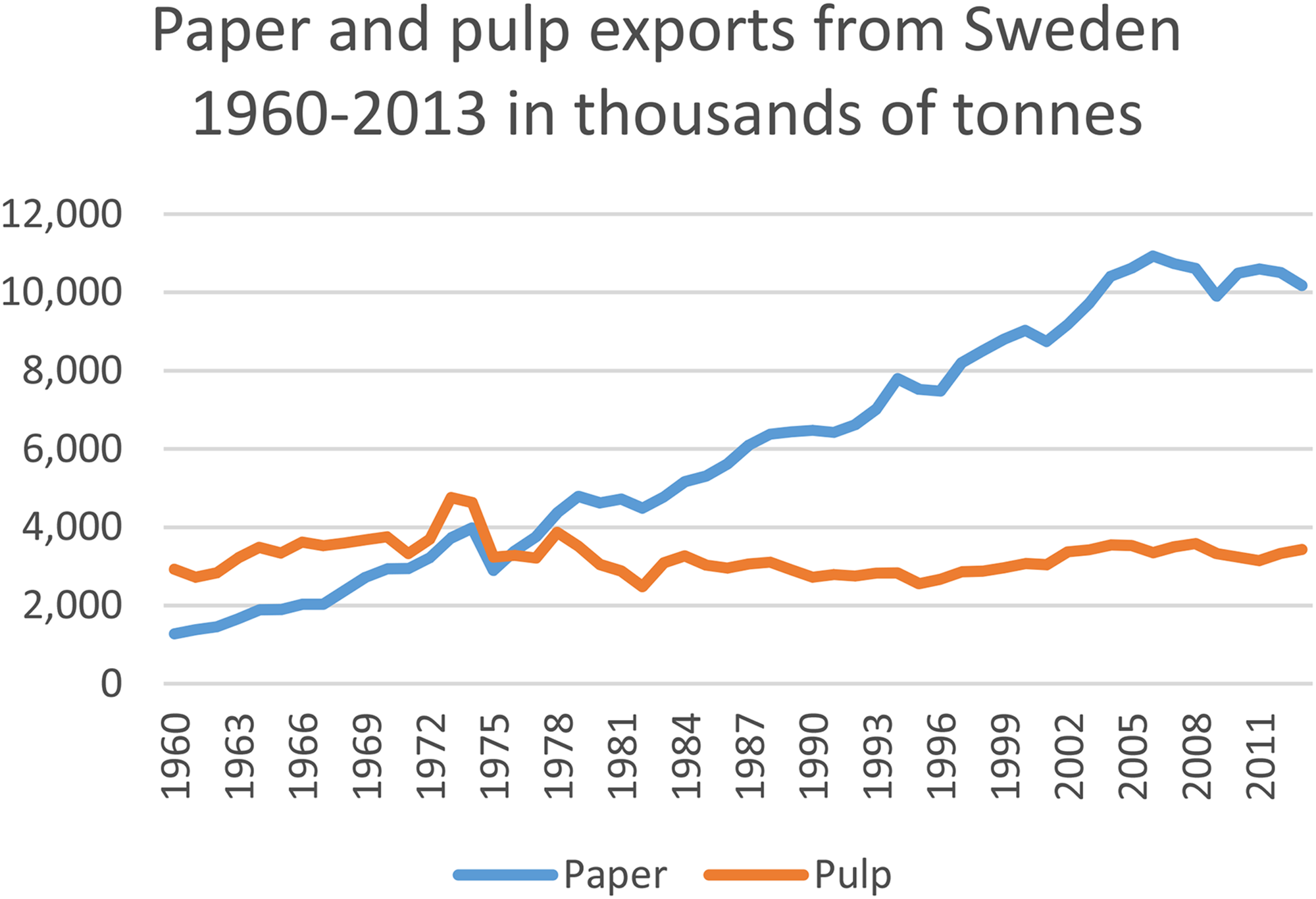
Paper and pulp exports from Sweden, 1960–2013 (thousands of tonnes). Source. Skogsindustrierna.
Second, specialized ship types emerged as a consequence of P&P companies growing larger through mergers and acquisitions. Given their scale, more emphasis was placed on synergies and also on the function of logistics, spanning land and sea transport. Some Swedish P&P companies grew in this manner. Stora as well as MoDo are good examples of companies that expanded through acquisitions, particularly during the 1980s, and this article will explore if and how this led to specialized maritime systems.
Third, when the value added of paper and pulp products increased, there was a need to lower the risk of damaging the cargo during transport. Specialized ships could be suitable for this purpose. Paper exports from Sweden have been higher than pulp exports since the 1970s (see Figure 1), and paper has more added value than pulp. The growth of paper exports continued, but after the financial crisis in 2008, the export of paper stagnated, and in 2013–2014 there was a significant drop in the production of graphic paper, while there was an increase in the production of packaging, tissue and other paper. 11
Even though the three factors that account for the specialization of shipping systems into two segments – open-hatch bulk carriers and ro-ro – apply to Sweden, they do not explain why Nordic companies developed shipping systems based on ro-ro. Understanding why this happened is the aim of this article.
Rather than taking a macro-perspective, the study focuses on the strategic choices that Swedish P&P companies made regarding the design and development of their maritime export systems. It focuses on all of the Swedish P&P companies that developed specialized maritime systems for P&P exports. There are two reasons for including several P&P companies. First, there is only scattered research on Swedish maritime transport systems for pulp and paper exports. Some studies cover the period up to the 1970s (thus missing the growth of paper exports), while a company biography of Sea-Link is the only academic monograph that covers the period from 1980 onwards, and then only for one company.
12
There is thus a need for a comprehensive overview. Second, selecting several P&P companies also indicates that the development of maritime systems for one P&P company was dependent on the actions of other companies. The article will aim to answer the questions:
What maritime systems for pulp and paper exports did Swedish P&P companies develop and on what strategic choices were they based? What underpinned the particularities of Swedish P&P exports, namely ro-ro systems and long-term commitments between P&P companies and shipping companies?
The study takes its point of departure at around 1960, when most of the pulp and paper companies used shipping services bought on the spot market, and where the pulp and paper were transported in (non-specialized) general cargo carriers.
13
The profitability of P&P industries in Sweden was decreasing from the 1950s,
14
which led to rationalizations, including the rationalization of maritime exports. By the 1970s, most of the P&P companies had developed, or were about to develop, specialized maritime systems for their exports, particularly to the main markets in Continental Europe and the UK. The study ends around 2015, during the decline of graphic paper production, the growth of which had been one of the causes for developing specialized systems.
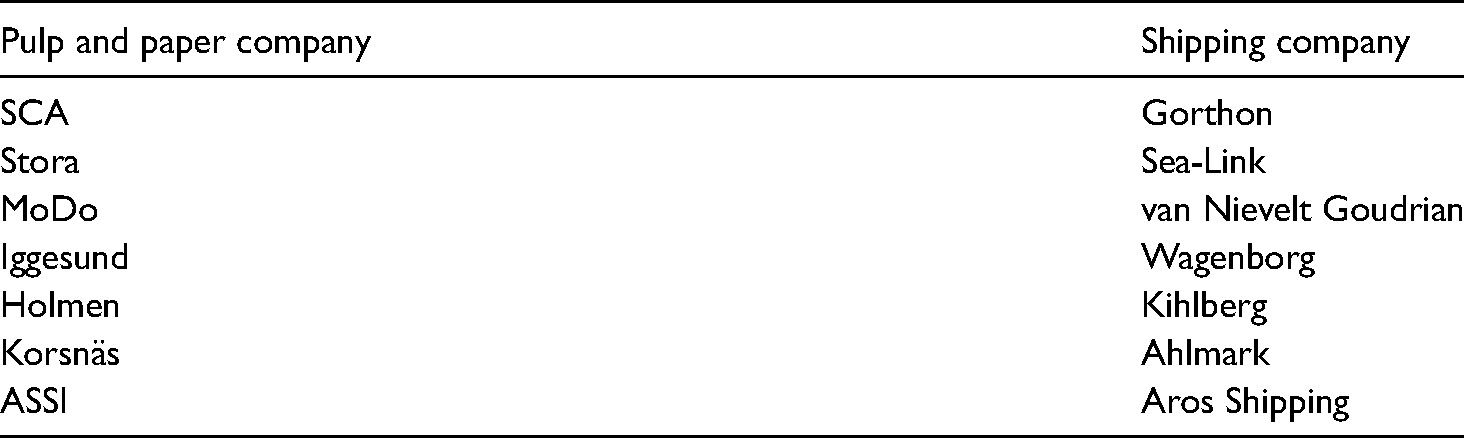
The article is based on publicly available printed sources, such as transport magazines (Svensk Sjöfarts Tidning, 1960–2015 and Transport & Hantering, 1976–2007), secondary literature, books and reports, corporate biographies, shipping companies’ corporate annual reports (Gorthon, Sea-Link, B&N), semi-internal magazines (SCA Shipping News, Holmenbladet) and annual reports of P&P companies (Iggesund, Holmen, SCA, StoraEnso, MoDo), as well as the corporate archives of the shipping organizations of SCA, 1960–2005, and Stora/StoraEnso, 1968–2001. Table 1 lists the main P&P and shipping companies featured in the paper, and Figure 2 maps the locations of the main P&P companies, mills and ports. Moreover, the author has conducted about 40–45 interviews with people in both P&P and shipping companies, most of whom are top managers of shipping divisions of P&P companies and shipping companies, technical managers and onshore staff, as well as other stakeholders. To answer the research questions, the article will analyse developments decade by decade, followed by a concluding section, in which the answers to the research questions are discussed.
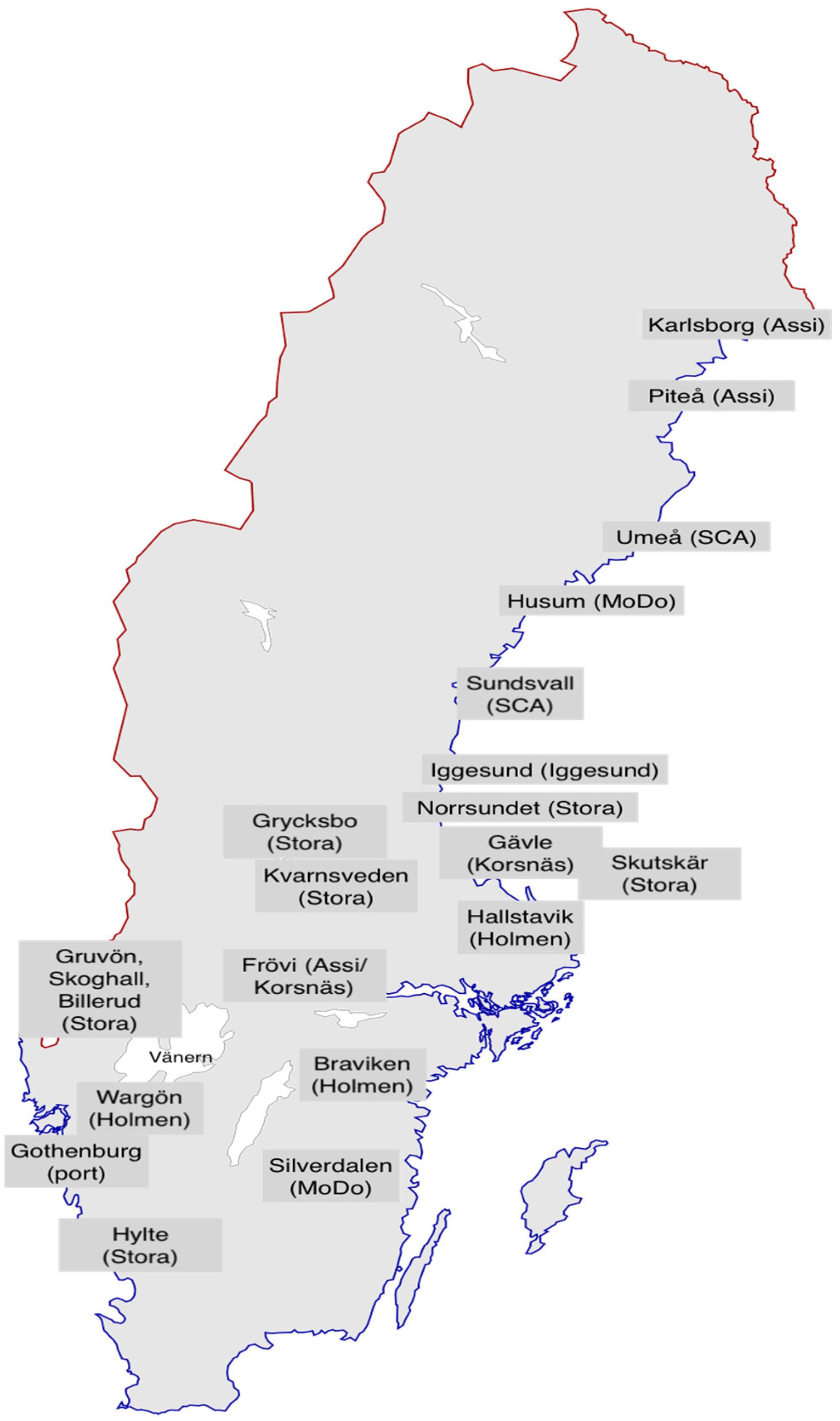
Map of Sweden with main companies, mills and ports featured in the study.
The principal pulp and paper and shipping companies featured in the study
1950s and 1960s: SCA's lo-lo system
The 1950s and 1960s were characterised by a growth of about 7% per year in the Swedish pulp and paper production, with the export volumes growing faster. 15 The main export products were newsprint, kraft paper and paper for corrugated fibreboard, 16 and the share of exports of paper to Western Europe grew to 79% in 1969. 17 The exports were undertaken primarily by ship. Although the shipping industry as a whole experienced significant change in the 1950s and 1960s, with growing tendencies of specialization, innovation and rationalization, 18 the Swedish forest industry predominantly used small general cargo carriers owned by independent, often German and Dutch, shipping companies. In the early 1950s, shipments were made from over 100 places around Sweden, and this number was only slightly reduced by the late 1960s.
SCA, a company predominantly based in mid/north Sweden, which expanded into newsprint and kraftliner production in the late 1950s and 1960s, faced a problem. 19 A quarter of the cost of its finished goods was attributable to transport and cargo handling, and it was not possible to achieve any significant cost savings by focusing on one link in the transport chain. 20 Therefore, a new transport system was developed, 21 in which all exports were concentrated in two ports in Sweden (Sundsvall and Umeå), and the number of foreign ports was reduced to five. 22 This was based on a system developed a few years earlier for Crown Zellerbach, an American pulp and paper company, with Bob Herbert, who had played an important part in Crown Zellerbach's operation, recruited to assist the development. The three ships delivered in 1967 and 1968 were developed versions of the Crown Zellerbach vessels. This project resulted in cost reduction. 23 Such a major overhaul of the export system was subject to both internal and external critique, but a spirit of forward thinking is said to have led to the successful implementation of the project. 24
1970s: a short-lived lo-lo copycat, and new ro-ro systems
In the 1970s and early 1980s, the business climate for forest products declined. The Swedish industry focused increasingly on paper production for export and economies of scale were sought through the introduction of larger mills. As Figure 1 shows, paper exports exceeded pulp exports in 1975 and continued growing. Export growth rates exceeded increases in production. 25
Given SCA's pioneering move regarding the creation of a maritime transport system in the 1960s, other P&P companies were reported to have felt the pressure to follow suit. Although SCA had inaugurated its system by 1970, the company investigated whether the shipping element could function even better with new ro-ro vessels, but reached the conclusion that the timing was not right. 26
One firm, Combi Shipping, which was one of many collaborations between Swedish P&P companies Stora and Korsnäs, followed SCA's path in an effort to renew its export system. To reap the knowledge and experience from SCA, a person who had worked as a consultant to SCA when they developed their shipping system was recruited to a senior position. The choice of using open-hatch bulk carriers (lo-lo) was debated. A discussion was held with another company that had a ro-ro ship in which the cargo was placed on load carriers and then rolled onboard. This often leads to shorter loading times, but the cargo hold is not fully utilized as the height of the load carriers causes ‘lost space’. There were many who believed that failing to exploit a ship's capacity was a mistake, which led them to favour open-hatch bulk carriers. The system was inaugurated in 1976 with two ships, but in practice it did not suit the changing and diversifying product mix of Stora and Korsnäs, and volumes were lost to other transport modes. 27 Within five years, in 1981, the lo-lo system was dismantled.
Several other P&P companies, namely MoDo, Holmen, Iggesund and ASSI, were expanding their paper production at this time. They created transport systems, but focused on ro-ro. Iggesund was an early mover in ro-ro and had used small ro-ro vessels in the 1960s, but they were now looking to renew their tonnage. 28 Three of the ro-ro ships delivered to these companies in the early 1970s, in the midst of a Swedish ro-ro boom, 29 were sister vessels. 30 The shipowner, Kihlberg, stated that when the first Iggesund ship was out on the market, it was easy to charter out the remaining two vessels, 31 as many companies were looking for ro-ro tonnage during this period.
While ro-ro means to roll on and roll off cargo, the experience of the different companies indicated the need for experimentation to find a cargo-handling solution that suited the particular company's need regarding cargo handling speed and reduction of damage to the cargo, as well as providing a cost-efficient solution. Holmen, for example, became interested in developing their transport systems in the late 1960s, 32 and began by chartering two ships from West Germany in 1972, 33 using sto-ro handling, which entailed stowing the cargo on the decks. 34 This has remained Holmen's preferred cargo handling solution until the present day. MoDo, with their increasing fine paper production, including cut (A4) fine paper, 35 tried to find solutions to protect their sensitive, high-value cargo, experimenting with various forms of load carriers on which the cargo was stowed and later rolled onboard. The preferred choice became rolltrailers. 36 Iggesund also experimented with different load carriers, including trailers that could ensure a door-to-door customer service for the European market. ASSI was able to introduce their ro-ro system after a new port was built in Piteå in 1973, enabling them to use ships that combined ro-ro and lo-lo. This combined system allowed for faster loading of different cargo types, and the ro-ro loading led to less damage to paper rolls. For all of these new ro-ro systems, there were collaborations with shipowners or brokers. Notable amongst those shipowners is Gorthon, serving MoDo and ASSI, which was establishing itself as a main player in forest product transports in Sweden.
1980s: P&P industry mergers and their effect on shipping systems
In the early 1980s, the Swedish forest industry experienced a strong growth in exports. In 1984, during the peak, the forest industry was the largest and most profitable export industry in Sweden. 37 Still, there were profitability issues, and from the mid-1980s, the forest industry started to consolidate at a faster pace in order to create large units that could compete on an international market. Larger units were able to make the investment necessary for survival, as well as facilitating rationalization. The number of factories decreased and the average production capacity of paper machines grew. The forest industry was further pursuing products with more added value, particularly in packaging, hygiene articles and office paper. The P&P companies’ customers also demanded improved paper quality for their newspapers, magazines and brochures. Three actors accounted for three-quarters of the total turnover in the Swedish forest industry: Stora, SCA and MoDo. Paper exports continued to grow and the primary market was Europe. 38 Demands for just-in-time deliveries were increasing in the 1980s. 39
SCA and ASSI did not engage in any mergers that affected their maritime transport systems. SCA's transport system remained intact during the 1980s, but the firm actively considered new builds to replace the existing ships, particularly because the produce shipped by SCA was less of a standard character (pulp and kraft paper), and more sensitive newsprint and fine paper. 40 However, despite that need, the existing ships provided a very beneficial transport solution at a low cost, and the company invested in the refurbishment of the ships. 41 ASSI, owing to demands of just-in-time traffic, switched transport provider from Gorthon to the newcomer Sea-Link, because of the size, price and speed of the ships. With Sea-Link's faster ships, with sto-ro handling, they could run a weekly service from Sweden to the UK and the Continent. 42
MoDo, like Stora, acquired other companies during the 1980s. The largest company after the mergers was Stora, which was at this point the largest European forest company, with about 35% of the Swedish forest industry's turnover. Stora acquired companies such as: Bergvik och Ala, Billerud, with several mills near Lake Vänern; Papyrus, with production capacity in the southern and western parts of Sweden; and Swedish Match. It also failed to take over Iggesund. By the end of the 1980s, Stora had a production capacity of 1 million tonnes in each of the following categories: pulp for sale, newsprint and journal paper, and carton and packaging paper. MoDo accounted for about 20% of the Swedish forest industry's turnover, and it acquired Holmen and Iggesund in 1988.
For MoDo, the acquisitions did not have an impact on the shipping systems in the 1980s. Given that MoDo's representatives were very content with their cargo being moved by rolltrailers, they wanted to develop pure rolltrailer ro-ro ships for the shipment of paper on pallets. Two ships were designed for this purpose and delivered in 1987. However, it was more difficult than predicted to fix the cargo on such ships, and therefore one of the ships, Vinca Gorthon, sank in 1987. At Holmen, the sto-ro cargo handling solution discussed previously was kept intact, and the increasing export volumes necessitated extra tonnage as well as the lengthening of ships. 43 Iggesund refined their transport system with a new ship delivered in 1979, which made it possible to convey fine, high-quality carton at a low cost, shifting such volumes from rail to ship. The system of carrying trailers for door-to-door transport continued. 44
Stora's acquisitions impacted on their maritime exports. After the dismantling of the lo-lo system, Combi Shipping turned to a combination of one ro-ro vessel and one lo-lo vessel from Sea-Link. 45 After a trial period, the cargo handling mode of ro-ro combined with a side door, which allowed for faster loading and discharge, was deemed a preferred solution and Sea-Link was able to supply two second-hand rebuilt ships, which entered into a five-year contract in 1987. However, given Stora's acquisitions of Billerud and Papyrus, the company's geographical focus shifted more towards the west of Sweden, and now included not only Combi Shipping, but also two other systems: shipments from Lake Vänern in small ships from Ahlmarks shipping company, and pulp and wood products exported from Norrsundet. 46 All three systems had equal volumes of exported cargo. Given that the purpose of the acquisitions was to look for rationalization effects, within all areas of operation, including outbound logistics, 47 Stora initiated two projects, the West Coast project and the East Coast project, towards the end of the 1980s.
Since Stora had many inland mills, the transport division looked for solutions based on train transport to a port on the west coast and then utilizing a ro-ro service to the UK and the Continent for the West Coast system. However, this led to significant concerns and resistance within the Lake Vänern region, not least because shipping was important for the region, and because of the investments made in the Trollhätte Canal (from Lake Vänern to the west coast) in the 1970s to promote shipping on the lake. 48 This coincided with an approach from Van Nievelt Goudrian (VNG), a Dutch shipping company, that wanted to discuss with Stora a ship type that was considered optimal for the traffic on Lake Vänern. Already in 1980, a container–oil–bulk (COB) ship - the Sara Cob - had been built, 49 which, as it names infers, could carry three different kinds of cargo. 50 The main argument was that it was the oil cargoes that were central, and the forest products paid the marginal cost on the ballast leg. 51 The person designing the Sara Cob was now working at VNG. However, rather than being used on Vänern, the COB vessels became the backbone of the East Coast system designed to replace the Combi Shipping system. Given that oil was transported to the east coast and pulp from the east coast, significant tests regarding smell were conducted since the ship carried both P&P and oil. 52
In the West Coast system the produce would instead be transported by rail to Gothenburg, where it would be exported on ro-ro vessels to the UK and the Continent. Paper from the inland mills was meant to be carried by rail or road to Gothenburg, but because of resistance in the Lake Vänern region, Stora's transport manager came up with an idea of creating road ferries to go from Karlstad to Gothenburg, with VNG suggesting a ship type that could also carry oil back to Vänern. This was the birth of the Väner shuttles, which operated on Lake Vänern, using the Trollhätte Canal to Gothenburg. 53
1990s: Stora and MoDo/SCA's new large-scale shipping systems
In the 1990s, paper exports from Sweden continued to grow strongly. 54 However, in general the forest industries suffered from lack of profitability owing to an oversupply of production capacity in Europe, leading to lower prices. The main owner of MoDo suffered from the Swedish financial crisis in the early 1990s, and SCA, buying the shares, saw possibilities to merge with MoDo since there were various synergies in terms of location, culture and business coverage. However, SCA had to shelve their plans after a long struggle with the other principal owners. Later in the 1990s, SCA was trying to slowly exit the graphic paper business, and in 1999 a new company was spun out of the fine paper business of MoDo and SCA, MoDo Paper, 55 which was sold to Finnish Metsä. A major merger between Stora and Finnish Enso was accomplished in 1998.
For Stora, the idea of creating a train-based transport system grew stronger during the 1990s, not least because the maritime systems that were in place in the early 1990s were problematic. On the east coast, the COB vessels were servicing Stora's mills on an on-demand basis. There were technical difficulties regarding the cleaning of the vessels for pulp transport, but they could be solved. The Väner shuttles were also hit by problems, owing to lower utilization and more technical and regulatory issues than expected. In 1990, VNG suffered from severe financial problems, which led to disruption of the operation of both the COB ships and the Väner shuttles. This made Stora switch to more conventional vessels provided by Aros shipping for the East Coast system. Even when the shuttles recommenced operations (and until they were finally removed from service in 2002), they did not provide the expected economic benefits, and the preference, as before the inauguration of the shuttles, was a train-based solution.
Significant efforts were dedicated by Stora and the Swedish Rail Administration to increasing the efficiency and lowering the cost of Swedish rail transport by developing a wagon profile that was as large as the maximum dimensions, as well as improving the railway from Stora's inland mills to Gothenburg. The main issues that the new system faced was not only to increase efficiency in Swedish rail transport, but also to eschew the traffic situation reigning in Germany, where the authorities had increased prices. To create a two-leg strategy by which not all rail-bound cargo went through Germany, the idea of a maritime link to a hub, called BasePort, in Belgium, evolved. 56
The maximum dimensions of an upgraded Swedish railway were the basis of the new StoraBox, which was known as the Stora Enso cargo unit (SECU) after the merger with Enso. The StoraBox could handle heavier weights, up to 80 tonnes, 57 and resembled a container with larger dimensions for use in ro-ro rather than lo-lo operations. It has been described as an extension of cassettes, with a top structure. 58
The design of the ships going from Gothenburg to Belgium was dependent on the new train-based logistics system. The ships were designed to be environmentally friendly and to avoid violent vertical movements to protect the cargo, and although they were optimized for the transport of StoraBoxes, they could be used for other purposes as general ro-ro carriers. The Dutch shipping company Wagenborg was the chosen shipowner. With three ships, departures up to six times per week were possible, well in line with the just-in-time demands of customers. The new system was introduced gradually from 1998 with nodes at Gothenburg and Zeebrugge, and was seen as a major innovation within the forest industry that would deliver substantial cost savings. 59 In the late 1990s, after the merger between Stora and Finnish Enso, there were investigations into how the different constituents exported their finished products.
For SCA, profitability issues, 60 as well as critique of its shipping division by the mills, 61 meant that 50% of SCA Shipping was sold to the transport company Bilspedition in 1991. Bilspedition was originally a truck hauling company but had since the late 1980s invested significantly in shipping. 62 The new jointly owned company hoped to organize not only SCA's transport, but also other customers in the forest industry. 63 Before Bilspedition's entry, a new transport project had been initiated by SCA for the shipment of lightweight coated paper (LWC – a high-quality paper more sensitive to moisture), including storage, a transport system and a ship. 64 A side-loading ro-ro vessel was chartered to handle LWC paper and A4 paper on pallets. However, this was merely a partial solution and a new distribution project was commenced given the new product mix as well as the customers’ demands for just-in-time deliveries. 65 It was led by SCA, but also involved MoDo, in which SCA owned a large stake.
However, SCA's shipping division was now jointly owned with Bilspedition, which proposed (in collaboration with Ahlmark) a system called CASH – a fully automated container system. 66 Owing to the uncertainty regarding the technology of the new container system, not the least from the mills’ perspective, 67 the lack of confidence in Ahlmark/Bilspedition's competence, MoDo's lukewarm interest in the system 68 and the conflicting economic interests of the parties, SCA opted for a ro-ro system. Bilspedition's representatives were not content, but their firm was in free fall owing to other shipping investments and they could not accurately monitor its engagement. In 1993, SCA bought back Bilspedition's share.
The ro-ro option was pursued using a novel kind of ship designed for cassettes. 69 The cassettes did not need lashing onboard the ships, which resulted in decreased time in port. On the return voyage, the cassettes could be stacked to allow the carriage of other cargo in 80% of the hold. These ro-ro ships could better handle the more diverse and smaller orders that SCA got from the market. 70 SCA collaborated with MoDo, first because of the ownership ties and later because of the obvious potential to rationalize the transport cost. SCA ordered three new vessels to handle the North Sea route, while MoDo would operate the Baltic route with existing vessels converted to take cassettes. The three new vessels were built in Spain, with Gorthon as shipowner (with a 15 year time charter agreement), and the system started operations in 1996. Iggesund was incorporated into the new transport system, while Holmen continued its own transport system, which was already optimized. SCA/MoDo's ships, moreover, were too long to enter Holmen's mills, and there is hearsay about problematical collaboration issues. Holmen also developed weekly traffic, including return cargo, and ordered a new ship, which was delivered in 1996.
2000–2015: the decline of graphic paper – shipping systems under pressure
The 2000s saw a continued reshaping of the Swedish forest industry, together with international expansion. For the Swedish P&P mills, exports continued to grow until the financial crisis in 2007–2008, after which there has been a stagnation of paper production and paper exports in Sweden, where graphic paper has declined radically since the mid-2010s. While SCA, Holmen (which was MoDo's new name) and StoraEnso expanded, state-owned ASSI underwent a restructuring process that led to its disappearance as a paper producer. For ASSI, the core business of the Piteå kraftliner factory was sold to Kappa in 2001 – later owned by SmurfitKappa. 71 This company continued to use ASSI's transport solution described previously, and developed two new ships in 2004 in collaboration with Wagenborg. StoraEnso and ASSI together joined some problematic mills to the new company Billerud in 2000, which were later merged into BillerudKorsnäs in 2012. These changes in the industrial structure influenced the transport solutions.
The BasePort system was inaugurated in 2000 with three ships. It moved cargo from StoraEnso's Swedish paper mills to Gothenburg by train, and then onwards to Belgium and the UK, where the SECU boxes were emptied and returned to Gothenburg. The merger between Stora and Enso was problematic, because Enso had had significant autonomy in its shipping operation before the merger, while Stora was becoming more centralized, as described above. 72 There were suggestions from StoraEnso's transport division about taking the volumes from northern Finland by rail to Gothenburg, but instead they were conveyed in small ro-ro ships to Gothenburg, which led to higher costs. 73 In the early 2000s, there were discussions about whether and how to integrate Stora and Enso's transport, and in 2005 the North European Transport Supply System was inaugurated, through which cargoes bound for the UK from southern Finland were first shipped to Gothenburg, before going to the main markets. 74 In 2011, however, the volumes from southern Finland went to Lübeck rather than Gothenburg, and in 2014 Gothenburg lost is role as key hub to Zeebrugge. The new system was called the ‘Stora Enso Short Sea System’.
The collaborative system between SCA and Holmen (previously called MoDo) was successful and the demand for shipping capacity outweighed the supply. In 2001, the three ro-ro ships were lengthened to cater for the increased demand. When the time-charter was due to expire in 2011, Transatlantic (previously Gorthon) was in financial hardship, and sold the ships to SCA, 75 which thereby became a shipowner again. 76 Yet another development during the 2000s saw an increase in container traffic. During the late 1990s, SCA started to experiment with container transport on the weather deck of the open-hatch bulk carriers (the ships built in 1967–1968). In 2008, the financial crisis precipitated a container shipping line crisis. As container vessels were cheap, SCA decided to charter a vessel in 2010, and has since used two container vessels. This affected the competitiveness of the ro-ro system, given the availability of cheap container tonnage. The mill in Husum, which was one of the partners in SCA's transport system, had changed owners (it was bought by Metsä), product mix and customer base; it therefore left the system. SCA and Iggesund continued to collaborate with three ships, twice a week to the Continent and once a week to the UK. This has extended the lifespan of the ro-ro system, which might be viewed as ‘business class’, while containers are ‘economy class’.
The transport system of the two previous Holmen mills (Hallstavik and Braviken) comprised five ships. From 2010, they chartered three vessels, which were faster and could guarantee a timetable-based service. However, the tides were turning in the paper sector and Holmen started to close down paper machines. The volumes decreased, and in the early 2010s, Holmen began to stress the role of train-and-truck in carrying the cargo. The price of trailer transport had decreased significantly owing to the large volumes of incoming cargo to Sweden. By using the backhaul route, Hallstavik and Braviken could decrease its transport costs. Furthermore, the customers had moved inland in the receiving countries, which is also a disadvantage for ship transport. In 2013, one of the three ships was returned. Similarly, for the Iggesund mill, the exports by ship decreased from 80 to 60% in 2012, 77 and the shift towards train transport was expected to continue, because of higher customer demand for smaller quantities, shorter delivery times and more environmental measures, notably the establishment of sulphur emission control areas.
Concluding discussion
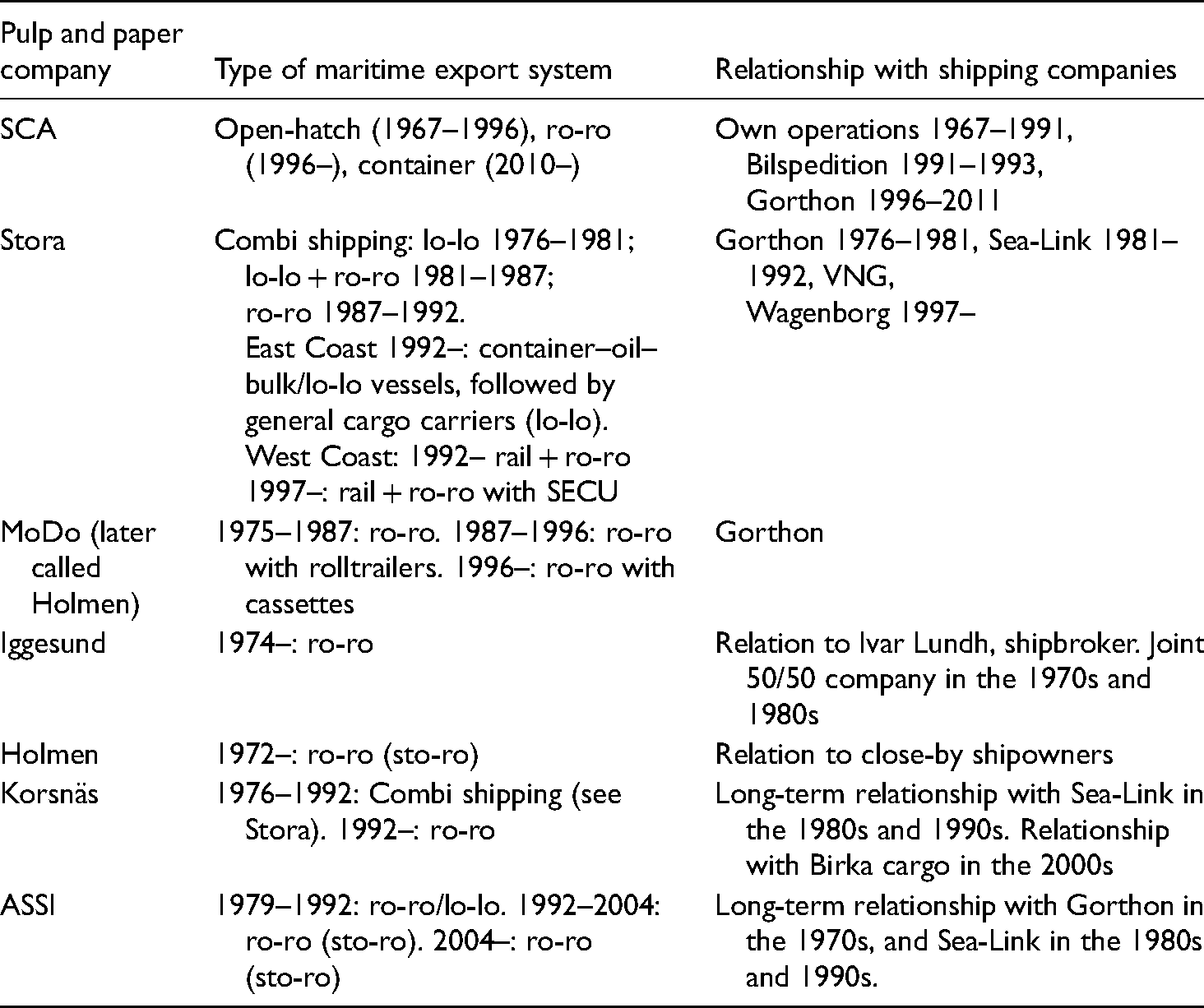
The sea transport systems for pulp and paper exports described in this study are summarized in Table 2. When exploring the strategic choices on which maritime systems were based, various explanations are evident in the empirical narrative. The three main contributing factors to specialization specified by Ojala and Tenold are also important for the Swedish P&P export systems. First, the growth of exports required the development of specialized solutions, which, in turn, contributed to growth. It is clear from the Swedish case that it was the growth of paper exports that led to the development of specialized shipping systems. Whether the specialized ships led to increased exports cannot be deduced from this study in a systematic manner, but it is likely that the growth of exports was dependent on the existence of suitable transport solutions. Second, mergers led to companies taking a more systematic approach to their transport, in relation not only to shipping, but also to land transport. We have seen that Stora and MoDo/Holmen, after their acquisitions, took a more comprehensive view of their transport, which in the former case led to a train-based solution, with a maritime component, and in the latter led to a new shipping system in collaboration with SCA. However, companies that did not merge with others also took a systematic approach to their transport, while the dissolution of corporations can also be a trigger for changes in the transport function: for example, Stora and Korsnäs. Third, the increased value of the cargo led firms to seek to reduce damage, a factor that was important in the Swedish context, especially as paper products such as fine carton and graphic paper have more added value.
The principal maritime export systems and their relationship with shipping companies, 1960–2015
In addition to these factors, several strategic choices led to the predominance of the ro-ro based maritime export system in Sweden, 1960–2015. First, mimetic tendencies influenced development. For example, SCA was inspired by developments abroad, leading to a strategic choice of open-hatch bulk carriers, which were seen to be the way to transport P&P in the future. Combi Shipping explicitly copied SCA's system. The other companies opted for ro-ro (or combined ro-ro and lo-lo) solutions. This was related to a growing ro-ro trend in Sweden and elsewhere. However, although there were mimetic tendencies amongst the companies, and within the P&P and shipping industries, one should not downplay the importance of strategic choices dependent upon striking a balance between values in the transport function.
Second, when striking a balance between values in the transport function, companies considered cost, their own product mix and customer demands. For example, SCA was actively looking for new ro-ro tonnage in the 1970s, perhaps because there were some drawbacks in the lo-lo system. Still, in archival material, it is repeatedly stressed that the cost of transport in the SCA lo-lo system was very competitive in relation to other companies’ ro-ro solutions. This indicates that a balance was struck whereby cost was prioritized over other values. The Combi Shipping case represents a telling break point between lo-lo and ro-ro, and the main argument was that the cargo space could be utilized better with lo-lo. The SCA solution was seen as state-of-the-art. However, with a more diversified product mix, the open-hatch bulk carriers became unsuitable. For the P&P companies opting for ro-ro, the priority was to reduce damage, not the least because of the more valuable, but also more diversified, product mix. Furthermore, customers demanded just-in-time, regular deliveries, and this could be ensured more easily with ro-ro ships that are loaded faster in any weather, and working on a fixed time schedule. The transport systems were developed partly as a response to the need to transport increasing amounts of paper, which is bulky and sensitive to pressure and moisture. 78 Thus, the need to carry increasingly sensitive cargo led to the ro-ro adoption, whereas a more diversified product mix reduced the scope to efficiently load open-hatch bulk carriers.
Like other shipping sectors, the maritime systems covered in this study have suffered from unbalanced trade flows, and in some periods more emphasis has been placed on finding backhaul cargoes. However, the will to avoid sailing empty on the backhaul invariably conflicted with the regular liner-like departures of the ships, which are often prioritized. This indicates that regular deliveries were more important than cost-cutting for these maritime systems. While the ro-ro solutions were able to provide frequent, just-in-time deliveries, since the 2000s volumes have shifted from ship to train. Some companies, such as the concern formerly known as Holmen (the Hallstavik and Braviken mills), have increasingly used the backhaul of rail imports to the populous Stockholm region to transport paper to the Continent.
A further contributory factor lies in the fact that maritime transport systems deployed for the export of pulp and paper from Sweden have served short-sea routes to the UK and Continent, whereas the more expensive ro-ro vessels could be legitimized owing to the short distances and the need to reduce the time at port. It is clear that the investment costs for some ro-ro cargo handling solutions were more expensive than for lo-lo vessels (for example SECU and cassettes), but there are also stories about difficulties of loading lo-lo vessels (particularly in the Combi Shipping case) and thus a need for highly skilled crane operators, which is not required in ro-ro operations. The geographical aspects of Swedish P&P exports need further exploration since P&P mills farther away from the markets (for example those of ASSI, SCA, or MoDo) have had less scope for intermodal shifts, and thus continue with a maritime solution.
These are the central arguments as to why a ro-ro based solution has been used in Sweden. Ro-ro is not something given, and the fact that Nordic P&P companies have opted for ro-ro needs to be situated within the histories of the companies and the nature of their operations. In the 2010s, there were already shifts away from ro-ro, which might imply that we are seeing the beginning of the end of an era of ro-ro based shipping systems. In future research, a systematic analysis of transport costs as well as handling damage, transport time, risk of delay, etc., will be necessary to further understand the economic choices that P&P companies have made.
Earlier research stressed the importance of long-term relationships between P&P and shipping companies in the Nordic countries, which this study has also addressed. Although there are several such long-term relationships, there are also cases where there has been a long-term approach, but in which a relationship to a shipping company was not central. SCA, for example, handled their own shipping operations between 1967 and 1996, and Stora led the development of their transport system (including the maritime component) only with partial assistance from shipping companies. This study has shown that such long relationships are not dependent on ro-ro, as previous research indicates, but on the will to control long-term transport solutions, whether they are based on lo-lo or ro-ro. The will to control the export is not remarkable given its importance in reaching the market. Furthermore, long-term solutions were most probably developed given the stable and growing market prospects at least up until the decline of graphic paper. The willingness to control the transport solution also stems from the fact that there were no suitable providers of transport services on the market that could provide the particular type of transport service requested by the P&P companies. The willingness to keep control of operations could also be dependent on company autonomy. Although there are exceptions, in general, the history of Swedish pulp and paper exports has been one of non-cooperation. Each P&P company has wanted to handle its exports in its own way, and to arrive at the terminal in a ship boasting the name of the P&P company. This autonomy-oriented and aesthetic characteristic of Swedish maritime exports has not been highlighted in earlier research, and could be explored further. In some corporate reports there are images of the ships, proudly and largely displaying the P&P company's name and livery. 79 To handle one's own shipping system and not collaborate with other P&P companies was a typical strategic choice for many of the companies.
In the empirical narratives (particularly Bilspedition and VNG in the early 1990s), it can be seen that not all relationships between P&P companies and shipping companies are long term and harmonious. The objectives and incentives of shipping companies differ from those of P&P companies, as do their views on the advantages and disadvantages of new cargo handling technology (for example, the CASH-vessels, the COBs, the Väner shuttles and the StoraBox system after Stora's merger with Enso). For future studies, it would be interesting to study in detail the vagaries of a particular relationship between a P&P company and a shipping company to further understand the dynamics of such collaborations.
Furthermore, the internal dynamics of a P&P company can impact on the choice of maritime transport system. Both for SCA and StoraEnso, this relationship can at times be problematic, since efforts at rationalization and centralization conflict with the autonomy of business units. Both the internal dynamics between mills and the shipping division, as well as the collaboration, or absence of collaboration, between different P&P companies regarding shipping operations merit further attention. A further dimension to explore, moreover, is that of Finland in relation to Sweden. Like Sweden, Finland has great stocks of forest resources that are some distance from the main Western European markets. In Finland, the shipping of forest products has been organized differently from that in Sweden, and a comparative study would be illuminating, not least to understand the role of shipping companies as boundary spanners, for example Sea-Link, which operated in both Sweden and Finland.
Footnotes
Declaration of conflicting interests
The author declared no potential conflicts of interest with respect to the research, authorship and/or publication of this article.
Funding
The author disclosed receipt of the following financial support for the research, authorship, and/or publication of this article: This work was supported by the Lars Erik Lundbergs Stiftelse för forskning och utbildning.
