



Abstract
Icebreakers have traditionally been seen as symbols of technological nationalism. While ship science for open-water vessels developed during the late nineteenth and early twentieth centuries, understanding of how to cope with polar and subarctic ice conditions lagged behind. This led state organizations in charge of icebreaking services to minimize risks in the development of new vessels by encouraging transnational expert cooperation. This article argues that such interactions were critical to the evolution of the modern icebreaker. We examine the development of three icebreakers in different countries in successive decades, and the critical technologies with which they are associated: the Ymer from Sweden and diesel–electric propulsion (1933); the American ‘Wind’ class and power-hull proportion (1942–1946); and the Voima from Finland and twin bow propellers (1956). We reconstruct the flow of information to explain the rationale for transnational cooperation in maritime technology development. The concept of ‘technology carriers’ is deployed in the analysis to enhance understanding of the role of international cooperation in polar and winter seafaring.
Icebreakers are gigantic, sophisticated machines bearing state flags and the fame of heroic missions. As tangible objects of competence and prowess, they have become symbols of technological nationalism: Ymer (1933), the first diesel–electric icebreaker, was a feat of Swedish electrical engineering, while the US ‘Wind’ class (1942–1946) icebreakers demonstrated the capability of the superpower to penetrate polar ice and the Finnish Voima (1954) marked the entrance of a peripheral country into the high-tech industry. Icebreakers are vessels of national importance in winter navigation countries, while they are fairly recent and curious exceptions in the annals of maritime history. In fact, fewer than 50 full icebreakers were launched between the late nineteenth century and the 1950s.
The specific significance of icebreakers, combined with their minor relevance to mainstream maritime history, has rendered icebreaker studies subject to non-scientific historical reviews written as stories for state institutions, such as the US Coast Guard, 1 or to honour national milestones, like the centenary of Finnish winter navigation. 2 When viewed through such national lenses, technological developments in icebreaking have appeared more as a series of innovations stemming from the natural conditions of the given country and demonstrating the modern technical prowess of the nation. This nationalistic tendency in icebreaker histories contradicts the international tone of maritime history. Norwegian economic and maritime historian Stig Tenold has recently noted that all maritime history crosses borders and that this international dimension provides avenues for cooperation between neighbouring fields, such as economic, cultural and industrial studies. 3
This article employs history of technology methods to analyse evolutionary technological developments through a study of material artefacts and engineering networks. It focuses on how icebreaking technology was developed and transmitted by a transnational network of engineers and experts working in close cooperation with shipyards and state actors between 1890 and 1954. While icebreaking occupies a marginal space in maritime technology, it paves the way for studies of the dynamic interplay between the national and international dimensions of naval architecture as a whole.
Systemic transformations are among the most thoroughly analysed topics in maritime history. Historians have shown how radical transitions, such as the shift from wood to steel, represented a systemic transformation that instantly nullified generations of experience and caused abrupt disconnections in organizational histories. As Larrie Ferreiro has pointed out, the systemic revolution in shipbuilding materials was not a single innovation but rather a deluge of interconnected inventions and improvements implemented in commercial shipbuilding gradually over the course of a century. 4 A worldwide systemic change, taking place simultaneously at several locations, can hide the human faces behind technological decision-making processes. How did risk-averse shipyards and naval architects come to adopt new technological solutions?
The transition from seagoing ships to ice-capable ships required a systemic change in naval architecture, as the dynamic between a ship's hull and ice follows natural laws other than fluid dynamics and could not just be derived from earlier hydrodynamic studies and experiments. While seagoing vessels had been systematically studied and developed using model-scale and full-scale trials since the eighteenth century, the first ice-model testing facilities did not open until the 1950s. 5 No individual country or shipyard had the resources or desire to independently embark on this novel branch of naval architecture before the second half of the twentieth century. The lack of comprehensive theoretical understanding of ice-going vessels and the small number of prototype icebreakers available globally made icebreaker developments slow, risky and expensive. Therefore, international cooperation and technology transfer became critical.
This article demonstrates the extent to which the development of seagoing icebreaking vessels was the result of a transnational and evolutionary process. We name the ships showcasing the developments, and leading engineers responsible for them, through the selection and adaption of various technology transfer processes. 6 This limited case study allows us to identify the human faces and interactions behind the evolution of polar ship technology and to increase understanding of the international and interdependent dimensions of maritime technological history.
To deconstruct the national narratives in the existing literature and construct a transnational interpretation of technology development, we study the continuities in material artefacts. As George Basalla wrote in his 1988 study of technological development, ‘the artefact – not scientific knowledge, nor the technical competence, nor social or economic factors – is central to technology and technological change’. 7 We focus on three key vessels, the Swedish Ymer, the US ‘Wind’ class and the Finnish Voima, and trace the development of three transformative technologies, hull shape, diesel–electric propulsion and bow propellers. We focus on large, seagoing state-owned ships. While large and small icebreakers are technologically intertwined, study of the latter would demand a different, typically municipal, set of sources and a different type of analysis. In addition, icebreaking operations and ice conditions in ports, canals and riverways are different from seagoing icebreaking operations and have called for a separate set of technologies, such as ice plows or multifunctional icebreaking tugboats. Therefore, we leave the technological history of harbour and inland waterway icebreaking for future studies.
In the development of icebreakers, naval architects have recognized that ice is not just ice, that ice formation and coverage significantly impact the performance of a certain type of icebreaker. For our story, the most important aspects of ice quality have to do with the difference between multiyear polar ice – thick and hard fast ice – and the winter ice typical of the low-salinity Baltic Sea or freshwater Great Lakes, which is not as thick or hard as polar ice, but characterized by formations that hamper icebreaking – brash ice, ridged ice and drift ice.
Methodologically, we focus on the role of ‘technology carriers’. According to Lars Olsson, college-educated engineers formed a social group that had both ‘the interest and ability to bring forth, maintain, and develop technological systems’.
8
This conceptualization derives from the earlier use of the term ‘social carriers of techniques, first introduced by Charles and Olle Edquist to examine technology transfer to developing countries
9
and later developed further by Henrik Björck to analyse the role of engineering newspapers in technology dissemination.
10
While Olsson analysed the entire production system at shipyards and identified management, the board of directors and owners as ‘system builders’,
11
we in contrast focus on technological solutions and hark back to the original definition proposed by Edquist and Edquist that characterized the role of technology carriers in a more specific manner. The original conceptualization draws attention to the choices made by actors in addition to interest and ability:
technology carriers need to have an ‘interest’ in choosing and implementing a specific technique; the entity must be ‘organized’ enough to be able to make a decision; it must have the necessary ‘social, economic, and political power’ to materialize its interest; the social entity must have ‘information about the existence’ of the technique; it must have ‘access’ to the technique; and finally, it must ‘be able to acquire’ the needed knowledge on how to manage the technique.
12
This study is based on primary sources from diverse organizational archives, including the US Coast Guard (USCG) archives in Washington, DC, the collections of Finnish actors, ministries and maritime administration (MKH) in Helsinki and the archives of the Swedish icebreaker service (SIS) in Stockholm. We also utilize other contemporary sources of information available to the actors, such as engineering journals and conference reports like the Swedish Teknisk Tidskrift and the American Proceedings for Civil Engineers. To identify and show connections between different prototypes, we analyse technical drawings, model pictures and measurement tables of the existing icebreakers, and when available, the original vessels. We start with a short primer on the early development of the icebreaker before analysing the development of our subject ships.
The merger of the American and the European icebreaker
The idea of an ice-capable ship is older than that of a special-purpose icebreaking ship. It emerged in various countries during the nineteenth century. Early prototypes differed in appearance, but stemmed from the same origin: the introduction of steel hulls strong enough to withstand the pressure of the ice, the development of steam engines powerful enough to push the ship through ice and growing needs of global traders who no longer had the patience to wait for the spring. From the 1830s onwards, major US ports used small, reinforced paddle steamers to break ice. The British-built St Petersburg boat Pilot (1864), along with the German tug Eisbrecher No. 1 (1871), were probably the first of a type of ship later known as the ‘European icebreaker’. This vessel had a rotund, spoon-shaped bow meant to climb atop the ice and crush it with the vessel's weight. Numerous such icebreakers were built in the 1880s and 1890s in Germany, Denmark and Sweden for passage through the Baltic Sea. 13
Finland began to develop winter navigation ships after a horrendous famine in 1866–1868. 14 The first ice-going vessel, the package ship Expressen, was launched in 1877. Its designer, Robert Runeberg (1846–1919), became a key technology carrier in the Baltic region. 15 In 1888–1889, he published a treatise on the technology of icebreaking ships that featured a systemic examination of existing vessels and recognized the fundaments of icebreaking. 16 With Runeberg's input, Finnish authorities decided to buy a new icebreaker from a Swedish shipyard. The icebreaker Murtaja (1890) copied European designs, which were predominant at that time. As the most expensive ship in Finland, it was greeted with immense expectations, but proved somewhat disappointing in use. Murtaja's blunt bow was inefficient and difficult to operate in the heavy pack-ice conditions of the northern Baltic Sea. 17
The problem stemming from the bow shape was resolved through transnational cooperation between Finnish, Russian and American technology carriers. In 1893, Runeberg presented a paper entitled The Possibility of Winter Navigation to St. Petersburg before the Russian Imperial Technical Society, claiming that year-round navigation to the Neva Estuary was technically possible. This encouraged Stepan Makarov, a naval innovator and officer, to focus naval technology development on icebreakers. The country eventually ordered the large icebreaker Yermak from Armstrong, Whitworth and Co. of Newcastle in 1897, together with a second Finnish icebreaker, Sampo. 18 Both ships were built with a diagonal, reinforced bow with a propeller underneath. This came to be known as the ‘American type’ of icebreaker.
The American-type icebreaking ship was developed for the Great Lakes by the naval architect Frank E. Kirby (1849–1929) as a solution for the harsh wintry conditions in the Mackinaw Sound. In 1888, he designed the ice-breaking railroad car ferry Ste. Ignace, which had a propeller at both at bow and the stern. 19 Kirby designed ferries for specific routes, not specialized icebreakers. His invention was turned into a full-fledged icebreaker only after Finnish technology carriers took note of it in 1896. Finland was preparing its tender for the Sampo and sent out inquiries about novel developments. A Finnish-born shipbuilder in New York, Konstantin Jansson, replied with information on Kirby and his ships. The Finnish Senate sent the master of the Murtaja, Leonard Melán, to the Great Lakes region to find out more. He observed the ships and met with Kirby, who gave him technical specifications to refine the tender for both the Sampo and Yermak (Figure 1). 20
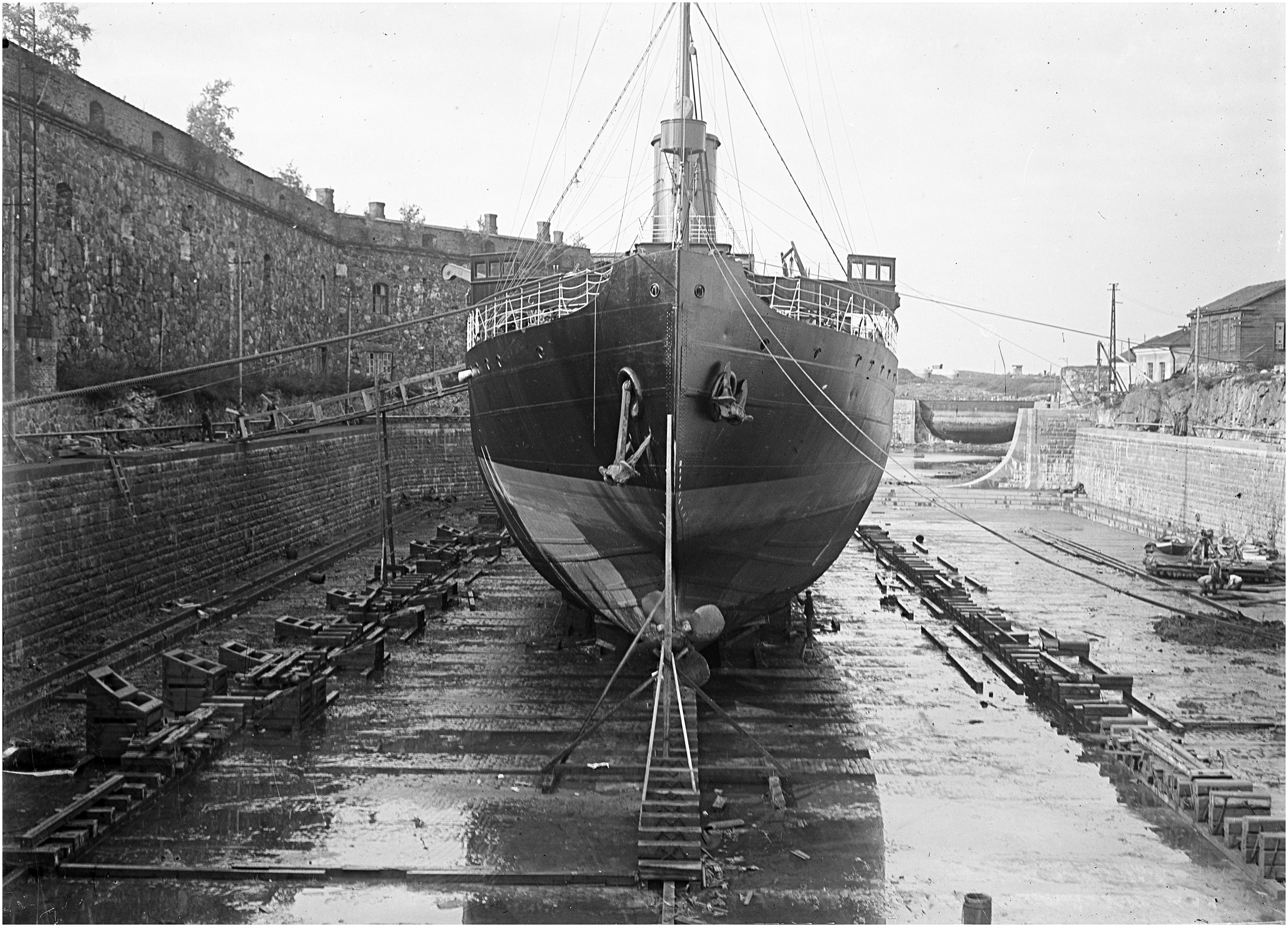
Icebreaker Wäinämöinen (formerly Tsar Mikhail Feodorovich, later renamed Suur Tõll) at Suomenlinna dock around 1920, showing the ‘American-type’ bow.
Cargo ships grew in size, which set new demands for icebreakers in the early decades of the twentieth century. A third steam engine and a third propeller were added to the stern of new icebreakers. 21 The Russian ship Tsar Mikhail Feodorovich (1914) was built in Stettin by AG Vulcan, then taken over by Finns during the Russian Revolution. Before it was handed over to Estonia in 1922, Karl Albin Johansson, Finnish naval architect, 22 measured the hull. The MKH did not trust domestic shipyards to deliver a new Finnish icebreaker in 1924, but it trusted Johansson to draw up the technical specifications for the tender submitted for the next state icebreaker. 23 The resulting icebreaker Jääkarhu (1925), co-designed by Johansson and contractors at the Dutch shipyard P. Smit Jr, was the largest and strongest icebreaker in the world at the time of its launch. 24 It became an integral precursor to the design of the world's first diesel–electric icebreaker.
The early 1920s also witnessed the beginnings of ice classifications for commercial vessels by various classification societies. Finland developed new regulations for ships in 1920, adding language regarding their ice-going capabilities in 1924. Since the country had no national classification societies, it relayed these developments to all relevant organizations, such as Lloyd's, Det Norske Veritas and Germanischer Lloyd. A later Finnish regulation was harmonized further with those of other Nordic countries as information exchange between state maritime authorities was formalized. 25 The development of ice classifications intensified in the 1950s between Finland and Sweden, leading to a joint Baltic system in the 1970s. However, this falls beyond the scope of this article, despite the shared feature of transnational expert networks.
Transnational cooperation in the interwar period
We turn our attention now to the namesake of the mythological parent of giants, Ymer. The harbour of the Swedish capital Stockholm freezes over in a typical winter. Cities further north on the Swedish Baltic coast face even harsher ice conditions and the Swedish icebreaker service was tied to the industrialization of Norrland at the time. When the First World War disrupted trade, the government set up a committee to explore the economic and logistical outlook for industrial expansion northwards. Sweden would need stronger icebreakers to keep the Norrland coast open throughout the year. Swedish shipbuilding had developed rapidly around the turn of the century, with shipyards copying and building European-type icebreakers from the 1870s onwards. In particular, the Malmö shipyard of Kockums Mekaniska Werkstad competed on Nordic markets by building icebreakers for Danish, Norwegian and domestic buyers, most notably completing the HMS Svensksund in 1891 for the Swedish state. It was an icebreaking naval vessel with a transitional sharp bow shape, but without the bow propeller. 26
Swedish shipbuilders followed recent trends in international icebreaking. After Finland had commissioned the Sampo, Swedish actors took note of its experiences with the ‘American’ bow. The Swedish naval architect Axel Lindblad released a widely read treatise on icebreaker construction in 1912. His theoretical insights were mostly based on Runeberg's treatise and the findings of the Finnish winter navigation commission of 1896, written in Swedish. Lindblad codified the nomenclature on the ‘American-type’ icebreakers to mean the shape of the bow and the existence of the bow propeller. He paid no attention to the aforementioned point that Kirby's ships were actually ferries, not purpose-built icebreakers. Since the book was easily available in Germany and Denmark, it had a marked influence on icebreaker construction in the southern Baltic Sea region in the years to come. Icebreakers like the Danish Storebjørn (1931) and German Stettin (1933) are good examples of this regional development in steam icebreakers (Figure 2). 27
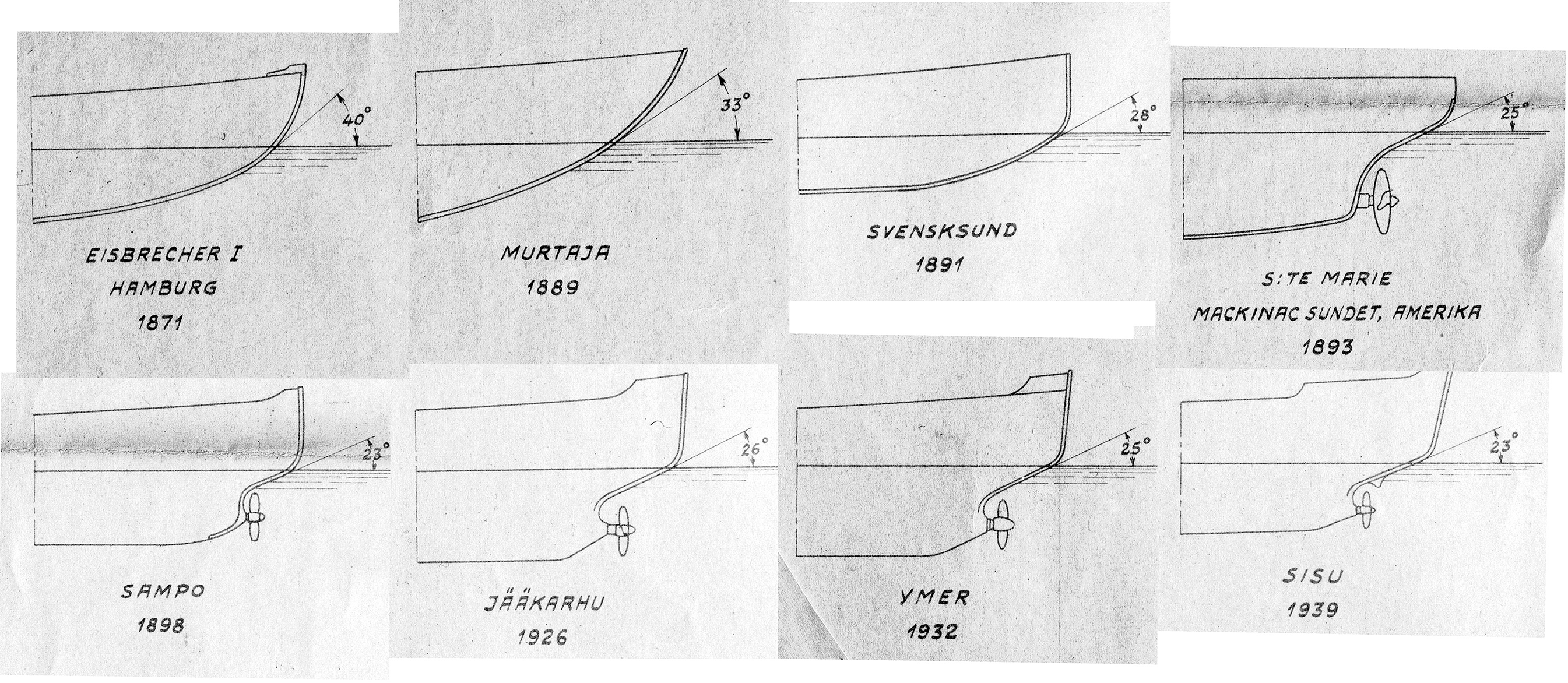
A concept drawing of the development and angle of the icebreaker bow.
The first Swedish sea-going icebreaker was built for the city of Stockholm by the local Finnboda shipyard in 1915. Initially named Isbrytaren II, the Sankt Erik was a full expression of an ‘American’ icebreaker, with the bow angle and shape copied from the Finnish icebreaker Tarmo (and via it from Sampo). 28 A critical instigator in this process was the Stockholm parliamentary representative Sven Lübeck, a waterway engineer with connections throughout the Nordic countries. He understood the role of electrical power in industrialization and supported the domestic shipbuilding of naval vessels. As Mats Fridlund, historian of technology, has pointed out, this was the period of strategic system building in Swedish electrical engineering and technological networks. 29
Icebreaking was a public service in Finland. Sweden adopted the same position after the Norrland Committee advocated a state-run service over private commercial operators. In 1924, the Swedish Parliament approved the purchase of a second large icebreaker, the Stats-isbrytaren (1926, renamed Atle in the 1930s). 30 With this ship, the Swedish state icebreaking service as a joint military and civilian service began to take form. Operating at the state level helped with information gathering and policy formulation, as Swedish officials saw Finland and Denmark as natural partners, which increased the scientific, technical and operational exchange of information. As a result, Nordic winter navigation regulations were mostly harmonized from 1928 onwards. 31
The two Swedish icebreakers soon proved to be insufficient for maritime traffic along the Swedish Baltic coast, and Norrland industries, together with maritime and shipbuilding interests, lobbied hard for a third state icebreaker. 32 The idea of overcoming winter conditions with technology had won over key advocates in Sweden. The winters preceding the global depression of the 1930s were notably hard in the Baltic Sea region, and Finnish icebreakers were used to help convoys pass the Danish Sound in 1929. Danish and Swedish officials negotiated with the USSR for the loan of the IB Lenin. This provided an opportunity for the Soviet state to accumulate foreign currencies since the payment was handled in UK Sterling. 33 Together, the lobbying combined with the harsh winters to persuade the Swedish state to start a new-build programme.
Finnish icebreakers were used as proof in Swedish intra-governmental memoranda for building stronger, rather than larger, icebreakers, as the passages along the Gulf of Bothnia were often shallow. The director of the shipping company Svea, Björn von Sydow, was a crucial member of the icebreaker lobby in Sweden and one of the builders of cross-Baltic shipping lines together with the key Finnish actor, FÅA director Henrik Ramsay. Naval architect O.R. von Sydow – his cousin – was tasked with designing three new icebreakers based on the tested dimensions and hull lines of the newest Finnish icebreaker, Jääkarhu. 34 Two of von Sydow's designs followed the ship with respect to propulsion, featuring oil-fired steam engines. The third plan was far more expensive and experimental, as it featured diesel–electric engines. At the time, Finnish civil maritime authorities had no interest in risking untested diesel–electric propulsion for icebreakers. Their expertise was in traditional steam propulsion, and they were typical maritime actors, cautious and conservative in the face of novel technological solutions (Figure 3). 35
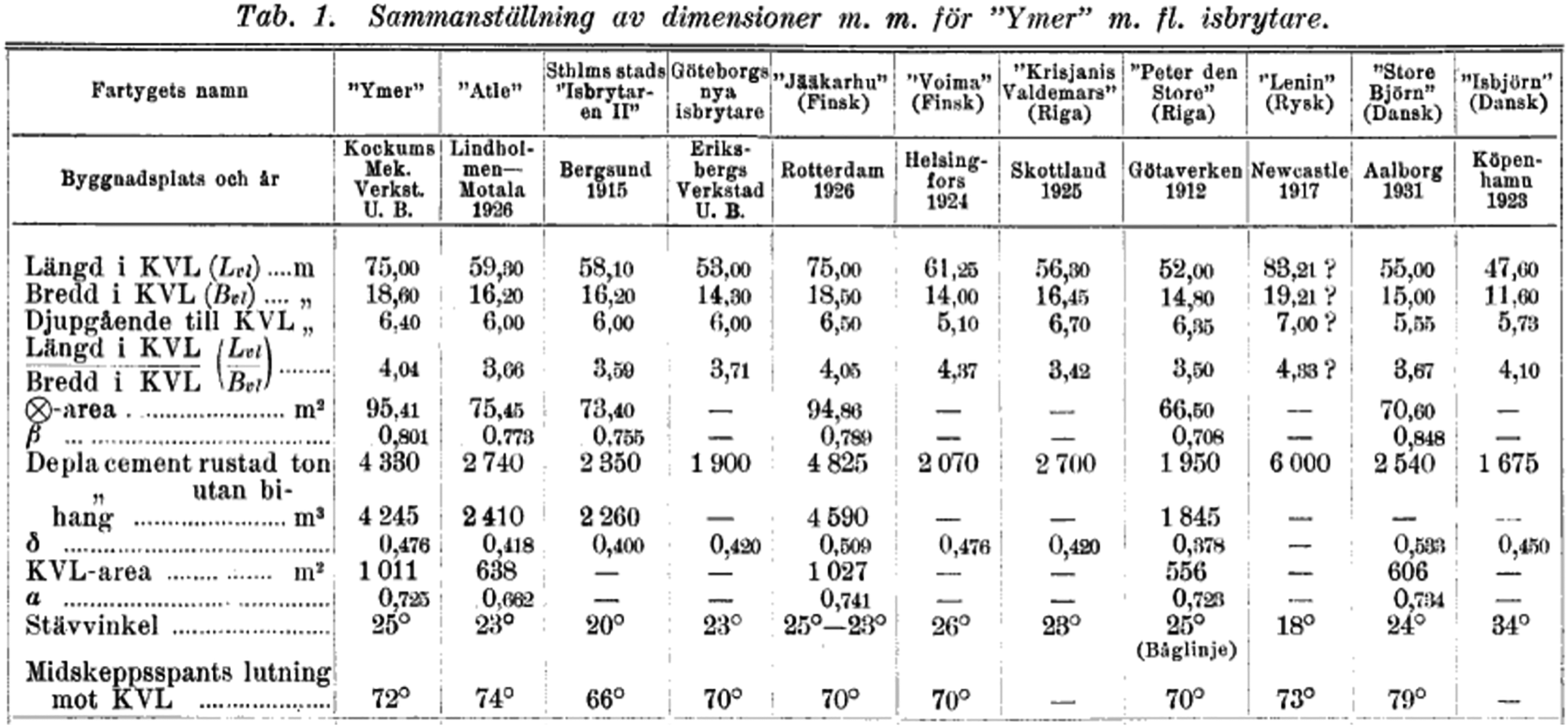
Comparison of the hull dimensions of specific icebreakers. Note the similarity between the Swedish ship Ymer and the Finnish, Rotterdam-built Jääkarhu.
The Swedish icebreaker innovations occurred in tandem with development of the nation's electrical technology policy. ASEA was a national technological jewel with close ties to government officials, and as such, it could inform development in other industries.
36
The company's technical chief engineer, Ragnar Liljeblad, gave a speech on icebreakers to Swedish shipbuilding engineers in 1930, where he stressed the following points: What are we waiting for? Where would one build a larger icebreaker with diesel–electric drive than in Sweden? Will we beg that England or Germany, who don't need such vessels, would give it a go? Our technical reputation demands that we do not trod familiar paths without criticism, but that we here in Sweden can take the lead, when development calls for it.
37
While the electrical engineering industry wanted to push forward with the plan, the Swedish government hesitated. The Board of Trade (under the Foreign Ministry) asked for expert testimonials on the performance of diesel–electric propulsion in icebreaking. The Royal Swedish Naval Materiel Administration (Marinförvaltningen) meanwhile supported the technological innovation. Naval officers invoked American experience with the ice-capable cutter USCGC Northland (1927) as an important example of the benefits of diesel–electric drive. Although recognizing that the cutter was not a full icebreaker, they still used it as an example in support of the new propulsion system in cold conditions. As the next section shows, this point was later evidently somewhat inflated by Edward H. Thiele, when he justified acquiring new icebreakers for the USCG (Figure 4). 38
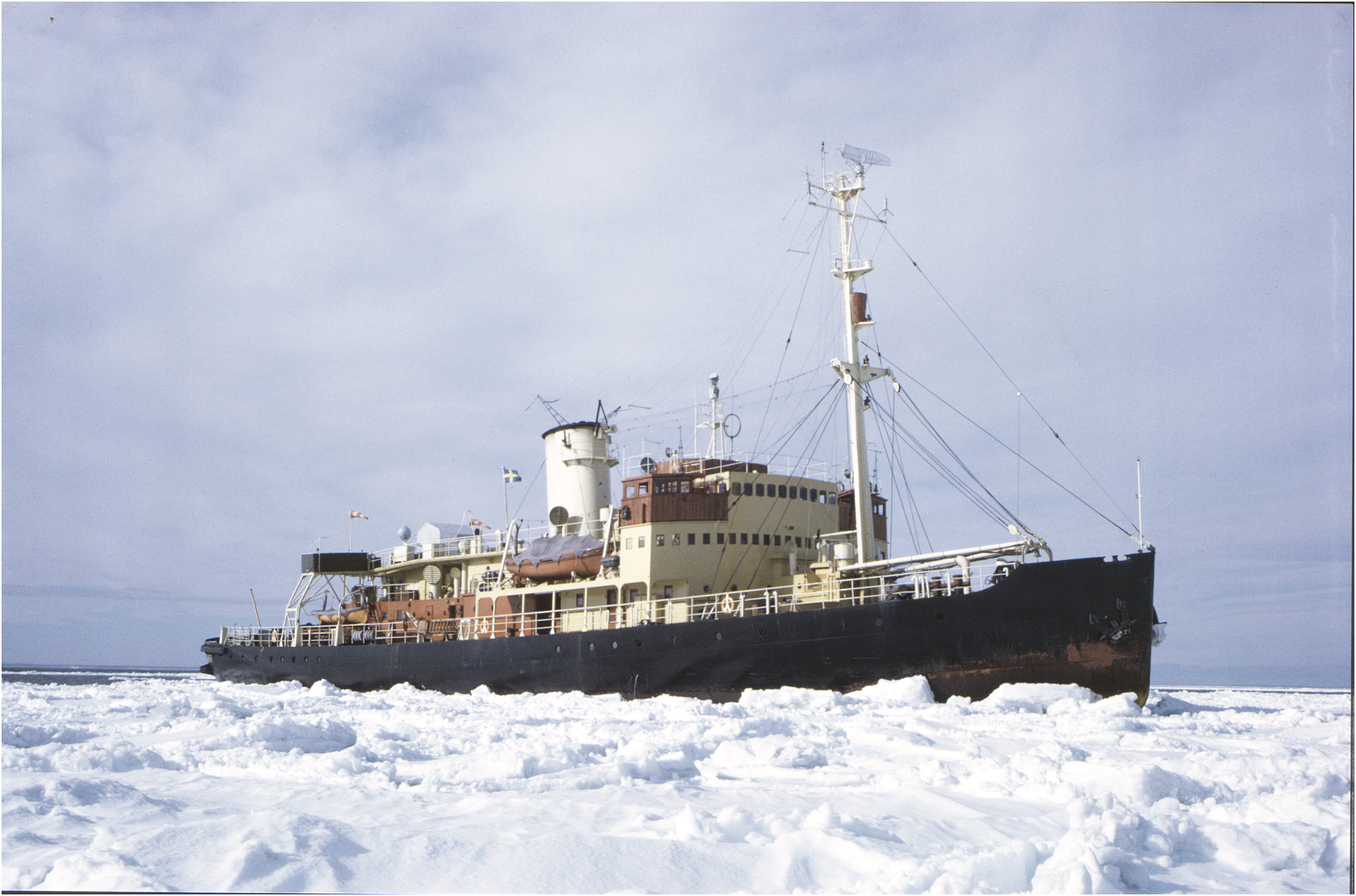
Icebreaker Ymer in the 1960s.
There was tacit understanding that the state icebreaker should be built at a domestic shipyard, even if the Swedish government asked for offers from abroad. Swedish shipyards were forerunners in the ongoing major transformation in shipbuilding, having already started to build motorized ships with engines from local machinery works. Swedish electrical and shipbuilding industries were strongly in favour of a move towards increased use of diesel–electric propulsion in demanding conditions. The final point of emphasis, however, was economic. Diesel-electric propulsion was projected to be cheaper to operate than steam, largely owing to fuel and manning costs. 39
In 1931, the Swedish state struck a deal with Kockums Shipyard in Malmö for a 6,000-shaft horsepower (SHP), three-propeller icebreaker. Upon launch in 1933, the Ymer 40 was the most cost-efficient Swedish state icebreaker to operate, and thus, the first deployed in any given winter. 41 It had a single bow propeller and two aft propellers. The bow shape was based on Finnish icebreakers from the 1920s, and Finnish officials from MKH had provided the necessary data. As a reward, they were then welcomed to study Ymer's performance in 1936, when Finland began planning its first diesel–electric icebreaker, Sisu (1939). 42
The master of the Ymer, Stellan Hermelin, was promoted to direct the icebreaker service during the Second World War. He had formulated a plan for a more systematic and international winter navigation policy with enduring knowledge transfer between public officials in icebreaking countries and new ice classifications for ships to reduce the risks of winter traffic. Finland was the obvious collaborator, and by 1955 Swedish and Finnish maritime officials had developed direct and uncomplicated relations with one another. 43 These connections were crucial for Finnish post-war efforts at developing a four-propeller icebreaker, a subject examined in the last empirical section. Before that, we need to examine icebreaker development throughout the northern Atlantic.
Transatlantic connections
The USCG cutter Storis (WMEC-38) was a light icebreaking cutter that patrolled mainly in Arctic waters from 1941 to 2007. She had a remarkably long career for a coast guard cutter, but the first thing that drew our attention was her name, which deviated from the naming tradition of the USCG. Storis was neither a name nor a place, but rather a misspelling of the Scandinavian words ‘stor is’, meaning great ice. Next, we will focus on the connections between the USCG and Scandinavian countries, which were fundamental to the development of the longest icebreaker class ever in the US, the ‘Wind’ class. This transnational connection also laid the foundation for US–Swedish information exchange that benefited both Finland and the USSR.
In the Nordic countries, icebreaking was established as a state-owned public service based on special purpose vessels. In the US, icebreaking vessels were classified as privately operated train and passenger ferries, or as governmental multipurpose cutters. The principal state authority in the US contributing to icebreaker development in the first half of the twentieth century was the USCG since it needed ice-capable cutters to enforce the law at high latitudes, to supply remote communities and, occasionally, to assist in winter navigation (Figure 5). 44
USCG officer E. Thiele's notes from Scandinavia.
The existing literature provides only limited information about the development process of the USCG polar cutters or their ice capability. A diverse set of functionality, low national priority and lack of systematic research and development contributed to the US falling behind northern European development efforts in designing dedicated, steel-hulled icebreakers with overpowered engines. The first attempt to build a dedicated polar vessel was the aforementioned cutter Northland, the design of which was based on a survey among officers with varying levels of Arctic experience. Developmental projects based on past experience tend to lean towards the conservative side. When the interviewees recommended auxiliary sails in case of ice damage far away in Arctic waters, the Northland ended up as a curious combination of an older shipbuilding tradition incorporating sails and the newest technology in shipbuilding, single-screw, diesel–electric propulsion. As the first steel-hulled USCG polar vessel, it ultimately proved that the conventional wisdom – that only a wooden hull has the flexibility to survive the pressure of the ice – was outdated. Otherwise, the ‘most expensive USCG acquisition’ proved a disappointment: underpowered in the Arctic ice, inefficient at icebreaking and difficult to handle. From the point of view of icebreaking history, the Northland was an ice-capable vessel instead of an icebreaker. Its faults laid the groundwork for a more systematic approach by the USCG to developing the next line of icebreakers.
The need for a full-fledged icebreaker in US waterways emerged in the 1930s as the result of an increased need for oil heating in large cities. Heating oil, unlike coal, could not be stored in unlimited quantities, meaning that it needed to be shipped throughout the winter. In 1933, Congress authorized the construction of an icebreaking cutter for the Hudson River. As a reflection of the urgency of the task, on 21 December 1936, President Roosevelt directed the USCG by executive order to assist with navigation and keeping navigational routes, channels and harbours open. The executive order gave icebreaking added importance, but it did not include any extra funds for research and development. According to USCG historian, R.E. Johnson, the problem was that ‘no one in the Coast Guard seemed to have known how to design an icebreaker’. 45 The faults with the in-house design of the Northland, together with the lack of resources to develop icebreaking expertise from scratch, motivated the USCG to gather available information from abroad as cost efficiently as possible.
The officer who was tasked with the transfer of icebreaking expertise from Scandinavia to the US was Edward H. Thiele (1905–1981). He had no previous expertise in polar navigation and was not even a naval architect by training, but instead an electrical engineer and a swimming coach at the Coast Guard Academy. He was married to a Danish woman though. Moreover, he happened to be in Copenhagen when the US icebreaking project was launched, sparing the USCG from having to pay his travel costs. Thiele's European leave was thus interrupted by an order to visit the northern European countries of Sweden, Finland, Denmark, Norway, Latvia and the Netherlands to study their icebreaker designs and record the dimensions of the hulls, details of the bow shape and any information about propulsion systems and propeller constellations. 46
In particular, Thiele focused on the Swedish ship Ymer. R.E. Johnson notes that ‘the head of the Swedish icebreaking service must have been amused when he explained that she combined the bow form of the Great Lakes car ferry Ste. Marie with Quincy B. Newman's diesel–electric drive’. While Johnson gave some credit to Swedish engineers for the quality of the ship's design, he determinedly overlooked the technological developments having taken place overseas during the previous 50 years by accrediting the car ferry's trivial act of driving backwards in the Great Lakes in the 1880s with the origin of modern icebreaking: ‘the basic information that Thiele sought [in Scandinavia] was readily available in the United States!’ 47
After returning to the US, Thiele participated in the design of the USCG's new icebreaking cutters, the class of four, 110-foot-long harbour tugs. Based on Scandinavian information (Table 1), the USCG Raritan (1939) and her sister ships had stronger hulls and more powerful diesel–electric engines than their predecessors. In the winter of 1940, they proved successful in breaking the ice on the Hudson River, under the types of conditions they had been designed for. 48
Later in the spring of 1940, with Germany occupying Denmark and the US State Department requesting that the USCG help protect Greenland's sovereignty, the focus of the USCG icebreaker project switched from coastal and inland waters to the Arctic. The Northland, Raritan and several other USCG ice-capable cutters joined the Greenland patrol, but none of them was a full-fledged polar icebreaker capable of breaking a navigable route for other surface vessels through multiyear polar ice. In 1941, Thiele returned to USCG headquarters, where he received an order from Treasury Secretary Morgenthau to build ‘the world's greatest icebreakers’. 49
Wartime Arctic operations laid out a new set of requirements: ice worthiness claimed priority, while seakeeping qualities were of secondary importance. Longer cruising ranges called for the utmost fuel economy, as ships had to be self-sustaining for a period of one year if caught in the ice. The ships’ machinery had to be capable of operating with outside ambient temperatures as low as −50°F. Thiele recalled afterwards that the issuing of power requirements in lieu of hull strength and space limitations ‘sounded more like submarine practice than any other type of ship’. 50
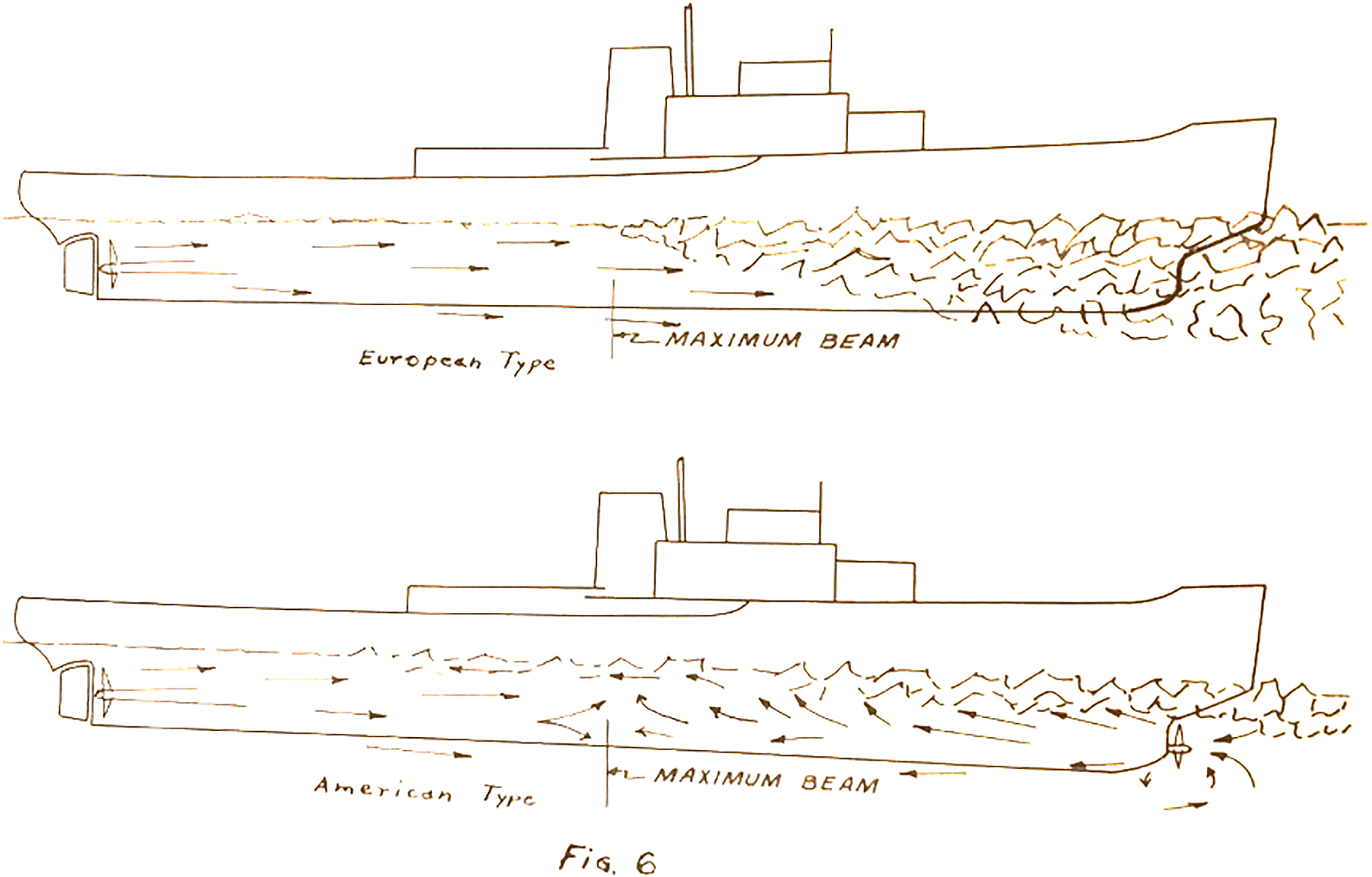
The process of advancing from transnational survey to the construction of the ‘Wind’ class icebreakers was described in detail in a presentation by USCG Rear Admiral Harvey Johnson before the Society of Naval Architects and Marine Engineering in 1946. 51 Even if the US was aiming to develop a polar icebreaker at the time, the most important design solutions originated in the Baltic Sea region: ‘the outstandingly successful Swedish icebreaker Ymer offered the closest approximation to the problem in hand, in that considerable power was installed in a ship of relatively short length, and it served as a prototype for the development of the Northwind-class vessels’. 52 Based on the survey, the ‘Wind’ class icebreakers became relatively short in proportion to engine power and beam. The USCG Wind had a hull length of 82 metres and was 19.4 metres wide, while the Ymer was 78.6 metres long and 19.3 metres wide. The ‘Wind’ class vessels were equipped with three propellers driven by 10,000 SHP, which again was close to the 9,900 SHP for the Ymer (Figure 6).
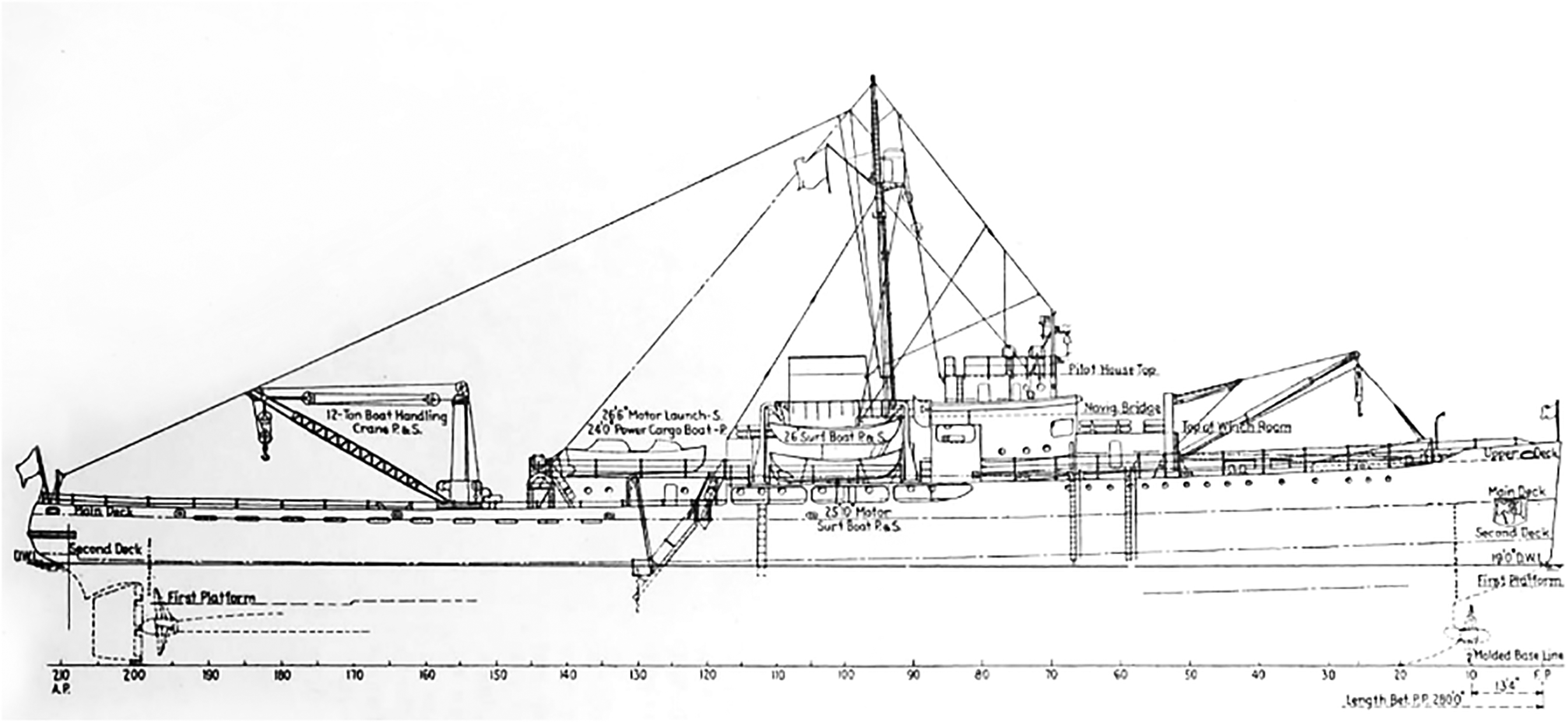
USCG Mackinaw, a smaller version of the Wind class icebreakers designed for operations in the Great Lakes.
The USCG adopted the overpowered diesel–electric drive, powerful heeling tanks, main dimensions and power ratio from the Ymer, but their response to bow propellers – proven to be superior on the Baltic Sea – was problematic when accounting for polar conditions. The USCG had physically examined only one icebreaker designed for polar waters, the Soviet Krasin, which the USSR had agreed to lend in exchange for assistance in 1941. The Krasin spent four months in Seattle and was thoroughly examined, even if retrospective American accounts diminish its role in new US icebreaker design. For example, Johnson cites Thiele: ‘[b]ut, good lord, it was a 1917 design … this was ancient history at its best’. 53
Thiele's survey relayed information on other Soviet polar icebreakers: the J. Stalin (renamed Sibir), Alexander Nevskiy and Stepan Makarov. While it is unclear how the USCG acquired this information, the Soviet Union's negative experience with bow propellers in Artic ice conditions appears to be the main evidence on which both Johnson and Thiele based their arguments on the issue. 54 The full-scale ‘Wind’ class icebreakers were equipped with detachable bow propellers that were seldom used in Arctic waters. The USCG Mackinac (WAGB-83) had three propellers like the Ymer – two aft and one forward. It was essentially a scaled-down version of the ‘Wind’ designed for the Great Lakes, where the ice conditions corresponded with those of the Baltic Sea.
By the end of the Second World War, icebreaker-building nations had acquired a basic understanding that sea ice was not just ice: conditions differed on various seas and various icebreaker designs were required. The science and technology of icebreaking was still in its infancy and lacked accurate descriptions and mathematical forms that could be used to test new innovative design ideas before ship construction. The last empirical section on the Finnish icebreaker Voima examines the culmination of icebreaker bow propeller developments before the era of model-scale experiments.
State-supported risk-taking
After the Second World War, it was evident to Finnish icebreaker technology experts that the bow propeller was effective in breaking ice on the northern Baltic Sea. The single bow propeller situated on the ship's centre line, however, had an adverse effect: a sideward movement that pushed the ship against one side of the ice barrier and increased friction. Solving this problem became critical when Finland lost two of its three newest icebreakers, Jääkarhu and Voima (1924), to the USSR as war reparations, leaving Finnish exports bereft of icebreaker assistance.
The government established a committee to plan the purchase of a new large icebreaker in January 1946. 55 The committee was chaired by the Ministry of Trade and Industry's maritime affairs director, Rear Admiral Svante Sundman. He was the personification of the state–industry nexus. Besides his other duties, he oversaw naval liaisons with the USSR and was named director of the war reparations administration ‘Soteva’ in 1948. Karl Albin Johansson was again asked to design the tender specifications for the next generation of icebreaker. The end-user organization, MKH, was led by Sundman's former navy colleague, Admiral Eero Rahola, who was not without important connections either. His younger brother was Jaakko Rahola, Professor of Shipbuilding at Helsinki University of Technology and the chief of Soteva's shipbuilding department. All key positions in Finnish maritime and shipbuilding affairs were both militarized and manned by well-connected individuals of known quantity during the postwar years. 56
The icebreaker committee took a study trip to Stockholm aboard the Swedish icebreaker Ymer in March 1946. They went through every detail of the ship, met with leading Swedish experts and received a wealth of technical and in-use information, including all of the changes made to the Ymer in an overhaul in 1945. During these talks, the possibility of including two bow propellers was raised. The Swedish were in favour of this idea, which had the potential to increase efficiency in pack ice. The Ymer, with its single bow propeller, had to back into heavy ice formations, a slow and fuel-consuming operation. Johansson was convinced that the slightly sleeker Ymer was more powerful than the Jääkarhu had been. 57 However, he disagreed on the benefits of two bow propellers and was able to turn Sundman to his view. Technical drawings in support of the committee report, drawn by Johansson, show a traditional three-propeller icebreaker of slightly larger dimensions than the Ymer (see Figure 7). 58
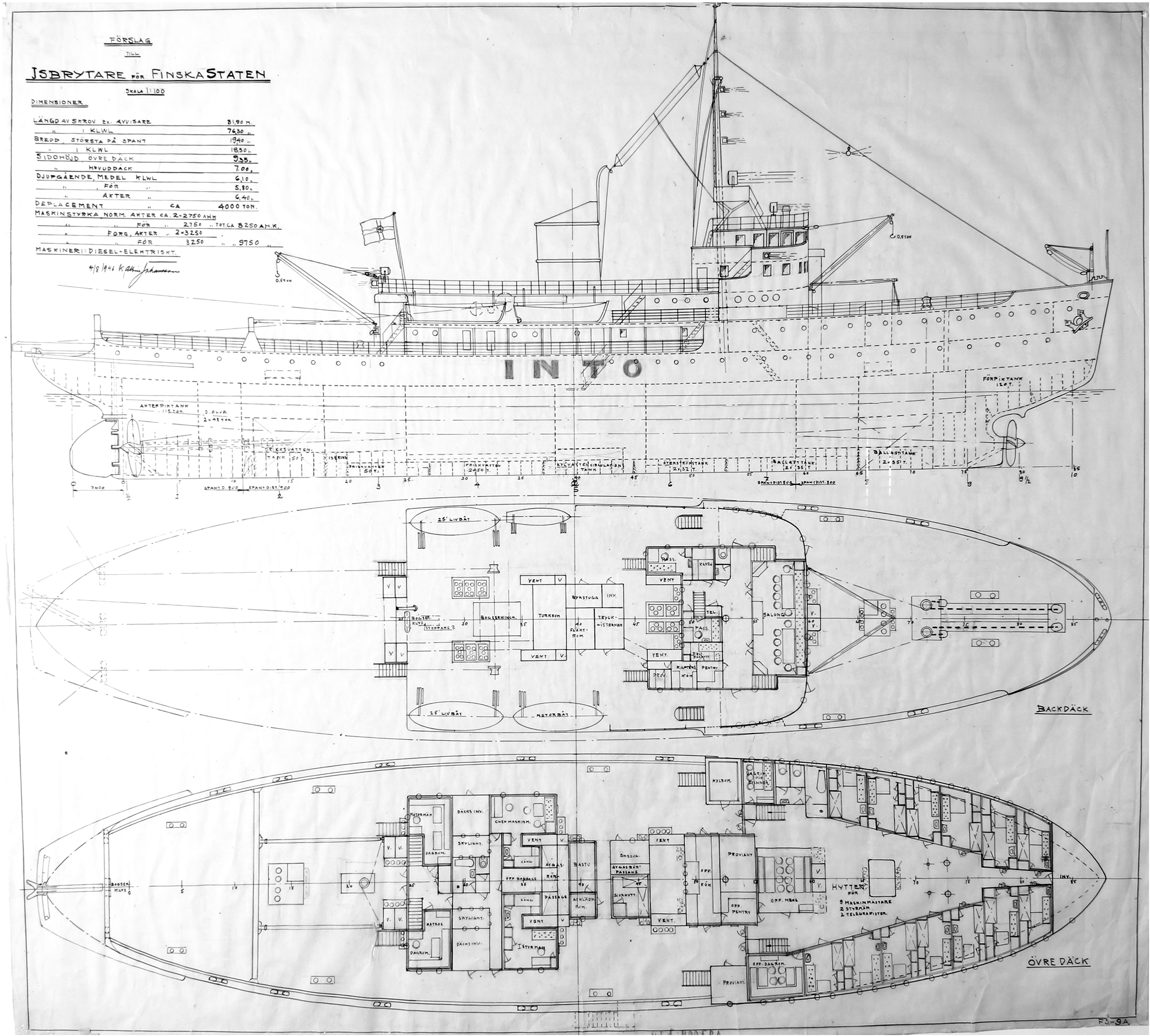
K.A. Johansson's concept drawing of a Finnish state icebreaker in late 1946, with only one bow propeller.
The Swedish icebreaking officials had received word from Canada that a new icebreaking train ferry had just been completed. The M/V Abegweit had two bow propellers that rotated in opposing directions and diminished friction on both sides of the hull. While Johansson argued that conditions at Prince Edward Island Sound differed from those in the Gulf of Finland, and that the ferry did not prove the feasibility of the novel propeller placement, Hermelin believed that Finland should test the idea. Sweden, too, was preparing to build new icebreakers, and Swedish officials were interested in how various designs, ranging from the ‘Wind’ class polar icebreakers without bow propellers to the Abegweit with two propellers, would behave. To press the issue, Hermelin sent materials on the Canadian ship directly to Director Sundman. 59
The MKH initially sided with Johansson in 1946, but prior to the release of the commission's report Eero Rahola changed his mind and sent Sundman a new letter pleading with the ministry to consider two bow propellers. Still, the final committee report omitted this opinion. In 1947, Finland was to complete a ship that was slightly larger but technologically quite similar ship to the Ymer. Fortunately for MKH and Hermelin, the Finnish state did not have enough funds to order the new icebreaker, and the propeller debate could continue. 60
Stellan Hermelin travelled to the US and Canada in March 1948 to investigate the propeller issue further. His naval background may have helped him in forming connections with the USCG. In New York, he met with USCG officials and visited the USCG Eastwind. Then he travelled to Washington, DC and USCG headquarters, where a meeting was arranged with a USCG commander, Admiral Joseph F. Farley, Captain Thiele, who had become head of the technical department, and many others. From Washington, Hermelin continued to shipyards in Detroit and Toledo and visited the USCG Mackinaw. He crossed the border into Canada to meet with St Lawrence Seaway chief engineer Maynard Metcalf, who was in charge of operations pertaining to the Abegweit. Finally, Hermelin visited the shipyard where the ferry had been built and met with its designers. Hermelin acquired numerous documents during his trip, which he promptly sent to Finland. 61
Hermelin was convinced that a two-bow propeller constellation for an icebreaker was not only feasible, but far superior to the extant single-screw design. His trip led to a reappraisal of the Finnish committee's findings. The Finnish electrical engine manufacturing company Ab Gottfr. Strömberg Oy, which had built the machinery for the prewar Finnish icebreaker Sisu and was in line to provide machinery for the new ship as well, asked Professor Jaakko Rahola to evaluate the issue anew after the ministry had downplayed Hermelin's findings. While committee specialist Johansson was the preeminent icebreaker designer, Rahola was the leading scientific authority on shipbuilding in Finland. Strömberg directors insisted that ‘it would be a great defeat for our country to leave the sea-going icebreaker with just one bow propeller’. Professor Rahola sided with the manufacturer, arguing that ‘theoretically speaking, the move from one to two bow propellers would lead to a significant increase in icebreaking capacity’. He argued that Finnish and Swedish tests on reversing icebreakers against ice formations had proved that the concept was sound. 62
Even the projected builder, Wärtsilä Helsinki Shipyard, seemed to side with MKH, Strömberg and Professor Rahola. Thus, when almost everyone around him had shifted in support of two-bow propellers, Johansson was left with no room to manoeuvre. When Wärtsilä's design department eventually drew the actual construction plans, the icebreaker Voima had its two bow propellers. 63
In 1955, Sweden ordered its largest icebreaker, the Oden, from Wärtsilä. Hermelin lobbied for buying the icebreaker from Finland because it would spare Sweden from using extra resources in designing its own icebreaker and, after all, the Voima already checked all of the boxes on Hermelin's wish list. 64 While the Swedish shipbuilding industry was capable of building such advanced vessels, it was already specializing in the serial production of large cargo ships. Hermelin obtained his modern Baltic icebreaker, and Wärtsilä was on its way to becoming the leading icebreaker builder in the world.
Conclusions
Before the first ice-model basins in the 1950s and 1960s, the technological development of icebreaking outpaced scientific understanding of ice mechanics. Icebreaker builders based their design solutions on experience, observation and approximations. No state had the resources for radical experimentation through trial and error, and neither was any shipyard willing to risk building an icebreaker that possibly would not work. How then did the technology change, given such a restricted and risk-averse framework?
We argue that, in contrast to nationalistic icebreaker histories that frame groundbreaking innovations locally, the technological development of the icebreaker was essentially a transnational process of knowledge transfer and adaptation. To deconstruct the inward-looking narratives in the existing literature, we have examined the technical establishment of certain icebreaker features – hull dimensions, diesel–electric propulsion and propeller constellations – by focusing on the role of technology carriers, individuals who were central to transferring technological solutions across borders. Our analysis of the Swedish Ymer, the American ‘Winds’ and the Finnish Voima revealed that even the most radical design solutions relied on the considerations and actions of a few, well-connected technology carriers. Even though we have focused only on these three projects for methodological reasons, it is worth remembering that these ideas were adopted and applied to varying degree in other countries as well. It would require a larger project to trace the wider network that conceived the Danish ship Bryderen (1884) and inspired the Finnish development of the German ship Stettin (1933), with its sharp ‘Runeberg bow’.
To recapitulate, technology carriers needed to have an interest in the technology in question; they were part of an entity that was organized to make technological decisions, they had the necessary social, economic and political power to realize their interest, they had information about existing solutions and access to this technology, and finally, they were able to acquire the needed knowledge on how to best manage the technology. These facets of technology carriage are presented in Table 2 on a case-country level.
Table of characteristics of various icebreakers
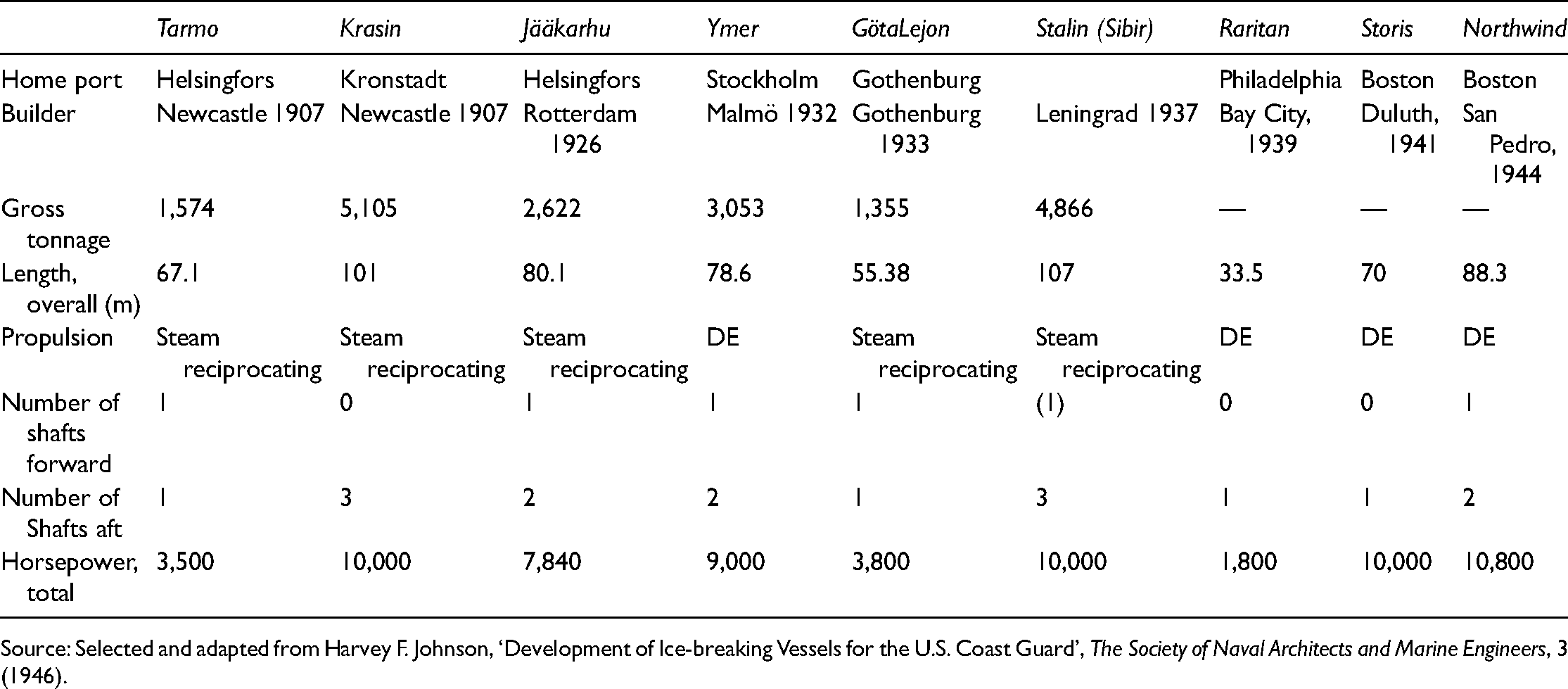
Source: Selected and adapted from Harvey F. Johnson, ‘Development of Ice-breaking Vessels for the U.S. Coast Guard’, The Society of Naval Architects and Marine Engineers, 3 (1946).
Breakdown of technology in the three icebreaker cases
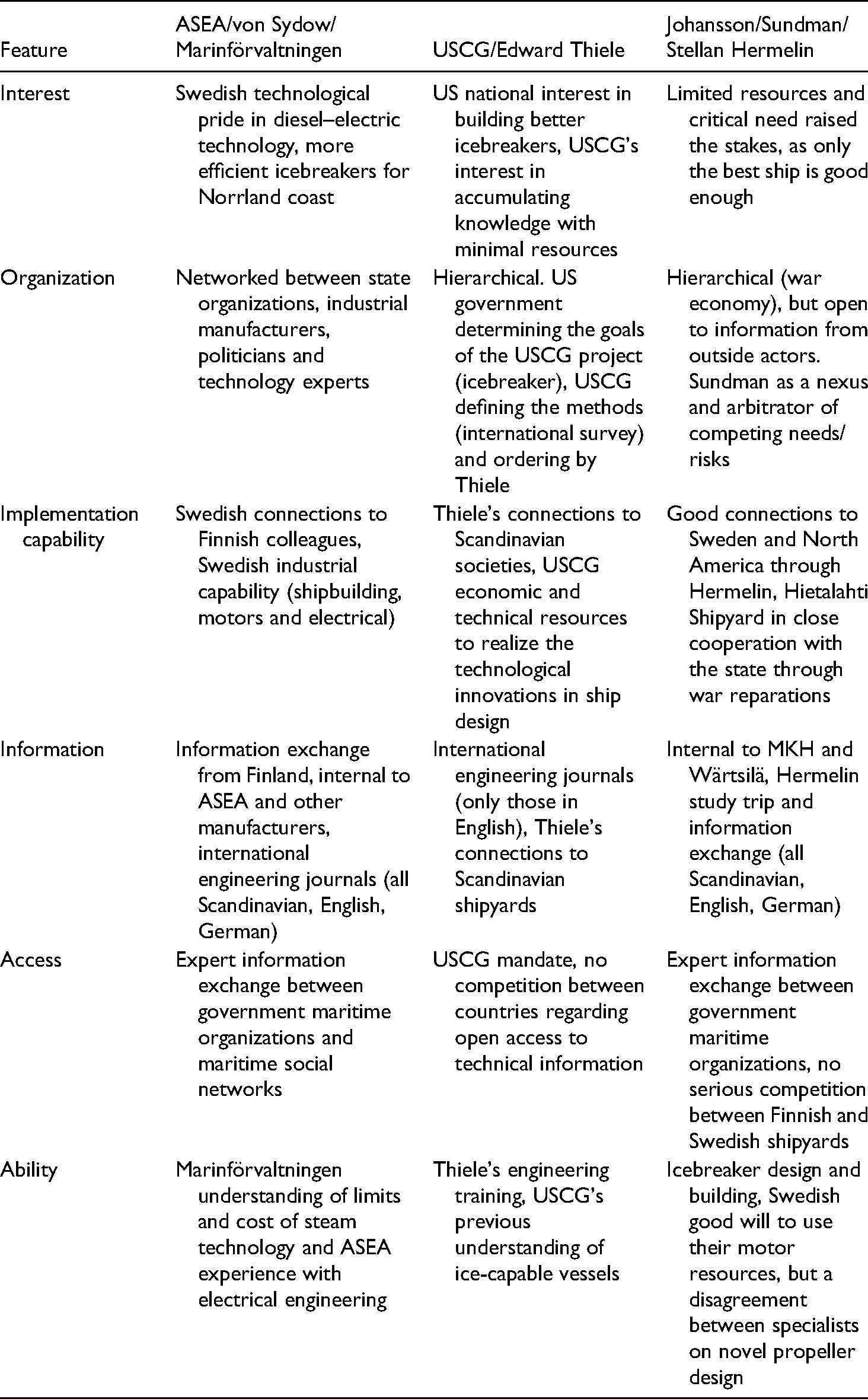
The key technology carriers in the transnational development of the icebreaker came from salient stakeholder groups. They either represented state organizations, like the Swedish organization Marinförvaltningen, the US Coast Guard or the Finnish Maritime Administration MKH, or else they acted in a private capacity representing industrial interests, like the Swedish electricity company ASEA or the Finnish shipbuilder Wärtsilä. In all cases, it was the national need for an improved icebreaker design that motivated expert actors to seek cooperation with one another and for governments to fund their efforts.
While these technology carriers were rarely system builders, they always had status in key organizations and close connections with those who chose a technology and assumed the risks, whether it was diesel–electric drive in the case of the Ymer, power-displacement ratio in the case of the ‘Wind’ ships or the four-propeller constellation in the case of the Voima. Who was and was not a state actor at any particular point reveals the messy complexity of interactions between state and industry. Arctic technology specialists developed direct international connections with one another, and new ideas were adopted through the resulting expert networks.
Most of the technology carriers who had a critical role in identifying and choosing novel technological solutions had technical training or close personal connections with technical experts. As buyers, governmental actors were often most active in pushing for new technologies and providing the necessary political leverage to muster the economic and intellectual resources necessary to realize novel technical solutions.
Technology carriers were able to visit ships and shipbuilding sites freely. Even though the Swedish SIS and Finnish MKH were governmental agencies and the USCG a semi-military organization, our technology carriers were able to transfer documents freely and even copy critical details. We explain this situation via two factors. First, between 1890 and 1954 no single company or country had a particular interest in building icebreakers for exports, nor were design solutions and technical details deemed commercial secrets. The power ratio, hull lines and propeller constellation were not patentable innovations, but rather best-known practices. Second, the technologies that the technology carriers recorded during their visits to foreign yards were relatively general in nature and not considered military secrets (Figure 8).
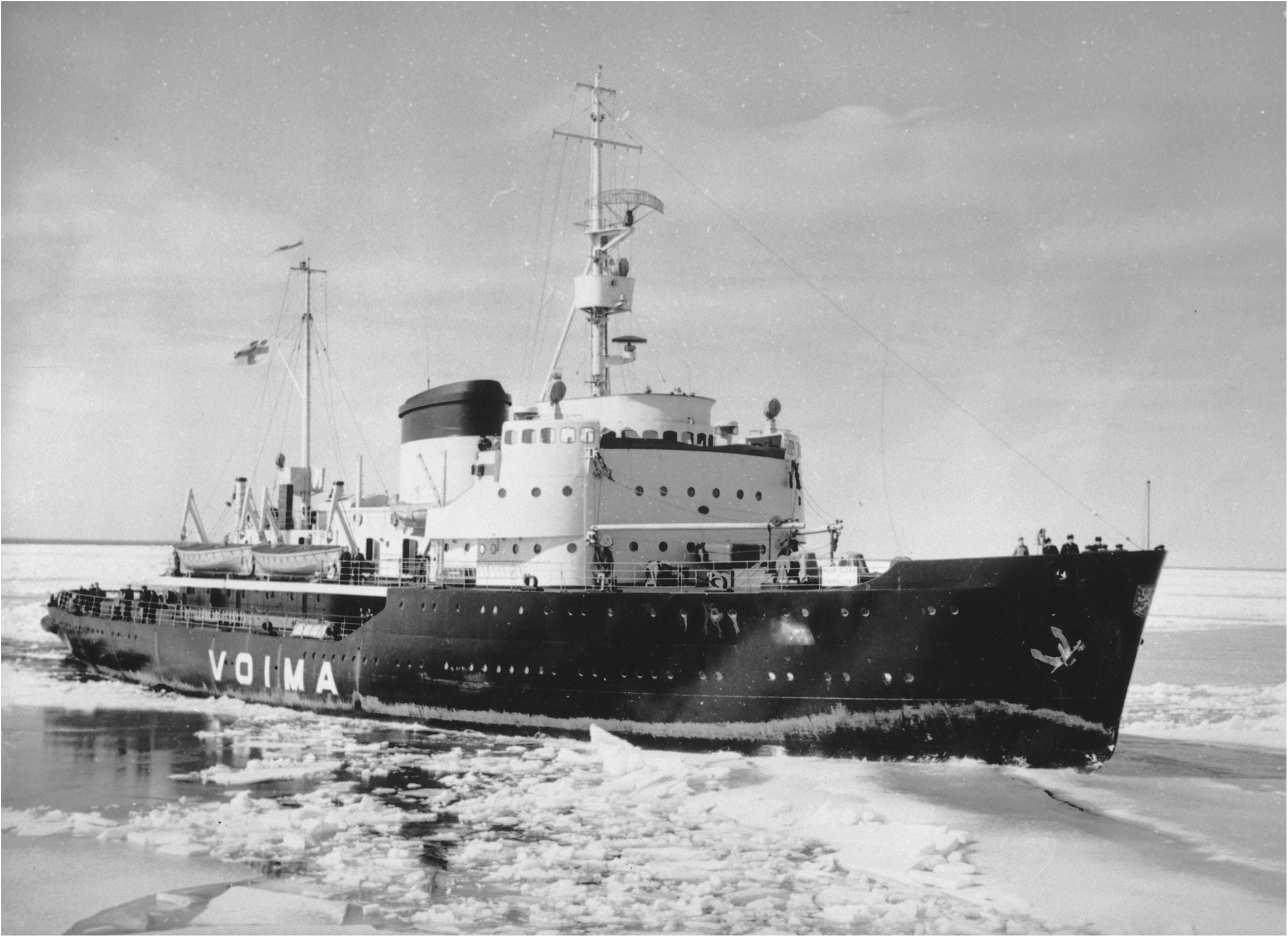
In 1954, the icebreaker Voima jumpstarted the Finnish icebreaker technology cluster that made Wärtsilä Shipyard (Helsinki) a nexus of Arctic knowledge.
Also, engineering journals published detailed reports of new icebreakers and represented another important source of information. Here, though, it is important to note a language barrier. While Finnish and Swedish actors were fluent in the Nordic languages and also often in German and English, following not only domestic affairs but also developments in other parts of northern Europe, most especially in the UK and the US, American published sources were largely restricted to the English-speaking world. The USCG therefore operated in a more limited intellectual context than the SIS or MKH.
This transnational approach to Arctic maritime technology did not change the nature of the ships. The Ymer, the ‘Winds’ and the Voima were still manifestations of Swedish, American and Finnish engineering skills, creative problem solving and state patronage. Yet the approach adopted here realigns the focus by which we interpret icebreaker history. National triumphs in maritime technology development are embedded in transnational, collaborative work between experts.
Footnotes
Acknowledgements
The research underpinning this article was funded in part by the Emil Aaltonen Foundation. It was conducted by the authors and is based on original documents in public archives and libraries. We thank our anonymous peer reviewers for their insightful comments. Our colleagues at the ‘Technology Management and Economics Program’ research seminar at Chalmers University of Technology provided us with the necessary clarity to finish this study. Timo Kunttu, Taru Laakkonen and all at the Finnish Maritime Museum were most accommodating in dealing with our requests for assistance, while Christian von Ostersehlte provided us with critical information on German icebreaker history. We thank you all!
Declaration of conflicting interests
The authors declared no potential conflicts of interest with respect to the research, authorship, and/or publication of this article.
Funding
The authors disclosed receipt of the following financial support for the research, authorship, and/or publication of this article: This work was supported by the Emil Aaltosen Säätiö

Notes
Author biographies
Aaro Sahari is a postdoctoral researcher in History at the University of Helsinki and the vice-chair of the Finnish Association for Maritime History. His research deals with the history of shipbuilding, national technologies and the politics of technology development.
Saara Matala is an historian of technology and business, with specialist interests in Arctic shipbuilding and East–West technology transfer.