




Abstract
Despite minor amendments to the Royal Navy's Articles of War throughout the eighteenth century, and a major reworking in 1749, both capital and corporal punishments were frequently employed as punishment for minor offences in a system that made England's ‘Bloody Code’ look positively humane. The 1860 Naval Discipline Act provided the first substantive overhaul of the original Articles of War, but historians have generally lamented this act as providing little comprehensive change to the governance of the navy. Using statistical data collected from thousands of courts martial records, this article takes a broad look at trends in naval courts martial, studying how these courts interacted with the legislative changes of the 1860s. Viewing how charges and sentences altered on the global scale, it becomes clear that the ‘arbitrary and cruel punishments’ of the previous century had at last given way to a centralized, formal expression of discipline.
On 11 December 1861, Commander B. G. W. Nicolas, captain of Her Majesty's Sloop Trident, was brought before court martial at Malta to answer for charges of ‘cruelty in causing unwarrantable and excessive punishment to be inflicted on two boys of the Second Class, and in ordering them to be kept on deck without food from noon until midnight, after having been corporally punished’. 1 Within a day, he was sentenced to be discharged with disgrace from Her Majesty's service, the most senior officer of the Royal Navy to receive that sentence during the 1860s. In the following month, a memorandum was penned by Lord Clarence Paget, Secretary of the Admiralty, in which he stated that their Lords Commissioners of the Admiralty could ‘find no extenuating circumstances to lessen their abhorrence of the cruelty of which it was proved Commander Nicolas had been guilty’. Despite the ‘former services of Commander Nicolas and his father’, the Admiralty saw no reason to modify the sentence, despite their power to do so under the Naval Discipline Acts of the 1860s. In the memorandum, the Lords of the Admiralty clearly stated their view on naval justice: ‘…while it is their [Lordships’] duty to enforce the maintenance of discipline, and to sanction the punishments which may be awarded by Courts Martial on those men who are brought before them for acts of insubordination, it is equally their duty to protect the men from being subjected to arbitrary and cruel punishments.’ 2
This statement – and the sacking of Commander Nicolas – seem to contradict the popular view of crime and punishment in the Royal Navy during the eighteenth and nineteenth centuries. Famous incidents such as the Bounty mutiny present accounts of brutal corporal punishments, such as the flogging of a sailor round the fleet and the ultimate punishment in the Royal Navy – being hanged from the yardarm. In 1939, Winston Churchill described the traditions of the navy, quite succinctly, as ‘rum, buggery, and the lash’, and numerous scholars have emphasized the military as the last bastion of corporal and capital punishment in many societies. 3 If this is true, then where does it leave the Admiralty's memorandum regarding Commander Nicolas’ sentence? This was an internal memorandum, issued to state the Admiralty's stance and reasoning relating to Commander Nicolas’ fate. It was not intended to be a sweeping, public statement regarding justice in the navy, nor was it meant to assuage public concerns over the draconian nature and reputation of naval punishment. Of course, it remains nigh impossible to determine how strictly the Admiralty intended to adhere to this declaration. Further trials over the decade suggest that in cases of socially elite defendants, naval courts were more than willing to look the other way, with no recorded objection from the Admiralty. 4 However, what is abundantly clear from the Courts Martial Returns of the Royal Navy is that the desire for legal reform shown in the numerous Naval Discipline Acts of the 1860s did indeed translate into at least some degree of actual change in the indictment and sentencing procedure of naval courts martial, 5 including several examples of direct Admiralty oversight. Rates of many of the more brutal punishments of the 1700s were dramatically reduced by the mid-nineteenth century, especially those involving the death penalty. 6
The legal records of the Royal Navy are organized into three categories: the punishment books of individual ships, the Courts Martial Reports, and the Returns. The most numerous of these records are the punishment books, which are interspersed throughout approximately 50,000 volumes of ships’ logs held by The National Archives at Kew, London. 7 The punishments for these minor offences were summarily inflicted by ships’ captains without need of a trial by court martial, and these sources comprise the single largest register of crime and punishment in the Royal Navy. In terms of archival volume, the Courts Martial Reports fall a distant second. The complete minutes of court proceedings, the Reports provide the most comprehensive record of the happenings of courts martial from the late seventeenth to the twentieth century. Lastly, the Courts Martial Returns provide a useful index of court proceedings from the 1740s through to the early twentieth century. Published quarterly for the Admiralty as summaries of the complete court proceedings, the Returns contain less detail than the Reports but still provide essential information regarding instances of specific charges and sentences in the navy, as well as their temporal and geographic breakdown. The sheer enormity of the punishment books and Courts Martial Reports limit their usefulness for any sort of long-term study, at least until significantly more work has been done to make these records digitally readable. Some particularly distinctive naval records have been digitized, such as Nelson's Trafalgar logs, the trials of Admiral Byng and Richard Parker, and the memoirs of many officers, a large number of which are held by the University of Michigan. The HathiTrust digital library holds the rights to digital copies of the Navy Lists for much of the nineteenth century, and numerous ships’ logs have been digitized in an effort to study global meteorological trends. 8
Most naval records, however, remain undigitized, limiting their use in a long-term comparative study, and it is here that the Courts Martial Returns supply a critical alternative. Their relatively small size (approximately 13,000 pages) make them a much more manageable source for a single historian, and the systematic manner in which they were recorded greatly aid transcription efforts. 9 That said, even 13,000 pages proved too much for a restricted timeframe, so this study is limited to the 1860s – the decade which saw the passage of the Naval Discipline Acts discussed below. In addition to this emphasis on the 1860s, I also digitized the records of selected years from the previous five decades in an effort to provide context for the changes brought about by the Naval Discipline Acts, and to illustrate trends in naval courts martial over the long-term. 10
As shown in these Returns, it is clear that the desire for change mandated by the Naval Discipline Acts existed long before they were first brought before Parliament. The number of lashes handed down by naval courts declined significantly following peace with France in 1815, and imprisonment emerged as an increasingly common alternative punishment. Although use of the lash would not be legally regulated in the navy until 1860, court-mandated floggings rarely rose above 50 lashes during much of the nineteenth century, and even instances of execution – the ultimate punishment in the sailing navy – were reduced significantly in peacetime. Of course, peace brought its own problems, forcing the much-reduced Royal Navy onto the global stage to defend the interests of the Empire. Such a widespread fleet tells a fascinating story of how understandings of naval law were disseminated worldwide, and how difficulties in global communication had a very real effect on the sentences of naval courts martial in a period of such rapid reform. Combined with other contextual information, the legal records of the navy on its distant stations show how differing circumstances altered the procedures of naval discipline, and indicate that the Admiralty's stance on the ‘arbitrary and cruel punishments’ of the eighteenth-century navy was at long last changing.
Trends in naval courts martial can most easily be studied, at least initially, through the legislation that influenced them. The various iterations of the Articles of War and the later Naval Discipline Acts took obvious inspiration from the same legal theories that influenced their counterparts in contemporary criminal courts, most clearly in the concept of legal deterrence, which formed the basis of both naval and criminal law well into the nineteenth century.
11
The Courts Martial Returns used in this study were not recorded consistently until 1755, some time after the 1749 Articles replaced the Articles introduced in the reign of Charles II in 1661. The obsession with the death penalty can clearly be seen in these early Articles, but some protection against abuse was included: …no Court martial where the pains of death shall be inflicted shall consist of less then Five Captains; at least the Admiral's Lieutenant to be as to this purpose esteemed as a Captain and in no case wherein [the] sentence of death shall pass by virtue of the Articles aforesaid or any of them (except in case of mutiny) there shall be execution of such Sentence of Death without the leave of the Lord High Admiral if the offence be committed within the Narrow Seas. But in case any of the Offences aforesaid be committed in any Voyage beyond the Narrow Seas whereupon Sentence of Death shall be given in pursuance of the aforesaid Articles or of any of them then Execution shall not be done but by Order of the Commander in Chief of that Fleet or Squadron wherein [the] Sentence of Death was passed.
12
This effectively ended the sole power that commanders traditionally held over those whom they commanded and was seen as a major step in legal reform in the navy.
The 1749 Articles of George II's reign contained relatively few changes from their 1661 predecessors, still authorizing the death penalty for the vast majority of offences. However, by the mid-eighteenth century, the common-law concept of discretionary justice that permeated the ‘Bloody Code’ was also manifest within the navy. Many of the offences, which were punishable by death in 1661, were now punished ‘upon Pain of Death, or such other Punishment as a Court Martial shall think fit to impose, and as the Circumstances of the Case shall require’. 13 This was not the case for every offence, however.
Among the most famous and widely cited exceptions to the use of legal discretion was the execution of Admiral John Byng in 1757 for ‘failing to do his utmost’ to protect Minorca from French invasion during the Seven Years War. Article 12 of the 1749 Articles clearly stated that: Every Person in the Fleet, who through Cowardice, Negligence or Disaffection, … shall not do his utmost to take or destroy every Ship which it shall be his Duty to engage, and to assist and relieve all and every of His Majesty's Ships or those of his Allies, … and being convicted thereof by the sentence of a Court Martial, shall suffer Death.
14
Unlike most other sections of the Act, Article 12 omitted any provision for clemency; even so, the officers who comprised Byng's court martial unanimously recommended him to the King's Mercy. It is still disputed whether Byng was actually guilty of these charges, but it was after the sentencing that the trial became truly noteworthy. 15 There were numerous political aspects to the King's refusal, including his personal rivalry with the ministry of Pitt the Elder and Parliament, as well as the Admiralty's desire to scapegoat Byng to divert attention away from its own strategic and logistical failings. N. A. M. Rodger noted that Byng's execution had a long-lasting effect in the offensive mindset of British flag officers, perhaps even justifying Voltaire's famous quip: ‘In this country, it is good to kill an admiral from time to time to encourage the others.’ 16 From a legal standpoint, Byng's execution was described on his grave as a ‘disgrace to public justice’. And indeed, Byng's death was the exception rather than the rule of naval justice under the 1749 Articles of War.
Unlike the Articles of Charles II, which stood for nearly a century without any major amendments, the 1749 Articles of George II were significantly altered several times prior to their total repeal in 1860. The 1779 Naval Courts Martial Act was notable for its direct response to the execution of Admiral Byng 30 years earlier, as it explicitly added an element of discretion in the sentencing of courts martial for those found guilty of violating the twelfth Article of War, freeing naval courts from solely relying upon Royal Mercy in cases of cowardice before the enemy. Additionally, the 1779 Act included a provision to prevent procedural delays for courts martial, allowing replacements to be called should members of the court be called away during the proceedings. 17 The 1797 Naval Courts Martial Act was passed in the immediate aftermath of the ‘Great Mutinies’ of Spithead and the Nore. 18 This Act further increased the discretionary elements of the naval justice system, making it easier for those condemned to death to receive conditional pardons.
The last of those minor Acts to amend and expand the powers of the 1749 Articles of War was the 1816 Naval Courts Martial Act. This largely concerned the role that gaols and imprisonment played in the early nineteenth-century naval justice system, specifically regarding methods by which convicted seamen could be removed from such gaols by government authority, on such grounds as pardon or insanity. 19 Coming into effect shortly after the final peace with Napoleonic France, the Naval Courts Martial Act mirrored the increasing popularity of imprisonment and other forms of incarceration within civilian courts, emphasizing that their use was also migrating to the navy, in turn highlighting the reforms that these systems underwent simultaneously. 20
While these minor acts were responsible for significant changes in the procedure of naval courts martial and resulting sentences, it was not until the 1860 Naval Discipline Act that the Articles of War themselves were more substantially overhauled. The most significant change included in the 1860 Act was the explicit inclusion of leeway in sentencing for naval courts. Only in the cases of traitorous conduct and murder was there no provision in the Act for alternative sentences to be used by discretion of the court, although several other offences allowed death as a possible ruling. 21 Additionally, the 1860 Act was the first piece of naval legislation that acknowledged the concept of degrees of offences, emphasizing lesser punishment for manslaughter than murder, and absence without leave than desertion. 22 This was combined with a hierarchy of punishment listed in Articles 45 and 46, specifically defining which punishments were available under what circumstances to be used in the navy, echoing a similar trend in the criminal law of the time. 23 For example, the sentence of death was prohibited unless passed by the court with a four-fifths majority. 24 Other regulations were put in place to lessen the frequency of the death sentence, such as that which required the confirmation of the sentence by a station's commander-in-chief or the Admiralty itself, where possible, with clear procedure for those sentenced to receive Royal Pardon.
The other major document that defined discipline in the Royal Navy was the Queen's (or King's) Regulations and Admiralty Instructions. Much more than a simple disciplinary manual, the Regulations was a guidebook that listed the duties and theoretically governed the actions of each member of Her Majesty's Navy. Commanding officers were solely authorized to punish those who broke the regulations, although the punishments were often restricted by the Regulations. For example, captains were forbidden from inflicting corporal punishment on petty officers and charged with protecting the men from ‘cruelty and oppression’. 25 The Regulations also limited to 12 the number of lashes captains could issue. Unlike the Articles of War, the Regulations had no centralized list of offences, and punishments were at the captain's discretion, barring the limitations in the Regulations. However, as shown in the trial of Commander Nicolas and numerous accounts of shipboard floggings, officers often ignored the restrictions imposed by the Regulations. The limit of 12 lashes was almost universally ignored, and it was not until the publishing of punishment returns in the mid-nineteenth century that some centralized effort to prevent this abuse of the Regulations was undertaken. 26
On a basic level, the distinction between the offences listed in the Articles of War and those ‘listed’ in the Regulations was the same that distinguished felonies and misdemeanours in the criminal law. Felonies were defined as ‘crimes, conviction for which resulted in an automatic forfeiture of all the felon's property to the Crown … “venomous” offences which cost a man his property … and his life’. 27 By the turn of the nineteenth century, nearly all felonies carried the sentence of death, although the liberal use of pardon ensured that relatively few executions actually took place. Misdemeanours, on the other hand, were ‘lesser crimes’, for which punishments included fines and various forms of corporal punishment, transportation overseas, and (by the late eighteenth century) short terms of imprisonment. The distinction between felonies and misdemeanours was, at least in part, shared in the Royal Navy; as the Crown protected its power to sentence felons to death, so too did the Admiralty uphold that right amongst its sailors.
Scholars have been cautious in making too direct a comparison between civilian courts and naval courts martial. 28 The two had functional differences obvious even to contemporaries, but the theoretical purpose of both naval and criminal law also had evident similarities. The obvious deterrent goals of both the 1661 and 1749 Articles of War were mirrored in the brutally draconian legislation of the 1723 Black Acts, which specified over 40 capital offences that would exist for the next century. Despite the appearance of such apparently strict legislation, historians of both naval and criminal law emphasize that, given ample use of the pardon, few of these numerous capital offences ever saw the death sentence deployed. A quick search of the legal database The Digital Panopticon shows that less than 30 per cent of the 5,443 capital convicts sentenced at the Old Bailey from 1750 to 1850 were actually put to death. 29 Barring extreme circumstances, the death sentence was even rarer in the Royal Navy, especially during times of war. Although execution was still used, as Voltaire famously stated, ‘pour encourager les autres’, even in major instances of murder, mutiny and sodomy, the Royal Navy had a very practical reason to avoid the death penalty wherever possible: shortage of manpower.
As Arthur Gilbert has argued, the professionalization of both the officer corps and seamen of the mid-to-late eighteenth-century navy had a decided impact on both corporal and capital punishments, especially when compared to their army counterparts of the same period. Unlike the average foot soldier, who was easily replaceable, able seamen were skilled labourers in every sense of the word, and the mutual respect that existed between such sailors and their officers would often preclude such horrific punishments. 30 Richard Woodman has emphasized such a social contract, arguing that the harsh punishments meted out by both captains and courts martial were seen as fair, provided that the officers respected the professional capabilities of the seamen. 31 This bears some comparison with the goals of the criminal law as described by Douglas Hay, 32 as naval law provided protection from abusive officers (at least in theory) while emphasizing the rigid rank and social strata that framed life aboard a warship – a much clearer example of Hay's thesis, perhaps, than any provided in civilian society.
Unlike the 1661 or 1749 Articles of War, the Naval Discipline Act of 1860 did not go unamended for decades. In fact, no less than five Naval Discipline Acts were passed from 1860 to 1866, with further amendments in 1884 and into the twentieth century. The sheer frequency of these Acts suggests the importance of legal reform in the navy in the minds of Parliament and the Admiralty. 33 The 1861 Act was almost entirely identical to that of 1860: over 94 per cent of the language was exactly the same. 34 The few differences further defined discretionary freedoms in sentencing under the 1861 Act, freedoms that were not always explicit in the 1860 measure. The 1864 Act contained even fewer changes than its predecessor, but its alterations also focused on emphasizing the various punishments available to naval courts. This was especially the case with the addition of the new Articles 39 and 40, which expanded on sentencing regulations for officers guilty of breaking Prize Law. 35 In 1865, the Naval Discipline Act Amendment Act was passed by Parliament, by far the shortest of any of these measures. Its sole provision increased the minimum term of penal servitude sentenced by court martial from three to five years. 36
The final amendment to the Naval Discipline Act in the decade was passed in 1866, which, unsurprisingly, was extremely similar in wording and intent to all others. Like many of its former iterations, the changes of 1866 largely centred on more explicit definitions of sentences for various offences. Unlike the previous Acts, however, it also provided several new Articles. The majority of these additions related to instances of desertion and absence without leave, specifically emphasizing the difference between these two offences and the consequences that those found guilty would suffer. The Act also included a major alteration in the court martial process itself, providing an opportunity for the accused to raise any objection to the court's constitution they wished, with the final decision resting on the court itself. 37 In all, the flurry of legislation following the original Naval Discipline Act brought forth only minor changes to the statute law of the navy, and the lack of debate surrounding the amending Acts of 1864–1866 emphasized the ease by which they were accepted by the Admiralty and Parliament. 38
The legislation that shaped naval law and the courts martial process during the nineteenth century had a very long pedigree. From the various iterations of the Articles of War to the Naval Discipline Acts of the 1860s, the law of the Royal Navy built upon legal traditions stretching back centuries, evolving constantly and symbiotically with the criminal law that developed alongside it. Even in the earliest versions of the Articles of War, provisions were made for pardon or discretion on behalf of the courts; and despite exceptions, such as the infamous trial of Admiral Byng, these provisions only became more explicit and expansive as time passed. However, to claim that legislation gives an accurate representation of patterns of crime, punishment and legal reform is naïve at best, necessitating a deeper look into the Courts Martial Returns of the Royal Navy to determine to what effect, if any, the aforementioned legislation actually had.
Churchill's summation of the ‘traditions of the navy’ was equally evocative and cynical, but the very fact that such an understanding of naval society was common knowledge suggests that it had at least some basis in fact. But how did the reality of corporal and capital punishment measure up to the popular image of it? How often did naval courts live up to the reputation of flogging a man ‘round the fleet’ or hanging him from a yardarm? Most importantly, perhaps, did the changing legislation of the Pax Britannica have any appreciable effect on long-term patterns of corporal and capital punishment in the nineteenth-century Royal Navy?
In the case of the death penalty, such questions are relatively easy to answer. With its deterrent goal, hanging was an inherently public affair in both civil and naval society, so any reports of those put to death are generally well documented. In the navy, the death penalty was the most severe possible punishment, reserved for the most serious of offences. However, despite the infamous history of being ‘hanged from a yardarm’, the death sentence had been closely regulated since the earliest days of the formal navy. That said, 20 of the 32 Articles of War for 1661 listed the death sentence as a possible outcome, with many listing it as the only sentence. Little changed when these Articles were replaced in 1749, which specified almost as many offences pronouncing the death penalty to be the sole acceptable punishment. Still, just because an Article specified the death penalty did not mean that naval courts routinely followed through.
Many scholars of English criminal law have noted that the death penalty was routinely implemented only in such cases where courts particularly wished to make a deterrent example. 39 For much of its history, manpower was the Royal Navy's most valuable resource and many of its administrative and disciplinary efforts – including the death penalty – were focused on maintaining it. The need for skilled sailors was all the more acute in times of war, which prevailed during much of the eighteenth century. Volunteers were almost always in short supply, and many of the methods used to acquire the necessary sailors did not deliver them in sufficient numbers. Impressment, the most infamous method of forced recruiting, was generally successful in achieving the quantity of men needed to man the thousand or so ships of the Napoleonic-era fleet, but these ‘recruits’ rarely afforded the quality sorely needed by ships’ commanders. This was especially true when the impressed sailors were not delivered by naval press gangs, but by local magistrates eager to rid their towns of criminals and vagabonds. 40 It was for this reason that the majority of the offences against naval manpower listed under the Articles of War threatened death to those who violated them.
Among the most convincing methods of categorizing naval courts martial is that proposed by John Byrn, who argued that the trials can loosely be grouped into two major categories: social crimes and naval offences. 41 The former are crimes, as defined under the British criminal law, which the Admiralty was also empowered to punish, including, for example, murder, sodomy and theft. The latter category included offences to ‘the prejudice of good order and Naval Discipline’, such as cowardice, desertion or mutiny. Byrn argued that the category to which the trial belonged influenced its very structure, as trials for social crimes were much more likely to use civilian legal precedent in their sentencing than were trials for naval offences. 42 Although he treats an era significantly earlier than the one studied here, Byrn's analysis of courts martial during the Revolutionary and Napoleonic Wars provides a convenient method of categorization that can be applied to the 1860s.
For these reasons, determining patterns of execution in the Royal Navy is not so easy as simply studying statute law. The Spithead mutiny of 1797, which saw the entire Channel Squadron rise up ‘to the prejudice of order and Naval Discipline’, did not result in a single execution: a general pardon was issued by the King. Even the following mutiny at the Nore, after which over 60 sailors were sentenced to death under Article 19 of the 1749 Act, resulted in fewer than 30 executions over the weeks that followed – certainly a very large group for the day, but significantly fewer than may have been executed. 43 The remainder received various sentences, ranging from hundreds of lashes to transportation, but still significantly less severe than the death sentence that the Articles of War prescribed. On the other hand, Admiral Byng's death sentence was exactly in line with the Articles, but his lack of a pardon surprised many contemporaries both within and outside of the navy. Clearly, the Articles of War were at least as flexible as the criminal law.
In his Reveries of the Art of War (1759), Maurice de Saxe devoted a significant portion of his first volume discussing crime and punishment in the eighteenth-century French Army. Although numerous aspects are incompatible for purposes of discussion, given the plethora of differences between English and French legal systems, let alone those of the Royal Navy and French Army, de Saxe emphasized a matter of such stark practicality that it bears mentioning even in a foreign context. Emphasizing one particular article of French military law, de Saxe noted the methods by which execution may be avoided: We have, for example, one very pernicious custom; which is, that of punishing marauders with certain death, so that a man is frequently hanged for a single offence; in consequence of which they are rarely discovered; because every one is unwilling to occasion the death of a poor wretch, for only having been seeking perhaps to gratify his hunger.
44
De Saxe argued that such regulations were often avoided, not necessarily due to any great level of sympathy from commanders, but from the very real desire not to hang valuable soldiers. In the naval context, Arthur Gilbert argues that the highly skilled, professional nature of the trained seaman made this desire particularly strong in the navy, which is clearly borne out in the death sentences of nineteenth-century naval courts martial. 45 As shown in Figure 1, of the 22 death sentences passed during selected years from 1816 to 1869, over half were pardoned.
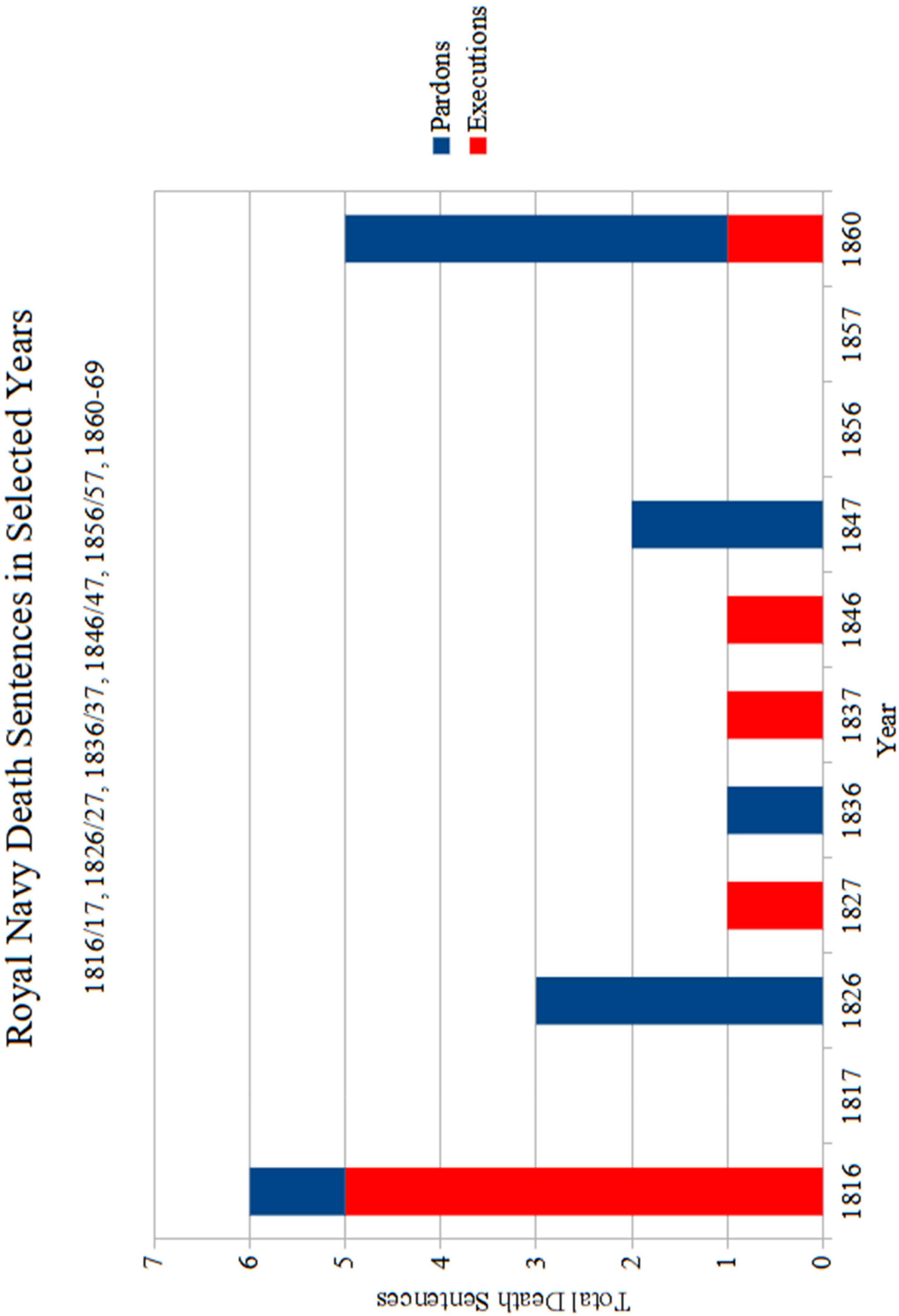
Data collated from TNA, ADM 194/42, 194/180, and 194/181. Includes trials where the sentence was ‘to suffer death’. The spike in 1816 was the result of the sodomy trials aboard HMS Africane. See B.R. Burg, Boys at Sea: Sodomy, Indecency and Courts Martial in Nelson's Navy (London: Macmillan, 2007).
Perhaps even more notably, aside from one instance of murder in 1837 (not pardoned), all of the death sentences were pronounced for either sodomy or assault on a superior officer, both of which were much more likely to be pardoned as the century progressed. The final execution in the years studied, that of Royal Marine Private John Dalliger of the Leven in July 1860, involved the shooting and wounding of his Commander and Acting Second Master.
When perusing the Courts Martial Returns, it is somewhat surprising to note that the presence or absence of war was a fairly minor factor in influencing the frequency of death sentences. Many of the navy's listed capital offences were specific to wartime, such as cowardice in the face of the enemy, but the charges that actually saw men hanged in the nineteenth century were not. The trial records of the period, therefore, show little correlation between active war and executions, even long before the legislation changed in the 1860s. In the years studied, only 1816 saw a significantly higher number of death sentences than the general average of two per year. This rash of executions aboard HMS Africane in late 1815 and early 1816 were quite anomalous, and clearly display the acute disdain felt for sodomites by contemporary society. Comparatively, the single sodomy trial held at London's Old Bailey in 1816 also saw the accused executed. 46
Despite these instances, by far the most notable observation regarding capital convictions in the nineteenth-century Royal Navy was the complete absence of such sentences following the passing of the 1860 Naval Discipline Act. The number of annually reported courts martial exploded in 1860 compared with previous years, despite a proportionally minor increase in the actual population of the fleet. 47 However, aside from the five death sentences passed in 1860, only one of which was carried out, not one of the nearly 2,000 Courts Martial Returns of the remainder of the decade involved the death penalty in any capacity, despite the existence of offences that still carried that sentence. As previously discussed, the Naval Discipline Act 1860 completely overhauled the punishments and sentences laid out in previous iterations of the Articles of War, providing a formal hierarchy of punishment and offering significantly more flexibility in sentencing to naval courts. 48 And it is quite clear that the Admiralty and naval courts made full use of this leeway, not only during the 1860s but long before as well.
Even more so than execution, corporal punishment has long been a hallmark of the abuses of the naval justice system. To this day, flogging with the feared cat ‘o nine tails remains the most infamous of the navy's punishments because, unlike the death penalty, it was well within a commanding officer's rights to issue some manner of corporal punishment without trial. Additionally, it was well known that, despite the limitations of a captain's power in such matters by the King's Regulations and Admiralty Instructions, officers frequently assigned more than the maximum twelve lashes. Both Rasor and Byrn emphasized that these violations often saw floggings of several dozen lashes or more, a truly horrific punishment even by the standards of the nineteenth century. 49
Although the receipt of ‘a dozen on the rack’ was the most common form of flogging, corporal punishment took several forms in the Royal Navy during the eighteenth and nineteenth centuries. One of the most infamous, ‘flogging round the fleet’, was a death sentence in all but name and was employed only by particularly strict disciplinarians for the most serious offences. Usually the punishment for an offence convicted by court martial, as a single captain did not have the authority or ability to issue it, a sailor flogged round the fleet received a set number of lashes (usually 12, possibly more) from every ship in the squadron. 50 Depending on the number of ships, this could easily involve several hundred lashes, when far fewer were often fatal. Fortunately, such a punishment was only used for a short period and was never issued by any of the courts martial analyzed in this study. 51
Corporal punishment in the Royal Navy took on another particularly grisly aspect in the form of ‘running the gauntlet’, sometimes referred to as ‘gauntlope’. Such a punishment, usually reserved for theft or some other crime that affected the ship's company as a whole, allowed the crew to beat the prisoner with pieces of belt or rope while the victim was escorted around the deck by an officer and marine. 52 It is questionable whether such a punishment was ever explicitly sanctioned by the Admiralty, and it was formally banned in 1806. As with flogging round the fleet, it never appeared in the analyzed records. Much like the death sentence, flogging round the fleet and running the gauntlet were as much intended as a deterrent for the witnesses as they were a punishment for the prisoner, as the crews of the ships involved would either witness or perhaps even take part in these extreme forms of corporal punishment.
A much more common form of corporal punishment in the Royal Navy was the practice of ‘starting’. Unlike ‘true’ flogging, starting was the practice whereby senior petty officers would use lengths of rope or other blunt objects to drive men to work harder or faster. Issued at the discretion of the petty officers, starting did not require the oversight of a senior officer or formal court to implement, and is therefore extremely difficult to study with any sort of consistency. That being said, numerous social historians of the Royal Navy, both contemporary and modern, as well as many first-hand accounts, emphasize how widespread the practice of starting was, and the extremely negative public response it generated was a large factor in its banning by the Admiralty in 1809. However, as Peter Kemp has noted, the practice continued for quite some time even after this order, and given its unregulated nature, it is extremely difficult to determine exactly how widespread illegal starting actually was. 53
Flogging round the fleet, running the gauntlet and starting were only officially sanctioned for a short period, but traditional flogging was formally employed by the Royal Navy for a much longer time. The Queen's Regulations and the 1860 Naval Discipline Act, at least in theory, greatly limited the number of lashes that officers and courts martial could assign, and numerous governmental reports during the nineteenth century kept Parliament and the Admiralty well informed as to the number of lashes handed out annually. 54 Unlike capital punishment, which rested solely in the hands of naval courts, corporal punishment and flogging were tools of discipline used by commanding officers at their discretion until their eventual prohibition in 1879. Therefore, the story that is told in the Courts Martial Returns is only part of a much larger narrative, and likely a small part at that. Rasor noted that although the numbers of sailors annually flogged fell quite dramatically during the mid-1800s, the average lashes awarded grew steadily from approximately 24 to 36 between 1830 and 1865. 55
Of course, the use of Courts Martial Returns to analyze corporal punishment can only reveal so much. Quarterly returns and stricter oversight by the Admiralty, at least in theory, helped to enforce the regulations surrounding flogging. As shown by the aforementioned trial of Commander Nicolas of the Trident, however, particularly tyrannical or sadistic captains chose to ignore these regulations well into the 1860s. Even those officers who chose to obey the new regulations regarding crime and punishment were left feeling as if their hands were tied, barred from their traditional methods of quelling disorder and restoring discipline by an Admiralty perceived as too eager to cave in to public demands. 56 The ultimate end to corporal punishment in the navy in 1879, not long after the passing of the Naval Discipline Acts, shows that public and parliamentary concern was not alleviated by the extreme tightening of regulations surrounding the lash.
The eventual decline of corporal punishment in the Courts Martial Returns was every bit as complex as the flogging used for shipboard discipline. Clearly naval courts were willing to sentence prisoners to even several hundred lashes rather than death, and such sentences continued well into the nineteenth century. The years analyzed throughout the first decades of the century show frequent sentences of over 100 lashes. One particular case, the court martial of Marine Private Thomas Foster ‘for having struck one Ensign Butler of the 39th Regiment, who had prevented him from committing a robbery on a sailor’, imposed 600 lashes. 57 Unsurprisingly, the most severe sentences were as punishment for equally serious crimes, such as mutiny and striking superior officers. As has been noted in comparisons between army and navy punishment, however, soldiers were often punished much more severely than sailors, and marines were often more likely to receive harsher floggings than seamen or petty officers. Even after the Naval Discipline Act prohibited sentences of over four dozen lashes, over 20 per cent of the nearly 2,000 courts martial of the 1860s prescribed some magnitude of corporal punishment, nearly always the full four dozen lashes. Even after imprisonment became a more widely accepted punishment, gaol terms nearly always incorporated some manner of corporal punishment. Still, by the end of the decade, the number of corporal sentences handed down by courts martial had fallen dramatically: only 20 in 1868 and 1869 combined (see Figure 2). This period also saw the growth of many other potential outcomes, which included reductions in seniority or, much rarer, rank, formal admonishments and the withholding of pay.

Data collated from ADM 194/180 and 194/181. Note the sharp decrease in floggings during the last years of the decade, especially compared to the proportionately consistent sentences of imprisonment. ‘Other’ includes reductions in seniority/rank, monetary punishments, acquittals and other less common outcomes.
Why was this the case? For an organization that had depended on the lash for centuries to uphold order and discipline, why was the Royal Navy of the 1860s now so willing to strictly regulate its use, then fully to give up corporal punishment less than 20 years later in 1879? 58 The answer, as noted earlier, was parliamentary pressure. Both the navy and Parliament were well positioned in the late 1850s to accept substantial change to longstanding traditions. The recent end of the Crimean War brought with it questions of the British Army's preparedness to fight a conflict in Europe, and push for reform likely reached the navy as well. On the naval side, the secretary of the Admiralty, Lord Clarence Paget, had become a loud voice of reform, using his presence in the House of Commons to advocate for early and expanded adoption of ironclad warships. 59 This reform was extended, by either personal belief or political necessity, to include the social composition of the navy, lamenting his inability to make substantive change to naval governance before this point. 60
This placed Lord Paget into a curious alliance with Admiral Sir Charles Napier, who commanded the Baltic fleet during the Crimean War. Ending the war as a ministerial scapegoat, Napier returned to a seat in parliament, where he developed a very radical reputation on both naval and civilian matters. Despite seeming a natural ally of Paget, the two were quite hostile to one another, Paget having incurred Napier's wrath due to poor performance in the Baltic and having subsequently assisted in his discrediting. 61 However, as is clear from a parliamentary debate held just weeks before the passing of the first Naval Discipline Act, the two evidently agreed on the necessity of naval reform.
This debate proved illuminating as to stated political views regarding discipline in the navy. Perhaps most surprising was the near total lack of any recorded objection to the Bill, even from the opposition themselves.
62
In fact, the majority of debate centred around whether the Bill went far enough in stamping out traditional symbols of naval tyranny, by limiting the powers of abusive captains and reducing or eliminating the navy's reliance on corporal and capital punishment.
63
Individual clauses of the Bill generated substantial debate regarding severity of punishment, but among the largest centred around the lash, John Brady stating that Parliament ‘should like to have some assurance that corporal punishment would be limited to a certain number of stripes, as it was in the army’.
64
Even at this early date George Hadfield, MP for Sheffield, argued: that severe corporal punishments did not promote discipline, and that public opinion was much against such punishments. In the prisons in Yorkshire the ‘cat’ had been abolished, and with advantage. … [he] disapproved of flogging entirely, both in schools and in the military services, and he contended that as the discipline of neither service had been relaxed by the relaxation of corporal punishment, it might safely be dispensed with altogether.
65
Numerous other members, notably William Williams (Lambeth), argued for a greater effort to completely abolish flogging, and although such cries were ultimately unsuccessful at this point, substantial discussion still occurred, particularly surrounding what a ‘lash’ actually entailed: but from the mode in which the lashes were laid on, [naval flogging] was much more severe than in the army. It was usual to strike with greater force, and take time between the lashes. He [Williams] had been told that 50 lashes in the navy were equal to 200 in the army.
66
This was confirmed by Admiral Napier, and a hard limit of four dozen lashes was eventually agreed upon.
Similar discussion occurred surrounding the sentence of death. Most notably, it was removed from a great number of offences where such a harsh sentence was deemed incongruent with the severity of the charge. For example, Admiral Napier argued for its removal for ‘misconduct of men in action’, stating that: it was not to be supposed that every man who, if necessity ever arose for impressment, might be pressed into the service, should possess sufficient nerve to be able to fight in an action; and to condemn such a man to death would be a most unjustifiable proceeding.
67
Similarly, there was significant debate regarding the legality of the conferral of such sentences. Williams and another MP, James White (Brighton), argued that in civilian courts the sentence of death might only be passed with a unanimous decision by the jury, so too in naval courts should the sentence only be passed by a unanimous decision of the court – at the time, it stood at a two-thirds majority, as it had since 1661. 68 It was cautioned, however, by Attorney-General Sir Richard Bethell, that no precedent for such unanimity existed in military law, and the check on abuses of such power rested with the Crown. Evidently those present were convinced, as the clauses were agreed upon. 69
Through these debates, how the general opinion regarding corporal punishment changed during the mid-nineteenth century is discernible. The beginning of the century saw sentences that would often prove fatal due to their severity and a social environment that normalized corporal punishment through the practice of starting and public flogging. The publication of quarterly Punishment and Courts Martial Returns by mid-century assisted in improving the power of Parliament and the Admiralty in overseeing the actions of the far-flung navy. Despite somewhat frequent violations of these limiting regulations, as shown by the work of other historians and the occasional trial for their violation, it is clear from the court martial records that, as with the trends surrounding the death sentence during the same period, the general reduction in flogging in the nineteenth-century navy was actually well under way by the time of the Naval Discipline Acts.
On 26 November 1862, Lieutenant Thomas Simeon of HMS Miranda was brought before court martial in Australia on charges of ‘neglecting to come on board from the shore to keep the watch; and for being off the deck during his watch’. 70 The following day he was adjudged to be ‘placed at the bottom of the List of Lieutenants of Her Majesty's Navy, and to be dismissed from HMS Miranda’, a fairly common sentence for officers and petty officers during the period. However, the sentence was ultimately suspended by the station's commander-in-chief, Commodore Burnett, due to an objection Simeon had raised regarding the makeup of the court. 71 Specifically, the captain of the Miranda was serving as the President of the Court, something explicitly outlawed in the 1860 Naval Discipline Act. 72 Questions of guilt aside, the fact that a senior officer of the Royal Navy was clearly so invested in the proper practice of courts martial in a period of abrupt legal reform emphasized how fundamentally the legal attitudes of the navy were changing. Another such example took place five years later on 7 December 1867, when Stourton Needham, assistant paymaster of HMS Landrail, was charged with ‘being unfit for the performance of his duty from the effects of intoxicating liquors… and behaving in a contemptuous manner … to his Commanding Officer’. 73 In this case, the proceedings and sentence were cancelled due to two of the members of the court also being called as witnesses – something not technically illegal under the Naval Discipline Act, but sufficiently controversial that the Admiralty issued a memorandum to guide courts on this issue in future. 74
Unlike the trial of Commander Nicolas, which was as unique for its extraordinary circumstances as for the Admiralty's response, the trials of Lieutenant Simeon and Mr. Needham were mundane. Failing to appear for watch was not an uncommon offence listed in officers’ trials, and the combination of drunkenness and contemptuous language was among the most common charges of the 1860s. The response of the Admiralty (or other senior officers) to these trials, therefore, is quite significant, especially given the memorandum published in the wake of Needham's trial. The willingness of senior naval administrators to not only work with Parliament to fundamentally change the governing legislation of the Royal Navy, but also of individual officers and sailors to effect change from within, reveals a very different Admiralty than that described in previous centuries.
Reform was unquestionably rooted in self-preservation, as public and Parliamentary pressures convinced the Admiralty that such change was necessary for their survival as an institution, but reform-minded officers such as Admirals Sir Charles Napier and Lord Clarence Paget worked from within the navy to advocate for change as well. Within a few short years of the passing of the first Naval Discipline Act, its effects were clearly visible in the Courts Martial Returns worldwide, in such examples as the virtual disappearance of the death sentence, the sharp decline in flogging, and the corresponding increase in imprisonment and other forms of non-corporal punishment. Charges which began the century carrying the unwaveringly imposed death penalty, such as sodomy and mutiny, had lessened in degree, and by 1879 even flogging would be suspended by the navy. By the end of the 1860s and after numerous Naval Discipline Acts, it had become obvious that the traditions of ‘rum, buggery, and the lash’ had given way to a more formalized approach to crime and punishment in the Royal Navy, one that placed the primary responsibility for maintaining discipline in the fleet upon the Admiralty and naval courts rather than individual officers.
Footnotes
Declaration of conflicting interests
The author declared no potential conflicts of interest with respect to the research, authorship, and/or publication of this article.
Funding
The author would like to thank Drs. David Zimmerman and Simon Devereaux for their invaluable supervision and assistance with the thesis from which this article is taken, as well as the University of Victoria which aided with research funding.

Notes
Appendix 1. Primary Sources
The National Archives, Kew, Admiralty Series
ADM 194/42, Courts Martial Indices, 1812–1855. ADM 194/180, Courts Martial Returns, 1855–1864. ADM 194/181, Courts Martial Returns, 1865–1872. Act for the Establishing Articles and Orders for the regulateing and better Government of His Majesties Navies Ships of Warr & Forces by Sea, 1661 (13 Cha. II St 1, cap. 9). An Act for amending, explaining and reducing into One Act of Parliament, the Laws relating to the Government of His Majesty's Ships, Vessels and Forces by Sea, 1749 (22 Geo. II, cap. 33). An Act to explain and amend an Act made in the Twenty-second Year of the Reign of His late Majesty King George the Second, intituled ‘An Act for amending, explaining, and reducing into One Act of Parliament the Laws relating to the Government of His Majesty's Ships, Vessels, and Forces by Sea’, 1779 (19 Geo. III., cap. 17). An Act to extend the Powers of an Act of the Thirty-seventh Year of His present Majesty, for enabling His Majesty more effectually to grant conditional Pardons to Persons under Sentence of Naval Courts-martial, and to regulate Imprisonment under such Sentences, 1816 (56 Geo. III., cap. 5). Naval Discipline Act, 1860 (23 & 24 Vict., cap. 123). Naval Discipline Act, 1861 (24 & 25 Vict., cap. 115). Naval Discipline Act, 1864 (27 & 28 Vict., cap. 119). Naval Discipline Act Amendment Act, 1865 (28 & 29 Vict., cap. 115). Naval Discipline Act, 1866 (29 & 30 Vict., cap. 109). Naval Discipline Act, 1884 (47 & 48 Vict., cap. 39). House of Commons Debate (21 August 1860). Vol. 160, Col. 1649–74. Pennell, C. H., A Return of the Number of Persons Flogged in the Navy in the Year 1859. Admiralty, 1859. Regulations and Instructions relating to His Majesty’s Service at Sea (London, 1806).
Parliamentary Statutes
Parliamentary Documents
Other Document
Author biography
Andrew Johnston is a PhD student in history at the University of Victoria, studying crime and punishment in the nineteenth-century British Royal Navy. His dissertation work continues that of his MA, conducting a digital analysis of courts martial and legal reform of the navy, with a specific interest in the relationship between military and criminal law.