




Abstract
Before the Tudors, England had no standing navy, and relied heavily on its urban corporations for shipping and coastal defence. Despite their significant naval contribution to medieval England, eminent maritime communities such as the Cinque Ports were notorious for indiscriminate piratical activities, especially at a time when the sea was largely a lawless area, and crime could hardly be differentiated from reprisals and private wars. In the late thirteenth and early fourteenth centuries, Admiralty jurisdiction was not yet established, and royal intervention into domestic maritime disputes was limited and only resulted in short-term peace. While local factors in royal mediation have largely been ignored in the historiography, this article argues that the result of arbitration depended significantly on local cooperation. It focuses on the recurring royal mediation in the perennial conflict between the Cinque Ports (Kent and Sussex) and Great Yarmouth (Norfolk), and especially on a notably hostile episode in 1316. Two opposing petitions from the Cinque Ports and Great Yarmouth, produced and submitted for the purpose of arbitration, show how the two communities presented maritime disputes and voiced their grievances before royal authority. By contextualising and comparing these petitions, the article explores the political language used by the two communites and the political awareness behind it, which led to their different reactions to the royal proclamation of peace in the following months. The dispute between the Cinque Ports and Great Yarmouth in 1316 also illustrates the nature of political interaction between England’s maritime communities and royal authority in the early fourteenth century, a period when the English Crown’s interest in keeping maritime peace was growing.
Keywords
It was not until the end of Henry VIII’s reign that England began establishing a standing royal navy. In preceding centuries, the naval activities and coastal defence of the state relied heavily on its urban corporations. 1 During wartime, merchant ships were impressed to transport troops and victuals, and mariners were encouraged to attack foreign ships at sea and on the coast. 2 Ships from the Cinque Ports, a confederation of Kentish and Sussex port towns, made a significant contribution to England’s logistical capacity, and also its defensive and offensive maritime operations, which included attacking enemy ships and protecting domestic merchant ships from enemy attacks. 3 This could be a lucrative job, and English seafarers often did not confine their attacks on targeted enemies or within prescribed periods. The English Crown received complaints from foreign merchants about plunder during peacetime, and from domestic merchants about indiscriminate raiding. 4
Although piracy did not appear in England’s legal terminology until 1536, aggressive merchants and mariners from its eminent maritime communities, especially from the Cinque Ports, gained a piratical reputation, as they were conspicuously involved in disputes over maritime assaults. 5 English kings were apparently aware that privateering could easily propel piratical behaviour. When ordering the Cinque Ports to provide protective services at sea in 1282, Edward I required trusted observers to be sent on board to prevent abuse of authorized violence: ‘no evil shall be done by the king’s men under colour [or] cloak (velamini) of the king’s order’. 6 In 1305, Edward I responded to a petition from four London merchants who complained about being robbed by a Sandwich ship around 1293, for which no compensation was forthcoming despite their suit before the mayor and town council in Sandwich. The Sandwich ship was meant to protect English merchants crossing the Channel, but attacked the Londoners when they were returning from Calais. The Warden of the Cinque Ports was subsequently commissioned ‘oyer and terminer’ to inquire into the case, although the outcome is not known. 7 In the early years of the Lancastrian administration, privateering ran rampant in the Channel and the North Sea, impeding overseas trade and imperilling foreign relations. Following the appointment of Henry, Prince of Wales, to the Wardenship of the Cinque Ports in 1410, severe action was taken to suppress illegal raiding. 8 The Parliament of 1414 passed the statute of truces, according to which, for the first time in the English judiciary, unauthorised maritime attacks were criminalised as high treason, as such assaults violated the truce and safe conduct directed by royal authority. 9
Royal efforts to restrain, redress and punish unlicensed maritime assaults, though evidenced by the cases mentioned above, were limited and highly dependent on the Crown’s will and resources, as well as diplomatic situations. The order of supervision on armed ships in 1282, as David Sylvester emphasises, was a rare arrangement, and accountability was not expected on normal occasions. 10 C. J. Ford also points out that the cases of intervention recorded in the Chancery Rolls were mostly those affecting the commercial interests of friendly countries, which suggests the selectivity of royal intervention. Ford further argues that the maritime havoc of the early fifteenth century was not a reflection of Henry IV’s loss of control over English seafarers, but a combined result of French government’s condoning of illegal raiding and the ensuing bout of mutual retaliation between the English and the French. 11
Rather than disputes between foreign shipping, however, this article focuses on the mediation of domestic maritime disputes. While violent confrontations at sea were inevitable between powerful English maritime communities, due to their large-scale shipping and frequent fishing and mercantile activities, royal intervention and the enforcement of peace appeared rather problematic. The perennial conflicts between the Cinque Ports and Great Yarmouth throughout the later Middle Ages provide a telling illustration. The extreme difficulty of enforcing long-term peace between the two rival communities has long been recognised in the historiography, yet most research has focused on the perspective of the royal government, examining its administration and concessions during peacemaking. 12 Meanwhile, local participation has been largely dismissed. Thomas Heebøll-Holm suggests that localities played a rather limited role in the actual making of a peace treaty, but were expected to accept it and carry it out. 13 In the case of the Ports-Yarmouth disputes, evidence from a letter close also seem to support Heebøll-Holm’s view: local representatives summoned before the royal council were expected to ‘consent to what should be then ordained by the council’. 14
However, this article argues that the success of peace enforcement was not simply determined by the power and institutional resources of royal authority, but also significantly depended on the attitudes of the maritime communities themselves. It is not surprising that local voices have escaped scholarly attention. Despite the longstanding grudges between the Cinque Ports and Great Yarmouth, the main evidence available is contained in the writs entered in the Chancery Rolls, while only three petitions, directly submitted from the two communities concerning their conflicts, survive in the Special Collections: Ancient Petitions (SC 8) in the National Archives. Two of them are attached to each other and dated to 1316 using the regnal year provided in the endorsement, while the third cannot be firmly dated and appears unrelated to the 1316 scenario. 15 Some other pieces of correspondence relating to the Ports-Yarmouth rivalry exist, but they are sparse. 16
This article focuses on the two opposing petitions of 1316, which were produced in response to Edward II’s order and submitted for the purpose of arbitration. 17 For the sake of convenience, the petition from the Cinque Ports is hereafter referred to as Petition CP, and the counter petition from Great Yarmouth is referred to as Petition GY. 18 Despite their scarcity and formulaic nature, Petition CP and Petition GY illustrate how the Cinque Ports and Great Yarmouth made accusations and presented justifications through petitionary language before royal authority in the early fourteenth century. A comparative reading of these documents reveals how the petitioners from the Cinque Ports understood and blurred the boundary between local and national interests with a higher level of political literacy. The political awareness of the Portsmen elucidates the rationale behind their unusual reaction towards the attacks from Great Yarmouth in the summer of 1316, and also deepen our understanding of the role that localities played in the process of royal intervention into domestic maritime violence.
Conflict between the Cinque Ports and Great Yarmouth, and the cycle of royal mediation
Before specifically focusing on Petitions CP and GY, this section looks at a wider context of the longstanding conflict between the Cinque Ports and Great Yarmouth during the late thirteenth and early fourteenth centuries, in order to illustrate the recurring pattern that appeared in the process of royal mediation over domestic maritime disputes.
The hostility between the Cinque Ports and Great Yarmouth had a long history, and its consequences often went beyond regional interests. At the root of the conflict was the struggle over specific privileges concerning Great Yarmouth’s fishery. According to their charters from the thirteenth century, the Cinque Ports enjoyed a privilege known as ‘Strand and Dene’, which allowed the Portsmen to come to Great Yarmouth’s sandbank to deliver fish and dry their nets. They were also entitled to a jurisdictional right at Great Yarmouth’s annual herring fair, during which the Ports sent over bailiffs to administer justice. 19
As Brooks pointed out, the Portsmen’s confrontations with Great Yarmouth in the first half of the thirteenth century were no different from those with other maritime communities, and royal authority exhibited a certain degree of indifference to the conflicts that occurred on the high seas. 20 The period between the late thirteenth and mid-fourteenth centuries, however, witnessed a growing royal concern to exert sovereignty at sea in order to keep the maritime peace. 21 Yet royal efforts to mediate in the Ports-Yarmouth quarrels only achieved superficial and short-term settlements. This was largely because the arbitration provided by royal authority was only designed to calm relations between the two communities, rather than compromise the privileges of the Ports. In 1277 and 1305, respectively, two ordinances were issued specifically to the two communities to impose peace. The ordinances restated the rights of the Cinque Ports in Great Yarmouth and clarified the duties of each side during the herring fair. 22
A typical example of how the Ports-Yarmouth hostility involved the Crown can be seen in the clash that took place in August 1297 during Edward I’s campaign in Flanders. When the king reached Sluys with a large fleet – half of which comprised ships from the Cinque Ports and Great Yarmouth – ferocious confrontations burst out between the two rivals. 23 According to the statement made by a Yarmouth jury in 1303, Great Yarmouth suffered great loss: there were 17 ships burnt, another 12 plundered and 165 men killed. 24 Violent disruption and the ensuing cycle of vengeance hindered Edward I’s logistical operations between England and Flanders, endangered the shipping of foreign merchants and also threatened the success of the autumn herring fair. 25 Although arbitration was arranged quickly between 6 and 11 September to impose peace, Great Yarmouth and the Cinque Ports did not stop attacking one another. 26 According to the records of inquisitions into the new rounds of clashes, there were eight complaints of plunder in 1298, and another eight in 1299. In January 1301, delegates of the two communities were summoned to Parliament for further arbitration. Another agreement was reached and both parties sealed letters of submission; superficially, peace prevailed until another serious conflict broke out in November 1302. 27
As exemplified in this case, the process of royal mediation assumed a cyclical pattern (see Figure 1). After a serious confrontation broke out, royal authority intervened by ordering both sides to contain their quarrels until delegates were summoned to meet before the king (or his deputy) and the royal council, sometimes in Parliament. At the meeting, a peace agreement would be ordained, with punishments or pardons agreed for those accused of committing felonies. But in many cases, the ordinance of peace was not strictly observed, hostilities recurred and more proclamations of peace were made, until another serious event broke out and the cycle restarted. 28 An undated complaint from Great Yarmouth confirms from a local perspective the continuation of hostility after royal arbitration, and also the aggressive and disobedient image of the Portsmen. 29 Furthermore, a cycle could be prolonged if a certain phase was repeated. For example, the king might decide to order further investigations and meetings to reach a better agreement or, if proclamations of peace were ignored and mutual retaliations continued, warnings could be re-issued, sometimes with threatening expressions. 30 Likewise, the cycle might also be shortened, if a certain phase was skipped.
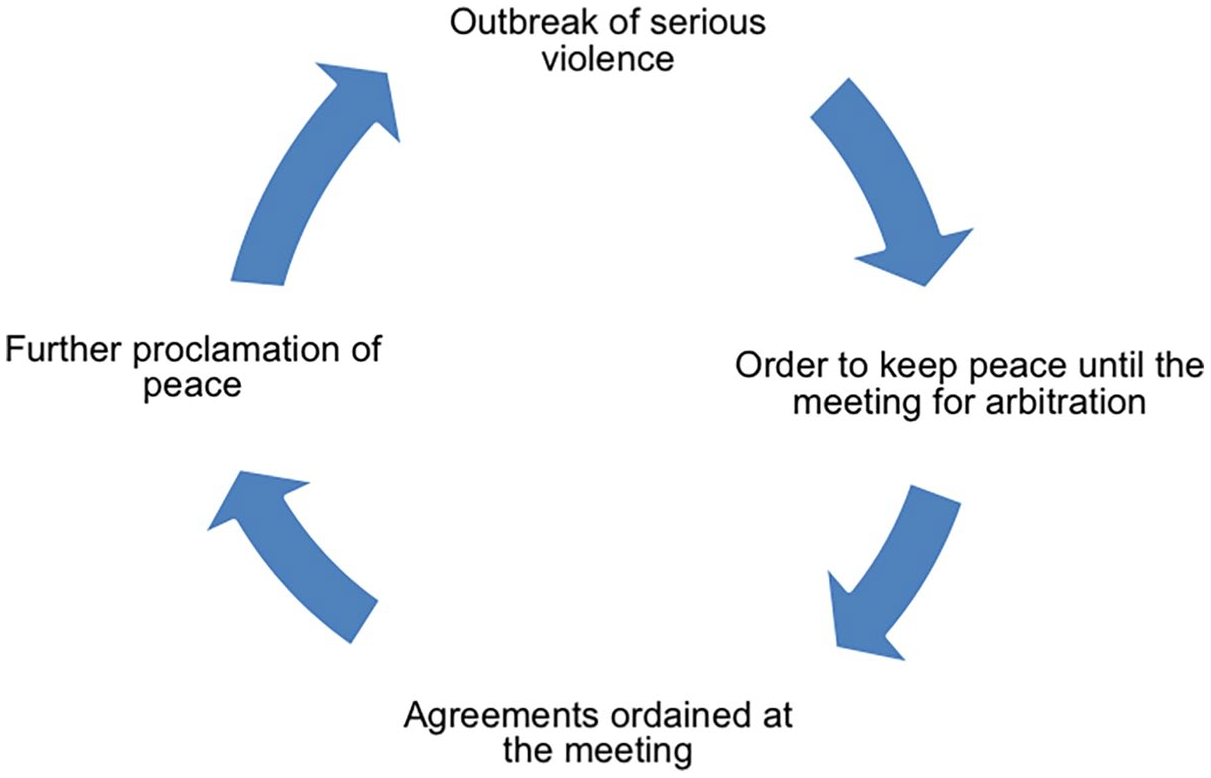
The cycle of royal mediation in the conflict between the Cinque Ports and Great Yarmouth during the later Middle Ages.
This recurring pattern was also apparent in the case of 1316. Once again, the Cinque Ports and Great Yarmouth were in heated conflict around Easter that year and, in response, Edward II summoned six delegates from each party to come before him and ‘set forth their grievances in writing’. 31 The prescribed written complaints were received in the third week of Easter. The immediate result of this arbitration is not known, but the pattern of negotiation over maritime peace in England shared the same features with the making of maritime treaties: local shipmasters and mariners were expected to accept and seal the agreements imposed on them, acting merely as executors of the royal ordinance. 32 Hostility must have continued, as the figure of the arbitration cycle suggests, and the king issued proclamations of peace in mid-July to forbid the two communities from attacking each other. 33 Yet, in contrast to the rather aggressive and uncompromised image they had borne before, the Portsmen this time demonstrated great tolerance and self-control. Until 10 August, men of Great Yarmouth kept attacking the vessels of the Ports, many of which were burnt and sunk on the high seas and also at various places along the south and southeast coast of England, while the Portsmen did not fight back. 34 This unusual self-restraint was recognised and appreciated, as Edward II ‘thank[ed]’ the Portsmen. 35 Delegates of the two communities again met before the royal council in mid-October to settle their quarrel. 36 In December, men of Great Yarmouth were pardoned, and ordered to pay £1,000 to compensate the Portsmen for their losses. 37
If the Portsmen kept retaliating as they normally did, the confrontation would have simply continued until the next arbitration meeting, before another round of the cycle started. However, this time the fight abated. For the rest of Edward II’s reign, no further violent issues between the Cinque Ports and Great Yarmouth were noted in the Chancery records. The Portsmen’s unusual tolerance of Yarmouth’s attacks in July and August 1316 was not a result of weakness or amity, but a political move – it was purposefully sending Edward II a signal of obedience and cooperation in a year when he was deep in the political mire and probably in great need of naval support. The next section will compare the petitions submitted by the Ports and Yarmouth to demonstrate the political acumen of the Portsmen in their cooperative attitude towards royal mediation.
Petitionary language used by English maritime communities
Edward II ordered the two petitions as part of the arbitration process. Table 1 summarises the main complaints cited respectively by the petitioners of the Cinque Ports and Great Yarmouth.
Petition GY vs Petition CP: structure and narrative focus.
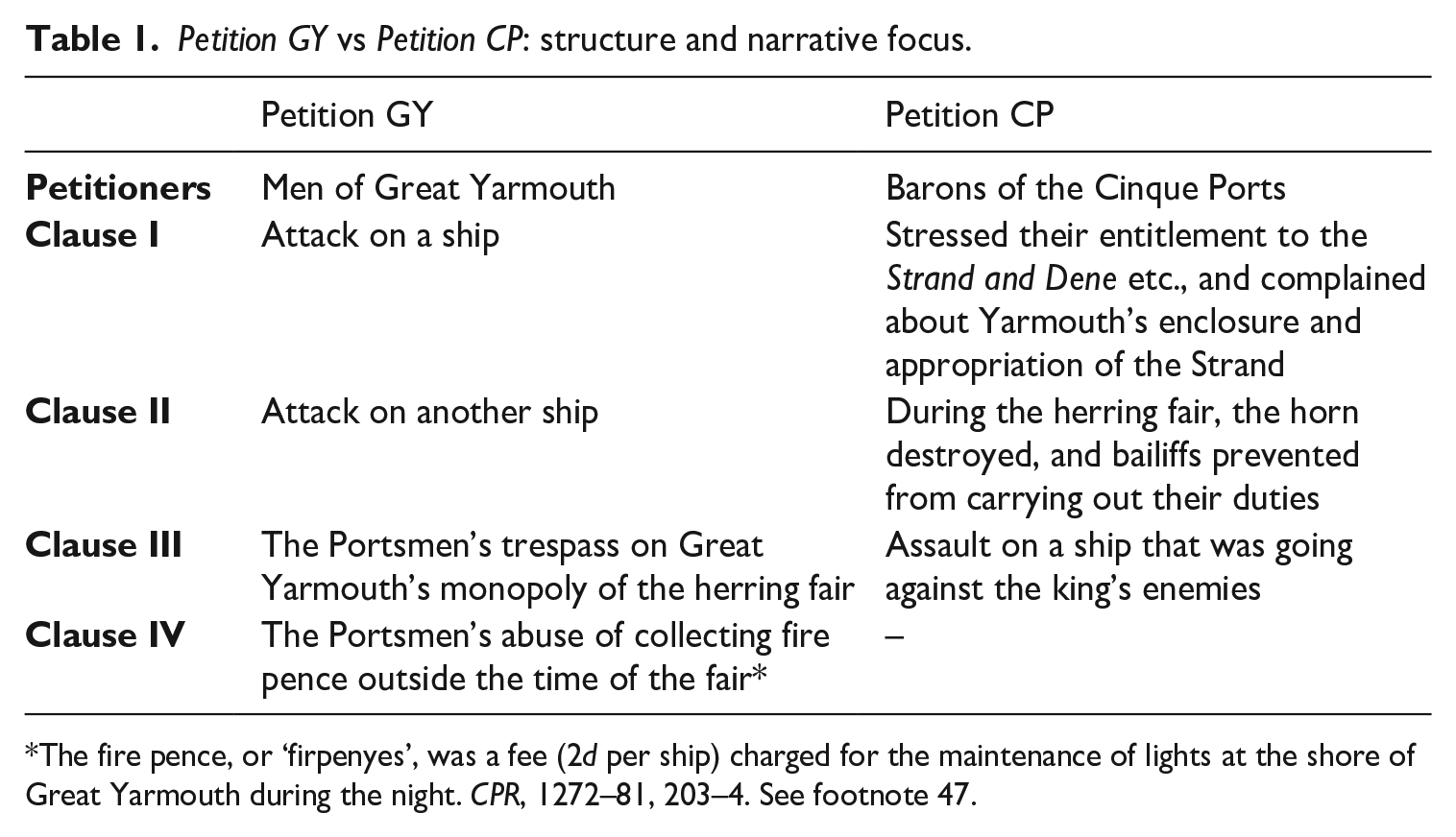
The fire pence, or ‘firpenyes’, was a fee (2d per ship) charged for the maintenance of lights at the shore of Great Yarmouth during the night. CPR, 1272–81, 203–4. See footnote 47.
As both petitions contain more than one clause, they belonged to a sub-group referred to as multiple-clause petitions, which constitute less than 3 per cent of the total number in the collection of SC 8, and diverge in terms of format from the majority of standard private petitions. 38 According to Gwilym Dodd, Matthew Philips and Helen Killick, complaints written in multiple clauses were usually deliberately framed in such a manner to serve ‘a more rhetorical or persuasive strategy’. 39 Itemizing wrongdoings was an effective way, aurally if not visually, since petitions were supposed to be read out and heard, to amplify the criminality of the accused. Petitioners who composed their complaints in this way were not expecting specific responses to each and every clause, but incorporating multiple charges to ‘construct a history of illicit acts’ of their opponents, so as to present them as a consistent threat to the king’s peace. 40 The outbreak of hostility between Yarmouth and the Ports could never be attributed to an isolated incident, so petitions with multiple clauses were an effective way of stating their respective cases. Despite the same accusatory objective, the two petitions revealed different levels of political literacy, fundamentally in the choice of narrative focus: while Great Yarmouth placed a strong emphasis on local interests, the Cinque Ports showed sophisticated skills in blurring the boundary between local and royal interests.
The two communities reported ship attacks in different ways. The first two clauses in Petition GY cited incidents of ship attack. This corresponded with traditional piratical complaints, which usually included information such as the place where the victims were attacked, the financial losses suffered and the level of violence involved. 41 When reporting the wrongdoings, the Yarmouth petitioners referred to a specific expression, accusing the Portsmen of being ‘en despit de nostre seignur le roy [et] contre sa pees’ (’in contempt of our lord the king [and] against his peace’). 42 Before the fourteenth century, however, the king’s peace did not extend to the high seas (’haute mer’), where the said attacks took place, but to the king’s highways and waterways within England. 43
Petition CP (Clause III) also contained a complaint about maritime plunder, but the Ports’ petitioners adopted a very different narrative strategy. The wrongdoers were accused of ‘baterent naivirerent maynerent [. . .] tuerent’ (’beat[ing], wound[ing], ill-treat[ing] . . . kill[ing]’), violent acts enumerated in an order of increasing gravity. 44 Curiously, these violent acts were not directly connected to the breaching of the king’s peace in Petition CP. This was probably because, in comparison to the Yarmouth petitioners, the Portsmen recognised the king’s indifference to their private grudges at sea until his own interest was affected. This view is attested, to some extent, by a writ issued on 17 July 1316, in which the king decided that the malefactors of Great Yarmouth ‘ought to be punished as quickly as possible’, in order to ‘cause terror’ to those who had dared or would dare to ‘perpetrat[e] anything contrary to the king’s proclamation’, rather than administering criminal justice. 45 The rationale behind this decision aligned with the statute of truce passed in 1414, as mentioned in the introductory section; piracy was deemed to be in contempt of royal authority and trespass against safe conducts, rather than a criminal offence in itself.
Therefore, instead of appealing to the restoration of the king’s peace at the end of the clause, which the petitioners of Yarmouth did, the petitioners of the Ports stated at the beginning that when the assault took place, the victim ship was sailing in the king’s service against his enemies. Private conflicts between two maritime communities might not be in the king’s interest, whereas an attack on his naval forces certainly was his business. Accordingly, the damage done to a Winchelsea ship was skilfully presented as an action detrimental to the king’s naval operations.
Clauses III and IV in Petition GY and Clauses I and II in Petition CP indicate that once more the issue in 1316 was essentially haunted by competition and resentment over the rights to the Yarmouth sandbank and its annual herring fair. Clause III in Petition GY concerned Great Yarmouth’s monopoly of the herring fair. The petitioners complained about further financial losses caused by the Cinque Ports, as during the time of the fair the Portsmen brought their goods to the neighbouring towns (Little Yarmouth and Gorleston) in order to hold a competing fair and market. Great Yarmouth’s monopoly of the fair was legally confirmed by the ordinance of 1305, where it had been decreed that the fair ‘shall always be at Yarmouth and nowhere else’. 46 In Clause IV, the petitioners complained that the Portsmen were now charging ‘firpenyes’ (or fire pence) beyond the period of the fair, whereas it should only be taken during the fair. The ‘firpenyes’ was a customary charge of 2d from each ship coming to the Yarmouth fair; according to the ordinance of 1277, the Portsmen who received the fire pence were responsible for keeping up fires ‘for the safety of the shore by night’. 47 The concerns expressed in these two clauses, although supported by legal documents, still possessed a strong local feature. The resulting losses were hardly at a national level, and it seemed rather far from the interest of the Crown itself.
Those who petitioned on behalf of the Cinque Ports, on the contrary, demonstrated a keen interest in associating their own grievances with the king’s concerns. Clause II of Petition CP was delivered in a narrative similar to that deployed to the presentation of the ship attack, as the petitioners of the Ports characterised the violation of their charter right as a disgrace to royal authority. The Portsmen also used the legal expression of breaching the king’s peace. While the Yarmouth petitioners might have used the notion in a general and casual way to accuse felons, the petitioners of the Ports made explicit efforts to present the offence of the Yarmouth people as an act of dishonour to the king. The petitioners of the Cinque Ports first highlighted their right and duty during the herring fair to carry the king’s banner, and to blast their horn to assemble people. However, they claimed, the men of Great Yarmouth had come, taken the horn away, broken it, detained it, and prevented the bailiffs of the Ports doing their work. The detailed description of the damage inflicted on this specific horn is telling, for it is absurd to imagine that the Great Yarmouth men, who allegedly came to make trouble, smashed nothing other than a horn. Yet the image of the broken horn was not chosen randomly. The banner and the horn were firmly related to the Portsmen’s jurisdictional privileges at the Yarmouth fair. The ordinance of 1277 had confirmed to the Portsmen that during the Yarmouth herring fair they were charged with the responsibility of ‘the keeping of the king’s peace’, together with the provost of Great Yarmouth. Moreover, four serjeants were expected to carry out the ceremonial duties of carrying the king’s banner, a horn, and two wands. 48 Through these four symbols, the power of royal justice during the fair was conferred to the Portsmen. The seizing, breaking and distaining of the horn, therefore, were directly linked to the contempt of royal authority. In essence, Great Yarmouth was obstructing the Portsmen from executing their administrative and judicial duties during the fair. By highlighting the broken horn, the petitioners of the Ports presented their case in terms of Yarmouth deliberately challenging the king’s authority.
It becomes clear in this comparative reading that the Cinque Ports used a better-calculated narrative to associate local concerns with royal interests, which demonstrates a high level of political literacy. The purpose of such discursive strategy, however, should not be simply interpreted as to win a better outcome in a single arbitration. There was no need, as royal intervention into the Ports-Yarmouth conflict always sought to calm the quarrels without compromising the Portsmen’s privileges in Great Yarmouth. Through the sophisticated narratives in Petition CP, the Cinque Ports demonstrated their political insight and sensitivity, implying that they well understood royal concerns. This image was in accordance with the message they conveyed through their strict observance of the royal proclamation of peace in July and August 1316. Therefore, the rather peaceful result between the two disputing communities that Edward II achieved at the end of 1316, and probably also for the rest of his reign, could be largely attributed to the cooperation of the Cinque Ports.
Edward II’s political distress, and the political awareness of the Cinque Ports
The Portsmen’s cooperative attitude was certainly not a reflection of overwhelming royal authority. On the contrary, 1316 was an especially troubled year, in which Edward II’s resources were overstretched. This section explores the wider political context of the year and suggests possible reasons why the Portsmen observed the peace proclamations despite continued attacks from Great Yarmouth during the summer.
The year of 1316 fell right in the middle of a period of ‘internal upheaval and external conflict’, between the defeat at Bannockburn in the summer of 1314, and the temporary reconciliation with the Lancaster faction in 1318. 49 The king was in great need of naval resources, since Scottish and Flemish vessels were becoming increasingly active off England’s east coast and in the Irish Sea. 50 Yet his maritime capacity was under extreme pressure. Edward Bruce’s invasion of Ireland in May 1315 extended the battlefronts between the Scots and the English, and consequently weakened Edward II’s authority among his Anglo-Norman magnates in Ireland. 51 The potential flows of manpower, revenues and victuals for the English were therefore constrained. 52 Both sides of the Bristol Channel were in trouble in 1316: the revolt of Glamorgan in South Wales took place between January and March, and the four-year long Bristol revolt culminated in the siege of Bristol in July. 53 Bristol itself was an important contributor to the royal fleet in the fourteenth century, especially to the Western squadron. Due to its strategic situation, Bristol played a vital part in the English king’s political influence in South Wales and across the Irish Sea. 54 If Glamorgan and Bristol were in trouble at the same time, the king’s naval strength and logistical capability in the Bristol Channel and into the Irish Sea would be significantly restricted.
The series of political and military disturbances during 1316 took place against a background of agricultural and, consequently, economic crisis. 55 The ‘Great Famine’ in England reached its height in 1316, with the yield of composite crops dropping by around 60 per cent compared to the average level before 1315, with food prices reaching their peak in the summer of 1316, while the real wages of English urban and rural workers were at their lowest level in the late Middle Ages. 56 On top of the unprecedented agrarian and economic crisis was the imposition of the heaviest royal tax on movables in Edward II’s reign to pay for the expensive military campaign against the Scots. For the only time during his reign, subsidies were collected over two successive years, in 1315 and 1316. 57 In 1315, there was resistance to the king’s tax collectors in Staffordshire, Shropshire and Yorkshire, with similar tensions evident in Buckinghamshire, Derbyshire and Nottinghamshire during the following year. In Yorkshire, moreover, a number of royal bailiffs refused to help levying and collecting the fifteenth from their tenants, or the sixteenth in the East Riding of the county. 58
Food scarcity, inflation, financial burdens on localities, and military and administrative expenses for defence as well as suppression, interacted to limit Edward II’s power. Although Petition CP made no specific reference to these difficulties, except mentioning a Winchelsea ship set forth against the king’s enemies, it is not surprising to see the Cinque Ports behaving in an unusually cooperative manner in a year of such turmoil. It is reasonable to presume that the Portsmen were sensitive enough and sufficiently informed by mid-July 1316 to have a good understanding of the political and military distress of Edward II, given their rich experience in communicating and collaborating with royal authority in the past, and their widespread mercantile activities and information networks. 59 The Portsmen’s good service during the Welsh campaigns between 1277 and 1283 had won them favourable terms in their charter of 1290. 60 The prospect of another campaign to the western seas, or to the north, would definitely appear more rewarding than breaching the king’s proclamation of peace to exact revenge on Great Yarmouth. Therefore, it was in the interest of the Cinque Ports to cease hostiliies with Great Yarmouth in the summer of 1316, and to exhibit to the king their willingness to cooperate.
Conclusion
The Cinque Ports exhibited extremely sharp political literacy and awareness in their sophisticated use of petitionary language. Despite the formulaic nature of petitionary texts, the petitioners from the Cinque Ports deployed certain narrative skills to transcend local grievances, and present local disputes as challenges to royal authority. In contrast to the Portsmen’s grasp of royal concerns, petitioners from Great Yarmouth showed much less political awareness. The petition from Great Yarmouth had a strong local flavour, which was not in the king’s particular interest at a time when England was bedevilled by political, fiscal and social problems. These differing levels of political awareness informed the responses of the Cinque Ports and Great Yarmouth to Edward II’s proclamation of peace in the summer of 1316. The Ports-Yarmouth conflict also reveals a cyclical pattern of royal mediation during the late thirteenth and early fourteenth centuries: instances of arbitration resulted in short-term armistices and recurring confrontations pervaded by peace proclamations. The unusual self-control of the Cinque Ports during the summer of 1316 meant that they did not emerge as another source of unrest for Edward II, and ensured the peaceful outcome of the royal mediation effort towards the end of the year. Royal intervention into the Ports-Yarmouth hostility in the late thirteenth and early fourteenth centuries also reflected a growing royal interest in domestic maritime disputes. The keeping of the maritime peace, and control over maritime communities, became pertinent to medieval kingship. Again, as evidenced in the case of the Cinque Ports, the result was not simply a reflection of the muscle of the Crown and diplomatic situations, but also depended on the political awareness of localities.
Footnotes
1.
N. A. M. Rodger, The Safeguard of the Sea: A Naval History of Britain, Vol. I: 660–1649 (London, 1997), 221–37; Craig L. Lambert, Shipping the Medieval Military: English Maritime Logistics in the Fourteenth Century (Woodbridge, 2011), 172–206; Andrew Ayton and Craig Lambert, ‘A Maritime Community in War and Peace: Kentish ports, ships and mariners, 1320-1400’, Archaeologia Cantiana, 134 (2014), 67-103; Andrew Ayton and Craig Lambert, ‘Shipping the troops and fighting at sea: Essex ports and mariners in England’s wars, 1337-89’, in Christopher Thornton, Jennifer Ward and Neil Wiffen, eds., The Fighting Essex Soldier: Recruitment, War and Society in the Fourteenth Century (Hatfield, 2017), 98-142; Eliza Hartrich, Politics and the Urban Sector in Fifteenth-century England, 1413–1471 (Oxford, 2019), 43–9.
2.
Susan Rose, ‘Maritime Logistics and Edward I’s Military Campaigns: What can be Learnt from the Surviving Documentation?’, Mariner’s Mirror, 99 (2013), 388–97; Craig L. Lambert, ‘Henry V and the Crossing to France: Reconstructing Naval Operations for the Agincourt Campaign, 1415’, Journal of Medieval History, 43 (2017), 24–39; C. J. Ford, ‘Piracy or Policy: The Crisis in the Channel, 1400–1403’, Transactions of the Royal Historical Society, 29 (1979), 63–78. For other sources of vessels, such as the king’s own ships and hired ships from abroad, see Lambert, Shipping the Medieval Military, 11–7; J. W. Sherborne, ‘The Hundred Years’ War. The English Navy: Shipping and Manpower 1369–1389’, Past & Present, 37 (1967), 166–70.
3.
Craig L. Lambert, ‘Naval Service and the Cinque Ports, 1322–1453’, in Gary P. Baker, Craig L. Lambert and David Simpkin, eds., Military Communities in Late Medieval England: Essays in Honour of Andrew Ayton (Woodbridge, 2018), 216–7; Gillian Draper and Frank Meddens, The Sea and the Marsh: The Medieval Cinque Port of New Romney (Dorset, 2009), 37. The confederation of the Cinque Ports consisted of seven major members (Romney, Hythe, Dover, and Sandwich in Kent, and Hastings, Rye, and Winchelsea in Sussex) with a group of smaller port towns affiliated as Limbs, locating at the eastern end of the English Channel. The only geographical exception was Brightlingsea in Essex, which became a member in the late fourteenth century. See K. M. E. Murray, The Constitutional History of the Cinque Ports (Manchester, 1935), 29, 43–4; Felix Hull, ‘Introduction’, in Felix Hull, ed., A Calendar of the White and Black Books of the Cinque Ports 1432–1955 (London, 1966), x–xiv; Claude Dove, The Liberty of Brightlingsea: A Cinque Port Limb of Sandwich (Brightlingsea, 1974), 24–30.
4.
For example, see The National Archives (UK) [TNA], SC 8/262/13058; TNA, SC 8/303/15127 TNA, SC 8/335/15837; TNA, SC 8/120/5998.
5.
Thomas Heebøll-Holm, ‘Towards a Criminalization of Piracy in the Middle Ages’, in Louis Sicking and Alain Wijffels, eds., Conflict Management in the Mediterranean and the Atlantic, 1000–1800: Actors, Institutions and Strategies of Dispute Settlement (Leiden, 2020); Thomas Heebøll-Holm, Ports, Piracy and Maritime War: Piracy in the English Channel and the Atlantic, c. 1280–c. 1330 (Leiden and Boston, 2013), 18–22; David Sylvester, ‘Communal Piracy in Medieval England’s Cinque Ports’, in Niall Christie and Maya Yazigi, eds., Noble Ideals and Bloody Realities: Warfare in the Middle Ages (Leiden, 2006), 164–7; Frederic L. Cheyette, ‘The Sovereign and the Pirates, 1332’, Speculum, 45 (1970), 47–8. ‘Malefactors’ was a more frequently used term (than ‘pirates’) in diplomatic records. See Heebøll-Holm, Ports, Piracy and Maritime War, 22. A notorious maritime robber and murderer could also be defined in Chancery records as an ‘enemye’ of the king. For the case of the Flemish pirate John Crabbe, see TNA, C 49/6/20; The Parliament Rolls of Medieval England [PROME], parliament of January 1333, item 14.
6.
CCR, 1279–88, 158. CCR refers to Calendar of the Close Rolls (47 vols, London, 1892–1963); Sylvester, ‘Communal Piracy in Medieval England’s Cinque Ports’, 169–70.
7.
TNA, SC 8/120/5998; CPR, 1301–7, 358. CPR refers to Calendar of the Patent Rolls (52 vols, London, 1891–1916).
8.
Stephen P. Pistono, ‘Henry IV and the English Privateers’, English Historical Review, 90 (1975), 323–7; Stephen P. Pistono, ‘Henry IV and the Vier Leden: Conflict in Anglo-Flemish Relations 1402–1403’, Revue belge de Philologie et d’Histoire, 54 (1976), 458–73; Malcolm Mercer, ‘The Administration of the Cinque Ports in the Early Lancastrian Period’, in Keith Dockray and Peter Fleming, eds., People, Places and Perspectives: Essays on Later Medieval & Early Tudor England in Honour of Ralph A. Griffiths (Stroud, 2005), 55–8; Draper and Meddens, The Sea and the Marsh, 38.
9.
J. G. Bellamy, The Law of Treason in England in the Later Middle Ages (Cambridge, 1970), 128–30; Thomas Heebøll-Holm, Philipp Höhn and Gregor Rohmann, ‘Introduction’, in Heebøll-Holm et. al, Merchants, Pirates, and Smugglers, 9–10.
10.
Sylvester, ‘Communal Piracy’, 170.
11.
Ford, ‘Piracy or Policy’, 63–70.
12.
For example, F. M. Brooks, ‘The Cinque Ports’ Feud with Yarmouth in the Thirteenth Century’, Mariner’s Mirror, 19 (1933), 27–51; Sylvester, ‘Communal Piracy’, 174–5. Heebøll-Holm, Ports, Piracy and Maritime War, 195–200.
13.
Heebøll–Holm, Ports, Piracy and Maritime War, 195, 198–9.
14.
CCR, 1313–8, 367.
15.
TNA, SC 8/320/E433; TNA, SC 8/320/E434; TNA, SC 8/48/2380.
16.
See TNA, SC 1/14/17, TNA, SC 1/20/63, and TNA, SC 1/32/66.
17.
CPR, 1313–17, 514.
18.
Petition CP refers to TNA, SC 8/320/E433, and Petition GY refers to TNA, SC 8/320/E434.
19.
Murray, Cinque Ports, 237; Brooks, ‘Cinque Ports’, 29–30; ‘dene’, in Joseph T. Shipley, ed., Dictionary of Early English (Lanham, 1995), 209.
20.
Brooks, ‘Cinque Ports’, 33.
21.
Tom Johnson, Law in Common: Legal Cultures in Late-Medieval England (Oxford, 2020), 93–101; Thomas K. Heebøll-Holm, ‘Law, Order and Plunder at Sea: A Comparison of England and France in the Fourteenth Century’, Continuity and Change, 32, Special Issue 1 (2017), 40–7.
22.
CPR, 1272–81, 203–4; CPR, 1301–07, 329; Samuel Jeake, Charters of the Cinque Ports: Two Ancient Towns, and their Members (London, 1728), 13–7.
23.
Out of 273 ships in the fleet, 73 were from the Ports and 59 were from Yarmouth. See Michael Prestwich, Edward I (Berkeley, 1988), 392.
24.
Brooks, ‘Cinque Ports’, 44; TNA, JUST 1/945. Brooks has evaluated this account of damage presented in JUST 1/945 as accurate – at least hardly an underestimation from the Yarmouth side, since the statement was provided by Yarmouth as part of evidence concerning its feud with the Ports up to 1303, before a special investigation over the matter was appointed. A few other sources provided different figures, but do not appear as reliable. See William Rishanger, Willelmi Rishanger, quondam Monachi S. Albani, et quorundam Anonymorum, Chronica et Annales: Regnantibus Henrico Tertio et Edwardo Primo, ed. by Henry Thomas Riley (London, 1865), 177; Henry Manship, The History of Great Yarmouth, ed. by Charles John Palmer (Yarmouth, 1854), 185–6; Henry Swinden, The History and Antiquities of the Ancient Burgh of Great Yarmouth in the County of Norfolk: Collected from the Corporation Charters, Records, and Evidences; and Other the Most Authentic Materials (Norwich, 1772), 189–90.
25.
CCR, 1296–1302, 59–60; Brooks, ‘Cinque Ports’, 43–6; Bruce Lyon, ‘The Failed Flemish Campaign of Edward I in 1297: A Case Study of Efficient Logistics and Inadequate Military Planning’, Handelingen der Maatschappij voor Geschiedenis en Oudheidkunde te Gent, 59 (2005), 34–5.
26.
TNA, SC 1/32/66; CCR, 1296–1302, 59–60, 62–3; CPR, 1292–1301, 308.
27.
Brooks, ‘Cinque Ports’, 42, 47–8; TNA, JUST 1/395; TNA, JUST 1/945; CPR, 1301–7, 183.
28.
CPR, 1281–92, 323, 339; CCR, 1296–1302, 59–60, 62–3.
29.
TNA, SC 8/48/2380.
30.
CPR, 1301–07, 357–8. CCR, 1313–8, 367; this letter close stated that the king had ordered the men of Great Yarmouth to treat the Portsmen friendly during the annual herring fair, ‘under pain of forfeiture of life and limb’.
31.
CPR, 1313–17, 514.
32.
Heebøll-Holm, Ports, Piracy and Maritime War, 195.
33.
CPR, 1313–17, 514, 520.
34.
According to the pardon issued to certain men of Great Yarmouth on 20 December 1316, the attacks took place ‘from the first of July last past to the feast of St Laurence then following [10 August]’. CPR, 1313–17, 576. See also CPR, 1313–17, 581, 583.
35.
CPR, 1313–7, 520.
36.
CCR, 1313–18, 367; J. R. Maddicott, The Origins of the English Parliament, 924–1327 (Oxford, 2010), 165.
37.
CPR, 1313–7, 576.
38.
Gwilym Dodd, Matthew Philips and Helen Killick, ‘Multiple-clause Petitions to the English Parliament in the Later Middle Ages: Instruments of Pragmatism or Persuasion?’, Journal of Medieval History, 40 (2014), 177.
39.
Dodd, Philips and Killick, ‘Multiple-clause Petitions’, 187–90.
40.
Dodd, Philips and Killick, ‘Multiple-clause petitions’, 188; also see 188–9 for specific instances, such as the Londoner’s petition against Nicholas Brembre in 1388, the petitions from Thomas Holland, earl of Kent, and abbot of Crowland and Spalding priory against each other in 1391, and the 33 charges against Richard II in 1399. W. Mark Ormrod, ‘Murmur, Clamour and Noise: Voicing Complaint and Remedy in Petitions to the English Crown, c.1300–c.1460’, in W. Mark Ormrod, Gwilym Dodd and Anthony Musson, eds., Medieval Petitions: Grace and Grievance (York, 2009), 142–3.
41.
Heebøll-Holm, Ports, Piracy and Maritime War, 28.
42.
TNA, SC 8/320/E434.
43.
Bruce R. O’Brien, God’s Peace and King’s Peace: The Laws of Edward the Confessor (Philadelphia, 1999), 73–5; David Feldman, ‘The King’s Peace, the Royal Prerogative and Public Order: The Roots and Early Development of Binding over Powers’, Cambridge Law Journal, 47 (1988), 105–6; Sir Frederick Pollock, Oxford Lectures and Other Discourses (London, 1890), 78–81. Brooks also pointed out the exclusion of maritime jurisdiction in the Angevin judiciary in the earlier thirteenth century, and calling it a habit of ‘being conveniently deaf’; see Brooks, 33. There was a wider context of legal pluralism in the maritime jurisdiction during this period, as seafarers in dispute could take their cases to various legal tribunals, including a local seigniorial court, a town court, a parliamentary court, and the court of chancery, before the English king established the admiralty court in the mid-fourteenth century to dispense maritime law across the seas surrounding England, over which he claimed sovereignty. See Heebøll-Holm, ‘Law, Order and Plunder at Sea’, 38–42, 45–50; Heebøll-Holm, Ports, Piracy and Maritime War, 163–74; Timothy J. Runyan, ‘The Rolls of Oleron and the Admiralty Court in Fourteenth Century England’, American Journal of Legal History, 19 (1975), 96–9, 107–9; Timothy J. Runyan, ‘Ships and Mariners in Later Medieval England’, Journal of British Studies, 16 (1977), 15–6; Rodger, Safeguard, 141–2.
44.
TNA, SC 8/320/E433.
45.
CPR, 1313–7, 520.
46.
CPR, 1272–81, 203–4.
47.
CPR, 1301–7, 329. See also Douglas B. Hague and Rosemary Christie, Lighthouses: Their Architecture, History and Archaeology (Llandysul, 1975), 21, 24–5; David E. van Zandt, ‘The Lessons of the Lighthouse: “Government” or “Private” Provision of Goods’, Journal of Legal Studies, 22 (1993), 62.
48.
CPR, 1272–81, 203–4.
49.
Seymour Phillips, Edward II (New Haven and London, 2010), 238, 320–1, 330–6.
50.
Rodger, Safeguard, 87–8.
51.
J. R. Seymour Phillips, ‘Edward II and Ireland (in Fact and in Fiction)’, Irish Historical Studies, 33 (2002), 9–12.
52.
Michael Brown, The Wars of Scotland 1214–1371 (Edinburgh, 2004), 212; Phillips, ‘Edward II and Ireland’, 8; Timothy O’Neill, ‘Trade and Shipping on the Irish Sea in Later Middle Ages’, in Michael McCaughan and John Appleby, eds., The Irish Sea: Aspects of Maritime History (Belfast, 1989), 28.
53.
CPR 1313–17, 492; R. A. Griffiths, Conquerors and Conquered in Medieval Wales (Stroud, 1994), 84–91; R. A. Griffiths, ‘The Revolt of Llywelyn Bren’, Glamorgan Historian, 2 (1965), 186–96; J. B. Smith, ‘The Rebellion of Llywelyn Bren’, in T. B. Pugh, ed., Glamorgan County History (Glamorgan County History Society, 1971), vol. 3, 72–86; Samuel K. Cohn Jr, Popular Protest in Late Medieval English Towns (Cambridge, 2012), 133–40; Phillips, Edward II, 274.
54.
Rodger, Safeguard, 134; Christian D. Liddy, War, Politics and Finance in Late Medieval English Towns: Bristol, York and the Crown, 1350–1400 (Woodbridge, 2005), 52–7; Peter Fleming, ‘Identity and Belonging: Irish and Welsh in Fifteenth-century Bristol’, in Linda Clark, ed., The Fifteenth Century VII: Conflicts, Consequences and the Crown in the Late Middle Ages (Woodbridge, 2007), 175–7.
55.
Maddicott shows great sympathy towards Edward II’s administration on this occasion, as he doubts ‘whether any government could have functioned effectively in 1316’. J. R. Maddicott, Thomas of Lancaster, 1307–1322: A Study in the Reign of Edward II (New York, 1970), 183.
56.
Philip Slavin, ‘Market Failure during the Great Famine in England and Wales (1315–1317)’, Past & Present, 222 (2014), 11–26; Buchanan Sharp, Famine and Scarcity in Late Medieval and Early Modern England: The Regulation of Grain Marketing, 1256–1631 (Cambridge, 2016), 33; Bruce M. S. Campbell, ‘Nature as Historical Protagonist: Environment and Society in pre-industrial England’, Economic History Review, 63 (2010), 286–9; Bruce M. S. Campbell, Three Centuries of English Crops Yields, 1211–1491,  (accessed 5 March 2020).
57.
J. R. Maddicott, ‘The English Peasantry and the Demands of the Crown, 1294–1341’, Past and Present, Supplement 1 (1975), 7, 14; James Conway Davies, The Baronial Opposition to Edward II: Its Character and Policy (London, 1967), 413–4.
58.
CPR, 1313–17, 324–5, 424, 493, 586, 593; CCR, 1313–18, 363, 365; Sharp, Famine and Scarcity, 53; Cohn, Popular Protest, 152, 169.
59.
For evidence of the Portsmen’s network, see TNA, SC 8/197/9805.
60.
CChR, 1257–1300, 344. CChR refers to Calendar of the Charter Rolls (6 vols, London, 1903–1927).