




Abstract
Suriname’s pre-modern economy was entirely dependent on water transport. While shipbuilding in the colony itself was not encouraged by the directors of the Suriname Company (1683–1795) in Amsterdam there was a need to support the colony’s transoceanic, regional and local transport. This article finds that Suriname certainly had an infrastructure for shipbuilding and repair, but its existence has been neglected in the historiography. Since there is no literature on shipbuilding in colonial Suriname this article explores a wide variety of primary sources to piece together the various types of shipbuilding and repair conducted in the colony. We have found that there was a modest-sized barge wharf, as well as the production of small vessels on the plantations, and among the maroons and indigenous people in the interior. The colony furthermore procured ships on an ad hoc basis from the regional North American shipping connections with Suriname.
‘This is a real plague’, sighed the Governor of Suriname, Joan Jacob Mauricius, in 1745, referring to the worms that were attacking wood in the water. 1 When issuing the charter for the colony back in 1682, these worms had been regarded as a benefit for shipbuilding in the Dutch Republic. The worms were given a favourable mention in the charter’s preamble, since the speed at which they ate through the wooden ships was such that the necessary repairs would certainly provide a boost for the industry in the Low Countries. The preamble stated that the Dutch shipbuilding industry would benefit ‘from the continual building and repairing of ships sailing there, and that got eaten up by worms’. 2 The industry’s interests in the Dutch Republic would obviously have been damaged if the colony itself were also to be permitted to build and fit ships. Consequently, any proposals to that effect from entrepreneurial colonists were rejected. 3 Indeed, from 1767 onwards, Dutch trade with Suriname was strictly limited to being carried on ships built and provisioned in the Republic. 4 This policy did not survive the huge loss of shipping capacity during the Fourth Anglo-Dutch War, 1780–1784. The need to continue shipping to the colony resulted in a lifting of this ban, allowing ships built outside of the Dutch Republic to service the colony. 5 Colonial shipbuilding could have helped to further resolve the shortage in shipping capacity in the late eighteenth century, however, it was ultimately not until the twentieth century that large seagoing vessels were built in Suriname.
The fact that no large vessels were built certainly does not mean that there were no shipbuilding activities at all in Suriname. Local demand was high for smaller vessels built in Suriname and for repairs to larger vessels. Almost nothing is known about these local shipbuilding and repair activities. Given that the history of shipbuilding in Suriname has previously been so neglected, this article can make only a modest start by outlining the developments during the colonial period. The conclusions presented are therefore provisional, based on research in a wide range of sources. The primary question examined here is how a society characterised by a dependence on water-borne transport was able to meet its needs for shipbuilding and repair, despite lacking a wharf of any substantial size.
With all transport in Suriname in the Early Modern period going by water, Suriname has been described as a ‘hydraulic slave society’. 6 It was not only imports and exports of goods that went by sea, as local movements of people and cargoes were all transported on the many rivers. Indeed, the indigenous name for the area, Guiana, means ‘land of many waters’, with astounding quantities of water flowing down from the mountains and the rain forest to the sea. Much of the network of rivers in the then colonised part of Suriname was directly subject to tidal influence, with vessels forced to take account of the tides when sailing upstream and downriver.
In order to convey as full a picture as possible of shipbuilding and repair in Suriname, this article discusses specific categories of vessels separately and indicates where they were built or repaired and who carried out the work. The research into ship repair was based on Dutch and English ship journals and governmental accounts and legislation containing references to repairs. The War of the Austrian Succession (1740–1748) triggered a feverish series of activities, including completion of Fort New Amsterdam (many vessels were required to transport the construction materials required) and the acquisition of vessels and crews to patrol at the mouth of the Suriname River. The second war of importance to this research is the North American War of Independence (1775–1783), with papers from captured American vessels providing an impression of repairs carried out. The archives of the Suriname Company and the local governing authorities also record details of activities at the barge wharf, while entries in the governor’s journals provide a picture of how the local governing authorities sought to procure vessels.
Barge wharf
Paramaribo had sufficient space for building and repairing ships. Unlike a private enterprise, the town’s barge wharf had a public function and was managed by the colonial authorities. This reflected their wish to concentrate work on ships at a specific area, both because the constant carpentry involved created a lot of noise and because the breaming of ship hulls represented a danger to nearby properties. 7 In the tenth article of the instructions given to foresters and inspectors of the commons, who were responsible for looking after these public grounds and whose responsibilities extended further than their titles suggest, we find instructions for performing work at the mill. This mill was probably located at the crossing of the Watermolenstraat and Waterkant. Most of this work involved larger ships, with references to Dutch, English and French vessels, and to breaming, pitching, caulking and cleaning, as well as to careening. 8 Whether the barge wharf in Suriname had a regional function is unclear.
In 1719, the colonial authorities decided to designate a site where private parties could repair their vessels. In 1722, they set aside a permanent location for these activities after complaints, primarily by Molenstraat residents, about the dangerous situations arising when ships’ hulls were breamed. The specific complaint was that when breaming the vessels, workers left the ‘huts of cane and large leaves or branches’ on the vessels and these could result in fire breaking out. The colonial authorities consequently decided to forbid the making, pitching, tarring or breaming of barges and other vessels elsewhere. 9 At the time, the College van Kleine Zaken (Court for Minor Cases) was responsible for managing the commons, and was instructed to equip the place with beams and planks to enable it to draw up vessels and materials, and to establish some places on land to which these could be attached. 10
Where these activities were to take place is described simply as the new expansion of the city, with the undated instructions for the harbour master stating that the breaming and drying of ‘barges and other vessels’ was permitted only between the brick factory and the edge of the bridge across the Drambrander canal at the end of Saramaccastraat. 11 This was precisely the area of the waterfront belonging to Paramaribo’s new expansion in the first half of the eighteenth century. While the exact location of a barge wharf in this part of the town remains unclear, later documents clearly show that a site was designated for this purpose.
This then will have been the place referred to by the crew of the Philadelphia, a ship owned by the Middelburgsche Commercie Compagnie (MCC), when they wrote in their logbook about work carried out on smaller vessels. As they reported: ‘We got the boat onto the quayside and breamed it and covered it with pitch ourselves.’ 12 After the ship’s captain had purchased a barge, the crew hauled it ‘onto the wharf for carpentry’. The carpenter was sent to the barge, where he and a second carpenter spent several days on this work, while other carpenters boarded the Philadelphia to caulk the ship. 13 Although, therefore, this ship was in need of considerable repairs, this did not take place at the place where work on smaller sloops and barges was conducted.
Once the new barge wharf had been established, it becomes clearer where work was performed and also what types of work were possible at this wharf. In 1773, the ‘old barge wharf’ was gradually phased out and a new one opened. 14 In that same year, the Committee of Foresters and the Commons was set up as a body independent of the Court for Minor Cases that had previously been responsible for these tasks. The minutes of this new committee indicate that its tasks included maintaining the town’s streets and squares, as well as being responsible for the landing stages and ladders along the waterfront, setting bread prices, the timber market, keeping the commons clean and the barge wharf. This committee was established at around the same time as the move from the old to the new barge wharf, with the foresters also being responsible for erecting the buildings at the latter. The relocating of the barge wharf meant it was now further upstream on the outskirts of the town. A map drawn by A. H. Hiemcke in 1806 shows a reasonably large wharf that also had a careening area (see figure 1). 15
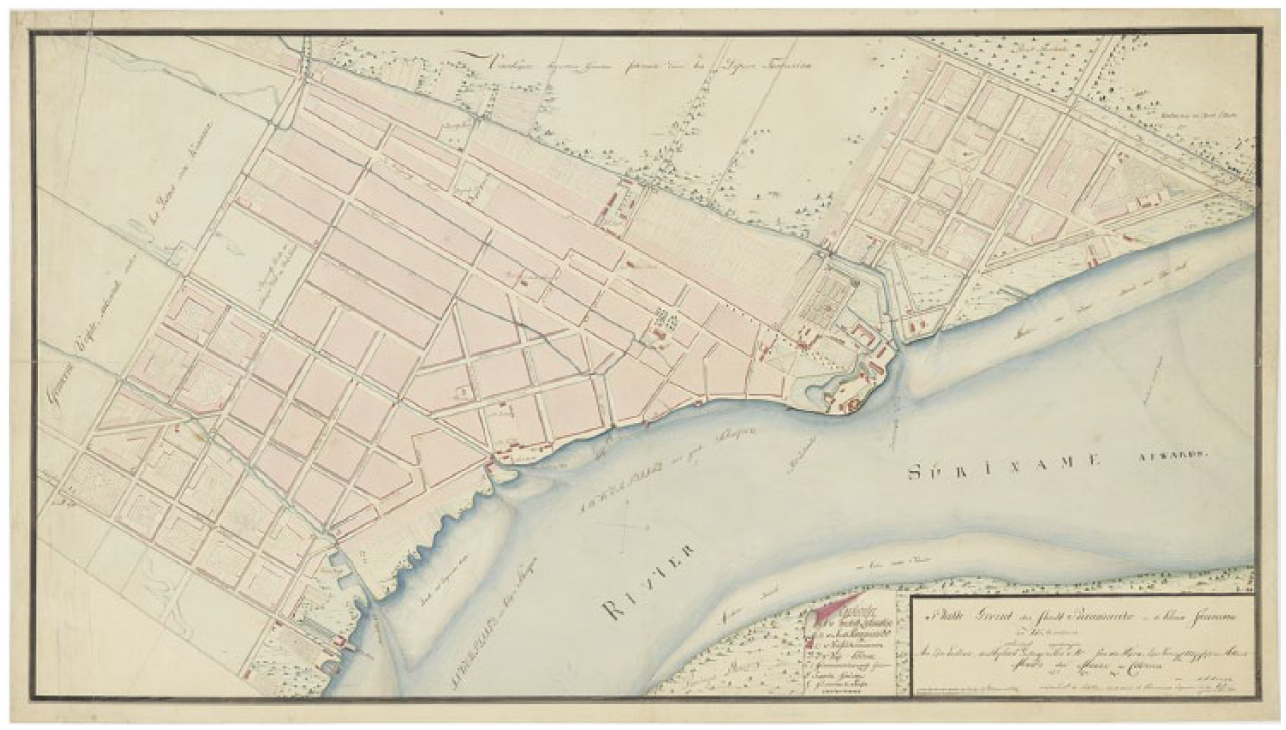
The barge wharf on the south side of Paramaribo, including the careening area and various buildings.
Almost no traces remain to show how this site was used. Oudschans Dentz made mention of shipbuilding activities at the wharf in his Geschiedkundige Aanteekeningen in 1881 ‘that was where the large barges for transporting sugar were built and set off from’. 16 While the source for this claim is not specified in the text, he states that, in 1911, the site was used as an abattoir. In 1980 the street which started at the barge wharf and named Pontenwerfstraat (Barge Wharf Street) was renamed in honour of Anton de Kom, the street’s most famous inhabitant. With this name change the last reminders of the wharf were removed from the city.
Indigenous techniques, knowledge and vessels
Vessels built in the colony were mainly intended for local use. In descending order of size these were barges, tent boats (tentboten) and various types of pirogues and dugout canoes (‘priauwen’ or prauwen and ‘corjaren’ or korjalen). Barges came in all shapes and sizes and were used primarily for transporting goods. Meanwhile tent boats were the means of transport favoured by the colonial elite, with teams of six or eight slaves rowing them along the waterways. 17 It is certainly possible that these boats, which were in effect a luxury product, were sometimes commissioned in and transported from the Netherlands, although many of the barges were built in the colony. More information is available on the way dugout canoes or korjalen were built, with various travel journals containing detailed descriptions.
Timber was available locally, although views on its suitability for shipbuilding varied. Indigenous knowledge of wood and how suitable it was for these activities was very important in the case of barges and tent boats, with various authors’ writings on Suriname including descriptions of the types of timber available.
18
‘The wood of the diterma tree … is good for carpentry, especially for vessels’.
19
‘The wanehout is not so heavy’, commented Anthony Blom in his Verhandeling van den landbouw in de Colonie Suriname, then going on to mention that not only tent barges, but also tent boats were made locally from that wood, ‘it is used for tent boats and tent barges’.
20
So, too, was the ‘copiehout suited because of its light weight,
21
but only if properly dried because otherwise the joints open too wide’.
22
The indigenous korjalen (small canoes) were made by skilfully hollowing out various types of tree trunks. Native knowledge of canoe-building was very likely to have been important for the colony. Herlein reports that the coconut tree was highly useful for the indigenous population: ‘From the trunks they make planks and small boats; from the bark around the coconut they make rope, and cloth from the leaves.’
23
The local prauwen and other types of canoes were not only used on rivers, but also went ‘quite a distance’
24
out to sea: They make these vessels from large, heavy tress that they shape from the outside using axes, distels and planes, and then burn out the inside. Usually they are long and narrow, pointed at the front and rear, and rounded on the underside; the largest ones are rounded at the rear, with stern decoration, and on the inside, around halfway, covered with a tent on and under which people can decently sit.
25
These were fairly large vessels, on which ‘20 to 30 people and their weapons sat and travelled along the sea coast’. 26 The use of korjalen or small prauwen was not restricted to the indigenous population and maroons, even though these vessels seem to have built in the interior exclusively by these groups. 27 According to Blom, the indigenous population and maroons sold korjalen and small prauwen to the plantations for amounts of between 12 and 15 guilders per vessel, although they were sometimes also exchanged for tajer (an edible plant), bananas, dram (a crude rum) or molasses. On the plantations, the enslaved used these light canoes for delivering letters and for errands. 28
Plantation vessels
Plantations needed various types of vessels, and this obviously incurred certain costs. As Philip Fermin reported in his description of Suriname in 1770, each plantation ‘also [need to] have a small boat’. 29 The tent boats were rowed by six or eight enslaved men and used ‘to bring the owner from his plantation to the town as that cannot be done overland, while all the residential houses are alongside the river’. 30 Having the opportunity to use such a vessel was prestigious and so only possible for plantation owners and directors. Consequently, a smaller vessel – a tent barge (tentpont) – was also needed. 31 The sources vary in their descriptions of barges, with many different names being used. What most authors refer to as a barge (pont) is referred to in Blom’s (reliable) plantation guide as a lastdrager, which Blom states was also known as a kroes kroes. As he explains, this was ‘a vessel called a schouw in Holland; from above, it is square; no keel from below, and covered with a roof of leaves and branches to keep the goods dry; it is used to transport goods to and from the plantations’. 32 Blom reserves the term ‘pont’ for ‘a rowing vessel, suited for whites; smaller than a tent boat […], the number of rowers is six or four […and they] are mainly used to travel from one plantation to another’. 33 A vessel designed specifically for use on sugar plantations was the keenpont, ‘keen’ being a corruption of the English ‘cane’ or sugar cane. This type of vessel was ‘made like a lastdraager, but smaller and open’. 34 In addition, the keenpont was ‘also not so round below, as it does not go outside the plantation and so is not used in deep water’. 35 As their name suggests, these vessels were used ‘on a sugar plantation to transport cane, and also food, firewood and wood for barrels’. 36 These barges journeyed along the canals that were dug across and along the plantations for draining the land and creating water power for the sugar mills. Each sugar plantation had around five of these keenponten. While Blom assumed fewer keenponten on smaller plantations, the number of vessels for use outside the plantation was the same. 37 Although most coffee, cocoa and cotton plantations did not have any keenponten, they needed the same number of extra vessels, while some of the larger coffee plantations had a narrow channel along which the coffee harvest could be transported on barges. 38
For most plantations, the costs of vessels used outside the plantation were the same, with the main variation in costs being attributable to the differing numbers of keenponten. 39 According to Fermin, a tent boat cost ‘one thousand to fifteen hundred Dutch guilders’ 40 , while he estimated the costs of the smaller vessels used on the plantation to be around ‘four or five hundred guilders, for all the plantation’s other needs’. 41 And these amounts were calculated excluding ‘a few small canoes for the slaves […for] if they go fishing or are sent to neighbouring plantations on special errands’. 42 Blom’s calculations of the vessel costs were lower, maybe because the vessels in his calculations were built on the plantations rather than being bought from specialised shipbuilders. In the case of a sugar plantation, Blom assumed five keenponten to cost a total of 1,000 guilders or, in other words, 200 guilders per vessel, while his calculations for vessels used outside the plantation were 800 guilders for a tent boat, 250 guilders for a tent barge and 200 guilders for a lastdrager. For each plantation, therefore, the total costs of acquiring vessels, excluding keenponten, amounted to 1,250 guilders. 43
Most of the work involved in repairing and maintaining these vessels was done on the plantations. The plantation managers were not only responsible for keeping an eye on work in the fields, but also for the tasks described by Pistorius: They also have to keep an eye on the sluices, small and large vessels, these must always be kept clean and dry so that they do not start rotting because of the mud, and be painted at least every six months as otherwise the worms will make them unfit for use within a short space of time.
44
Blom, too, stated the manager was also to be responsible for ensuring ‘that the buildings and vessels are maintained and repaired in good time’. 45 He estimated annual vessel maintenance costs of 135 guilders. 46 Work on local vessels was, therefore, anything but a specialised activity carried out at the barge wharf in the town. The enslaved on the plantations were also required to have a certain degree of expertise, not only for maintaining vessels, but also for building them. As Blom put it, ‘The carpenters are negros who have been taught that trade since they were young; they have to carry out the repairs needed to the buildings, if that is their work; they are also used to make these vessels.’ 47
Vessels owned by local governing authorities
During the War of the Austrian Succession (1740–1748), French ships threatened British ships off the coast of Suriname. On a number of occasions, these tensions led to confrontations at the mouth of the Suriname River, where French privateers captured some of the British ships. The colonial authorities consequently felt forced to acquire a barque to assist them in defending the territory. The history of this Sociëteitsbark, which was used by the colonial authorities in 1742–45, illustrates how they sought to acquire ships in the absence of a large wharf and shipbuilding facilities. 48 The barque had to be repaired regularly, and maintaining even a relatively small ship such as a barque and keeping it operational in the colony took quite some efforts. The Batchelor arrived from New London, captained by John Keith, on 22 November 1742, weighing 35 last and carrying goods valued at 815 Surinamese guilders (the exchange rate was lower than for the Dutch guilder so as to encourage cash to be brought into Suriname). 49 On Tuesday 4 December of that year, Nicolaas Braat bought the Batchelor for 6,300 Dutch guilders and renamed it Sociëteitsbark. 50 Why Captain Keith decided to sell the ship is unclear. As it obviously needed a crew, the governor assigned ‘three negros and two mulattos, who came here on an English ship’. 51 In other words, not only the ship, but also the crew came from the regional intercolonial shipping world.
The fitting of the ship progressed slowly and it was not until April 1743 that the order to sail to the new fort could be given. 52 Two weeks later, however, this order had still not been executed. Not only were there problems with the provisioning, but complaints went back and forth between the ship’s officer and the black seamen. As a result, the crew members were dismissed and the governor made a fresh attempt to recruit sailors among Dutch skippers in Suriname. 53 When these attempts, too, proved unsuccessful, 54 the governor switched to using a press gang or form of impressment. This involved an adjutant drawing lots onboard Dutch ships to determine who had to serve on the barque, with seamen being told they would be selected whether they liked it or not. 55
Finally, it looked as if all the efforts had come to fruition when the ship set sail for the fort on Wednesday 8 May 1743. 56 But only four days later, a group of four soldiers and officers were dispatched to the barque. The report then came back ‘that the sailors who had been borrowed were behaving badly, did not want to work and were grumbling about food’. 57 They complained about the barque leaking and that it needed careening. With sadness the governor ordered the barque to return. 58 Just under two months of repairs followed as worms had eaten through the skin of the ship. But even after these repairs, the ship was still unable to set sail. The repairs turned out to have been done by tilting the ship on its side so as to cover the skin with a new layer. This tilting had resulted in damage to the mast. 59 It was not until Wednesday 21 August 1743, therefore, that the governor received the report that the ship had been repaired at great cost and effort and that it could now continue sailing, without the need for repairs, for several years to come. 60
The barque returned for cleaning in late November 1743. 61 It was now fit to sail along the river, and to be used for defence purposes and primarily for customs activities. By December of the same year, however, it had once again sprung a leak. 62 The request from a British captain, Benjamin Call, to refloat his two-master snow Betty was therefore very much welcomed, given that the salvage fees for this work represented a good opportunity to offset the costs of repairing the Sociëteitsbark. 63 The barque remained afloat throughout 1744, and when the threat of war increased, the British skippers made an additional ship available in order to repel a possible attack. 64 Interestingly, the British willingness to contribute to Suriname’s defence seems to have exceeded that of the Dutch seamen. 65
By early 1745, the barque was once again in need of major maintenance work. The governor hoped that the authorities would be able to use their own supplies of timber. On 10 March, the governor noted that ‘Complaints about the vessels from all sides!’ 66 And the difficulties started piling up. As well as the problems with the barque itself, one of the government’s barges had drifted off, while worms had not only put the officers’ barge out of use, but were also eating away at the korjalen and bridges. The maintenance work on the Sociëteitsbark found many defects. And then there was the question of whether the Society’s woodlands would be able to supply sufficient amounts of timber to complete the repairs. The commander at the helm of the barque needed so much wanehout 67 for the barque’s keel that arrangements had to be made with the widowed Mrs Bossé, who owned some woodlands, to supply the required timber. 68 All this, however, was to no avail. As a result, the helmsman was relieved of his duties on 24 September 1745 and, just over a month later, on 4 November, the Sociëteitsbark and its fittings were sold at public auction for a modest 710 Dutch guilders. 69
In addition to the Sociëteitsbark, the governing authorities had more vessels at their disposal, mainly barges for transporting goods and people between the various military posts, the Society’s agricultural holdings, the woodlands and the Worsteling Jacobs stone quarry. On Friday 17 January 1744, the governor and Captain Bird agreed that more timber needed to be cut to build barges. Until then, Bird would acquire an extra barge for immediate use. 70 Getting such a barge built was, however, anything but straightforward. As Bird was unable to find a ship’s carpenter, the governor took on responsibility for this. 71 He found someone with supplies of timber and who was willing to build him a barge for 80 guilders within three weeks. The governor also signed up two carpenters working for two ship captains to build a second barge from wood that would be brought to the town from Marshalkreek. 72 The next morning, however, his agreement turned out to be a misunderstanding as Bird had set two other ship carpenters to work with Bird’s own ‘black carpenters’ on the timber available. 73
Another possibility was for the governor to purchase smaller vessels from skippers. The MCC ship Philadelphia, for example, sold a sloop with ‘masts, straps, rigging, drag and mooring ropes’ for 140 guilders. 74 The governor decided instead to purchase ‘two inland barges’ because barges made of wood from the Republic ‘that are usually bought from ship captains’ very quickly became ‘damaged’. 75 These locally built barges came at a considerable cost. In July 1744, for example, the governing authorities paid 860 guilders for two barges made of local wood, 76 followed by another from local wood for 650 guilders later that year. 77 It is not clear where exactly these vessels were built. Johan Frederik Knöffel, who was commissioned by the governing authorities to build a barge, was a plantation owner. The other vessels were likely also to have been built on plantations. The governor expected it to be ‘a fine piece of work’. 78 Given that Knöffel was primarily known for being a plantation owner, and a benefactor of the Lutheran church, it is reasonable to assume that he did not have a separate shipbuilding business. Indeed, no traces of any other shipbuilding activities on his part have been found. Given how enthusiastic the governor was about his work, or that of his workers (free, enslaved or otherwise), a more in-depth study of him and his business activities, possibly in notarial records, could possibly reveal more information about these local shipbuilding activities.
Regional (non-Dutch) shipping
The vessels used in the shipping between Suriname and North America were smaller than the cargo ships used on transatlantic voyages. Ships from North America accounted for as many as half of all the ships calling at Suriname. The average size of these ships was one fifth of that of the transatlantic freighters. 79 This section examines the repair and maintenance work performed on various smaller, regional ships in eighteenth-century Suriname. The work performed varied, including not only work on masts and rigging but also on ships’ hulls.
Very little information is available on these non-Dutch ships and how they went about repairs in the colony. The archive of the High Court of Admiralty does, however, offer us a glimpse of the way in which repairs were made to these vessels. During the North American War of Independence the British navy chased after American ships. Any that were captured then had their case submitted to one of the subsidiary courts or to the British High Court of Admiralty. As a result, a number of North American ships travelling to Suriname are listed in the British Admiralty archives. One of these, the Sally was commanded by Thomas Valentine. The ship’s papers of the Sally include a list of payments made by Valentine while he was laid up in Suriname. Rather than being for purchases and sales of trading goods, these payments related to drinks for the crew, salt for pickling fish, planks of wood for the ship, and regular purchases of neals (nails), possibly for repairs or making barrels. Hardwood purchased was specifically intended for repairs: as Valentine wrote, 12 guilders ‘paid for 20 feet bruinhard for use of the mast’. Workers were also recruited: ‘paid for negro hire sundry times’ the sum of 3.60 guilders, and later also 87.75 guilders for ‘sundry negro cuper [cooper]’ and 30 guilders for ‘negro hire’. 80 These were considerable sums, given the fact that the average cost of hiring a slave was 0.75 guilders a day. 81 The repairs to the mast, for which the bruinhard was bought, also required a carpenter, who was paid 48 guilders for his work. In this case, the repairs were not stated to have been done by a ‘negro’, and so maybe the carpenter was a free black or white ship’s carpenter and his fellow (free or other) workers. 82 Like the Sally, a comparable ship, the Dolphyn captained by Benjamin Russel, also purchased planks, possibly for repairs. As well as the ‘negro hire’ mentioned for the Dolphyn, reference is also made to money paid for ‘mending mainsail’. 83
The logbook of the Eagle, captained by James Ross, provides an indication of the timing of repairs. This ship arrived in Paramaribo from Charleston on 24 March 1778. Work on onloading the ship began almost immediately, soon to be followed by barrels being made to store molasses. It was then time for maintenance and repairs, while some crew members were sent to the plantations to collect goods for trading. The ship was now empty, therefore, and so maintenance work on a larger scale was possible. The rigging was taken down for inspection and maintenance on 10 April. Three days later, the ship was capsized to find a leak. 84 The person writing in the logbook seems, unfortunately, not to have been very educated as the book is not easy to read or understand. How or where the ship was capsized is not entirely clear, although the logbook refers to ‘employd boot toping the schoner’ on 14 April, which suggests that a barge was used to pull the mast sideways. The same day, reports the logbook, ‘negro Philop’ came onboard and, on the 16th, was ‘employed in scraping the waist to pay [paint] it’; on the 17th ‘employed in paying [painting] the schoners waist in side’, and on the 18th ‘employed in scraping waste out side’. The barges with molasses arrived over the next few days; the most important task then was to load it onto the ship, together with provisions for the voyage to North America. 85
It was not only ships destined for Suriname that stopped over in the colony, but also ships in need of emergency repairs. Two examples from 1743 suggest that these visits were of short duration and involved intensive work. Where this work took place, however, remains unclear. One of these occasions was when Captain Joshua Ingram arrived at the coast on a leaking ship with 40 slaves and a request for repairs to the ship. 86 On Wednesday 27 February 1743, the vessel was reported still to be at the river mouth and not able to set out to sea safely. The captain was subsequently given permission to repair his ship, but only if he landed and guarded the slaves. 87 On Saturday 23 March 1743, the captain swore the oath for his cargo and set sail from the colony with the 40 slaves. A few months later, on 3 June 1743, Captain Newark Jackson’s Rising Sun requested permission to enter Suriname for repairs. Although he was given permission to enter the territory, within seven days he was urged to make haste with the repairs. According to the governor – who might have suspected that Jackson was on a smuggling run – he was taking too long to caulk his ship. The following day, 11 June, the ship departed. 88
Transatlantic ships
The largest ships travelling to Suriname were probably the slave ships of the West India Company (WIC). In terms of the numbers of slaves embarking on ships in Africa, these ships were clearly larger during the years that the WIC was responsible for the colony’s slaves. The slave ships were largest during the years when the WIC owned both a third of the colony and had a monopoly on slave trading for Suriname (until 1738). 89 During these years, practically all slave ships transported 500 or more enslaved Africans to the colony. The number of slaves per ships fell rapidly and remained around 300–400 per vessel in the years after liberalisation and before the Fourth Anglo-Dutch War (1780–1784). 90 The change after the end of the WIC’s involvement in slave trading is also clearly reflected in the tonnage of the slave ships, and particularly in the halving of this during the period for which largely complete records are available, from 1710 to 1780. Although the WIC slave ships were the largest vessels calling at the colony, the information available on them is remarkably scarce. Far more information can be found in the archives of the Middelburgsche Commercie Compagnie (MCC). The latter’s vessels, however, were smaller and accordingly had smaller crews, which meant the work carried out on these ships may have differed from that on the larger ships of the WIC.
Upon arrival, and once their human cargoes had been unloaded, the slave ships were converted into cargo ships. Various journals refer to the breaking away of ‘schotten’ [bulkheads], with the description being most detailed in the records relating to Eenigheid, a snow. After several days of large-scale slave auctions, the journals reported, it was time for ‘removing the bedding between the deck and bulwark, the rails and slave huts, bulkheads and slave galley’. 91 Repairs continued after the ship had been converted, probably using timber that had previously been used to equip the vessel to transport slaves. The journal of the Philadelphia reported, for example, that ‘the carpenter put some bedding in the double skin’. 92 And if there was still too little space, more fittings inside the ship were sacrificed to allow the double skin. Just like caulking, making a double skin was a regularly recurring activity, according to the slave ship journals. It was usually added after the caulking as that was when the ship’s skin had to be made as watertight as possible. As well as being caulked and having a double skin added, ships also had to be cleaned, as evidenced in the reference to ‘the portside of our ship being scrubbed from the outside’ and, if necessary, painted both inside and outside. 93
The slave ships had their own crew onboard for repairs, usually comprising several carpenters, or a master carpenter and a labourer, who had already converted the ship from a cargo ship into a slave ship on the African coast. 94 Almost every journal includes references to caulking. Not all slaves had to leave the ship before the carpenters could begin their work; the carpenter on the Philadelphia started caulking the starboard side on the day of the first auction. 95 Ideally, however, this sort of work would not have started until all the people and goods had been unloaded. Carrying out work on a ship, particularly below the waterline, was extremely difficult in the absence of a dry dock (and without quayside facilities) as the ship had to be careened in order to perform the repairs below the waterline. The journal of the Middelburgs Welvaren reports, for example, that they ‘careened our ship over the port side and cleaned the starboard side under water and spread tar and resin on the double skin as best we could’. 96 This work took a day to complete, with the other side of the ship being done the next day. 97 Capsizing a ship such as this not only required quite some preparations – all the holes and hatches on the side of the ship that would come under water had to be tightly closed – but also a large quantity of materials. And in the case of a slave ship, another ship or several barges were also needed to turn the ship on its side in the strong current and to bear the weight if it was turned too far. The extent of collaboration is not clear from the journals, although reference is made to MCC skippers exchanging carpenters on their ships. The carpenter from the MCC’s Middelburgs Welvaren regularly came to assist during the repairs to the Vliegende Faam, for example. 98 Other seamen were also called on to assist when help was needed. These seamen were not always keen to provide help as they had been hired to load, unload and repair their own ships and did not expect to have to perform additional work onboard another vessel. 99 Carpenters were sometimes also supplied by cargo ships, and so not by the company’s own ships. The Philadelphia, for example, hired ‘a carpenter from a freighter to help the carpenter do the caulking’. 100
Ship captains anchored on the waterfront at Waterkant could also decide to hire workers to carry out repairs onboard. The MCC’s frigate Vergenoegen, for instance, hired several people during its stay; firstly a carpenter for repair work, as well as Christiaan Pieters, a carpenter from Copenhagen, who was taken on as a carpenter and then promoted to chief helmsman before the ship departed. Two Afro-Surinamese carpenters were also approached, with the logbook referring to the recruiting of ‘two negro carpenters to help double-skin the ship’. 101 Few journals of the cargo ships, which were mainly from Amsterdam, have been found. Given that these cargo ships had smaller crews, they probably arranged for others to perform such repairs, maybe regularly assisted by free or enslaved workers from the town.
Conclusion
Owing to the lack of literature on shipbuilding facilities and activities in the colony, this article has sought primarily to provide an inventory of how eighteenth-century Suriname met the need for shipbuilding and repairs. The main conclusions are that the colony was actively involved in building smaller vessels, as evidenced by the important barge wharf in Paramaribo that the governing authorities made available upstream. The main reason why the authorities choose to locate these activities at the wharf was to concentrate the noise involved in repairs and to reduce the danger of fire breaking out and spreading. The barge wharf was certainly not the only site at which these activities were performed as, for centuries, the indigenous population had been building all sorts of smaller dugout canoes and the like for river and sea travel. The colonists introduced a variety of barges and tent boats, some of which were built locally, while others were purchased from skippers and ship captains from the Republic. It is interesting to note that barges made of local wood were more valued than Dutch barges or barges made in the Netherlands.
Ships arriving in Suriname had been at sea for months and sometimes even a year. Suriname was therefore a place where seagoing vessels could be repaired, and where ships regularly sailed up the river for repairs. These repairs were done by the ships’ own crews, with crew members sometimes being sent from one ship to another, while craftsmen, both free and enslaved, were also brought in to repair vessels.
Regional shipping was particularly important with regard to purchases of ships. Smaller, North American ships were acquired to be used for both defensive and civil purposes. Lastly, the barge wharf is clearly an interesting subject for further research. It was a public facility, established with the aim of concentrating activities at a fixed site along the waterfront. Interestingly, local craftsmen were probably trained and used at this site, without a guild structure, and these craftsmen are likely to have played an important role in the free Afro-Surinamese community that went on to develop in the nineteenth century.
Footnotes
1
‘Dit is hier een groote plaag!’. National Archive, The Hague (NL-HaNA), Government Secretary of Suriname (1.05.10.01), inv.no. 4, scan 104, governor’s journal, 10 March 1745.
2
‘door den continuelen aenbouw ende reparatie van schepen derwaerts varende, en van de worm aldaer opgegeten warden’ Octroy ofte fondamentele conditien, onder de welcke haer Hoogh. Mog. ten besten en voordeele van de Ingezetenen deser Landen de Colonie van Suriname hebben doen vallen in handen ende onder directie van de bewindthebberen van de generale Nederlandtsche Geoctroyeerde West-Indische Compagnie (Jacobus Scheltus, 1682).
3
Karwan Fatah-Black, White Lies and Black Markets: Evading Metropolitan Authority in Colonial Suriname, 1650–1800 (Boston 2015), 52–3.
4
NL-HaNA, States General (1.01.02), inv.no. 3822, Resolutien van de Hoog Mogende Heeren Staaten Generaal der Vereenigde Nederlandsche Provincien genoomen in den jaare 1767.
5
Fatah-Black, ‘White Lies and Black Markets’, 170.
6
Gert Oostindie and Alex van Stipriaan, ‘Slavery and Slave Cultures in a Hydraulic Society’, in Slave Cultures and the Cultures of Slavery (Knoxville 1995), 78.
7
‘Breaming’ entailed clearing a ship’s hull of weed, shells and other accumulated debris by burning and scraping.
8
WIP, 394: Plakkaat 329, ‘Instructie voor de houtvesters en opzichters der gemene weiden’, 17 August 1728. ‘Sal exactelijk belett worden dat geen vaartuygen, onder wat benaming het ook mogte weesen, ‘t zij Duytsche, Engelsche, Fransche of andere natien toebehoorende, ergens anders sullen kielhalen, branden, pikken, braauwen en schoonmaken als op de aangeweesene plaats bij het oude edele societeyts waterwerk, op paene van te vervallen in eene breuke van vijfentwintig guldens Surinaems geld.’ This instruction in the legislative enactments is dated 1728, although this would seem unlikely, given the prohibition on performing work at the mill that was announced in 1722. Cf. WIP, 349–50: Plakkaat 298, ‘Notifikatie. Aanwijzing van een vaste plaats voor het repareren van ponten en andere vaartuigen’, 21 November 1722.
9
‘verbieden haare ponten en anderen vaartuygen elder[s] te maaken, pikke, teeren of te branden’. WIP, 349–50: Plakaat 298.
10
‘die plaets met balken en planken bequaem te maken tot het ophaalen van vaertuygen en matriaalen, alsmede aan land eenigen posten te plaetsen om deselve daer aen vast te maaken’. WIP, 349–50: Plakaat 298.
11
‘barquen of andere vaartuygen’, ‘het steenen werk’, ‘hoek van des loge’. WIP, 461–3: Plakkaat 387, ‘Instructie voor de havenmeester’, undated.
12
‘Wij haalden de boodt op de wal en branden en pekten de selve weer’. Zeeuws Archief (ZA), Middelburgsche Commercie Compagnie, 1720–1889 (20) (MCC), inv. no. 922, Philadelphia 1760–1761, journal 11 February 1761.
13
‘op de werf om te timmeren’. MCC, inv. no. 922, Philadelphia 1760–1761, journal 18, 19 and 20 February 1761.
14
On 13 August, the local governing authorities decided ‘te adverteeren dat van nu voort aan geen Vaartuige meerder ter Reparatie off Timmering mogte gebregt worden op de Oude PonteWerf, ende daar Zijnde moete Zorgen binnen Ses weeken vervaardigt te zijn, en voorts als nu te gaan naa de Nieuwe Ponte Werf over de Dominices creecq’ [that from now on, no more vessels could be brought to the Old Barge Wharf for repairs or carpentry work, and those already there must be completed within six weeks, and then go to the New Barge Wharf across the Dominices creek].
15
Henk den Heijer and Piet Emmer, eds., Grote Atlas van de West-Indische Compagnie. Deel III. De Nieuwe WIC (Voorburg, 2012), 284–5.
16
‘Daar werden de groote ponten voor suikertoevoer gebouwd en liepen ze van stapel’. Fred. Oudschans Dentz, Geschiedkundige Aanteekeningen over Suriname en Paramaribo (Paramaribo, 1911), 10.
17
Karwan Fatah-Black, ‘Slaves and Sailors on Suriname’s Rivers’, Itinerario, 36, No. 3 (2012), 61–82.
18
Karwan Fatah-Black, ‘Paramaribo en het Achterland in de Achttiende Eeuw’, OSO: Tijdschrift voor Surinamistiek en het Caraïbisch Gebied, 30:2 (2011), 298–315.
19
‘diterma-boom … is goed tot timmerhout vooral voor vaartuigen’. Jan Jacob Hartsinck, Beschryving van Guiana, of de Wildekust in Zuid-America (Amsterdam, 1770), 74.
20
‘Het wanehout is zo zwaar niet’. Anthony Blom, Verhandeling van den Landbouw in de Colonie Suriname (Amsterdam, 1787), 339.
21
Wood from an American deciduous tree.
22
‘geschikt vanwege de lichtheid, maar alleen als het goed gedroogd is, omdat anders de naaden te wyd open gaan’. Blom, Verhandeling van den Landbouw, 339.
23
‘Van de stam maken zy planken en scheepjes; van de baste die om de cocos-noot zit bereiden zy touwen, van de bladen ook zeilen’ J. D. Herlein, Beschryvinge van de Volk-Plantinge Zuriname: Vertonende de Opkomst dier Zelver Colonie, de Aanbouw en Bewerkinge der Zuiker-Plantagien. Neffens den Aard der Eigene Natuurlijke Inwoonders of Indianen; als ook de Slaafsche Afrikaansche Mooren; Deze Beide Natien haar Levens-Manieren, Afgoden-Dienst, Regering, Zeden (Leeuwarden 1718), 210.
24
‘een geheel eind weegs’. Thomas Pistorius, Korte en Zakelijke Beschrijvinge van de Colonie van Zuriname (Amsterdam, 1763), 17–8.
25
‘Deeze vaartuigen maken ze van groote en zwaare bomen, die zy van buiten met bylen, distels en schaven fatsoenneeren, en van binnen met vuur uitbranden. Doorgaans zyn dezelve lang en smal, van voren en van agteren spits toeloopende, en van ondere rond: de grootste zoort zyn van agteren rond, met een spiegelwerk, en van binnen, omtrent halfwegen met een tent overdekt, op en onder de welken men gevoegelyk zitten kan.’ Pistorius, Korte en Zakelijke Beschrijvinge, 17–8.
26
‘20 a 30 perzoonen met hunne wapentuigen zitten en in zee langs het strand varen.’ Pistorius, Korte en Zakelijke Beschrijvinge, 17–8.
27
Blom, Verhandeling, 414–5.
28
Blom, Verhandeling, 414–5.
29
Philip Fermin, Nieuwe Algemeene Beschryving van de Colonie van Suriname (Harlingen, 1770), 7–8.
30
‘om den eigenaar van zyne plantagie naar de stad te brengen, om dat men zulks te land niet doen kan, dewyl alle de woonhuisen langs de boorden van de rivier liggen’. Fermin, Nieuwe Algemeene Beschryving, 7–8.
31
Fermin, Nieuwe Algemeene Beschryving, 7–8.
32
‘een vaartuig dat men in Holland een schouw noemt; het is van boven vierkant, van onderen zonder kiel, en bedekt met een dak van pien, om de goederen droog te houden: men gebruikt het om goederen van de plantagiën af en aan- te voeren’. Blom, Verhandeling, 425.
33
‘een roei- vaartuig, geschikt voor blanken; kleiner dan een tentboot […], het aantal roeiers is zes of vier […en ze] worden meestal gebruikt om van de eene plantagie naar de andere te vaaren’. Blom, Verhandeling, 425.
34
‘gemaakt als een lastdraager, maar kleiner en open’, Blom, Verhandeling, 436.
35
‘ook van onderen zo rond niet, vermits ze niet buiten de plantagie komen, en dus in geen hol water gebruikt worden’, Blom, Verhandeling, 436.
36
‘op een suiker-plantagie om het riet of keen, als ook de kost, brandhout en kuiphout aan te voeren’, Blom, Verhandeling, 436.
37
Blom, Verhandeling, 120.
38
Blom, Verhandeling, 143, 223, 245, 262.
39
Blom, Verhandeling, 436.
40
Fermin, Nieuwe Algemeene Beschryving, 7–8.
41
‘vier of vyf honderd guldens, tot andere noodwendigheden der plantagie’. Fermin, Nieuwe Algemeene Beschryving, 7–8.
42
‘eenige kleine praeuwen voor de slaaven […voor] als zy gaan visschen, of, om byzondere bevelen te volvoeren, naar de nabuurige plantagiën gezonden worden’. Fermin, Nieuwe Algemeene Beschryving, 7–8.
43
Blom, Verhandeling, 120.
44
‘Vervolgens moet hun oog gaan over de sluizen, kleine en groote vaartuigen, deeze moeten altoos zuiver en schoon gehouden worden, op dat ze door den drek niet schielyk aan het rotten geraken, en ten minsten om de zes maanden worden geschilderd, terwyl de wormen dezelve anders, binnen korten tyd onbruikbaar maken’. Pistorius, Korte en Zakelijke Beschrijvinge, 94.
45
‘dat de gebouwen en vaartuigen wel onderhouden en tydig geprepareerd worden’. Blom, Verhandeling, 365.
46
Blom, Verhandeling, 121.
47
‘De timmerlieden zyn negers die van jongs af by dat ambacht zyn opgebracht, zy moeten de gebouwen, zo verre hun werk is, voorzien van de noodige reparatiën; ook worden zy wel gebruikt om de bovengemelde vaartuigen te maken’. Blom, Verhandeling, 113.
48
The term Sociëteitsbark can be confusing as a ship named Amerika was also described as such.
49
NL-HaNA, Government Secretary of Suriname, inv. no. 3, scan 18, governor’s journal, 28 November 1742. Details of the weight, the probable spelling of the captain’s name and the goods imported derive from Postma, Suriname North America Data Collection, unpublished, 2009.
50
NL-HaNA, Government Secretary of Suriname, inv. no. 3, scan 18, Governor’s Journal, 4 December 1742.
51
‘drie negers en twee mulatten, welke met een Engels schip hier gekomen zijnde’. NL-HaNA, Government Secretary of Suriname, inv. no. 3, scan 27, Governor’s Journal, 26 December 1742.
52
On 22 April 1743, the barque was ordered to the new fort and outbound ships were ordered to report there. NL-HaNA, Government Secretary of Suriname, inv. no. 3, scan 86, Governor’s Journal, 22 April 1743.
53
NL-HaNA, Government Secretary of Suriname, inv. no. 3, scan 91, Governor’s Journal, 4 May 1743. Before going to church on Sunday 5 May 1743, the governor summoned the ships’ captains and kindly urged them to provide five seamen. NL-HaNA, Government Secretary of Suriname, inv. no. 3, scan 92, Governor’s Journal, 4 May 1743.
54
On 7 May 1743, a number of seamen again refused to serve on the Sociëteitsbark. NL-HaNA, Government Secretary of Suriname, inv. no. 3, scan 92, Governor’s Journal, 7 May 1743.
55
NL-HaNA, Government Secretary of Suriname, inv. no. 3, scan 93, Governor’s Journal, 7 May 1743.
56
NL-HaNA, Government Secretary of Suriname, inv. no. 3, scan 94, Governor’s Journal, 8 May 1743.
57
‘dat de geleende matroosen op de bark den beest speelden, niet werken wilden, en murmureerden over ‘t eten’. NL-HaNA, Government Secretary of Suriname, inv. no. 3, scan 97, Governor’s Journal, Governor’s Journal, 12 May 1743.
58
NL-HaNA, Government Secretary of Suriname, inv. no. 3, scan 96, Governor’s Journal, 12 May 1743.
59
NL-HaNA, Government Secretary of Suriname, inv. no. 3, scan 123, Governor’s Journal, 6 July 1743.
60
NL-HaNA, Government Secretary of Suriname, inv. no. 3, scan 146, Governor’s Journal, 21 August 1743.
61
NL-HaNA, Government Secretary of Suriname, inv. no. 3, scan 193 et seq., Governor’s Journal, 25 November 1743.
62
NL-HaNA, Government Secretary of Suriname, inv. no.3, scan 203 et seq., Governor’s Journal, 28 December 1743.
63
NL-HaNA, Government Secretary of Suriname, inv. no. 3, scan 202, Governor’s Journal, 26 December 1743.
64
NL-HaNA, Government Secretary of Suriname, inv. no.3, scan 258, Governor’s Journal, 1 June 1744.
65
NL-HaNA, Government Secretary of Suriname, inv. no. 3, scan 246, Governor’s Journal, 26 April 1744. The request for captains to provide seamen again encountered problems. Ibidem, Governor’s Journal, 14 August 1744. Seamen from the barque had already been hired by another captain and refused to return.
66
67
Wood from common deciduous tree in Suriname.
68
NL-HaNA, Government Secretary of Suriname, inv. no. 4, scan 96, Governor’s Journal, 12 February 1745.
69
NL-HaNA, Government Secretary of Suriname, inv. no. 4, scan 160, Governor’s Journal, 4 November 1745.
70
NL-HaNA, Government Secretary of Suriname, inv. no. 3, scan 210, Governor’s Journal, 17 April 1744.
71
NL-HaNA, Government Secretary of Suriname, inv. no. 3, scan 252, Governor’s Journal, 14 May 1744.
72
NL-HaNA, Government Secretary of Suriname, inv. no. 3, scan 252, Governor’s Journal, 15 May 1744.
73
‘timmernegers’. NL-HaNA, Government Secretary of Suriname, inv. no. 3, scan 252, Governor’s Journal, 15 May 1744.
74
ZA, MCC, inv. no. 925, Philadelphia, 1760–1761, negotieboek [accounts]; ZA, MCC, inv. no. 922, Philadelphia, 1760–1761, Journal 3 March 1761.
75
NL-HaNA, Government Secretary of Suriname, inv. no. 3, scan 255, Governor’s Journal, 26 May 1744.
76
NL-HaNA, Government Secretary of Suriname, inv. no. 3, scan 261, Governor’s Journal, 9 June 1744.
77
NL-HaNA, Government Secretary of Suriname, inv. no. 4, scan 41, Governor’s Journal, 20 September 1744.
78
NL-HaNA, Government Secretary of Suriname, inv. no. 4, scan 43, Governor’s Journal, 21 September 1744.
79

80
The National Archive, Kew (TNA), High Court of Admiralty (32) (HCA), inv. no. 447, Account of the costs for the ship Sally, Captain Thomas Valentine while being in Paramaribo (Paramaribo, 17 December 1777).
81
Fatah-Black, ‘Slaves and Sailors on Suriname’s Rivers’, footnotes 50 and 52.
82
TNA, HCA, inv. no 447, Account of the costs for the Sally, Captain Thomas Valentine while being in Paramaribo (Paramaribo, 17 December 1777).
83
TNA, HCA, inv. no. 309, Account of expenses in Suriname by Captain Russel of the Dolphyn (Suriname, 1778).
84
‘getting the schooner by the head to find out our leak’. TNA, HCA, inv. no. 325, Log of the Eagle, Captain James Ross, Boston to Charlestown to Surinam to Boston and from Bermuda to New York (1778).
85
TNA, HCA, inv. no. 325, Log of the Eagle, Captain James Ross, Boston to Charlestown to Surinam to Boston and from Bermuda to New York (1778).
86
NL-HaNA, Government Secretary of Suriname, inv. no. 3, scan 53, Governor’s Journal, 26 February 1743.
87
NL-HaNA, Government Secretary of Suriname, inv. no. 3, scan 54, Governor’s Journal, 27 February 1743.
88
NL-HaNA, Government Secretary of Suriname, inv. no. 3, scans 108–124, Governor’s Journal, 3, 7, 10 and 11 June 1743 and 7 July 1743.
89
Johannes Postma, Database: Dutch Trade and Shipping with Suriname, 1683–1795 (2009), DANS.
90
91
‘slagen de bedding tussen deks en schans, de palisaden en slavenhuijsjes, schotten en slaven Combuijs weg’. ZA, MCC, inv. no. 391, Eenigheid (snow), 1764–1765, 17 January 1765. The journal of the Philidalphia includes largely similar wording: ‘wij braken den slaven combuijs weg, en de bedding tussen deksen in de schans en het schot op het dek en de slave huijsjes’: ZA, MCC, inv. no. 922, Philadelphia, 1760–1761, Journal, 31 January 1761.
92
‘de timmerman stak enige beddingdelen in de dobbeling’. ZA, MCC, inv. no. 922, Philadelphia, 1760–1761, 12 February 1761.
93
‘schrabde ons schip aan bakboordt buitensom’ ZA, MCC, inv. no. 39, Eenigheid (snow), 1764–1765, Journal, 25 January 1765.
94
Leo Balai, Het Slavenschip ‘Leusden’: Slavenschepen en de West Indische Compagnie, 1720–1738 (Zutphen, 2011), 95.
95
ZA, MCC, inv. no. 922, Philadelphia, 1760–1791, Journal, 26 January 1761.
96
‘krengden ons schip over bakboordt en maken de stuurboordtzij schoon onder water en smeerden de dobbeling met pick en arrepuijs [harpuis – KFB] zo ver als wij bij konden’. ZA, MCC, inv. no. 787, Middelburgs Welvaren, 16 and 17 September 1757.
97
ZA, MCC, inv. no. 787, Middelburgs Welvaren, 16 and 17 September 1757.
98
ZA, MCC, inv. no. 1153, Vliegende Faam (snow), 1756–1758.
99
On 29 July 1757, the captain ordered three seamen on the Middelburgs Welvaren to go to the assistance of another captain. The three seamen, however, firmly refused. ZA, MCC, inv. no. 787, Middelburgs Welvaren, 29 July 1757.
100
‘een timmerman van een vragthaalder om de timmerman te helpen calfaten’. ZA, MCC, inv. no. 922, Philadelphia, 1760–1791, Journal, 17 February 1761.
101
‘twee timmernegers om het schip te helpen dubbelen’. ZA, MCC, inv. no. 1097, Vergenoegen (frigate), 1788–1790.