




Abstract
The port of Cochin on the Malabar Coast of India had always been a centre of shipbuilding. After the Dutch conquest in the port in 1663, the Dutch East India Company (VOC), too, established a shipyard there. At this yard, the VOC experimented with building ocean-going ships until the management of the company decreed that these were to be built solely in the Dutch Republic itself. During the first half of the eighteenth century, the yard focused on the repair of passing Indiamen and the construction of smaller vessels for use in and between the VOC commands in Malabar, Coromandel, Bengal and Sri Lanka. For most of the vessels built during the 1720s and 1730s, detailed accounts exist, allowing for a reconstruction of the costs of the various shipbuilding materials in Malabar, as well as the relative cost of labour. From the 1750s onwards, operations at the yard again become more difficult to discern. Likely, the relative decline of the VOC’s presence in Malabar caused a reduction in operations at the yard, but the shipyard was still in existence when Cochin was captured by British forces in 1795. However, this did not mean the end of Cochin as a shipbuilding centre, as a number or Royal Navy frigates were built at Cochin during the early nineteenth century.
In 1982, a wreck was discovered at Midge Bay on New Zealand’s North Island. In itself this was not noteworthy, as the treacherous bay is home to a number of wrecks. Recent investigation of a few pieces of salvaged timber, however, indicates a building period between 1696 and 1716, which would make it a special find indeed. Since the salvaged timbers are teak and lagestoemia, this would indicate a vessel built in south- or southeast Asia. The archaeologists responsible for dating the timbers presented a hypothesis that they belong to an Asian-built vessel of the VOC, the Dutch East India Company. This would, in their opinion, indicate more Dutch visits to New Zealand between Tasman’s 1642 voyage and Cook’s 1769 visit to the island. 1 The conclusion and hypothesis garnered much criticism, not least from Wendy van Duivenvoorde, who worked on the wreck of the Batavia. 2 She argued that the researchers took a major leap by arguing that this was a VOC vessel from only a few timbers. Additionally, she argued that the VOC simply did not build vessels in Asia that matched the size of the Midge Bay wreck. 3 Her argument is that the VOC built all of its ocean-going vessels in Dutch yards and simply was not interested in shipbuilding in Asia. She refers to the yard at Batavia, which mostly served as a repair and maintenance facility for the ships of the VOC that operated in Asia. This article will argue that the VOC did indeed build ships in Asia, for regional and local communication as well as longer-range vessels. This construction took place not at the most famous yard at Batavia (Onrust), but at lesser-known yards, of which the shipbuilding facility at Cochin in Malabar was perhaps the most important.
The maritime service of the VOC is perhaps one of the most studied aspects of a much-studied topic. The publication of Dutch Asiatic Shipping in the 1980s made it possible to quantify intercontinental shipping and compare aspects like length of voyages and types of ships used with other East India Companies. 4 The attention paid to intercontinental shipping was not equalled by interest in the other main pillar of the VOC as a shipping firm: the intra-Asian trade. Though the organization of the Asian trade is perhaps one of the most important differences between the VOC and its European rivals, this aspect of the maritime service remained relatively understudied. This has recently begun to change. Els Jacobs mapped the company’s intra-Asian trade in 2002. Her focus was mainly on the products that the company traded within Asia. The recently finished project Boekhouder-generaal Batavia (bookkeeper-general of Batavia) makes a wealth of data on the intra-Asian trade available for researchers. But this focus on products and routes does not shed much light on the shipping service itself: the crews and vessels and their remuneration, maintenance and construction. Robert Parthesius did chart the intra-Asian shipping of the company until 1660. 5 Unfortunately, Cochin is not included in his research since the VOC only captured the town in 1663. Additionally, intra-Asian shipping only covers part of the VOC’s shipping in Asia, since much local and regional traffic is excluded from this research.
The VOC’s shipping in Asia was in many ways more complex and more varied than the intercontinental routes with large ocean-going vessels. Ships flying the Company’s colours undertook a great variety of tasks. Besides the Company’s own trade and transport of personnel, troops and letters between the factories in Asia, there were also patrols in areas where the VOC claimed a monopoly or monopsony of some sort, primarily the Moluccas, Ceylon and the South Malabar coast. 6 In addition, company vessels undertook military expeditions against both European rivals and Asian foes. These could vary from large scale battlefleet encounters to facilitating and supporting amphibious attacks.
This multiplicity of tasks required a multitude of ship types and of course crews to man them. Most eye-catching was the so called ‘naval power’ (navale magt); the East-Indiamen deployed in Asia, mostly crewed by Europeans. Only more recently has attention shifted towards the crews recruited in Asia itself. Matthias van Rossum studied the VOC’s Asian sailors and the cooperation between European and Asian seamen. As a consequence of this shift, the ‘small fleet’ of galliots, pantchiallangs, sloops, gamellen and other craft has garnered attention. 7 These vessels provided crucial services in many areas. Local communication within and between regional commands was provided by small craft, as were the patrols against the trade in goods on which the VOC claimed a monopoly. Use of these small vessels in an anti-smuggling role provided an opportunity for their crews to enrich themselves by engaging in exactly the types of activities their patrols were intended to counter. 8 These small ships were naturally not built in the Netherlands but had to be built or purchased within Asia. The yard of Cochin was one of the yards at which the Company built vessels. Besides building smaller vessels, Cochin occasionally built much larger ocean-going ships, as well as repairing passing Indiamen. This provides a different set of activities than, for instance, Onrust near Batavia, which was primarily a repair yard and which has garnered more historiographical attention. 9 This article will focus on the Cochin yard and its production. What kinds of vessels were built here for which purposes? How expensive was shipbuilding at Cochin and how quickly could the yard build ships? I will deal with the period 1663–1750, with a particular focus on 1730–1740, since this was the height of production at the yard. Based on the files from the Cochin yard, it is possible to say more about the costs and technical challenges of shipbuilding in Asia.
VOC shipyards in Europe and Asia
The VOC, unlike its English rival, operated its own shipyards in Europe for its entire existence. The Company owned yards in Amsterdam, Middelburg, Rotterdam, Delftshaven, Hoorn and Enkhuizen, one in each Chamber. In general the company built its own ships. Occasionally, ships were hired or bought from other builders. In 1659–60 for example, the Company bought a series of six large ships from private yards or the admiralties. 10 This also happened occasionally in the eighteenth century: the Herstelder (Restorer) in which Governor-General Van Imhoff sailed to Asia in 1741 had been built at the Amsterdam admiralty yard as Edam the previous year. This was part of a programme to gain knowledge of the new shipbuilding methods introduced in the Amsterdam Admiralty yard by a series of English master shipwrights. 11 But in principle the VOC built its own ships. This is a difference between the VOC and the EIC, but it is worth noting that the EIC was the outlier here: most other India Companies also built their own ships. 12 The VOC yards were economically of great importance for the Chamber cities, especially the smaller towns like Hoorn and Enkhuizen. 13 In the course of the eighteenth century the company spent 823 million guilders on building and outfitting ships for Asia, building over 350 ships. 14
Yet the choice for self-built ships is remarkable, for the Dutch Republic hosted a flourishing private shipbuilding industry that could also have provided them at good prices. In the area of the Zaan at the height of the industry in 1670–79 there were no fewer than 112 persons registered as shipwrights or ship brokers. 15 The choice of ‘in-house’ construction at its own yards was probably inspired by a wish influence the designs and standardize the ships. The charters for the Company’s East Indiamen were indeed regularly changed by its management and inspections were carried out on new ships to check whether the shipwrights complied to these charters. 16 But the Company did not build all of its ships in the Netherlands. Jaap Bruijn mentions a number of examples bought in Asia. Batavier, which was built at Batavia in 1735, was unique in making the voyage to Europe. 17 But since the focus of Bruijn was on intercontinental shipping, the vessels which remained in Asia fall outside the scope of his research. 18 Femme Gaastra mentions in Bewind en Beleid that according to the High Government of the Indies there were 96 Asian-built vessels in the Company’s service by 1680. 19 The raises the question where these vessels were built, to which designs. Most attention to VOC shipbuilding and repair in Asia has focused on Onrust, but this was primarily a repair yard. Research on activities which were related to shipbuilding, such as sawmills, has also tended to focus on Java, resulting in a rather one-sided picture. 20 But the VOC built ships in other regions as well. Cochin, the VOC’s capital of its Malabar Command, was the site of the yard from its capture in 1663 onwards. In contrast to Onrust, the Cochin shipyard focused on new construction rather than repair.
The early years and building the Standvastigheid, 1663–1700
Cochin was captured by a VOC expeditionary force under Rijckloff Volckertsz. van Goens on 7 January 1663. Quickly afterwards a report was produced on the state of the conquered city. Van Goens and Jacob Hustaert reported that teak was very cheap in Cochin and that wages for sawing the wood were also low. Interesting is the following quote: ‘djati wood [teak], the best timber in India, is very abundant, the Portuguese declare there is enough to build …. ships yearly’. 21 The number of the yearly construction is left blank in the citation, but it is certain that the Portuguese did build ships at Cochin and that the VOC could also do so. Van Goens’s role is important: he played a crucial role in setting up the future Malabar Command. Cochin fell under his control until 1670 as Malabar was a sub-command of the Ceylon Government, which Van Goens effectively led until 1676. The main attraction for building ships at Cochin is immediately apparent: cheap lumber of high quality and low wages. As a result, it was decided to build a ship at Cochin as a test. In his instruction for incoming Commander Isbrand Godske of March 1664, Jacob Hustaert ordered him to build ‘a small yacht approximately as large as the Kat, though more defensive for war-service’. 22 This was to be an experiment to see how expensive it would be in practice to build ships at Cochin. Unfortunately no more is known of the yacht named Kat other than it was on the Indian West Coast in 1664 before being condemned in Bengal in August 1665. 23 Four years later, in January 1668, the new Malabar Commander Van der Dussen was ordered to build sloops for Quilon, Cannanore, Bengal and Surat. The Cochin yard would thus help supply the South-Asian VOC commands with the shipping they needed for their local requirements. These sloops would likely be deployed within these commands. In Bengal, for example, smaller vessels maintained communications between the VOC establishments along the Hooghly.
The maintenance of a shipyard at Cochin is shown by the controversy between Rijckloff van Goens and Adriaan van Reede tot Drakensteyn, the Malabar Commander in 1670–1677. Van Reede, a former protégé of Van Goens, became a rival upon his assumption of the Malabar Command in 1670. Upon his promotion to member of the Council of the Indies in 1677, he was tasked with writing a report on the VOC in South India. This critical report provided an impetus for Van Goens to voice fierce criticism of Van Reede’s conduct in Malabar. Amongst other things, he accused Van Reede of building ships for the VOC’s rivals: ‘that there [Cochin] they built a large vessel for Baba or in the name of Sirchan Loddij, for the purpose of being sent to Porto Novo with pepper and areca nuts, against the company’s interest’. 24
This episode shows that at least until the 1670s it was possible to build seagoing vessels at Cochin. Unfortunately no more is known of this vessel. More is known, however, of a vessel built 10 years later. In 1686–7 the Standvastigheid was built at Cochin. This yacht measured 115½ feet stem to stern, was 27 feet wide and had a depth of hold of 11½ feet (32.7 x 7.8 x 3.3 meters) and was armed with 12 guns. 25 Building the vessel had cost a total of 35,000 guilders, all equipment included. 26 Commander Gelmer Vosburgh and the Council at Cochin were enthusiastic and described it as ‘strong and soundly constructed’. 27 But there were still some remarks to be made, both of the vessel itself and of the yard. In the first place, her hull was not sheathed since there were not enough nails to give her a sheathing of flattened iron nails. The smithy at Cochin was not capable of producing enough nails. The availability of cheap hardwood had been an argument for maintaining a yard at Cochin, but shipbuilding required more raw materials than wood alone. Iron was one of these, but cordage, sails, tar and so forth were also required. Though timber was cheap, procuring supplies of other materials proved more problematic.
Another issue was specialist knowledge. If the experiment was to be continued and ‘like or even larger vessels are to be built here’, Vosburgh and the Council argued that more experienced Dutch shipwrights were required. 28 The yard itself would also need to be reconstructed: the Council noticed that a well-enclosed space would need to be found outside of the town which could easily be guarded to prevent theft of nails and other stores. The yard at which the Standvastigheid was built was thus likely a very provisional affair: a single slipway with a number of small buildings. The important warehouses were located inside the fortress as a part of the equipagewerf, the supply of naval stores from which passing ships were supplied when necessary. In December 1687 the Council mentioned that the sawmill was little used in practice, since it was either too windy or calm. This is remarkable, since reports from the 1660s mentioned a tidal mill. 29 Regardless of the type of mill, it was redundant since the wages for sawing lumber were so low that it was not economical to use it. There was still enough wood to build ‘sloops, boats, yachts and other small vessels’. 30 Personnel remained a problem, however. Standvastigheid had been on the stocks for a full 18 months. By recruiting more personnel it was hoped that future construction could be quicker. A good smithy would be useful, but tests had shown that West Indian iron ore was less suitable and more expensive than Coromandel iron. During the rainy season, carpenters could be used to make carriages for the fortress guns and the Council indicated that it had sounded out the Ceylon and Coromandel Governments. Cochin could build a replacement for Ceylon’s condemned yacht Trincomalee and Coromandel could be supplied with sloops.
Events were to take a different turn, however. Standvastigheid did not satisfy in practice. At least, Inspector-General Adriaan van Reede reported in his inspection of Cochin in 1690–1 that errors in construction and poor quality timber meant that the vessel was much deteriorated. 31 The Heeren XVII at home were told that the stem of the ship was built with poor quality wood ‘which was inexcusable for the person who had supervision of it [her construction]’. 32 The news that Cochin had still decided to repair the vessels thus came as an unpleasant surprise to the Heeren. They calculated that building such relatively large vessels was much cheaper in the Netherlands than Asia. As a consequence of this, the yards in Asia were prohibited from building vessels larger than 60 feet (17 metres). This order was affirmed in August 1694 and it was stated that boats, sloops and other small craft could still be built in Asia. 33 Small vessels for local trade and communication and patrols were still to be built at Cochin. Additionally, the yard was to become a repair yard as well. Ships under the Ceylon Government were to be repaired at Cochin and passing ships from Surat and Persia could also be maintained and repaired there if they were found to be ‘in such a state that they could not leave the anchorage without peril’. 34 But, significantly, the Dutch management expected the best results from shipping Malabar timber to Coromandel and Ceylon, which desperately needed good timber. Standvastigheid itself remained in service until 1695 and visited Japan and South Africa. Hendrik Zwaardecroon’s memorandum for his successor Magnus Wichelman upon leaving Malabar in May 1698 shows that activities at the yard had indeed diminished with the order to stop major new construction. 35 It is likely that Cochin only produced new vessels for its own use. This remained the case until the late 1720s.
New construction 1700–1740
The decision to stop major construction at the Asian yards marks a period when Cochin’s shipyard is mentioned only rarely in the sources. From the 1730s this again changes and there is a multitude of sources on the activities at the yard. This might not only reflect real activity at the yard, but also be a result of changes in the way reports and letters were submitted to the High Government and the Heeren XVII. Reports of ships on the stocks were now appended to the Malabar letters and papers, which makes it possible to get a much more detailed picture of the yard’s activity and development.
A good perspective of the expected increase in activity at the yard is provided by a report on the required repairs and new buildings to be constructed in and around the Cochin fortress from 1730. Besides the repair of the fortifications and other Company buildings, the yard receives special attention. The report’s writers mention that an area of 260 x 300 feet needed to be enclosed by a wall. Within this area three slipways would be built. A parallel slipway of 64 feet would be used for repairs and two slipways of 64 and of 40 feet were to facilitate new construction. Besides these facilities, a covered 34-foot slipway was to be made, along with the usual support buildings: a house for the carpenters, a guardhouse, storehouses for nails, iron and wood, two covered sawpits and facilities for bending wood and boiling tar and pitch. All of this was to be built for 6,199 guilders. 36 It is likely that at least a part of this programme was in fact carried out. In 1733 Cochin was asked how much time it would take to build a 110-feet long ship. Master shipwright David van de Velde replied that with the available personnel it would take nine months. If an increase in personnel was agreed upon, he could build the requested ship as well as an extra sloop, all in 12 months. The second vessel would be built on the equipagewerf inside the fortress, with the larger vessel built in the yard outside the walls. Interestingly, the required timber would need to be supplied from Calicut, since the South of Malabar was said no longer to supply the required quality.
Production in the 1730s and 1740s
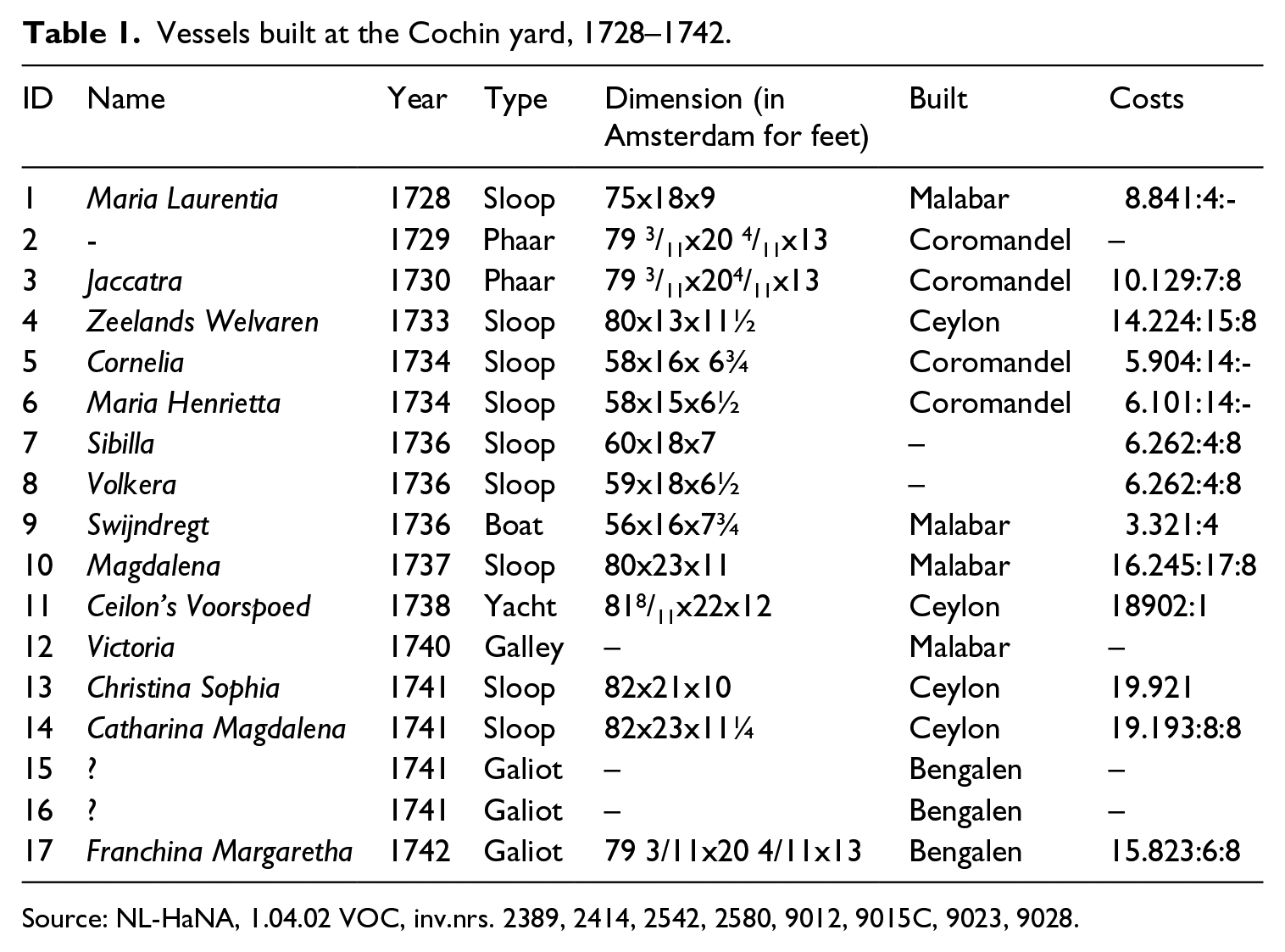
The plans for the new yard are related to an increase in production at Cochin. From the late 1720s until the early 1740s the production of new vessels is well documented. Information on the costs and required material of the vessels were now routinely forwarded to Batavia as separate appendices. These accounts are thus easily found in the TANAP-database of letters and papers sent to the Republic from Asia. 37 Table 1 provides an overview of production at Cochin from the late 1720s until 1742. From that year onwards the detailed lists of costs of new-built ships disappear from the inventories. This could be related to the changing position of the VOC in Malabar from 1742 onwards, a question to which I will return later.
Vessels built at the Cochin yard, 1728–1742.
Source: NL-HaNA, 1.04.02 VOC, inv.nrs. 2389, 2414, 2542, 2580, 9012, 9015C, 9023, 9028.
In the period 1728–1742 there are 17 clear references to ships built at Cochin. In most cases it is clear the vessel was indeed built, since there are detailed accounts of the total costs. There are, however, a few uncertainties. It is possible that the phaar Jaccatra (ID 2) is the same vessel as the nameless vessel mentioned a year earlier (ID 1). The same is possible for the galliots for Bengal in the early 1740s. Franchina Margaretha could well be one of the two nameless vessels mentioned the year before. Total production is thus either 17, 16 or 15 vessels in a period of 14 years.
The vessels varied from the boat Swijdregt of 15.8m to the 23.2m long sloop Catherina Magdalena. To give a better idea of the costs of building a vessel in Cochin, I will give the detailed accounts of the building of the sloop Cornelia of 1734. The Cornelia was built for the Coromandel Government and maintained communications between the capital Negaptnam and the outlying posts like Pulicat, Sadras and Masulipatnam. This was one of the smaller vessels built at Cochin, measuring 16.4m stem to stern, 4.5m wide and 1.9m deep in the hold. What was the division between material and labour costs? And was timber indeed as cheap as the seventeenth-century proponents of building at Cochin had envisioned? The Cornelia cost a total of 5,905 guilders and 14 stivers. This number was divided in the books under two general headings: building the hull of the vessel and the rigging and equipment costs. Construction of the hull had cost 4,438 guilders, six stivers and eight penningen. The 67 teak beams and 128 teak frames had cost 1,065 guilders, 10 stivers. The labour costs for the hull were divided into four categories: wages for sawing the timber (cost f. 269:5): 2,688 day wages of carpenters amounted to 1,008 guilders, while 59 days of labour for the woodcarvers cost f. 20:4:8. Finally, 125 days of wages for coolies amounted to f. 23:9. Altogether, the labour for the hull had cost f. 1320:18:8, about 30 per cent of the total costs of the hull. Besides timber and labour, the other expenses were spread over a large number of smaller items, such as copper, lead, paint and bricks for the kitchen. The largest of them was ironwork: 5,120 nails and 61 rivets amongst others. The ironwork cost f. 1,130:15:8. or a quarter of the total. The rigging, which included masts and all the rope, cost another f. 1,467:7:8. 38
This brief overview of the costs of building a vessel at Cochin could serve as the basis for a comparison to see whether labour and timber costs were indeed cheaper than in the Netherlands. A good basis of comparison would be the galiots, as this type of vessel was also built by the VOC in the Netherlands.
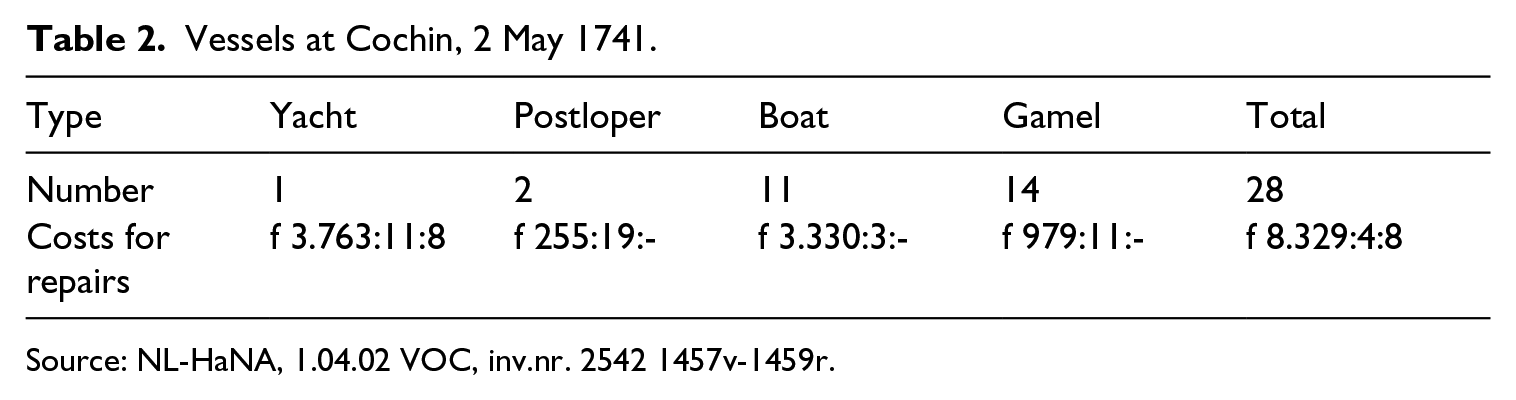
Ships at Cochin: The 1741 survey
The lists of new-built ships still do not provide a full picture. There are a number of lists of vessels which served at Cochin with their associated repairs and costs. Table 2 shows the vessels present at a survey on 2 May 1742, with the estimated costs for repairing them. There were 28 vessels in Cochin at that moment. The majority of them are of types which either appear only very summarily or not at all in the building lists: boats and gamels. The only vessel from these categories for which we have the construction costs is the boat Swijndregt, which had cost f. 3321:4 to build in 1736. Six years later this boat needed repairs worth f. 515:14:8. The gamels were small galleys, which were used on the Malabar backwaters. They could be used in wartime as well, but in peacetime they had the important task of providing firewood and fresh drinking water to the fortress. 39 The boats were also used to maintain contact with larger vessels on the roads and as ‘station vessels’ at the outlying Malabar forts. This can be surmised from the names of a number of these vessels: Cranganoor and Chettua. The small vessels were crucial for the functioning of Cochin as a VOC port and fortress and for enforcing the VOC’s monopoly on the export of pepper. The ability to build these vessels locally was thus of great importance.
Vessels at Cochin, 2 May 1741.
Source: NL-HaNA, 1.04.02 VOC, inv.nr. 2542 1457v-1459r.
The repair yard
The shipyard was not only engaged in new construction, but also facilitated repairs, both to the small vessels stationed at Cochin as well as passing larger vessels. Examples of this latter category include repairs to the Noordwolfsbergen in October–November 1738. Noordwolfsbergen was built in 1733 at the VOC’s Amsterdam yard and measured 650 tons. 40 The vessel was first used on the direct route to China and later in the intra-Asian trades. During the summer of 1738 the ship was engaged on the route to Mocha, where the VOC procured coffee. During this voyage it was attack by Angria ‘pirates’, who formed an increasing threat for VOC vessels in Western India. On the return voyage the vessel dropped anchor at Cochin, where it was inspected on 28 October by the head of the ship-carpenters D. van de Velden and equipagiemeester P. Hesseling. They found that the deck was in a poor state. The deck beams were not properly caulked, which had resulted in the spoliation of part of its coffee cargo. The built-up mainmast was damaged by the heavy rolling of the vessel and a leak in the stern needed to be fixed. 41 These repairs had all been completed by 4 November when the two inspectors reported that they had checked the repairs in the presence of the ship’s officers. There were still some things that needed fixing but they were beyond the yard’s capabilities. The ship needed to be sent to a yard where it could be hove down, careened and have the wood sheathing replaced. 42 This shows the limitations of Cochin as a repair yard for larger ships. The most acutely necessary repairs could be conducted there, but large-scale maintenance, which required heaving down, would likely happen at Onrust. Noordwolfsbergen likely left Cochin immediately after her repairs; she arrived in Colombo on 25 November with coffee worth 190,314 guilders. 43
The end of the yard
Commander Frederik Cunes in his 1756 memorandum for his successor Caspar de Jong mentioned the vessels built at Cochin as being of high quality. Interestingly, he mentions that the old condemned Maria Laurentia was sold to the local merchant Naga Parboe. Old VOC vessels could thus have second lives in private service. But as far as the yard was concerned, Cunes set a new line. Both yards (the building yard and the equipagiewerf) were expensive to maintain. 44 Malabar was notorious for running large deficits and the yards were part of this problem. Cunes thus proposed cutting the number of employees at the yard and only maintaining a master and four carpenters. Additional labour could easily be hired when necessary. New construction could also be outsourced to private builders and so the Company could be spared the costs of employing personnel who might not have enough work. 45 Thus, the yard had gone from a useful facility for all of the South Asian commands to a burden upon the Malabar Command. Partly this was a result of the VOC’s accounting. Malabar constructed ships for Bengal, Coromandel and Ceylon, as well as Malabar itself, but the costs for maintaining the facility were being shouldered by Malabar alone. To save costs in Malabar the yard was downsized, which forced the other Governments to procure ships elsewhere, perhaps at higher cost. Commander De Jong, in his 1761 memorandum, still mentions the building of a lighter and two gamels. Though the yard is not mentioned specifically, it still shows that it produced vessels. In the memorandum of Godefridus Weijermans for his successor Breekpot four years later the yard is mentioned as being threatened by coastal erosion: ‘in the meantime the terrain at Calwetij has so diminished that engineer Zeijnen fears the company’s ship yard is at risk…’ 46 Coastal erosion was a persistent problem at Cochin and also threatened to undermine the fortress’s walls on the shore. Breekpot, in his 1769 memorandum, mentions neither the yard nor ships built. Cochin at that time still had 10 small vessels at its disposal, mainly for maintaining communication on the inland waterways and for unloading larger vessels in the roads. These vessels were considered highly important and would need to be maintained, but nothing is said of the yard. 47 Late eighteenth century maps of Cochin still show the yard to the east of the fortress marked as ‘Galwetty or the Company’s shipyard’. 48 Seagoing ships will no longer have been built here.
The decline of the yard at Cochin might be explained by the changing position of the VOC in Malabar from the early 1740s onwards. The rise of the powerful state of Travancore to the south in the 1730s, and the invasion of North Malabar by Mysore in the 1760s, made the Company’s position ever more precarious. Travancore succeeded where the VOC had failed and was able to implement a successful state monopoly on the export of pepper. The VOC was steadily reduced to trading arms for pepper on conditions set by Travancore. Though the VOC had never really been able to implement its own monopoly, the treaty of Mavelikkara still marked a fundamental change. 49 The Company no longer claimed to be the arbiter of conflicts amongst the southern Malabar states. The formal end of the Company’s claims to a monopoly of pepper export also marked an end to the maritime patrols to counter smuggling. This might have reduced the need for ships at Cochin, undermining the economic case for the yard. These developments were further strengthened after Mysore invaded Malabar in 1766. It has been mentioned that shipbuilding timber was increasingly imported from the lands of the Zamorin, which were now in Mysorean hands and devastated by the ensuing conflict. Importation might have become ever more difficult. 50 Thus, by the late 1760s it might have been less necessary to build ships at Cochin; indeed, it might have become impossible to do so.
Conclusion
The VOC shipbuilding facility at Cochin is but one example of the yards the Company maintained in Asia. Further research can highlight a number of interesting aspects of VOC shipbuilding in Asia. Comparisons of comparable vessels built in Asia and the Netherlands can highlight the extent to which Asian yards could compete with Dutch ones on price. Such an approach should also include private yards, like those at Rembang on Java. This paper has focused on the production of vessels at the VOC yard at Cochin. Though it was technically possible to build large ocean-going vessels there, the yard focused on smaller vessels. This sheds some light on a little researched part of the VOC’s Asian shipping. To enforce monopolies and privileges the Company required small vessels that could also secure communications within and between neighbouring commands. Yards like the one at Cochin met these requirements. Another important role was repairing vessels operating in the western Indian Ocean and which might not be able to reach Onrust safely. Cochin thus fulfilled its role as a node in VOC shipping. In contrast to expert opinion, such as Van Duivenvoorde’s, larger ships could and indeed were built at Cochin; this was prohibited by decree from the Heeren XVII. The lack of country traders to whom vessels could be sold profitably meant that it was not economical to maintain yards in competition with those in the Netherlands. Different choices in the Company’s organization of the intra-Asian trades might have resulted in a larger role for the yard at Cochin. After the British takeover of Cochin in 1796, ships were in fact built there, both for private merchants, the EIC as well as the navy. It is unclear, however, if this happened in the same location where the VOC had its yard. 51 A topic not broached in the article is the possible influence of local shipbuilding traditions on the ‘European’ vessels built at the yard. This is a fascinating topic but also one which is difficult to trace from the sources. Archaeological excavation of a wreck would be helpful in this regard.
Footnotes
1
Jonathan Palmer et al, ‘The Discovery of New Zealand’s Oldest Shipwreck – Possible Evidence of Further Dutch Exploration of the South Pacific’, Journal of Archaeological Science, 42:1 (2014), 435–41; at 441.
2
Wendy van Duivenvoorde, Dutch East India Company Shipbuilding: The Archaeological Study of Batavia and Other Seventeenth-Century VOC Ships (College Station, 2015).
3
Wendy van Duivenvoorde, ‘Response: The Discovery of New Zealand’s Oldest Shipwreck’, Journal of Archaeological Science, 46:1 (2014), 191–4; at 192.
4
Jaap R. Bruijn, ‘Schepen van de VOC en een Vergelijking Met de Vaart op Azië door Andere Compagnieën’, BMGN, 99, No. 1 (1984), 1–20.
5
Robert Parthesius, Dutch Ships in Tropical Waters: The Development of the Dutch East India Company’s Shipping Network in Asia 1595–1660 (Amsterdam, 2010).
6
Chris Nierstrasz, In the Shadow of the Company: The Dutch East India Company and its Servants in its Period of Decline (Leiden and Boston, 2012), 73–8.
7
Matthias van Rossum, Werkers van de Wereld: Globalisering, Arbeid en Interculturele Ontmoetingen Tussen Aziatische en Europese Zeelieden in dienst van de VOC, 1600–1800 (Hilversum, 2014).
8
The experience of one sailor on these small patrols is given in Perry Moree and Piet van Stelenburg, Verdrinken Zonder Water: De Memoires van VOC-matroos Jan Ambrosius Hoorn, 1758–1778 (Zutphen, 2014), 119–20, 122–34.
9
For example: Lodewijk J. Wagenaar, ‘Het Iiland Onrust bij Batavia als Onderdeel van het VOC-Scheepsbedrijf in de 17e en 18e Eeuw’, Antiek, Tijdschrift voor Liefhebbers en Kenners van Oude Kunst en Kunstnijverheid, 25, No. 2 (1990), 65–80; at 76–80; Hans Bonke, ‘Het Eiland Onrust: Van Scheepswerf van de VOC tot Bedreigd Historisch-Archeologisch Monument’, in M.H. Bartels, E.H.P. Cordfunke and H. Sarfatij, eds., Hollanders uit en Thuis: Archeologie, Geschiedenis en Bouwhistorie Gedurende de VOC-Tijd in de Oost, de West en Thuis. Cultuurhistorie van de Nederlandse Expansie (Hilversum, 2002) 45–60.
10
Huis te Swieten, Beurs van Amsterdam, Stadhuis van Amsterdam, Wassende Maen, Rijsende Son and Nagelboom.
11
For the introduction of English building methods to the Amsterdam Admiralty, see Jaap R. Bruijn, ‘Engelse Scheepsbouwers op de Amsterdams Admiraliteitswerf in de Achttiende Eeuw: Enkele Aspecten’, Mededelingen van de Nederlandse Vereniging voor Zeegeschiedenis, 25 (1972), 18–24.
12
Jaap R. Bruijn, ‘Schepen van de VOC en een Vergelijking met de Vaart op Azië door Andere Compagnieën’, BMGN, 99, No.1 (1984), 1–20; at 3–4.
13
J. P. Sigmond, Nederlandse Zeehavens Tussen 1500 en 1800 (Amsterdam, 1989), 136–42.
14
Femme Gaastra, ‘Arbeid op Oostenburg. Het personeel van de Kamer Amsterdam van de Verenigde Oostindische Compagnie’, Werkgroep VOC-Oostenburg, Van VOC tot Werkspoor (Utrecht, 1986), 65–80; at 67.
15
Aris van Braam, ‘Over de Omvang van de Zaandamse Scheepsbouw in de 17e en 18e Eeuw. De Zaandamse Scheepbouw: Functie en Structuur’, Tijdschrift Holland, 24:1 (1992), 33–49; at 40.
16
Jaap R. Bruijn, Femme Gaastra and Ivo Schöffer, Dutch Asiatic Shipping in the 17 th and 18 th Centuries. Volume 1: introductory volume (The Hague, 1987), 37–52.
17
Bruijn, ‘Schepen van de VOC’, 4.
18
Bruijn, ‘Schepen van de VOC’, 4.
19
Femme Gaastra, Bewind en Beleid bij de VOC: De Financiële en Commerciële Politiek van de Bewindhebbers, 1672–1702 (Zutphen, 1989) 167.
20
Peter Boomgaart, ‘Technologies of a Trading Empire: Dutch Introduction of Water- and Windmills in Early-Modern Asia, 1650s–1800’, History and Technology, 24, No. 1 (2008), 41–59; at 49–50.
21
Nationaal Archief, Den Haag [hereafter NL-HaNA], Verenigde Oostindische Compagnie (VOC), nummer toegang 1.04.02, inventarisnummer 1239, 1639.
22
H. ‘s Jacob, De Nederlanders in Kerala: De Memories en Instructies Betreffende het Commandement Malabar van de Verenigde Oost-Indische Compagnie (The Hague, 1976), 22. Hustaert to Van Dielen, 6 March 1664.
23
NL-HaNA, VOC, 1.04.02, inv.nr. 1251. fol. 1229–1230.
24
NL-HaNA, Hoge Regeringe Batavia, 1.04.17, inv.nr. 542.
25
The VOC used Amsterdam feet of 28.3cm.
26
NL-HaNA, VOC, 1.04.02, inv.nr. 8908, fol. 142–53.
27
NL-HaNA, VOC, 1.04.02, inv.nr. 8908, fol. 99.
28
NL-HaNA, VOC, 1.04.02, inv.nr. 8908, fol. 99.
29
Boomgaart mentions a tidal mill, which seems the more natural option given its location. Boomgaart, ‘Technologies of a Trading Empire’, 51.
30
NL-HaNA, VOC, 1,04.02, inv.nr., 8986, fol. 18. Outgoing letter from Malabar, 17 December 1687.
31
For the background to Van Reede’s inspection, see Gaastra, Bewind en beleid, 147–57.
32
NL-HaNA, VOC, 1.04.02, inv.nr 323, Heeren XVII to Malabar, 6 July 1693.
33
NL-HaNA, VOC, 1.04.02, inv.nr 323, Heeren XVII to Malabar, 22 Aug. 1694.
34
NL-HaNA, VOC, 1.04.02, inv.nr 323, Heeren XVII to Malabar, 22 Aug. 1694.
35
‘s Jacob, De Nederlanders in Kerala, 323.
36
NL-HaNA, VOC, 1.04.02, inv.nr. 9014A, fol. 1926v–1927.
37
Accessible at www.tanap.net. The National Archives now also hosts an index on the letters and papers:  . In the future this will be linked to the scanned files, making it very easy to find relevant sources.
38
NL-HaNA, VOC, 1.04.02, inv.nr. 9017, fol. 1121 e.v.
39
G. Alfredo, A. J. van der Burg and P. Groot, The Dutch in Malabar, Being a Translation of Selections Nos. 1 and 2 with Introduction and Notes (Madras, 1911), 77.
40
41
NL-HaNA, VOC, 1,04.02, inv.nr. 2446, fol. 257–8.
42
NL-HaNA, VOC, 1,04.02, inv.nr. 2446, fol. 259–60.
43
44
P. Groot, Selections from the Records of the Madras Government, Dutch Records No. 3: Memoir of Commander Frederik Cunes Delivered to his Successor Caspar de Jong. Copied by the rev. P. Groot (Madras, 1908), 28.
45
Groot, Selections from the Record, 28.
46
G. Weijermans and P. Groot, Selections from the Records of the Madras Government, Dutch Records No.12: Memoir of Commandeur Godefridus Weijerman Delivered to his Successor Cornelis Breekpot on the 22 nd February 1765. Copied by the Rev. P. Groot (Madras, 1910), 19.
47
C. Breekpot and J. Fruijtier, Selections from the Records of the Madras Government, Dutch Records, No. 7: Memoir of the departing Commander Cornelius Breekpot, Delivered to his Successor the Worshipful Titular Governor and Director-Elect Christian Lodewijk Senff (Madras, 1909), 28–29.
48
NL-HaNA, Collectie Leupe, 4.VEL, inv.nr. 907, legend under ‘h’.
49
P. Emmer and J. Gommans, Rijk aan de Rand van de Wereld: De Geschiedenis van Nederland Overzee, 1600–1800 (Amsterdam, 2012), 341–342.
50
Lohuizen, The Dutch East India Company and Mysore (Den Haag, 1961) 28–51.
51
A. Lambert, ‘Strategy, Policy and Shipbuilding: The Bombay Dockyard, the Indian Navy and Imperial Security in Eastern Seas, 1784–1869’, in H. V. Bowen, M. Lincoln and N. Rigby, eds., The Worlds of the East India Company (Woodbrigde, 2002), 135–151, 148; A. Buley, The Bombay Country Ships 1790–1833 (Richmond, 2000), 31–36; R. Winfield, British Warships in the Age of Sail 1817–1863: Design, Construction, Careers and Fates (Barnsley, 2014) 178–179, provides examples of ships built in Cochin for the Royal Navy in the early 19th century.