




Abstract
The objective of this article is to examine the interRAI system for developing digital solutions. As an organization, interRAI provides all the necessary tools for digitalization of interRAI assessments and applications to create an integrated information system for decision support. The organization’s model for developing software is to license software vendors in a competitive market. Thus, service providers should carefully consider required and desired features and functionality of software as these will determine how well the interRAI system will work in daily practices. The eight features presented in this article offer general guidelines for procurement agencies and software developers.
Introduction
In recent years, the social and healthcare sector has increasingly turned to advanced digital solutions to improve service delivery and patient outcomes.1,2 The implementation of interRAI information systems represents a pivotal step in this transformation, offering tools that standardize and improve the collection of clinical assessment data and enhance decision-making processes. The objective of this article is to present the interRAI model for digitalization, its strengths and weaknesses, and how Information Technology (IT) solutions could be improved. Often the interRAI system and the software solution are regarded as the same thing. From a user perspective this is understandable, as the tool for using interRAI is a software solution. However, these two must be separated. If the purpose is to only collect assessment data, digitalization can be relatively simple, focusing only on developing electronic versions of the assessment forms. However, if the goal is to use the interRAI system as a digital decision-support system in daily work, by professionals, the users need more sophisticated solutions. The objective of this article is to focus on the latter, to illustrate, through informatics and digital health lens, important software features for health leaders’ consideration when selecting a vendor for implementation of interRAI systems. Through a narrative review 3 of publicly available web sites and procurement documents, as well as our expertise supporting implementation of interRAI systems across countries, we present a list of desirable software features to enable uptake of the tools as a digital decision-support system. Before going into this discussion, there are different options for creating information systems to support vulnerable populations. Why choose a system like interRAI in the first place?
System of Integrated Assessments and Applications
From the perspective of digitalization, an integrated system of assessment instruments has many benefits, but it is not the only option. The other option would be to compile a system based on stand-alone instruments that are already available. Stand-alone instruments generally target single domains such as physical functions, cognition, depression, and pain. Although these tools may be both valid and reliable,4,5 they create some challenges from the perspective of creating an integrated information system. Operationalization requires implementation of multiple data collection forms which can increase risks of repeat assessment and double documentation as different scales often use similar assessment items. Further, these tools also vary in structure and coding.6,7 The interRAI system takes a broader approach on assessment. Rather than focusing on a single domain, interRAI comprehensive assessments focus on multiple domains to describe functions and health status of the person holistically. The intention is to understand the person and not only specific health problems. The interRAI system spans both the continuum of care, from primary to facility-based care settings, and the lifespan from infants, children, and youth, to the care of older adults,8-10 with over 30 assessment instruments that have a common structure, coding system, and outputs—including outcome scales, action plans for care planning, case-mix algorithms, and quality indicators.
The interRAI Model for Digitalization
As a scientific not-for-profit organization, interRAI develops the assessment standards and output applications but not the software solutions. Rather, it relies on the software market to provide digital solutions. Software vendors computerizing interRAI systems must be licensed with interRAI, and interRAI collects a small royalty fee. The vendor license gives the vendor the right to use copyrighted material, including the assessment forms, manuals, and algorithm code for interRAI approved health index scales, quality indicators, and case-mix classifications. Currently, interRAI has licensed over 35 software vendors around the world. Licensed companies and their products are listed on the interRAI website (www.interrai.org).
Digitalization Tools Provided by interRAI
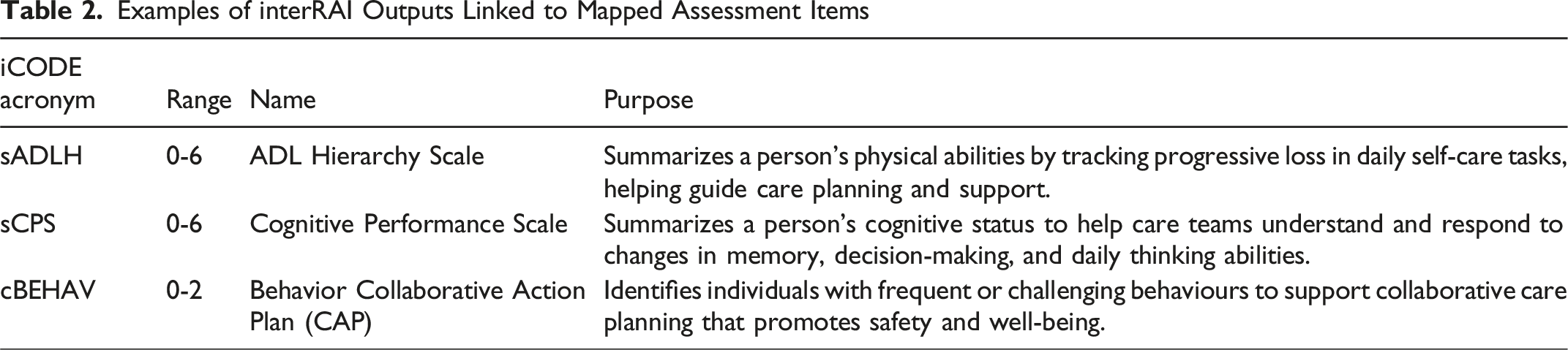
While interRAI develops and maintains all intellectual content for the assessment system, independent licensed vendors leverage this content to build software for deployment into clinical practice. To support consistency in programming across vendors, interRAI has developed a generic variable naming system called iCODE. Each assessment item has a unique iCODE, with common assessment items represented by the same iCODE across assessment instruments. This system serves as the foundation for digitization, allowing tracking of common assessment items and outputs across instruments and standardizing the coding of all interRAI approved outputs.
Tools provided for digitalization of the assessment system content include: • Assessment forms and user manuals, • iCODES of data items, and • Algorithms in iCODES for scales and measures.
Examples of Variable Mapping Between iCODE and interRAI Assessments in Home and Long-Term Care Settings

Examples of interRAI Outputs Linked to Mapped Assessment Items
Interoperability
The common data structure and the coding standard within the suite of interRAI instruments ensure interoperability. There is no need to apply third-party systems to create a common language within the interRAI system. However, other standards are needed for exchanging electronic healthcare information between IT systems. Several interRAI partners are engaged in FHIR/HL7 and SNOMED development.11,12 The Canadian Institute of Health Information (CIHI) uses the FHIR standard when data are sent by the facility/region/ministry of health directly to the interRAI Reporting System (IRRS).13,14 Recent study in Australia also confirms the feasibility of mapping interRAI to SNOMED terminology to advance age care interoperability. 15
interRAI Information Systems
The interRAI solutions provided by vendors are often SaaS (Software-as-a-Service) solutions with various features. There is no single software system or architecture, as every vendor is different. Figure 1 presents an overview of how a larger information system using interRAI data might look. The interRAI assessment software may be stand-alone or integrated with or part of an EHR system for care planning applications and reporting, and while the vendor’s interRAI solution is the main tool, information may also be exchanged between multiple other solutions in the larger system. Information System Using interRAI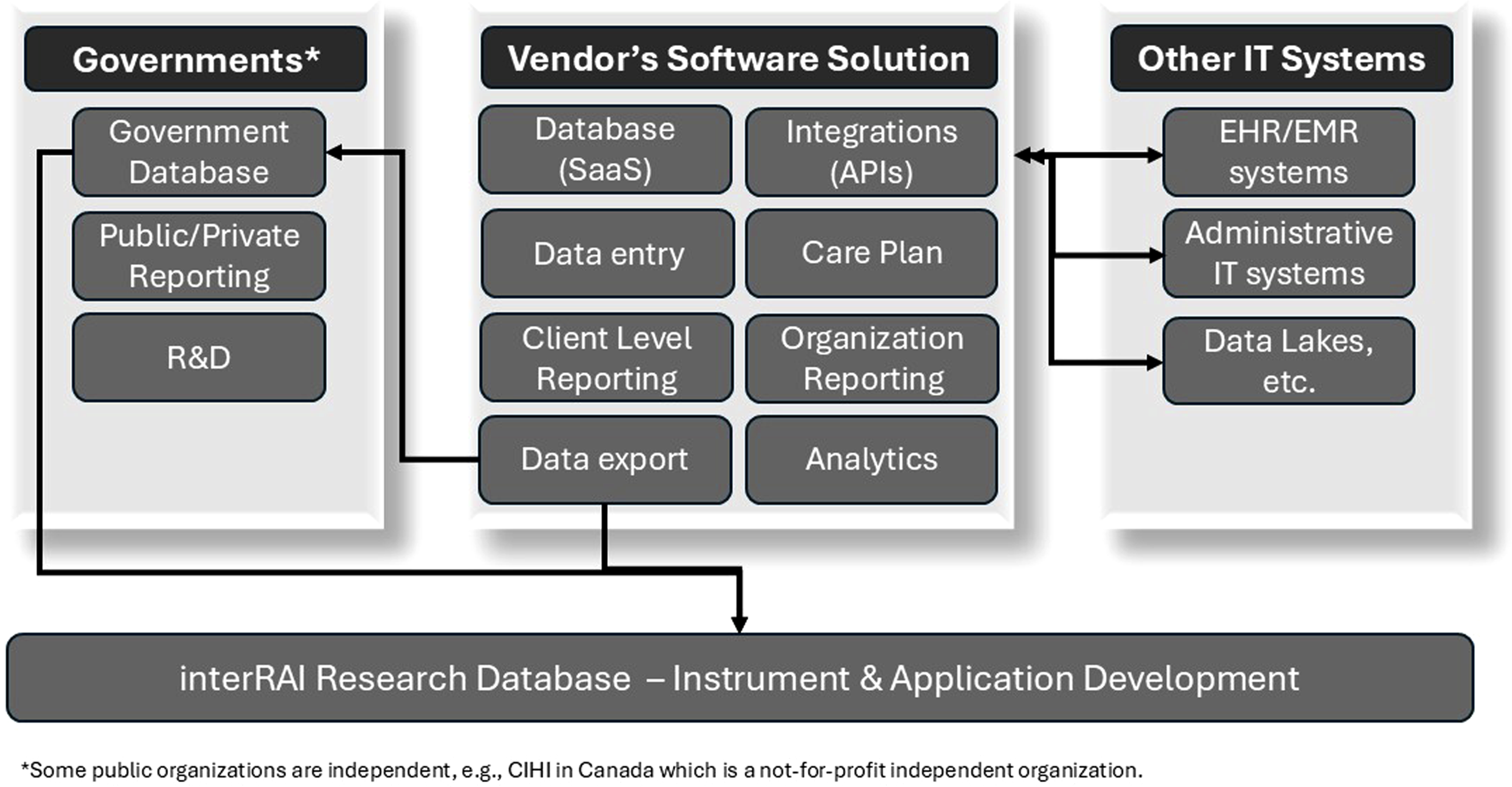
Examples of Procurements Internationally
Internationally, the purchaser of interRAI software is generally a public sector entity. The main difference is whether there is one or multiple vendors operating in a jurisdiction. In the United States, about half of states use interRAI instruments in state-run home care programs and state Medicaid agencies are responsible for this software procurement. In Canada, software vendors providing interRAI solutions need to be licensed and complete conformance testing with CIHI. 16 The procurement of software is a provincial/territory matter, done at the regional health authority or individual care provider agency level. Some provinces have also developed their own interRAI software solutions. In Finland, the Finnish Institute for Health and Welfare (THL) is responsible for the implementation of mandated interRAI instruments. Regional Well-being Counties are responsible for procurement of interRAI software, and in some cases private service providers. In Belgium, a national approach has been taken with the government providing service providers with free interRAI software which also functions as the national interRAI data repository. Private vendors that provide additional interRAI solutions must be able to integrate with the national solution. In New Zealand, one private vendor provides the interRAI solution for the whole country with Health New Zealand responsible for both implementation and the software solution. In Singapore, the Agency for Integrated Care has also chosen one vendor to provide the interRAI software solution.
Procurement Considerations
The procurement of software is extremely important to the clinical adoption of interRAI and other health information systems because of how intertwined the information, system, and service are in terms of user satisfaction. 17 Through the Request for Proposal (RFP) process, software solutions are commonly assessed and ranked on price, performance, and functionality; however, frequent resource and fiscal constraints drive decision-making with little attention given to impact on clinician or operational workflow. 18 Poor functionality can be very costly financially and hinder a smooth and successful implementation. A balanced approach to procurement, which considers both the clinical workflow and desired operational and management requirements should be considered. Below, we expand on the vendor solution considerations, focusing on features that could be considered relevant for any jurisdiction internationally.
Desirable Features and Functionality
While interRAI provides explicit guidance to vendors on the minimum requirements for interRAI software, experience has shown that additional features can help create more useful and actionable systems. The following is a list of desirable features which support the optimal use of the interRAI assessment as a decision-support system. Many of these features are common to any software solution but especially important for the implementation of interRAI software solutions.
Flexible Data Entry
For assessments conducted in an office environment, users typically prefer laptop and desktop solutions. In community settings, users often prefer mobile solutions with offline capabilities because of unstable networks, especially in rural and remote jurisdictions. A good software solution should support all these devices. If there is a need for mobile solutions, buyers should especially pay attention to offline capabilities. For self-rated assessments, platforms adapted to independent completion of assessments, where users can log-in using secure identification methods and complete the assessment independently, provide additional assessment flexibility.
Accuracy of Assessments
At the point-of-care, user manuals embedded in the software environment facilitate assessor access and use of reference materials, while having outcome scales computed in real-time provides instant assessor feedback regarding assessment accuracy. Different types of alerts for logical inconsistency in the assessment can also be added to reduce errors. Forcing functions, such as rules for auto-population of unstable items on follow-up assessments, can also be implemented to ensure assessor review of items expected to change over time. These types of functionalities support buyers’ efforts to improve data quality.
Integration With Care Planning
Given that the main purpose of interRAI assessments is to support person-centred and data-informed care planning, linking assessments to care planning tools in the software is critical. Software which allows assessors to flag important assessment items and results for planning and provides easy-to-use customizable digital care planning templates facilitates use of interRAI data at the point-of-care. Care plans can also be structured based on the interRAI assessment language using items, status, and outcome measures; this reduces free text and makes documentation more standardized. This kind of integration between the assessment and care planning process can save documentation time. Buyers should pay great attention to how the assessment and care plan are linked together digitally.
Person Level Reports for Data-Informed Clinical or Care Management Use
Meaningful summaries of assessment results should be programmed for efficient point-of-care use. These reports support clinicians and other members of the circle of care to more easily review and understand assessment findings. Individual-level reports providing an overview of the person’s health status and functional performance, as well as progress reports tracking changes and effectiveness of care between assessment periods, are recommended. Progress reports should be linked to evaluate progress of the care plan. Buyers should pay attention to how the solution provides client reports, and whether these can be customized by the user.
Organization Level Reports for Data-Informed Operational Management
Aggregated reports support managers and administrators to plan, develop, and evaluate services. These reports should reflect different levels within the organization to facilitate performance monitoring. To adhere to local privacy regulations, functionality should limit access to information based on roles and work duties. Typically, managers do not need information where individuals can be identified but require aggregate information on distributions and basic statistics on key measures to compare case mix, outcomes, and quality. Some measures like quality indicators can only be calculated at an aggregate level.
Efficient Use of Information
A well-designed solution makes data accessible to multiple users across an organization. Although comprehensive assessments can take up to 2 hours to complete, reusing collected information for various purposes such as performance management and reporting can make this time investment cost-efficient. Effective software solutions maximize the delivery of relevant information to users based on their roles while ensuring privacy is maintained.
Data Analytics
InterRAI assessment systems generate large volumes of reliable and valid data, increasing demands for user-friendly analytics. Real-time tools embedded in software allow organizations to analyze data internally, reducing lag time for clinical and operational insights and saving staff time. These types of software features may be less critical during initial implementation, but they become essential as data accumulate. Thus, purchasers should review the need for such solutions. Future considerations as to how AI and other tools can support this functionality will also be important.
Data Export and Integration
Licensed vendors are required to enable export of interRAI data using the iCODE system for data submission, reporting, and research purposes. In many regions, governments require submission of interRAI data for public and private reporting, policy development, and benchmarking. To support these uses, software systems need robust data integration and technical capabilities. Further, to support on-going research and development work within interRAI research network, software embedded de-identification options facilitate secure data sharing, while maintaining privacy requirements.
Conclusion
As an organization, interRAI provides the tools necessary to digitalize its assessment system, which is grounded in a robust evidence base of over 2,300 scientific publications demonstrating the reliability, validity, and utility of its assessment instruments. From a vendor’s perspective, the royalty fee represents an investment in maintaining and advancing the interRAI standard. However, it is important to distinguish between the assessment standard itself, and the software solution used to deliver it. The interRAI business model of licensing private vendors encourages innovation by letting private vendors produce software in the competitive market, an approach that offers flexibility but limits direct control of the final product. In this type of market, the negative effects can be altered with (1) more detailed software requirements in the licensing contract and by (2) giving more information to the organization buying software.
Providing better information can be a powerful way to improve market functions. 19 Where the buyer is a public sector organization, the requirements in the RFP are extremely important; otherwise, there is a risk that vendors only provide minimal features. Studies show that digital health technologies can be very cost-efficient; however, poor implementation and lack of standardization can lead to inefficiencies and waste. 20 From the perspective of improving solutions, we believe the purchaser has a significant role to influence the final product. The eight features presented in this article offer some guidelines for procurement agencies and software developers.
Footnotes
Acknowledgements
The authors wish to extend their sincere thanks to those who contributed to the scientific review of this manuscript, with particular appreciation to George Heckman, John Hirdes, and people at CIHI.
Ethical Approval
Institutional review board approval was not required.
Funding
The authors received no financial support for the research, authorship, and/or publication of this article.
Declaration of Conflicting Interests
The authors declared the following potential conflicts of interest with respect to the research, authorship, and/or publication of this article: Magnus Björkgren is a private consultant and a Senior Advisor for Vitec Raisoft Oy, Finland. Melanie Thomasson is employed by HCBS Strategies, which has participated as a subcontractor on projects administered through FEI Systems in the USA. Margaret Saari receives unrestricted salary support through her role as a Clinical Scientist with the SE Research Centre in Canada. Len Gray is a professor in Geriatric Medicine, University of Queensland, Australia. The authors affirm that these relationships have not influenced the content of the manuscript and declare no additional conflicts of interest.