




Abstract
Forceful imposition of settler-colonial laws and institutions violate Indigenous rights to self-determination, with profound impacts on health and wellness. As a team of Indigenous and non-Indigenous health leaders working in what’s known colonially as “British Columbia,” our collective work advances the rights and health of Indigenous Peoples (First Nations, Métis, and Inuit) by dismantling Indigenous-specific racism and White supremacy. We envision settler-colonialism as a net composed of hundreds of thousands of “colonial knots” that entangle Indigenous Peoples and prevent sovereignty and self-determination. The net also depicts Indigenous resistance, and the way forward of “untying colonial knots” patiently and persistently every day. We unpack this metaphor of the settler-colonial net and the artwork that inspired it. Our aim is to offer one more tool to Canadian health leaders who are bringing their hands, hearts, and minds to the complex and messy work of arresting White supremacy, Indigenous-specific racism, and settler-colonial harm.
Introduction
Introducing ourselves
Introducing ourselves is an essential protocol within many Indigenous worldviews. We’re a team of Indigenous and non-Indigenous health leaders working in what’s known colonially as “British Columbia” (BC). The overarching purpose of our collective work is to advance the rights and health of Indigenous Peoples (First Nations, Métis, and Inuit) by dismantling Indigenous-specific racism and White supremacy. Dr. Danièle Behn Smith (Eh Cho Dene and Métis/French Canadian) is Deputy Provincial Health Officer, Indigenous Health in BC’s Office of the Provincial Health Officer (OPHO). Dr. Kate Jongbloed (White occupier) is a post-doctoral fellow in the OPHO and an Associate with Qoqoq Consulting. Ms. Jorden Hendry (Tsimshian/Settler, Lax Kw’alaams) is a doctoral student at University of British Columbia. Mr. Joe Gallagher, Kwunuhmen (Tla’amin Nation) is CEO of Qoqoq Consulting; Vice President of Indigenous Health and Cultural Safety at BC’s Provincial Health Services Authority; and founding CEO of BC’s First Nations Health Authority.
Our perspective is rooted in BC’s unique context: unanswered land questions, an established BC First Nations Health Governance structure, and as the first jurisdiction in Canada to bring the United Nations Declarations on the Rights of Indigenous Peoples (UNDRIP) into law with the BC Declaration on the Rights of Indigenous Peoples Act (BC Declaration Act).1-5 This paper is foremost for BC health leaders, with relevance to all Canadian health leaders and those in other sectors. We write in the “settler first person” to emphasize that our topic is settler responsibility. We share a tool we use daily to connect with hearts and minds of settler health leaders to help daylight their responsibility—and agency—to arrest White supremacy, undo settler-colonial harms, and respond to Indigenous-specific racism in health systems.
Indigenous rights and responsibilities since time immemorial
First Nations territories cover every inch of the province termed “British Columbia” and occupied by colonial settlers. 6 Laws and governance systems rooted in lands and waters have upheld the sovereignty of diverse Nations here for thousands of years. First Nations rights and responsibilities to ancestral territories have never been ceded or surrendered, and are upheld in provincial, national, and international law. Distinctions-based framing acknowledges the specific rights, interests, priorities, and concerns of First Nations, Métis, and Inuit Peoples who call BC home, while respecting and acknowledging these distinct Peoples and their unique cultures, histories, rights, laws, and governments. 7
Forceful imposition of settler-colonial laws and institutions violates Indigenous rights to self-determination, with profound impacts on health and wellness.8,9 Elders remind us that given thousands of years of Indigenous history on these territories, the settler-colonial era is a speck in time—but one that has caused and continues to cause tremendous harm. It is the work of this generation of health leaders to build on strong foundations created by Indigenous Peoples who have resisted imposition of foreign laws and continue to fight for their inherent rights since the creation of Canada and BC.1,6
Indigenous-specific racism in Canadian health systems
We have long known about racist inequities in health determinants and outcomes between Indigenous and non-Indigenous people across Canada. Associations between experiences of settler-colonial policies and poor health are well documented.10-14 Evidence of the prevalence of Indigenous-specific racism in Canadian health systems is mounting, and so is clear guidance from Indigenous Peoples regarding its remedy. We remember Brian Sinclair,15,16 Hugh Papik, 17 Keegan Combes, 18 and many others who have died or not received care that they needed. Following the racist death of Joyce Echaquan in a Quebec hospital in 2020, her family and Nation have released guidance to health systems across Canada in the form of Joyce’s Principle. 19 In BC in 2020, we received 24 recommendations from the In Plain Sight: Addressing Indigenous-specific Racism and Discrimination in BC Health Care investigation, which documented that 84% of respondents had experienced racism within BC’s health system. 20 Localized efforts to document and provide instructions to arrest Indigenous-specific racism in health systems are emerging in other Canadian jurisdictions as well.21,22
Focusing on Indigenous-specific racism (rather than racism generally) acknowledges that it is Canada’s original sin. It is realized by the perpetual denial of the title and rights of Indigenous Peoples. Working to arrest Indigenous-specific racism has been recognized explicitly in the BC Declaration Act Action Plan: “BC recognizes the need to address Indigenous-specific racism in this province and within our systems, practices, and policies. First Nations, Métis and Inuit Peoples have experienced ongoing, systemic and race-based discrimination that has maintained unequal treatment and normalized the false notion that Indigenous Peoples are ‘less than’ their non-racialized counterparts.”
7
We have clear legal obligations to recognize and enact Indigenous rights. These include our obligations under international (e.g. UNDRIP
23
), federal (e.g. Bill C-15
24
), and provincial (e.g. Bill 41
5
) law. The Truth and Reconciliation Commission of Canada outlined UNDRIP as the framework for reconciliation.
25
Indigenous Peoples have provided 335 recommendations across two national reports—including the Truth & Reconciliation Commission Calls to Action (94)
26
and the National Inquiry MMIWG Calls to Justice (231)
27
—outlining actions that must be taken to stop inflicting colonial harms. We have also received detailed localized instructions to address Indigenous-specific racism in the health system, including the In Plain Sight Recommendations (24),
20
and BC Declaration Act Action Plan (89)
7
here in BC. The instructions have been provided, and it is the work of Canadian health institutions to follow them. Settler-colonialism—rooted in White supremacy—is a system of power that seeks to eliminate Indigenous Peoples and establish settlers’ rights to Indigenous lands. White supremacy is a pattern of values and behaviours rooted in a false and socially constructed racial hierarchy in which White people and White ways of knowing and being are deemed superior. Indigenous-specific racism—the manifestation of White supremacy and impact of settler-colonialism—is a system that structures opportunity, material conditions, and access to power.
28
These three interrelated systems of oppression create unfair disadvantage for individuals and communities based on Indigeneity.28,29Key concepts
Using a net metaphor for settler-colonialism to uphold foundational directions from Indigenous Peoples
We have begun to envision settler-colonialism as a net composed of hundreds of thousands of “colonial knots” that entangle Indigenous Peoples and prevent them from exerting sovereignty and self-determination. The net also depicts Indigenous resistance, and the way forward of “untying colonial knots” patiently and persistently every day. Next, we unpack this metaphor of the settler-colonial net and the artwork that inspired it. Our aim is to offer a powerful tool to health leaders bringing their hands, hearts, and minds to the complex and messy work of arresting White supremacy and Indigenous-specific racism.
Net metaphor for settler-colonialism
In 2014, Vancouver hosted the TED Conference, bringing with it an art installation by American artist Janet Echelman, “Skies Painted With Unnumbered Sparks” (Figure 1). The installation—a massive net across the sky—weighed nearly 3,500 pounds and stretched from building to building, high above the Seawall walkway, piers of Canada Place, and waters of Burrard Inlet. It was made up of 860,000 individual knots. Although this was not the artist’s intent, Echelman’s vast artwork inspired the net-and-knot metaphor that underpins this discussion of how Indigenous rights have been impeded by the tightly woven and overwhelming fabric of settler-colonialism. Skies Painted with Unnumbered Sparks. Photo by Ema Peter, courtesy Studio Echelman.
Caught in a settler-colonial net
We invite you to imagine that each of the main lines holding the net is an imposed structure of settler-colonialism (e.g. the Indian Act, Reserve System, Residential School System, health system). The hundreds of thousands of knots are the policies and practices that shape settler-colonialism in finer detail. First Nations, Métis, and Inuit Peoples are caught in this net, strung high above their territories, which are the foundations of their laws and cultures. The net endures through a narrative of “Canada” as a country of White settlers (and now, multiculturalism) perpetuated through education systems, popular culture, and media.
Territories known colonially as “Canada” have been home to diverse Nations since time immemorial. Colonial land theft was undertaken Nation by Nation across Turtle Island to displace Indigenous Peoples from their lands and waters for the benefit of settlers. The nation-to-nation relationship outlined in the country of Canada’s founding documents is undermined by pan-Indigenous approaches and exacerbated by displacement of groups and individuals from their ancestral territories. The settler-colonial project has rendered these distinctions invisible; the single net in our metaphor reflects the harmful pan-Indigenous approach which lacks distinctions between Nations, and between diverse First Nations, Métis, and Inuit communities and their connections to land and waters.7,8
White supremacy: Weaving the net
Foundations of White supremacy are evident in Canada, a country created on Indigenous lands through claims of sovereignty legitimized by the Catholic Church which created the conditions for weaving and maintaining our metaphorical net. In the 1400s, the Catholic Church created a legal framework for colonization through edicts that allowed Christian European states to acquire underlying title to Indigenous lands upon “discovering” them. This legal fiction contrasts with Indigenous sovereignty rooted in connection to land. Yet, this Doctrine of Discovery remains the basis of the Canadian state. Contrary to countries where colonial powers have been ousted through independence movements, the term “settler-colonialism” reflects that imposition of this legal fiction is ongoing in Canada.
Canada’s founding decisions were made entirely by White men, to the complete exclusion of all others, including women, Indigenous Peoples, and settlers of colour. Denial of land rights and title and imposition of genocidal policies and practices was a deliberate strategy of settler-colonialism that sought to consolidate power and create a majority of White settlers. 6 Despite present day shifts in peoples’ personal beliefs and organizational commitments to equity, diversity, and inclusion, inherited systemic White supremacy and racism continue to perpetuate unearned advantage and disadvantage which more than 150 years later results in Canadian leadership remaining nearly exclusively the purview of White men. White supremacy underpins, and persists within, all settler systems and institutions and serves to generate and reinforce inequities in access to power, privilege, and resources.6,30 Moving towards a desired future in which Indigenous rights are respected requires work to identify, arrest, and dismantle embedded systemic White supremacy and Indigenous-specific racism, towards upholding inherent rights of Indigenous Peoples.
Imposition of a segregated system
Settler-colonial laws and systems have created a segregated race-based (apartheid) system. This is a direct result of the White supremacist origins of Canada and its provinces and territories. 6 Settler-Canadians are therefore not trapped in this net. Socialization and education uphold systemic racism in settler-colonial institutions, which shape a society inherently racist against Indigenous Peoples to perpetuate the freedoms, privileges, and benefits of White-dominant society enjoyed through the denial and oppression of Indigenous title and rights. This is unique to Indigenous Peoples who have been on these lands for thousands of years. Racialized settlers who have come to these lands and experience harmful, but different, racism, as they have not had these fundamental rights continually denied. Settlement in Canada—regardless of racism experiences—means benefitting from denial of Indigenous rights and title.
By design, Echelman’s net looked different depending on time of day and vantage point. In daytime (Figure 2), its fibres blended with sky. At night (Figure 3), it was lit up with a vivid projection, making it impossible to miss. Characteristics of White supremacy and settler-colonialism are their ability to remain invisible to those who benefit. However, sometimes—like when media reported mass graves of Indigenous children had been detected at the sites of former residential schools—the net becomes momentarily so obvious. In these vivid moments, the refrain “This is terrible, what can we do?” is heard like an echo until the lights dim and the net retreats under the radar once more, maintaining a status quo that confers benefits to settler-Canadians while harming Indigenous Peoples. Daytime. Photo by Ema Peter, courtesy Studio Echelman. Nighttime. Photo by Ema Peter, courtesy Studio Echelman.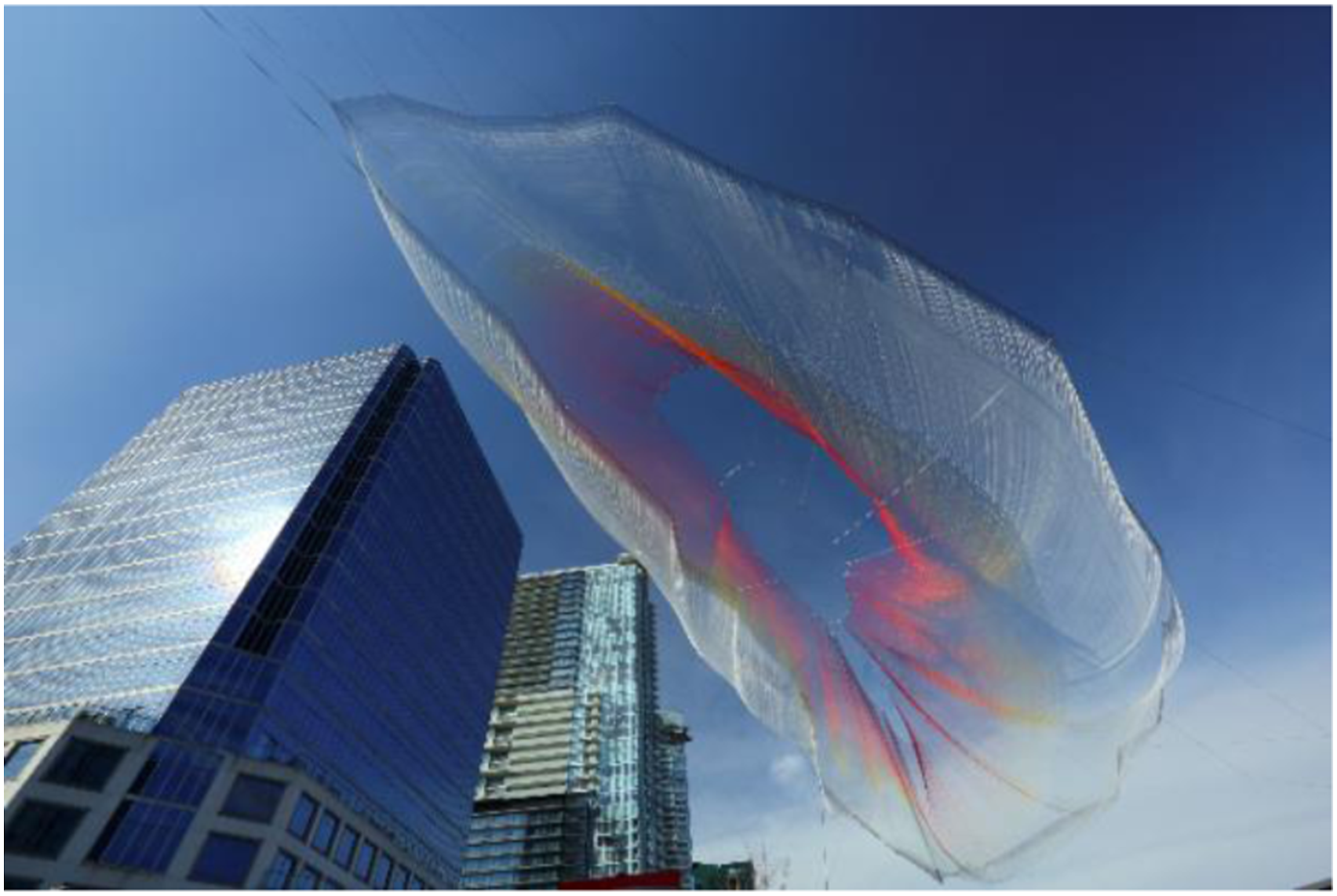

Building and maintaining the settler-colonial net
Images of installation (Figure 4) of Echelman’s net add to our metaphor. It wasn’t the artist up in the lift, rather a group of workers in high-visibility vests: regular people, “just doing their jobs.” In our work with mainstream health organizations, we often hear people giving away the power they hold to make change. Yet, with hundreds of thousands of colonial knots before us, each of us likely has many within our own sphere of influence and the opportunity to take the first step: attempting to identify at least a few of them. Installation. Credit: Studio Echelman.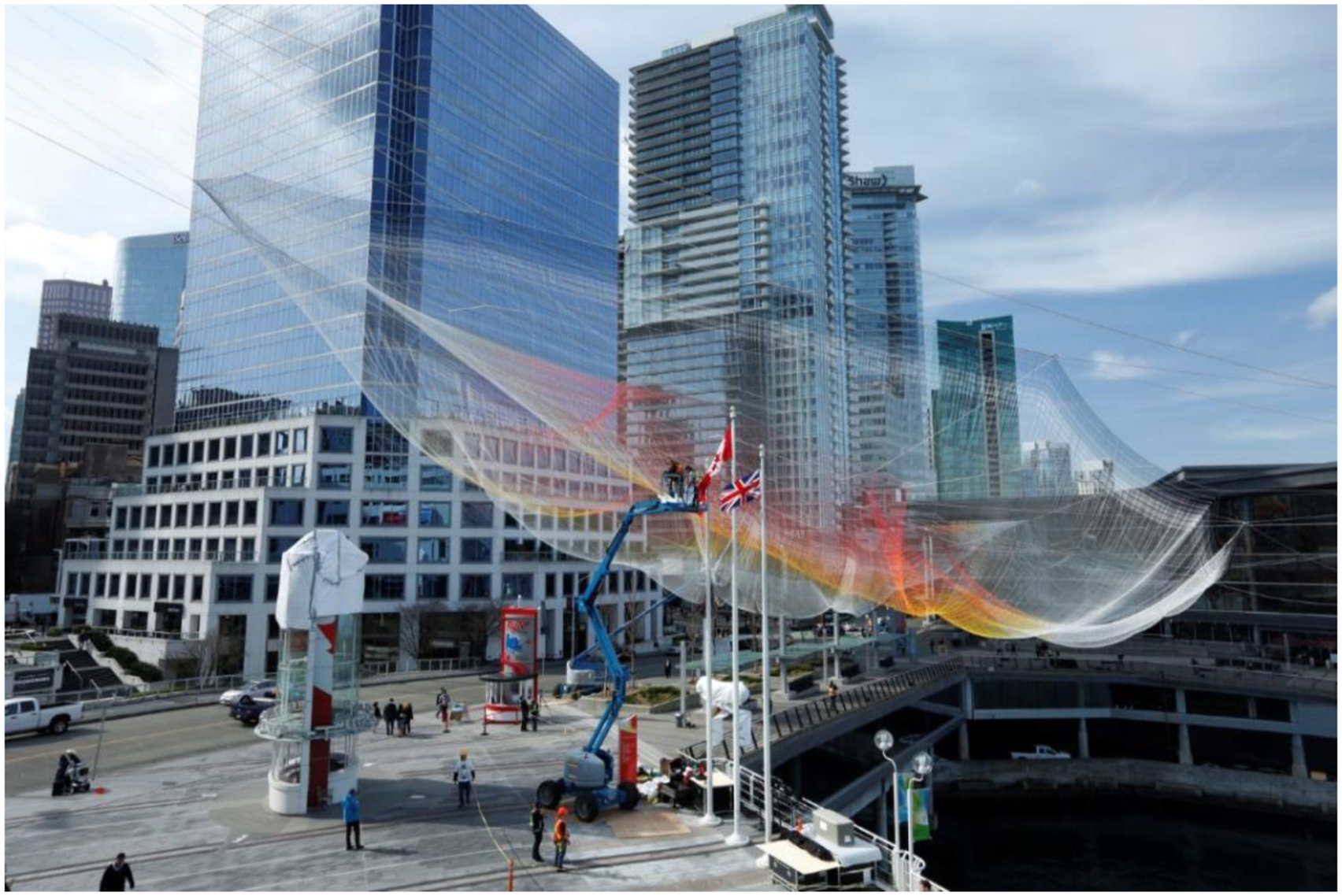
Asserting dominion on Coast Salish territory
Echelman’s net was installed on the shared territory of three Coast Salish Nations: Xʷməθkʷəy̓əm (Musqueam), Səl̓ilwətaɁɬ (Tsleil-Waututh), and Sḵwx̱wú7mesh (Squamish). These territories have never been ceded or surrendered. No treaty exists between these Nations and the Governments of Canada or BC. Yet, in the image, you can see both the Canadian Flag and the Union Jack, marking ongoing occupation of unceded territory. Even the soundtrack asserts Canadian dominion and occupation of unceded Coast Salish territory: If you were there at noon, you would hear the first four notes of ‘O Canada’ played at Canada Place. In the background is the Fly Over Canada kiosk, a tourist attraction that allows you to “soar across Canada from coast to coast.” 1 This slogan reminds us of how the settler-colonial net stretches across all of Canada, entwining Indigenous Peoples in all provinces and territories.
Dismantling the settler-colonial net
The settler-colonial net is not solid. Indigenous resistance has ensured there are many holes, despite attempts through history to tighten the weave. 1 Instead, the settler-colonial system has created a precarious situation. Cutting the major lines all at once would create tremendous harm. This is one of the major critiques of the 1969 White Paper and calls to abolish the Indian Act in one swoop. 8 Government actions that take a pan-Indigenous approach further undermine nation-to-nation relationships acknowledged in stated commitments to distinctions-based approaches.
Instead, the work is to untie enough knots that the major lines can be cut safely without harm. As we have said, each of us has multiple knots within our spheres of influence. Our task is to identify those knots, and with guidance from First Nations, Métis, and Inuit Peoples, untie them. Dismantling the net will result in a sacred restoration of Indigenous Peoples’ ability to be in right relations with their lands and waters.
International, 23 federal, 24 and provincial 5 laws articulate obligations of governments and systems to uphold the inherent rights of Indigenous Peoples. These include treaties, Section 35 of Canada’s Constitution, court rulings, UNDRIP, and related provincial (BC Declaration Act 5 ; Declaration Act Action Plan 7 ) and federal (Bill C-15 24 ) laws. BC has made progress on acknowledging legal plurality, “recognizing that within Canada there are multiple legal orders, including Indigenous laws and legal orders with distinct roles, responsibilities and authorities.” 7
It is important to recognize these legal obligations, as they are sometimes obscured by mainstream narratives that centre benevolence. 31 Actions fueled by benevolence can be harmful as they depend on the altruism of health leaders, rather than recognizing that upholding Indigenous rights and arresting White supremacy is part of a professional and legal responsibility.
Since contact, Indigenous Peoples have been asserting their inherent rights, and demanding to no longer suffer genocidal harms inflicted by White supremacy and Indigenous-specific racism. Recent examples include testimonies of thousands of (intergenerational) survivors of settler-colonial harms reflected in the Truth and Reconciliation Commission of Canada’s Calls to Action 26 and National Inquiry into Missing and Murdered Indigenous Women and Girls Calls for Justice. 27 Underpinning these recommendations is the need to disrupt the dominance of settler ways and approaches.
Discussion
Echelman did not set out with intention to provide a metaphor for settler-colonialism. However, from our perspective, her sculpture offers a comment on how to move forward from here. Untying colonial knots is difficult and requires patience. It is not the work of a select few, but the work of every single Canadian. Each of us has colonial knots within our sphere of influence, and gifts to bring to untying those knots. We understand White supremacy to be an everyday issue, requiring everyday attention.
Seeing our relationship to the net
It is up to each organization and individual to see the settler-colonial net and our relationship to it. 32 First, for those of us who are non-Indigenous settlers on these lands, we must recognize our ongoing complicity in a system that has been created for our benefit, freedom, and privilege through the oppression and denial of freedom and rights of Indigenous Peoples who are the original titleholders across Turtle Island. Settlers experience unearned advantage rooted in entitlement based on capitalist values that underpin settler-colonialism. 29 On the other side of this system of oppression, unearned disadvantage impacts the original inhabitants of these territories who hold rights and title, as well as other diverse Indigenous Peoples who reside here today. Accepting this as true is the first step for Canadian health leaders (and all Canadians) to begin to untie colonial knots within our spheres of influence. How we show up in society from this place of unearned privilege in relation to settler-colonialism is part of our readiness to begin to undo colonial knots.
Organizing and strategizing to act
To uphold Indigenous rights towards reconciliation, we must ask ourselves: In my sphere of influence, how are we upholding or undermining foundational commitments made to Indigenous Peoples? How will we hardwire in accountability and action? Are we holding space for this work yet? If not, how will we hold space moving forward? Knowing which knots exist in our sphere of influence, as individuals and at work, is an ongoing, iterative process. So too is understanding the path forward identified by Indigenous Peoples. What is critical is to know deeply which foundational instructions fall within our professional responsibility as an organization, a team, and an individual. Further, we must create ongoing processes to continue to identify colonial knots; quickly activate a culturally safe response when one is identified; and assess new actions to ensure we are not creating new knots. These steps will ensure we are prepared to be trustworthy partners with the original inhabitants of the territories where we live. 33
Conclusion
Coast Salish Knowledge Keeper Sulksun has shared with us that each day we have the choice to be good medicine or bad medicine. The net of settler-colonialism is just 150 years old here in BC, compared to the thousands of years that First Nations laws have governed these lands and waters. The natural laws of these territories have been rendered invisible through legislation and socialization. Through the resistance of BC First Nations, we are beginning to see the net of settler-colonialism, and our relationship to the net. Keeping our hands, hearts, and minds on this task requires stamina and persistence. It requires everyday discipline to Indigenous-specific anti-racist action. Yet, it is the work of our generation of health leaders. We hope this metaphor of a settler-colonial net will help you in taking anti-racist actions in your health leadership.
Footnotes
Acknowledgements
We acknowledge with great respect the territories of the lək̓wəŋən peoples on whose traditional territory the Office of the Provincial Health Officer stands, and the Songhees, Esquimalt, and W̱SÁNEĆ peoples whose historical relationships with the land continue to this day. In addition, we acknowledge the territories of the hən̓q̓əmin̓əm̓ and Skwxwú7mesh snichim speaking peoples of the xwməθkwəy̓əm (Musqueam), Sḵwx̱wú7mesh (Squamish), and səlilwətaɬ (Tsleil-Waututh) Nations where three of the authors reside. We recognize and express our gratitude for the medicines within these territories, and the First Nations territories that stretch across every inch of the province of British Columbia. We recognize generations of First Nations, Métis, and Inuit from elsewhere in “Canada” who also call these lands and waters home and have inherent Indigenous rights to health and wellness. ?imot, maarsii, mussi cho, t'oyaxsut 'nüüsm, and thank you to the Elders, mentors, and teachers who have taught us the lessons we bring forward in this work, including artist Janet Echelman. We dedicate this piece of work to all people in British Columbia who have died as a result of systemic and interpersonal racism over the past 150 years.
Declaration of conflicting interests
The author(s) declared no potential conflicts of interest with respect to the research, authorship, and/or publication of this article.
Funding
The author(s) disclosed receipt of the following financial support for the research, authorship, and/or publication of this article: This work was supported by the Canadian Institutes of Health Research (Health Systems Impact Fellowship 460829).
Ethical approval
Institutional Review Board approval was not required.
