




Abstract
This qualitative study examines the determinants of effective inter-organization information sharing in the Health Capital Planning process (the process), primarily in the final stage of the process which focuses on the review of final expenses and release of a holdback. Using thematic analysis and building off a scoping review that was conducted in preparation for this study, we provide a framework for effective information sharing during the process. We interviewed 17 leaders from the Government of Ontario and hospitals across the province. The results of the interviews indicate that the most essential determinants of effective inter-organization information sharing in the process: organizational characteristics; reducing complex bureaucracies; preserving human resources and expertise; clear and standardized information; reducing policy changes; networks; negotiation abilities; information technology; training; record retention; and early planning. This study confirmed the need for effective intra-organization and interpersonal information sharing to achieve successful inter-organization information sharing.
Introduction
Capital represents the total funds allocated and spent by a Health Service Provider (HSP) to build, acquire, or renovate health physical assets such as property, buildings, technology, or equipment. 1 In Ontario, Canada, health capital planning and oversight is the responsibility of the provincial government. 2 The Ontario Health Capital Planning process (the process) consists of 5 major stages with the final funding approval sub-stage known as the Final Cost Reconciliation (final) stage. 3,4 This stage begins when the project is 100% complete around ten years after Stage 1 of the project. 3,4 During this stage, HSPs provide their audited expenses for assessment by Ministry of Health (MOH) for the release of the remaining balance of their health capital funds. The balance is 5% of the total project cost. 3 Every stage of the process relies heavily on the previous one and requires regulatory and often funding approval from the MOH. 4 During the final stage, all partners involved must have a clear understanding of not only the requirements of the stage itself but also the full process and a detailed history of the project. 4
Infrastructure planning is complex and lengthy in any sector and in any jurisdiction.5,6 Given that, effective information sharing is critical but challenging.5,6 This qualitative study investigates the determinants of effective inter-organization information sharing in health capital planning by examining the Ontario process from the perspective of MOH leaders, the Ministry of Infrastructure (MOI), and hospitals.
Theory
Infrastructure planning remains understudied in the literature1,2,7 particularly within the realm information sharing.5,6 When an infrastructure project is initiated, numerous partners must collaborate to deliver the project. 8 Throughout the multi-phased life cycle of a health capital project (such as planning, tendering, and construction), a large amount of information is produced on project scope, budget, risk, and approvals. 5 Therefore, effective information retention and sharing between the partners involved is crucial.5,6 We chose to focus on the Final Cost Reconciliation stage since it is the last stage of the process in Ontario and requires the partners of the project to have all the necessary information to be able to reconcile audited costs against the estimated costs of the project. 3
This qualitative study builds on two previous studies. A literature review on the factors influencing information sharing 9 and an unpublished scoping review that was conducted in preparation for this paper. Yang and Maxwell reviewed existing literature to identify factors most critical for successful information sharing within public organizations and establish three independent information sharing frameworks: interpersonal, intra-organizational, and inter-organizational. 9
The modified framework that we generated through our scoping review confirmed the importance of the elements that Yang and Maxwell 9 outlined and built on them by identifying further determinants of effective inter-organization information sharing specifically for the planning of publicly funded infrastructure projects:8,10-48 frequency of communication; alignment of goals; contracts and record management; clarity; and reducing information asymmetry and clarity. Our framework demonstrated that it is challenging for organizations to implement effective inter-organization information sharing without first implementing effective interpersonal and intra-organization information sharing. This means that to ensure effective inter-organization information sharing when planning infrastructure projects, all three frameworks that Yang and Maxwell identified should be combined and the additional factors we identified should be built into the framework. The framework we established through the scoping review informed the development of the research question, the interview guide for this study, and served as the basis for the framework we established through this study.
Material and methods
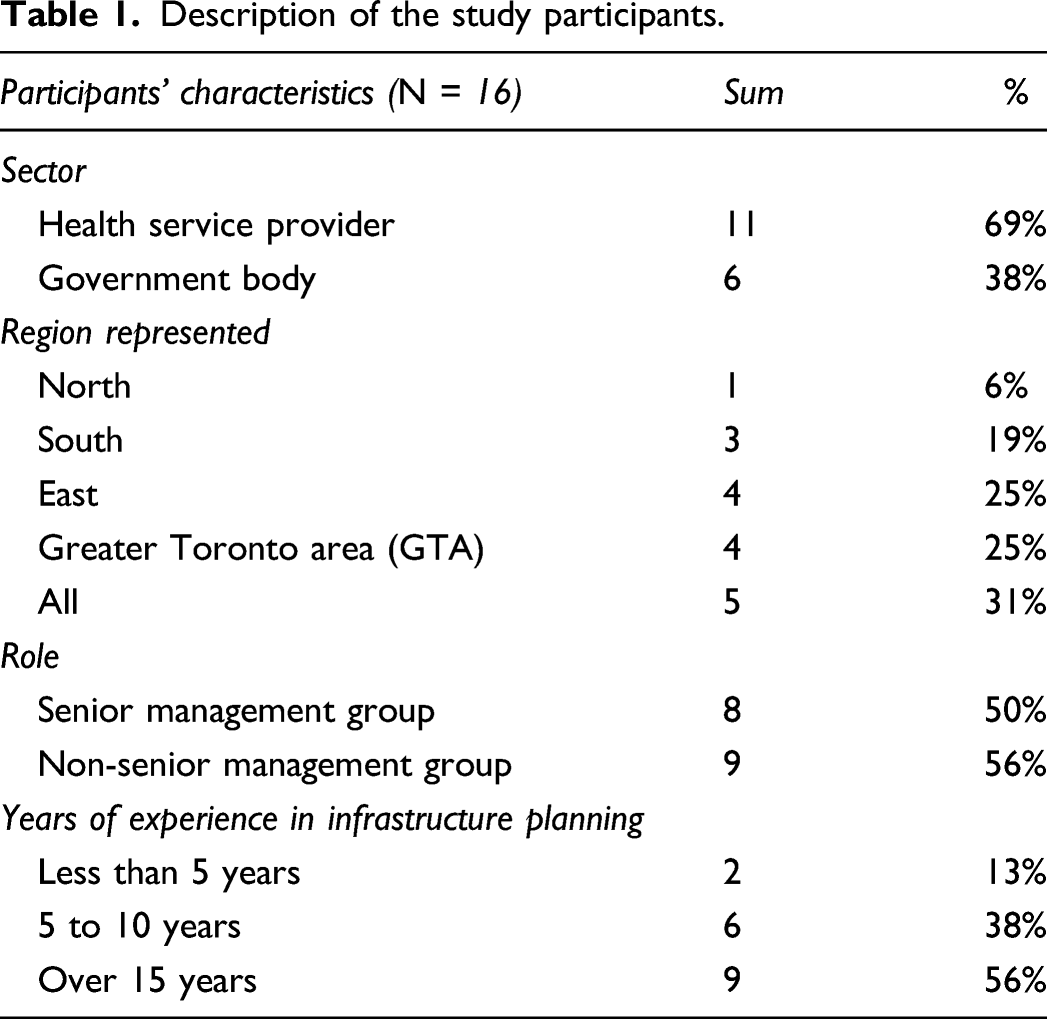
With ethics approval from the University of Toronto Health Sciences Research Ethics Board, and informed consent from participants, we conducted semi-structured interviews from November 1, 2020 to March 17, 2021 with members of the Senior Management Group (SMG) using purposeful sampling and non-SMG individuals using snowball sampling from (a) MOH, (b) MOI, and (c) hospitals across the province. For this paper, SMG individuals are those with executive level roles. Participants with knowledge of the final stage of the Ontario process were included. Data collection ended when the dataset engendered sufficient information power to draw meaningful conclusions in response to the research questions. 49 The data were analyzed using inductive and deductive thematic analysis 50 (Supplemental material 1 51 ).
Results
Description of the study participants.
Participants' experience with information sharing during the financial reconciliation stage.
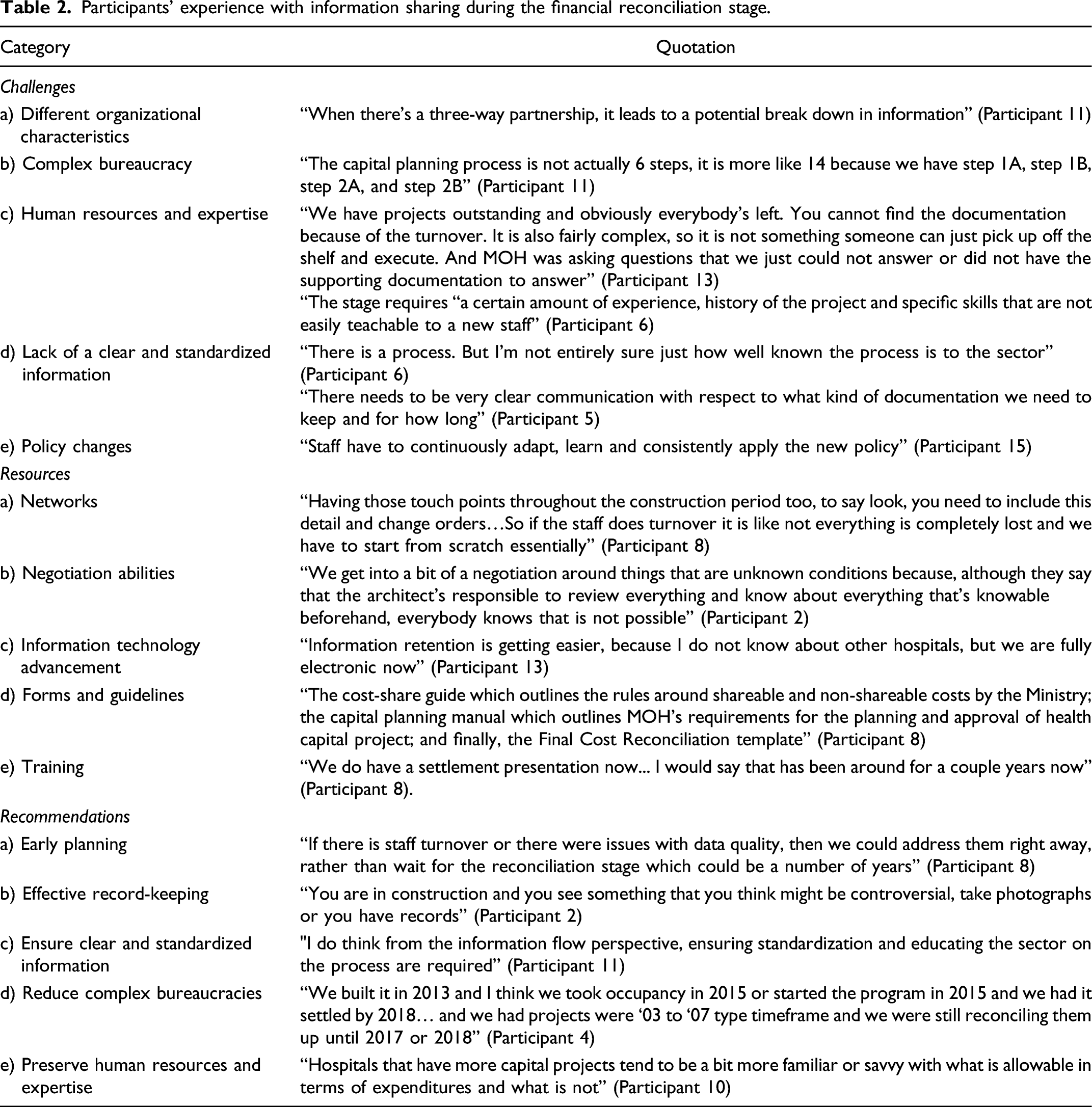
Challenges
One of the leading reasons for the challenges associated with the stage is different organizational characteristics (a). The process requires at least 2, and in some cases 3, different organizations with different rules and procedures to collaborate and coordinate the delivery of a complex project.
The second leading challenge is navigating complex bureaucracies (b), which is a result of the length and complexity of the process in general. All stages of the process are mandatory for every project regardless of the size, scope, and magnitude.
Due to the length of the process, most organizations are unable to retain the human resources and expertise (c) needed to fulfill the requirements of the stage. Staff turnover means that “a lot of the corporate memory has moved on” (Participant 7). Therefore, organizations struggle with their ability to complete and support the requirements of the stage.
Participants indicated that the lack of a clear and standardized process (d) adds another layer of complexity to the stage. Participants from both MOH and hospitals acknowledged that the process does exist, but it is just not very well communicated and understood by the sector. The “timelines and expectations” on when or who should initiate the stage should be explained to the sector (Participant 6). Hospitals are not clear on the documentation they need to maintain throughout the cycle of their health capital projects.
Finally, participants also confirmed that policy changes (e) happen regularly, which has an impact on the progress of work of both the hospitals and MOH. Given that the stage is the final funding sub-stage of the process, and it relies heavily on the previous stages of the process, any change in policy at any stage can be challenging for organizations when reconciling a project.
Resources available
Most participants indicated there are strong networks (a) and collaboration between the hospitals and MOH when it comes to the final stage. Participants confirmed that regular communications between MOH and HSPs throughout the process have a positive impact on the efficiency of the stage
Hospitals confirmed that they can negotiate (b) with MOH if they disagree with the Ministry’s assessment of their submission. The negotiations are around change orders. Hospitals can provide additional supporting documents if they believe an item should be funded.
Participants highlighted that although still challenging, record retention became easier with infrastructure technology advancement (c). In terms of supporting material and templates, MOH provides three essential forms and guidelines document (d). Finally, in the recent years, MOH introduced a training presentation (e) that can be shared with HSPs.
Recommendations
Participants indicated that early planning (a) is crucial. It is important to ensure that all parties involved in the project understand and agree on the scope and cost of the project from the beginning of the process. If there are changes to the scope of the project (“change order”) which are common with construction projects, participants recommended assessing them immediately and discussing them with MOH to avoid loss of knowledge at the end of the process.
Participants confirmed the importance of record-keeping (b) throughout the process to ensure knowledge retention and mitigate the issue of staff turnover. Hospitals indicated that having clear and standardized information (c) around timelines, who should initiate the process, and guidelines from MOH would make the stage more efficient and encourage the organization to “act on reconciling their projects” (Participant 1). There needs to be clarity around what is required in terms of documentation as there are costs associated with record retention from the hospitals’ side. Participants, especially from the hospitals indicated that some of the guiding documents and templates provided by MOH should be enhanced. Many of them were not aware of the presence of the training document and have indicated that submission templates are difficult to use and “have limited instructions.” (Participant 1)
Participants from MOH indicated that they have been working on streamlining the requirements of the stage to reduce complex bureaucracies (d). Hospitals indicated that recently the final stage became faster and more efficient. Finally, preserving human resources and expertise (e) remains a top priority for organizations when it comes to the final stage. Due to the technical nature of the stage, participants confirmed the importance of maintaining the knowledge and experience of their staff (Figure 1). Summarizes the factors most essential for effective information-sharing in health capital planning. The figure also demonstrates the need for effective intra-organizational and interpersonal information sharing to achieve successful inter-organization information sharing in the planning of infrastructure projects.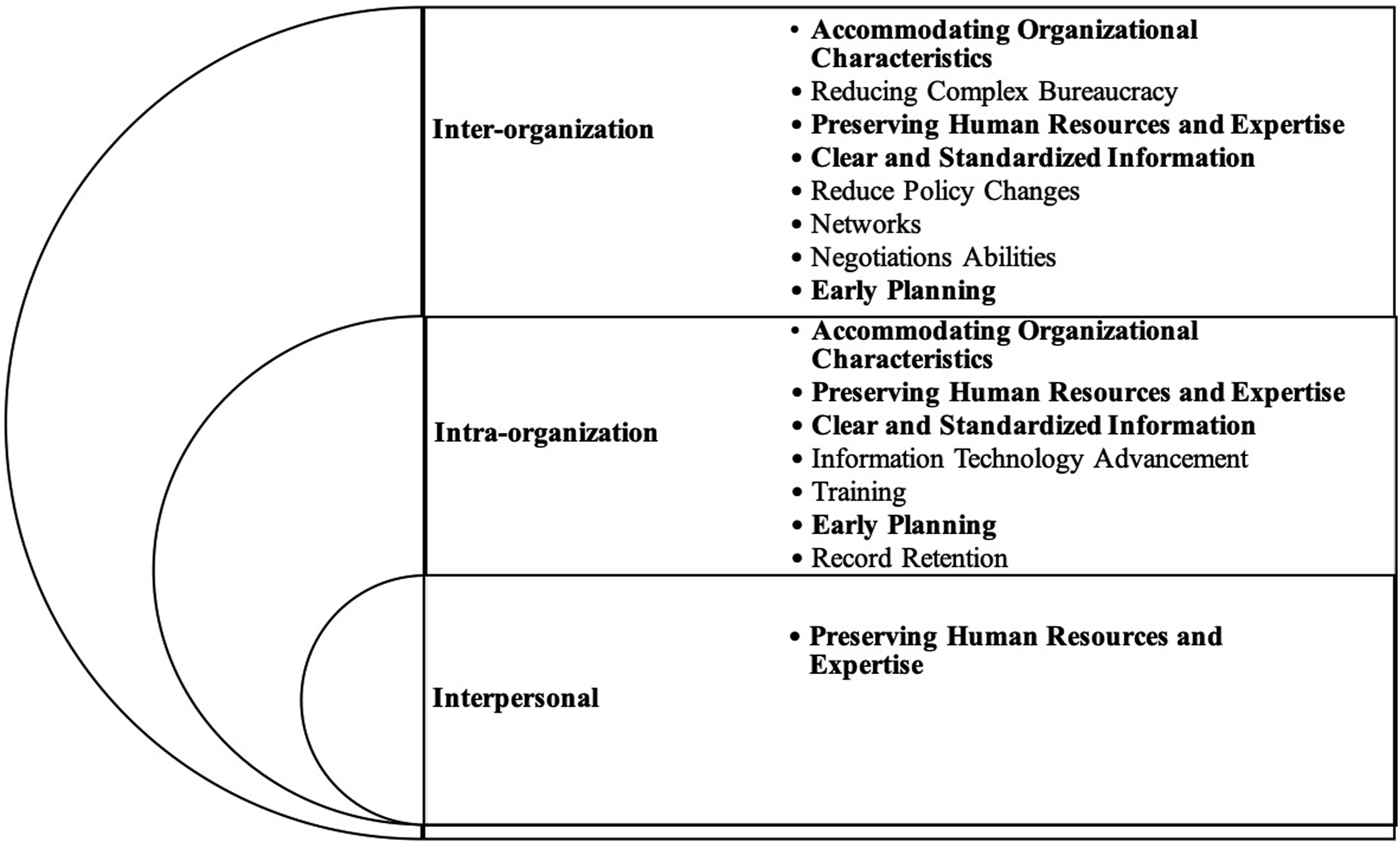
Discussion
We examined the determinants of effective inter-organization information sharing in health capital planning by examining the Ontario process, specifically its final stage. Through the interviews conducted for this study, most of the participants indicated that the planning and funding of a health infrastructure project require extensive collaboration and coordination enabled by effective information sharing within the organizations involved and between them.
Participants emphasized the importance of staff and knowledge retention to reduce delays that can result from training new individuals. 40 The importance of technical expertise was highlighted throughout the interviews.7,27 This will help partnering organizations ensure strong oversight of their projects, reduce the margin of error, and the need for change orders.
Our study also confirmed importance of certain determinants of effective inter-organization information sharing that already exist in the literature: clear instructions, standardized information, and the simplification of the overall capital planning process.22,9 Participants indicated that confusion around the process, especially in terms of roles and responsibilities, timelines, changing policies, and limited guidelines, can be restraining when it comes to prioritizing and completing the requirements of the process. Participants also confirmed that record-keeping is important to be able to respond to clarifications on expense items, and to effectively negotiate when there is a disagreement on the funding eligibility for projects. 20
Finally, we confirmed the importance of working closely with all the contributors to a health capital project early in the planning process to ensure that all the parties understand and agree on the goals of the project including, scope and cost. This will reduce the potential for conflict between contributors, limit change orders, and lead to effective negotiations.
Implications and future direction
Our study outlines to experts the challenges, resources, and importance of determinants that influence the effectiveness of inter-organization information sharing in planning complex public projects such as capital. In terms of practical implementation of our findings: first, policy-makers could benefit from examining the challenges that we outline in this paper to understand the barriers that planners experience. Second, the planners such as HSPs could benefit from the resources available to them as outlined in our paper. Our paper found that some resources are not well advertised to the sector. For example, there is a training document that MOH developed that most of our participants were not aware of it. Finally, both policy-makers and planners could benefit from our recommendations. Our study suggests that organizations should review the quality of their inter-organization information sharing enablers against our recommendations to identify areas of improvement and set up strategies to enhance their practices and the capital planning process. For example, our framework suggests that staff retention and technical expertise play an important role in enabling effective inter-organization information sharing in the health capital planning process. Organizations could benefit from evaluating their current staff and knowledge retention trends and put in place strategies to preserve them.
On the research side, there continues to be a need for studies on improving the efficiency of health capital planning.1,2,7 Our study contributes to the literature of efficient infrastructure planning and effective inter-organization information sharing. We confirmed the importance of the factors most critical to effective information sharing as established in existing literature,8-48 outlined a new factor (early planning), and produced an inter-organization information sharing framework to guide health capital planning. Our study confirmed that for organizations to successfully collaborate to plan and manage a health capital project, the three information sharing frameworks that Yang and Maxwell identified 9 must build off each other. We showed that for organizations managing publicly funded capital projects, it is essential to ensure effective flow of information from within and between the organizations. This is likely due to the nature of the projects which requires collaboration and coordination across different levels of authority and the involvement of a wide range of technical expertise.
Further research is required to understand the fiscal and opportunity cost of improving the effectiveness of inter-organization information sharing in the process. We recommend more research to determine if further delays and inefficiencies can result from organizations investing their efforts into ensuring effective inter-organization information sharing in the health capital planning. Finally, future research is needed to examine the utility of our framework in other jurisdictions where policy-makers either control oversee or are responsible for enabling and facilitating the capital raising or expenditure for large public institutions.
Limitations
First, given the technical and specialized nature of the process, we selected our study participants using a mix of purposeful and snowball sampling methods, which in turn could mean that our findings may not be representative of the entire health capital sector in Ontario. However, to help alleviate the selection bias associated with our study, we interviewed participants until the dataset engendered sufficient information power to draw meaningful conclusions. 10
Second, the focus of the study is on health capital planning, and at first glance, the findings may not seem extendable to other public sectors or to non-public, market-driven fields. However, we would argue that understanding the challenges associated with inter-organization information sharing and the mitigation strategies that our study offers can be beneficial to any field, especially those managing large complex projects.
Finally, the focus of our study is on publicly funded projects and may not seem applicable to private infrastructure developments. However, we argue although our findings geared more towards optimizing public resources, they offer applicable recommendations to privately funded projects as well. Ultimately our study looks at the determinants of effective flow of information between funders and service providers to optimize the available resources. Therefore, despite the specific context of the study, the recommendations can be beneficial and transferrable to different sectors.
Conclusion
Through the interviews conducted for this study, most of the participants indicated that the planning and funding of a health infrastructure project require extensive collaboration and coordination enabled by effective information sharing within the organizations involved and between them. This is particularly true in the case of the final stage of the Ontario process, which requires extensive intra-organization and inter-organization work. Therefore, we chose to investigate the Ontario process to identify the determinants of effective inter-organization information sharing in the planning of public health capital projects.
