




Abstract
In 2011, British Columbia (BC) First Nations came together to speak with one voice and by consensus made the largest self-determining decision made in this country: to take control over their own health and wellness. Guided by First Nations perspectives, values, and principles, the First Nations Health Authority works alongside the First Nations Health Directors Association and the First Nations Health Council to advance a shared vision of “healthy, self-determining, and vibrant BC First Nations children, families, and communities.” Strong leadership, rooted in the knowledge and teachings that have sustained BC First Nations for thousands of years, is integral to achievement of the vision. This article reflects on Indigenous approaches to health and wellness leadership in the BC context, drawing from traditional teachings shared by BC First Nations Elders and knowledge keepers in four areas: upholding governance and self-determination, “change starts with me,” building a leadership team, and reconciliation and partnership.
Introduction
In May 2011, British Columbia (BC) First Nations came together to speak with one voice and by consensus made the largest self-determining decision ever made in this country: to take control over their own health and wellness. 1 –3 This decision enabled a one-of-a-kind health governance partnership with the federal and provincial government that recognizes the role of BC First Nations to make decisions over health and wellness services for First Nations people. 3,4 The First Nations Health Authority (FNHA) is the operational arm of a new First Nations Health Governance structure created by and for First Nations people, which serves as a leading practice for Indigenous health and wellness services transformation in Canada. 5
Guided by First Nations perspectives, values, and principles, FNHA works alongside the First Nations Health Director’s Association (FNHDA) and the First Nations Health Council (FNHC) to advance a shared vision of “healthy, self-determining, and vibrant BC First Nations children, families, and communities.” 6 Strong leadership, grounded in the knowledge and teachings that have sustained BC First Nations for thousands of years, is integral to achievement of the vision. 7 –9 The FNHA looks to honour those who have paved the way, builds and nurtures partnerships in the current environment, and plans for a health system that will be sustainable well into the next seven generations.
Leading with ceremony is foundational to the success of the work. To honour the teachings of BC First Nations, FNHA champions a wholistic 10 perspective in which individual human beings own their health and wellness journeys (Figure 1). It represents the four dimensions of wellness—physical, mental, emotional, and spiritual health 11,12 —and acknowledges the influence of factors including values and supports, where we come from, and the social determinants of health. 13 –15 Mainstream approaches understand health from a “sickness” perspective, as reflected in a focus on diagnosing and treating illness. The FNHA works with the mainstream system by championing the perspective that health and wellness are fundamentally interconnected and through an approach of reciprocal accountability where partners embrace their respective responsibilities to achieve common goals and their accountabilities to one another. 6,9,16
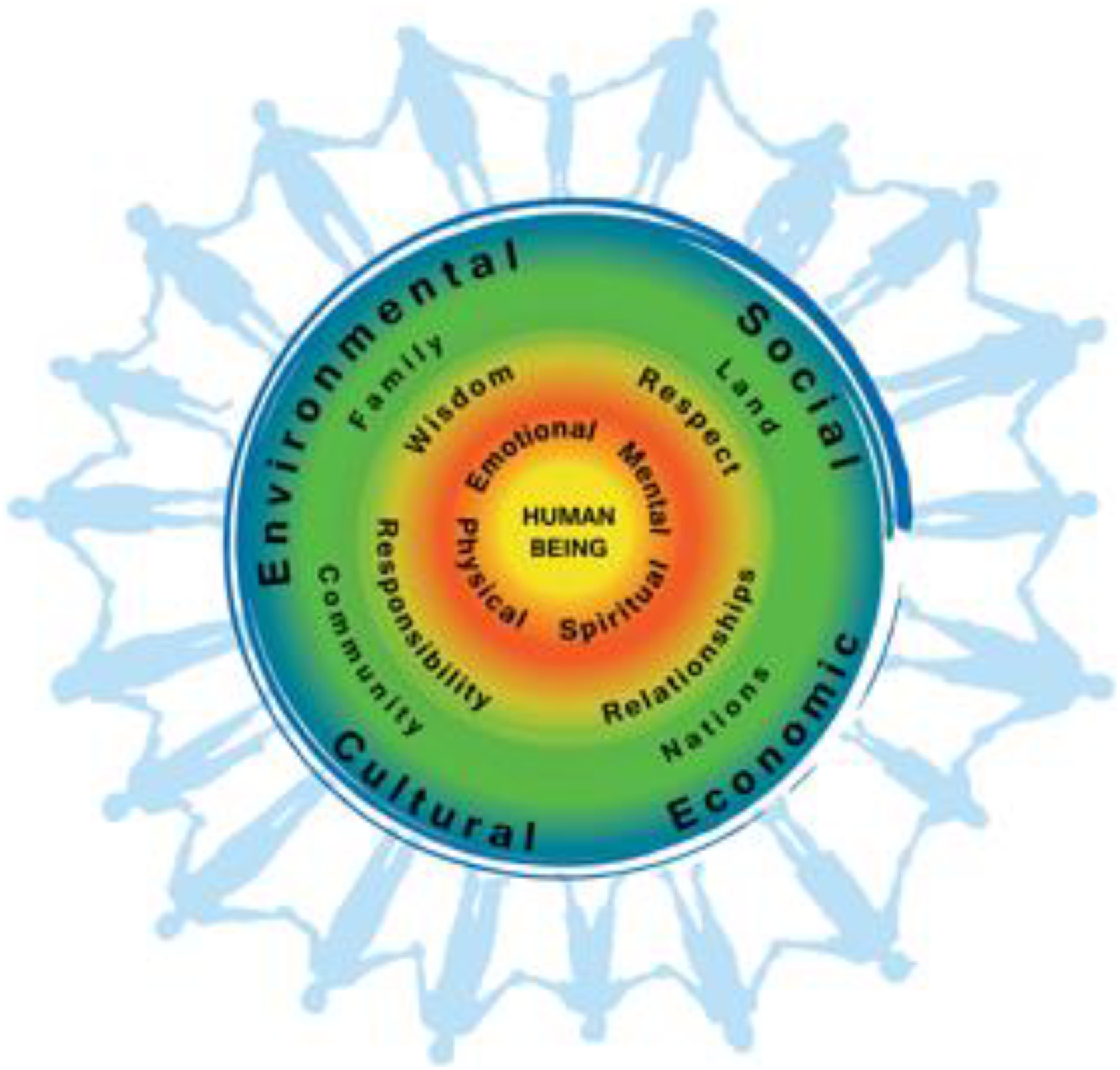
First Nations perspective of health and wellness.
This article presents one Indigenous health leader’s reflection on Indigenous approaches to health and wellness leadership in the BC context, drawing from traditional teachings of BC First Nations. Four areas have been FNHA’s primary focus in strengthening its leadership capacity: upholding governance and self-determination, “change starts with me,” nurturing leadership, and reconciliation and partnership.
Upholding governance and self-determination
“There was a way that we governed that looked after everyone. That was the role of the chief, to look after his ha’hoolthlii (people, land, and resources). And the principles that drove those were understanding that heshookish tsa walk (all things are one or all things are connected), and ʔisaakcamis (respect for self, others, all living things, and all inanimate things). Those are the pillars of governance.”
17,18
(teaching from Wickaninnish Cliff Atleo Sr., Nuu-Chah-Nulth)
Upholding Indigenous Peoples’ inherent right to self-determination is fundamental to an Indigenous approach to health and wellness leadership. 8,16,19 BC First Nations have long-established governments, laws, and ways of life that existed well before Canadian confederation. 20,21 BC First Nations’ inherent right to self-government is an existing Aboriginal right that affirms the right to govern matters of importance and in relation to the historic connection to unceded territories. These rights are recognized and affirmed in both International and Canadian law. 22,23 Traditional systems of governance were disrupted through imposition of colonial laws. Under the Indian Act (note 1), traditional governance structures were undermined and replaced with colonial systems (bands and leadership elections) that did not exist prior to contact. 9,24 Today, the landscape of First Nations governance in British Columbia is largely shaped by divisive and disempowering colonial policies and yet some nations continue to be more aligned with traditional governance structures as reflected in the teaching from Wickaninnish. 25
Creation of the BC First Nations health governance structure represents a collective exercise of BC First Nations self-determination built on a foundation laid by generations of Indigenous leaders. 3,26 This is a living example of the principles of self-determination and self-government laid out in the United Nations Declaration on the Rights on Indigenous Peoples 22 and by the Truth and Reconciliation Commission of Canada, 27 both of which have been endorsed by the federal 28 and BC governments. 29 The FNHA functions as the operational arm within this governance framework. In this context, Indigenous health and wellness leadership is enacted through honouring and upholding BC First Nations right to decision-making. This calls for continuous engagement with BC First Nations who set direction to inform the work of the BC First Nations health governance structure (FNHC, FNHDA, FNHA, British Columbia, and Canada).
As Wickaninnish’s teaching highlights, leaders in the Indigenous health and wellness sector are responsible for knowing who the people are that they are working for. 9,16 In the FNHA context, this includes BC First Nations as “customer-owners,” playing dual roles in both governing and accessing the programs and services. 16 Today, colonial policies have resulted in less than half of First Nations people living within their community on reserve, while more than half live off reserve either within their respective territory or as guests in other First Nations territories. 26,30 Until 2013, on-reserve health services were delivered by Health Canada incorporating few health service standards resulting in poor health outcomes for those being served. Since 2013, health and wellness leadership has focused on supporting First Nations ownership and control over on-reserve health services, recognizing diversity of First Nations cultures and understanding colonial impacts. Further complexity comes as all First Nations in BC at some point rely on health services controlled by the mainstream health system, where culturally unsafe experiences contribute to poor health outcomes. To address this, BC First Nations decision-making is becoming hardwired into the provincial health system at multiple levels to address health issues and strive for culturally safe services.
Change starts with me
“Our first job on this earth is to be the best human beings that we can be.” (teaching from Qut-Same Leonard George, Səl̓ilwətaɁɬ Nation)
“It starts with me” is core to the FNHA’s ecosystem of health and wellness (Figure 2). It reflects that each person owns their own health and wellness journey. This is essential to self-determination, recognizing that decision-making rests with the individual, their family, their community, and their nation. Through the BC First Nations health governance structure, individuals, families, communities and Nations are taking back control that has been undermined by colonization and systemic racism. 31 –34
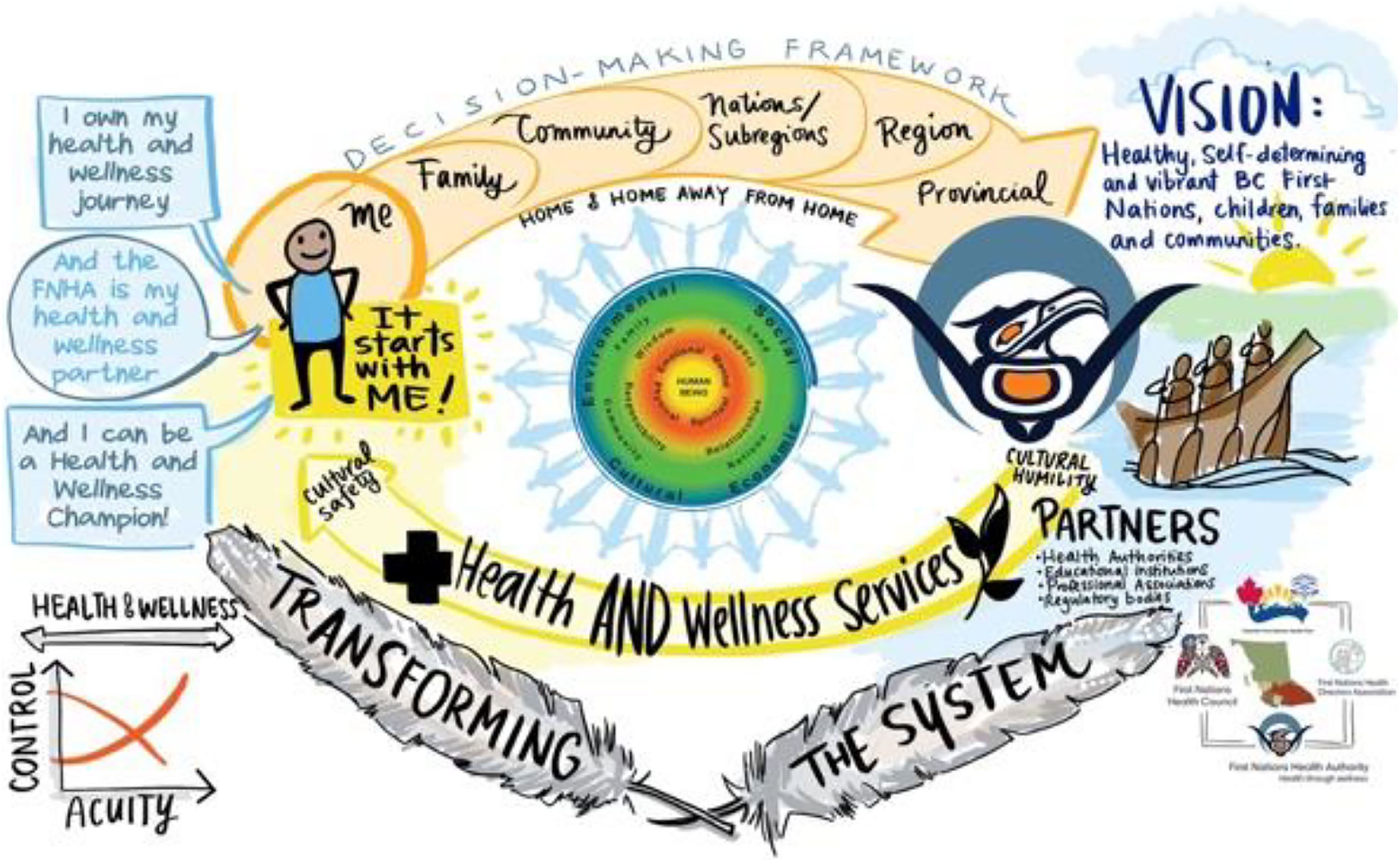
Ecosystem of health and wellness.
Living it
Indigenous health and wellness leadership begins with the leader “living it” by owning their own health and wellness journey, defining what it is for themselves, and striving every day to live well. 7,25 “Living it” is leading by example and being accountable to those in our circles of influence to champion health and wellness. 9,16
Being a wellness partner
The FNHA’s role is to be a partner to every BC First Nations person on their health and wellness journey by meeting them where they are at and supporting them to get to where they want to be. A fundamental component of Indigenous health and wellness leadership in British Columbia is to uphold the value of “nothing about us without us.” 16 Leaders must recognize that BC First Nations already have all that is needed for wellness and partner in a manner that facilities reclaiming wellness through revisiting an Indigenous paradigm.
Being a wellness champion
A wellness champion is someone who promotes health and wellness through their spheres of influence, within their own families, communities, and nations. 35 Leaders have an additional role of incorporating the BC First Nations perspective of health and wellness within the mainstream health system, as well as supporting others who lead by example as wellness champions.
Nurturing leadership
Qut-Same talked about championship teams being great teams that did not always have the best players. Often, having the best player is not enough to win a championship. Instead he spoke about teams where the players were all at their personal best. (teaching from Qut-Same Leonard George, Səl̓ilwətaɁɬ Nation)
A strong leadership team grounded in First Nations teachings and values that is able to draw on the best of what mainstream health has to offer is essential to Indigenous approaches to health and wellness leadership.
36
When the leadership team functions well in this way, First Nations communities and people benefit. BC First Nations teachings recognize that each person carries with them certain gifts and it is each person’s responsibility to bring their gifts forward.
25,36
When all gifts are brought together, the team finds its true strength. Leaders within the FNHA come from diverse work experiences and cultural backgrounds.
36
Coming together to work through a First Nations health governance paradigm is a challenge if humility is not present and ego prevails.
9
Guided by experience, awareness, vision, and respect for knowledge, leaders in Indigenous health and wellness lead teams that are open to new ideas and opportunities, while constantly incorporating cultural humility in the work. It is acknowledged that one person does not “carry the team,” instead each person contributes to success, their strengths are recognized, and everyone is at their personal best. “nə́c̓aʔmat tə šxʷqʷeləwən means that ‘we are one heart and one mind.’ The most important law that we have as Coast Salish people is the word nə́c̓aʔmat. nə́c̓aʔmat means that ‘we are one.’”
37
(snəw̓əyəɬ (teaching) from Te’Ta-in (Shane Pointe), xʷməθkʷəy̓əm)
Leaders are needed at all levels of the organization. To support a common identity for a diverse group of leaders, First Nations culture and values were embedded into the organization. In August 2013, FNHA’s Elder Advisor Qut-Same Leonard George (Səl̓ilwətaɁɬ Nation) adopted all FNHA staff as honorary members of the Tak’aya Wolf Clan. Being part of a clan system means becoming family and provides an identity for the FNHA rooted in the protocols and teachings of the Coast Salish peoples upon whose territories the FNHA’s central activities operate. Wolves are intelligent, adaptable, and loyal: traits that Qut-Same recognized would be central to success as a new organization. The FNHA lives by these teachings which provide guidance for leaders at all levels.
Mentoring future leaders is also an important part of Indigenous approaches to health and wellness leadership. 19 When future leaders have the opportunity to learn from established leaders, they gain the knowledge and skills they need to be leaders today and in the future. 7
Reconciliation and partnership
“We’ve endured a lot with colonization. We’ve been through a lot. Some of the worst neglects and abuses that we’ve suffered have come though institutions. [Coming together in ceremony] is what our Elders would describe as ‘untying’ some of that harm…that’s a word our old people use. Yeqwethet. Literally, it can mean to untie but it also means to heal, to make better.”
39
(teaching from Gabriel George, Səl̓ilwətaɁɬ Nation)
Reconciliation requires resetting the relationship between Indigenous people and settler Canadians to move forward together to address inequities in the determinants of health and health status stemming from colonization.
13,15,43
Establishing trust with BC First Nations individuals, families, communities, and Nations requires cultural safety and humility.
44,45
Research with Indigenous people has shown that when healthcare providers do not know basic history of colonialism, including residential school, it compromises their ability to be empathetic while providing healthcare to Indigenous Peoples.
43
Cultural safety and humility training that builds on stories told directly by Indigenous people about their experiences creates understanding and empathy.
43
Ensuring that health services are free of racism and discrimination and are places where First Nations people feel safe is an important area of work in progress in BC.
44,46
“If we pray in a circle, and face the eagle feather placed on the drum in the centre of the circle, we each see feather differently even though we are looking at the same thing. Together, our perspectives contribute to the full perspective of that drum and feather in a way a single view does not capture.” (teaching from Sye
Conclusion
At its core, Indigenous health and wellness leadership in the BC context is about implementing a First Nations decision-making framework that meets individuals, communities, and nations where they are at in terms of their unique health and wellness journeys. It involves respecting First Nations governance and self-determination and leading with both humility and courage. To fulfill the vision of “healthy, self-determining and vibrant BC First Nations children, families and communities,” health and wellness leaders and partners at all levels must work with and for BC First Nations communities. Nurturing positive and productive relationships among First Nations and with provincial and federal partners is key to progress to date. Although the four elements of Indigenous health and wellness leadership presented here are grounded in the BC experience, they may resonate with other Indigenous groups seeking self-determination over health and positive relationships with the mainstream health system. Further, when applied to health and wellness, the traditional teachings and knowledge of BC First Nations shaped by their special relationship to lands and waters over thousands of years can be embraced by and positively transform the health system for all British Columbians and Canadians.
Footnotes
Acknowledgments
The author would like to honour the generosity and time Qut-same gave to our organization before his passing in December 2017. The author is grateful to each of the elders and knowledge keepers—Wickaninnish, Qut-Same, Te’Ta-in, Gabriel, and Sye