




Abstract
Psychoeducational assessments often determine access to essential services, yet most tools used in Canadian contexts remain grounded in Western frameworks that do not reflect Indigenous worldviews. This brief report describes the development of an Indigenous Assessment Protocol co-created through an Indigenous-led, community-engaged processes. Used alongside standard tools, the protocol supports practitioners in contextualizing assessment results through a strengths-based, holistic understanding of child development. This practice-based contribution joins a growing number of responses across Canada that heed national calls for more culturally grounded and community-engaged approaches to assessment.
Keywords
Introduction
Psychoeducational assessments play a crucial role in determining eligibility for essential support services and funding within education, healthcare, and social services systems. These evaluations are often the gateway through which students access school-based and community interventions, accommodations, and financial resources that can profoundly influence developmental trajectories and overall well-being (American Educational Research Association [AERA], American Psychological Association [APA], & National Council on Measurement in Education [NCME], 2014).
For Indigenous students and communities, the stakes of assessment are even higher. Access to culturally safe healthcare, school-based services, and community-based supports often hinges on the results of psychoeducational evaluations, even though these tools have been developed within Western paradigms that rarely reflect Indigenous worldviews, epistemologies, or relational contexts (Gone, 2013; Kirmayer & Jarvis, 2019). As a result, Indigenous children and youth are at risk of misdiagnosis, inadequate supports, and further systemic marginalization (Kirmayer & Valaskakis, 2009). These shortcomings are not simply technical oversights; they reveal deeper systemic biases embedded in assessment and evaluation practices. Standardized assessments often prioritize norms and constructs that are misaligned with or illegible to Indigenous worldviews, leading to decisions that may unintentionally perpetuate inequity and intergenerational harm (Josewski et al., 2023).
In its response to the Truth and Reconciliation Commission of Canada [TRC] (2015) report, the Canadian Psychological Association [CPA] (2018) acknowledged the profession’s longstanding failure to serve Indigenous communities adequately, and, at times, its role in furthering colonial harm. The CPA report outlines how psychological assessments—including psychoeducational evaluations—have contributed to the mislabeling, surveillance, and over-pathologizing of Indigenous peoples through Western-centric models of health, education, and wellbeing, standardized tools that lack cultural validity, and diagnostic practices that exclude Indigenous worldviews. It explicitly warns against practices that reduce assessment to deficit-framed categories or ignore the social, historical, and relational context of behavior. The CPA (2018) calls instead for the co-development of culturally grounded assessments in partnership with Indigenous communities and emphasizes that assessments should be situated in lived experience, shaped by local knowledge, and oriented toward strengths, healing, and self-determination.
This brief report from practice shares a situated response to this call: an Indigenous-led, community-engaged process grounded in a commitment to more respectful and culturally responsive approaches to assessment. What emerged is a living framework built upon clinical practices already in use, shaped by the relationships and teachings shared during the community-engaged process, and guided by ongoing relational accountabilities. We offer this account not as a template, but as one among a growing number of efforts across Canada to reimagine psychoeducational assessment in ways that are culturally grounded and community-led (e.g., Schroeder et al., 2024; Yukon First Nation Education Directorate, 2021).
Development Process
In response to an on-the-ground need for culturally grounded psychoeducational assessments, MindKey Health—a community clinic serving school-aged youth and specializing in psychoeducational assessments—convened a retreat to inform the development of a strengths-based assessment approach to support working with Indigenous children and families. The retreat was Indigenous-led and centered, guided by Boyer, a member and former Chief of the Mississaugi First Nation, and an Indigenous clinician and Elder with the Métis Nation of BC who co-founded the clinic. Retreat participants included Elders, clinicians, allied health professionals, practitioner-scholars, and community advocates from both Indigenous and non-Indigenous backgrounds. Each was invited to contribute diverse perspectives, witness the process, and help surface what conventional approaches often overlook. All collaborators had completed cultural safety training and took guidance from the Indigenous leadership team in observing local protocols. The retreat was held with permission from a local Nation, under the guidance of Boyer, who ensured that ceremonial and relational protocols were observed before the work began.
The goal of the retreat was to inform an assessment protocol that reflected Indigenous ways while still meeting the formal criteria required to access services. The retreat was intentionally structured to privilege Indigenous voices and uphold the principles of ethical space (Ermine, 2007), a conceptual framework that invites respectful engagement between Western and Indigenous knowledge systems. The retreat focused on a central question: What does it mean to come to know a child in a good way? This question reframed psychoeducational evaluations as a relational and ethical responsibility, explored through story, ceremony, and teachings led by the Indigenous leaders.
Discussions explored how psychoeducational practice might become more culturally congruent, trauma-informed, and responsive to the cultural, historical, and relational contexts of Indigenous communities. Participants emphasized that for psychoeducational reports to be useful, they must move beyond prioritizing standardized metrics and instead center relationality, intergenerational strengths, spiritual wellbeing, and community context, constructs often absent in Western assessment frameworks. These insights echo calls in the literature to expand notions of clinical validity to include cultural validity, recognizing that assessments must not only be technically sound but must also resonate with the lived experiences, histories, and cultural contexts of Indigenous students in order to support culturally coherent, identity-affirming interpretation and use of assessment findings (Gone, 2013; Kirmayer & Valaskakis, 2009).
Following the retreat, the development of the assessment protocol was carried forward through regular dialog primarily between Boyer, Roberts, and MindKey Health leadership. Drawing on the insights and learnings gathered during the retreat, and grounded in our lived knowledges and shared commitments, we collaboratively re-shaped the clinic’s existing Resilience Compass 1 through an Indigenous lens, identifying eight core pillars of wellness and resilience that form the foundation of the assessment protocol. These pillars were not drawn from a single Nation, but emerged from teachings shared across communities, with the understanding that the protocol would remain adaptable and evolve through local validation and use.
Symbolic and Relational Foundations of the Protocol
This community-engaged process surfaced an Indigenous-informed protocol to guide psychoeducational assessments at MindKey Health, currently represented visually as the Holistic Wellness Wheel (Figure 1). The wheel represents the clinic’s Resilience Compass reinterpreted through an Indigenous lens, offering a symbolic structure for understanding assessment findings in relation to Indigenous teachings on wellness, responsibility, and interconnection, and honoring the full context of the learner.
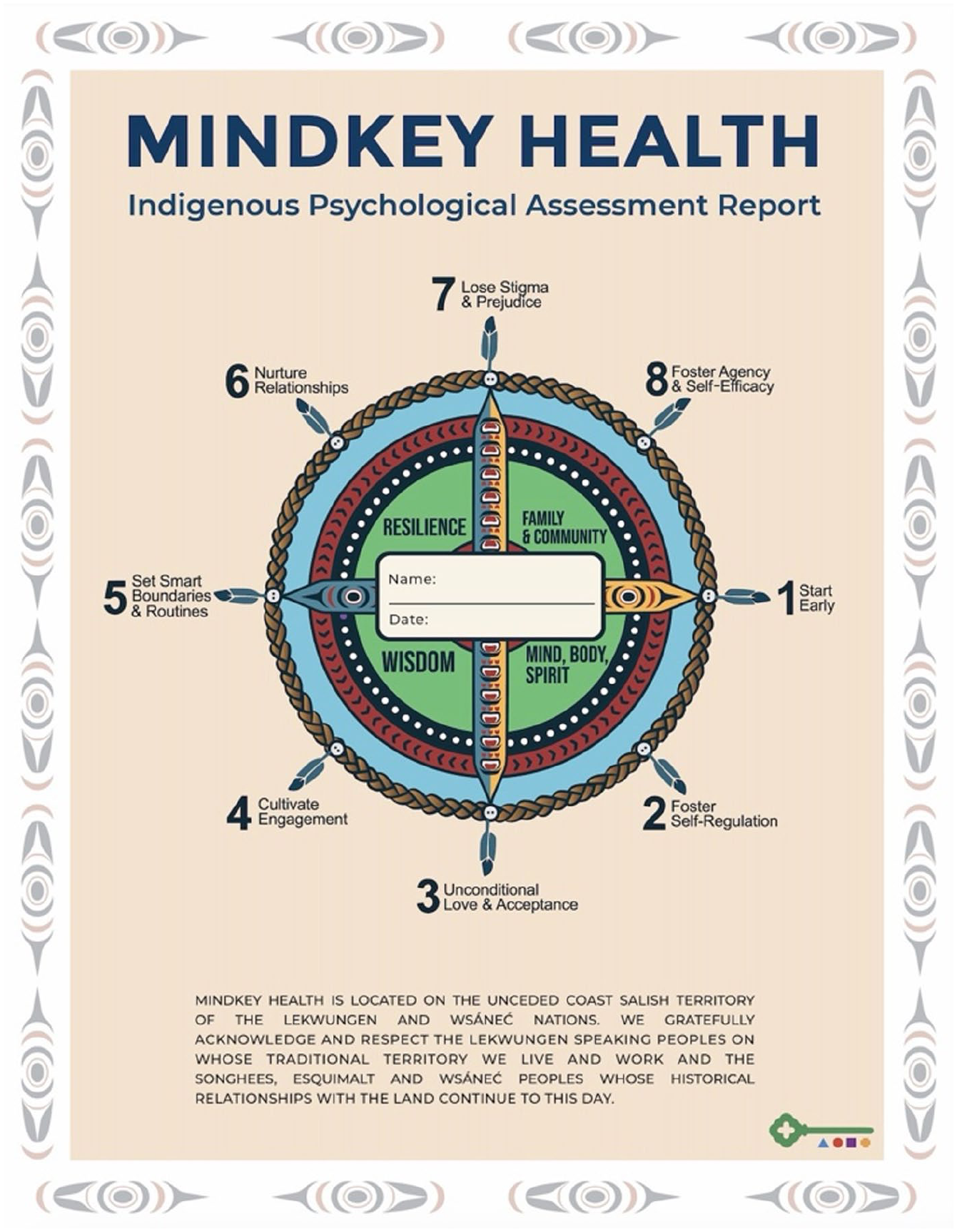
The Holistic Wellness Wheel from MindKey Health’s Indigenous Assessment Protocol. The Holistic Wellness Wheel is divided into four quadrants—Mind, Body & Spirit; Wisdom; Resilience; and Family & Community—each anchored by two relational pillars. These eight pillars reflect cultural teachings and values including early development, emotional regulation, unconditional love, and community connection. The design elements (e.g., sweetgrass, beadwork, and directional lines) honor diverse Indigenous Nations and teachings. At the center of the wheel is the child, representing relational accountability and the sacred responsibility of assessment.
The wheel is divided into four interrelated quadrants—Mind, Body, & Spirit; Wisdom; Resilience; and Family & Community—each grounded in two pillars. These quadrants reflect ways of being and relating that are central to many Indigenous teachings. The wheel is oriented eastward, with Pillar 1 (Start Early) marking the Eastern doorway, symbolizing new beginnings and the sacred nature of child development. The other pillars follow a clockwise pattern, reflecting the continuous, relational nature of growth and wellness. Together, these pillars guide those involved in the assessment process in understanding and contextualizing assessment findings within the child’s full cultural, familial, and historical experience. The eight pillars:
Start Early: Prioritizing timely intervention and early support.
Foster Self-Regulation: Teaching emotional and behavioral grounding.
Unconditional Love and Acceptance: Supporting families, caregivers, and trusted helpers through a foundation of care.
Cultivate Engagement: Fostering connection and purpose.
Set Smart Boundaries and Routines: Creating structured, nurturing environments.
Nurture Relationships: Building strong social skills and networks.
Lose Stigma & Prejudice: Addressing stigma and advancing Truth and Reconciliation.
Foster Agency and Self-Efficacy: Supporting confidence, voice, and resilience.
The visual elements surrounding the wheel also carry deep meaning. In many Indigenous traditions, knowledge is transmitted through symbol. The visual elements in the Indigenous Assessment Protocol are meant to carry teachings that inform how wellness and development are understood. Circles of sweetgrass, beadwork, and ceinture fléchée honor specific Nations and teachings, while horizontal and vertical lines pay tribute to the Coast Salish and Inuit peoples, respectively. The central green circle represents Mother Earth and the sacredness of interdependence. Feathers and mother-of-pearl buttons evoke cultural resilience and ancestral guidance. The child at the center of the wheel invites those walking alongside to hold the assessment process with humility and relational accountability.
Held in trust by Mindkey Health, the protocol is used alongside standard psychoeducational assessments to support culturally grounded interpretation and reporting. It helps situate findings—whether cognitive, academic, adaptive, or mental health—within the child’s relationships, identity, and community context. In this way, the protocol helps surface supports and insights that reflect community priorities and context. Importantly, the protocol is not a finished product: ongoing consultation, feedback, and local adaptation will be essential to ensure it remains dynamic, responsive, and relationally accountable.
Relevance to the Practice of School Psychology
There is a longstanding call across research and practice to reimagine assessment in ways that make room for Indigenous knowledge systems and community-defined understandings of development and wellbeing (Greenwood et al., 2018; Stevenson & Tobias, 2023). Responding to this call requires more than revising tools. It invites a deeper reckoning with the assumptions that shape how school psychology defines core concepts such as intelligence, wellness, and development, and asks us to reimagine the foundations of assessment itself—how we come to know, what we value, and who gets to decide. Escobar (2018) and Blume (2020) help illuminate this shift, naming how Eurocentric and individualist frameworks have constrained what counts as knowledge, and pointing toward relational, community-grounded, and pluriversal ways of making sense of learning, development, and wellbeing.
The Indigenous Assessment Protocol described here emerged as a situated response to the persistent misalignment between the assessment practices required for access to school and community supports, and the ways of understanding development and wellbeing held within the Indigenous communities. Rather than replacing formal tools, the protocol is used alongside them, helping to interpret findings through a framework shaped by Indigenous teachings, relationships, and relational accountability. For practitioners at MindKey Health, the protocol supports assessment practices that are more responsive to cultural context and guided by community-defined priorities. Although the protocol does not resolve structural or systemic barriers, it offers a practical, community-specific pathway for working relationally within the constraints of school and clinical practice. This work joins a growing number of community-led efforts across Canada to reshape assessment practices through Indigenous paradigms and priorities (e.g., Schroeder et al., 2024; Yukon First Nation Education Directorate, 2021).
Yet even as such efforts expand what is possible within existing tools and constraints, they also surface the difficult realities faced by those carrying out this work. Practitioners routinely report navigating ethical tensions and relational strain created by the same systems that hold them accountable for managing dilemmas the system itself has produced (e.g., Schroeder et al., 2024; Yukon First Nation Education Directorate, 2021). Reports from the field consistently highlight how these tensions are intensified by underfunding, rigid diagnostic requirements, and the weight of relational accountabilities (e.g., Schroeder et al., 2024; Yukon First Nation Education Directorate, 2021).
Attending to how system constraints are lived and worked through in practice can help surface the complexities that arise when normative, universalist paradigms are applied across diverse contexts. Machado de Oliveira (2021) offers the concept of hospicing to make sense of systems that, in many contexts, no longer support or may never have supported the kinds of practices needed to respond meaningfully to the lived realities of those they affect. This framing helps name and honor what many practitioners already experience—the tension of navigating systems that are both necessary and insufficient—and invites a form of disciplinary stewardship that stays lovingly present with what is no longer working, while also sensing what else might take root. From this view, responding to harm in assessment is not only about fixing what isn’t working, but also about listening for new possibilities: What if psychoeducational assessments were anchored not in norm-based comparisons, but in community-defined priorities? What if psychological wellbeing was understood not as an individual trait, but as a reflection of relational harmony with kin, with the more-than-human, with time? What if our frameworks were shaped not only by academic metrics, but also by land, community, and accountability? From this view, psychoeducational assessment becomes a way of listening for what is needed, where we are, when we are, and to whom we are accountable. Community-engaged scholarship offers one pathway through which practitioners can help the academic field remain attuned to how such conversations are already reshaping practice.
Many school psychologists—particularly those who are not Indigenous—may feel unsure how to begin this type of community-engaged partnership. For us, three commitments guided our work. First, the work was only possible because of shared commitments held within longstanding kinship ties and professional relationships. Because the work emerged from real relationships, we carried a shared responsibility to move with relational accountability. Second, we chose to prioritize trust-building over products or timelines. Third, the work required a commitment to engaging in sustained reflexivity and a continual reckoning with our own assumptions, attachments, and inherited frameworks. We completed cultural safety training, observed Indigenous protocol throughout, and, for non-Indigenous participants, took direction from the Indigenous leadership team.
This is not a prescriptive model, as community-engaged work cannot be. For those wondering where to begin, we suggest starting with small commitments: reading the TRC (2015) Summary Report; reviewing the CPA’s (2018) response to the TRC report; learning about the Indigenous Nations where one lives and works; participating in local, provincial, or professional cultural safety training; or reading the reference list that has shaped this protocol. For those looking for further engagement, Appendix 1 offers 10 reflections that emerged through this work. They are not intended as prescriptive standards, but as small invitations for thinking with others about how to move with assessment differently.
Conclusion
The development of MindKey Health’s Indigenous Assessment Protocol is not a solution to the longstanding tensions between assessment practices and culturally-grounded supports. It is one situated response to a specific, on-the-ground need. Used alongside standard psychoeducational tools, the protocol supports practitioners to contextualize formal assessment results through a strengths-based and holistic understanding of a child. It joins a growing body of community-led scholarship offering grounded accounts of how practitioners are navigating current systems constraints, expanding what assessment can look like in practice and offering insights to inform future directions in research, training, and policy (e.g., Schroeder et al., 2024; Yukon First Nation Education Directorate, 2021).
Footnotes
Appendix 1

Funding
The authors received no financial support for the research, authorship, and/or publication of this article.
Declaration of Conflicting Interests
The authors declared no potential conflicts of interest with respect to the research, authorship, and/or publication of this article.